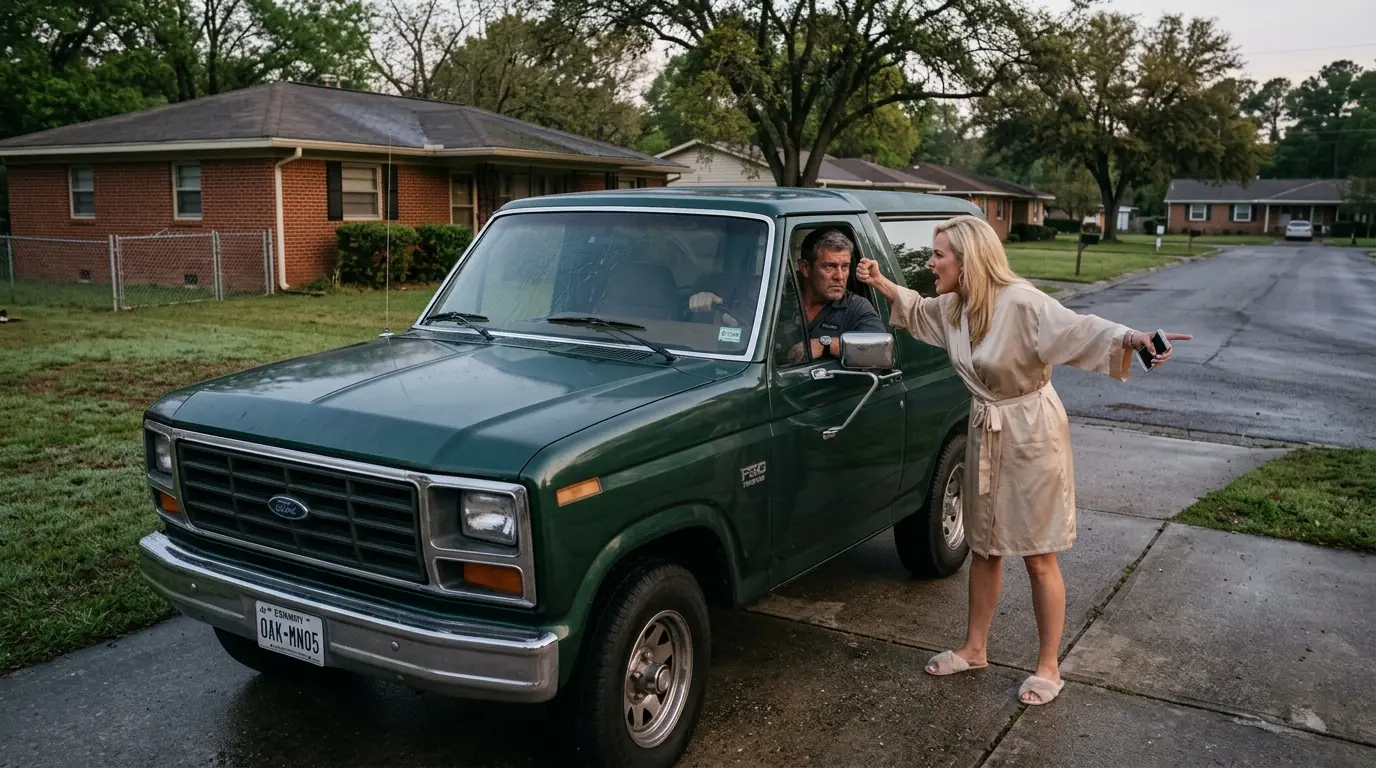
Cassidy Whitmore crossed my front lawn a few seconds after six in the morning wearing a cream-colored silk robe, expensive slippers, and the expression of someone who had already decided the argument before reaching my truck. I had barely shut off the engine of my restored 1985 Ford Bronco when she struck the driver’s window with the flat of her hand and told me to move the “junk” because she had clients coming later and did not want them seeing it. When I told her calmly that the Bronco was registered, insured, and parked entirely inside my own driveway, she raised her phone and said she would call the police if I did not move immediately. I watched her press 911 because I had already learned that explaining property law to Cassidy only gave her more sentences to distort later.
My name is Garrett Boone, though nearly everyone who has known me longer than ten minutes calls me Bo, and at forty-three I had spent eighteen years in law enforcement. Six months before Cassidy moved into the white-columned colonial next door, the city council appointed me chief of the Willow Ridge Police Department, a thirty-two-officer agency serving a county-seat community surrounded by farms, commuter subdivisions, and neighborhoods old enough that everybody seemed to know who planted every large tree. I had grown up on Oakmont Drive, left for college and the academy, returned as a patrol officer, and eventually bought my mother’s small ranch house after she died. Becoming chief had changed my office, schedule, and responsibilities, but it had not changed the address printed on the utility bills I had known since childhood.
My mother’s house was not impressive, and that was one reason I loved it. It had yellow brick, a detached garage, a long L-shaped driveway, chain-link fencing, mature oaks, and a kitchen window through which my mother had watched half the neighborhood grow up. The Bronco had once belonged to my father, and I spent three years restoring it after his death, replacing rusted panels and rebuilding the engine slowly enough that the project became less about transportation than remembering him. Cassidy saw an aging truck sitting beside a modest house, while I saw forty years of my family’s life arranged around a parking pad.
She had purchased the neighboring property six weeks earlier and seemed unsettled from the beginning that our houses did not share her understanding of status. Her place was larger, with white pillars, an ornate front door, landscaping installed by professionals, and a leased Mercedes she washed twice a week even though she barely drove it. During our first conversation, Cassidy introduced herself as a luxury real-estate consultant, then complained that one of my oak trees dropped leaves into her yard and suggested I remove a limb that had been growing there before either of us was born. I offered to rake the leaves whenever necessary, and her smile became thin because compromise was apparently less satisfying to her than control.
The second disagreement involved my Bronco. Cassidy knocked on my door one morning after I returned from an overnight emergency-management meeting and informed me that the vehicle lowered the appearance of the street because potential clients might assume the neighborhood was “declining.” I told her there was no homeowners association, no deed restriction prohibiting my truck, and no municipal code preventing a registered vehicle from sitting on a private driveway. She answered, “Some people care about standards even when the law is behind,” which struck me as an unusually revealing sentence.
I did not tell her I was police chief during either conversation because the information had nothing to do with leaves or parking. Being a chief did not make my property rights stronger, and I had learned early in my career that introducing a badge into a private disagreement could turn ordinary conflict into something far uglier. I wanted Cassidy to treat me correctly because I was her neighbor, not because she feared my position. That principle became much more difficult to preserve after she dialed 911.
The dispatcher who answered happened to be Stella Price, a fifteen-year communications veteran who recognized both my address and Cassidy’s exaggerated description of a threatening unknown man refusing to move a suspicious vehicle. Cassidy stood beside my driveway speaking loudly enough that I heard her say she felt unsafe, that the driver was behaving aggressively, and that access might be blocked, although she had crossed my lawn to reach me and her own driveway remained completely open. I called the nonemergency line after she finished and told Stella, “It’s Bo, send somebody anyway, because I want the contact documented and I do not want this closed just because you recognize the address.” Stella went quiet for half a second, then said she understood.
Officer Patrick McNally arrived nine minutes later and parked on the street rather than in either driveway. Patrick had once been my patrol partner, but I stayed beside the Bronco while he took Cassidy’s statement first because her complaint deserved the same process it would have received if the homeowner next door had been a plumber or schoolteacher. Cassidy described my vehicle as abandoned, claimed I had threatened her by refusing to move, and suggested I might not live at the address. Patrick wrote everything down without correcting her until she finally pointed at me and demanded that he order me to move.
Patrick looked toward me and said, “Morning, Chief, do you have the registration handy so I can close the vehicle issue cleanly?” Cassidy’s face changed so rapidly that for one second I almost felt sorry for her. She stared from Patrick to me and asked why he had called me chief, prompting Patrick to explain that I headed the Willow Ridge Police Department and that the vehicle was legally parked on property registered to me. When Cassidy demanded his supervisor, Patrick answered professionally that I technically occupied that role but that any complaint involving me could instead be reviewed by the city manager or an outside agency to avoid a conflict.
Cassidy stood completely still after Patrick drove away. A sprinkler hissed three houses down, birds moved through my mother’s oak tree, and an ordinary weekday morning seemed to surround the two of us while something much less ordinary settled into her expression. She finally said, “You think that badge makes you special, but I know important people too, and this is not over.” I answered, “I hope it is,” then went inside and opened a notebook because instinct told me hope was not going to be enough.
I created a simple incident log rather than a police case file. Date, time, action, witness, supporting document, and outcome went into each entry, while photographs and copies remained in a separate folder in my personal office. I also emailed City Manager Rebecca Sloan and City Attorney Harold Meyers explaining that I had an escalating private neighbor dispute and would recuse myself from any enforcement decision involving Cassidy unless there was an immediate threat to life. Rebecca replied within twenty minutes that all future complaints involving either property should be routed to a lieutenant for routine handling and referred outside the department whenever criminal accusations required independence.
That precaution turned out to be necessary three days later. I was mowing my front lawn at ten on a Saturday morning with an electric mower barely louder than a vacuum cleaner when dispatch received a noise complaint from Cassidy’s number. Officer Elena Ramirez arrived looking embarrassed but checked the ordinance anyway, confirming that weekend lawn equipment was permitted between nine in the morning and eight in the evening. I thanked her, finished the lawn, and added the call number to my notebook.
Cassidy’s curtain moved while Elena drove away. I had the uncomfortable feeling that Cassidy was not simply annoyed anymore but recording interactions in the hope that quantity might eventually look like evidence. One complaint could be dismissed as misunderstanding, while ten unrelated accusations could create smoke around a person even when none contained fire. I had investigated enough harassment cases to know that repetition could damage reputation long before anyone studied accuracy.
Four days later, I came home to find a surveyor standing beside my backyard fence. He introduced himself as Russell Lane, explained that Cassidy hired him because she believed my fence encroached approximately four inches onto her property, and showed me preliminary measurements that appeared inconsistent with a certified survey completed when I bought the house. I retrieved my documents, and Russell compared reference points before admitting his own work order contained a property-marker description that did not match county plat records. He said he would correct the survey and tell Cassidy, which I assumed would end the issue.
Two days afterward, certified mail arrived demanding removal of the fence within thirty days. Cassidy’s letter threatened civil action, loss of property value, and attorney fees, even though the surveyor she hired had already acknowledged the boundary error. I sent everything to a private attorney named Daniel Pierce, an old college friend who practiced property and municipal law two counties away and had no professional connection to my department. Daniel answered with a restrained letter attaching the certified survey and requesting that any future property claims come through counsel rather than confrontations at my residence.
Daniel also told me something important. “Do not investigate her as a cop because you are angry as a neighbor,” he said, explaining that even completely lawful database access could look retaliatory if I used my official position to gather information for a personal dispute. I promised that anything I personally collected would come from my own cameras, documents, ordinary public records, or materials voluntarily provided by witnesses. If potential criminal conduct appeared, someone else would investigate it.
The next event tested that boundary. I spent most of one Sunday installing sprinkler heads along the side yard, and by Monday afternoon three were broken cleanly below ground level. Cassidy walked over while I knelt beside the damage and claimed her nephew had accidentally stepped on them while trimming weeds near the line. The footprints in damp soil looked deliberate, but appearance was not proof, so I photographed everything and called the county sheriff’s office rather than assigning one of my officers.
Deputy Clara Chen handled the report. She photographed the broken heads, measured the location against the property line, interviewed Cassidy and her nephew separately, and noted inconsistencies without making an arrest. Cassidy said the damage was accidental, and because the replacement value remained modest and intent could not be proved beyond the visible footprints, Clara classified the incident as a disputed property-damage complaint. Before leaving, she told me privately, “Keep documenting, but stay out of the case decisions,” and I assured her that was exactly why I called her.
Cassidy discovered the neighborhood Facebook group that week. Her first post warned residents about “authority figures who believe badges excuse aggressive behavior” and included a photograph taken from her front yard with my house perfectly visible behind her. She never used my name, but everybody on Oakmont Drive knew exactly who she meant. I took screenshots before responding to nothing.
Mrs. Evelyn Delacroix responded for me. She had taught third grade in Willow Ridge for thirty-two years, knew me since I was seven, and possessed the kind of neighborhood credibility no official title could manufacture. Evelyn wrote that Garrett Boone had lived on the street most of his life, that she had never seen him threaten anyone, and that people should verify facts before accusing neighbors publicly. Fifteen residents agreed with her before Cassidy deleted the post.
I did not feel victorious. Public arguments created winners only in the minds of people who enjoyed watching them. What concerned me was the pattern forming across emergency calls, property allegations, social-media insinuations, and physical damage. I began wondering whether Cassidy wanted me angry more than she wanted any specific outcome.
That suspicion intensified when I found a large manila envelope taped to my front door. Inside were photographs of me arriving home in uniform, leaving in uniform, carrying department paperwork into my house, and climbing into my Bronco on different dates. A handwritten note said public officials should “set examples rather than hide behind authority,” and another line demanded that I stop parking the Bronco where “the neighborhood had to look at it.” I photographed the envelope in place before touching it.
Daniel advised me to preserve the materials but avoid confronting Cassidy. Rebecca Sloan arranged for the city’s professional-standards consultant to review whether any of the photographs presented a security concern, while the sheriff’s office added them to the existing harassment documentation. None contained threats serious enough to justify immediate criminal charges. Their importance lay in showing fixation.
I requested public call-for-service records associated with my address through the same process any resident could use. The response showed eleven calls from Cassidy’s phone or residence during slightly more than one month, including suspicious vehicle complaints, noise allegations, an animal complaint involving a dog I did not own, and two claims that my lawn watering violated restrictions that were not currently in effect. Every responding officer had documented no violation. My house had generated more police calls in five weeks than the rest of Oakmont Drive combined.
The binder on my kitchen table became thick enough that Elaine Ramirez, who lived two doors down and worked as an accountant, joked that Cassidy was single-handedly creating a municipal archive. I told Elaine the binder worried me because people often assumed documentation meant someone planned retaliation, when in reality good documentation was how retaliation could be avoided. Facts written down while events were fresh reduced the temptation to fill memory gaps with anger later. Elaine said that sounded like police-chief language, and I told her it was mostly my mother’s advice about receipts.
Cassidy escalated from neighborhood complaints to politics during the sixth week. County Supervisor Brent Hollister, a fifty-nine-year-old car dealer preparing for a possible state senate campaign, began appearing in photographs with her at civic events. She had purchased her Mercedes through one of his dealerships and apparently persuaded him that a story about a police chief abusing a female neighbor could become useful evidence of his commitment to public accountability. I knew Hollister professionally but had never considered him a friend.
Cassidy filed a formal ethics complaint alleging abuse of authority, misuse of police resources, intimidation, retaliation, and surveillance. She claimed officers had been sent to frighten her after she challenged my parking and said department patrol cars intentionally drove past her house at suspicious hours. The accusation ignored the fact that she initiated nearly every police contact herself and that Oakmont Drive lay on a common patrol route connecting two arterial streets. Still, formal allegations against a chief deserved independent review.
I wrote to the city manager before the complaint reached my desk. “I am requesting complete recusal from investigative decisions involving this matter,” I said, and Rebecca referred the ethics allegations to retired judge Marianne Cook, who contracted with the city for independent administrative reviews. Marianne ordered preservation of dispatch records, GPS logs for patrol vehicles, body-camera footage from every response, and my department communications during the relevant period. I handed over everything without directing which evidence she should examine first.
Hollister leaked the existence of the complaint to a local newspaper before Marianne completed even the preliminary review. The Wednesday headline read POLICE CHIEF FACES ETHICS INQUIRY AFTER NEIGHBOR DISPUTE, and my phone began ringing before I finished breakfast. Department policy prevented me from debating a pending complaint publicly, which meant the accusation traveled freely while my response remained inside a sealed administrative process. I understood intellectually why the policy existed and hated it personally.
My officers became protective in ways I had to stop. Two wanted to post publicly that Cassidy had made false calls, while another suggested releasing body-camera clips under public-records law before the investigation ended. I told them none of that was happening and reminded them that loyalty to me did not give them authority to weaponize department information against a complainant. “If the process only feels fair when it protects people we like, it is not much of a process,” I told them during roll call.
At home that evening, I was less composed. I sat at my mother’s kitchen table reading comments from people I had never met who had already decided I was either a corrupt bully or a heroic victim. The emotional temptation was to answer every accusation personally, but I knew anything I wrote would become part of the fight Cassidy seemed determined to create. So I closed the laptop and went outside to sand a piece of old fence wood for a bookshelf I had been planning.
The anonymous letter arrived four days later. Copies went to city council members, the county board, and at least one reporter, accusing me of using department vehicles for private errands during work hours. The writer listed visits to a hardware store, coffee shop, and several businesses where my official SUV had supposedly been seen. Rebecca had no choice but to open a separate administrative verification because ignoring accusations against a police chief would have created a worse problem.
Every listed trip had an ordinary explanation supported by records. The hardware-store visit involved emergency supplies purchased after storm damage to a traffic-control trailer, while the coffee-shop meeting involved a business owner experiencing repeated thefts from employee vehicles. Two other locations corresponded with community meetings already listed on my calendar. The allegation collapsed quickly, but the review still consumed staff time and created another headline.
I began noticing Cassidy’s Mercedes behind me more often. Once could be coincidence, twice perhaps too, but when the same white vehicle appeared three cars back during trips to a hardware store, pharmacy, city office, and restaurant across different days, I changed my route and watched it follow. I did not stop her, call patrol, or perform any maneuver designed to create a confrontation. I simply documented dates and told the independent reviewer that someone might be monitoring my movements.
Mrs. Delacroix brought the first clue about Cassidy’s larger motive. Evelyn had attended an open house nearby because, in her words, being eighty and nosy was one of the few pleasures nobody could legally tax. She heard Cassidy tell prospective buyers that Oakmont Drive was “transitioning upward” and that certain longtime residents resisted standards necessary to increase property values. Then Evelyn learned Cassidy had quietly listed her own house for significantly more than she paid only months earlier.
That did not make Cassidy a criminal. People bought, renovated, and resold houses constantly, and ambitious asking prices were not evidence of fraud. What it did explain was why she might care obsessively about the appearance of my older home and Bronco. She seemed to believe changing the narrative around the block would increase the value of the property she intended to sell.
The attempted tow happened during my next overnight shift. To remove even the argument about private-driveway visibility, I had parked the Bronco legally on the public street, where overnight parking was permitted, and gone to the station in my city vehicle. At three in the morning, Evelyn saw a tow truck positioning beside the Bronco and called my personal phone. I asked her not to approach and notified the county sheriff’s office because my department again had a conflict.
Deputy Chen arrived before I did. The tow driver produced a private work order from Cassidy claiming an abandoned vehicle blocked driveway access, although photographs showed the Bronco nowhere near her driveway. He also told Clara that Cassidy offered two hundred dollars in cash if he removed it without contacting the registered owner first. The driver had not yet moved the vehicle, so nobody charged him, and investigators treated Cassidy’s request as another potentially false report requiring review rather than instantly labeling it attempted theft.
That distinction frustrated neighbors who wanted someone arrested immediately. I understood the frustration because a growing pile of questionable acts can feel obvious long before any single criminal charge becomes provable. Daniel reminded me that the objective was not to find the fastest accusation matching our anger but to preserve conduct accurately enough for someone independent to decide what the law supported. I repeated that to myself often during the next several months.
Judge Marianne Cook completed the ethics review on day thirty-eight. Her report found no evidence that I used patrol officers to retaliate, no improper surveillance, no misuse of department resources, and no policy violation involving my personal vehicle or property. Dispatch records showed Cassidy initiated the calls, body-camera footage showed responding officers treated her professionally, and vehicle GPS data showed routine patrol patterns rather than targeting. The complaint was dismissed.
The newspaper printed the result. It occupied far less space than the original accusation.
That bothered me more than I expected. People remember charges because charges contain conflict, while exoneration often reads like administrative cleanup. I could not control how newspapers allocated attention. I could control whether my own behavior gave Cassidy anything truthful to add.
The pet incident began with Biscuit, Evelyn Delacroix’s fifteen-year-old beagle. Biscuit started vomiting after wandering through the rear flower beds, and a veterinarian found slug-control pellets in his stomach. He survived after treatment, but before Evelyn returned home, Cassidy posted online suggesting that a “public official with a history of hostility” might be responsible. The insinuation was obvious enough that neighbors immediately asked whether she was accusing me of poisoning a dog.
I had installed a doorbell camera after the earlier incidents. Its angle captured part of Cassidy’s side yard, not private interior spaces, and two days before Biscuit became ill the video showed Cassidy’s nephew spreading commercial slug pellets near her garden during strong wind. The footage did not show anybody intentionally placing poison in Evelyn’s yard, but it did show pellets scattering toward the property line. Evelyn shared the clip publicly after speaking with her veterinarian, who said accidental drift was consistent with what Biscuit might have encountered.
The story could easily have become another accusation against Cassidy that went beyond the evidence. I told Evelyn not to claim intentional poisoning because we had no proof of intent. She agreed and posted only that the product appeared to have spread accidentally and that neighbors should be careful using toxic garden materials around animals. The important consequence came in the comments, where other residents began describing unrelated experiences with Cassidy.
The Okonkwo family two houses down said Cassidy had reported their home accounting business as unlicensed even though every permit was current. Gary Tinsdale across the street said she accused his teenage son of scratching her Mercedes until grocery-store security footage proved the vehicle had already been damaged elsewhere. Another family said she complained repeatedly about their basketball hoop despite its legal placement. None of those incidents alone established criminal behavior, but together they showed I was not the only neighbor experiencing conflict.
My brother Marcus became involved against everyone’s wishes. He brought his seven-year-old twin daughters for a Sunday barbecue, and they spent several hours playing in my fenced backyard while Marcus and I remained outside. Two days later, child protective services visited his home after an anonymous caller reported the girls had been left unsupervised at “a dangerous law-enforcement official’s residence where firearms were accessible.” The allegation was false, but mandatory procedures required an assessment.
Marcus was furious. His divorce had been contentious enough that even a closed child-services report could become material his former spouse’s attorney might mention during future custody arguments. The investigator found the children healthy, confirmed the report lacked evidence, and closed the matter quickly. She could not tell us who called.
I wanted to assume Cassidy did it. Daniel stopped me.
“Pattern is not proof of authorship,” he said. I told him the wording sounded exactly like her obsession with my position.
“Maybe.” Daniel paused.
“But if you start writing conclusions before evidence, your binder becomes propaganda instead of documentation.”
I changed the entry. Anonymous CPS report after children visited residence; source unknown.
That small correction mattered more than it seemed. I had spent weeks telling myself Cassidy distorted facts because they were inconvenient. If I began doing the same thing simply because I believed I understood her pattern, I would make my own evidence less trustworthy. Discipline was not only keeping my voice down when angry. Sometimes it meant leaving a blank where certainty felt emotionally satisfying.
The contractor cancellations arrived next. A roofer missed an appointment after receiving a text from a number one digit different from mine saying the work was no longer needed. Two additional contractors received similar messages, and one forwarded the text chain before arriving anyway because the wording seemed strange. The spoofed numbers could not be tied to Cassidy without records nobody had lawful authority to obtain yet.
I made police reports through the sheriff’s office and preserved the contractor statements. Nobody subpoenaed telephone data merely because I suspected my neighbor. Clara Chen told me repeated impersonation might eventually justify a broader investigation if evidence connected the events. Until then, the proper classification remained suspicious interference.
Then my mail stopped.
At first I assumed delivery problems. After three days without even advertisements, I contacted the local post office and learned someone had requested temporary pickup of mail addressed to my house. A clerk remembered a woman claiming to be my spouse but could not confidently identify her from a photograph, and the counter camera had not captured a clear face because the customer wore sunglasses and stood partly outside the best angle. I had never been married.
Missing mail included an insurance renewal, bank statement, and county tax notice. None contained information that alone would destroy me, but the possibility that someone had impersonated my spouse transformed the problem from neighborhood harassment into potential federal mail-related crime. The postal supervisor told me to contact the United States Postal Inspection Service. I made the report as Garrett Boone, homeowner, not Garrett Boone, police chief.
Postal Inspector Lena Brooks interviewed me two days later. She was meticulous, skeptical, and unimpressed by my title, which immediately made me trust her more. Lena collected the pickup authorization, employee statement, postal records, and whatever camera footage still existed, then warned that the evidence might not identify a suspect. I told her I understood.
Cassidy smiled at me the evening the county sent a replacement property-tax notice. I stood in my driveway reading the late-fee information when she stepped onto her porch and asked whether I was having trouble keeping up with adult responsibilities. Every muscle in my shoulders tightened because the timing felt too precise to be harmless. I answered, “Good evening, Cassidy,” walked inside, and wrote the exchange down without claiming it proved mail theft.
My hands shook after I closed the door. Not from fear, exactly, but from the effort of continuing to behave like the version of myself I wanted documented. Cassidy seemed to understand that a raised voice from a police chief could become more useful to her than twenty quiet provocations. I sat at the kitchen table until my breathing slowed.
That night I made a decision that changed the direction of everything. I stopped trying to understand Cassidy through rumor and began reviewing only public civil records available to any citizen, partly because Daniel said background information could help my attorney decide whether we needed a protective order. I searched court dockets, property records, business registrations, bankruptcy notices, and civil judgments in places where Cassidy had publicly listed prior addresses. What emerged was complicated but concerning.
She had been involved in civil disputes in Arizona, Nevada, and California. Former business partners accused her of taking deposits and failing to provide promised consulting services, landlords pursued unpaid rent, and several small-claims judgments remained on record. One bankruptcy petition had been dismissed after disputes over disclosures, although the public documents did not prove criminal concealment. Cassidy also appeared to change business names frequently.
I printed the records and called Daniel. “This looks bad,” I said.
“It looks like civil litigation,” he corrected. I told him the pattern felt larger.
“Then report facts to the appropriate agency and stop there.”
That answer frustrated the investigator in me. It protected the chief in me.
I sent a written packet to the state attorney general’s consumer-protection intake, the Postal Inspection Service because of the mail report, and the county district attorney through counsel. I did not call an old federal friend asking for a favor or request that anyone “dig into” Cassidy privately. My cover letter said only that I was a homeowner experiencing documented harassment, that the attached public records might show similar disputes elsewhere, and that my position created a conflict requiring outside review. Then I waited.
Nothing happened for nine days.
That was healthy. Real investigations did not materialize because a police chief became impatient.
On the tenth day, Postal Inspector Brooks called Daniel instead of me. She said federal and state databases contained enough related complaints under Cassidy’s name and several business variations to justify coordination with financial-crimes investigators, but she would not discuss details because I was a potential witness. Daniel relayed only what I needed to know. I was instructed to preserve new evidence, make no attempt to obtain nonpublic financial records, and avoid alerting Cassidy that outside agencies were reviewing anything.
That afternoon felt anticlimactic. I had imagined discovering one hidden fact that transformed everything, but the actual turning point was a lawyer telling me to keep doing what I had already been doing. No agent handed me a secret file. No warrant appeared.
The investigation belonged to people who were not being harassed by Cassidy. That was exactly how it needed to be.
The next month required more restraint than everything before it. Cassidy continued making complaints, and I continued responding only as a resident or through counsel. The sheriff’s office handled criminal allegations involving my property, city administrators handled complaints against me, and federal agencies handled any matter within their jurisdiction. I deliberately stopped asking for updates I was not entitled to receive.
I did improve my private security. After repeated property incidents, I hired a licensed company to install hardwired exterior cameras covering my driveway, front entrance, mailbox area, side yard, and portions of the street visible from my property. The installer configured synchronized timestamps and a secure backup so original footage could be preserved if an incident occurred. I paid for professional installation because chain of custody mattered more to me than saving money.
Cassidy noticed the cameras immediately. She posted that “certain officials” had turned the neighborhood into a surveillance state. My cameras captured only areas where I had a legitimate security interest and no interior of her property. Daniel reviewed the placement before installation.
The cameras did something more valuable than catch wrongdoing. They stopped me from wondering whether every sound outside required investigation.
For the first time in weeks, I slept through most nights. If something happened, a system would record it without my body remaining permanently alert. That mattered because harassment works partly by convincing its target that vigilance can never be lowered. I began understanding why victims with no legal training could become consumed by behavior that outsiders dismissed as petty.
Evelyn organized a neighborhood text group on her own. I refused to let it become a surveillance network and repeatedly told participants not to follow Cassidy, photograph her through windows, confront visitors, or create situations designed to provoke evidence. Residents could share incidents involving their own property and preserve ordinary security footage. Nothing more.
The distinction disappointed a few neighbors who had begun treating the conflict like entertainment. Gary Tinsdale joked that we needed code names. I told him we needed better hobbies.
He laughed and stopped.
The outside investigation remained invisible. Federal agents contacted previous civil complainants without telling me who they were. Financial subpoenas, if they existed, were not shared with me.
Postal records were reviewed. Lender documents were obtained through lawful process rather than a police chief calling a bank.
Months later, I would learn that investigators found more than I ever could have found through public records. Several loan applications contained income representations supported by documents that appeared altered or unverifiable. Wire transfers moved money among accounts in different states around property purchases and quick resales. Some prior complainants described being targeted after challenging Cassidy about money or property, though not every dispute was fraudulent.
The pattern investigators developed was less theatrical than the story Cassidy’s eventual prosecutors would tell a jury. She had not purchased eight houses with a perfectly identical master plan or deliberately selected public officials every time. Real misconduct was messier. What prosecutors believed they could prove involved repeated false representations in financial transactions, misuse of business entities, interstate communications tied to those representations, and intimidation of certain people who threatened deals or credibility.
My harassment fit into that broader pattern without becoming the center of it. I found that strangely comforting.
Cassidy did not know any of this. What she knew was that her ethics complaint failed, neighbors had begun comparing stories, and her house had not sold at the price she wanted. Her Mercedes disappeared for three days and returned with temporary dealer plates after what I later learned was a payment dispute.
Financial pressure did not make her criminal. It appeared to make her less careful.
One Friday morning, I found another anonymous complaint had been filed with the state police standards board accusing me of falsifying training hours. That allegation was easy to disprove because state systems maintained the records independently. The board closed the preliminary inquiry after confirming my certifications. Cassidy’s name did not appear on the complaint.
I added it to my notebook as anonymous and moved on.
Then the first camera incident happened. At 2:13 one morning, footage showed a hooded figure approach the Bronco and drag something along the driver’s side. The person’s face remained obscured, but the resulting scratch cut through paint in a long line and formed letters resembling CORRUPT across the rear quarter panel. I woke to the damage at six and called the sheriff’s office.
Deputy Martinez handled the scene. He photographed the vehicle, collected video, and asked whether I recognized the clothing or shoes. I told him a pair of purple athletic shoes resembled footwear Cassidy had worn previously but that similarity was not identification. Martinez checked older doorbell footage voluntarily provided by me and noted the same distinctive shoe model.
He did not arrest Cassidy. Clothing similarity, build, proximity, and motive might support suspicion, but a covered face left room for reasonable doubt.
The next night, someone tried my rear door. The hardwired camera showed a figure approaching from outside the frame, inserting what appeared to be a tool near the doorjamb, then leaving quickly after the alarm activated. Deputies found a screwdriver in bushes and footprints in damp soil.
This incident was more serious. The sheriff’s office collected the tool for prints and DNA, documented shoe impressions, and formally opened an attempted burglary investigation. I gave a statement and then stepped away.
Two days later Clara Chen called Daniel, not me. The screwdriver carried a partial latent print insufficient for immediate identification but potentially usable for comparison if investigators later obtained lawful exemplars. Shoe impressions were consistent with a common women’s athletic-shoe size and tread pattern. Nothing was conclusive.
Cassidy continued posting online as though nothing had happened. She announced that she would address the city council during public comment about “systemic police intimidation” and invited regional media. Brent Hollister publicly supported her right to speak.
I supported it too. A citizen did not lose the right to criticize a police chief because that chief believed she had harassed him.
That position angered some officers. Lieutenant Marcus Hill asked whether I seriously planned to sit in the room while Cassidy accused us of corruption. I said yes.
“She’s lying.” I told him that could be true without giving us authority to silence her.
Marcus shook his head. “You have more patience than me.”
I answered, “That’s why I’m not letting you run the meeting.”
The investigation complicated the council event in ways I did not know yet. Federal agents had obtained enough evidence for search warrants connected to Cassidy’s financial records and electronic devices, but prosecutors had not decided exactly when to execute them. They did not need a public spectacle. In fact, the United States attorney handling the matter specifically rejected an early suggestion from one agent that arresting Cassidy near the council meeting might reduce flight risk because television cameras and political context could make legitimate enforcement look retaliatory.
I learned that only much later. At the time, nobody told me an arrest warrant might be approaching.
Daniel did receive a call from Assistant United States Attorney Rachel Kim asking whether Cassidy had made any statements suggesting imminent flight. I provided the threatening text she had recently sent saying, You’ll be sorry you didn’t sell when I gave you the chance, but I did not interpret it for them. My cameras also showed boxes being moved into her Mercedes on two evenings.
That could mean she planned to leave. It could mean staging supplies for a property showing.