The ribs had been smoking for almost seven hours when Vanessa Harwood stepped into the middle of Magnolia Lane with her phone pressed against one ear. Behind her, sixty-three people filled the Coleman family’s backyard, children chased each other beneath two oak trees, and an old Earth, Wind & Fire song played at a volume low enough for conversations to rise above it. Vanessa stared across the street at the gathering and told the 911 dispatcher, “There are dozens of strangers over there, smoke everywhere, cars blocking the road, and I don’t know what these people are capable of.” At the grill, Darius Coleman wiped barbecue sauce from his fingers, watched her through the open side gate, and quietly told his wife, “Don’t change a thing.”
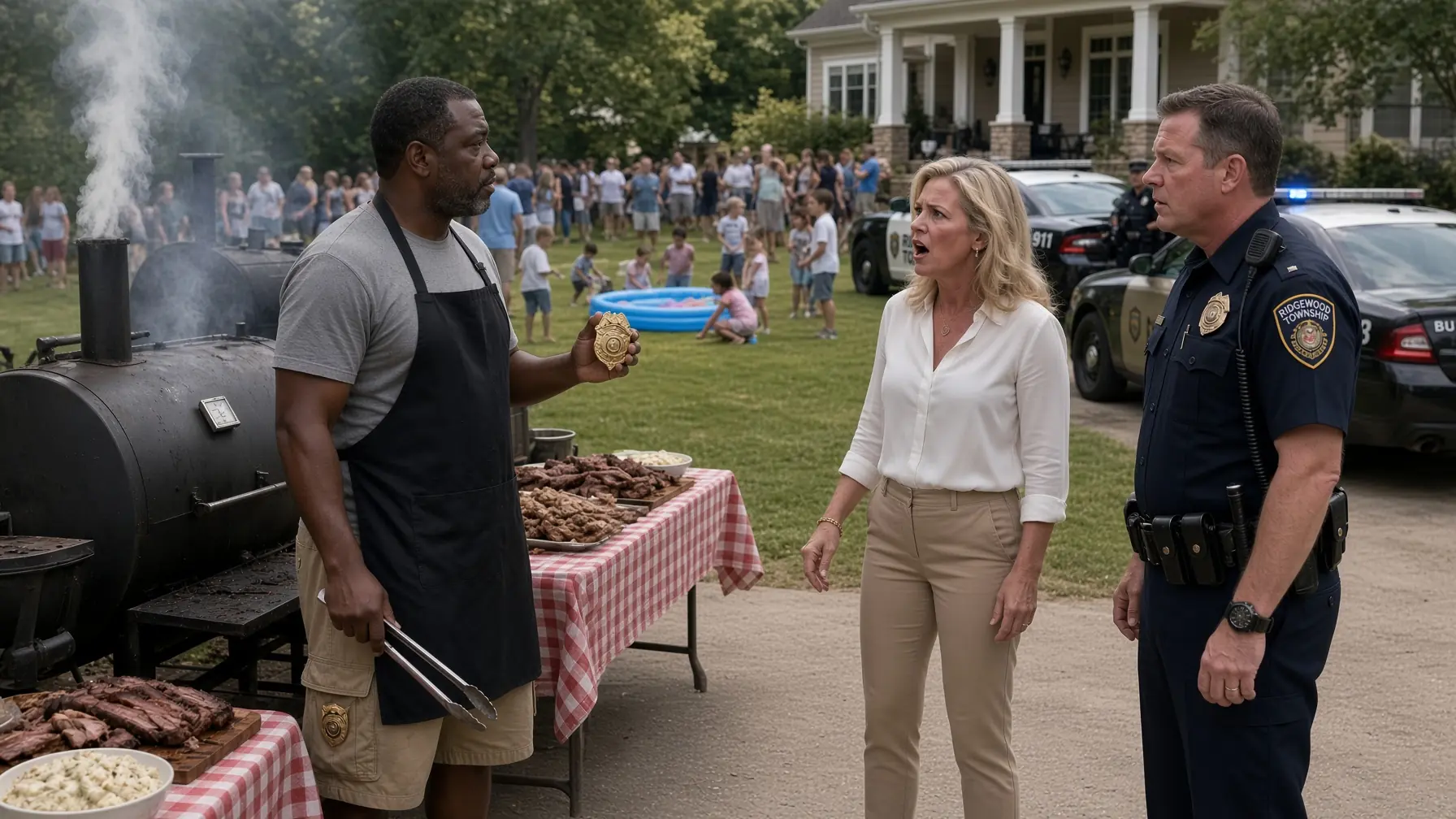
Renee Coleman looked toward the street and saw Vanessa pacing beside her driveway as if directing an emergency only she could see. Three months of letters, complaints, anonymous flyers, code-enforcement visits, and carefully phrased insults had taught Renee that arguing with Vanessa usually created more material for Vanessa to reinterpret later. She placed another tray of corn on the serving table and told their twelve-year-old daughter, Tessa, to stay in the backyard with her cousins. Darius turned another rack of ribs and waited.
The first patrol car arrived without sirens. A second followed less than a minute later, and because Darius had formally recused himself from any police matter involving his own residence, the city shift commander requested a county sheriff’s supervisor before anyone took enforcement action. Vanessa did not know about the recusal, the written directive, or the fact that the man wearing a faded barbecue apron across the street had spent twenty-eight years in law enforcement. She only knew police had arrived, and the smile crossing her face suggested she believed the system had finally come to remove the problem she had spent three months describing.
Sergeant Michael Durant from the Fulton Ridge County Sheriff’s Office stepped from an unmarked SUV and looked first at the parked cars, then at the open backyard. Nothing blocked the street, nobody appeared intoxicated or combative, and the smoke rising above the fence came from three commercial-quality backyard smokers positioned well away from structures. He asked the city officer beside him what had been reported. The officer quietly answered, “Large disturbance, possible unsafe fire, caller says she feels threatened, and the address belongs to Chief Coleman.”
Durant looked toward the grill. “Chief Coleman?” he asked.
Darius set down his tongs and walked toward the driveway with both hands visible. “That’s me,” he replied, stopping well inside his property line. Vanessa’s expression changed so quickly that Renee saw it from thirty feet away.
Darius did not show a badge. He did not tell the officers what to do, and he did not ask them to look at the cameras mounted under the porch eaves. Instead he said, “Sergeant, I’m the homeowner, I’m also conflicted, and I want this handled exactly as you would handle any other call.” Durant nodded once and replied that this was already the plan.
Vanessa crossed the street before anyone invited her. “He’s lying about this being some little family gathering,” she said, pointing toward the backyard. “These people show up every weekend, they take over the street, and he has spent months intimidating anybody who complains.” Durant asked what Darius had done that afternoon to threaten her.
Vanessa hesitated. “You don’t understand what it’s like living beside this.” Durant asked the question again. Vanessa looked toward Darius and said, “He stared at me when I called.”
Behind them, more than sixty guests had gone quiet. Darius’s attorney, Imani Porter, sat near the fence with an untouched plate of macaroni salad because she had learned months earlier that the safest way to handle the dispute was to let Vanessa describe her own actions without interruption. Journalist Celia Morris stood near the porch, not livestreaming, but taking notes for an article she had been researching about selective HOA enforcement on Magnolia Lane. Neither woman moved closer.
Durant asked Vanessa whether anyone had blocked her driveway. She said no. He asked whether anyone had entered her property.
“No.”
“Threatened you verbally?”
“Not today.”
“Damaged anything?”
“No.”
“Is there an uncontrolled fire?”
Vanessa looked toward the smokers. “There’s smoke.”
Durant followed her gaze. “That wasn’t my question.”
The entire confrontation lasted less than four minutes before Durant requested the original 911 call be preserved. Nothing about the gathering appeared to justify emergency intervention, but a call being unfounded was not automatically a false report. People could misinterpret noise, smoke, crowds, or risk without committing a crime. What concerned him was Vanessa’s claim that she felt threatened when she could not identify any threat beyond Darius looking in her direction.
One of the city officers walked the curb and documented the parked vehicles. Every car remained legally positioned. Another officer checked the backyard from the gate with Darius’s permission and found no commercial food service, no admission charge, no blocked exit, and no violation requiring immediate enforcement. Durant asked the fire department whether the smokers presented an issue, and the responding captain said they did not.
Vanessa’s frustration increased with every ordinary answer. “So everyone is just going to pretend this is normal?” she demanded. Renee finally stepped from beside the serving table and walked to Darius’s side.
“What part?” Renee asked.
Vanessa looked at her. “Excuse me?”
Renee kept her voice low. “Which part of my family eating in our backyard is the abnormal part?”
Vanessa’s mouth opened. No answer arrived.
Several neighbors watched from the sidewalk. Frank Lawson, who lived two houses down and had spent three months telling himself the disagreement was none of his business, looked at the ground. Gordon Pike, president of the Magnolia Ridge Homeowners Association, stood beside a cooler near the driveway looking as uncomfortable as a man attending an event where he expected to be called as a witness at any moment.
Vanessa turned toward Durant. “This is exactly what they do, they gang up on people who speak out.” Renee asked, “Who is they?”
Vanessa looked around. For the first time she seemed aware that the gathering included Black families, white families, Latino families, Asian families, teenagers from the high school, retired teachers, firefighters, accountants, two pastors, and several neighbors who had accepted Darius’s invitation simply because they were tired of pretending the conflict did not involve them. She pointed toward the yard and answered, “All of this.”
Darius said nothing. The silence worked better than anything he could have added.
Durant told Vanessa he saw no basis to shut down the gathering. He also told her that dispatch would review whether emergency services had been appropriately used because the reported facts did not match the scene. Vanessa accused him of protecting another police officer.
“That is why the county is here,” Durant replied. “Chief Coleman isn’t directing us.”
She looked toward Darius. “You planned this.”
Darius finally answered. “I planned a barbecue.”
Vanessa laughed once, sharply. “With a lawyer and a reporter sitting in the yard?”
Imani closed her novel. “I’m his lawyer because you sent twelve HOA complaints, multiple code complaints, and repeated police calls concerning his family.” Celia added, “And I’m here because I’m reporting on the HOA dispute, not because Chief Coleman controls my calendar.”
Vanessa stepped backward. “This is entrapment.”
Imani shook her head. “You were invited to eat ribs.”
Someone at the far table laughed before quickly covering it with a cough. Even Durant looked away for a second.
Darius did not laugh. He looked toward Vanessa and remembered the first morning she had crossed the fence with a yoga mat under one arm, a highlighted HOA handbook in the other, and a smile so bright it made the warning beneath it almost seem polite. Six weeks had passed since then. To understand why the entire neighborhood was now watching Vanessa argue with a county sheriff’s sergeant, the story had to return to that morning.
Darius had moved his family to Magnolia Lane in early March. Ridgewood was an affluent small city south of Atlanta with established oak trees, large lots, highly rated schools, and the kind of neighborhood association that published landscaping guidelines longer than some municipal ordinances. Darius had accepted the police-chief position three months earlier after spending nearly three decades moving through patrol, investigations, training, internal affairs, and command. He chose the house because Renee wanted room for family gatherings and because their children deserved a place that felt more like home than an extension of his career.
Their son Jordan was sixteen and ran the four-hundred meters for Ridgewood High. Tessa was twelve, loved painting, hated socks, and had already decided the magnolia tree near the driveway belonged in every picture she drew of the house. Renee was forty-eight, worked as a school counselor, and possessed the rare ability to listen without making people feel examined. Darius believed moving there had been one of the best decisions they had made.
The backyard helped. A wide patio ran beneath the kitchen windows, and two old oaks created enough shade that even Georgia summers became tolerable after four in the afternoon. The previous owner had built a brick pad near the rear fence for a smoker. Darius looked at that pad during the home inspection and told Renee, “This house understands me.”
Barbecue had always been family language. Darius’s father, Raymond Coleman, taught him to smoke ribs over hickory when Darius was ten, and Raymond learned from Darius’s grandfather Otis, who ran a roadside juke joint outside Macon where musicians sometimes paid for plates because nobody had cash. The recipe was never written down. Brown sugar, paprika, cayenne, black pepper, salt, mustard powder, and several proportions Darius adjusted by touch rather than measurement passed from one generation to the next.
His older brother Leon had been better at it. Leon was nineteen when a broken taillight stop outside Macon turned into an arrest that kept him in county jail for eleven months while charges shifted, weakened, and eventually disappeared. No dramatic exoneration followed, only a dismissal, a bus ride home, and a young man who no longer laughed as loudly as before.
Darius joined the police academy three years later partly because of Leon. He spent much of his career refusing to simplify that decision into revenge against bad policing or loyalty to good policing. Leon taught him something harder: a system could contain decent people and still produce terrible outcomes when nobody questioned the convenient version of a story. Darius built his career around documentation because memory favored whoever wrote first.
That was why the small camera beneath the Coleman porch eave had been installed during move-in week. Renee called it Darius’s professional paranoia, though she never asked him to remove it. It covered the patio, side gate, and most of the family’s property line without pointing into neighbors’ windows or private areas. Darius checked it on the morning of their first barbecue and then went back to rubbing brisket.
By eight, the house was awake. Renee unfolded tables, Jordan hung string lights, and Tessa painted cardboard labels for the food. Marvin Gaye played softly from a speaker near the kitchen door.
At 9:12, Vanessa Harwood appeared at the fence. She was fifty-one, sold luxury real estate, chaired the HOA’s Architectural Review Committee, and had lived on Magnolia Lane for fifteen years. Her clothes were expensive without appearing designed to look expensive, which Darius recognized as a separate skill.
“Are we having a little party today?” she asked. Darius looked toward the empty yard.
“Eventually.”
Vanessa leaned over the fence and smiled at Tessa. “Your daughter is adorable.”
Tessa looked up from a paintbrush. “Thanks.”
Vanessa turned toward Darius. “And so articulate.”
Tessa looked at her father. She had spoken one word.
Darius said nothing. Vanessa moved quickly into the HOA rules.
She reminded him that amplified music was subject to community standards, guest parking could not block sidewalks, outdoor cooking equipment required safe clearance, and gatherings should not interfere with neighbors’ enjoyment of their homes. Every point sounded reasonable in isolation. What bothered Darius was that she had highlighted those pages before the family held a single gathering.
He thanked her. Vanessa waited as though expecting more.
There was nothing more.
She left. Darius turned the brisket.
By two, twenty-seven people filled the backyard. Nobody blocked a driveway, music remained low, and most guests lived nearby or attended church with Renee. Vanessa watched from her kitchen.
At three, HOA president Gordon Pike appeared. He wore khaki shorts, a green polo shirt, and the expression of a man whose volunteer position had unexpectedly become full-time conflict management. “Darius, neighbor called about music.”
Darius looked toward the speaker. “Too loud?”
Gordon shifted. “She says it’s disruptive.”
Darius took out his phone and lowered the volume. “Problem solved.”
Gordon visibly relaxed. “Appreciate you.”
“Want a plate?”
Gordon looked across the street toward Vanessa’s window. “Maybe next time.”
That was the first detail Darius wrote down. Not because declining barbecue was suspicious, but because Gordon’s eyes went to Vanessa before he answered. Darius had spent too many years watching institutional relationships to ignore which direction people looked when deciding whether ordinary friendliness carried a cost.
The first written note arrived four days later. It reminded the Colemans to store trash containers out of public view after collection. Their trash cans were already inside the garage.
Renee laughed at first. “Maybe she sent it to everyone.”
Darius photographed the note. “Maybe.”
The second interaction occurred at the community mailbox. Vanessa asked Renee where she was “originally from.” Renee answered Atlanta.
Vanessa clarified that she meant heritage. Renee repeated, “Atlanta.”
Vanessa laughed. Renee did not.
The first formal HOA notice arrived three weeks after move-in. It alleged repeated noise concerns and reminded the family that community rules allowed enforcement when recurring gatherings interfered with neighboring properties. No fine accompanied it.
Darius requested the dates and supporting evidence. The response listed three Saturdays.
He checked his own calendar. One date involved a gathering.
One involved only Darius, Renee, their children, and Renee’s sister.
On the third, the family had been in Birmingham for Jordan’s track meet.
That changed his attitude.
Darius emailed Gordon politely. “Please correct the record to reflect that our household was not present on April 13 and provide the basis for the reported violation.”
Gordon replied that the notice was only advisory. Darius answered, “Advisory records still become records.”
The correction arrived two days later. Vanessa did not contact him.
The following Saturday, Darius kept the gathering smaller. Twenty-two people came. Music remained low.
Gordon appeared at 3:04. “Another complaint.”
Darius looked at the speaker. Stevie Wonder was playing softly enough that Gordon had to step closer to hear it.
“I’ll turn it down.”
Gordon nodded. “Thanks.”
Darius touched the volume control. Then he asked, “Did you check whether it violated anything?”
Gordon looked uncomfortable. “I’m trying to keep everybody happy.”
“That wasn’t my question.”
Gordon exhaled. “No.”
Darius nodded. “Then next time, could you check before asking one family to change what it’s doing?”
Gordon looked toward the ground. “Fair.”
Across the street, Vanessa watched through the window. She lifted one hand and gave Darius a tiny wave.
He remembered it.
The formal petition arrived two weeks later. It circulated under the title Concerns Regarding Frequent Large Gatherings on Magnolia Lane and described traffic, noise, safety, parking, neighborhood character, and property-value risks. Darius’s name appeared nowhere.
It did not need to. No other household hosted regular backyard gatherings.
Eleven residents signed.
Frank Lawson did not. Vanessa visited his porch personally.
She told him frequent parties could damage resale value. Frank said he had never noticed a problem.
Vanessa replied, “You may when the wrong kinds of people decide this is where they want to spend their weekends.”
Frank stared at her. “What kinds?”
She smiled. “Transient guests.”
Frank declined to sign. He did not tell Darius.
That omission would bother him later.
The HOA meeting took place at the Ridgewood Community Center. Fluorescent lights buzzed above folding chairs while fifty residents sat through landscaping approvals and a discussion about replacing mailbox posts. Darius and Renee sat in the third row.
Vanessa approached the microphone. “This is not about one household.”
Renee wrote nothing on the pad in her lap. Darius folded his hands.
Vanessa described peace, safety, community expectations, traffic, and the reasons people bought homes in Ridgewood. Then she said, “We need to preserve the character families invested in.”
Darius heard several people murmur agreement. Nobody looked at him.
He did not speak.
Gordon tabled any rule change for further review. Vanessa returned to her chair looking satisfied.
Darius went home and submitted a written request to inspect HOA records relating to complaints, enforcement notices, meeting minutes, and comparable violations. He cited the association’s governing documents and applicable corporate-record access rights without threatening litigation. He also copied Imani Porter, whom he had known for twelve years through community policing and civil-rights conferences.
Imani called the next morning. “You planning to hire me?”
“Maybe.”
“That means yes.”
“Read first.”
She laughed. “Still a cop.”
“Unfortunately.”
The HOA’s first production arrived nine days later. It contained twelve complaint entries involving the Colemans in less than three months. Noise, parking, trash cans, exterior decorations, a door wreath, a basketball hoop stored temporarily beside the garage, and repeated large gatherings all appeared.
Every complaint came from Vanessa.
That alone did not prove racial discrimination. Difficult neighbors existed across every demographic category.
The comparison mattered.
During the same period, the HOA had documented no formal complaints against any other Magnolia Lane household. Darius knew that fact did not necessarily mean nobody complained because informal issues might never become records. He asked for two additional years.
Gordon called. “Darius, this is becoming a lot.”
“Twelve complaints about my house became a lot first.”
“I’m not accusing you.”
“Neither am I.”
The second batch produced a different picture. Other households had received occasional warnings for grass height, exterior paint, visible trash bins, boats, trailers, and fence problems. None had received anything approaching the frequency of complaints against the Colemans.
Darius created a timeline. He did not label it racism.
He labeled it Magnolia Lane HOA Contacts — Coleman Residence.
Renee watched him spread papers across the kitchen table. “Does making it look like a case file make you feel better?”
“No.”
“Then why?”
“Because I don’t trust myself to remember it neutrally anymore.”
She sat beside him.
“That might be the saddest thing you’ve said since we moved here.”
Darius looked toward the backyard. “I’m angry.”
“I know.”
“If I organize it while angry, I can check myself later.”
Renee took his hand. “Your children don’t have that luxury.”
He understood what she meant the following evening.
Jordan came home from track practice and went directly upstairs. Darius found him sitting on the edge of his bed, shoes still on.
“What happened?”
Jordan stared at the floor. “Kid at school said his mom heard our family is trying to turn Magnolia Lane into a party street.”
Darius sat beside him.
Jordan continued, “He called us ghetto.”
The word changed the room.
“Did he threaten you?”
“No.”
“Touch you?”
“No.”
“Want me to call the school?”
Jordan shook his head quickly. “I can handle a stupid comment.”
Darius waited.
Then Jordan asked, “Are people trying to make us move?”
Darius hated the question more than every complaint combined. He placed one hand on his son’s shoulder.
“No.”
“You sure?”
“Yes.”
“How?”
Darius looked at him. “Because whether we move someday will be our decision.”
Jordan nodded without looking convinced.
Darius did not promise that everyone would accept them. He did not tell his son that racism disappeared when confronted. He said, “Belonging isn’t permission somebody else gives you.”
Jordan looked at him.
“That sounds like something Grandpa would say.”
“It is.”
Leon had actually said it after buying his first house.
Darius left the room and called Imani.
“I’m hiring you.”
“Finally.”
“I want everything clean.”
“What does clean mean?”
“No chief-of-police shortcuts.”
Imani became serious. “Good.”
Darius explained that Vanessa had also called police regarding gatherings. He knew because responding officers had mentioned repeat complaints informally, but he had never accessed records himself.
Imani told him not to. She would obtain public dispatch data through ordinary request procedures and seek any releasable recordings.
Darius agreed.
The next morning he sent a memorandum to the city manager, city attorney, deputy chief, and internal-affairs commander. It disclosed the neighborhood dispute, directed that Darius have no operational involvement in any complaint regarding his property or Vanessa, and requested outside supervisory review whenever feasible. He also prohibited subordinates from giving him nonpublic information about any related call.
Deputy Chief Lorraine Webb called him. “You know this is overkill.”
“Probably.”
“You think anybody believes you’d fix your own calls?”
“I don’t want belief to be the control.”
Lorraine became quiet.
“Fair.”
The first 911 call after the recusal came two Saturdays later.
Darius had twenty guests. Music averaged low enough that Renee could hear Tessa complaining about broccoli from across the patio.
Vanessa called emergency dispatch.
She reported heavy smoke, a large crowd, and concern about fire safety. She also said unfamiliar individuals had been entering and leaving the property.
Officer Tara Owens responded with a county deputy because of Darius’s recusal. Owens recognized her chief immediately.
“Afternoon, sir.”
Darius shook his head. “Today I’m Darius.”
“Understood.”
She inspected the scene. Nothing violated law.
The county deputy checked parking. Nothing blocked traffic.
They documented the call and prepared to leave.
Vanessa came outside.
“You’re doing nothing?”
Owens answered, “We found no violation.”
Vanessa pointed toward the yard. “This happens every weekend.”
Darius stepped closer but remained inside his driveway. “Vanessa, you’re welcome to join us.”
She recoiled. “I don’t want your food.”
Several guests heard her.
“I want peace.”
Darius answered, “You have it.”
“No, I don’t.”
She pointed toward the guests.
“Not with this.”
Renee walked from the patio. “With what?”
Vanessa stared at her.
“Don’t twist things.”
Renee stopped beside Darius. “You pointed at my family.”
Vanessa’s face hardened.
“I have lived here fifteen years.”
Nobody answered.
“It was quiet.”
Still nothing.
“It was safe.”
Renee said, “It still is.”
Vanessa looked toward the officers. “I feel threatened.”
Owens asked, “By what?”
Vanessa pointed at Darius. “Him.”
“What did he do?”
“He’s standing there.”
Owens kept her voice professional. “Standing on his property isn’t a threat.”
Vanessa’s frustration broke through her practiced smile.
“This street was fine before you people started doing this every weekend.”
The yard went silent.
Darius heard the phrase clearly.
So did Owens.
So did the county deputy.
So did the porch camera.
Renee asked, “Which people?”
Vanessa realized too late what she had said.
“You know exactly what I mean.”
“No,” Renee replied. “I want you to explain it.”
Vanessa stepped backward.
“You’re twisting my words.”
Darius never raised his voice. “Go home, Vanessa.”
Her eyes widened as though he had threatened her.
“This isn’t over.”
She walked away.
The gathering ended early.
Nobody wanted to be the first guest to leave, so people invented reasons one by one. Children became tired.
Someone remembered church preparations.
Someone else had work early.
By sunset, the backyard was mostly empty.
Tessa carried paper plates toward the trash.
She stopped beside Darius.
“Why doesn’t she like us?”
Darius looked toward Renee.
There was no answer appropriate for twelve and honest enough for the question.
Renee knelt beside her.
“Sometimes people decide who someone is before they know them.”
“Because we’re Black?”
Renee closed her eyes briefly.
“Yes.”
Darius felt something inside him tighten.
Tessa asked, “Did we do anything?”
“No.”
“Then why?”