Harlan Pritchard did not knock. He pushed open the door of Eleanor Whitfield's one-room cabin on a Tuesday morning in late August, glanced at the cracked walls, the single iron cooking pot, and the blanket folded neatly beside her bed, and laughed as though the room itself had been arranged for his amusement. He had come wearing a clean coat and polished boots, carrying an offer he believed she would be desperate to accept. Eleanor remained beside the small pine table, watching him with an expression he could not interpret. He was accustomed to women in difficult circumstances thanking him before he had finished speaking.
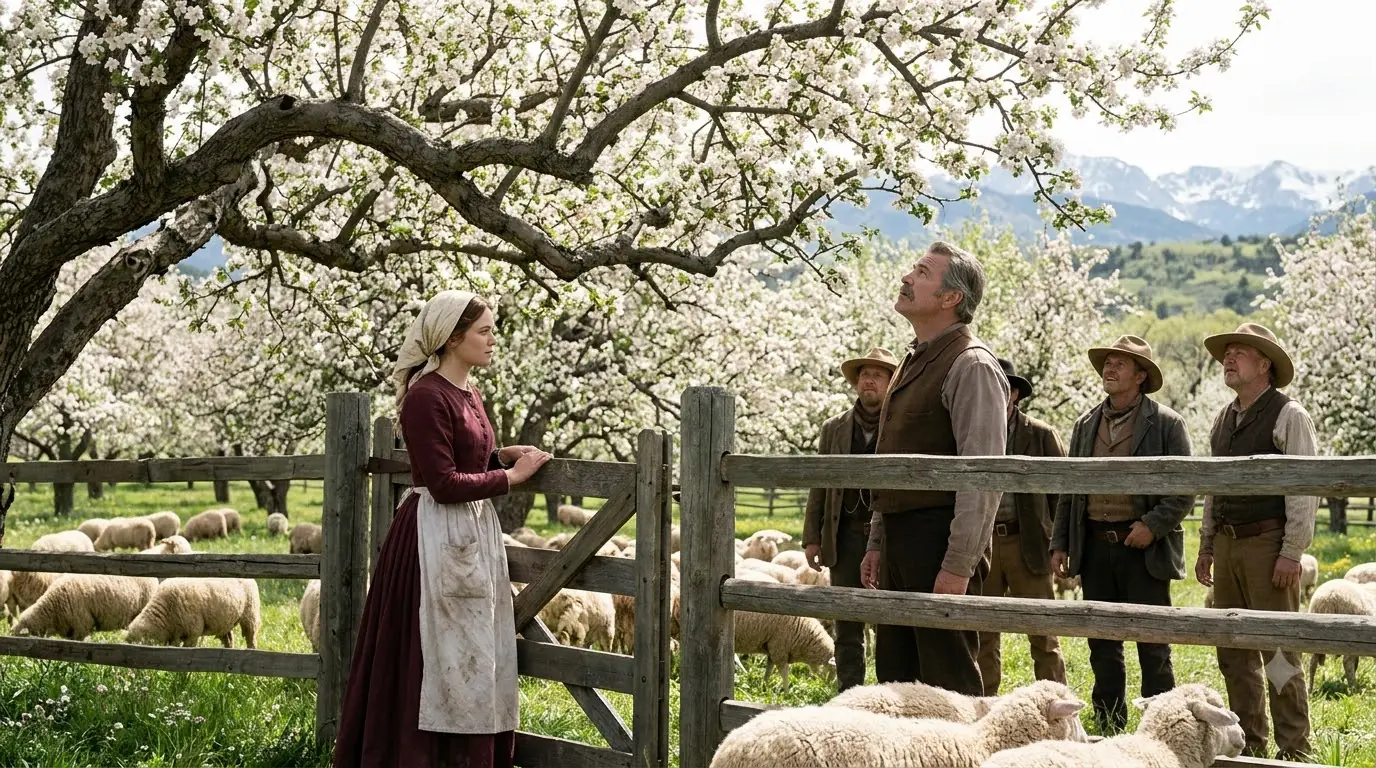
"Six weeks,"Pritchard said, leaning against the crooked doorframe. "That's about how long you have before the first hard snow. Forty-four acres of exhausted soil, an orchard everybody calls dead, and a creek that scarcely runs in summer. You don't have the money to survive another winter up here."He laid a folded paper on her table. "I'm offering you a dignified way out. Most women in your position would be grateful."Eleanor did not pick up the offer. She had already heard the rumors from the grain depot, the banker, and people who treated her decision to buy Barren Ridge as a joke. She knew the sum written on that page would be lower than the land was worth, because Pritchard assumed she had no alternative. "Most women in my position aren't me,"she answered. His smile faded, but he left the paper there, certain the weather would persuade her where he had failed.
What he could not know was that Eleanor had spent the spring examining forty-four old apple trees, cutting tiny windows through their bark to see whether any living tissue remained beneath. Thirty-five had appeared lifeless. Nine had shown a thread of green. She did not yet know how to save them or whether they could ever produce fruit, but she knew the difference between a dead orchard and an orchard someone had stopped believing in.
She was 24 years old. She had grown up in Cincinnati, the daughter of a school teacher father who died when she was 19, and left her a modest inheritance that she had stretched for 5 years with the particular stubbornness of someone who refused to admit they were slowly running out of options. She had no farming experience. She had no family in Colorado. She had read three books on soil science, two on orchard management, and one on sheep husbandry, which she'd found for a nickel each at a used bookshop in Denver.
And she'd read all of them on the train west with the focused attention of someone studying for an examination they could not afford to fail. The land agent in Willow Creek was a tired-looking man named Edgar Weller, who had the defeated expression of someone who'd watched too many hopeful people make too many bad decisions. He handed her the deed with a look that said he'd seen this before, and it never ended well. "You understand what you're buying,"he said. It wasn't quite a question. "I understand it's 44 acres with an orchard and a creek and a structure