Rain found every hole in the roof of the old Hargrove Dairy.
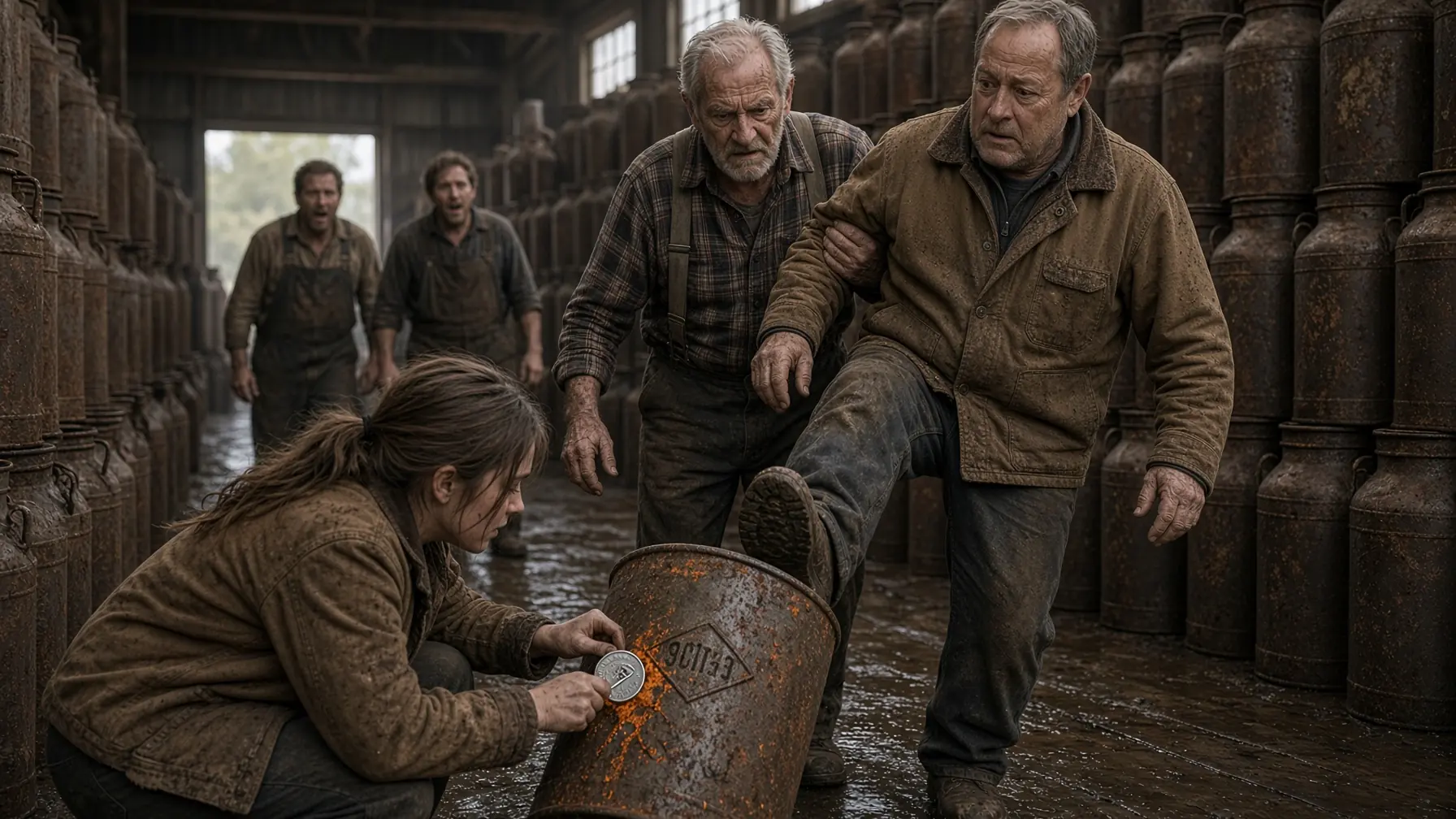
It fell through rotted boards and missing sheets of tin, dripping onto stacked pallets, broken conveyor belts, and a bottling line that had not moved since 1997.
Farther inside, beneath rafters stained black from decades of moisture, stood rows of steel milk cans.
Hundreds of them.
Rusty lids.
Bent handles.
Flaking paint.
Dents left by farmers, truck beds, loading docks, and thirty Wisconsin winters nobody remembered individually anymore.
Callie Reed had counted every one.
One thousand four hundred.
At six in the morning, she crouched beside the third row with a flashlight between her teeth and a coin in one hand.
She scraped gently along the bottom edge of another can.
Rust came away in reddish flakes.
Beneath it, a faint factory mark appeared.
Callie pulled the flashlight from her mouth and wrote something in the spiral notebook balanced on her knee.
Then she moved to the next can.
And the next.
A man in a canvas jacket stood in the doorway watching rain blow across the abandoned loading yard.
Bud Tanner had spent most of his career emptying buildings people no longer wanted.
Closed feed mills.
Farm implement shops.
Dairies.
Grain warehouses.
He had learned not to become sentimental about anything left behind.
If it was not bolted down and nobody wanted to bid on it individually, it became tonnage.
Scrap had a price.
Nostalgia usually did not.
Bud looked at Callie.
“You’re going to catch pneumonia counting garbage.”
She did not look up.
“It’s not garbage yet.”
Bud laughed.
Then walked back into the rain.
Callie heard his boots disappear across the concrete.
She kept scraping.
At that moment she could not have explained exactly what she expected to find.
She was not an antique dealer.
She was not a dairy historian.
She was not hunting some mythical can worth ten thousand dollars.
Eight months earlier, she had barely managed to keep her furniture-refinishing shop open.
Two slow winters had emptied most of her savings.
If someone had asked whether buying fourteen hundred rusted milk cans from a condemned building sounded like a responsible business decision, Callie would have answered no.
Then done it anyway.
Because of Ruth.
Her grandmother.
Ruth Reed had spent thirty-one years working at Hargrove Dairy.
She started there when milk still arrived from small farms in steel cans loaded onto route trucks before sunrise.
She remained through the transition to bulk tanks.
Later came stainless tanker trucks.
Plastic jugs.
Automated bottling.
Larger processors swallowing smaller operations.
By the time Ruth retired, the old milk cans had already become obsolete.
But she remembered them.
When Callie was a little girl, one sat beside Ruth’s porch steps filled with petunias.
It had a dent near the base and faded black numbers stenciled across one side.
Callie once asked why Ruth did not repaint it.
“Because then I couldn’t read it.”
“You can read a milk can?”
Ruth smiled.
“If you know what you’re looking at.”
She showed Callie scratches along the handle.
A blue stripe nearly worn away.
A route number.
A tiny stamped symbol beneath the rim.
“This one came off the Miller route.”
“How do you know?”
“The number.”
“What about this dent?”
Ruth touched it.
“Probably loading dock.”
“You know that?”
“No.”
Callie frowned.
Ruth laughed.
“That’s different from knowing.”
Then she told her granddaughter something Callie remembered decades later.
“You preserve what you know. You don’t invent the rest.”
At ten years old, Callie thought that was an unnecessarily serious rule for an ugly metal can.
At thirty-four, kneeling in the ruins of Hargrove Dairy, it became the rule that saved her from destroying the most important pieces she found.
Ruth died two winters before the liquidation.
Callie inherited very little materially.
A small box of photographs.
Some recipe cards.
A set of woodworking clamps that had belonged to Ruth’s husband.
And the milk can from the porch.
Callie put it inside her refinishing barn and rarely touched it.
It felt less like decoration than an unfinished sentence.
Then word spread through town that the old Hargrove property had finally sold.
The buildings were structurally unsafe.
Demolition would begin in a month.
Everything inside had to go.
That was how Callie ended up standing in the abandoned dairy asking Bud Tanner what would happen to the milk cans.
“Scrap,” he said.
“All of them?”
“If nobody wants them.”
“How many?”
Bud shrugged.
“Lot.”
Callie counted.
Then found him beside his truck.
“One thousand four hundred.”
Bud looked at her.
“You counted them?”
“Yes.”
“That was your first mistake.”
“What do you want for them?”
He laughed.
“How many?”
“All.”
His smile disappeared.
“All what?”
“All fourteen hundred.”
Bud stared at her for several seconds.
Then looked toward the building.
“Ma’am, that isn’t decorating. That’s an industrial quantity of rust.”
“What do you want for them?”
He took the clipboard from under his arm.
“Two dollars each if you clear every one yourself.”
Callie calculated.
“Twenty-eight hundred.”
“Cash.”
“When?”
“Property clear in thirty days.”
“I’ll do it.”
Bud laughed again.
“You got trucks?”
“One.”
“You need more.”
“I’ll figure it out.”
“Storage?”
“I’ll figure it out.”
“Help?”
Callie paused.
“I’ll figure that out too.”