The timber shifted before anyone shouted. Clara Reed was crouched beneath the unfinished truss when the lifting line snapped sideways and dropped the beam 6 in. The whole frame groaned above the river. Wade Mercer jumped from the stone abutment, caught her arm, and hauled her onto solid ground. Back.
Clara shouted. The crew froze. She pulled free of Wade, snatched up her carpenter square, and pointed toward the hanging joint. Lower it. One of the men stared at her.
We just got it up and you'll put it down. Contractor Amos Bell pushed through the workers. What now? Clara pressed the square against the joint. This shoulder was cut too shallow.
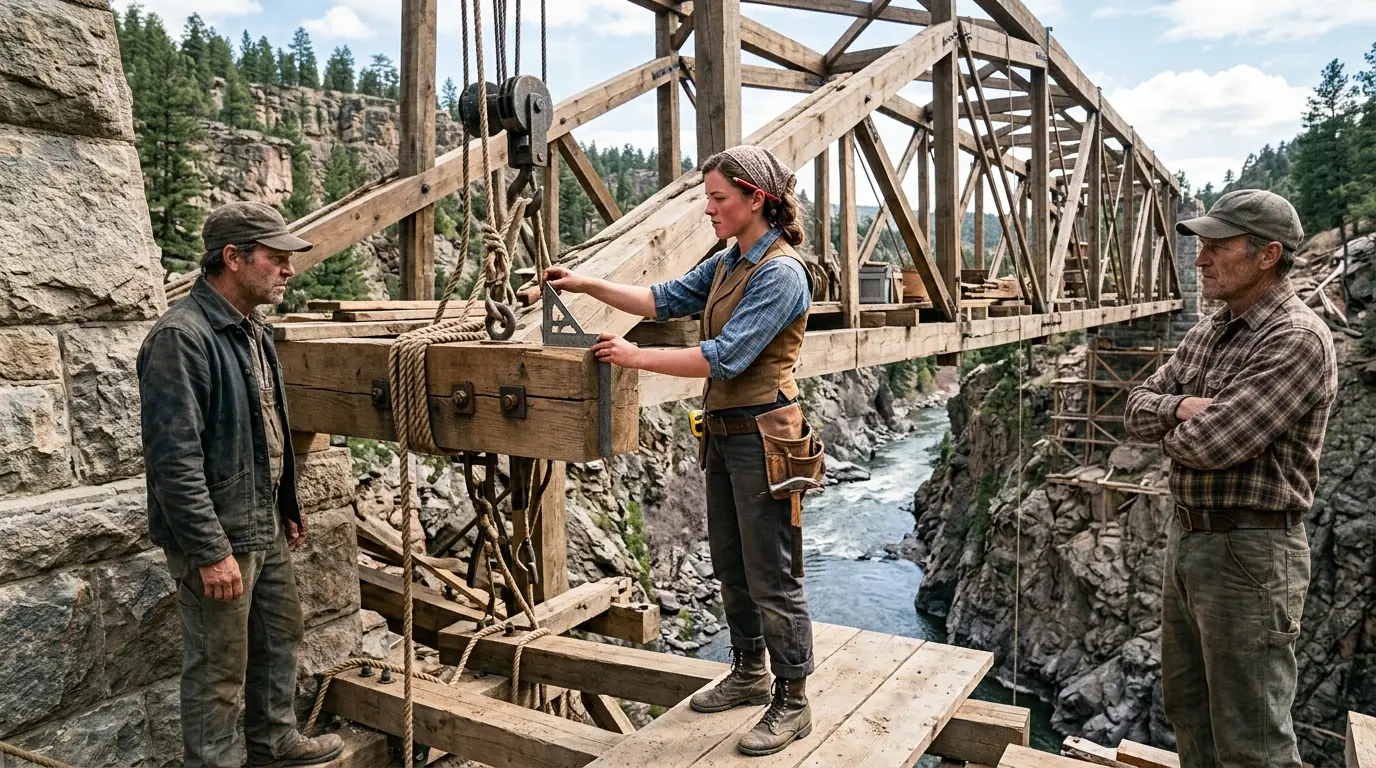
Bell squinted. It'll hold. No. Cold wind moved through the Colorado gorge, carrying the smell of wet pine. Bell folded his arms.
We've already lost three days. You'll lose the bridge if you pin that joint. Several workers looked toward Wade. Clara held out the square. Anyone who doubts me can check it.
Wade took it and laid it against the cut. A thin gap showed along the edge. She's right. Bell's face hardened. You brought her here to estimate timber.
I brought her because she knows timber. That isn't the same as running a bridge crew. Clara wiped grit from her palm. I didn't ask to run your crew. I asked you not to raise bad work over men's heads.
Bell kicked a wooden pin into the dirt. I'm finished. Wade stared at him. You're walking off? I won't put my name under a woman who thinks a carpenter's square makes her a bridge builder.
Clara picked up the pin and turned it in her fingers. You shouldn't put your name under this either. It split. Bell walked toward the road. Two men followed him.
The others stayed. Mesa crossing had washed out in spring. Ranchers had spent months using a rough upstream fort that would become useless when winter water rose. 12 working days remained. Clara knew because she had counted them before breakfast.
Wade removed his gloves one finger at a time. Can you finish it? She looked at the unfinished span. The bridge. Yes.
You just lost your contractor. I noticed by supper you may lose more men. So Clara tucked the square into her belt. Don't ask because you want courage from me. Ask if you intend to live with the answer.
His eyes stayed on hers. Can you finish it? Clara walked to the timber table and unrolled the drawings. For seven years, she had checked other men's measurements and watched them sign their names beneath her work. 12 days if deliveries hold.
Then take the job. Clara looked up. The committee won't approve me. They approved Bell. That does not improve their judgment.
A corner of Wade's mouth moved. Give them better judgment. Clara rolled the drawings closed. If I take responsibility, I take authority. You'll have it.
No committee member changing cuts after supper. No rancher ordering men around once they're on this site. No one telling me dangerous work is good enough because a wagon is waiting. Wade nodded. And my wages match the job.
Yes. And when something goes wrong, you don't stand in front of me and explain it away. I stand beside you. That wasn't what I said. I know.
Clara looked toward the river. Get the committee. By midafternoon, five committee members stood beside the rejected joint. Clara showed them the bad cut, the split pin, and the corrected measurements. One turned toward Wade.
Are you certain? Wade pointed at Clara. Ask the person building your bridge. By sunset, Clara Reed was forewoman of Mesa Crossing. She reorganized Bell's abandoned work.
Good timber went north of the saw horses. Questionable stock went beside the tool shed. Every approved cut received a short red mark from the carpenter's pencil behind her ear. As Ratali, the sawmill foreman watched her. Finally, he said, "Red mark means approved.
Yes, and no mark. Don't use it. Ezra grunted. It was not praise. It was enough.
Near dusk, Clara started down toward the lower staging. Wade stepped into her path. You're not going under there again today. Move. You were nearly crushed this morning.
And now I know why. You can inspect it from above. No. She pointed toward the staging. You hired me to decide what is safe.
If you don't trust me to stand where I need to stand, replace me now. For several seconds, only the river answered. Then Wade stepped aside. Take a rope. That'll do.
He handed it to her. No argument. Later, one of Wade's ranch hands reached for a timber before Clara gave the signal. Wade stopped him. She gives the order here.
The man glanced at Wade, then waited. Clara marked the timber red. She said nothing, but her hand stayed on the pencil a moment longer. Before dark, a polished wagon rolled down the road. Gideon Rusk climbed out wearing a black coat and silver watch chain.
He owned the toll road through the southern ridge. I hear Bell quit. Clara kept writing measurements. You heard quickly. I make my living from roads.
Rusk checked his watch. I also bought the remaining forged bridge straps in Pine Junction this morning. Clara stopped writing. Wade's face went still. All of them?
He asked. Everything available this side of Denver. Rusk looked toward the incomplete span. If this bridge is not open when the ford closes, the committee can still sign my seasonal freight contract. Guaranteed passage.
No construction risk. At your toll, Clara said, at a fair toll, he tipped his hat. 12 days, Miss Reed. Then he returned to his wagon. Darkness settled into the gorge after he left.
The crew went home. Clara stayed beneath the first completed section with her notebook and red pencil. Wade came beside her. Still think 12 days? Clara looked across the empty space where the central span had to go.
Other people had spent years signing their names over work she had measured. This time there was no one to hide behind. She placed the pencil against the pale timber and drew one clean red line. We have 12, she said. So we use 12.
By sunrise, Clara had changed the whole work site. Bell had tried to build three sections at once. Clara stopped that. She divided the remaining men into two crews. Ezra Thally ran the saws.
Wade's ranch hands carried and fitted timber. Nobody touched a piece until Clara had checked the cut and marked it red. The first argument came before breakfast. A broad shouldered carpenter named Jeb Carver dropped his mallet on the bench. I've built barns since before she was old enough to carry that pencil.
Clara kept measuring. Then you should know 6 in is still 6 in no matter who reads the rule. A few men looked away to hide smiles. Jeb did not. You plan on measuring every nail, too?
No. She marked the timber. Only the things that can kill somebody. Ezra coughed into his sleeve. That ended it.
By noon, the bridge had gained 12 ft. Then a wagon came down from Pine Junction. The driver carried no iron. Clara walked beside him as he climbed down. Where are the straps?
Bought out by rusk. The driver rubbed his beard. Not just the straps, bolts, too. Half the heavy spikes. Wade heard from the far side of the workbench.
How much did he offer? Enough that the supplier didn't ask questions. Clara looked toward the piles of timber. Gideon Rusk did not need to break the law. He only needed the calendar.
That afternoon, two more workers left. Rusk had offered them higher wages to grade his southern road. Jeb Carver was one. He collected his tools without looking at Clara. Nothing personal.
Clara tied a new line around a timber stack. Work usually is. He hesitated. Then he walked away. Wade watched him go.
I can bring more ranch hands. Can they cut joints? No. Then they carry. Your short three trained men.
I know we could pay more. With what? We did not answer. Clara turned back to the bridge. Rusk wants us spending money faster than we spend timber.
What do you want to do? Stop pretending we still have Bell's crew. She pulled the work schedule from beneath a stone. We finish one section before touching the next. No wasted movement.
No man waiting for another man to catch up. Wade studied her new marks. You already changed the schedule 20 minutes ago. He looked at her. You ever ask permission?
Only when somebody else is responsible for the answer. For the next two days, Mesa Crossing became a machine built from tired people. Wade worked his ranch before daylight, then rode straight to the gorge. He hauled timber. He turned the drilling brace.
When Clara told him to hold a beam steady, he held it. He never used his committee seat to change an order. That mattered more to her than she allowed herself to examine. On the third evening, Clara found him sitting on an overturned timber block, rubbing his shoulder. You're lifting wrong.
I own cattle. That doesn't make your back special. She showed him how to shift the load closer to his body. Wade followed her instructions. You enjoy ordering me around.
No, you answered too fast. I enjoy not having to explain the same thing twice. He smiled. Clara looked away first. The river ran darker below them.
Wade picked up his gloves. You know what this bridge means to the valley? Freight. More than that. She waited.
My ranch can survive one bad winter route. Smaller farms can't. The toll road would eat half their margin before spring. Clara looked toward the central span. So, this isn't about your cattle.