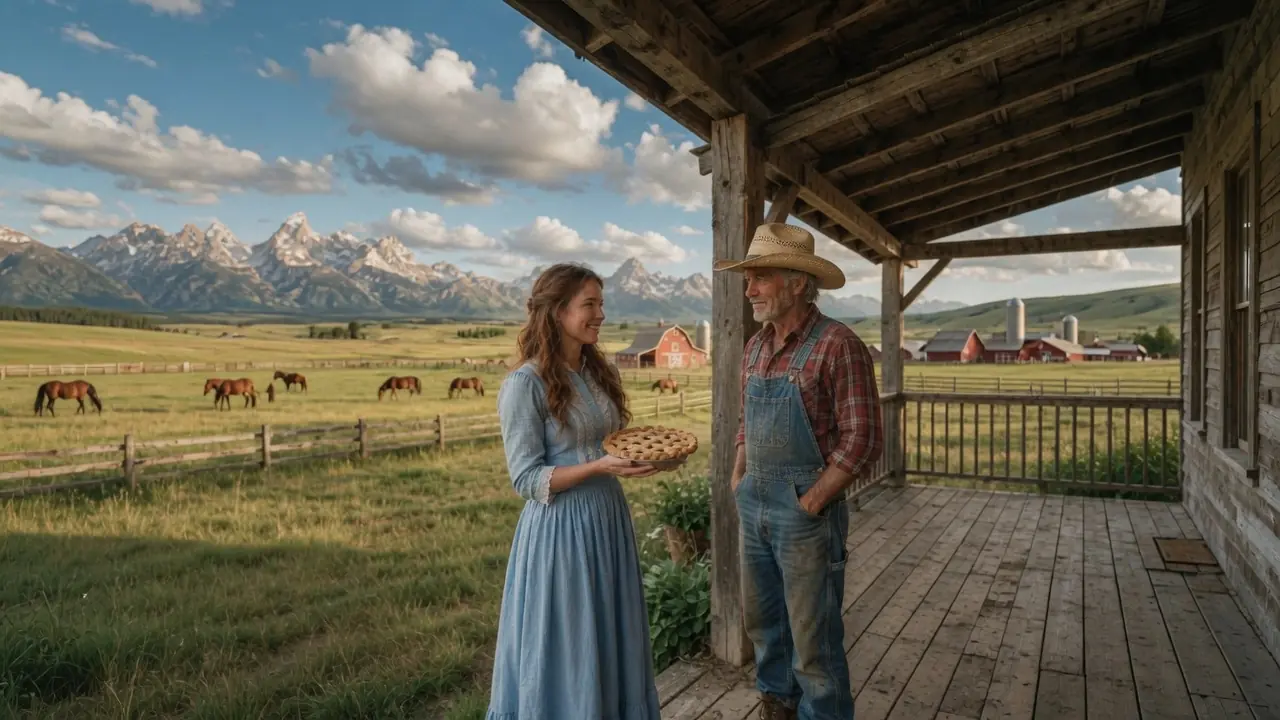
Margaret Hale carried the apple pie across the field on a Tuesday morning, holding it carefully with both hands as if it were something fragile and sacred. The Colorado mountains rose behind Thomas Calloway’s farm, blue and steady beneath a clean September sky, while the red barn stood bright against the grass. She had made that walk every Tuesday for three years, sometimes with bread, sometimes with soup, sometimes with a pie when the apples were good. She always told herself it was neighborly kindness, but her trembling fingers around the pie plate knew better.
Thomas Calloway was standing on his porch when she arrived, one hand resting against the post, his hat pushed back from his weathered face. He was fifty-five years old, a widower, and the kind of quiet man grief leaves behind when it does not destroy him completely. He had worked the same farm for most of his life, tending fields, mending fences, caring for livestock, and speaking only when words were needed. Since his wife Eleanor died three years earlier, the house behind him had grown too large, too still, and too full of memories that no one touched.
Margaret was twenty-five, strong from work, sharp from managing her own land, and patient in a way people often mistook for innocence. Her parents had moved to Denver to live near her older sister, leaving her in charge of forty acres, a small orchard, and enough responsibilities to make older men nervous. She fixed her own gates, negotiated her own prices, and never asked for help unless a problem truly needed two sets of hands. People in Durango admired her, but they also whispered that a young woman alone should not remain alone too long.
Thomas had never asked why she kept bringing food. Every Tuesday, he accepted whatever she carried with the same quiet words. “You didn’t have to,” he would say, his rough hand reaching carefully for the dish. Margaret always answered, “I know,” because it was true, and because saying more would have made the truth too visible. Over time, that small exchange became a place they both stood in without admitting what it meant.
That morning, she held out the pie, and Thomas looked at it with a rare smile that changed his whole face. “Apple,” he said, as if it were a discovery worth honoring. Margaret nodded, her cheeks warming beneath the edge of her bonnet. “September apples,” she said. “The good ones.”
Thomas took the pie from her hands, and for a moment their fingers brushed against the warm tin. He looked down at the golden crust, crimped neatly around the edges, then lifted his eyes to her face. The morning seemed to pause between them, with the horses grazing beyond the fence and the mountains standing still as witnesses. Then he smiled again, softer this time, and said, “If only I were ten years younger, Margaret.”
He meant it as a joke, the kind of harmless line a lonely man says to make a kind woman laugh. But Margaret did not laugh. Her smile faded into something deep and unreadable, and her hands folded tightly against her apron. She looked at Thomas Callable, and her hands folded tightly against her apron. She looked at Thomas Calloway as if he had opened a door without realizing what stood behind it.
“You baked this pie just for me, Margaret?” he asked, still trying to keep the moment light. Margaret drew a slow breath, her eyes steady though her fingers trembled slightly. “I baked it because Tuesdays feel empty without you,” she said. Thomas’s smile faltered, and the pie felt suddenly heavier in his hands.
The porch went silent. Thomas stood there with the pie in his hands, staring at her as if she had spoken in a language he had always known but never expected to hear again. Margaret turned before he could answer, because courage has a strange way of vanishing after the truth is out. She stepped down from the porch, crossed the yard, and walked back through the field with her head high and her heart beating hard enough to hurt.
Thomas watched her go until the blue of her dress disappeared beyond the fence line. He looked at the pie, then at the place where she had stood, then back at the pie again. The joke had not been a joke anymore, and he knew it. For the first time in three years, the empty house behind him felt less like a grave and more like a question.
Eleanor Calloway had died in the spring of 1880 after an illness that took its time and left no corner of the house untouched. Thomas had sat beside her bed through the long weeks, listening to her breathe weaker each night while the cottonwood leaves whispered outside the window. When she was gone, he buried her beneath the tree east of the house and returned to work the next morning because work was the only answer he understood. People called him strong for it, but strength was not what he had felt.
He had felt hollow. The farm still needed feeding, mending, planting, and counting, so he gave himself to tasks that did not ask him to explain his grief. He patched fences, fixed equipment, and rose before dawn because mornings came whether a man wanted them or not. But inside the house, he stopped expecting warmth, and over time, he convinced himself that was the same as peace.
Margaret had known Eleanor well. The Hale property bordered the Calloway farm, and both families had shared tools, harvest labor, winter meals, and news for nearly thirty years. Eleanor had been the kind of woman who made people feel welcome before they noticed they had been lonely. After she died, Margaret felt the silence spread across the neighboring farm like frost.
Two weeks after the funeral, Margaret brought over a pot of chicken soup. Thomas answered the door with his sleeves rolled up and grief hidden behind a face too tired to lie properly. He looked at the pot, then at her, and said, “You didn’t have to.” Margaret said, “I know,” and left before pity could embarrass either of them.
After that, Tuesdays became a pattern. Margaret never came too often, never stayed too long, and never acted like Thomas needed saving. She brought food because people had to eat, and because grief sometimes forgets how to care for the body carrying it. She told herself that was all it was, but every week she found herself making the bread a little better, stirring the stew a little longer, and choosing the good apples when the season came.
Thomas noticed more than he admitted. He noticed the way Margaret stood straight when men at the market tried to talk over her. He noticed that she knew the price of hay, the weight of cattle, the cost of nails, and the exact weak spots along her south fence. He noticed that when she laughed, it was not careless but chosen, as if joy were something she still believed in despite knowing the world could be hard.
He also noticed, then immediately told himself not to notice, that she was beautiful. Not in the polished way town people praised, but in the truer way of someone alive inside her own skin. Her hair caught red in sunlight, her eyes were steady, and her hands carried work without apology. Thomas placed all of this under the safe word neighbor and warned himself never to open the drawer again.
The problem was Daniel Marsh. Durango loved Daniel because he was twenty-eight, handsome, prosperous, and belonged to a family that owned the largest supply store in town. He smiled easily, wore clean collars, and knew how to make older women approve of him before he finished a sentence. By every practical measure, he was the kind of man the town believed Margaret should marry.
Daniel brought flowers to Margaret’s house the day after Thomas’s pie joke. They were arranged flowers, not wildflowers, which meant he had ordered them deliberately and spent enough money to make his intention plain. Margaret accepted them politely and placed them in water on her kitchen table. Daniel sat across from her, speaking of railroad contracts and new opportunities, while she looked through the window toward Thomas’s fields.
Daniel was not cruel, and that made refusing him harder. He was courteous, generous, and reasonably intelligent, though he spoke more about his prospects than his values. He asked if he might escort her to the Harvest Social at the end of October. Margaret said she would think about it, which was honest enough to be kind and vague enough to give her time.
After he left, she stood by the window and looked toward the Calloway farm. The late sun lay across the fields, and she imagined Thomas somewhere near the north fence, checking posts because that was what he did when the day turned. Her heart pulled toward that land with a certainty that frightened her. Daniel was everything people wanted for her, but Thomas was what she wanted for herself.
Thomas, meanwhile, spent two weeks turning Margaret’s words over in his mind. Ten years wouldn’t be enough. I came for you. He thought about them while repairing the barn roof, while moving the cattle toward winter pasture, and while sitting at the kitchen table beside the pie she had baked. The pie disappeared slice by slice, but the words remained.
He did not let himself feel flattered for long. He was fifty-five, and that number stood before him like a locked gate. Margaret was twenty-five, bright and capable, with years ahead of her that should not be tied to a man already carrying gray in his beard and sorrow in his bones. He told himself that caring for her meant protecting her from his own wanting.
Then he imagined Daniel Marsh walking beside her at the Harvest Social, smiling that polished smile and offering her exactly what the town believed she deserved. The thought did not make Thomas angry at Daniel. It made him angry at himself. He had spent three years accepting Margaret’s Tuesdays, letting her kindness enter his life while pretending it meant nothing because pretending required less courage.
One afternoon, Thomas stood in front of the small mirror by his kitchen door. He saw the lines around his eyes, the weathered skin, the gray hair, and the face of a man who had survived more than he expected to survive. Then he remembered something Eleanor had once said while he was refusing help during a flood. “Stubbornness in the wrong direction is just foolishness wearing boots.”
Thomas put on his hat and walked across the field. Margaret was mending the fence between their properties when he reached her, sleeves rolled up, hair pinned loosely, tool in hand. She did not look surprised to see him. She only kept working, because she knew Thomas Calloway did not speak until a thought had finished forming.
“Margaret,” he said. She pressed the fence wire down and answered without looking up. “Thomas.” He placed both hands on the top rail and looked at the mountains, then at her. “I’ve been thinking about what you said.”
“Which thing?” she asked, though her hands had gone still. Thomas exhaled slowly. “You know which thing.” Margaret set down the tool and faced him, her expression steady but her fingers gripping her apron. The afternoon wind moved through the grass between them.
“Ten years wouldn’t be enough,” he said. “I’ve been thinking about what that meant.” Margaret lifted her chin. “And what did you conclude?” Thomas looked down at the fence rail, gathering honesty like a man gathering a rope with rough hands. “I concluded that I don’t know what you meant, and that I’d like to.”
Margaret studied him for a long moment. The field was quiet, the mountains blue in the west, and a hawk moved high overhead. Thomas did not rush her, and that patience nearly broke her. She had spent three years waiting for him to see what she had stopped trying to hide.
“It meant,” Margaret said slowly, “that ten years would not make you any more what I wanted.” Thomas looked at her, and his jaw tightened as if he were preparing himself for pain. She stepped closer to the fence. “Because you are already exactly what I wanted.”
Thomas closed his eyes briefly. When he opened them again, there was fear in his face, but also wonder. “Margaret, I am old enough to know what people will say.” She smiled sadly. “People say things when they do not have the courage to live their own lives.”
He looked at her hands, strong and capable from work, then at her face. “In twenty years, I will be seventy-five.” Margaret did not look away. “And in twenty years, I will know I spent them with a man who showed up when it mattered.”
The words struck him with quiet force. He remembered the spring flood when her fence had come down and he had taken lumber over before breakfast without telling anyone. He had not thought she noticed. Now he understood she had noticed everything, not because she needed rescuing, but because she understood the language of actions better than the language of speeches.
The Harvest Social came at the end of October. Margaret went because hiding would have given the town too much satisfaction. Daniel Marsh was there, handsome and attentive, bringing her cider, asking for a dance, and behaving with enough grace that she almost wished she could want him. But wishing is not choosing, and Margaret knew the difference.
Martha Greer from the dry goods store pulled Margaret aside beside the refreshment table. “Daniel Marsh is a good man,” Martha said, keeping her voice low but firm. “He is young, prosperous, and ready to build a life.” Margaret looked across the room at Daniel, who smiled when he saw her looking. She smiled back kindly, then turned to Martha.
“Do you know what Thomas Calloway did after my fence came down in the spring flood?” Margaret asked. Martha blinked, startled by the change in subject. “He was there the next morning with lumber he could not spare and tools he had not been asked to bring.” Margaret’s voice softened. “He fixed it and never mentioned it afterward.”
Martha sighed. “That is kind, Margaret, but kindness is not everything.” Margaret looked toward the dark windows where the mountains were hidden beyond the town lights. “No,” she said. “But quiet faithfulness might be.” She set down her cup and left the social early, riding home beneath a sky full of stars and the certainty that she would rather be judged for truth than praised for choosing safely.
In November, Thomas began preparing his house without announcing it. He fixed the porch rail that had leaned for two years. He replaced the east kitchen window so morning light could enter properly again. Most important, he opened the spare room where Eleanor’s things had rested untouched since her passing.
He did not erase Eleanor. He folded her dresses, packed her letters, kept her Bible on the shelf, and placed one of her shawls in a cedar box. He did the work slowly, sometimes sitting on the bed with one hand over his face until the ache passed. Making room for Margaret did not mean removing Eleanor from his life; it meant admitting life had more room than grief had allowed him to believe.
On a Thursday, not a Tuesday, Thomas knocked on Margaret’s door. She opened it with flour on her sleeve and surprise in her eyes. He stood on her porch with his hat in both hands, looking more nervous than he had during floods, cattle losses, or bank meetings. Margaret said nothing, because she knew he had come with words that needed space.
“I’ve been doing work on the house,” he said. Margaret’s mouth curved faintly. “I know.” Thomas blinked. “You noticed?” Her smile deepened. “Thomas, I have been visiting that house for three years. I notice everything.”
He looked down at his hat, then lifted his eyes to hers. “Daniel Marsh is a good man,” he said. “He is young, respected, and sensible in every public way.” Margaret leaned against the doorframe, listening. “I am fifty-five years old, I have a farm that needs work, a porch I only just fixed, and a kitchen window I should have replaced two years ago.”
“Then don’t compete with Daniel,” she said softly. Thomas went still. Margaret stepped closer, her face open and steady. “Ask me what you came to ask me.”
Thomas swallowed. “I would like to come calling on you properly, if you will allow it.” Margaret looked at him, this careful, decent farmer who had nearly let arithmetic steal courage from him. Her eyes filled, but she smiled. “Thomas Calloway, I have been waiting for you to get here for approximately three years.”
He stared at her for a moment, absorbing the answer as if it were both joy and scolding. “I was thinking it through,” he said. Margaret laughed, and the sound warmed the porch more than the afternoon sun. “I know,” she replied. “Come in. There’s coffee.”
Durango had opinions, as Durango always did. Some people said Margaret was foolish for choosing a man thirty years older. Others said Thomas had no right to ask for a young woman’s future after already having lived so much of his own. A few, kinder or wiser, said that people who minded their own houses badly should be careful giving advice about someone else’s heart.
Daniel Marsh handled the matter with grace. He came to Margaret’s farm one afternoon, hat in hand, and told her he wished her happiness. “I had hoped,” he admitted, “but I did not want to be chosen by argument.” Margaret thanked him, and her respect for him grew because disappointment had not made him cruel. A month later, he began calling on a banker’s daughter from Denver, and the town quickly found a new subject.
Reverend Cole spoke privately with Thomas before the courtship became formal. “She is twenty-five,” the reverend said. “You are fifty-five.” Thomas nodded because pretending otherwise would have insulted them both. “In twenty years, Thomas, the difference will not be smaller.”
“No,” Thomas said. “In twenty years, I will be seventy-five, and she will be forty-five.” The reverend waited. Thomas looked toward the church window, where winter light lay pale across the floor. “But in those twenty years, she will have had a man who sees her clearly, speaks truthfully, and does not make her smaller for being strong. I think that is worth something.”
The reverend considered this for a long time. Then he nodded once. “So do I,” he said.
Their courtship was quiet, but it was not small. Thomas came on Sundays with coffee, books, and sometimes a tool he claimed needed checking near her barn. Margaret rode with him along the creek between their properties, where aspens shook gold leaves into the water. They talked about crops, cattle, weather, grief, fear, work, children, and the strange courage required to accept happiness after loneliness has become familiar.
One evening in December, Margaret asked him if he ever felt guilty. Thomas knew what she meant without needing the name spoken. He sat beside her on the porch, hands folded, eyes on the mountains. “Sometimes,” he said. “But Eleanor was wiser than my guilt, and she never wanted me to worship sorrow.”
Margaret reached over and touched his hand. “I don’t want her place.” Thomas turned to her, and something in his face softened with deep relief. “Good,” he said. “Because it is not empty. I am making you your own.”
They married on a Saturday in February 1884, inside the Durango church while snow shone white along the mountain ridges. Margaret wore a deep green dress the color of pine trees after rain, because she had never cared for rules that did not suit her heart. Thomas wore his good jacket, and when he saw her coming down the aisle, his weathered face broke into that rare smile she loved most. The town watched closely, but Margaret looked only at him.
After the wedding, she moved into the Calloway farmhouse with books, linens, her mother’s pie recipe, and a certainty that changed the air in every room. The farm became theirs, not his with her inside it, but truly shared. She kept accounts with frightening precision, corrected feed expenses, and discovered two overcharges from a supplier in the first month. Thomas kept the fields, livestock, fences, and land knowledge built by decades of attention.
They divided work by competence instead of custom. Sometimes Margaret fixed a fence post because she was better with that kind of hinge. Sometimes Thomas baked bread because he had learned while Eleanor was ill and found the quiet of it soothing. Neither found this remarkable, though the first time a neighbor saw Thomas flouring a counter, the story traveled through Durango by supper.
In April, Margaret found Thomas on the porch at sunset, looking at the mountains with the expression she now understood as contentment. She sat beside him and rested her hands in her lap. “Are you happy?” she asked, not anxiously, but honestly. Thomas watched the last light touch the peaks before answering.
“I stopped expecting to be,” he said. Margaret waited, knowing he was not finished. He turned to her then, his eyes quiet and full. “But that is not the same as not being. Yes, Margaret, I am happy.”
She took his hand. The porch rail he had fixed stood firm beneath the fading light, and the new kitchen window caught the last of the day. Somewhere inside, a pie cooled on the table, filling the house with apples and cinnamon. Thomas looked at the woman beside him and understood that love had not returned late; it had arrived exactly when both of them could recognize it.
Their son William was born in January 1885, with red hair from his mother and a solemn gaze that made Thomas laugh quietly every time the baby studied him. Thomas was fifty-seven when he became a father, and the fear of that truth sat with him for weeks before he spoke it aloud. One night, while Margaret rocked the baby near the stove, Thomas stood by the window and asked, “Will I be enough?”
Margaret looked at him over William’s small head. “You fixed my fence the morning after the flood without being asked,” she said. Thomas frowned slightly, not understanding. Margaret smiled. “That is what a father does. You already know how.”
He never asked again. He rose for night crying, warmed milk with awkward tenderness, and carried William across fields while naming every ridge, fence line, creek bend, and tree. Margaret watched them from the porch sometimes, her hand resting against her heart. The town had counted Thomas’s years and found them too many, but William counted only the arms that held him.
On a September morning in 1886, three years after the pie and the joke that was not a joke, Thomas saw Margaret crossing the field toward him. She carried William on her hip, his red hair bright beneath the Colorado sun, his small face serious as he watched the mountains. Thomas stood at the north fence, one hand resting on the top rail, and felt time fold gently around him. The past was not gone, but it no longer stood between him and the life before him.
Margaret reached the gate, and Thomas opened it for her. She handed William to him, and the boy grabbed at his vest with solemn importance. Thomas looked at his wife, then at his son, then at the mountains doing what they had always done. Gratitude moved through him so strongly that for a moment he could not speak.
“If only I were ten years younger,” he said, not joking now, but honoring the foolishness he had almost hidden behind. Margaret smiled at him with the same expression she had worn on the porch three years earlier. “Ten years wouldn’t have been enough,” she said. “I needed exactly you. Exactly this.”
William looked between them, too young to understand the words but old enough to feel the warmth they created. Thomas handed him back to Margaret, closed the gate, and walked beside his family across the field. The red barn stood behind them, the mountains rose ahead, and the land between their farms no longer felt like distance. It felt like the place where two lives had finally met.
Years later, people in Durango would still tell the story of Margaret Hale and Thomas Calloway. Some told it as a scandal that became a marriage, some as a lesson in ignoring gossip, and some as proof that love did not always arrive in the shape people expected. But Margaret remembered it most simply. She had baked a pie, crossed a field, and told the truth when a man she loved mistook his fear for wisdom.
Thomas remembered it too. He remembered the warm pie plate in his hands, the sun on her blue dress, and the moment her answer made his careful life tremble. He had nearly counted himself out of happiness because the numbers looked unfavorable. Margaret had counted differently.
She counted the man who showed up with lumber after the flood. She counted the man who accepted kindness without turning it into debt. She counted the man who spoke slowly because he wanted his words to be honest. And in the end, those were the numbers that mattered.
Every Tuesday after that, Thomas still asked what she had baked, even when they lived in the same house. Margaret would roll her eyes, smile, and say, “Something for a farmer who thinks too much.” He would take the pie, bread, or biscuit from her hands with the same reverence he had shown that September morning. And every time, the house felt alive.