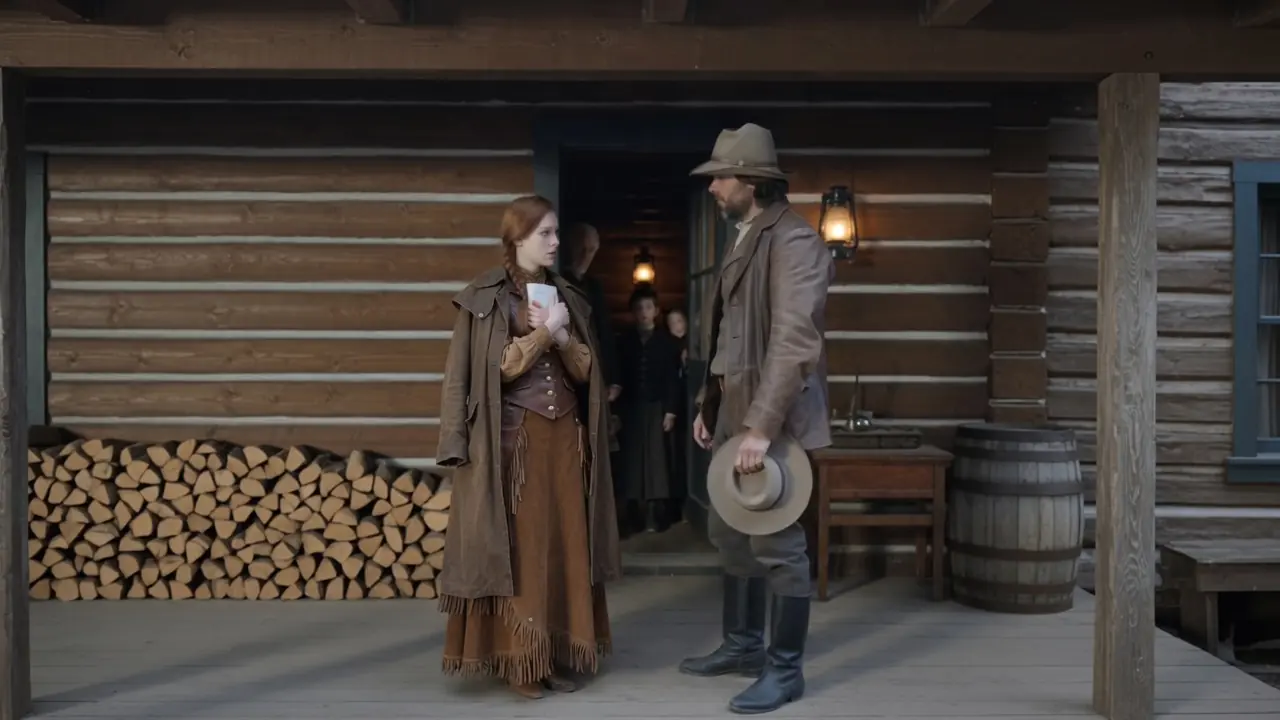
The first time Lydia Hail saw Ethan Crowe, he was standing on the porch of her father’s dying cabin with his hat in one hand and mountain dust on his coat. He did not look like a man who could save anybody. His boots were worn, his beard was rough, and his leather coat had the tired color of something that had seen more storms than shelter. Behind Lydia, her father coughed from the bedroom, her mother stood frozen in the doorway, and the debt collector’s cruel words still seemed to hang in the air.
Samuel Garrett had come that morning with a ledger, a sheriff’s notice, and the smug patience of a man who knew hunger made people weak. He had told Lydia’s mother that the cabin, the land, the few animals, and every useful piece of furniture would be auctioned if the debt was not paid by the fifteenth. Lydia had asked how much they owed, even though she knew the answer would ruin her. When Garrett said the amount, her mother covered her mouth, and Lydia felt the floor of her childhood drop away beneath her feet.
Her father, Thomas Hail, had once been a strong man who could split logs before breakfast and carry feed sacks like they were pillows. Now sickness had thinned him until his hands looked too large for his wrists. Medical bills had eaten through their savings, bad harvests had stolen the rest, and every week brought another paper stamped with words that made poverty sound official. Lydia was twenty-two years old, but she had already spent years watching hope leave the house one item at a time.
When Garrett finally rode off, Lydia thought the worst of the day had ended. Then Ethan Crowe arrived. He introduced himself without flourish, stepped into their cabin only after Lydia allowed it, and stood near the wall like a man who trusted no room until he understood every corner. His gray eyes rested on Lydia, not with pity, but with a strange, sharp kind of interest.
“I can pay every debt on this cabin before sundown,” he said. Lydia almost laughed because the claim sounded impossible coming from a man dressed like he owned nothing but his horse. Her mother stiffened, offended before she was relieved, and Lydia crossed her arms over the paper she still clutched against her chest. “A man dressed like you doesn’t carry that kind of money,” she said.
Ethan’s expression did not change. “Then marry me, and you’ll learn what these mountains have been hiding.” The cabin went silent except for her father’s breathing in the next room. Lydia stared at him, trying to decide whether he was a madman, a liar, or the answer to a prayer she was too practical to admit she had whispered. “Are you offering me rescue,” she asked, “or a trap?”
“A contract,” Ethan answered. “Your family’s debts paid in full. Your mother keeps this cabin. Your father rests without fearing eviction. In return, you become my wife and come with me into the high country.” He said it as if marriage were a bridge that could be built quickly if both sides understood the cost. There was no romance in his voice, but there was no mockery either.
Lydia’s mother stepped forward. “My daughter is not property.” Ethan nodded once. “No, ma’am. That is why I am asking her, not buying her.” Lydia looked from her mother’s shaking hands to the cracked stove, the leaking roof, the thin blankets in her father’s room, and the debt notice lying on the table like a death sentence. Pride had kept them standing, but pride could not pay Garrett.
“I don’t know him,” Lydia said. Her father tightened his weak grip around her hand. “Then learn him. Watch what he does when he has power over you. Words are cheap, Lydia girl. A man’s character shows up in what he could take but doesn’t.”
Her mother wept quietly in the kitchen, folding and refolding a blue shawl as if she could delay morning by keeping her hands busy. Lydia packed one bag because Ethan had said the mountain trails would not allow for more. She chose two dresses, her mother’s sewing kit, her father’s old watch, a comb, a Bible with loose pages, and a small journal she had never had enough time to fill. Before dawn, she kissed her father’s forehead and told him she would write.
Ethan was waiting at the north crossroads with two horses and a preacher. The marriage ceremony lasted less than ten minutes. Lydia repeated the words in a steady voice, though her heart felt like it had stayed behind in the cabin. When the preacher pronounced them husband and wife, Ethan did not try to kiss her; he only handed her the reins of a calm gray mare and said, “Her name is Slate. She’ll take care of you if you trust her.”
They rode north before the sun had fully cleared the ridge. Lydia did not look back because her father had told her not to, and because if she saw the cabin one more time, she might break the promise she had just made. Ethan rode ahead at first, letting the trail decide the silence between them. After an hour, she asked, “What exactly have I married?”
“A complicated life,” he said. “But not a dishonest one.” Lydia almost smiled at that. “You proposed marriage to a stranger and still think honesty belongs in this conversation?” Ethan glanced back. “I did not promise comfort. I promised your family’s debts would be paid, and they will be.”
They traveled for two days through narrow mountain paths, pine forests, and cliffs that made Lydia’s hands tighten around the reins. Ethan never mocked her fear. When the trail grew steep, he slowed his horse without making a speech about courage. When they camped, he slept on the far side of the fire and kept his word without Lydia needing to remind him.
On the third morning, the trail rose through a pass so narrow Lydia wondered how wagons could ever survive it. Then the mountain opened. Below them lay a hidden valley, wide and green despite the cold season, protected by white peaks and thick forest. Roads wound through the trees, smoke rose from chimneys, and buildings stood where Lydia had expected only wilderness.
She pulled Slate to a stop. “What is this?” Ethan looked down at the valley with an expression she could not read. “Home.” Lydia stared at the barns, workshops, storehouses, and the great timber lodge on the rise. It was not a poor man’s home. It was not even the home of an ordinary rancher.
As they descended, workers began to notice them. Men paused near a sawmill. Women looked up from carrying baskets. A boy leading horses stopped in the yard with his mouth open. Their surprise deepened when Ethan dismounted and said, clearly enough for all to hear, “This is my wife, Lydia Crowe. She will be treated with the same respect you give me.”
The name struck her strangely. Lydia Crowe. It sounded like a woman who belonged to someone else’s story. An older woman with gray-streaked hair and a sharp, kind face approached and took Lydia’s hand. “Martha Hayes,” she said. “Housekeeper, cook when necessary, referee when the men are fools, and the first person you come to if Mr. Crowe forgets how to speak plainly.”
Lydia looked at Ethan. “Does he do that often?” Martha snorted. “Often enough to keep me busy.” Ethan removed his gloves with a faint sigh. “Martha.” The older woman waved him off. “Don’t Martha me. You brought home a bride and told her half a story.”
Inside the lodge, Lydia’s confusion turned into anger. The main room had polished floors, carved beams, bookshelves, thick rugs, and a stone fireplace large enough to heat her family’s entire cabin. Her room was bigger than the main room she had grown up in, with a proper bed, a writing desk, a wardrobe, and a window overlooking the valley. There was even running water from a spring system, something Lydia had heard about but never expected to touch.
When Ethan came to explain, she was standing by the window with her arms folded. “You let me believe you were poor,” she said. “The whole town believes it.” Ethan closed the door behind him but stayed near it, giving her space. “The town believes what I allow it to believe.”
“That is not an answer.” His face remained calm, but not cold. “My family owns timber contracts across these mountains. This valley is the center of the operation. My father built it, and when he died, he left it to me.” Lydia stared at him. “So you are rich.”
“By most definitions, yes.” The simple answer made her angrier than denial would have. “You watched me choose between debt and a stranger because you wanted to know if I would marry you without knowing what you owned.” Ethan’s jaw tightened. “I wanted a wife who would accept the arrangement honestly, not chase a fortune.”
Lydia stepped closer. “And did you get what you wanted?” For the first time, his composure shifted. “I do not know yet.” That answer stopped her. It was not arrogant, not triumphant, not cruel. It sounded almost lonely.
Over the next week, Lydia learned that the valley was less a mansion and more a small, hidden town. Ethan employed loggers, carpenters, teamsters, cooks, stable hands, and families who had followed steady wages into the mountains. He owned mills, timber rights, transport contracts, and land that made the word wealthy feel too small. Yet he ate with his workers, rose before dawn, and spent hours reviewing ledgers by lamplight.
He gave Lydia a written agreement because she demanded one. It stated that her family’s debt had been paid in full, that she would have her own money, her own locked room, the right to write to her mother, and the right to leave if the marriage became unsafe or unbearable. Ethan read every term, signed without protest, and gave her the document himself. “A partnership cannot begin with a cage,” he said.
Lydia did not trust him fully, but she began to respect him. Trust, she decided, was too large a bridge to cross in one week. Respect was only the first plank. It helped that Ethan did not pretend kindness erased deception, and Lydia did not pretend money erased fear.
Winter tightened around the valley, and with it came the first real test of Lydia’s place. Ethan’s uncle, Marcus Crowe, sent letters from Denver accusing Ethan of mismanaging the timber empire. Marcus claimed Ethan’s sustainable cutting methods were weak, his wages too generous, and his leadership too soft. He also hinted that Ethan’s sudden marriage to a poor mountain girl proved bad judgment.
Ethan planned to ride to Denver alone. Lydia found him in his office, standing over maps and contracts with the expression of a man preparing for a trial he expected to win but not without scars. “You were going to leave me here,” she said. Ethan looked up. “I was going to spare you.”
“Do not dress exclusion up as kindness.” He studied her for a moment, then slowly set down the letter. “Marcus will attack you.” Lydia lifted her chin. “Then teach me enough that he regrets choosing me as a target.”
For the next ten days, Ethan taught her the timber business. Lydia learned about board feet, rail contracts, milling costs, worker injuries, sustainable harvest cycles, and the difference between short profit and lasting wealth. She had managed poverty her whole life, and that made business less mysterious than Ethan expected. Numbers were numbers, whether they measured cattle feed, medicine debt, or timber contracts.
When they arrived in Denver, Marcus Crowe was waiting with polished shoes, fine gloves, and the smile of a man who believed blood entitled him to other people’s labor. The meeting took place in a formal business office filled with investors, lawyers, and men who looked Lydia over as if trying to decide what price tag belonged on her dress. Marcus greeted Ethan loudly, then turned to Lydia. “And this must be the wife from nowhere.”
Lydia smiled politely. “From the mountains, Mr. Crowe. I understand men in offices sometimes confuse everywhere outside Denver with nowhere.” A few faces turned down to hide amusement. Marcus’s smile thinned. Ethan said nothing, but Lydia felt his attention settle beside her like quiet approval.
Marcus began with accusation dressed as concern. Ethan was too young, too isolated, too idealistic. His cutting methods reduced immediate yield. His worker policies drained profit. His refusal to let Marcus advise the company proved arrogance. Lydia listened as each insult circled the same hunger: control.
When Marcus finally turned on her, the room sharpened. “And now my nephew brings a wife no one knows, from a background no one can verify, and expects us to call that stability.” Lydia stood before Ethan could answer. Her hands were calm at her sides.
“My background is simple,” she said. “I come from a family nearly destroyed by debt, bad luck, and men who profit from desperation. I understand survival better than most people in this room understand comfort. I married Ethan Crowe for practical reasons, and since then I have studied this operation because my future is tied to it.” She looked directly at Marcus. “If your best argument is that I was poor, then you have mistaken hardship for weakness.”
The room went still. Margaret Chen, one of Ethan’s investors, leaned back in her chair with a small smile. Harrison Wells, the railroad contractor, tapped his pen against his ledger. Richard Blackwood, an eastern investor, watched Lydia with sudden interest. Marcus’s face darkened.
Lydia continued before he could recover. “You claim Ethan’s methods weaken profit, but his injury costs are down, equipment loss is down, and long-term yield projections are up. You claim he lacks stability, yet every major contract has been delivered on time. You claim concern for the company, but you have offered no plan beyond putting yourself closer to its money.”
Marcus snapped, “You insolent girl.” Ethan stood then, his voice quiet but dangerous. “Careful, Uncle. That is my wife and my partner.”
Margaret Chen spoke next. “Mrs. Crowe raises a fair point. Mr. Marcus Crowe, what exactly is your business experience beyond being related to the founder?” Marcus stumbled over a response, and Ethan laid down records of failed ventures, unpaid loans, and gambling debts his father had once covered. One by one, Marcus’s grand accusations collapsed under documents, numbers, and Lydia’s calm refusal to shrink.
By the end of the meeting, the investors reaffirmed Ethan’s control. Marcus left humiliated, his clean shoes striking the floor like angry punctuation. Ethan and Lydia remained in the room after everyone else had gone, surrounded by papers that had defended not only a company, but a marriage neither of them had yet learned how to name. “You did not have to stand up for me,” Ethan said.
“Yes,” Lydia answered. “I did.” He looked at her then, really looked, and something between them changed. Not love yet, but the first honest shape of it.
Denver brought another battle the following evening. Marcus’s wife, Caroline, invited them to dinner, pretending welcome while sharpening every word like a pin. She seated Lydia far from Ethan and surrounded her with women who asked polite questions meant to expose rough edges. Lydia answered each one with the same direct courage she had used in the business room.
When Caroline asked whether mountain girls learned proper manners, Lydia replied that mountain girls learned which plants healed, which clouds warned of storms, and which men were lying before they finished speaking. When a banker’s wife asked if Lydia found society overwhelming, Lydia said, “Not overwhelming. Just louder than necessary.” Margaret Chen laughed so openly that Caroline’s mouth tightened for the rest of the evening.
After dinner, Ethan found Lydia near the balcony, away from the crowd. “Are you all right?” he asked. She exhaled slowly. “I would rather face a snowstorm than another woman with diamonds and a grudge.” Ethan smiled, and the softness of it surprised her. “You handled her better than I ever have.”
“She wanted me ashamed of where I came from,” Lydia said. “But shame belongs to people who use comfort to belittle survival.” Ethan looked at her with something deeper than gratitude. “My father built an empire. You might be the first person I’ve met who understands what it should become.”
They returned to the hidden valley with more than victory. Margaret Chen offered Lydia independent consulting work, wanting her practical view on sustainable resource management for mining operations. Ethan encouraged her to take it, not as his wife, but as herself. The offer frightened Lydia more than marriage had because it asked her to believe she had value beyond emergency sacrifice.
Spring came with letters from her mother and the news that her father had died peacefully after learning the debts were cleared. Lydia grieved him in her room, holding his watch until the metal warmed in her palm. Ethan did not intrude. He left tea outside her door and waited until she came downstairs on her own.
When she finally joined him in the office, he looked up from the ledgers. “You do not have to work today.” Lydia sat across from him, opened a folder, and wiped her eyes once with the back of her hand. “My father told me to be brave but not reckless. Sitting alone with grief feels reckless.”
So they worked. Slowly, grief became something she carried, not something that carried her. She wrote to her mother, sent money, and invited her to come to the valley when she was ready. For the first time, Lydia could offer help without emptying herself to give it.
Months passed, and the marriage changed without announcement. The locked door between their rooms stayed open more often. Ethan began asking her opinion before he made decisions. Lydia began reaching for his hand when no one was watching.
Their partnership became known throughout the territory. The Crow timber operation expanded without destroying the mountain forests. Margaret Chen’s mines adopted Lydia’s proposals, saving money while protecting workers and land. The same people who once whispered that Ethan had married a desperate poor girl now spoke of Mrs. Crowe as if she had always belonged in rooms where decisions were made.
Marcus Crowe’s downfall came through his own greed. Fraudulent mining claims, false investor promises, and debts he could no longer hide dragged him into disgrace. Caroline left Denver under a cloud of scandal, though she sent one last bitter letter claiming Lydia had ruined the family. Lydia burned it in the office fireplace without finishing the final page.
“She still thinks this was about winning,” Lydia said. Ethan watched the paper curl into ash. “For people like Caroline, everything is a contest.” Lydia looked around the office, at the maps, ledgers, and plans spread between them. “Then she never understood us at all.”
By the second winter, Lydia’s mother had moved into a small cottage on the edge of the valley. Martha claimed she needed help with the household, though everyone knew she simply liked having another sensible woman nearby. Margaret Hail found peace there, helping with the library, teaching children to sew, and watching her daughter become someone poverty had tried but failed to bury. One evening she told Lydia, “Your father would not believe the size of this place, but he would believe the size of you.”
Lydia carried those words with her for years. She helped Ethan establish the Crow Institute for Sustainable Resource Management, a training school for foremen, investors, and landowners who wanted to build wealth without stripping the land bare. She wrote lectures, led classes, challenged powerful men, and became famous for saying that waste was not strength and greed was not vision. Ethan stood beside her, never in front of her.
On the fifth anniversary of their wedding, Lydia stood on the lodge porch as the valley glowed beneath a clear evening sky. Students from the newest training class moved between the buildings, workers laughed near the stables, and smoke rose from chimneys across the compound. Ethan came to stand beside her, his hand finding hers with the ease of long habit. “Do you ever think about that first day?” he asked.
“The cabin?” Lydia said. “The debt? Your terrible proposal?” He laughed quietly. “All of it.”
She looked at him, the poor mountain cowboy who had never truly been poor, the secretive stranger who had become her partner, the man who had offered rescue and then allowed her to build power of her own. “I think about it every day,” she said. “Not because I regret it. Because it reminds me that sometimes the life you fear most becomes the road to the life you were meant to claim.”
Ethan lifted her hand and kissed her knuckles. “And would you choose it again?” Lydia looked across the hidden valley, no longer hidden from her, no longer a mystery meant to frighten her. It was home now, not because Ethan had given it to her, but because she had fought, worked, and grown until her name belonged to every beam and road and field.
“Yes,” she said. “But I would ask more questions before the wedding.” Ethan smiled. “Fair.”
The mountains stood silent around them, holding old secrets and new promises. Lydia Hail had once stood on a poor cabin porch with a folded paper against her chest and no good future left to choose. Now Lydia Crowe stood at the center of an empire she had helped reshape, not as a rescued woman, not as a purchased bride, but as a partner, a leader, and a builder of something that would last.
She had married a man the town called poor. She had followed him into mountains no map had bothered to name. And there, in a hidden valley filled with timber, labor, danger, and possibility, she discovered the greatest fortune was not the wealth Ethan had concealed.
It was the woman she became after she stopped letting desperation decide her worth.