The train left Willa Hart behind in a cloud of steam, dust, and public pity. She stood on the wooden platform with one travel bag at her feet, one folded contract in her gloved hand, and every eye in the small frontier town fixed on the humiliation she was trying not to show. The man who had sent for her, Albert Pugh, had looked at her once, frowned as if she were a poor shipment delivered to the wrong address, then walked away before the stationmaster could even finish unloading her trunk. He did not shout, did not apologize, and did not give her a reason. He simply decided she was not what he wanted and left her standing there as if a woman could be returned like damaged goods.
Willa had traveled four days to reach that town. She had ridden by rail across miles of gray prairie, sat through cold nights with strangers sleeping upright beside her, and held that mail-order bride contract in her lap as if it were a ticket to a life where she might finally belong. She was twenty-five, orphanage-raised, and used to surviving on very little, but hope had made her foolish in ways hunger never had. Albert’s letters had been short, practical, and plain, but she had mistaken that plainness for honesty. He said he needed a wife who could keep a home, cook meals, mend clothes, and stand steady beside him in a hard country.
She could do all of that. She could bake bread from poor flour, stretch salt pork through three meals, mend a torn sleeve so cleanly no one saw the rip, and wake before dawn without complaint. She had worked since she was twelve, first in the orphanage laundry, then in a boarding house kitchen, then taking in mending for women who complained about wrinkles while she slept with an empty stomach. When Albert’s letter arrived through a marriage bureau, she did not imagine romance. She imagined a roof, honest work, a table, and perhaps one day a chair that was hers.
Now the roof was gone before she ever saw it. Albert had stood at the edge of the platform in a stiff black coat, looked her over from bonnet to boots, and said, “You did not mention you were so plain.” The words had not been loud, but they carried in the cold afternoon air. A woman near the general store covered her mouth. Two men by the hitching post chuckled softly. Willa had felt the shame strike her face, but she had kept her chin level because dignity was the last shelter she owned.
“I mentioned I could work,” she had answered. Albert’s mouth twisted as if work were not enough now that he had seen her. He said he had changed his mind, that circumstances had shifted, that perhaps the bureau could correct the matter. Then he handed the contract back to her with two fingers and walked across the street without looking over his shoulder. The stationmaster shifted awkwardly beside her, then busied himself with a crate that did not need moving. No one knew what to say to an unwanted bride in a town small enough to remember the story forever.
Willa stood very still. She did not chase Albert. She did not plead. She did not cry where the whole town could take comfort in watching her break. The wind tugged at her brown shawl and pushed dust across the platform boards. Her one bag sat beside her, worn at the corners, packed with two dresses, a Bible from the orphanage matron, a sewing kit, and three coins tied into a handkerchief.
She looked down the street and tried to decide where a woman went after being publicly refused. The hotel looked too expensive. The church door was closed. The general store porch was full of watching faces. She could feel them measuring her, not cruelly perhaps, but with that hungry curiosity people have when someone else’s life has just collapsed in front of them. Then a man stepped away from the hardware store across the street and crossed toward the platform.
He was broad-shouldered and tall, with a dusty hat pulled low and a paper bag of metal fittings in one rough hand. Sawdust clung to the cuffs of his trousers. His shirt sleeves were rolled to the forearms, showing the kind of hands that had built more things than they had broken. He did not hurry, and he did not look at her as if she were a spectacle. He looked at her as if she were a person standing in trouble.
“Ma’am,” he said when he reached the platform steps. His voice was quiet, not soft exactly, but steady. “That man left you standing here alone.” Willa met his tired blue eyes and felt the sting of the entire town sharpen behind her ribs. “I noticed, sir,” she replied. “So did the whole town.”
Something like respect moved across his face. He stepped onto the platform but stopped with enough distance between them to be proper. “Name’s Seth Callan,” he said. “I’m a carpenter. Widower. I have two children and a house that needs keeping.” Willa’s fingers tightened around the handle of her bag, not because she trusted him, but because she needed something to hold. Seth glanced once toward the street where Albert had vanished, then back to her.
“I won’t pretend I know your business,” he continued. “But I know what it looks like when a person has nowhere clear to go.” She studied him carefully. Men were often kind in public and cruel in private. The orphanage had taught her that charity could carry hooks, and boarding houses had taught her that a woman alone was often mistaken for prey. Yet Seth’s face held no smile of advantage. Only grief, work, and a practical sort of decency.
“What are you asking me, Mr. Callan?” she said. “One question first,” he replied. “Can you cook?” A few people on the boardwalk leaned closer, as if this were another show beginning. Willa lifted her chin. The answer came out before she had time to dress it politely. “Better than I can beg.”
Seth’s mouth twitched, almost a smile, but not quite. “Good,” he said. “Because my daughter burned porridge yesterday, and my boy fed half the bacon to a stray dog because he thought it looked lonely.” A startled laugh escaped Willa before she could stop it. It was small, and it vanished quickly, but it warmed something inside her that Albert’s rejection had nearly frozen. Seth noticed, but he did not make much of it.
“I can offer room and board,” he said. “No marriage. No promises beyond honest terms. You cook, help with the house, maybe keep my children from ruining themselves before spring. In return, you get a bed, meals, and wages small enough to insult us both but steady enough to count.” Willa stared at him, waiting for the trick. “Why?” she asked.
Seth looked past her for a moment toward the far road, where late afternoon light rested on the hills. “Because my wife died two winters ago, and I learned what it means to have a house stop being a home,” he said. “Because my children need more gentleness than I know how to give. And because nobody should be left on a platform like a sack of flour.” Willa swallowed, her throat suddenly tight. She had expected pity, but pity made people feel tall. This sounded more like recognition.
“What will people say?” she asked, though she hated herself for asking. Seth looked toward the boardwalk, where several faces immediately pretended to be interested in the sky. “People will say something either way,” he answered. “Let them tire themselves out.” Willa looked at her bag, then at the empty stretch of track where the train had disappeared. She had arrived to become a wife and instead received an offer to work. Strange as it was, work had always been safer than promises.
She nodded once. “I will come for one month,” she said. “If your children dislike me, or if your house proves unsafe, I leave.” Seth accepted the terms without offense. “Fair,” he said. “And if your cooking is worse than my daughter’s porridge, I reserve the right to complain politely.” This time, Willa almost smiled. She picked up her bag before he could reach for it, but he took her trunk when the stationmaster finally remembered he had one.
They walked through town side by side, not close enough to invite scandal but close enough to invite gossip. Willa kept her gaze forward as whispers followed them from the boardwalk. Someone said Albert had dodged trouble. Someone else said Seth had found trouble. Willa pretended not to hear, though each word landed. Seth said nothing until they reached the edge of town, where the road turned toward low hills and scattered cottonwoods.
“My place is not fine,” he warned. “I did not expect fine,” she replied. “It has a roof that leaks over the washroom if the rain comes sideways.” “Then it has a roof.” He glanced at her, perhaps surprised by the answer. The road stretched ahead, rutted and pale in the evening light. Willa’s boots pinched from the journey, but she walked without complaint.
Seth’s cabin sat half a mile beyond town near a stand of cottonwoods, with a shed behind it, a workbench under a lean-to, and fresh-cut lumber stacked beside the porch. It was not fine, but it was standing. Smoke rose from the chimney, thin and crooked. A small girl stood in the yard holding a wooden spoon like a weapon, and a younger boy crouched beside a brown dog that looked guilty and well-fed. Both children froze when they saw Willa.
“This is Clara,” Seth said, nodding to the girl. “She’s eight and bossier than a church bell.” Clara frowned. “Pa.” Seth ignored the warning. “That’s Thomas. He’s six and cannot be trusted near bacon.” Thomas stood quickly, wiping his hands on his trousers. The dog wagged its tail with the confidence of a criminal loved by fools.
Willa stepped forward, suddenly more nervous than she had been in front of the whole town. Children saw more than adults thought. Clara looked her over with hard suspicion, from bonnet to boots, then asked, “Are you the bride who got left?” Seth inhaled sharply. “Clara.” Willa held up one hand to stop the scolding. “Yes,” she said. “But I am also the woman who may save you from burning porridge.”
Thomas’s eyes widened. “Can you make biscuits?” “If there is flour.” “We have flour,” Clara said, still suspicious. “Bad flour.” “Most flour is bad if no one knows what to do with it.” Clara’s stern expression cracked for the briefest moment, then closed again. Willa understood. A motherless child did not welcome a strange woman just because adults were tired.
Inside, the cabin smelled of smoke, dust, old grief, and something scorched. A pot sat on the stove, filled with gray porridge so thick it looked capable of holding up a fence post. The table was cluttered with plates, tools, school slates, and a child’s torn stocking. A woman’s presence had once lived there; Willa could see traces of it in the faded curtains, the neatly carved shelf, and the careful way a blue cup had been placed high enough that no child could break it. But loss had settled over everything like ash.
She put down her bag and rolled up her sleeves. “Where is the flour?” she asked. Clara pointed. Thomas watched with open hope. Seth stood awkwardly near the door, as if uncertain whether to help or flee. Willa turned to him. “Water?” she asked. He moved at once, grateful for instruction.
That evening, Willa made biscuits, fried potatoes, and a thin onion gravy from almost nothing. The children ate as if she had pulled a feast from the floorboards. Seth ate slowly, quietly, his eyes on his plate until Thomas asked if she could stay forever. Clara kicked him under the table. Willa pretended not to notice, but her chest tightened. Forever was a dangerous word when even tomorrow had not been promised.
After supper, she washed dishes while Clara dried them without being asked. The girl was stiff with pride and grief. “My mother made better biscuits,” Clara said after a while. “I expect she did,” Willa replied. That seemed to disarm her. “You’re not going to say yours are better?” “No. A daughter is allowed to think her mother made everything best.”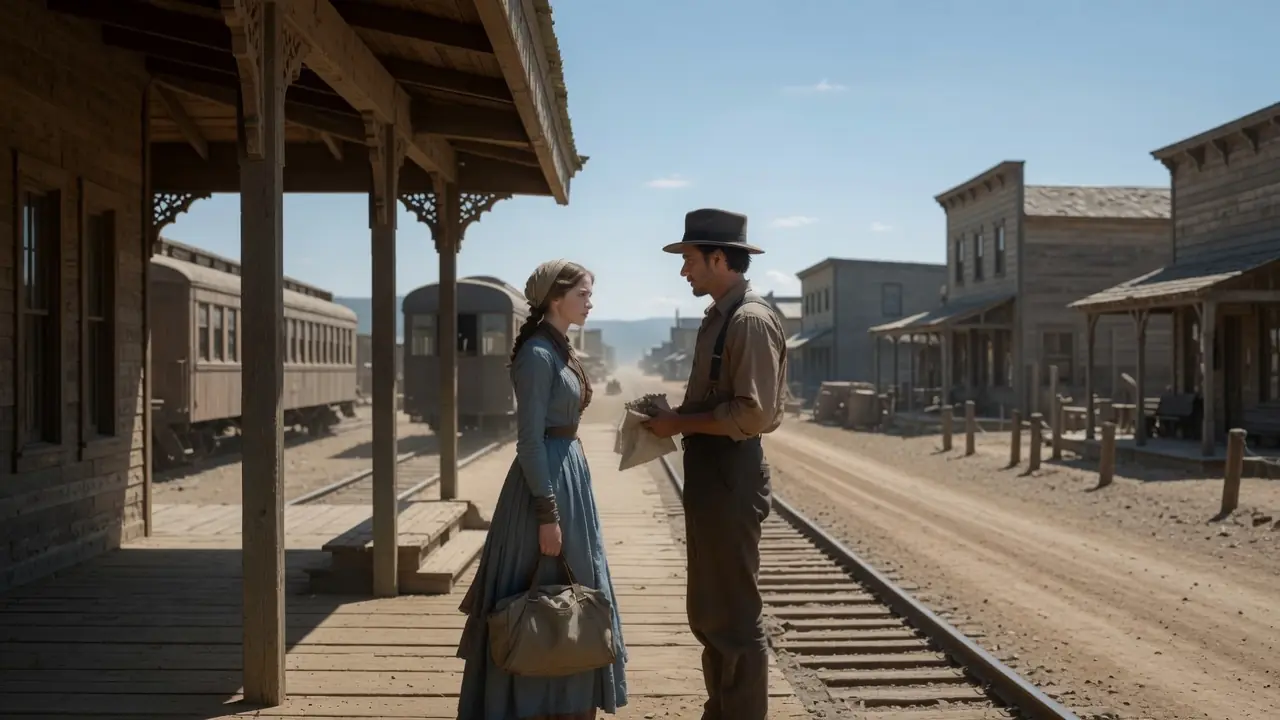
Clara stared at her for a long moment, then looked away. “She died coughing.” “I’m sorry.” “Pa doesn’t talk about her.” Willa rinsed a plate and placed it in the girl’s towel. “Some men build walls when they do not know how to carry sorrow.” Clara frowned at that, not fully understanding, but hearing enough to know it mattered. From the table, Seth looked toward the stove, his jaw tight.
The first week passed like a test neither Willa nor the household had agreed to take aloud. She rose before dawn, made breakfast, swept floors, washed clothes, mended socks, and learned where the cabin groaned in the wind. Clara challenged her at every turn, testing whether she would leave, snap, or try to become a mother too quickly. Thomas attached himself to her apron strings by the third day and asked questions without breathing between them. Seth kept distance, polite and grateful, but always guarded.
On the fourth morning, Albert Pugh came to the cabin. Willa saw him through the window and felt her hands still over the bread dough. He stood in the yard, hat in hand, looking less proud than he had at the station. Seth was at the workbench, planing a board. Clara and Thomas were inside, watching Willa’s face more than the window. Albert cleared his throat and called her name.
Willa wiped her hands and stepped onto the porch. She did not walk into the yard. “Mr. Pugh,” she said. Albert looked embarrassed, which was not the same as sorry. “I heard you were staying here,” he said. “The town has been talking.” “I imagine it has.” He shifted his weight. “I may have acted too quickly at the station.”
Seth set down the plane but did not move closer. Willa noticed and appreciated it. Albert continued, “A man gets surprised, and people look on, and pride can make him foolish.” “Pride did not sign the contract,” Willa said. “You did.” Albert’s mouth tightened. “I am offering to correct matters.”
The words hit her strangely. A week earlier, she might have felt relief. Now she felt only the cold memory of the platform, the returned contract, and the eyes of an entire town. “Correct matters,” she repeated. “You mean you have decided I am acceptable after all?” Albert flushed. “I mean I am willing to proceed.”
Willa looked back through the doorway. Clara stood stiff by the table, Thomas beside her, both silent. She looked at Seth, who did not speak for her. That mattered more than Albert would ever understand. She turned back to the man who had abandoned her in public and said, “I am not a parcel misplaced by the railway, Mr. Pugh. You cannot refuse delivery and then request it again when the town begins to laugh.”
Albert’s face hardened. “You think a carpenter’s charity is better?” “I think honest work is better than a coward’s bargain.” Albert took a step back as if struck. Seth’s mouth tightened, but he still said nothing. Willa folded her hands in front of her apron. “Good day, Mr. Pugh.”
After he left, the cabin remained silent for several seconds. Then Thomas whispered, “Does that mean you’re staying?” Clara elbowed him, but not hard. Willa turned back inside and returned to the dough. “It means the bread still needs kneading,” she said. Seth picked up his plane again, but his eyes stayed on her with something new in them. Not pity. Not gratitude alone. Respect.
By the end of the month, the cabin no longer felt like a place holding its breath. The curtains were washed. The table was cleared each evening. Clara’s dresses were mended, Thomas’s questions had become less frantic, and the dog had learned that bacon theft carried consequences. Seth repaired the leak over the washroom after Willa placed a pot under it and said she disliked being rained on indoors. She said it plainly, without complaint, and he fixed it before sunset. That became their language at first: work, need, repair.
The town still talked, but less loudly. People grew bored when scandal turned into routine. Willa went to the general store twice a week, paid with Seth’s account, and ignored every glance that lingered too long. Mrs. Elkins, the storekeeper’s wife, eventually said, “You have made yourself useful at Callan’s place.” Willa smiled politely. “I intend to be more than useful, ma’am.” Mrs. Elkins blinked, then laughed despite herself.
The first real thaw between Willa and Clara came on a rainy afternoon. Clara tore her mother’s old shawl while trying to pull it from a nail, then stood in the bedroom with her face white and furious. “I ruined it,” she said when Willa found her. Her small hands clutched the torn cloth as if it were a wounded bird. Willa sat beside her on the bed. “Then we mend it.”
“You can’t.” “I can try.” Clara’s eyes filled with tears she refused to let fall. “It still won’t be hers.” Willa took the shawl gently. “No. But it can still keep you warm.” That was the first time Clara cried in front of her, silently, angrily, with her face turned away. Willa stitched the tear that evening by lamplight, and Clara sat beside her until the last thread was knotted.
Spring came slowly, with mud first, then green. Seth built a small chicken coop behind the cabin because Willa said buying eggs from town was foolish when they had space. Thomas named every chicken, which made supper conversations morally complicated. Clara began helping Willa bake without pretending she already knew how. Seth laughed more often, not loudly, but enough that the house changed shape around the sound.
One evening, after the children slept, Willa sat on the porch steps mending one of Seth’s shirts. The air smelled of damp earth and cut wood. Seth came out with two tin cups of coffee and handed one to her. He sat on the far end of the steps, leaving respectable space between them. “Your month ended three weeks ago,” he said.
Willa kept her eyes on the needle. “I noticed.” “I have wages for you.” “You paid me last Saturday.” “Not enough.” “It was what we agreed.” He rubbed one hand over his jaw, clearly uncomfortable. “I agreed because I was desperate and you were stranded. That doesn’t make it fair.” She finally looked at him. “Fairness is rare enough that I do not complain when I get close to it.”
Seth studied her for a moment. “Albert came by my shop today.” Willa’s needle paused. “Did he?” “Said I had taken advantage of his intended bride.” “He gave up the right to that phrase.” “That is what I told him.” Willa looked at him sharply, and Seth’s eyes held a quiet fire she had not seen before.
“What else did he say?” “That no decent woman would live in a widower’s house without marriage.” Willa felt heat rise in her face, not shame this time, but anger. Seth looked away toward the dark yard. “I told him no decent man would abandon a woman at a station and then lecture others on decency.” Willa’s fingers tightened around the shirt. “Thank you.”
“I didn’t say it for thanks.” The porch fell quiet. Crickets had begun their evening song. Seth turned the tin cup between his hands. “If people keep talking, I can make arrangements for you to board with Mrs. Elkins. It might protect your name.” Willa looked out at the yard, at the chicken coop, at the shed, at the window where Clara’s repaired shawl hung over the chair.
“And who protects your children’s supper?” she asked. “We managed before.” “Barely.” He almost smiled. “True.” She set the mending in her lap. “I have lived my whole life being moved from place to place for the comfort of other people’s opinions. I do not wish to do it again.” Seth looked at her, and the silence between them changed.
Neither of them spoke of love. They were not foolish children. Love, if it existed, had entered through work first, through biscuits and repaired roofs, through grief named without demand, through children who stopped flinching at absence. But something had grown in that cabin, something stronger than rescue and quieter than romance. Willa felt it every time Seth saved her the last cup of coffee, every time Clara asked her to braid her hair, every time Thomas crawled into the kitchen half-awake and trusted she would be there.
Summer arrived hot and golden. Willa planted beans, taught Clara to roll dough thin, and made Thomas wash his hands before touching anything edible. Seth built a proper pantry because she said their supplies were scattered like drunk churchmen after a dance. He also built her a small sewing table near the east window, though he claimed it was because he was tired of seeing thread on the dining table. She ran her hand over the smooth wood and said nothing, because gratitude sometimes becomes too large for speech.
The proposal came in August, but not the way Willa might have imagined as a girl. There were no roses, no grand declaration, no kneeling in dust before a crowd. Seth found her in the kitchen after the children had gone to bed, holding his hat in both hands like a nervous boy. Willa was wiping flour from the counter. “You look as if the barn fell down,” she said.
“It didn’t.” “Then speak.” He drew a breath. “I know how you came here. I know what people said. I know you agreed to work, not to be trapped by gratitude.” She set the cloth down slowly. He continued, “So I am asking plain. Not because I need a cook. Not because the children need keeping. Because I want you here, Willa. As my wife, if you can bear the thought.”
Her throat tightened. For a moment, the train platform returned: the shame, the whispers, Albert’s cold assessment. Then it faded, replaced by Clara’s repaired shawl, Thomas’s biscuit-crumb grin, Seth’s steady hands, and the sewing table by the window. “Ask me properly,” she said softly. Seth blinked, then swallowed. “Willa Hart, will you marry me?” She smiled then, small and real. “Yes, Seth Callan. I will.”
They married two weeks later in the small white church with the door propped open against the heat. Clara stood beside Willa holding wildflowers, proud and tearful. Thomas declared loudly that now biscuits would be permanent, which made half the congregation laugh. Albert Pugh sat nowhere in the room, though Willa heard later that he had left town after losing money on a bad land deal. She felt no satisfaction at that news. Some people were not worth carrying, even in triumph.
Years later, people would tell the story differently. They would say Seth Callan saved the abandoned bride at the station, as if Willa had been only waiting to be rescued. She never corrected them unless they said it in front of her children. Then she would set down whatever she was holding and say, “No. He asked if I could cook. I decided whether he deserved an answer.” Seth would smile from across the room and never disagree.
Willa learned that a second chance does not always arrive dressed as a dream. Sometimes it looks like a dusty carpenter holding hardware fittings, asking a practical question on a public platform while everyone waits to see if you will break. Sometimes a new life begins not with being chosen, but with choosing what you will no longer accept. She had come west looking for a home and lost the one promised to her before she ever crossed its threshold. In losing it, she found a better one, built not on a contract, but on respect, work, patience, and a question simple enough to change everything.
The train that abandoned her became a memory. The platform became a story. The shame became something she could hold without bleeding. And in the cabin where grief had once sat at every chair, Willa Hart Callan built a life that smelled of bread, sawdust, rain, and children laughing after supper. She was not the bride Albert Pugh rejected anymore. She was the woman who had answered, “Better than I can beg,” and meant it.