The first motorcycle hit the puddle at almost fifty miles an hour.
Brown roadside water exploded into the air.
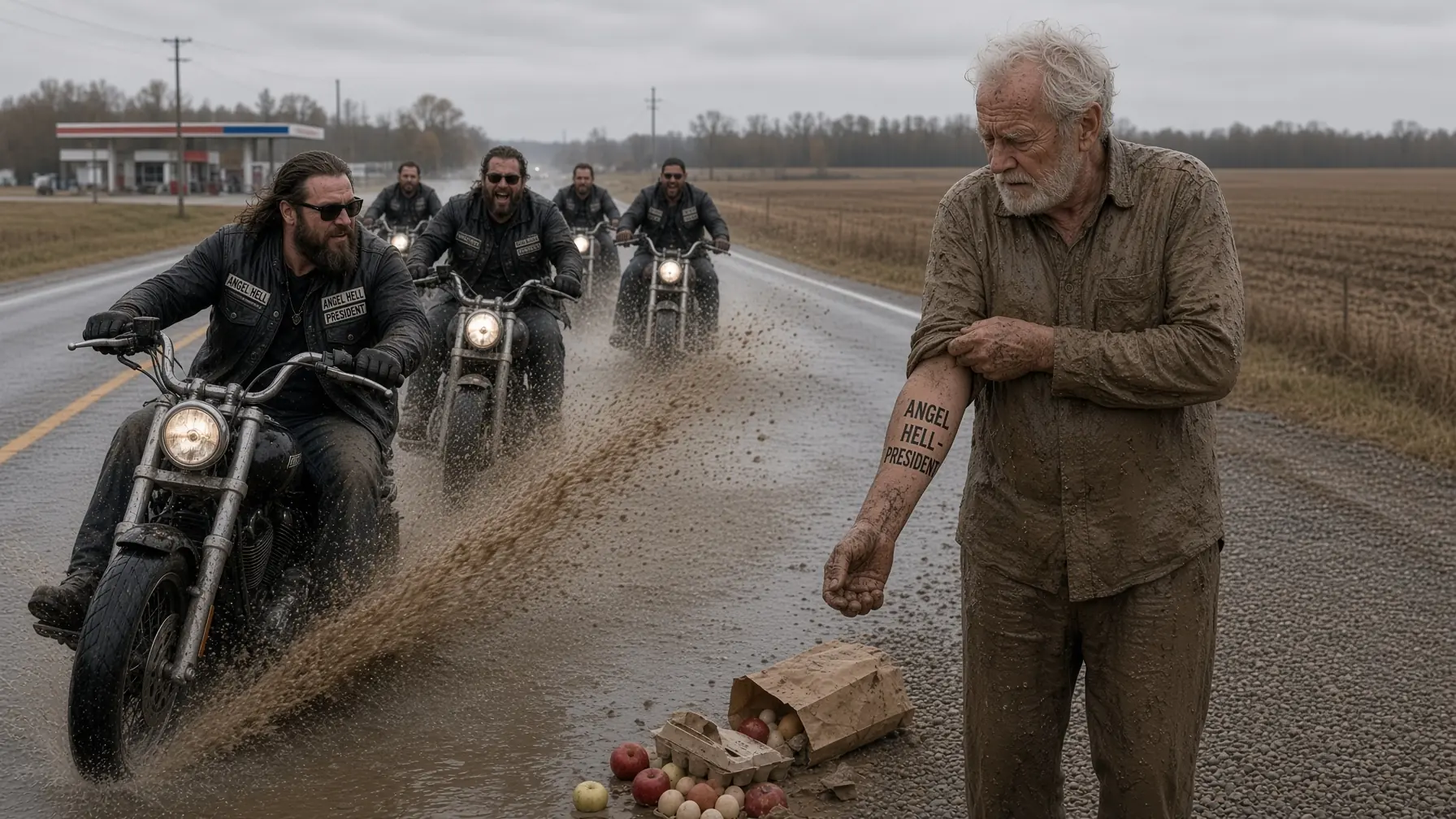
It struck the elderly man from shoulder to ankle.
His thin gray hair flattened against his forehead.
His glasses disappeared beneath muddy droplets.
The paper grocery bag in his arms collapsed almost instantly.
A carton of eggs fell through the bottom and shattered across the gravel shoulder.
Two apples rolled toward the highway.
A loaf of bread landed in the mud.
The old man stopped walking.
The motorcycle did not.
At the handlebars sat Wade Mercer, president of the local Black River Riders chapter.
He looked into his mirror.
Saw what he had done.
Then raised one hand in an exaggerated apology.
“Sorry, Grandpa!”
The riders behind him laughed.
Six more motorcycles entered the puddle.
They had room to avoid it.
They did not.
One after another, they sent dirty water across the shoulder until the old man disappeared behind spray.
By the time the last bike passed, his long brown coat was dripping.
One shoe stood in muddy gravel.
The other had sunk near the ditch.
The riders accelerated toward a gas station half a mile ahead.
Only one motorcycle slowed.
Eli Foster was twenty-two.
He had been riding with the Black River Riders for eleven months.
He was not a full member.
Not yet.
His leather vest had no complete club colors.
No bottom rocker.
No voting rights.
No authority.
He was what the club called a prospect.
Which meant he cleaned bathrooms after meetings.
Guarded motorcycles during overnight events.
Fetched beer.
Swept the shop.
Accepted insults without answering.
And spent almost a year proving he wanted to belong.
Wade had told him more than once:
“You want the patch, you learn not to embarrass the men wearing it.”
Eli had believed that.
Then he looked into his mirror.
The old man was trying to pick up an orange near the white line.
A delivery truck thundered past close enough to move his coat with its wake.
He stepped backward.
Nearly lost his balance.
Eli looked ahead.
Wade and the others were already turning into the gas station.
If Eli broke formation, they would notice.
If he helped the old man, Wade would call him soft.
Maybe worse.
His patch review was in two weeks.
Eleven months of work could disappear because of one decision.
The old man bent again.
His left hand shook badly.
One knee barely seemed to cooperate.
Eli cursed.
Then turned the motorcycle around.
The old man heard the engine returning and moved farther from the road.
Eli stopped twenty feet away.
Killed the motor.
Removed his helmet.
“I’m not going to hurt you, sir.”
The old man looked at him through muddy glasses.
“You already participated.”
The words were quiet.
That made them worse.
Eli looked down.
“Yes, sir.”
He retrieved the orange before another vehicle hit it.
Then an apple.
Canned soup.
A package of coffee.
The bread was ruined.
So were the eggs.
The paper bag had torn completely apart.
“I’m sorry.”
The old man removed his glasses and wiped them with a dry corner of his scarf.
“You weren’t leading.”
“No.”
“You slowed down.”
“Not enough.”
The old man studied him.
Eli had expected anger.
Maybe cursing.
Instead, the man looked at him as though deciding whether he was worth further conversation.
Then he said:
“Young men often think being less cruel than the man ahead of them makes them innocent.”
Eli had no answer.
Cold wind moved across the fields.
It was November in northern Arkansas.
Rain had stopped twenty minutes earlier, but the temperature was dropping quickly.
The man’s coat was soaked.
“Do you live close?”
“Two miles east.”
“I can take you.”
The old man looked toward the motorcycle.
“At my age, climbing onto the back of a stranger’s motorcycle sounds less like transportation and more like a hospital appointment.”
Despite everything, Eli almost smiled.
“I can call someone.”
“My phone is in what used to be the grocery bag.”
They found it beneath a crushed package of crackers.
The screen was cracked.
Water inside.
Dead.
“I’ll replace the groceries,” Eli said.
“You don’t have to.”
“Yes.”
He met the man’s eyes.
“I do.”
Eli gathered the salvageable items.
When he stood, the wind pulled the old man’s wet coat open.
Eli saw black leather beneath it.
At first he assumed it was an old motorcycle vest.
Then he saw the patch.
His hands stopped.
A black river.
Three silver lines.
A red-tailed hawk with its wings spread.
The bird faced left.
The current Black River Riders patch showed the hawk facing right.
Eli knew that because he had spent months staring at the colors he hoped to earn.
This design was different.
Older.
The stitching was faded.
The leather worn smooth around the shoulders.
Above the emblem:
BLACK RIVER RIDERS
Below it, a narrow rocker almost hidden by age.
Gold thread.
Two words still legible.
FOUNDING CHARTER
Then:
1968
Eli stared.
The old man pulled his coat closed.
“What?”
“Where did you get that vest?”
His face changed immediately.
Not frightened.
Alert.
“Why?”
“That’s Black River.”
“No.”
The man looked toward the gas station.
“Black River came from this.”
Eli’s mouth went dry.
There were stories about the original vest.
He had heard them late at night in the clubhouse when older members drank enough to remember history honestly.
Seven original patches.
Hand stitched.
Only one was believed to remain.
The founding vest.
Belonging to a rider called Hawk.
Samuel “Hawk” Hayes.
Some younger members said he had been little more than Walter Hayes’s quiet brother.
Others said that was the cleaned-up version later presidents preferred.
The old stories were different.
Samuel had been the mechanic who kept the first seven motorcycles running when nobody had money for replacement parts.
He had carried medical supplies on club rides because he had served as an Army medic.
He found jobs for veterans returning from Vietnam.
He repaired houses for injured members.
And when somebody got stranded fifty miles from nowhere, Hawk was usually the man who arrived first.
One old member once said:
“Walter gave Black River a voice.”
“Hawk gave it a spine.”
No one knew where Samuel went after Walter died.
Some said he was dead too.
Others believed he had walked away because he hated what the club had become.
Eli swallowed.
“What’s your name?”
The old man stared at him.
Then:
“Samuel Hayes.”
Eli almost dropped the groceries.
At the gas station, Wade noticed the missing motorcycle.
He was standing beside the pumps laughing with the others.
“Where’s the prospect?”
Someone pointed down the highway.
Eli was visible beside the old man.
Wade’s smile disappeared.
He climbed back onto his bike.
Five riders followed.
They returned fast.
Samuel did not move when the motorcycles surrounded him.
Wade removed his sunglasses.
“What are you doing, prospect?”
“Helping him.”
“I can see that.”
He looked at Samuel.
Then at the ruined groceries.
“Sorry about the bath, Grandpa.”
His mouth curved.
“Road gets messy.”
Samuel wiped mud from his cheek.
“Only when somebody doesn’t know how to control his motorcycle.”
Silence.
One rider looked away.
Wade stepped closer.
“You have something to say?”
“I already said it.”
“I’ve been riding forty years.”
Samuel looked toward his front tire.
“You entered the water with the wheel angled right because you were watching yourself in the mirror.”
Wade’s jaw tightened.
“Your left hand loosened when the front tire floated.”
“You corrected late.”
“The motorcycle saved you from your own vanity.”
One rider coughed to hide a laugh.
Wade turned.
Nobody met his eyes.
Then Eli said:
“Boss.”
Wade looked at him.
“You need to see his vest.”
Samuel’s coat shifted again.
The old emblem appeared.
Everything changed.
A rider named Owen Briggs climbed slowly off his motorcycle.
Everyone called him Bear.
Sixty-five.
White beard.
Scar along his jaw.
One leg dragged slightly after a crash twenty years earlier.
He walked toward Samuel.
Then stopped.
His face went pale.
“No.”
Samuel looked closely at him.
“You’re Daniel Briggs’s boy.”
Owen’s mouth opened.
“My father was Daniel.”
“You were nine when he brought you to the old clubhouse.”
Owen stared.
“You stole two root beers from the kitchen.”
His eyes widened.
“You hid behind the tool shed because you thought Daniel would whip you.”
Owen stopped breathing.
Samuel continued:
“I found you first.”
“I told him the bottles broke when I dropped a toolbox.”
Owen removed his sunglasses.
His eyes were wet.
“Uncle Hawk?”
Samuel nodded once.
“Hello, Owen.”
Wade looked between them.
“You know him?”
Owen turned slowly.
“He helped found this club.”
Wade laughed.
“This old man?”
Samuel looked at the president patch on his chest.
“That explains more than you realize.”
Wade folded his arms.
“The club was founded by Walter Hayes and six veterans.”
“Five veterans.”
Samuel answered immediately.
“One diesel mechanic who never served.”
“And me.”
He touched the old patch beneath his coat.
“I drew the original river.”
“Walter wanted an eagle.”
“I told him every club in America thought it needed an eagle.”
“So I drew a hawk.”
Samuel pointed toward the river.
“The black river represented the thing all of us had crossed before finding one another.”
Owen whispered:
“My father told me that.”
Samuel nodded.
“He was there.”
Wade still looked unconvinced.
“Anybody can memorize stories.”
Samuel studied him.
Then asked:
“You use Walter’s oak desk?”
Wade hesitated.
“In the office?”
“Yes.”
“Left drawer sticks when it rains?”
Nobody answered.
Samuel continued.
“Under that drawer is a string of numbers carved backward into the wood.”
“The numbers open a steel safe beneath the floor.”
Owen closed his eyes.
Wade stared.
“What safe?”
Samuel almost smiled.
“That question is going to become important.”
The Black River Riders had never been one giant national corporation controlled by one man.
That was mythology.
The organization had grown through loosely affiliated chapters.
Separate clubs.
Separate finances.
Separate properties.
Shared insignia.
Shared traditions.
And, in the case of the original Arkansas chapter, one unusual legal arrangement Walter and Samuel Hayes had created after a property dispute in the late 1970s.
The clubhouse land, original insignia rights, and certain charter assets were placed into the Hayes Brotherhood Trust.
Local riders could use them.
But they did not own them outright.
Samuel had been named one of the trustees.
Later, after Walter’s death and the deaths of the other original trustees, Samuel became the last surviving trustee.
For more than thirty years, he had done almost nothing with that authority.
He did not attend meetings.
Did not choose presidents.
Did not interfere with rides.
The trust did not make him king of Black River.
It did not allow him to command grown men simply because his vest was old.
But it meant something Wade Mercer had never bothered to understand.
The clubhouse did not belong to him.
Neither did the original Black River insignia.
The chapter had permission to use both.
And permission came with conditions.
Samuel held out one muddy hand.
“Owen.”
“Yes?”
“Phone.”
Owen gave it to him immediately.
Wade laughed.
“You’re serious?”
Samuel dialed from memory.
An older man answered.
“Thomas?”
Pause.
“It’s Hawk.”
Longer pause.
“Yes.”
“I’m alive.”
Owen looked away, smiling.
Samuel continued.
“I need you at the clubhouse.”
“Bring the trust binder.”
“The current license agreement.”
“The original charter too.”
Another pause.
“Yes.”
“Today.”
He ended the call.
Wade stepped closer.
“You’re not walking into my clubhouse and taking over.”
Samuel handed the phone back to Owen.
“I have no interest in taking over your club.”
“Good.”
“I’m interested in whether this chapter still has the right to use property belonging to the trust.”
Wade’s confidence flickered.
“This is ridiculous.”
Samuel looked at the ruined groceries near Eli’s boots.
“Maybe.”
“Let’s read the paperwork.”
Forty minutes later, Samuel entered the Black River clubhouse for the first time in more than three decades.
Thirty riders waited.
Some had heard the name.
Others only knew rumors.
Several older members recognized him before anyone spoke.
One removed his cap.
Another whispered:
“Hawk.”
Samuel walked past them.
His wet coat hung heavily from his shoulders.
His left knee bothered him on the uneven ground.
He accepted no help.
Inside, old photographs covered the walls.
Walter Hayes appeared everywhere.
Young.
Lean.
Smiling beside motorcycles.
Samuel found one photograph from 1972.
Walter stood beside him.
Except someone had cut Samuel’s half of the photograph away.
Only one shoulder remained.
Samuel stopped.
“Who did this?”
Nobody answered.
Wade entered behind him.
“I cleaned up the history wall.”
Samuel turned.
“You erased me.”
“You haven't been here in decades.”
“I wasn’t asking where I’ve been.”
Wade shrugged.
“You left.”
Samuel looked toward Walter’s photograph.
“I buried my brother.”
That quieted the room.
Walter Hayes died in 1989.
Not in a gang fight.
Not in some legendary highway battle.
A drunk driver struck him while he was helping a stranded family change a tire outside Little Rock.
He died before the ambulance arrived.
For twenty-one years before that, Walter and Samuel had built Black River around a simple idea.
Motorcycles made men mobile.
Mobility made them useful.
They carried food.
Medicine.
Tools.
They found work for veterans.
Repaired roofs for widows.
Helped injured riders make rent.
Escorted funerals.
Picked stranded motorists off lonely highways.
They were not saints.
They fought.
Drank.
Made stupid decisions.
Samuel never pretended otherwise.
But the patch was supposed to mean that if a man wore it, people in trouble had one more person willing to stop.
After Walter’s death, leadership changed.
Slowly.
Helping became less important than image.
Image became intimidation.
Some riders discovered fear was easier to create than respect.
Samuel fought against it.
Then a younger president told him:
“You and Walter had your time.”
“Let the new generation decide what Black River is.”
Samuel went home.
Placed the founding vest inside a cedar chest.
And stopped attending meetings.
He expected Black River either to remember itself or collapse.
Instead it survived.
Just not as something he recognized.
Owen and three riders moved Walter’s oak desk.
Beneath a loose floorboard sat a steel safe.
Wade stared.
“You knew that was there?”
Owen shook his head.
“No.”
Samuel entered the combination.
The lock released.
Inside were old property documents.
The original charter.
A rolled deed.
Trust papers.
Club minutes dating back to 1968.
Ten minutes later, a black sedan entered the yard.
Attorney Thomas Preston stepped out carrying a leather case.
Sixty-two.
Gray suit.
When he saw Samuel, he stopped.
Then smiled.
“My father told me you were too stubborn to die.”
Samuel shook his hand.
“Your father was irritating.”
“So I’ve heard.”
Thomas placed the documents on the main table.
“This is the current trust agreement.”
“Recorded deed.”
“Insignia license.”
“Local chapter charter.”
Wade remained standing.
“What exactly is he claiming?”
Thomas answered:
“Nothing today.”
“That’s not an answer.”
“It’s the responsible answer before reviewing the facts.”
He opened the documents.
“The trust owns the clubhouse property.”
“The chapter occupies it under license.”
“The trust also controls certain founding marks.”
“Samuel cannot interfere in ordinary chapter elections.”
“He cannot simply remove your presidency.”
“He cannot take motorcycles.”
“He cannot order your members around.”
Wade smiled.
Then Thomas continued.
“But both agreements contain termination provisions.”
The smile vanished.
“For what?”
“Fraud.”
“Intentional property damage.”
“Repeated criminal use of trust property.”
“And conduct materially inconsistent with the mutual-aid purposes written into the founding charter.”
Wade pointed toward Samuel.
“So because some water splashed on him, he gets the clubhouse?”
“No.”
Thomas shook his head.
“He doesn’t.”
Samuel looked at Wade.
“This was never about one puddle.”
Thomas opened another folder.
“Over the previous eighteen months, the trust administrator received complaints.”
Wade’s face changed.
“About what?”
“Unpaid restaurant bills.”
“Threats.”
“Vandalism.”
“Two alleged assaults involving chapter members.”
“Several reports of riders using club identification to intimidate businesses.”
“Alleged.”
“Yes.”
Thomas nodded.
“Which is why nobody is terminating anything today.”
That mattered.
Samuel did not want revenge.
He wanted the truth.
Samuel removed his wet coat.
The founding vest became fully visible.
Scratched leather.
Faded thread.
Old repairs.
Half a century of road wear.
Nobody spoke.
Samuel looked around.
“I don’t want your president patch.”
“I don’t want your votes.”
“And I certainly don’t want thirty grown men pretending an eighty-year-old mechanic is their commander.”
“What I want is one answer.”
He looked at each rider.
“Does Black River still mean anything?”
Wade folded his arms.
“We’re standing inside Black River.”
“I see a building.”
“I see motorcycles.”
“I see men wearing something Walter and I helped create.”
“That wasn’t the question.”
A younger rider near the wall asked:
“What did it mean before?”
Samuel looked toward the old photographs.
“It meant that if your motorcycle died at two in the morning, somebody came.”
“If your roof collapsed, somebody climbed it.”
“If you got hurt and couldn’t work, your children still ate.”
“If an old man stood beside the highway with ruined groceries, nobody laughed and kept riding.”
His eyes moved toward Wade.
“We did not measure strength by how frightened strangers became when we arrived.”
Wade scoffed.
“That was fifty years ago.”
Samuel looked at him.
“Decency didn’t expire.”
Eli still held the replacement groceries.
Wade noticed.
“You.”
Eli straightened.
“Put those down.”
“No.”
“You’re a prospect.”
“I know.”
“Then follow the president’s order.”
Eli looked around the room.
At the full patches.
At the history wall.
At Samuel’s old vest.
At the patch he had wanted for nearly a year.
“I’m delivering his groceries.”
Wade stared.
“You’re done.”
“You’ll never wear Black River.”
Samuel looked toward Eli.
Then Wade.
“That might be the first favor you’ve done him.”
Owen laughed once.
Wade spun toward him.
“You think this is funny?”
“No.”
Owen stood.
“I think the prospect turned around when none of us did.”
“I think that should embarrass every full patch in this room.”
The riders became silent.
Wade looked for support.
Nobody moved toward him.
For the first time since becoming president, Wade Mercer stood in a clubhouse full of men who were no longer willing to confuse his authority with the club itself.
The review lasted a year.
Not a day.
Not one dramatic meeting.
One year.
Financial records were examined.
Old debts were identified.
Complaints investigated.
Some turned out exaggerated.
Others did not.
Three members left immediately.
Two were suspended later.
One business owner refused an apology.
Samuel told the club to respect that.
“You don’t apologize to purchase forgiveness.”
“You apologize because you owe it.”
Owen became interim president until a formal election.
Eli remained a prospect.
He complained.
Samuel answered:
“You turned around once.”
“That’s a beginning.”
“You don’t earn a patch because you managed to behave like a decent human being one afternoon.”
Eli nodded.
Then looked toward Samuel’s garage.
“What’s under the tarp?”
Samuel stopped.
“Nothing you need.”
That guaranteed Eli would look.
Beneath the canvas stood a red 1962 Harley-Davidson Panhead.
Dust covered the tank.
Chrome had dulled.
Beside it sat an old sidecar.
Eli stared.
“Whose is that?”
“Mine.”
“When did it last run?”
“1991.”
Eli looked personally offended.
“You parked a Panhead for thirty-four years?”
“My brother died.”
“My priorities changed.”
Eli walked around it.
“We could restore it.”
Samuel raised one eyebrow.
“We?”
“The chapter.”
“I’m not giving you a motorcycle.”
“I didn’t ask you to.”
He smiled.
“Make it part of earning the patch.”
Samuel studied him.
Then pointed toward the engine.
“You touch anything before cleaning your hands, and I’ll remove you from the property myself.”
Eli grinned.
“So that’s a yes?”
“It’s a threat.”
Every Saturday, they worked.
Eli.
Owen.
Several other riders.
Samuel supervised.
The carburetor came apart.
Fuel system cleaned.
Wiring replaced.
Engine rebuilt carefully.
The sidecar restored.
Samuel rejected nearly every modern modification.
“LED lighting?”
“No.”
“Electronic display?”
“No.”
“Phone mount?”
Samuel looked disgusted.
“I crossed six states before your mother was born without a telephone telling me where to turn.”
“And how often did you get lost?”
“Frequently.”
“That proves my point.”
“It proves you lack adventure.”
They compromised on improved brakes.
Samuel called it cowardice.
Eli called it surviving long enough to argue again.
During the restoration, Eli found a folded page inside one saddlebag.
Walter’s handwriting.
Six rules.
BLACK RIVER
Never leave someone stranded.
Never let a family go hungry because one of us got hurt.
Pay what you owe.
Never wear the patch to win an argument you couldn’t win without it.
Help first.
Leave people less afraid than you found them.
Eli read the final line twice.
Samuel stood behind him.
“Walter wrote that after he started a bar fight.”
Eli turned.
“Seriously?”
“He was drunk.”
“You keep making the founders sound terrible.”
Samuel smiled.
“We were young men.”
“That’s what young men are for.”
“What changed?”
“We survived long enough to become embarrassed by ourselves.”
Eli laughed.
Samuel took the paper.
“The point of history isn’t pretending the old men were better.”
“It’s remembering what they learned too late so you might learn it earlier.”
By spring, the Panhead ran.
The first attempt failed.
Second coughed.
Third produced smoke.
Then the old engine caught.
The garage filled with that deep uneven rhythm Samuel had not heard in thirty-four years.
He stood completely still.
Put one hand on the gas tank.
For a moment, Eli saw the eighty-year-old man disappear.
There was only Hawk.
Young again.
His brother alive.
Arkansas roads open ahead of them.
Seven riders with more ambition than money.
Samuel closed his eyes.
“Hello, old girl.”
Eli looked away.
He did not mention the tears.
At the end of the one-year review, the chapter voted.
Nineteen members chose to reaffirm the original mutual-aid charter.
Two abstained.
None opposed.
The trust renewed the clubhouse license.
Owen was elected president.
Several disciplinary changes became permanent.
And finally, Eli stood in the clubhouse while his full patch was handed to him.
He looked toward Samuel.
“You going to tell me I don’t deserve it?”
Samuel shook his head.
“No.”
Eli smiled.
“You earned it.”
The smile widened.
Then Samuel continued:
“Now comes the difficult part.”
“What?”
“Deserving it tomorrow.”
Owen laughed.
“Welcome to Black River.”
On the anniversary of Walter Hayes’s death, the chapter held a charity ride benefiting families of highway workers injured on the job.
More than one hundred motorcycles gathered.
Samuel wore the founding vest.
The red Panhead stood at the front.
Eli brought him a helmet.
“You riding?”
Samuel stared.
“What did you think we rebuilt it for?”
“You’re eighty.”
“Your ability to count remains impressive.”
“Your knee barely works.”
“My hands do.”
“Sidecar?”
“No.”
“Samuel.”
“Eli.”
They compromised.
Samuel would ride at the front with Owen nearby.
No showing off.
No excessive speed.
No proving anything.
The convoy left.
Twenty miles later, they reached the same section of highway.
Overnight rain had created another puddle.
An elderly woman walked along the shoulder carrying groceries.
Samuel saw her.
Then Eli.
Then Owen.
Samuel slowed.
Owen slowed.
Eli slowed.
Behind them, more than one hundred motorcycles reduced speed in sequence.
Samuel guided the Panhead along the clean edge of the lane at almost walking pace.
Not one drop reached the woman.
She looked up.
Samuel lifted two fingers from the handlebars.
She waved back.
The riders continued.
No laughter.
No dramatic gesture.
Just motorcycles leaving someone exactly as they found her.
Dry.
Unafraid.
Respected.
Eli watched the founding patch moving ahead of him.
And finally understood what it meant.
The patch did not make them brothers.
The motorcycle did not make them strong.
Neither one could manufacture character.
Those things were symbols.
Their value came from what a man chose to do while wearing them.
Months earlier, seven motorcycles had entered a puddle.
Six men followed their president because following was easier than thinking.
One prospect turned around.
And one muddy old man standing beside ruined groceries forced an entire chapter to remember that there was a difference between being feared and being respected.
Fear disappeared when the motorcycles left.
Respect was what remained afterward.
Samuel Hayes never returned to become president.
He never wanted command.
He did something harder.
He made younger men decide what they wanted the words Black River Riders to mean when there was nobody around powerful enough to force them to behave decently.
Some chose differently and left.
That was fine.
A clubhouse could be inherited.
A patch could be stitched.
A charter could be preserved inside a steel safe beneath an old desk.
But character could not be transferred on paper.
It had to be demonstrated.
Again.
And again.
Especially when the easiest thing in the world was simply following the motorcycle in front of you.