By the time Cal “Ridge” Boone rolled his 1952 Panhead through the east gate of the Red Butte County Fairgrounds, the Wyoming morning had already turned the dirt parking lot into a pale brown haze. Horse trailers rattled over ruts, pickup trucks idled beside livestock pens, and the old wooden grandstand threw long slatted shadows across the rodeo arena. Somewhere behind the beer tent a band was tuning badly, and from the hill beyond the fairgrounds came the hard, irregular bark of motorcycles warming up for the afternoon exhibition.
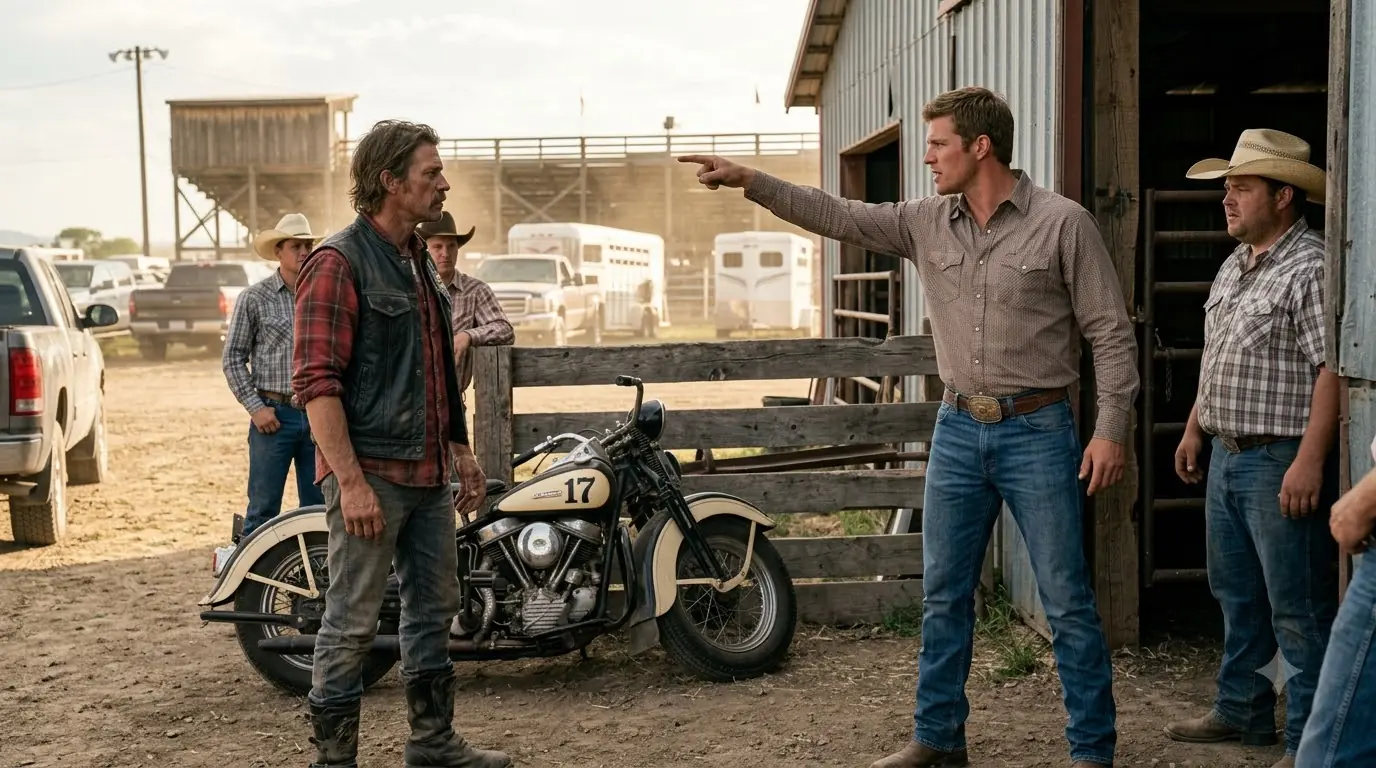
Cal fit the place better than most of the men who would later say he did not belong there. He was forty-three, five foot nine, lean from years of welding and ranch repair work, with a weathered face, brown hair brushing his collar, a heavy moustache, and a small scar tucked under his chin. A faded red flannel shirt showed beneath his black leather vest, and the horseshoe-and-piston tattoo on his forearm had softened into blue-gray ink from years of sun. He looked less like a showman than a man who knew how to keep a broken machine moving until morning.
The Panhead beneath him looked the same way. Its cream-and-black paint had lost its shine years ago, the tank wore scratches older than some of the riders in the parking lot, and the chrome had gone cloudy around the edges. The number 17 had been painted by hand on the tank, not with the perfect block lettering used on show bikes, but with the kind of brushstroke that carried a slight human tremor. Cal parked beside the livestock barn, shut down the engine, and rested one hand on the tank for half a second before swinging off.
“Did that thing come over on the Oregon Trail?” a voice asked.
Cal turned. Wes Dalton stood ten feet away with four rodeo hands behind him, all of them wearing boots that looked cleaner than the dirt around them. Wes was twenty-nine, tall and broad, the kind of man who had once been good enough at amateur rodeo to expect people to remember it. He had his father’s last name, his father’s fairground access, and none of his father’s patience.
“Almost,” Cal said.
A couple of ranchers nearby chuckled. Wes smiled, but only with his mouth. “Fairgrounds is for registered exhibitors.”
“I’m registered.”
“For what? Antique scrap?”
Cal pulled a folded card from his shirt pocket and held it up. “Old-timer hill climb. Exhibition class.”
Wes took the card, read it, then looked past Cal toward the hill. “That slot’s full.”
“It wasn’t yesterday.”
“It is now.”
Cal held out his hand until Wes gave the card back. “Then somebody forgot to tell registration.”
Wes’s jaw tightened. His friend Clay Ransom, a heavy-shouldered rodeo hand with a straw hat pushed back on his head, laughed and said, “Maybe they thought the machine would die before it got here.”
Cal glanced at the Panhead. “It made it farther than his last bull ride.”
That got a bigger laugh. Wes’s face changed.
The thing about county fairs was that everybody knew enough about everybody else to make a joke dangerous. Wes’s wreck in Casper the summer before had been talked about all winter, especially the part where the bull never actually touched him before he fell off. Cal had not meant much by the remark. That almost made it worse.
“You’re forty-three,” Wes said, stepping closer. “Riding a museum piece.”
Cal tucked the registration card back into his pocket. “You’re twenty-nine and still asking Daddy where to park.”
The laughter this time came from people Wes knew. Men near the livestock gate looked away when Wes glared at them, pretending to study a horse trailer latch.
Cal should have walked away then, and he knew it. He had not come to win anything. The old-timer hill climb offered no real money, only a ribbon, a photograph in the county paper, and the right to say you had made the run up the same slope riders had been climbing since the fifties. He had entered because the tradition mattered, not because a forty-three-year-old welder on an old Panhead needed to prove he could still twist a throttle.
But Wes did not let him walk.
Within twenty minutes, a fair mechanic named Lowell Pritchard was kneeling beside the Panhead with an inspection clipboard while Wes stood over him listing reasons the motorcycle should be disqualified. “Brake’s old. Frame’s modified. It leaks.”
“It sweats,” Cal said.
Wes looked at him. “What?”
“Old Harleys sweat oil. People leak.”
Lowell snorted and wiped the underside of the engine with a rag. “Not enough to fail. Brake’s legal. Frame’s straight. Tires pass.”
Wes pointed to the front drum. “Outdated.”
“So are horses,” Cal said. “Fair still lets those in.”
Lowell stood and handed the inspection card back. “Bike passed this morning. It passes now.”
Wes looked at the card, then at Lowell. “You sure?”
Lowell was in his fifties, soft-spoken and careful around people with influence. He hesitated just long enough for Cal to notice. “I’m sure.”