I need you to get out of that seat because men like you don't belong in seats like this. The slap came before Marcus Washington could respond. Open-palmed and deliberate. Diane Whitmore Ashford simply looked down at the man in seat 2A like she had simply corrected a disorder in the natural order of things. Marcus did not move nor reach for his face.
His hands rested flat on the legal files spread across his tray table. Four years of work. 17 veterans. The most important case of his career waiting 18 hours away in a Washington courtroom. What Diane Whitmore Ashford didn't know was that the man she had just struck was the only person on that plane whose silence was more dangerous than anything she could say.
The seat was perfect. Wide. Leather. Cool to the touch. Marcus Jerome Washington had earned it.
Not with old money or a family name but with 15 years of 60-hour weeks, cold coffee, and cases nobody else wanted to take. He settled into seat 2A, pressed his back against the cushion, and let out a slow, quiet breath. The boarding process was still underway. Around him, the first-class cabin hummed with the soft sounds of people finding their places. Overhead bins clicking shut.
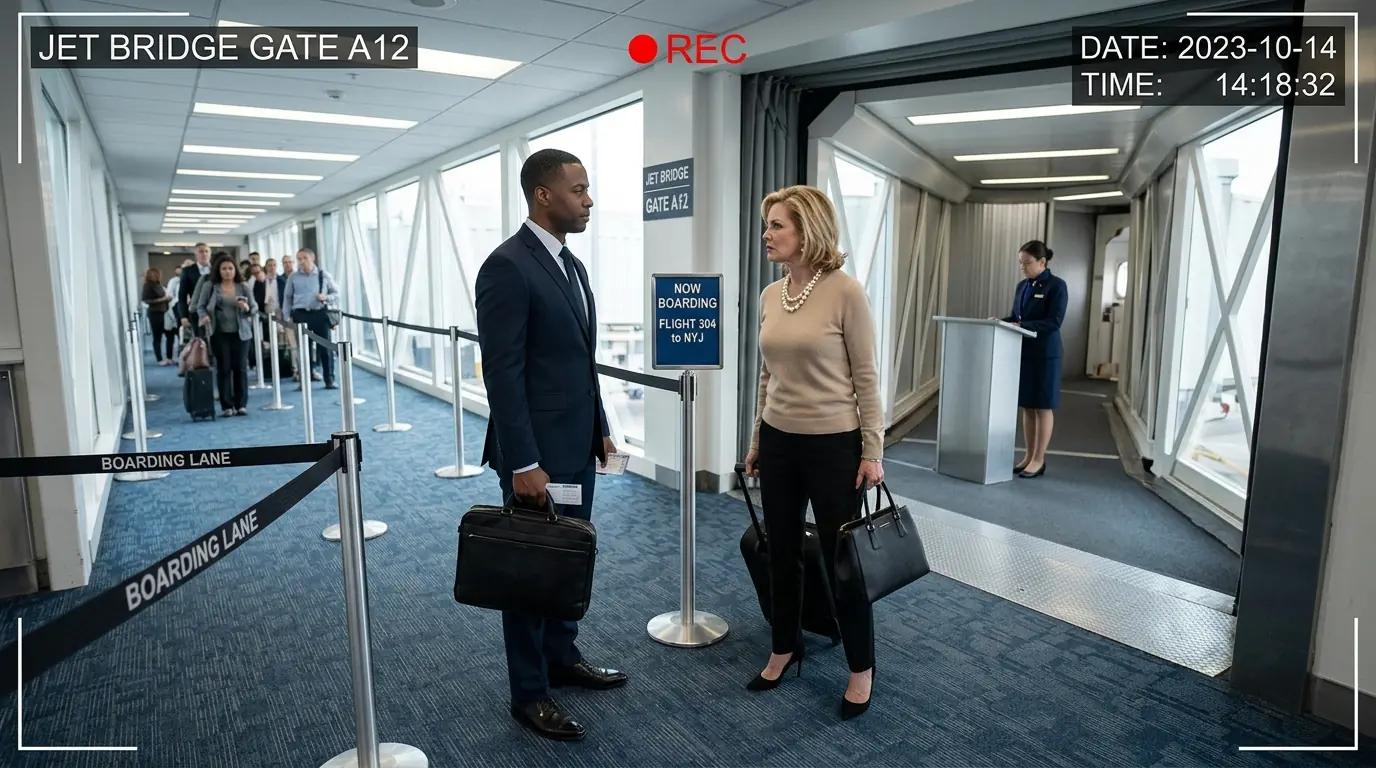
Flight attendants moving with practiced ease. The low murmur of conversation. Marcus paid none of it any attention. He had work to do. He laid his legal briefs across the tray table and put on his reading glasses.
The documents were dense. Hundreds of pages of VA records, denial letters, and government memos. Each page represented a man who had served this country and come home to find the country didn't much care. 17 veterans. 17 families.
17 stories of sacrifice that had been answered with bureaucratic silence and form letter rejections. Marcus had been carrying those stories for four years. Oral arguments were in 18 hours. He picked up his pen and underlined a key passage in the top brief. The government's argument rested on a narrow definition of systemic intent.
A legal phrase specifically designed, Marcus believed, to make discrimination impossible to prove. He had spent months building the counter-argument. Every document in this stack was a brick in that wall. His sparkling water sat untouched in its cup holder. He hadn't noticed the flight attendant place it there.
Come home with a win, Marcus Jerome. He heard Angela's voice as clearly as if she were sitting beside him. He saw her at the departure gate. Her warm brown eyes steady. Her hands straightening his jacket lapels even though they didn't need straightening.
She had kissed his cheek. A soft, quick press of her lips just below his cheekbone. Then she stepped back and looked at him the way she always did before the big ones. Like she already knew how it would end. Angela Washington had been a fourth-grade teacher for 12 years.
She was not a lawyer. Not a strategist. Not a person who knew the difference between a circuit court and an appeals panel. But she understood people in a way Marcus sometimes envied. She had read those denial letters alongside him at the kitchen table.
She had watched him pace the living room at 2:00 in the morning talking through arguments to nobody. And when he had moments of doubt, which he did, though he kept them private, her voice was always the one that cut through. "You don't get to give up on them," she had told him once. "They didn't give up on this country when this country gave them every reason to. " Marcus touched the cheek she had kissed. Then he looked back at his briefs.
The cabin continued filling around him. A businessman in a gray suit settled across the aisle. A couple in matching travel jackets took the seats behind. Nobody bothered Marcus. Nobody looked at him twice.
He was deep into the government's third counter-argument when he heard the sound of rolling luggage. Loud. Deliberate. The kind of luggage that announced itself. He didn't look up immediately.
People boarded with loud luggage all the time. He kept his eyes on the page, pen hovering, following a footnote about benefit eligibility thresholds. The rolling stopped. Very close. He became aware of a presence at the edge of his row.
Not moving. Not sitting. Just standing there. Waiting. He could smell expensive perfume.
Sharp and floral and a little too much of it. He still didn't look up. He heard a sharp exhale. The kind that wasn't accidental. The kind designed to be heard.
Then the voice came. Cool. Certain. Carrying the particular confidence of someone who had never once been told that they were wrong. "You're in my seat. " Marcus finished the sentence he was reading.
He set his pen down. He reached into his breast pocket and produced his boarding pass. Crisp. Unfolded. Printed that morning.
He held it up without looking at her. Seat 2A. His name. His ticket. He placed it on top of his briefs and picked up his pen again.
There was a pause. Brief and sharp. Like the moment before weather changes. He looked up. Diane Whitmore Ashford was staring down at him.
Diamonds at her throat. Sunglasses pushed up into perfectly styled hair. Her assistant stood two steps behind her. Eyes down. Boarding pass trembling slightly in her hands.
Diane wasn't looking at the boarding pass Marcus had just shown her. She was looking at him. And the expression on her face said everything she hadn't said yet. Diane didn't move. She stood over Marcus the way people stand over things they intend to claim.
Weight shifted forward. Chin lifted. One hand resting on the top of his seat like she was already measuring it for herself. Marcus held her gaze. Steady.
Unhurried. "Ma'am," he said, "I just showed you my boarding pass. " "I don't need to see your boarding pass. " Her voice was the kind of smooth that comes from a lifetime of being listened to. "I need you to get out of my seat. " Her assistant took a small step forward. Boarding pass extended like a peace offering. "Mrs.
Whitmore Ashford, if I could just your ticket actually shows "I didn't ask you. " Diane didn't even turn around. The assistant went quiet. Her hand dropped. Marcus did not raise his voice. He did not shift in his seat.
He folded his hands over his legal briefs and said simply, "This is seat 2A. My name is on the boarding pass I just showed you. I'd suggest you check your own ticket. " Something moved across Diane's face. Not embarrassment. Not confusion.
Something colder than both. She turned and snapped her fingers at the nearest flight attendant. A young man, no older than 30, who had been watching from the galley entrance with the careful expression of someone hoping not to get involved. He came forward anyway. That was his job.
"This man," Diane said, gesturing at Marcus without looking at him, "is clearly in the wrong seat. He obviously made a mistake. I need this handled. " The flight attendant glanced at Marcus, who held up his boarding pass without a word. The young man checked it carefully. Then he asked to see Diane's.
Her assistant produced it before Diane could object. The flight attendant looked at both. Once. Then again. His expression remained professional.
But something behind his eyes flickered. The recognition of exactly what kind of situation this was. "Ma'am," he said carefully, "this gentleman is correct. Seat 2A is his assigned seat. Your ticket shows seat 2C, which is just "I know where 2C is. " Her voice dropped to something sharper.
"That's not what I asked you. " "I understand, but do you know who I am? " She said it without raising her voice, which somehow made it worse. Like a door being locked rather than slammed. "My family has flown this airline exclusively for 22 years. 22 years. I want this handled appropriately or I will make one phone call that will make your supervisor's week very, very difficult. " The flight attendant stood his ground.
Barely. "Ma'am, I'm not able to reassign a confirmed seat without "Fine. " She cut him off like he hadn't spoken. "Fine. " She turned back to Marcus. He had not moved. Had not spoken.
Had not looked away from her. He simply sat in his seat. Hands folded. And waited. Diane leaned in close.
Not close enough for the whole cabin to hear. Just close enough for him. When she spoke, her voice was quiet, deliberate. Each word placed like something she'd thought before and had been waiting to say. "Men like you," she said, "don't belong in seats like this. " The words landed like a stone dropped into still water.
Marcus felt them move through him, down through his chest, and into something deep and old that he had spent his entire adult life refusing to let define him. He thought of Angela at the departure gate. He thought of 17 veterans and 4 years of work and 18 hours until the most important morning of his career. He closed his legal brief. He looked directly at Diane Whitmore Ashford.
"Ma'am," he said, his voice perfectly level, "I suggest you take your assigned seat. " It happened fast. Her hand came up and across, open-palmed, full force, no hesitation. The sound cracked through the first-class cabin like something breaking. Her rings caught the high point of his cheekbone. The sting was immediate and sharp.
Marcus did not flinch. He did not reach for his face. He did not stand up. He did not raise his voice. He turned back to face forward.
His jaw was set. His eyes were fixed on the middle distance. His hands rested flat on his closed brief, completely still. The only thing that moved was a single slow breath drawn in and released through his nose. The cabin had gone completely silent.
Not quiet. Silent. The kind that has weight. Nobody spoke. Nobody moved.
Even the flight attendant stood frozen in the aisle, one hand raised mid-gesture, mouth slightly open. Somewhere in the back of the cabin, a child asked its mother something in a whisper. Diane straightened up. Her chin was still lifted. Her expression had not changed, but her hand, the one that had struck him, dropped slowly to her side.
The silence lasted 3 seconds. Then Captain Eleanor Reyes walked in from the forward galley, and the temperature in the cabin changed. She was not a tall woman, but she moved like someone who had never once questioned whether a room belonged to her. 20 years of flying had given her a particular kind of authority, quiet, absolute, and completely impossible to argue with. Her four-stripe epaulets sat sharp on her shoulders.
Her dark eyes swept the cabin once and took in everything. The frozen flight attendant, the standing woman, the seated man with the red mark rising on his cheekbone. She had seen enough. "Ma'am. " Her voice was even, controlled. The voice of someone who did not need volume to command attention.
"I need you to step back from that seat. " Diane turned slowly, like the request was barely worth acknowledging. "And you are? " "I'm the captain of this aircraft. " She clasped her hands in front of her. "And I watched what just happened. " Something shifted behind Diane's eyes, quick, almost invisible. "I don't know what you think you saw. " "I know exactly what I saw. " Captain Reyes didn't raise her voice. She didn't need to.
"And so do the overhead cameras this airline installed in every first-class cabin 3 months ago, following a passenger assault lawsuit. They record continuously from the moment the boarding door opens. " She paused, letting that settle. "Every word, every action, everything. " The color in Diane's face shifted. Not quite pale, not quite red. Something caught between the two.
Captain Reyes turned to the flight attendant. "Please call the gate agent. Now. " The young man moved immediately, clearly relieved to have a direction. Diane's assistant took one quiet step backward. Diane herself did not move.
She pivoted back toward Captain Reyes with the full force of everything she had, her name, her money, her certainty that the world would rearrange itself if she pushed hard enough. "Do you have any idea? " she said, her voice climbing for the first time, "what my family's lawyers will do to this airline? I have been a platinum member for 22 years. I have a relationship with your executive team personally, personally, and I was provoked. I was provoked by this man. " She gestured at Marcus without looking at him, "who refuses to behave appropriately, and I want him removed, not me.
Him. " "Ma'am. " "Harold. " She turned sharply toward the seats across the aisle. "Harold, say something. " Senator Harold Bryce, silver-haired, patrician, completely still in his window seat, glanced up from his phone. His expression was careful, political. The expression of a man calculating distance. "Diane," he said, his voice low and measured, "I think you should listen to the captain. " Her lips parted.
Something that might have been betrayal crossed her face. Then she sealed it shut. Two airport security officers appeared in the boarding door. The gate agent stood behind them. Captain Reyes addressed Diane with complete calm.