"Get away from me before I show this whole street exactly what kind of animal you are. " Vivian Ashby's voice tore across the quiet cul-de-sac like a fire alarm going off in a library, and she staggered backward off her own front step with one manicured hand pressed flat against her cheek. Her platinum hair catching the afternoon light as she turned in a slow, deliberate circle so that every neighbor watering a lawn or checking a mailbox could see the wounded look on her face. She pointed one trembling finger straight at the man standing motionless in the middle of the road. He hit me. You all saw it.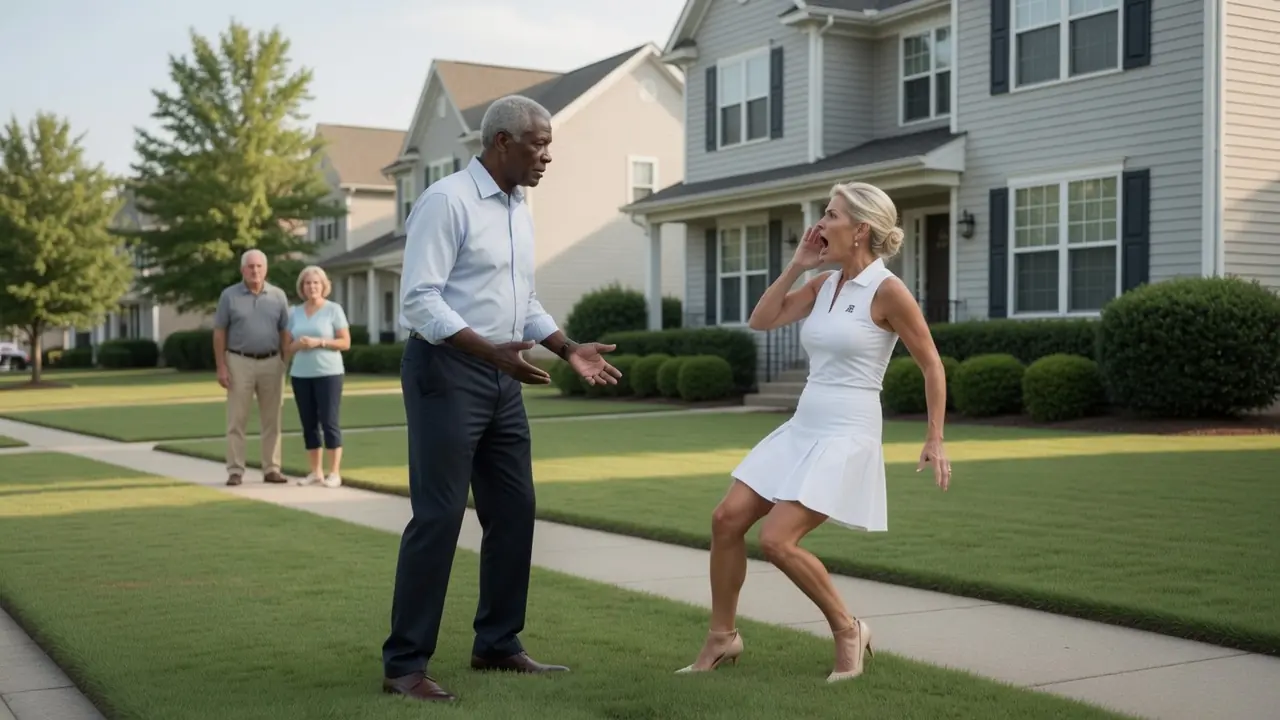
He put his hand right across my face because I asked him to stay off my property and now he's just standing there like he did nothing wrong. Solomon Reeves did not move. He stood in the center of Bell Haven Court, with his shirt sleeves still rolled up past his elbows, and both hands open at his sides, palms turned outward where anyone could see them. And he let the silence stretch, because 30 years on the bench had taught him one thing better than any other, which was that the moment you start explaining yourself to a person who has already decided the story, you have handed them the pen. His breathing stayed slow.
His eyes stayed on hers. And though every muscle in his body wanted to step toward her and ask what in God's name she thought she was doing, he understood with total clarity that a single step forward, a single raised hand, a single loud word would be all the proof this woman needed. ""Call whoever you want, " he said. And his voice came out level and quiet, so quiet that the neighbors leaned in to catch it. "But tell them the truth. " Vivian was already pressing her phone to her ear, and she folded herself down toward the pavement as she did it. Her shoulders shaking, her sobs pitched high and loud enough to carry to the houses at the far end of the street. ""Yes, I need police.
Please hurry. My neighbor just attacked me. He hit me in the face. I'm terrified he's going to do it again. "" She glanced up between words and for half a second before the tears came back. Her eyes were dry and sharp and calculating, measuring the crowd the way a stage actor measures a house from behind the curtain.
Solomon saw that look. He had seen it a hundred times before worn by defendants who knew the evidence was against them and had decided to gamble everything on performance instead. He had learned to wait for people like that to keep talking because they always did and they always said too much. Across the street, a teenage boy stood frozen beside a lawn mower with his phone held up in both hands. And two houses down, an elderly woman in a gardening apron had come to the edge of her yard with her mouth open.
And somewhere behind the perfect hedges, a screen door banged as another neighbor came out to watch. The afternoon had turned into theater, and Vivian Ashby was giving the performance of her life. What she did not know, what none of them standing on that pristine street knew, as the first far-off wail of a siren began to climb toward them, was that the quiet man she had just accused of assault in front of 40 witnesses, had spent three decades of his life deciding exactly this kind of question, weighing exactly this kind of lie in a federal courtroom 200 m away. She did not know his name meant something. She was about to find out that some people spend years pretending to be powerful, and a few of very few spend their whole lives being quiet about it.
The siren grew louder. Solomon lowered his eyes just for a moment and let out a long, slow breath. Bell Haven Estates had been built to look like the answer to every question a certain kind of person had ever asked about the good life, and on an ordinary afternoon it delivered on that promise without a single crack showing. The lawns ran flat and green from one property line to the next, trimmed so evenly they might have been measured with a ruler. And the flower beds along the driveways were planted with imported blooms that cost more than some people's monthly rent, and the houses themselves sat back from the road behind low decorative fences and tasteful stone.
Each one a little larger than it needed to be. Each one saying the same quiet thing about the people who lived inside. 412 homes, all of them expensive. All of them convinced that the walls and the fees and the neighborhood association had bought them something more than shelter. They had bought the right to feel safe from the world, and safety in a place like Bell Haven meant sameness.
Solomon Reeves had moved into number nine Bell Haven Court 8 months earlier in the long gray weeks after his wife Eleanor had died because the house was small enough to keep and quiet enough to think in. And because Nell had circled it in a real estate magazine 2 years before, back when they still talked about slowing down. He had not slowed down so much as stopped, and the house had become less a home than a place to stand still. On this particular afternoon, he was not standing still at all. He was crossing back from Ines Salazar's driveway with his forearms aching and a fine sheen of sweat across his forehead because the ceramic planter Inz had wanted moved off her walkway weighed a good 60 lb.
And at 68 she was far too proud to ask for help and far too smart to hurt herself trying to do it alone. You didn't have to carry the whole thing yourself, Ines had said, hovering beside him with her hands twisting in her apron. He had only smiled and set it down where she pointed and wiped his forehead with the back of his wrist and said nothing much at all because that was his way. He was a big man who had learned young to take up less space than his size suggested to keep his voice low and his movement slow, and the habit had followed him from the neighborhood he grew up in all the way to the federal bench, and it had never once let him down. In 30 years, he had faced hardened men who wanted him dead and slick men who wanted him bought.
Pointed straight out at the road. "Vivian hated that thing. Said it made the street look like a prison. " She shook her head slowly. Funny the things people decide to hate. Solomon had followed her gaze to the dark porch, and the little weathered lens still bolted above the door.
And then the moment passed, and he had thanked her and turned for home, thinking about supper, and the stack of case summaries a former clerk kept mailing him because retirement had not entirely taken. He was halfway across the quiet street, sleeves rolled, sweat cooling on his neck. An ordinary man in an ordinary hour when a voice cut through the warm afternoon like a blade drawn across silk and the perfect street stopped being perfect. Excuse me, you. I saw exactly what you did.
Solomon turned toward the sound and found Vivian Ashby marching down her flawless driveway with her chin lifted and her heels striking the pavement in hard, even beats her white tennis outfit. Fresh, as if she had stepped out of a catalog, her face already flushed a deep, satisfied red. He had seen that particular color before on people who had come looking for a fight, and were delighted to have found one, and he kept his voice easy when he answered, because easy was the only thing that ever helped in a moment like this. Ma'am, I'm not sure what you mean. Don't ma'am me.
She stopped a few feet from him and jabbed a finger toward her flower beds. My roses. Those bushes cost $450 a piece imported, and you trampled all through them like you owned the place. " Solomon glanced at the roses, which sat behind a low ornamental fence, a good 4 ft back from the sidewalk, close enough to admire, and far too far to touch. And he understood at once that the roses were not, the point had never been. The point where only the excuse a person reaches for when the real complaint is something they can't say out loud in polite company.
I was helping Mrs. Salazar move a planter, he said. I never left the public walkway. I never touched your yard. Liar. Her voice climbed.
And this was the thing he noticed. The thing that made the back of his neck go cold. Because as she said it, she took a step backward rather than forward, and then another, angling herself toward her own front door toward the small glass eye of the doorbell camera mounted beside the frame. And with every accusation, she retreated another half step and forced him to follow her into the frame if he wanted to be heard at all. She was not backing away in fear.
She was blocking a scene. I watched you from my kitchen window. I watched you the whole time, and you people always think you can do whatever you want in a neighborhood like this, and nobody will say a word. The words landed exactly where she meant them to, and Solomon felt his jaw tighten, but he did not give her the reaction she was fishing for. Down the street, the teenage boy who cut half the lawns in Bell Haven had stopped his mower and gone still, and old Mr. DeLuca had come out onto his porch, and phones were appearing one by one along the block, like little glass flowers turning toward the sun.
Ines came hurrying back across her lawn with worry all over her face, calling Vivian's name, asking what on earth was happening, and Vivian rounded on her long enough to tell her to stay out of it unless she wanted to explain why she was helping a criminal. And then she turned back to Solomon and kept coming. Ma'am, I need you to lower your voice and step back, Solomon said, and he raised one hand, palm out, not reaching for her, not anywhere near her. Only the flat universal gesture that means stop. That was the moment Vivian Ashby had been building toward.
Her own right hand came up fast, faster than the eye wanted to follow, and she struck her own left cheek with a crack that echoed off the houses hard enough to bloom a red mark across her skin. And then she flung herself backward with her arms flailing as if a great invisible force had shoved her, and she screamed the words to the whole street. He hit me. He hit me right in front of my own house. Ines Salazar's voice cut through the gasps like a school teacher sharp and certain.
That is a lie. I saw you. You struck yourself. You hit your own face, Vivian. I watched you do it with my own two eyes.
But the sirens were already coming, and Vivian was already sobbing into her phone again, and the crowd had already begun quietly to arrange itself into an audience that had come too late to see the whole play, and would therefore believe the ending it was given. The two patrol cars came around the corner fast and pulled up nose-to-tail at the curb. And the first officer out was a broad, heavy-shouldered man whose name tag read Bruner. And he took one look at Vivian's reddened cheek and one look at the tall man standing calm in the middle of the road. And Solomon could see the whole thing decided behind his eyes before a single question had been asked.
The second officer, younger and thinner with Nash, stamped on his tag, hung back half a step with a look on his face like a man who had walked into the middle of a conversation he didn't understand. ""Sir, turn around and put your hands behind your back, " Bruner said, and his hand was already drifting toward the cuffs on his belt. Solomon did not move. "Am I under arrest? " "You're about to be if you don't cooperate. Turn around. " Ines was calling out from the edge of her lawn that she had seen everything that the woman had hit herself, and Bruner ignored her the way a man ignores a radio in another room, his whole attention fixed on Solomon, and Vivian stood behind him now, with her arms folded, and the faint beginning of a smile pulling at the corner of her mouth, because the scene was going exactly the way she had written it, and the man in the road would be in handcuffs on her perfect street within the end of it. And that was all she had ever wanted.
Bruner stepped in and closed one thick hand around Solomon's wrist. "Officer, " Solomon said, and his voice was so quiet and so steady that the younger cop's head came up. "Before you put those on, run my name. " Bruner's grip loosened by a fraction. Something in the calm of it reached him where the shouting never would have. What's your name?
Solomon Reeves. He said nothing else. He did not reach for a wallet, did not announce a title, did not so much as lift his chin. He simply said his name, two words, flat as a stone, dropped into still water, and then he waited the way he had waited on a hundred witnesses who thought their silence was a shield, and never understood that his was a weapon. Nash had already lifted his shoulder radio and was reading the name into it low, and the answer came back through his earpiece in a burst of clipped static, and the young officer's face changed all at once, drained pale, and he took a full step backward away from Solomon, as though he had just realized he was standing beside a live wire.
For one second, the whole street held its breath. The neighbors felt it before they understood it. The way a room feels. A change in pressure before the storm. Vivian's practiced expression froze half-formed the smile she had been building suddenly stranded on her face with nowhere to go.
And for that single suspended heartbeat, she was not the wounded victim or the offended queen of Bell Haven, but simply a woman who did not yet know why the air had gone wrong. Nash crossed to his partner and put his mouth close to Bruner's ear and whispered a handful of words. And whatever those words were, they moved through Bruner's face like ice water, the color going first white and then a mottled, furious red as the meaning arrived. Solomon watched them both and said nothing. He had lived this exact moment more times than he could count.
The moment when people discovered that the man they had been ready to throw away was someone who could end careers with a single phone call, and he had learned long ago that it was not a moment to enjoy. It was only a door opening onto a longer fight. Vivian recovered first. She always did. The tears came back in the trembling, and she pushed past the shock and planted herself beside the officers.
Don't let him intimidate you with some fancy title. Rich men always claim to be somebody the second they get caught. Look at my face. Look what he did to me. Bruner straightened his shoulders and tried to gather the authority that had fallen out of him.
All right. So, you're some kind of judge. That doesn't give you the right to put your hands on a woman. But his voice had lost its edge, and everyone on the street could hear it. And Solomon simply looked at him and answered quiet as ever.
Take statements from every witness before you write your report. The patrol cars had not yet pulled away from the curb when Solomon's phone buzzed against his chest, and he drew it out expecting a message from Ruth, or one of the old clerks, and instead found himself staring at a notification stamped with the crest of the Bell Haven Estates Homeowners Association marked urgent marked immediate action required. And when he opened it, he understood that Vivian Ashby had not been idle during the few minutes it took the police to arrive. The email had already gone out to all 412 homes in the community. Dear residents, it began due to a serious incident of violent conduct involving resident Solomon Reeves of number nine Bell Haven Court.
The standards committee is calling an emergency meeting for tomorrow evening and effective immediately pending review. Mr. Reeves's access to all community amenities is suspended because the safety of our families must come first. It was signed. Vivian Ashby chair standards committee. Solomon read it twice.
Standing there in the road with the smell of cut grass in the air and his heart beating slow and hard. And the thing that struck him, the thing that told him exactly what kind of fight he was in was not the cruelty of it, but the speed. She had drafted and sent a community-wide condemnation of him while the officers were still writing down her lie before a single charge had been filed before anyone had asked him a single question. And every neighbor who had watched from a window would now open their inbox and see him named as a danger to their children. The lie was already moving through Bell Haven faster than any truth could ever hope to catch it.
Because a lie needs only to be shouted while the truth has to be proven, and proving things takes time that people like Vivian never intend to give you. " He turned his phone face down against his palm, and stood for a moment, looking at the dark, empty house across the street where the Brimleys used to live, and he was aware of a cold thing building somewhere under his ribs. But he did not let it reach his face or his hands, because he had spent 30 years learning that anger is a fire you keep in a stove, not a house you burn down to stay warm. He straightened the phone in his hand, squared it against the edge of nothing, and slid it back into his shirt pocket. Nash lingered by his cruiser, unwilling somehow to simply drive off, and he glanced at the phone, and then at Solomon's still face. Everything all right?
The association has already sent a notice about this to the entire neighborhood, Solomon said. Before you've written your report, before anyone's been charged, before you've even left. He let that sit. Across the driveway, Vivian stood on her front porch with her arms crossed, watching him the way a person watches a fire they are sure will burn out on its own. No longer bothering to hide her satisfaction.
And he met her eyes across the quiet street and understood that this had never been about a rose bush or a footstep on a lawn. This was about making a man's life in this neighborhood so heavy, so exhausting, so publicly shameful that he would eventually pick up and leave on his own and thank her for the chance to go. A silver sedan came around the corner 20 minutes later and stopped hard behind the last patrol car, and Solomon's sister climbed out of it like weather rolling in off the coast, 62 years old, and moving with the unstoppable stride of a woman who had spent 40 years running emergency rooms, and had long ago decided that fear was a luxury for other people. Ruth Reeves Danner had her gray hair pulled back tight and her reading glasses pushed up on her head and her eyes already blazing, and she came straight across the lawn calling her brother's name, not sparing so much as a glance for Vivian Ashby up on her porch. "Solomon, what is happening here?
Why are there two police cars in your driveway? " "There's nothing happening now, " he said. "Come inside. " But she planted herself in front of him with her hands on her hips and looked from the retreating officers to the woman on the porch to the crowd that hadn't quite finished dispersing. And she read the whole scene in about 4 seconds the way she'd once read a trauma bay. And what she read made her voice drop into something low and dangerous. That woman did something to you.
Did you touch her? No. Then why does she look like she just won the lottery? He put a hand on her arm gently and steered her toward the front door because the last thing this street needed was a second Reeves standing in the road giving the neighbors a show and because he knew his sister and he knew that her love came out sideways as fury and always had ever since they were children and she'd fought every fight. He was too careful to fight for himself.
Inside at the kitchen table over the kettle, she filled without being asked because that was what their mother had always done when a hard conversation was coming. He told her everything plain and in order, the way he'd give a summary from the bench. Ruth wanted to burn it all down. She wanted a lawyer on the phone that night in a press conference by morning. And Vivian Ashby's name in every paper in the state, and Solomon let her say all of it, let her get it out of her system.
And then he shook his head slowly and told her the one thing he had learned that she never quite believed. Anger makes headlines. Ruth, it doesn't win. If I go out there tonight and shout, they'll have exactly the story they want. The angry man they can be afraid of.
If I leave this neighborhood, it looks like guilt. So, we don't shout and we don't leave. We gather proof quietly and we wait for her to keep talking. People like this always keep talking. Ruth sat with that, her jaw working her tea going cold in front of her.
So, we just take it. No, he said, we do everything. We just do it right. He looked across the street through the kitchen window at the lit windows of the Ashby house, where a slim figure moved from room to room with a phone pressed to her ear, working, always working. This was never about a rose, he said quietly.
She wants me gone. The change in Bell Haven had happened overnight, and Solomon felt the whole shape of it the moment he stepped out his front door the next morning into air that smelled of cut grass and blooming honeysuckle, because everything looked exactly as perfect as it always had, and nothing was the same underneath. Mrs. Patterson, three doors down, had been watering her window boxes, and the day before she would have waved and asked after Ruth's visit, and this morning she saw him coming down his own walk and gathered up her watering can, and hurried inside without a word, pulling her door shut a little too hard, and the sound of that latch carried down the quiet street, and told Solomon everything he needed to know about how the story had spread. He kept his pace steady on the way to the mailbox, the same slow, deliberate walk he had used his whole life, because a man in his position learned early that any change in his stride could be read as a change in his heart, and he would not give them that. An older couple came along the sidewalk with their small grandson, a boy, who on any other day stopped to pet the neighbor's golden retriever, and to say good morning to the tall, friendly man from number nine.
And this morning the grandmother took the child's hand and pulled him firmly across to the far side of the walk, whispering something urgent into his ear, and the boy went confused, looking back once over his shoulder at the nice man who had somehow become a person to avoid between one sunset and the next. Solomon nodded at them anyway, polite as ever, and felt the cold thing turn over again beneath his ribs, and let his face show nothing at all. Wedged against his front door when he came back was a folded square of paper with no name and no signature. And when he opened it, the handwriting was careful and cowardly at once. "Maybe it's time you found a neighborhood where you'd be more comfortable, " it read.
"Some places just aren't meant for certain people. " He read it, standing on his own step, and then he closed his hand around it slowly and crushed it into a tight ball. And he thought that in his long life he had been called far worse things by far better men. But there was something uniquely poisonous about cruelty that hid behind an unsigned note. Cruelty that wanted the wound without the risk of being known. Inside on the neighborhood form on his phone, Vivian had posted a long tearful message thanking everyone for their support after the frightening incident mourning that speaking up about property damage had led to physical intimidation, and the comments had already begun to pile up beneath it.
Some rushing to her side, a few asking careful questions, one saying flatly that the wrong kind of residence always brought the wrong kind of problems. And near noon, a text arrived from Devon Prior, the boy who cut the lawns four words that made Solomon set the phone down and stand very still at his own window. Mr. Ashby drove past my house real slow twice. My mom's scared. The intimidation had started, and it had started with the youngest and the most vulnerable person who had seen the truth.
And Solomon understood that Grant Ashby was doing his part. Now making certain that every witness knew exactly what it would cost to open their mouth. The Bell Haven Clubhouse looked entirely different under the flat white fluorescent lights of an evening meeting than it did during the daytime socials when the same room glowed golden and gracious for wine tastings and holiday parties. And now the folding chairs stood in crooked rows, and the residents filed in with the careful lowered faces of people arriving at something closer to a public execution than a neighborhood dispute. Solomon came in with Ruth at his side, and she wore her good dress, and the same iron expression she had once reserved for hospital administrators who tried to bully her nurses.
And he had chosen a plain navy suit because he would not perform humility for these people, but he would not hand them the arrogance they were hoping to find either. Vivian arrived 10 minutes late, moving slowly and carefully like a woman still in pain, and she had darkened the makeup along her left cheek, so that under the harsh lights it read as a lingering bruise, and she wore a soft cream blouse with the collar left open to suggest fragility, and her husband Grant walked half a step behind her, with his hand hovering near her elbow, as though she might collapse at any moment. Roland Tate, the association president and insurance man, whose every sentence was built to shed liability, called the meeting to order from behind a folding table set up like a bench. And Solomon watched all of it with the flat patient attention he had spent a lifetime perfecting, and he thought that he had presided over more honest trials run by more honest people in far worse rooms than this. We're here to address a serious matter of resident conduct and neighborhood safety.
Tate announced, and then he gave the floor to Vivian, who rose and dabbed at dry eyes with a folded tissue, and told the room in a voice that trembled at all the right moments that she had never dreamed she would have to stand in front of her own neighbors, and explain why she no longer felt safe in her own driveway, that she had approached the judge calmly, respectfully, only to be struck across the face in broad daylight. Grant connected a tablet to the wall-mounted screen, and the doorbell footage played the carefully chosen angle that showed Solomon's arm rising toward her face and then cut off clean an instant before the moment she had struck herself, and the clip ended on her scream. The room went silent and an elderly man in the front row shook his head in disgust and Solomon felt the temperature of the whole community turn against him in the space of 30 seconds of edited video. When Tate invited him to respond, Solomon stood and he did not raise his voice and he did not point or plead. That footage is incomplete, he said.
Other people were there. Another camera saw it from a different angle. Review everything before you decide anything. That was all. Ruth beside him could not hold it, and she came halfway out of her chair with fire in her throat, calling the meeting a shameful thing, a mockery.
And Solomon reached over and touched her wrist once, and she understood the trap even through her fury. Understood that they were waiting for exactly this for the angry woman and her angry brother. And she lowered herself back into the seat with her hands shaking. The board voted to issue temporary fines and to open a formal resident review, and as the room broke into whispering clusters, and people gathered their jackets, Vivian drifted close to Solomon on her way to the door, and paused just long enough to speak in a voice pitched only for him. "You may know courtrooms, Judge, " she murmured, smiling.
"But I own this room. " The morning after the clubhouse meeting, Solomon spread a legal pad across his kitchen table and set three mugs of coffee steaming beside it, and Ruth sat across from him with her reading glasses down on her nose. And Ines Salazar took the chair between them with her weathered hands wrapped around a cup for the warmth, and Solomon looked at the two women who had refused to leave his side, and said the thing he had decided in the dark hours of the night. We stopped defending. Last night proved they'll twist anything I say into a weapon. So, we go the other way.
We find the pattern because a woman doesn't perform something that smoothly the first time. She's done this before, and if she's done it before, there are people out there she did it to. Ines, and something old and grieved came into her face. She has done it before she said. I've watched it for years and told myself it wasn't my business.
The Brimley's Walter and Fay they lived right across the street in the blue house that's dark now. She told them how Walter had suffered a stroke that left him needing a wheelchair and how Fay had built a simple wooden ramp from their front door down to the driveway so he could still get outside and feel the sun. Nothing fancy, just planks and a railing, and how Vivian had called it an eyesore and a violation of the architectural standards and pushed the association to find them $75 a week until they either tore it out or moved. Walter couldn't use the front door after that. FA had to wheel him out through the garage and down the steep pitch of the driveway, and twice the chair got away from her, and he went over hard.
And in the end, she sold the house of 20 years to pay the fines and his medical bills, and Walter died six months later in a facility across town, having never come home again. "I watched that woman take a man's dignity, " Ines said, and her hands trembled around the cup, $75 at a time. The kitchen went quiet except for the soft tick of the wall clock. And Solomon wrote it all down in his careful hand, the names and the dates and the small terrible details. And then Ruth consulted her own notes and told him about a second one.
A delivery driver named Andre Whitfield, who'd brought a heavy piece of furniture to Vivian's house the previous spring and been ordered to carry it upstairs and assemble it. And when he'd explained that his company only delivered to the door, she had accused him of raising his voice and stepping toward her. And she'd called his supervisor three separate times, demanding he be fired, threatening the company with bad reviews and a report to the Better Business Bureau until they let him go. A church deacon, Ruth said. Five kids, 12 years without a single complaint until her.
Solomon added the name to a list that was starting to look less like a coincidence and more like a habit, less like a habit and more like a machine. One that fed on the people least able to fight back the workers who needed the job and the old folks on fixed incomes and anyone at all who lacked a lawyer and a title and the money to make her stop. Devon Prior stood in Solomon's kitchen an hour later, with soil still under his fingernails, and his shoulders drawn up around his ears, 17 years old, and looking every bit as tired as a man three times his age, and it took him a long time, and two cups of the coffee, Ruth pressed into his hands before he could say the thing he'd come to say. Grant Ashby had come by again the night before, had stood beside the boy's truck in the dark, and talked in that low, friendly, terrible voice about how the county came down hard on unlicensed landscaping operations, about how the association kept lists of which workers were welcome in Bell Haven and which ones weren't. About how a kid with a phone could get himself into a great deal of trouble filming things that only looked a certain way.
My mom works two jobs, Devon said, staring at the table. I help with the rent. If I lose my clients in this neighborhood, I don't know what we do. Solomon kept his voice gentle. What happened between you and Mrs. Ashby before all this?
Something did. I can see it on you. The boy's jaw worked and then it came out. Last summer, Vivian had accused him of stealing garden tools, expensive ones, a set of pruning shears and a hedge trimmer. And she'd called the police, even though he had never once worked on her property, had never set foot in her backyard, and the officers had searched his truck in his mother's garage and turned up nothing at all.
Two weeks later, Vivian had found the tools in her own garage where she said she'd forgotten she moved them during a party, and she had not apologized, had instead told the police that Devon must have sneaked them back once he realized he was caught, and had suggested he was probably just waiting for another chance to steal. And after that, Devon said his voice going flat and bitter in a way no 17-year-old's voice should. Officer Bruner started coming around. Parked his patrol car in front of our house three, four times that summer. Made sure all the neighbors saw it.
Some of my clients canceled, said they didn't want any trouble, Solomon set down his pen. Bruner, he repeated, and he watched Ruth and Ines exchange a look across the table. Because there it was, the same name from the road, the same officer who had been so eager to reach for the cuffs, and now the shape of it was becoming visible the quiet understanding between a woman with money and a badge that would do her small cruelties for her. Solomon looked at this exhausted boy who was being ground between the truth and his own survival at his stained hands and his young frightened face. And he thought of every person he had ever watched get crushed this way slowly, deniably by people who never had to raise their voices because they had learned to let institutions do their raising for them.
Devon, he said quietly. You tell the truth when you're ready and not one minute before. I will not let them break you for it. That's a promise, son. And I've kept harder ones.
That night the fight went out of Solomon for a little while, the way it does even in Strong Men when the losses pile higher than the winds, and he sat alone in the worn armchair that had been Eleanor's favorite in the small circle of the lamp with the rain that had blown in off the coast, drumming its impatient fingers against the dark windows. He had spent the whole day chasing what Vivian had stolen, the missing footage, the erased truth, demanding the world set itself right on his schedule, and he was tired down into his bones in a way that had nothing to do with his age. It was then that Ruth came in quietly and set an old shoe box on the table beside him, its corners gone soft with the years, and said only Nell's letters, and left him alone with them. Inside, tucked among the notes his wife had slipped into his briefcase over four decades of marriage, the little encouragements, and the longer letters she'd written during the hard cases, was an envelope he had never opened marked in her careful hand for the day you become a judge. She had given it to him on his swearing in morning 30 years before, and he had been too overwhelmed to read it then, and somehow had never found the right quiet hour since, and now his hands were not entirely steady as he broke the seal, and unfolded two pages covered edge to edge in the handwriting he would have known anywhere in the world.
Most of it was love and pride, and the ordinary tender things, but one paragraph stopped the breath in his chest and held it there. You have a gift, Solomon, and it isn't power whatever they'll tell you she had written. Your gift is patience. You let arrogant people show the whole world who they are because you never rush them and you never interrupt. You wait and you watch and you remember everything.
And then when they're certain they've won, you simply let them look at what they've done. Don't you ever lose that. Don't let a bully write the ending. Solomon read it twice, and then he folded the pages closed and sat for a long time listening to the rain, and something in him settled back into its proper place. The old patient thing that had carried him through every fight that ever mattered.
He had been playing Vivian Ashby's game, fast and furious, and reactive, chasing the pieces she'd swept off the board. And that was exactly the fight she wanted, because she was better at it than he could ever be. He was going to stop chasing. He was going to do the one thing he had spent his whole life learning how to do, which was to be still and to wait and to let the guilty tell on themselves. By the time the rain thinned to a gray mist just before dawn, Solomon had filled four pages of the legal pad, not with anger this time, but with the slow, methodical logic that had built his reputation on the federal bench, and the questions he wrote were the right ones at last.
Who benefited from the boy's phone disappearing, who had the reach to make it vanish so fast and so clean, who wanted this story buried as badly as Vivian did, and had a badge to help bury it. The answer was not only Vivian, because for all her money and her cruelty, she had no direct hand on the machinery of the police, which meant someone with a badge had helped her, and the boy had already given him that name twice. He understood something else that morning, something the shouting version of him had missed entirely in his rush to be vindicated, and it was the one thing that made him more than just another wronged man on a suburban street. When a person destroys evidence and intimidates a witness in a matter that touches a sitting federal judge, they have stopped committing a neighborhood grievance and started committing a federal one. And Solomon knew precisely which doors that opened and precisely who would come through them because he had spent 30 years on the other side of exactly those doors.
He did not need his title to overpower anyone. He needed it only the way a mapmaker needs to know the terrain, so he would understand what was truly at stake here, and who was quietly, unknowingly standing in a great deal more danger than they realized. Della Pruitt, who had been his attorney and his friend for longer than either of them cared to admit, sat with him over the cold coffee and listened to the whole thing. And when he laid out the plan, she went quiet for a long moment before she smiled. Because the plan was not to leak the truth to the internet where Vivian's lawyers would cry doctored footage and her defenders would call it a setup and the whole thing would dissolve into the gray fog of he said she said that always protected people with money.
The plan was to force Vivian Ashby to stand up in front of her entire community on the record with witnesses present and a reporter she herself had invited and to tell her lie one final time in the fullest possible daylight, and then only then to show them all what had really happened, so that she would be trapped between admitting she had lied and doubling down on a lie the whole room could see with no third door to slip through. And there was one more piece, the piece that turned a wish into a weapon, and Ines gave it to him when she leaned across the table and said softly that she'd been thinking about Walter Brimley's little camera again, the one bolted over that dark front porch, pointed straight out at the road, the one Vivian had hated so much, and Solomon sat down his pen and looked out his window at the empty blue house across the street. That camera had been watching the road on the afternoon Vivian Ashby struck herself. If any part of it still worked, if any part of that footage still existed somewhere, then the woman who owned the room did not own the one thing that mattered. And Solomon Reeves began quietly to smile.
Ruth's voice cut through the morning quiet like a blade calling his name from the living room. And Solomon came in pulling on his robe to find her standing frozen in front of the television with the remote trembling in her hand. And on the screen was the edited doorbell clip playing on a loop beneath a banner that read federal judge under scrutiny after alleged assault. The anchor's smooth voice explaining that Judge Solomon Reeves of the United States District Court was facing serious questions this morning after doorbell footage appeared to show a physical altercation with a neighbor outside her home in an upscale community. The clip showed his arm rising toward Vivian's face and cut off at exactly the moment it always cut off.
And to anyone watching quickly, half listening over their own coffee, it looked damning. Then the broadcast cut to Vivian standing on her front lawn in a simple white blouse, small and fragile against the brick of her mansion, tears sliding down her face as reporters held their microphones toward her. And she said in a voice that broke on cue that she had never wanted any of this public attention, that she was only a woman who had spoken up and been attacked for it, and that powerful people were now trying to intimidate her into silence, trying to make her story disappear, because it was inconvenient for a man who believed his position made him untouchable. A reporter asked what she'd say to those who claimed she had fabricated it, and her voice dropped to a wounded whisper. She had a video.
She had a police report. She had a bruise. What more? She asked the camera, "Could anyone possibly need? " Solomon watched his own face flash on the screen, watched 30 years of careful, honorable work reduced to a 5-second loop of a raised hand, and he felt the phone in his pocket begin to buzz with the first of what would be many calls from colleagues and reporters and old friends who did not know what to believe. Ruth turned to him with her face pale and furious, ready for him to be crushed, ready to catch him, and instead she found him standing very calm and very still, looking at the television the way a man looks at weather he has been expecting for a long time.
"She moved first, " he said quietly. "That's fine. She's supposed to. Let her spend all her ammunition where I can see it. " The phone that would not stop ringing brought worse news within the hour. And it came from Dela, who spoke fast and low the way she did when something had gone genuinely wrong.
Devon Prior had been picked up at dawn. Officer Bruner had claimed the boy matched the description of someone knocking over and vandalizing mailboxes along the far end of the neighborhood the night before, and on that thin excuse, he had brought Devon in, and more to the point, seized his phone as possible evidence, and by the time Dela had gotten wind of it and started making calls, the video that mattered the boy's clear recording of the whole ugly afternoon was already gone, not corrupted by some phantom professional hacker in the night. Nothing so grand or so hard to trace as that. Grant Ashby had frightened the boy into deleting it off his phone days ago, and the backup copy that should have lived in the cloud had quietly vanished, too. And it did not take a genius to connect it to the fact which Devon had mentioned in passing.
And Solomon had written down that Grant Ashby's oldest friend from college ran a small computer security outfit two towns over and owed the Ashbies more than one favor. It was smaller than a conspiracy and uglier for being so ordinary. A scared kid, a threatening man, a friend willing to make a file disappear. A cop willing to invent a reason to take a phone. That was all it took in the end to nearly bury the truth.
And Solomon understood that this was the real lesson of the whole thing, that evil almost never looked the way people imagined it, that it was rarely a grand dark plot, and almost always just a chain of small, deniable choices made by ordinary people protecting each other. The cruelest part arrived last in a call from Yolanda Prior, whose voice was so thick with fear he could barely make out the words. They had taken her boy. They had taken his phone. He had been home with her all night watching movies on the couch, nowhere near anyone's mailbox.
And now people were saying her son had worked with the judge to destroy evidence, saying her son was a criminal, and his landscaping clients were already cancelling one after another. And how was he supposed to have any future now? How was he supposed to go to college with something like this hanging over his name? The line went dead before Solomon could answer. And he stood in his kitchen with the phone still against his ear, feeling the full weight of it settle onto him, because every single person who had stood beside him was now paying for it.
And the youngest of them, a boy of 17, who had done nothing but tell the truth, was paying most of all. He sat alone that night in Eleanor's chair after the reporters had finally given up on his front step, and the last worried colleague had hung up. And for a while Solomon Reeves let himself feel the whole crushing size of it, because a man is allowed that even a strong one, even a patient one, so long as he does not let it decide anything. Ruth had gone to lie down. The house was dark except for the one lamp, and in that small pool of light, he made himself look honestly at the cost of the fight he had chosen at the list of names on his legal pad.
Every one of them, a person who had said yes to the truth, because he had asked them to, and was now bleeding for it. Ines threats taped to her door now. Andre Whitfield's name was being dragged back through the mud on the neighborhood forum. Devon sat somewhere in a holding room, and his mother sat somewhere else with her hands shaking, watching the future she'd worked two jobs to build for her son, come apart over a lie that had cost the person who told it exactly nothing. Solomon had spent his whole career telling himself that the law, whatever its faults, eventually bent toward the people who deserved it.
And now he sat in the dark and made himself sit with the harder truth that it only bent that way when someone was willing to push, and that the pushing always fell hardest on the ones who could least afford the weight. He thought about walking away. He let himself think it all the way through, the way he'd let himself feel everything else. The simple arithmetic of it, that he could sell the house and move somewhere no one knew his name, and let Vivian Ashby have her perfect street and her perfect story, and no one would blame him, and the young landscaper and the old teacher and the church deacon would all still be exactly where they were. That was the thing that stopped him.
That was always the thing. He could leave, but they couldn't. And the woman across the street would simply find the next one and the next, because people like her never stopped on their own. They only stopped when someone finally patiently refused to move. Solomon reached over and turned out the lamp and sat a while longer in the dark.
And when he finally stood, he was not tired anymore. He was ready. The Brimley's daughter lived 30 minutes away and worked as an accountant for a small firm, and Solomon found her through the public records the next morning, and called her office. And Clare Brimley's voice came back cool and careful, a woman who had seen the news, and wanted no part of the person who had destroyed her parents. He did not argue with her.
He simply told her plainly and without drama about a 17-year-old boy sitting in a holding room because he had tried to help whose phone had been taken and whose video had been erased and whose mother was terrified for his future. And then he asked the only question that mattered. Did she still have any access to the footage from her parents' porch camera, the one that had watched the road? The line went quiet for a long moment. I almost cancelled that account a dozen times.
Clare finally said. But the sale of the house fell through over some title dispute, and the security plan was paid up through the end of the year, so the camera just kept recording to the cloud this whole time, and nobody ever bothered to shut it off. Solomon closed his eyes. My parents went through hell because of that woman. Clare went on her voice tightening.
She is doing to that boy exactly what she did to them. He said quietly that she would keep doing it to someone else and then someone after that until a single person finally made her stop and the silence on the line this time was different. Let me check the archive, Clare said. I'll call you back. She called back in 47 minutes, and her voice had changed entirely, breathless, almost frightened by what she had found.
The camera had not only seen it, it had heard it. The angle was clean and wide-pointed straight across at Vivian's driveway, and it had caught every second of that afternoon Solomon walking peacefully back from Ines's house. Vivian storming out to meet him, the finger jabbing toward his face, his own hand rising flat and defensive, and then unmistakable in the clear light, her own right hand flashing up to strike her own cheek before she flung herself backward and screamed. And there was more. After the patrol cars had gone, and most of the neighbors had drifted inside, the camera's microphone had picked up Grant Ashby crossing the street to threaten Devon by his truck.
And it had picked up Vivian on her porch afterward the mask off, now murmuring to her husband in the cold, satisfied voice of someone who had done all this before. Solomon listened to Clare describe it, and he did not shout, and he did not rush. He simply thanked her, and told her to protect the file, and hung up, and sat for a moment with the old, patient stillness his wife had loved in him. He had the truth now. He would choose the room where it walked into the light.
Della Pruitt filed the demand that same afternoon a formal request for a full public hearing before the entire community within 48 hours. And she wrote it in language the association could not refuse without looking like the guilty party themselves, citing a resident's right to face his accuser, the community's right to transparency, and the plain fairness of letting every neighbor who had judged Solomon in the dark now see the matter in the light. Roland Tate tried to postpone it and then tried to make it a closed session of the board alone. And Dela calmly pointed out in writing that Vivian Ashby had already taken this dispute onto the public airwaves and into every inbox in Bell Haven, and that a woman who had demanded so loudly to be heard could hardly object to being heard once more this time on the record, with the officers who had responded present, and the reporter she herself had cultivated invited to attend. Solomon understood exactly why the setting had to be controlled.
Why he could not simply post Clare's footage online and let the truth defend itself, and he explained it once to Ruth, who wanted the whole world to see it that very night. If they leaked it, Vivian's lawyers would call it doctored. Her defenders would call it a setup, and the same fog that always rose to protect people with money would rise again, and the truth would drown in it. But if they made her stand up in front of 400 of her neighbors and tell her lie one last time fully out loud and then played the tape, she would have nowhere left to stand. She could not back down without admitting she had invented the whole thing, and she could not press forward without every person in that room watching the video call her a liar to her face.
The trap did not need Solomon's title or his anger. It needed only her own pride, and her pride was the one thing he could always count on. The Bell Haven Clubhouse had never held so many people, every folding chair filled, and every foot of wall lined with residents standing, and near the front sat the reporter with her notebook open, and along the sidewall stood Officer Bruner, in plain clothes, with his arms crossed, making certain everyone understood. The police stood with Vivian while near the emergency exit at the very back. Officer Nash stood pale and shifting from foot to foot like a man carrying something heavy that was eating him alive.
Vivian swept in last in a soft cream dress that made her look fragile and wronged Grant at her elbow, the faint darkened makeup still ghosting her cheek, and she took her seat like a woman arriving to be vindicated at last. Roland Tate called the hearing to order. And when he gave Vivian the floor, she rose and dabbed at her eyes before she had said a single word, and she told the room the whole story. One final time, how she had only meant to protect her home, how she had been struck for it, how a powerful man was now using his influence and his lawyers to intimidate a frightened woman into silence. And she pointed a trembling finger at Solomon and said that he believed his title placed him above the law.
Several residents nodded. A woman near the window wiped her eyes. And through all of it, Solomon sat perfectly still with his hands folded on the table, and when Tate finally asked whether he cared to respond, he rose, and he looked around at the 400 faces of people who had already condemned him once, and he did not give a speech. He turned toward Dela, who stood ready at her laptop, and he said one word, ""Watch. "" The screen filled with the wide, clean view from across the street, the timestamp glowing in the corner, and the room watched Solomon walk home in peace, and Vivian storm out to meet him, and they watched his hand rise flat and defensive, and heard his quiet voice tell her to step back. And then they watched, in the pitiless clarity of that borrowed camera, Vivian Ashby draw back her own right hand and strike her own face before she hurled herself backward and screamed.
The clubhouse went absolutely silent. And then the silence broke all at once. A woman's purse hitting the floor, a chair scraping over as someone stood too fast. A low collective sound like the whole room exhaling a breath it had held for two weeks. That's fake, Vivian said, her voice, climbing toward a shriek that's doctored they edited it, and Dela simply let the footage keep running through the arrival of the police and Bruner's instant certainty and then through the part that ended everything.
Grant crossing the street to threaten a boy by his truck, and Vivian's own voice drifting clear across the recording from her porch afterward, cold and satisfied, telling her husband that people like that always moved out once you made staying expensive enough. No one in the room could pretend not to understand what they had heard. Even the reporter had stopped writing her pen, frozen above the page. Solomon turned from the screen to face the packed room, and instead of speaking, he simply looked toward the third row, and Ines Salazar rose from her chair with the steady authority of a woman who had run a school for 30 years, and said clearly that she had stood right there and watched Vivian strike her own face, and that she had stayed silent this long, only because this woman had threatened her once before over her late husband's pickup truck, and had promised to make her life in Bell Haven unbearable. The room stirred, heads turned, and then near the back, Devon Prior stepped forward with his mother's hand tight on his shoulder, his clothes still wrinkled from the holding room, and in a voice that shook but did not stop.
He told them how Grant Ashby had threatened his family's livelihood, how Bruner had taken his phone and erased his video and invented a story about mailboxes to keep him quiet, and how he had been made to feel that the truth would cost him his whole future. Then Clare Brimley stood the woman whose camera had just torn the room open, and she told them about her father's wheelchair ramp and the $75 a week, and the house her parents had been forced to sell, and how her father had died in a facility across town without ever coming home, and the room that had wept for Vivian 20 minutes earlier now sat stunned and horrified at what it was hearing. Dela read a sworn statement from Andre Whitfield, the deacon, who had lost his job for refusing to carry furniture up a flight of stairs, and she held up a folder thick with the names of others who had already begun to come forward, and the pattern that Vivian had built so carefully in the shadows stood fully in the light at last. It was Officer Nash who broke first among the guilty. He came away from the wall by the exit with his face burning and said to the whole room that Bruner had pressured him to back Vivian's story before either of them had looked at a shred of evidence had told him she was connected and that crossing her would cost them both and that he had gone along with it because he was afraid and that he was ashamed and that he would be filing a corrected report in the morning and telling internal affairs everything he knew.
Bruner shoved up out of his chair and stormed for the doors with the reporter's cameraman already turning to follow him, and Roland Tate, gray-faced, resigned his position on the spot before anyone could demand it. Vivian sat frozen in the ruin of her performance. Her makeup smeared her hands, shaking the woman who had owned the room, now the smallest thing in it. And Solomon looked at her quiet as ever, and said only, ""You finally met the truth. It doesn't take sides. " In the weeks that followed, the whole shape of Bell Haven changed, and it changed fast.
Internal Affairs opened a full investigation into Officer Bruner and on the strength of Nash's testimony, and Clare's footage referred the matter of the erased evidence and the intimidated witness upward, where the involvement of a federal judge turned a local complaint into something with far longer teeth, and Bruner found that the badge he had used as a weapon offered him no protection at all. The association held emergency elections. Ines Salazar was chosen as its new president by the largest margin in the community's history. And her very first act was a rule requiring real evidence before any resident could be fined or reported. And her second was the creation of a defense fund for the workers and the seniors and anyone else who might someday be targeted the way the Brimleys had been.
The truth once it was moving could not be stopped. Other families came forward and the newspaper began calling it the Ashby pattern and settlement checks went out to people who had spent years believing no one would ever believe them. Devon Prior's landscaping business filled up so completely that he had to turn away work because the same neighbors who had once crossed the street now lined up to hire the boy who had told the truth. Grant Ashby moved out first, and their marriage came apart soon after another casualty of a lie that had finally cost the people who told it everything. And one gray Tuesday morning, a for-sale sign went up in front of the Ashby house, the largest and most expensive on the street, and the neighbors watched the movers carry out box after box, while Vivian sat in her car with the engine running, and refused to look at any of them.
Solomon did not celebrate it. He had seen too many of these endings to mistake the fall of one cruel person for the fixing of everything that had let her rise, and he knew the fund and the new rules mattered more than the empty house across the street ever would. But he allowed himself standing at his own window that morning, one small, quiet moment of something close to peace, watching a neighborhood that had chosen comfort finally painfully choose the truth instead. The for sale sign went up on a Tuesday, and Vivian Ashby sat in her car at the end of her driveway with the engine idling, watching the movers carry her life out the front door piece by piece, unable to make herself look even once at the perfect street that had been hers.
Across the road, Solomon Reeves knelt in the warm, dark soil beside Devon Prior, the two of them packing the earth firm around the roots of a young rose bush, red and white and pink. The colors Inz had picked out that morning with her weathered hands, and the boy laughed low at something the old man said, and the sound carried easy across the quiet. He did not watch her go. He was busy making something grow.