"You can take my money, sir, but you cannot take my dignity."
Marabel Quinn said it with mud on her boots, dust across the hem of her pale blue dress, and three wooden crates holding everything she still owned stacked behind her on the auction platform. The noon sun burned white over Blackwater, Wyoming Territory, and the whole square had gone unnaturally quiet. Even the horses tied beside the general store seemed to have stopped shifting in their traces.
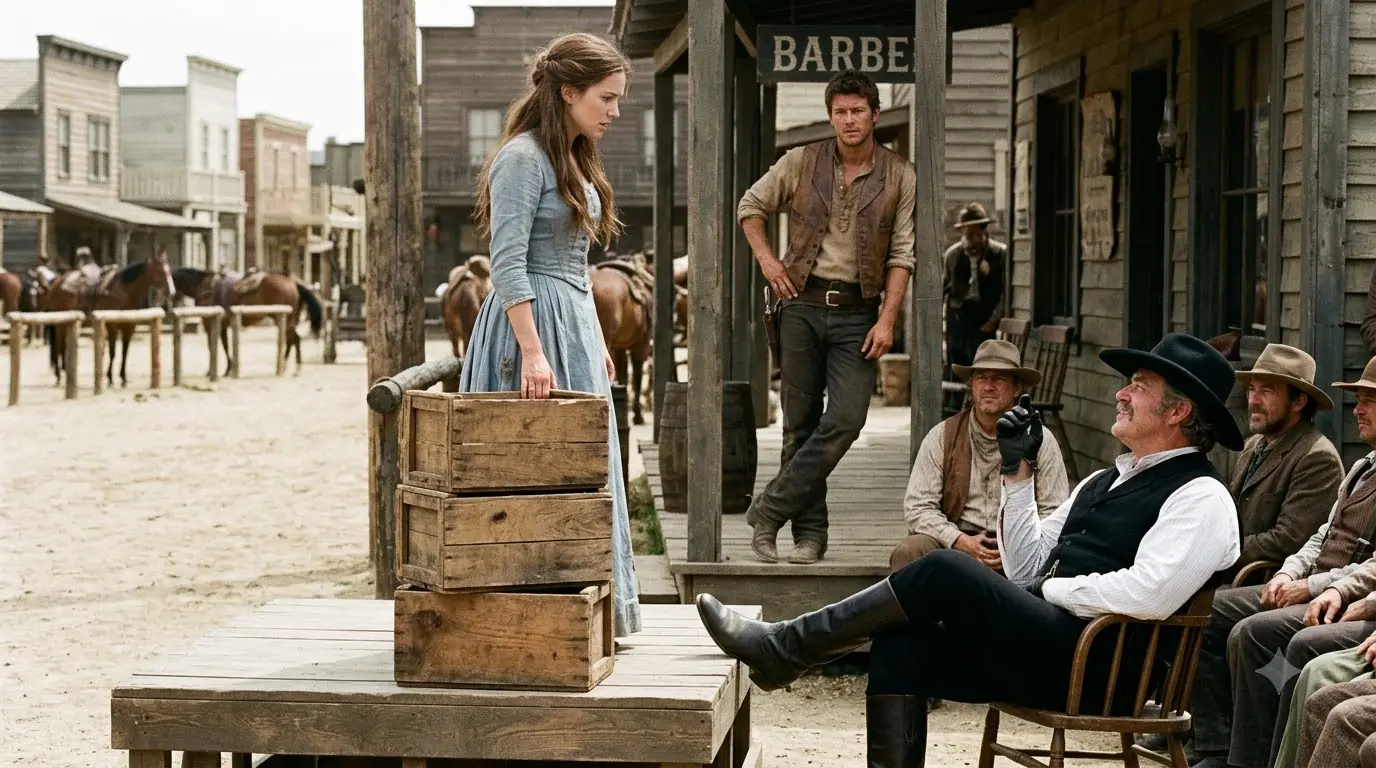
Gideon Vale sat in the front row beneath the shade of the mercantile awning, one boot crossed over the other, broad hat tipped back just enough for everyone to see the smile on his face. He owned the largest cattle spread east of town, half the freight wagons that came through Blackwater, the grain warehouse, and enough debt notes on enough families to make his name carry farther than any sheriff’s badge. When he lifted one gloved hand and offered fifty dollars for Mara’s homestead, a few men near the saloon laughed because they knew the number was an insult.
Mara did not laugh. Her father had paid nearly six hundred dollars for those forty-three acres fifteen years earlier, back when he still believed Blackwater might become a decent town. The land had a shallow creek bed, a weathered two-room house, a barn leaning slightly to the north, and a well that had gone half dry during the previous summer. It was not rich ranch land, but it was hers, or it should have been. Now the town judge had ordered it sold for delinquent taxes Mara swore had never existed until the week she refused Gideon’s first offer.
"Take the money, girl," Gideon called lazily. "You should be grateful anyone wants that worthless dirt."
Mara lifted her chin. She had spent three days begging clerks to show her the tax notice they claimed had been mailed. She had watched the bank freeze the small account her father left her. She had been refused feed at two stores and blacklisted by a freight company that owed Gideon most of its wagons. She had slept two hours the night before the auction and cried exactly once, in the barn where no one could hear her.
"You can take my money, sir," she repeated, louder this time, "but you cannot take my dignity."
Nobody laughed after that.
At the back of the crowd, Jonah Reed pushed away from the wall of the barber shop.
Mara had seen him around Blackwater for years without ever truly knowing him. He was thirty-two, broad through the shoulders, lean everywhere else, with a face darkened by weather and a habit of listening before he spoke. He hired himself out to ranchers during drives, repaired tack in winter, and slept in whatever bunkhouse paid on time. He owned a sorrel gelding named Dusty, a saddle patched in three places, and a reputation for minding his own business.
That morning, he stopped minding it.
"Sixty," Jonah said.
The auctioneer blinked. Gideon slowly turned.
"You can’t afford it," Gideon said.
Jonah walked toward the platform and removed a small leather pouch from inside his coat. It landed on the auction table with a heavy clink.
"Count it."
Mara stared at him. "What are you doing?"
"Buying land."
"My land."
"At the moment," Jonah said, glancing toward Judge Horace Pike, who sat beside the auctioneer pretending disinterest, "it appears everyone in town except you has decided that point is negotiable."
Mara stepped closer, furious enough to forget her humiliation. "I do not need a man buying my property to rescue me."
A nervous chuckle passed through the crowd.
Jonah nodded once. "Good. I’m not rescuing you."
That answer stopped her.
He faced the auctioneer. "I am buying the property because it is worth more than fifty dollars and because I dislike theft dressed up as paperwork. If Miss Quinn wants to buy it back later, she can. If she doesn’t, I will own a bad well and a crooked barn. Either way, nobody drags her off that land this afternoon."
Gideon rose. His chair scraped against the wooden walkway.
"You think you can walk into my town and interfere with my business?"
Jonah looked around slowly. "Didn’t know Blackwater belonged to you."
"Everybody here knows who keeps this town alive."
"That so?" Jonah’s voice remained quiet. "Then you ought to be able to survive losing an auction."
The bidding climbed.
Gideon raised to eighty. Jonah answered ninety. Gideon went to one hundred twenty, then one-fifty. By two hundred, the crowd understood Jonah was not bluffing. By three hundred, Mara had stopped being angry long enough to become afraid for him. She knew what trail hands earned. She knew a leather pouch that heavy represented years of long drives, winter camps, broken ribs, and wages not spent.
At four hundred twenty dollars, Gideon leaned back.