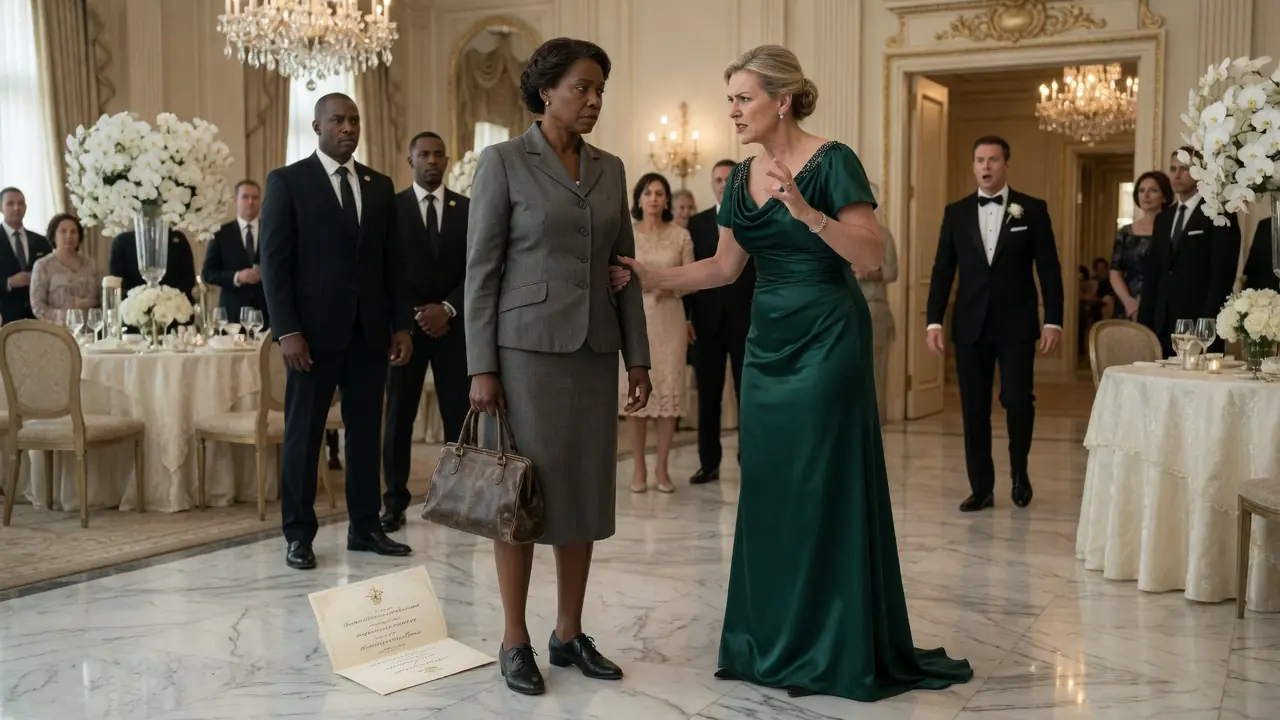
The sound of a slap cracked through the grand ballroom of the hotel, sharp enough to silence 300 conversations at once. The woman who had just been struck did not cry out. She simply raised one hand and pressed it gently against her own cheek, as though checking that the moment had truly happened. She was Black, somewhere near 55 years old, dressed in a suit that had clearly been worn for many years, its fabric softened by age rather than fashion.
Around her stood the kind of crowd that measured people by the shine of their shoes, and by that measure she did not belong. The mother of the bride stood inches away, her hands still raised, her voice dripping with contempt as she asked how someone like her had dared to walk through these doors. Nobody in that glittering room moved to help her. Then, just as two security guards stepped forward to remove her, the groom came tearing through the crowd, pushed past his own relatives, and bowed his head so low that his forehead nearly touched her shoulder, saying the words that would unravel everything: “Hello, ma’am.”
The hotel had spent 6 days transforming its largest hall into something out of a fairy tale designed for people who had never needed to dream small. Crystal chandeliers hung from the ceiling like frozen rain, and white orchids climbed the walls in cascades that cost more than most people's monthly rent. The bride's family, the Caldwells, had built their fortune over three generations in commercial real estate, and they intended for every guest to understand that fortune the moment they walked through the door. Valets in white gloves parked cars that gleamed under the afternoon sun, and a quartet played softly near the entrance, filling the air with something elegant and faintly cold.
The guest list read like a registry of the city's wealthiest families, every name attached to a building, a bank, or a seat on some influential board. Among the rows of designer gowns and tailored tuxedos, a woman in her mid-50s stepped quietly through the side entrance, carrying nothing but a worn leather handbag and a folded invitation she had kept safe inside her coat pocket. Her suit was modest, a soft gray that had clearly been pressed with care despite its age, and her shoes, though clean, showed the wear of someone who walked rather than rode. She moved with no hesitation, no nervous glance over her shoulder, the kind of calm that comes from a person who has long stopped needing anyone's approval to feel at peace with herself.
The young woman at the registration table looked her over once, then twice, her painted smile faltering slightly as she scanned the elegant printed list for a name that did not seem to belong among the others. There was no name matching what the woman offered. Not on the first page, not on the second, and the attendant's eyes flicked nervously toward the ballroom doors as if searching for someone who might know what to do with a guest who did not fit the picture. The older woman simply waited, her hands folded over the handle of her bag, her expression patient in the way of someone who had been underestimated more times than she could count, and had long ago decided it was no longer worth her anger.
She explained in a voice low and steady that she had indeed been invited and that the groom himself would vouch for her presence. The attendant exchanged a glance with a colleague, unconvinced, and the murmurs began to ripple outward through the nearby guests like a stone dropped into still water. Whispers spread quickly in rooms built for appearances, and within minutes half the hall had turned to study the woman standing quietly near the entrance. Some guests assumed she had wandered in from the kitchen staff entrance by mistake.
Others guessed she might be a distant relative, the kind of family connection that wealthy households sometimes tolerated out of obligation rather than affection. Nobody bothered to introduce themselves. Nobody asked her directly who she was. Instead, they asked each other, trading guesses dressed up as concern, their voices pitched just loud enough to be overheard.
Nobody knew her name, her history, or the years she had spent building something far larger than the room could imagine. And in their ignorance, they decided, without discussion, that she was unworthy of basic courtesy. The question that would soon shake the entire celebration had not yet been asked aloud, though it hung over the room like a held breath. Who exactly was this woman, and why had she come?
The whispers eventually reached the Caldwell family, carried by an aunt who considered herself the unofficial keeper of the guest list, and who took personal offense at any irregularity threatening the day's perfection. She crossed the ballroom floor with quick, deliberate steps, her heels clicking against the marble like a countdown, and positioned herself directly in front of the woman, with the kind of posture reserved for confronting trespassers. Her first words were not a greeting, but an accusation disguised as a question, asking whether the woman understood that this was a private event for invited guests only. The woman answered calmly that she understood perfectly well, and that she had, in fact, been invited.
The aunt's eyebrows rose with theatrical disbelief, and she turned slightly to address the small cluster of onlookers who had gathered nearby, inviting them silently to share in her amusement. A young man nearby suggested loudly enough for everyone to hear that perhaps she had confused this ballroom for the staff cafeteria one floor below, and a ripple of laughter followed his joke. Another guest, a woman dripping in jewelry that could have funded a small business, asked whether she was perhaps here to collect donations for some charity drive, her tone suggesting the question was less curiosity and more insult. The older woman's expression did not change.
She had clearly weathered worse than a room full of strangers amused by her presence. Margaret Caldwell, mother of the bride, arrived moments later, drawn by the commotion the way certain people who believe themselves entitled to control are always drawn toward conflict. She was a striking woman in her early 60s, dressed in deep emerald silk, her every gesture practiced and precise, the product of decades spent commanding rooms exactly like this one. She demanded to know who exactly had let a stranger wander uninvited into her daughter's wedding, her voice carrying the particular sharpness of someone accustomed to immediate answers.
When nobody could explain, she turned the full weight of her irritation directly onto the woman standing quietly before her, asking bluntly who had invited her and why she thought she belonged here. The woman met Margaret's gaze without flinching, her voice even and unhurried, as she explained that the groom himself knew her, and that he would confirm it the moment he was asked. The answer landed strangely in the room, not because it lacked confidence, but because it seemed, to everyone listening, utterly implausible. Margaret let out a short, disbelieving laugh, the kind meant to wound rather than express genuine amusement, and repeated the woman's words back to the gathered crowd, as though sharing a particularly absurd joke.
Several guests joined in, their laughter rising in waves, each person seemingly competing to express the loudest disbelief that their golden accomplished groom could possibly have any connection to a woman dressed the way she was. Nobody in that glittering crowd considered, even for a moment, that the joke might be on them. Margaret's patience, thin even on ordinary days, evaporated entirely under the weight of the laughter she had encouraged, and something in her expression hardened into genuine anger rather than mere irritation. She accused the woman of lying, of inventing a connection to the groom simply to talk her way into an event she had no right to attend, her voice rising loud enough to draw attention from across the entire hall.
The woman did not raise her own voice in response. She simply repeated calmly that she was telling the truth and that there was no need to shout. To Margaret, that composure read not as dignity, but as defiance, and defiance from someone she had already dismissed as unworthy felt to her like an insult demanding immediate correction. The crowd around them thickened, drawn by the unmistakable scent of conflict, the way moths gather toward flame, phones lowering slightly as people leaned in to watch rather than record, eager not to miss whatever happened next.
Margaret accused her of trying to embarrass the family on the most important day of her daughter's life, of seeking attention or perhaps even money, throwing out theories with the rapid carelessness of someone who had stopped listening the moment she decided she already knew the truth. The woman's only response was a quiet, steady repetition of the same simple fact that the groom would recognize her, that all of this could be resolved the instant someone simply went and found him. Nobody moved to do so. They preferred their assumptions to the truth, at least for a little while longer.
A cousin of the bride, eager to prove his usefulness to the family that controlled most of his employment prospects, stepped forward and suggested loudly that perhaps the woman should simply leave before things grew any more uncomfortable for everyone involved. Another guest, a business partner of the Caldwell family, added that surely a woman of her circumstances had better places to be than crashing a celebration meant for people of genuine accomplishment. Each comment landed like a small stone added to a growing pile. None individually devastating, yet together forming a weight that would have crushed a person with less resolve than she carried.
The woman remained motionless, her gaze steady, neither shrinking from the insults nor rising to meet their cruelty with anything resembling matching anger. It was precisely that calm, that refusal to perform the outrage everyone seemed to expect from her that finally pushed Margaret past the edge of whatever restraint she had been clinging to. It was in that charged silence, thick with judgment and unspoken accusations, that Margaret's hand rose before anyone fully registered what was happening, and the sound of her palm against the woman's cheek rang out across the marble floor like a gunshot in a quiet church. The entire hall seemed to inhale at once and forget for several long seconds how to exhale again.
Conversations died mid-sentence. Glasses paused halfway to lips. Even the string quartet near the entrance let their bows hover above the strings, uncertain whether to continue playing through whatever had just occurred. The woman's head turned slightly from the force of the strike, and a faint red mark bloomed across her cheek, visible even from the back rows of folding chairs.
She did not stumble. She did not cry. She lifted one hand slowly to her face, pressing her fingers gently against the spot where Margaret's palm had landed. And for a moment, she simply stood there, absorbing the silence rather than breaking it.
Nobody in that enormous room, not a single guest among the hundreds present, stepped forward to ask if she was all right, to object, to offer even the smallest gesture of basic human decency. Margaret stood with her chest rising and falling rapidly, her hands still hovering in the air, as though she half expected applause for restoring order to her daughter's celebration. The woman lowered her hand at last, straightened the collar of her aging gray suit with unhurried fingers, and spoke words that would echo through the room far longer than the slap itself. “There are prices that pride always eventually pays,” she said quietly.
The sentence confused more people than it clarified, delivered without anger or theatrical flourish, simply stated as fact, the way a person might mention the weather. Margaret blinked, momentarily thrown by the calm defiance in those words, though she quickly recovered and turned to summon two security guards stationed near the entrance, instructing them with a dismissive wave to escort the troublemaker out before she ruined another moment of the celebration. The guards approached cautiously, clearly uncomfortable with the assignment, but unwilling to challenge the bride's mother on her daughter's wedding day. The woman did not resist as they positioned themselves on either side of her, simply waited, her posture straight, her dignity entirely intact, despite everything that had just been done to diminish it.
Behind the heavy doors leading to the preparation suite, the groom had just finished adjusting his cuff links, when the muffled commotion from the ballroom reached his ears, faint at first, then unmistakably wrong, in a way that made his stomach tighten with sudden dread. His name was Daniel Whitfield, a 32-year-old dressed in a perfectly tailored black tuxedo that fit him like it had been poured rather than sewn, the picture of a man who had built an extraordinary life from almost nothing. He paused mid-motion, head tilting slightly toward the sound, some instinct deeper than logic, telling him that whatever was happening out there concerned him directly. His best man asked if everything was all right.
But Daniel was already moving toward the door, his pulse quickening with each step closer to the noise. He pushed through the heavy doors just in time to see two security guards positioning themselves beside a woman in gray, her cheek marked with unmistakable redness, the crowd around her parting just enough for Daniel to see her face clearly for the first time. Recognition struck him like a physical blow, and every carefully rehearsed plan for his wedding day evaporated instantly from his mind. He did not pause to consider what his bride's family might think, did not weigh the optics of his next move against the carefully curated image of the day.
He simply ran, weaving through stunned guests and abandoned champagne flutes, his polished shoes echoing against the marble floor with an urgency the room had not yet seen from him. He reached her in seconds, though to everyone watching it felt like an eternity stretched thin by disbelief, and without a single word of explanation to the crowd, Daniel bowed his head low before her, lower than any of them had ever seen a groom bow to anyone on his own wedding day. His voice, when it finally came, was thick with an emotion that silenced even the faint rustle of fabric and jewelry throughout the hall. “Hello, ma’am,” he said, the words simple yet carrying the unmistakable weight of deep, long-held respect.
"I am so sorry you were made to wait," he continued, his voice cracking slightly as his eyes flicked briefly toward the mark still visible on her cheek. The entire ballroom seemed to freeze in that instant, caught between confusion and the dawning suspicion that everything they had assumed about this woman was about to be proven catastrophically wrong. Margaret Caldwell stood several feet away, her hands still faintly trembling from what she had done, watching her future son-in-law bow before the very woman she had just struck without hesitation. Her mind raced through possibilities, each one more unsettling than the last, searching desperately for some explanation that would not require her to confront the magnitude of her own mistake.
The crowd's murmurs shifted in tone, no longer mocking, but uncertain. The laughter of moments earlier had been replaced by a tense, expectant hush, as everyone waited to understand what Daniel clearly already knew. Even the bride, standing near the altar in her flowing white gown, turned with wide eyes, her bouquet trembling slightly in her grip as she watched her groom kneel before a stranger her own family had just humiliated. For Daniel, the years collapsed backward in an instant, memories surfacing with a clarity that made the present moment feel almost unreal by comparison.
He had grown up in a part of the city where ambition often died quietly, suffocated by circumstances most people never had to consider. He had been raised by a single mother who worked two jobs until exhaustion finally claimed her when Daniel was only 14 years old. After her death, he had bounced between distant relatives who could barely afford to feed their own children, eventually finding himself entirely alone at 17, sleeping for months in the backseat of a car that barely ran, surviving on whatever odd jobs the city offered a teenager with no fixed address. College had felt like a door permanently sealed shut, not for lack of grades or determination, but for lack of the one resource that mattered most in those years, namely money he simply did not have and no family willing or able to provide.
He had applied to a small community scholarship program more out of desperation than genuine hope, expecting rejection the way he had come to expect most things in life. Instead, he received a letter inviting him to an interview. And in that modest office with peeling paint and a single overworked air conditioner, he met the woman who would alter the entire trajectory of his existence. She had not looked at his torn shoes or his secondhand jacket with judgment, only listened, really listened, as he described dreams he had never dared speak aloud to anyone before.
She funded his education in full, not merely tuition, but housing, books, even a reliable used car so he could reach his classes without depending on unreliable buses that left him stranded in the cold more nights than he cared to remember. When his grades occasionally slipped under the weight of working nights to cover basic expenses, she sat with him for hours, not lecturing, simply helping him untangle calculus problems and budget spreadsheets with the patience of someone who had clearly mentored many young people before him. She taught him gradually and deliberately how businesses actually function beneath their polished surfaces, how negotiations worked, how to read a room and a balance sheet with equal precision. When he stumbled badly during his first failed business venture in his mid-20s, losing nearly everything he had built, she was the one who helped him stand back up rather than simply walk away.
Throughout all those years, she never once mentioned wealth, never hinted at resources beyond the modest scholarship fund she openly administered, never wore anything beyond simple, practical clothing that suggested comfort rather than affluence. She drove an older sedan with a small dent above the rear wheel, ate lunch from a paper bag rather than any of the restaurants near her office, and signed every letter she sent to her students with nothing more than her first name and a single line of encouragement. Daniel had assumed, reasonably enough, given everything he observed, that she was simply a dedicated woman of modest means who had devoted her life to helping students like him out of pure generosity rather than financial excess. He never thought to question further, never felt entitled to ask about her personal finances or her past, grateful simply for the chance she had given him, without expecting anything beyond his own success in return.
It would be years before he understood just how profoundly he had underestimated the woman who had quietly reshaped his entire future. There had been a single afternoon years earlier when Daniel had pressed her gently about why someone with so little visible means devoted so much of her time to strangers with nothing to offer in return. She had only smiled at the question, brushing it aside the way she brushed aside most inquiries into her own life, telling him simply that she had once been given something she could never properly repay, and that the only honest way to settle such a debt was to pass it forward to someone else who needed it just as badly. He had accepted the answer without pushing further, assuming it referred to some scholarship or kindness she herself had once received decades earlier.
He did not yet understand that the debt she spoke of was measured not in dollars, but in something far harder to repay, and that her quiet life of simplicity was a choice rather than a circumstance. Standing now before the gathered crowd, still bowed slightly, with his hand resting gently near her shoulder, Daniel turned to face the hundreds of guests who had watched his bride's family humiliate the woman responsible for every success he had ever achieved. His voice, when he addressed them, carried none of the polished charm typically reserved for wedding toasts, replaced instead by something raw and unmistakably furious beneath its careful control. He told them plainly that the woman they had mocked, the woman they had refused to seat, the woman his own mother-in-law had just struck across the face, was the same person who had pulled him out of a parked car and placed him on a path toward everything he now possessed.
The room, already tense, grew tighter still, and guests exchanged glances that suggested the shock had only just begun. But Daniel was not finished, and what came next would reshape the entire afternoon far beyond a simple matter of personal gratitude. He explained, his voice steady despite the emotion threading through it, that this woman was not merely his mentor from years past, but remained deeply connected to his current success in ways most of the room would find difficult to believe. She had been, he revealed, the very first investor in his company, providing capital when no bank or venture firm would take a chance on an unproven young man with nothing but ambition and a business plan scrawled across notebook paper.
She held a quiet, substantial stake in everything he had built since, a stake she had never once mentioned publicly, never used to claim credit or attention for herself. More than that, Daniel continued, she had founded and personally funded the largest scholarship organization operating within the entire state, an organization responsible for sending thousands of students just like him toward futures they otherwise never could have afforded. She had built this empire of quiet generosity over decades, deliberately avoiding publicity, declining interviews, refusing naming rights on buildings or programs that might have memorialized her contributions in stone and brass. She preferred, he explained, to remain exactly as she appeared, an unremarkable woman in simple clothing, because visibility had never been the point for her.
The point had always been the students themselves, their futures, their second chances. Nothing more and nothing less. A murmur swept through the crowd as several guests began exchanging uncertain glances, names, and half-remembered details suddenly clicking into place behind widening eyes. A man near the back, a prominent local businessman who had built several successful ventures of his own, suddenly straightened in his seat, recognition dawning visibly across his features, as he placed her name within conversations he had overheard years earlier among serious investors.
A woman seated closer to the front, a state representative known for her work on education funding, rose slightly from her chair, her hand pressed against her chest as she finally connected the quiet philanthropist from countless funding reports to the woman standing battered before them. The realization spread outward through the room like ripples expanding from a stone dropped into still water. Each person arrived at the same dawning horror only moments after the person beside them. An elderly attorney seated near the center tables removed his glasses entirely, cleaning them with the edge of his napkin as though doubting his own eyesight, muttering to his wife that he had drafted papers years earlier for a foundation bearing initials he now recognized belonged to the very woman standing before them.
A younger guest, a graduate of the same scholarship program, though years apart from Daniel, rose from her seat entirely, tears already forming, as she realized the woman, who had quietly funded her own tuition, without ever once requesting a photograph or a thank you letter, was standing only a few feet away, freshly struck and humiliated. She pushed through the crowd to stand near the front, unable to remain seated any longer, wanting simply to be near the woman who had altered her own life in ways nobody around her yet understood. Others soon followed, drawn less by curiosity now than by something closer to reverence, the earlier mockery dissolving into a quiet collective shame that spread through the hall faster than any announcement could have managed alone. The president of one of the city's largest banking institutions, present as a guest of the bride's family, rose from his seat entirely and crossed the room with quick, purposeful steps, extending his hand toward the woman with an expression that mixed genuine respect with visible embarrassment at having witnessed what had occurred without intervening.
He addressed her directly by name, a name Daniel had not yet spoken aloud to the crowd, but which clearly carried enormous weight within certain circles of finance and philanthropy that this wedding's guest list had never fully appreciated. He apologized profusely, his voice low and sincere, expressing genuine horror that such treatment had occurred within his presence at any event, let alone one celebrating new beginnings. The woman accepted his hand graciously, her expression calm, betraying none of the satisfaction she might reasonably have felt at this sudden dramatic reversal of fortune. The atmosphere within the ballroom had transformed entirely within the span of mere minutes.
The earlier mockery and casual cruelty had been replaced by something closer to collective shame, guests shifting uncomfortably in their seats, suddenly aware of how loudly they had laughed only moments before. Margaret Caldwell stood frozen near the center of the room, her earlier fury entirely drained away, replaced by a creeping horror, as she began to understand the magnitude of what she had done in front of hundreds of witnesses, several of whom held considerable influence within the very social and financial circles her family depended upon. She glanced toward her daughter, seeking some form of support or reassurance, but found only stunned silence reflected back at her. The woman she had struck remained remarkably composed throughout, her posture unchanged, her dignity entirely intact, despite everything thrown against it.
Margaret approached slowly, her earlier confidence replaced by visible hesitation, each step seeming to cost her something significant in pride she had never before been forced to surrender. She began speaking before she had fully decided what to say, words tumbling out in an attempt to explain away what had happened as simple misunderstanding rather than deliberate cruelty. She insisted that nobody had told her who the woman truly was, that she would never have acted so harshly had someone simply provided a proper introduction beforehand, her voice rising slightly, with the particular desperation of someone realizing apologies rarely undo damage already done. The woman listened patiently, allowing Margaret to finish before responding with words far quieter than the chaos surrounding them, yet carrying weight enough to silence the older woman entirely.
“It was not the slap itself that wounded me most deeply,” the woman explained, her voice steady and clear enough to carry across the hushed room. “Physical pain fades quickly enough, a simple fact of biology rather than philosophy. What truly disturbed me,” she said, turning her gaze slowly across the assembled crowd of guests, who only minutes earlier had laughed at her presence, was that not a single person among them had considered her deserving of basic respect before learning anything about who she actually was. Her worth, she explained, should never have depended upon recognition of her bank account or her philanthropic resume.
Human dignity, she reminded them, ought to be offered freely, unconditionally, long before any resume or reputation entered the conversation at all. The words landed with the force of a sermon delivered without raised voice or dramatic gesture, simply stated plainly into a room full of people, forced now to examine their own complicity in what had occurred. Heads bowed throughout the crowd, not in performative shame, but in genuine, uncomfortable reckoning. Guests recalled their own laughter, their own assumptions, their own silence, while a stranger was humiliated in front of them.
Even those who had said nothing during the confrontation, who had simply watched without objecting, felt the weight of her words settling uncomfortably across their shoulders. The string quartet near the entrance remained entirely silent now, their instruments resting untouched, the moment far too heavy for music of any kind. Daniel stood beside her throughout this exchange, his jaw tight, his earlier emotion hardening now into quiet resolve as he watched the woman who had saved his future stand, vulnerable before people who had treated her so carelessly. When Margaret finished her stammering apology, Daniel spoke again, his voice carrying clearly across the ballroom despite its quiet delivery.
He told the gathered guests, told his own bride's family directly, that he could not in good conscience continue forward with a celebration built atop such cruelty toward the very person responsible for his entire success. If respect could not be extended to her, he said, "Then perhaps this wedding did not deserve to continue at all. Not today, not in this room, not under these circumstances." The announcement landed like another slap across the room, this time absorbed collectively rather than by a single person.
Guests shifted nervously as they realized the celebration's continuation now hung entirely in question. Vanessa Caldwell, the bride, stood frozen near the altar throughout the entire unfolding scene, her white gown suddenly feeling far heavier than it had only an hour earlier, her carefully arranged bouquet trembling visibly within her grip. She had spent months planning every detail of this day, every flower, every song, every carefully chosen word for her vows, never once imagining that the celebration itself might collapse before reaching its intended conclusion. Her gaze moved between her mother, pale and shaken near the center of the room, and her groom, standing resolute beside a woman she barely recognized, yet somehow understood mattered enormously.
For several long, suspended seconds, Vanessa said nothing at all, the silence stretching uncomfortably as every guest waited to see which direction she would choose and whether loyalty to her own mother would outweigh the clear moral weight of what Daniel had just declared. When she finally moved, it was not toward her mother, but across the room, her gown trailing softly against the marble floor as she approached the woman in gray with visible determination replacing her earlier shock. She apologized directly, her voice trembling slightly, but unmistakably sincere, expressing genuine horror at what her own family had done in her name on her wedding day in front of everyone she had ever wanted to impress. She turned then toward her mother, her expression hardening with a resolve nobody in that room had previously witnessed from her.
Margaret's face crumpled slightly under her daughter's gaze, the realization dawning that even her own child now stood apart from her in this moment of public reckoning. Vanessa told her mother plainly that wealth had never granted anyone the right to humiliate another human being. Regardless of appearances, assumptions, or confidence in one's own social standing, the words seemed to cost Vanessa something significant to speak aloud, given decades of deference toward her mother's opinions and judgments, yet she delivered them clearly enough for every guest present to understand exactly where she now stood. A tense silence followed, broken only by Margaret's quiet, shuddering breath, as the full weight of her actions finally settled fully across her shoulders.
The two families, Caldwell and Whitfield, stood divided across an invisible line that had nothing to do with wealth or status, and everything to do with basic human decency, with guests watching anxiously to see which side would ultimately prevail in this unexpected confrontation. Several relatives from the Caldwell side attempted weak justifications, suggesting the woman should have announced herself more clearly upon arrival and that confusion alone explained the unfortunate incident rather than genuine prejudice. Their words fell flat against a room already too aware of what had truly transpired, the laughter and mockery that had preceded the slap impossible to reframe as simple misunderstanding. The woman herself remained silent throughout these attempted justifications, watching the unfolding family drama with the patient detachment of someone who had witnessed human nature reveal itself in similar fashion many times before.
An uncle on the Caldwell side, red-faced and clearly uncomfortable with how thoroughly the afternoon had unraveled, attempted to suggest that perhaps everyone was overreacting to a simple misunderstanding that could be smoothed over with a quiet word and a fresh round of champagne. Vanessa turned on him sharply, her earlier hesitation entirely gone now, telling him plainly that what had happened was not a misunderstanding, but a choice made deliberately by people who decided a stranger's appearance gave them permission to humiliate her. Her words carried a new firmness that surprised even those who had known her since childhood, a side of her rarely displayed beneath the polished, agreeable exterior she usually presented at family gatherings. The uncle fell silent, retreating back into the crowd without further argument, and the room's attention returned once more to the unresolved standoff between mother and daughter.
It was Margaret who finally broke the prolonged silence, her earlier defensiveness collapsing entirely under the combined weight of her daughter's disappointment and the room's collective judgment. She turned toward the woman she had struck, her composure entirely gone now, replaced by something raw and more honest than anything she had displayed throughout the earlier confrontation. She admitted, her voice barely above a whisper, yet carrying clearly through the silent hall, that she had judged based on appearance alone, that she had assumed worth could be measured through fabric and footwear rather than character or contribution. She asked with genuine humility now replacing her earlier arrogance, whether there remained any possibility of forgiveness for what she had done.
The woman considered the question for a long moment, the entire ballroom holding its breath collectively as they waited for her response. The outcome of the entire celebration seemed to balance precariously upon whatever she chose to say next. She told Margaret that forgiveness was certainly possible, though it would require more than words spoken under the pressure of public exposure and embarrassment. True change, she explained, came from understanding rather than mere apology, from genuinely reconsidering the assumptions that had led to such cruelty in the first place, rather than simply regretting the consequences once they became publicly uncomfortable.
Margaret nodded slowly, tears now visible along the edges of her carefully applied makeup, the first genuine emotion she had displayed since the confrontation began. Daniel watched this exchange unfold with quiet satisfaction, his earlier anger softening slightly as he witnessed something resembling genuine accountability finally emerging from the chaos. He turned to the woman who had shaped his entire future and asked gently whether she would consider allowing the celebration to continue, whether enough had been resolved within that room to justify moving forward with the day everyone had originally gathered to celebrate. The woman glanced toward Vanessa, still standing resolute beside her mother despite everything that had occurred, and toward Daniel himself, the young man she had watched grow from a frightened teenager sleeping in a car into someone capable of standing firmly for what mattered most.
She smiled, then, the first genuine smile she had offered since arriving, and told them that yes, perhaps the day could continue after all. The ceremony resumed roughly 30 minutes later, though the room itself felt entirely transformed from what it had been only an hour earlier, guests now watching with newfound humility rather than casual judgment. Margaret personally arranged for the woman to be seated in the front row of honor, a position typically reserved for immediate family, an unmistakable public gesture, acknowledging exactly how significant this woman's presence truly was. She insisted on escorting her there herself, walking slowly beside her, across the same marble floor where the earlier confrontation had unfolded, her earlier arrogance replaced now by something resembling genuine respect, however hard-won, and painfully late in arriving.
The gesture did not erase what had happened, but it offered at minimum a visible acknowledgement that something fundamental had shifted within that room. Daniel stood at the altar moments later, his bride beside him, and before continuing with the ceremony's traditional proceedings, he asked permission to address the room one final time. His voice, steadier now than during his earlier confrontation, carried a different quality entirely, something closer to reflection than urgency. He told the assembled guests that success, real success, never began with money sitting comfortably in a bank account somewhere.
It began instead, he explained, with the very first person willing to believe in someone before that belief had been earned through achievement or evidence, someone willing to extend trust simply because they recognized potential worth nurturing. He gestured toward the woman seated in the front row, her cheek still faintly marked from earlier in the day, and told the room plainly that she had been that person for him, and that he owed her more than mere words could ever properly express. The woman listened to his words with quiet composure, her expression calm despite the visible mark still lingering on her cheek, a small physical reminder of how the day had begun. She felt no lingering anger toward the room full of guests who had laughed at her and no bitterness toward Margaret despite everything that had occurred, only a quiet satisfaction in watching Daniel stand confidently for the values she had spent years trying to instill within him.
She had not come to this wedding seeking recognition or apology, only to celebrate quietly alongside a young man she had watched transform his entire life through nothing but determination and the smallest possible opportunity. Whatever humiliation she had endured throughout the afternoon felt to her far less significant than witnessing the man Daniel had become. As the ceremony concluded and guests rose to applaud the newly married couple, the camera capturing the moment for the family's records framed something unexpected within its final shot, something far more meaningful than the traditional image of bride and groom walking arm in arm toward their future together. Vanessa and Daniel walked slowly down the aisle as tradition demanded, but rather than proceeding alone toward the doors, they paused deliberately beside the front row, extending their hands toward the woman seated there, inviting her to walk alongside them rather than simply watch from a distance.
She rose slowly, accepting their offered hands, and the three of them walked together toward the open doors and the bright afternoon sunlight waiting beyond. The image lingered in the minds of everyone present long after the wedding itself faded into memory, repeated in conversations throughout the following weeks among guests still processing what they had witnessed that afternoon. Wealth, many of them realized, however impressive its outward display, had never guaranteed the kind of character capable of recognizing genuine worth beneath unfamiliar appearances. The woman in the simple gray suit had walked into that ballroom, carrying decades of quiet generosity behind an unassuming exterior, and the room's failure to recognize that worth before subjecting her to public humiliation, revealed far more about their own character than it ever could about hers.
Dignity, as she herself had stated so plainly amid the chaos, was never something that needed to be earned through wealth or status, but something owed unconditionally to every person, regardless of what they wore or how they arrived. In the months that followed, the scholarship organization she had founded quietly expanded its reach into two additional counties, funded in part by a sizable donation made anonymously the week after the wedding, though several guests who had been present that afternoon quietly suspected exactly where the contribution had originated. Margaret Caldwell, for her part, began volunteering once a month at the very same community center where Daniel had once been interviewed for his original scholarship, an act she undertook without publicity or announcement, as though finally understanding that meaningful change required more than a single tearful apology delivered under pressure. She never spoke of the wedding incident publicly again, but those closest to her noticed a quiet shift in how she greeted strangers afterward, a pause before judgment that had not existed in her before that afternoon.
Whether that shift would last permanently, nobody could say for certain, though the woman in gray, when asked once by Daniel whether she believed real change was possible for someone like Margaret, only smiled and said that people rarely change completely, but they can certainly learn to pause. Long after the last guest departed, and the elaborate decorations were quietly dismantled, the lesson of that afternoon remained, repeated in hushed conversations among those who had witnessed it firsthand, and eventually spreading further still among those who only heard the story secondhand. A single greeting, spoken with genuine respect at precisely the right moment, had managed to expose every assumption an entire room full of wealthy, confident people had carried into that celebration.
It served as a quiet reminder, one that outlasted the flowers and the music and even the marriage celebration itself, that true worth could never be measured by appearance alone, and that respect offered only after status became clear, was never truly respect at all, but merely calculation dressed up to look like decency. The mark on her cheek faded within days, as such marks always do. But the lesson it left behind in that ballroom remained etched far longer in the memory of everyone who had stood there and said nothing until it was almost too late.