“Oh, hell no. Who let this one in?” Patricia Whitmore’s voice sliced across the Meadowbrook Country Club terrace loud enough to stop a waiter mid-step. She was staring at the Black woman in dark jeans and a navy blazer, sitting alone near the wide terrace window with corporate documents spread neatly across the white tablecloth. “Babe, look,” Patricia said, nudging her husband with a cruel little laugh. “We’ve got another charity case trying to eat with the members.”
The spring benefactor brunch had been arranged to impress the richest families in Greenwich, Connecticut. Crystal glasses caught the clean morning light, fresh lilies perfumed the air, and violin music drifted softly from the far corner of the terrace. Outside, forty-seven acres of perfect green lawn rolled toward the golf course, maintained by a staff the members rarely looked in the eye. Meadowbrook was not just a club; it was a gate, and everyone inside believed they knew exactly who belonged behind it.
At the corner table, Dr. Jordan Ellis did not look up right away. She was forty-three years old, a Black American CEO with a PhD in aerospace engineering from MIT and the founder of Ellis Industries, a defense technology company valued in the billions. Her company employed twelve thousand people across eight states, and its latest headquarters project was worth 1.5 billion dollars. Yet that morning, she had dressed down on purpose, wearing dark jeans, a navy blazer, simple gold studs, and no visible sign of wealth.
Robert Henderson, the club president, had invited Jordan personally. He wanted Ellis Industries to sponsor a 5 million dollar STEM program connected to the club’s charitable foundation. Jordan had agreed to attend only under one condition. She wanted to observe the culture firsthand, not as a celebrated CEO, not as a donor, but as an ordinary guest no one recognized.
That was why her phone sat in her pocket with the recording app ready. Jordan had learned through years of boardrooms, airports, hotels, and private events that people revealed themselves most clearly when they believed there would be no consequences. She wanted to know how Meadowbrook treated someone it assumed did not belong. She expected cold glances, maybe a whispered insult or two. She did not expect a child to assault her in front of a room full of adults.
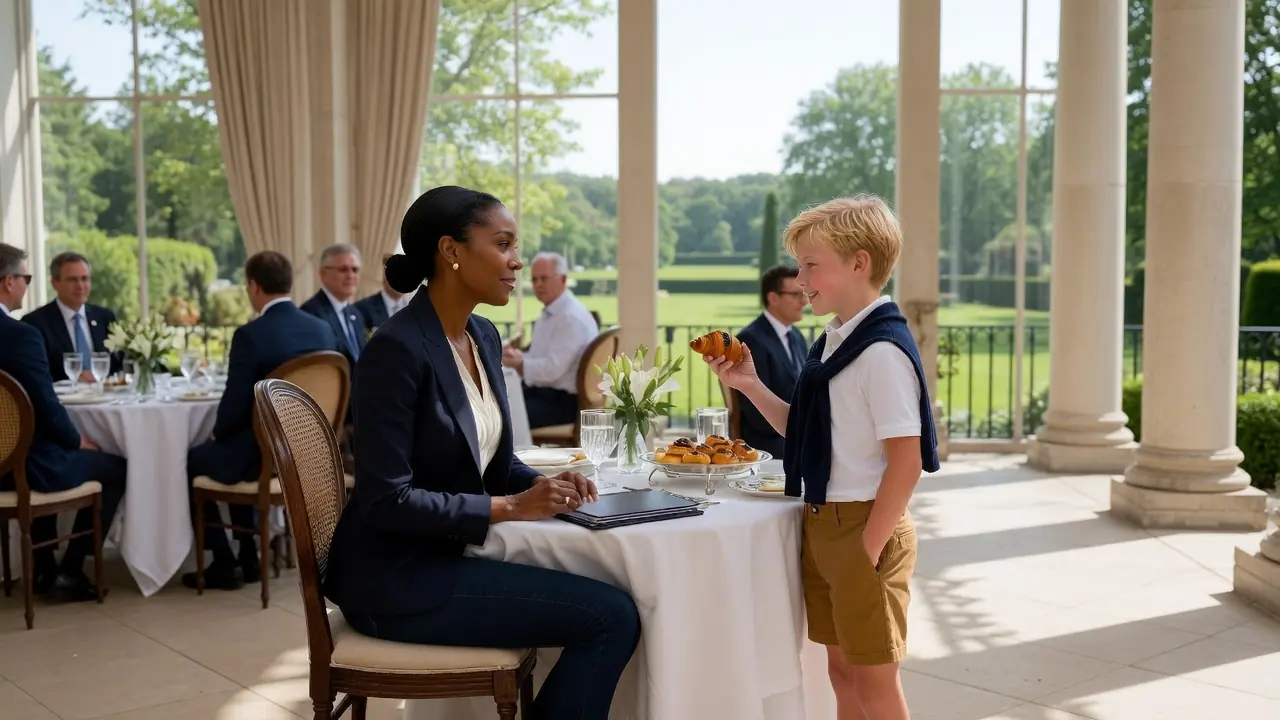
Brandon Whitmore, Patricia and David Whitmore’s twelve-year-old son, stood beside his family’s table with a chocolate croissant in his hand. He had pale blond hair, a white polo shirt, a navy sweater tied around his shoulders, tan shorts, and the smug little grin of a boy who had never been told no. He looked at Jordan, then at his mother, waiting for permission. Patricia smiled wider, enjoying the attention.
“Go on, Brandon,” she said, laughing from her table. “Teach her a lesson she won’t forget.” Brandon’s grin stretched across his face as he raised the croissant like a baseball. “Look at you sitting there,” he said toward Jordan, his voice dripping with childish arrogance. “Thinking you belong with all of us.”
Jordan finally lifted her eyes. Her face remained calm, but the terrace had gone quieter around her. Brandon tossed the pastry once in his hand, enjoying the attention. “Bet you can’t handle this like someone from our world,” he added, then pulled his arm back and threw.
The croissant spun through the air in one smooth, cruel motion. It hit Jordan’s hair and shoulder, bursting apart as chocolate smeared across her white collar, blazer, and the documents in front of her. For half a second, the entire terrace froze. Then Patricia screamed with delight and clapped her hands like her son had performed a party trick.
Jordan did not scream. She did not jump up. She reached slowly for her napkin and dabbed chocolate from her collar with careful movements, though her fingers trembled slightly. Her breathing stayed controlled, one slow inhale, one slow exhale, while her phone quietly continued recording everything.
Thomas, the club manager, stood near the kitchen doors with his jaw clenched. He was fifty-three, Black, and had worked at Meadowbrook for thirty years. He had heard the jokes, swallowed the insults, and watched men and women with money treat staff like furniture. That morning, he watched Jordan wipe chocolate from her hair, and his fists tightened at his sides.
At table seven, an elderly woman named Margaret started to rise. Her husband grabbed her wrist and pulled her back down with a sharp shake of his head. Margaret’s face twisted with shame, but she sat. Everyone sat. Everyone watched.
Jordan placed the stained napkin on the table and began gathering her wet papers. Water from a knocked glass had spread across her documents, blurring ink on confidential reports, projections, and contracts. She stacked each page carefully, one after another, as if order might keep the humiliation from becoming real. Patricia snapped her fingers toward Thomas without looking at him.
“Thomas, get over here,” Patricia said. Thomas approached with the neutral expression of a man who had survived decades by showing nothing. “Yes, Mrs. Whitmore.” Patricia pointed toward Jordan like she was pointing out a stain on the carpet. “That woman. I don’t recall seeing her on the guest list.”
Thomas hesitated. “Mr. Henderson invited her personally, ma’am.” Patricia’s eyes narrowed. “Robert Henderson invited her?” she repeated, then laughed. “I find that very hard to believe. He knows our standards.”
Jordan kept stacking the papers. Patricia stood abruptly, her chair scraping against the marble terrace floor. David followed her, still holding his phone, and Brandon trailed behind them, grinning like the morning had become entertainment. Other diners turned to watch more openly. Even the violinist missed a note.
Patricia stopped directly behind Jordan’s chair, close enough for her perfume to overwhelm the smell of lilies. “Excuse me,” she said in a voice like ice. “This is a members-only event. I am president of the ladies’ auxiliary committee, and I don’t recognize you.” Jordan did not turn around at first.
“I’m talking to you,” Patricia snapped. “It is basic manners to look at someone when they are speaking.” Jordan turned slowly. Chocolate still streaked her hair, but her eyes were calm in a way that made Patricia’s smile falter. “I was invited by Mr. Henderson,” Jordan said quietly. “I have every right to be here.”
Patricia gave a sharp little laugh. “Robert Henderson would not invite someone dressed like that to a benefactor’s event.” Her gaze moved over Jordan’s jeans and blazer with open contempt. “Let’s be real. Jeans to Meadowbrook? What are you, the help?”
David stepped closer and looked Jordan up and down like she was a problem to be removed. “Look, miss, nobody wants a scene,” he said. “Why don’t you just leave quietly?” Jordan’s jaw tightened, but her voice remained controlled. “I have an invitation.”
“From who?” Patricia said. “Show me.” Jordan held her gaze. “It was verbal. Mr. Henderson called me personally.” Patricia turned toward the watching terrace. “How convenient. No paper trail.”
A few people nodded. More looked uncomfortable but said nothing. David tried calling Robert Henderson, but the call went straight to voicemail. Patricia’s smile sharpened. “So we have no proof you were invited,” she said. “You are wearing jeans, and you are going through corporate documents that probably do not belong to you.”
Before Jordan could stop her, Patricia reached across the table and snatched one of the papers. She scanned the header and read it aloud with mock surprise. “Ellis Industries Q2 aerospace projections.” She raised her eyebrows. “Oh, this is rich. Did you steal these from some office?”
Jordan stood slowly, and only then did Patricia realize Jordan was taller than she was. “That is confidential property,” Jordan said. “I need it back.” Patricia held the paper higher. “Or what? You’ll call your lawyer, sweetie? Lawyers cost money.”
Then Patricia ripped the paper in half. She ripped it again, and pieces fluttered down onto the marble like white ash. “Oops,” she said. The terrace went silent, and even the violins stopped.
Jordan’s hands curled into fists at her sides. “You just destroyed corporate property,” she said evenly. David laughed. “Lady, I do not know what office you clean, but those documents probably belong to your employer, not you.” He stepped closer, close enough for Jordan to smell bourbon on his breath. “Let me guess. Secretary? Assistant? Here to pick up your boss?”
“Maybe catering staff,” Patricia added. “The uniform room is through the kitchen.” Laughter rippled through nearby tables, not everyone, but enough. Jordan bent down to collect the torn papers, and her hands shook visibly now. Brandon saw another chance to perform.
He darted forward and kicked Jordan’s briefcase hard. It toppled over, sending documents, pens, a red leather folder, a USB drive, and a tablet scattering across the marble. Patricia laughed again. “Brandon, stop that,” she said, but her voice was delighted. “You’ll get your shoes dirty.”
Jordan knelt on the floor and began gathering her things. Chocolate from her hair dripped onto the marble while she reached for contracts marked with government seals. David watched with disgust mixed with amusement. “Look, sweetheart,” he said, “Meadowbrook is a private club. We have standards. We have traditions.”
Patricia circled her slowly. “What David is trying to say politely is that you would be more comfortable at the public facilities in town.” Then she lowered her voice just enough to make the words sharper. “You know, where people like you usually go.” The phrase hung in the air, and no one could pretend anymore that this was about clothing or invitations. It was about who they believed had the right to exist in the room.
Thomas stepped forward. “Mrs. Whitmore, perhaps we should...” Patricia cut him off without turning. “Stay out of this, Thomas, unless you want to join her.” Thomas stopped, his hands clenched at his sides. Thirty years of swallowed words held him in place. Margaret stood again, her voice shaking. “Patricia, that’s enough.”
Her husband yanked her down again. “Margaret, don’t.” Jordan gathered the last document and stood slowly, briefcase in one hand, torn papers in the other. Chocolate stained her blazer, water soaked her jeans, and her eyes were wet, but her expression had become stone. She looked at Patricia, at David, and at Brandon.
“I understand perfectly,” Jordan said quietly. “More than you know.” She turned toward the terrace exit. Ten tables stood between her and the door. Every eye in the room followed her.
She made it five steps before Brandon grabbed his half-full glass of orange juice. Pulp floated near the top as he pulled his arm back. Thomas saw the motion and shouted, “Brandon, no.” But it was too late.
The juice flew in a bright arc and hit Jordan squarely in the back. Cold liquid soaked through her navy blazer, and orange pulp slid down the fabric before dripping onto the marble floor. Patricia’s shriek of laughter echoed off the vaulted ceiling. David high-fived his son across the table.
“That’s my boy,” David said proudly. “That’s my boy.” Other parents smiled weakly, while some looked away. Jordan stopped walking. She stood perfectly still as orange juice dripped from her blazer, forming a small pool at her feet.
She did not turn around right away. Her shoulders rose and fell once with a controlled breath. Then she reached into her pocket and pulled out her phone. The screen had been recording for twenty-three minutes.
Jordan tapped stop and saved the file. Then she turned slowly to face the terrace. Her expression was calm, almost eerily calm, as she looked at Patricia, David, Brandon, and every single person who had watched in silence. “I’m leaving now,” she said, her voice carrying clearly across the terrace. “But I will be in touch.”
Patricia waved dismissively. “Oh, we’re so scared. Thomas, call security. I want her escorted out properly.” Jordan’s eyes locked on David. “That won’t be necessary,” she said. “I know the way.”
She walked toward the exit with measured steps, leaving a trail of chocolate and orange juice behind her. At the door, she paused and turned back one last time. “See you Monday, Mr. Whitmore.” David frowned. “Monday? Lady, I do not even know who you are.”
Jordan smiled, but it did not reach her eyes. “You will.” Then she was gone. Patricia burst into fresh laughter, asking if everyone had heard Jordan threaten them. Within minutes, she had posted a photo of Jordan’s stained back on Instagram, adding mocking captions, emojis, and hashtags about private club standards.
The terrace returned to normal almost too quickly. The violins resumed. Servers returned to work. Conversations picked back up, as if Jordan Ellis had never been there at all. But Patricia’s post was already spreading beyond her control.
At first, the comments praised her. Then different comments appeared. Some people asked if the woman had been invited. Others said the post looked racist and cruel. Patricia deleted critical comments and blocked users, but one comment made her pause. “Wait, is that Jordan Ellis? She spoke at my university last year. She’s a CEO.”
Patricia screenshotted the comment and sent it to David with laughing emojis. He did not respond. Sixty-four minutes after Jordan left, David’s phone rang. It was Robert Henderson, the club president, and his voice was tight with panic.
“David, I just got six texts about an incident at brunch,” Robert said. “What happened?” David waved his hand even though Robert could not see him. “Some woman tried crashing the event. Patricia handled it. No big deal.”
“Some woman?” Robert’s voice rose. “David, who was she? What did she look like?” David frowned. “I don’t know. Black woman, jeans, didn’t belong. Claimed you invited her, but...” Robert’s breathing became audible on the line. “Oh, God. David, what did you do?”
“What?” David said, irritated. “We asked her to leave. She was going through corporate documents.” Robert’s voice dropped into ice. “That was Dr. Jordan Ellis. CEO of Ellis Industries. I invited her personally to discuss the STEM sponsorship.”
The terrace suddenly felt too hot. David’s mimosa glass stopped halfway to his mouth. “That’s not possible,” he whispered. “She looked like...” Robert cut him off. “Like what, David? Finish that sentence.”
David could not finish it. Robert continued, “She was conducting an anonymous evaluation of our club culture before committing 5 million dollars. What did you do?” David’s mouth went dry. “There was a misunderstanding. My son threw some food. Patricia may have said some things. We didn’t know who she was.”
“That is exactly the problem,” Robert snapped. “You did not need to know who she was. You should have treated every guest with respect.” David hung up and immediately searched Jordan Ellis on his phone. The results filled the screen: Forbes profile, corporate interviews, keynote speeches, Ellis Industries headquarters project.
Then he saw it. Whitmore Properties Group was listed as lead bidder for the 1.5 billion dollar headquarters campus. Final decision meeting, Monday morning, 9:00 a.m. Forty-eight hours away. David’s stomach dropped like an elevator with cut cables.
“Patricia,” he said, his voice strangled. “Get over here.” Patricia was showing friends her Instagram post, but David’s tone made her stand. “What’s wrong with you?” she asked. David turned the phone toward her. “That woman Brandon threw food at was Jordan Ellis.”
Patricia blinked. “Who?” David’s hands shook. “Jordan Ellis, CEO of Ellis Industries. The company I’m bidding for. The 1.5 billion dollar contract.” Patricia grabbed his phone, looked at the photos, and her face went white. “Oh my God,” she whispered. “That’s not possible. She was dressed like...”
“I know what she was dressed like,” David snapped. Then his chair fell backward as he stood too fast. “And you posted it on Instagram.” Patricia pulled out her phone and deleted the story immediately, but the screen warned that deletion might not remove all shared copies. Screenshots already existed. The internet had already done what the internet always does.
Reporters started calling. Business partners started texting. Clients asked urgent questions. Robert Henderson ordered David and Patricia to attend an emergency board meeting. Patricia’s follower count began dropping, and screenshots of her post spread with captions identifying Jordan as the CEO of Ellis Industries.
Across town, Jordan sat in her home office. The recording was crystal clear, every word, every laugh, every insult. She had already sent it to her attorney, Rachel Martinez, a civil rights specialist with decades of experience. Rachel called back within ten minutes.
“Jordan,” Rachel said, “this is everything. Assault, battery, defamation, intentional infliction of emotional distress. Multiple witnesses will corroborate.” Jordan touched her hair, still sticky with chocolate. Her stained blazer hung over the chair beside her. “I want all of it,” she said. “Every consequence.”
On Monday morning at 8:45, David Whitmore stood in the Ellis Industries lobby with white roses in his hand. He wore his best navy suit and had rehearsed his apology seventeen times. The receptionist looked up with a professional smile that carried no warmth. “Mr. Whitmore, there has been a schedule change. Ms. Ellis is unavailable.”
David’s voice cracked. “Unavailable? The contract presentation is at nine.” The receptionist’s expression did not change. “You should check your email.” David pulled out his phone with shaking hands. At exactly 9:00 a.m., the email arrived.
“After comprehensive review,” it read, “Ellis Industries has decided to pursue alternative partnerships for our headquarters campus project. Your firm’s bid has been withdrawn from consideration effective immediately. This decision is final.” His phone slipped from his hand and clattered onto the marble floor. The 1.5 billion dollar contract was gone.
Behind him, his project team emerged from the elevator dressed for the presentation of their lives. “David?” his lead architect asked. David looked at them with a hollow face. “Go home,” he said. “We lost it.” Then he walked out to the parking garage and sat in his Mercedes, staring at nothing.
At eleven that morning, Jordan entered a packed conference room. Journalists lined the walls, cameras flashed, and microphones from major networks crowded the podium. She wore a charcoal suit, her hair styled perfectly, and she looked exactly like what Patricia and David had failed to see: power. Her attorney stood on one side, and civil rights representatives stood on the other.
“On Saturday, May eighteenth,” Jordan began, “I attended Meadowbrook Country Club as an invited guest. I was evaluating the club for a 5 million dollar STEM donation. Instead, I was physically assaulted by a twelve-year-old child while his parents laughed.” The room went silent. “I was told I did not belong, accused of theft, and publicly humiliated. I recorded everything.”
She played thirty seconds of audio. Patricia’s voice filled the room, mocking Jordan. Then came the impact of the croissant, Patricia’s delighted laugh, David threatening to have Jordan removed, and Brandon bragging about what he had done. Several journalists covered their mouths. One wiped tears from her eyes.
“This is not one incident,” Jordan said when the audio stopped. “This is the daily indignity people of color face when appearance is judged before humanity.” She looked straight into the cameras. “I have a PhD from MIT. I built a 2.3 billion dollar company. I employ twelve thousand people. None of that protected me from being treated like trash.”
She announced a civil suit against the Whitmore family. Her attorney announced that Meadowbrook’s membership practices would be investigated. The screenshot of Patricia’s deleted Instagram story appeared on the screen behind them. Jordan’s voice remained steady. “The internet is forever,” she said.
By noon, the Whitmore family’s world was on fire. David’s apology statement was torn apart online within minutes. Clients canceled contracts, business partners demanded answers, and his company’s board moved to remove him from leadership. Patricia posted a tearful apology video, insisting she was not racist, but the public did not believe her.
Her sponsorships disappeared one by one. Her follower count collapsed. Charity boards removed her. Her friends stopped calling. Brandon’s private school expelled him, citing the incident and his previous bullying record.
Meadowbrook revoked the Whitmore family’s membership unanimously. Their access cards were deactivated, and they were told to collect their personal items by Friday. The bank demanded a meeting about David’s business loans. The social world that had once protected them began closing every door at once.
The story became national news. Jordan appeared on morning television and calmly explained what had happened. She said she recorded discrimination because documentation was often the only protection people had. Her words spread far beyond Connecticut.
Investigations revealed deeper patterns at Meadowbrook and at Whitmore Properties. Families of color had been rejected under vague phrases like “cultural fit” and “traditional character.” Former employees described discriminatory rental practices. What began with a croissant became the key that unlocked years of hidden cruelty.
The trial months later lasted three weeks. The jury deliberated for six hours and found the Whitmores liable on all counts. Jordan was awarded millions in damages, but she said afterward that the money had never been the point. The point was accountability.
David eventually filed for bankruptcy. His company collapsed under lost contracts, legal fees, and public disgrace. Patricia’s influencer career disappeared, and she took a retail job at a cosmetics counter, where her manager was a Black woman she addressed carefully as “ma’am.” Brandon was ordered into therapy and community service, forced for the first time to confront the harm his parents had taught him to excuse.
Meadowbrook settled the discrimination lawsuit and was forced into major reforms. Many old members resigned in protest, but new families joined, and the club slowly changed. Thomas, the manager who had stayed silent for thirty years, testified and finally told the truth about what he had seen. Margaret testified too, admitting she was ashamed she had not stood up sooner.
Jordan used the public attention to launch the Beyond Appearances Initiative. The program funded 20 million dollars in STEM scholarships for students of color, partnering with universities across the country. At Ellis Industries, she told her employees that silence protects abusers and that power means nothing if it is not used to open doors for others. The applause lasted long after she stepped away from the podium.
Months later, Jordan spoke at a civil rights conference in Atlanta. “Character has no dress code,” she told the crowd. “Respect is not reserved for people you recognize. Dignity is not determined by designer labels.” Her voice was firm, her face calm, and the world listened.
What happened at Meadowbrook became more than a viral scandal. It became a warning about entitlement, prejudice, and the cost of assuming someone has no power because they do not look the way you expect. Brandon thought he was throwing food at a woman who could not fight back. Instead, he exposed the entire world that raised him.
Jordan Ellis did not ask for revenge. She demanded accountability. She turned public humiliation into a lesson that no amount of money could erase. And by the time the Whitmores begged for forgiveness, the damage had already been done, not to Jordan’s future, but to their own.