The clock on the mantelpiece read 11:47 when Walter Haymes heard the knock. Not a polite knock, the kind that belongs to neighbors borrowing sugar or postal workers dropping off parcels, but something heavier, more deliberate. Three solid strikes against the wood of his front door that Walter felt as much as heard, vibrating faintly through the floorboards of his living room and traveling up through the legs of the old Windsor chair where he sat. He did not move immediately. At 74, Walter had developed the particular stillness of a man who had learned to measure time rather than chase it. 41 years behind the glass counters of Haymes and Son Timepieces on Morrison Street had taught him that most things worth doing were worth doing slowly.
His hands, though knotted now at the knuckles and mapped with the raised veins of age, still moved with precision when they needed to. But the rest of him, the broader machinery of his body, had settled into a quieter rhythm. The knock came again. Four strikes this time. Walter set down the book he hadn't really been reading and rose from his chair with the measured effort of a man negotiating with his own joints.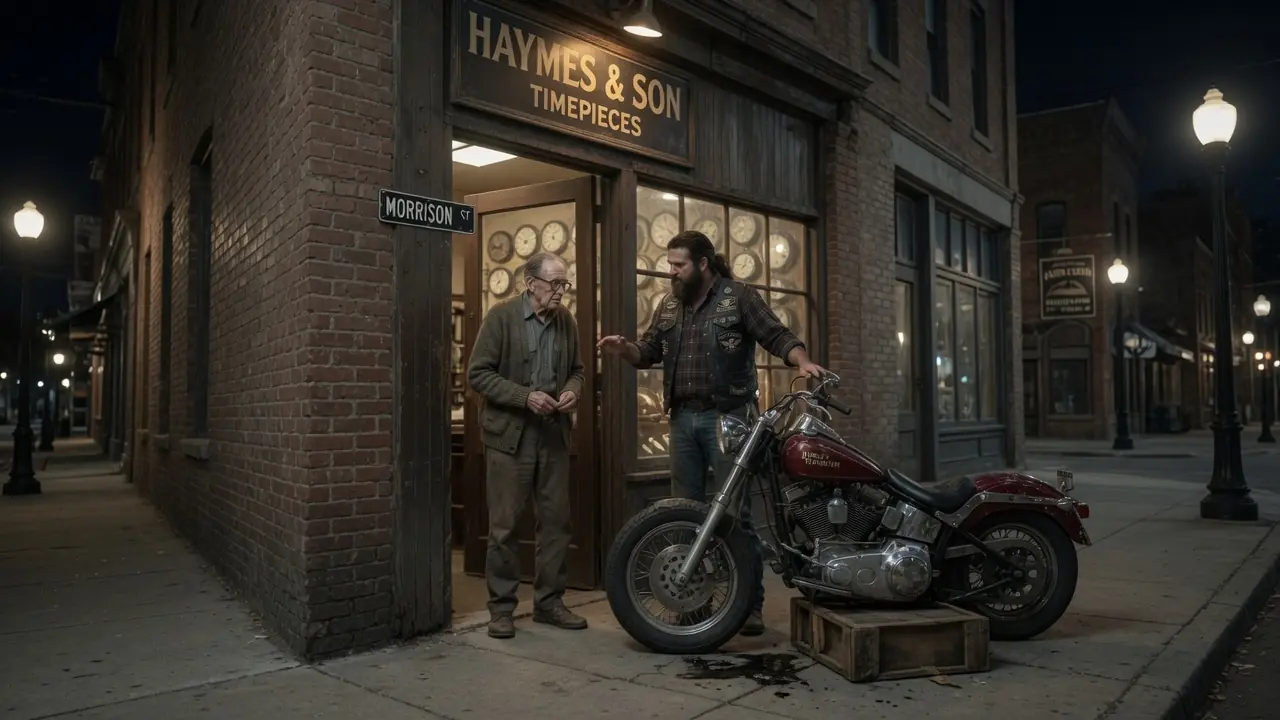
The living room was warm but dim, lit by a single floor lamp in the corner and the low blue glow of the television, which he'd muted an hour ago when the news became too loud for his thoughts. Framed photographs lined the far wall, Meredith on their wedding day, her dark hair pinned with small white flowers, Tommy at his college graduation squinting against the June sun, the shop on Morrison Street in its better years, the window display gleaming with grandfather clocks and anniversary pieces, and the German cuckoo clock that Walter had repaired 17 times and never quite trusted. He crossed the room and lifted the curtain from the narrow window beside the door. What he saw there on the sagging wooden porch of his house on Ember Creek Road was a large man, very large. The man stood with his arms slightly away from his sides, not in aggression, but with the unconscious posture of someone accustomed to taking up space.
He wore a leather vest over a dark flannel shirt, the kind of vest that carried patches and insignia, the way a military uniform carries ribbons. His hair was dark and pulled back. His beard full and dense. And even in the poor orange light of the porch lamp, Walter could see the layer of road dust that coated him from shoulders to boots. A motorcycle was visible at the edge of the gravel driveway.
It sat at an unnatural angle, leaning too far to be resting on its stand, leaning the way things lean when something has gone wrong. Walter held the curtain for a moment longer than necessary. His late wife, Meredith, would have recognized the hesitation. Not quite fear, but the careful assessment of a man who had lived long enough to know that the world contained both kindness and its opposite. And that the difference was not always visible from a window.
He let the curtain fall and opened the door. The man was taller up close. six-foot-two, Walter estimated, maybe six-foot-three, with a build that suggested he'd worked physically for most of his life. Up close, the road dust was more apparent. On his cheekbones, in the creases beside his eyes, at the base of his neck above the collar. "Sorry to bother you," the man said.
His voice was low and unhurried, carrying the flattened vowels of the Tennessee uplands. "Saw your light on. My bike's down at the end of your drive. Something let go about 3 miles and I coasted her in here. I'm Dale.
Dale Crow. Walter looked at him for a moment. Then he looked past him at the motorcycle. "What let go? " Walter asked.
Dale turned slightly to indicate the bike. Primary chain, I think, or the tensioner. She was running rough for the last 20 miles, and then just quit. He paused. "I was hoping you might have a phone I could use.
Mine's dead. " "The nearest shop that could help you tonight is about 40 miles south," Walter said, "and it won't be open until 8:00 tomorrow. " "I know it," Dale said. He didn't add anything to that. He simply stood and waited, and Walter recognized in that patience the manner of a man who understood that asking for help was already the harder thing, and that adding words to it only made it worse.
Walter opened the door wider. "Come in," he said. "Let me get a look at that machine. " Dale Crow's eyebrows rose, just barely, just enough. "I don't want to put you out.
" "You're not," Walter said. And then, because he was Walter Haymes, and he had never been good at leaving things unsaid, he added, "I was a clockmaker for 41 years. I know my way around a mechanism. Whether that translates to motorcycles, we'll find out. " He retrieved his coat from the hook by the door, an old canvas barn coat that had been Meredith's father's, and his flashlight from the kitchen drawer, and his reading glasses from the mantelpiece, because at 74, his eyes required assistance that they had not required at 40.
Walter crouched beside it with the flashlight and examined what he could see without opening anything. Even in the poor light, the signs were legible to him, the way the signs of a misbehaving movement were legible. The particular stillness of a mechanism that had simply stopped, the small residue of oil around the primary cover that spoke to heat and stress. "Do you have tools? " Walter asked.
"In the saddlebags. " "Bring them out, and bring them to the garage. There's more light in there. " The garage was attached to the back of the house and smelled of motor oil and wood shavings, and the particular dry mustiness of spaces where things are kept but not often used. Walter's workbench occupied the far wall, a heavy wooden surface 8 ft long equipped with vices and drawers and the accumulated tools of a lifetime in fine mechanical work.
The overhead fluorescent light had been dead for three months because Walter hadn't gotten around to replacing it, but there were two shop lights on extendable arms and a good desk lamp that he brought over from the bench. And by the time Dale had unstrapped the saddlebags and laid his tools out, the garage was lit with the warm amber quality of multiple overlapping pools of light. "It's an older model," Walter said, beginning the process of removing the primary cover. "Mid-90s, I'd say. " "'96," Dale confirmed.
He stood at Walter's shoulder, not crowding, just present, the way a person stands when they're watching something being done that they respect but cannot do themselves. Walter worked carefully with the habit of a man who had spent four decades opening the cases of things more delicate than this. He removed the cover, wiped the threads with a clean rag he found on the bench, and examined the primary chain in the better light. The tensioner, a small unglamorous piece of equipment that existed purely to maintain the correct pressure on the chain, had failed at one of its mounting points, allowing the chain to go slack. "There it is," Walter said.
Dale leaned in to look. ""Can it be fixed? "" "Depends on what you have in those bags. " Walter picked up the tensioner and turned it in his fingers, looking at it with the same focused attention he had given to mainsprings and escapements. "And whether I have anything here that will substitute.
" What followed was an hour of the particular concentrated problem-solving that Walter had always loved, the kind that existed entirely in the physical world, in the relationship between a part and its function and the available materials. Dale's tool bag was well-stocked because Dale was the kind of man who had learned that the road rewarded preparation. Walter's garage contained, among other things, a collection of salvaged hardware that Meredith had called his Magpie Corner, bolts and brackets and small metal components accumulated over decades without any specific purpose except the instinct that they might one day be useful. The power went out at 12:45 a.m. It happened without drama. One moment the shop lights were burning and then they were not.
And the garage was dark except for a narrow rectangle of paler dark at the door. Walter stood still for a moment in the sudden quiet, listening to the absence of the refrigerator hum from the kitchen. "Storm's been threatening all evening," he said. "Line goes out here sometimes when the wind comes off the ridge. " He found the candles in the kitchen.
Meredith had kept an emergency drawer stocked with candles and matches and a hand-crank radio, and Walter had never changed its contents. He brought four of them to the garage, set them at intervals across the workbench, and lit them. The light they produced was different from the shop lamps, softer, more directional, casting the work in amber and shadow, and leaving the corners of the garage in darkness. Dale Crow looked at the candlelit garage, at the old man standing at the workbench with a tensioner in one hand and a pair of reading glasses pushed up on his forehead, and he said nothing. There was nothing useful to say.
They worked through the power outage. Walter found a bracket in the magpie corner that could be adapted. It required modification, a careful reshaping with a file and a steady hand, but Walter's hands were steady when they had a purpose. He worked at the bench while Dale held the light from his phone and handed him tools when asked, and otherwise stayed quiet in the way of a man who understood the value of silence in a workspace. It was this quality in Dale Crow, the stillness, the lack of performed impatience, the way he simply existed in the garage without demanding acknowledgement, that Walter noticed more than the leather vest or the road dust or the patches.
He had worked alongside many people in his years at the shop, and he had learned that you could tell a great deal about a person from the way they occupied a workspace where they were not in charge. Dale occupied it the way a careful man does, with attention and without complaint. Around 2:00 in the morning, Walter set down his file and flexed his hands. "Coffee," he said. It was not quite an offer and not quite a question.
"I won't turn it down," Dale said. They sat at the kitchen table, Walter's kitchen table, the same oak table where he had eaten breakfast for 37 years, and where he and Meredith had done the shop's bookkeeping on Sunday evenings, and where Tommy had sat as a boy doing homework while Walter read the paper. A pot of coffee between them, the windows dark, the power still out, and the candles from the garage now supplemented by two more from the emergency drawer. "You passing through? " Walter asked.
"Heading to a gathering," Dale said, "took the long route. " He wrapped both hands around the mug. "You're not from here originally. " Walter shook his head. "Ohio.
Came down for a girl and stayed for 40 years. " He paused. ""She passed four years ago. "" "I'm sorry," Dale said, and the words were plain and direct without the excess that people sometimes added when they didn't know what else to say. "The shop closed the same year," Walter continued, which surprised him.
He didn't usually talk about either thing to people he'd just met. "Three months after she died, I'd been keeping it going mostly out of habit, I think. After she was gone, the habit ran out. " Dale nodded slowly, as if this made a particular kind of sense to him. "What do you do now?
" he asked. Walter looked at his hands. "I read. I tend the garden when it's the right season. I sit with the clocks.
" He glanced toward the living room, where four clocks of various sizes occupied the mantelpiece and the shelves. Each one ticking, each one keeping slightly different time, each one a piece of a life's work that had no shop to return to. "I keep them running. " Outside, the wind moved through the trees along Ember Creek, and the candle flames wavered slightly, and Dale Crow looked at Walter Haymes across the kitchen table with an expression that Walter could not quite read, but that seemed in its quiet way to be taking account of something. They returned to the garage at half past two.
Walter worked and Dale assisted, and the candles burned low and were replaced. The bracket adaptation required patience more than expertise, the kind of slow iterative work that Walter had always found satisfying, the kind where each small increment of progress was visible and measurable. By 3:30 a.m., he had the tensioner modification complete, and by 4:15 a.m., the primary cover was back in place. He stood and pressed both hands flat against the workbench to relieve the ache in his lower back. "Try it," he said.
Dale wheeled the Road King to the top of the driveway, which had a slight downhill grade, and attempted to start it. The engine turned over twice, caught, stumbled, caught again, and then settled into the deep rhythmic pulse that Walter supposed motorcycles were meant to make, a sound like a very large, very confident heart. Dale sat on the idling bike for a moment, his head slightly bowed, his hands on the grips. Then he shut it off and walked back to where Walter stood. "What do I owe you?
" he asked. Walter shook his head. ""Nothing. "" "That's not an answer I can take. " "Then take it anyway," Walter said.
"It's what's being offered. " Dale looked at him. In the gray pre-dawn light, the power was still out, but the eastern sky above the tree line had begun to separate itself from the darkness. His face was clearer than it had been in the candlelit garage. He was younger than Walter had initially estimated. early forties with the kind of wear on him that came from a life lived mostly outdoors and in motion, and the kind of calm that came from having made peace with that life.
"I'll be back through this way," Dale said. "When I am, I'd like to bring you something. " "You don't need to. " "No," Dale agreed, "I don't need to. " He offered his hand.
""Thank you, Walter. "" Walter shook it. The man's hand was large and calloused, and the grip was firm without being demonstrative. The grip of a man who meant the handshake as a statement rather than a performance. Dale Crow put on his helmet, kick-started the Road King once more, and rode slowly down Ember Creek Road and out of sight.
Walter stood at the edge of his driveway until the sound of the engine faded into the early morning quiet of the Tennessee hills. Then he went inside, extinguished the remaining candles, and went to bed. He slept until 9:00, which was unusual for him. When he woke, the power had returned, and the birds were loud in the yard, and the clock on the nightstand read 9:14 a.m. And Walter lay still for a few minutes in the particular light of a morning after, thinking about nothing in particular. He thought about the tensioner, about the candles on the workbench, about the way Dale Crow had said, "Thank you.
" Not effusively, not with the excess that sometimes made gratitude feel like a performance, but with the directness of a man who meant exactly what he said and nothing more. Walter got up, made coffee, and went to tend the garden. The summer had been dry in Millhaven, and the beds along the south fence required attention. The tomato plants especially, which had grown tall and unruly in the weeks of heat, and now needed staking and trimming. Walter worked in the morning sun with the patient attention he brought to everything, staking each plant and tying the stems with lengths of soft twine from the shed.
Ruth Albright came over the fence at 11:00 a.m., which she did most mornings, because Ruth had lived next door for 30 years, and had never fully absorbed the concept of property boundaries as they pertain to conversation. "Whose motorcycle was that in your driveway last night? " she asked, leaning on the fence with the comfortable authority of a woman who had earned the right to be curious. "A traveler," Walter said. "His machine broke down.
" Ruth processed this. "At midnight? " "About that. " "And you let him in? " "He needed help with his engine," Walter said.
"I helped. " Ruth looked at him over the fence with the expression she reserved for Walter's more inexplicable decisions, a mixture of fond exasperation and a kind of grudging respect. She was 70 years old and had been a school teacher for 35 of them, and she brought to all situations the assessment skills of a woman who had spent three decades evaluating the quality of explanations. "Was he? " she began, and then seemed to recalibrate.
""Were you all right? "" "He was a perfectly decent man who needed attention and repaired," Walter said. "We had coffee. He left at dawn. " Ruth considered this.
"Well," she said finally, "I suppose that's that, then. " But it wasn't that. Three days after Dale Crow rode down Ember Creek Road, a package appeared on Walter's porch. He found it when he stepped out to collect the morning paper. A flat box, neatly wrapped, with his name on the front in blocky handwriting and no return address.
Inside was a pair of leather work gloves, the good kind, made from thick cowhide with a soft lining. Exactly the sort Walter would have chosen for himself and never gotten around to buying. With them was a note, written on plain white paper in the same blocky hand. For the next time something needs fixing. DC Walter stood on the porch in his slippers and read the note twice.
Then he folded it and put it in his shirt pocket and went inside to make his coffee. And he thought about Dale Crow on and off for the rest of the day, in the way you think about something that has settled into a different place than you expected. The weeks that followed were ordinary weeks. Walter tended his garden and read his books and wound his clocks, and drove twice a week into town for groceries or the occasional lunch at the counter of Bev Hartwell's diner on Morrow Avenue, where the coffee was strong and the pie was reliable, and Bev herself was a compact, cheerful woman of 55 who had been feeding Millhaven for 20 years and knew everything about everyone without seeming to try. He had lunch at the counter on a Tuesday morning when Scott Devlin came in for takeout.
Scott was a deputy with the county sheriff's office, a lean man in his mid-30s who had grown up two roads over from Walter and still referred to him as Mr. Haymes, despite repeated invitation to do otherwise. "You look well," Scott said, waiting for his order. "I sleep all right," Walter said. "Mrs. Albright said you had a motorcycle in your driveway a few weeks back. " Walter looked up from his pie.
""Ruth talks to everyone. "" "She does," Scott agreed with the easy equanimity of a man in law enforcement who had long since made peace with the information flow of small towns. ""Everything okay? "" "A man's tensioner failed 3 miles from my house," Walter said. "I fixed it.
We had coffee. " Scott nodded slowly. He had the look of a man assembling a fuller picture from partial information, but he didn't push further. "Well," he said, "good of you. " ""Anyone would have.
"" Scott picked up his order from the counter and held the door. "Not everyone would have," he said, "but that's you, Mr. Haymes. " Walter returned to his pie and thought, not for the first time, that Scott Devlin had the makings of a genuinely good man underneath the uniform, which was not always a given. He drove home by way of Morrison Street as he sometimes did, passing the building that had been Haymes and Son Timepieces. It was a tax preparation office now.
The display window held a poster advertising refund advances, and the glass was slightly smudged at shoulder height, the way shop windows get when they're not cleaned often enough. Walter drove past it at 15 miles per hour and did not stop. Tommy called that evening as he did every Sunday. "How's the garden? " Tommy asked.
He was in Cincinnati, where he worked in project management for a construction company, a world so removed from clock making that Walter sometimes marveled at the distance a generation could travel. "Good enough," Walter said. "Tomatoes are coming. Beans are slow. " "You been out much?
" "Some. Had lunch at Bev's Tuesday. " "Good," Tommy said. There was a pause, the kind of pause that contained something waiting to be said. "I was thinking I might come down for a weekend in the fall after the season turns.
That would be good, Walter said, and he meant it. Though he and Tommy had a relationship that functioned better in small doses, they loved each other in the abstract and exhausted each other in the particular, which Walter understood was not so different from many fathers and sons. You're doing all right, Tommy asked. I'm doing fine, Walter said, and he was. The evenings were long now, the way summer evenings in Tennessee tend to be, and Walter sat on the back porch after supper and listened to the creek and the birds and the sound of the occasional car on the road, and he thought about mechanisms, the way things work together, the way small components maintain the function of much larger systems, the way a single failed part could stop everything, and a single careful repair could set it going again.
He wore the work gloves Dale had sent whenever he worked in the garden. He kept the note in the same drawer where he kept Meredith's letters. He did not think about the motorcycle again in any particular way, and the weeks passed the way weeks pass in a small town in summer, slowly and full of themselves, and Walter settled into the rhythm of them until the morning his neighbor's dog started barking at something down the road. The first sound was low and distant, the way thunder sounds before it resolves itself into something specific, a vibration at the threshold of hearing, more felt than identified. Walter was on the back porch with his morning coffee when he heard it, and he thought for a moment that a storm was coming in off the ridge, but the sky was cloudless.
He set down his coffee and walked around the side of the house following the sound, which was growing. Ruth Albright was already at the fence, which meant the sound had preceded Walter's awareness of it by some time. She stood with both hands on the rail, looking down Ember Creek Road in the direction of town, and even from across the yard, Walter could see the expression on her face, a particular stillness that was different from her usual animation. "Walter," she said without looking away from the road. "I hear it," he said.
He came to stand beside the fence. They appeared around at the south end of Ember Creek Road in a formation that Walter would later struggle to describe accurately, because the language he had for impressive things was the language of small, precise objects, mainsprings and jeweled bearings and the tiny screws that held the world of a watch together. And what came around that curve required a different vocabulary entirely. They came two abreast, filling the road from edge to center line, a column of motorcycles that appeared first as a collection of chrome and color and sound, and then, as they drew closer, resolved into individuals, men and women on large machines, each of them carrying the particular gravity of people who have traveled a long way together for a purpose. The sound was immense, not aggressive, but full.
The way a piece of music is full when it is being played by the right number of instruments. It took them four minutes to round the curve and come to rest on Ember Creek Road. Walter stood at his fence and counted seconds the way he had counted seconds his entire life, with the automatic precision of a man whose relationship with time was not casual, and four minutes was what it took for 980 machines to travel from the curve to the point where the column stopped. four minutes was longer than it sounded when you were standing still. Walter stood at his fence and watched them come. Scott Devlin's cruiser was pulled over at the far end of the road, lights on.
Scott himself stood beside it with his arms at his sides watching. Two other county vehicles were visible further back. They were not stopping anything. They were simply there. The column slowed as it approached Walter's house and came to a stop.
Not all at once, but sequentially, the way a train stops. Each pair of riders drawing to a halt as the pair in front of them did until the entire column had come to rest on Ember Creek Road. The sound shifted from motion to idling, a deep communal pulse, and then one by one the engines began to go quiet. Walter counted for a moment, then stopped counting. There were too many.
From the front of the column a figure dismounted and walked toward the fence. He was familiar before Walter had fully identified him. The height, the deliberate pace, the way he carried himself as though the world around him was simply context rather than impediment. Dale Crow. He was cleaner than he'd been on the night of the repair, which was not difficult, but he was wearing the same leather vest with the same patches and his bearing was the same.
The particular calm of a man who was at ease with whatever was happening, including this. He stopped at the fence and looked at Walter and the look contained something that Walter didn't immediately have a name for. "I told you I'd be back through. " Dale said. "You did.
" Walter said. ""I brought some people. "" Walter looked at the road, at the column of motorcycles and riders stretching back past the curve and out of sight. Ruth Albright beside him had not moved and had not spoken, which was unusual enough to register. "How many?
" Walter asked. "980," Dale said, "give or take. " Walter was quiet for a moment. "That's a lot of people," he said. "Yes," Dale agreed.
"It is. " A pause. "I told them what you did, what you did for me, the candles and the coffee, and the fact that you didn't ask anything back. " He looked at the fence between them, and Walter thought he saw something shift in the man's expression, something that was not quite sentiment, but was related to it. "These are my people, Walter, my brotherhood, and I wanted them to know about you.
" Walter looked at the road again. Along the column, riders had begun to dismount. They stood beside their machines without advancing, without pushing through the fence, or demanding anything, simply standing the way people stand when they want to acknowledge something without knowing exactly how to do it. A woman near the front of the column, compact and silver-haired, wearing a vest that matched Dale's, met Walter's eyes and nodded once. He nodded back.
"I don't know that I did anything worth 980 people," Walter said. "That's the thing about worth," Dale said. "You don't usually get to decide it. " Beside Walter, Ruth Albright finally spoke. "I'm going to make more coffee," she said.
She went over the fence the way she always went over the fence, with the ease of a woman for whom property lines had always been theoretical, and walked through the side gate and up to Walter's back door. Walter looked at Dale. "You'd better come in," he said. It was Bev Hartwell who organized the food. Walter would learn this later, how Dale had come by the diner two days before the arrival, had sat at the counter with a cup of coffee and explained in his direct and unhurried way what he was planning and what he was hoping for.
Bev, who had been feeding people in Millhaven for 20 years, had looked at him with the assessing expression of a woman who calculated portions and logistics as naturally as breathing and had said simply, "I'll need three days and a number for the headcount. " Dale had given her both. So, when 980 motorcycles came down Ember Creek Road on a Tuesday morning in late summer, there were already three folding tables being set up in Walter's side yard by Bev's son, Marcus, and two of his friends and a truck from the diner was parked at the top of the drive and the smell of coffee, industrial quantities of coffee, coffee as a statement of intent, was already moving through the warm morning air. Bev herself arrived at 7:30, a full 90 minutes before the column, because Bev had learned long ago that a kitchen that is not ready is a kitchen that fails the people depending on it. She walked through Walter's yard with the proprietary confidence of a woman who is operating on territory she has claimed by competence and she had organized the table set up with the efficiency of someone who had catered county fairs and church socials and three separate Fourth of July events and had never once run out of food.
Walter did not know any of this until it was happening. He stood at his open front door and watched the organized influx with the expression of a man whose world had been rearranged overnight. The yard was filling, not chaotically, but with the particular order of a group accustomed to operating collectively. Riders parked along the road and the gravel shoulder in precise rows, walked through the gate in small clusters of three and four, and arranged themselves in the yard and along the fence with a naturalness that suggested they had done this before, been guests, been gracious, moved through someone else's space without consuming it. Dale stayed at Walter's side.
"This is too much," Walter said. "It's exactly the right amount," Dale said. A man from near the middle of the column, compact, in his fifties, with a gray beard and the kind of face that suggested extended time outdoors, approached them. "This is Garrett," Dale said. "He's been riding with me for 16 years.
" "Mr. Haimes," Garrett said. He offered his hand. "Dale talks about you like you're the only mechanic worth knowing in Tennessee. " "I'm a clockmaker," Walter said. "Was," Dale said quietly, and there was something gentle in the correction.
"Was," Walter agreed. The morning unfolded in a way that Walter could not have anticipated and would spend considerable time afterward attempting to describe to people who asked. It was not a party, exactly. There was too much quiet for that, too much of the particular stillness that collects around things that mean something. People came and introduced themselves and shook his hand and said, in their various ways, that they had heard about him, that they appreciated what he'd done, that they were glad to meet him.
Some of them were brief, a handshake and a nod and a thank you, and they moved on. Others stayed longer, wanting to know about the shop on Morrison Street, about the clocks, about Meredith, about what it was like to spend a life maintaining precision in a world that ran on approximation. Walter answered all of it. He had been a man who lived quietly for four years, and he found, to his own surprise that he had things to say. Not performed things, not the practiced stories people tell when they want to seem interesting, but actual things.
Memories and observations and the kind of considered thought that accumulates when you spend a great deal of time alone with your clocks and your garden and the sound of Ember Creek. A woman named Sandra, mid-40s, auburn hair, her vest marked by road miles, sat with him on the front porch steps for half an hour and told him about her father who had been a watchmaker in Knoxville. And Walter recognized in her the particular grief of someone who had lost a parent they hadn't fully understood until after it was too late to tell them. He recognized it because he had spent years on the other side of that equation, wondering whether Tommy understood the shop, understood what it had meant, what it had contained, and receiving no clear answer. Scott Devlin appeared at the gate at midmorning, now off duty in civilian clothes.
"Bev called me," he said, which was all the explanation that was required. He stayed for two hours. Walter saw him at various points around the yard in conversation with different riders with the ease of a man who was good at meeting people where they were. Walter thought again about what he'd thought at the diner, the makings of a genuinely good man, and felt something close to satisfaction at the confirmation. Ruth came and went throughout the morning as Ruth always did, moving between Walter's house and her own with the free circulation of a woman who had long since established dual citizenship.
She brought things from her own kitchen, a plate of biscuits, a jar of her summer preserves, and she talked to people in the yard with the cheerful authority of a retired school teacher who had never lost the habit of taking genuine interest in whoever was in front of her. At one point, Walter found her in his kitchen putting on another pot of coffee, and he stood in the doorway and watched her for a moment. "Ruth," he said. She turned. "What?
" He didn't quite know what he'd been going to say. Something about Meredith, maybe. How Meredith would have handled this morning, how she would have known exactly what to do with 980 unexpected guests, or something about how the house hadn't felt this full since before. "Thank you," he said. Ruth waved a hand.
"Go back outside. People came to see you, not the inside of your kitchen. " He went back outside. Dale was standing near the garage, looking at the side wall where Walter kept the old tools, the ones that hadn't made it to the shop or hadn't been needed there, the overflow of a working life. Hammers and chisels and wrenches and the small precise instruments of watchmaking stored alongside the heavier implements of general repair.
"You've got more tools than most shops I've seen," Dale said. "Accumulation," Walter said. "41 years of accumulation. " He looked at the wall himself. "Meredith wanted me to sort through them after I retired.
I never did. " "Maybe they're still waiting to be useful," Dale said. Walter looked at him. "Maybe," he said. The afternoon light had begun its long summer decline when Dale gathered the group.
Not with announcement or noise, but with the quiet movement of a man who simply started doing something and trusted that others would follow. They assembled in the yard in a way that suggested this had been planned, though Walter had not been told of any plan. Dale stood at the edge of the porch and looked at Walter, who stood at the top of the steps. "We wanted to do something for you," Dale said. "And we talked about what that meant.
What kind of thing fits what you did for me and how you did it. " He paused. "We didn't want to bring you something that didn't match. " A large man near the back of the group, very large, larger even than Dale, came forward carrying something wrapped in canvas. He handed it to Dale.
Dale unwrapped it on the porch railing. It was a clock. Not a commercial piece, not something bought from a store, but a handmade thing, a mantel clock in a case of dark walnut, the face clean and white with Roman numerals, the hands blued steel. The case had been built by someone who knew what they were doing, and the movement inside, Walter could see it through the glass panel in the side, was a mechanical movement of real quality. "We have a man in the group," Dale said, "who does woodwork, and another who does metalwork, and a woman who used to repair movements before she retired.
" He set the clock carefully on the railing. It took them six weeks. Walter looked at the clock for a long time. He stepped forward and lifted it carefully from the railing, the way he had lifted thousands of things in his life, with both hands, with attention to balance, with the particular care of someone who understood that mechanisms deserved to be handled as though they mattered. He turned it, examined the case, looked at the movement through the side panel.
The workmanship was genuine, not perfect. There was a slight irregularity in the routing on the case's upper molding, and one of the numerals was very slightly off-center, but genuine, which in Walter's experience was worth considerably more than perfect. He set the clock down on the railing again and straightened up. He was not a man who cried easily. He had cried when Meredith died, and once at the closing of the shop, and once at Tommy's wedding, when the ceremony hit something he hadn't been expecting.
Otherwise, the mechanism by which the world's sadness or beauty found its way to the surface of him was slow and careful, like a well-regulated movement. Nothing rushed, nothing lost. He was not going to cry now, either. But it was closer than it had been in some time. "This is a fine piece of work," he said.
The riders stayed until late afternoon. Not all of them. A group of perhaps 150 departed shortly after the clock presentation, their machines pulling out of the road in orderly succession, heading north. The remaining about 800 stayed, dispersed around the yard and along the fence in the easy dispersal of people who have accomplished the main purpose of a visit and are now simply present with each other. Bev's tables had been resupplied twice by the truck from the diner.
Someone had started a fire in Walter's old fire pit in the backyard, not without asking first, which Walter noted. And people were sitting around it in the warm afternoon sun, the fire more symbolic than necessary. A man with a guitar, Walter didn't know he was going to be there, had been playing since mid-afternoon. Nothing formal, just the kind of background music that a guitar produces when the player is good and relaxed and not trying to be anything other than present. Walter sat in the Adirondack chair by the back porch, Meredith's chair, really, the one she'd preferred in summer, and received people who came to sit with him the way you receive something you hadn't known you needed.
A man named Troy, who turned out to be the woodworker who had built the clock's case, sat with him for a while and told him about working with walnut, the way the grain ran, the way the wood moved with humidity, the choices you made when you were building something that was meant to last. Walter listened with genuine interest because he had always been interested in the relationship between craftsmen and their materials, the way mastery developed through years of attention to the specific properties of a specific medium. "Dale said you made clocks for 40 years," Troy said. "Repaired them mostly," Walter said. "Made some.
More repair. " He looked at the yard, at the people in it. "Repair is the better discipline, I think. Making is creation. It's yours from the beginning.
Repair means working with what's already there, working with what someone else built, understanding it on its own terms, finding what's gone wrong and setting it right without imposing anything new. " He paused because he'd gotten further into the thought than he'd intended. "There's a kind of respect in that. " Troy was quiet for a moment. Then he said, "That's exactly it.
" Later, Dale sat with him. The yard had thinned somewhat by then. The afternoon was going to evening, the sky streaked with the long warm colors of a summer Tennessee sunset, and more riders had departed in orderly groups, and the fire in the pit had settled to coals. "You could have just come by yourself," Walter said, "or called. " "Could have," Dale agreed.
"Why didn't you? " Dale was quiet for a moment. He turned his coffee mug in his hands, looking at it the way people look at things when they're finding words for something that doesn't usually get put into words. Because what you did for me mattered, he said finally. And things that matter, you don't acknowledge them in small ways just because small ways are easier.
He looked at Walter. You opened your door to me at midnight. You worked through a power outage. You wouldn't take anything for it. He shook his head.
That kind of thing, you don't meet it with a phone call. Walter looked out at the yard. The last of the light was going. Someone had strung lights along the fence. Not party lights, but the small warm lights that people hang when they want to space to feel inhabited rather than festive.
And the yard had taken on a different quality in them, something between a gathering and a photograph of a gathering. I didn't do anything exceptional, Walter said. A man needed help. I helped. That is the exceptional thing, Dale said.
Walter was quiet. He thought about the shop on Morrison Street, about the people who had come through its doors over 41 years, not just with broken watches, but with the story of the watch, which was always also the story of themselves. The anniversary gift from a husband who'd been gone for 10 years. The pocket watch from a grandfather who had carried it through a war. The school clock from a building that was being torn down, brought in by a teacher who couldn't bear for it to be destroyed.
He had repaired all of it. The mechanisms and in some way he'd never tried to articulate the connections those mechanisms represented. Meredith used to say, he began, and then stopped. He didn't often start sentences with Meredith anymore. She used to say that I wasn't really fixing clocks.
She said I was fixing the relationship between people and time. Dale waited. "She was smarter than me," Walter said. "She usually was. " Dale said nothing, which was the right response.
The guitar player had moved to the porch and was playing something slower now, something that had the quality of an ending without being sad about it. The remaining riders were settling into the easy quiet of people winding down, and the fire pit had gone fully to coals, and the evening had become what it was going to be. Ruth came and sat on the porch steps, which she'd been doing all day at intervals, as though the steps were her personal contribution to the occasion. She had a glass of iced tea and the particular contentment of a woman who had been fully occupied with useful things and was now allowing herself to rest. "Well," she said in her way.
"Well," Walter agreed. "Meredith would have loved this," she said. Walter looked at her. "She would have been insufferable about it," he said. Ruth laughed, the real kind, the kind that doesn't consult itself before coming out.
And Walter felt something shift in his chest, some particular tension he hadn't known was there releasing in the way things release when they've been held too long. The departures were gradual and unhurried. Dale organized the column formation on the road again with the quiet efficiency of a man who had done this many times, and the machines filed out in sequence, the sound swelling and then diminishing as they rounded the curve at the south end of Ember Creek Road. People shook Walter's hand at the gate, or some of them did, others just nodded or raised a hand or said something brief. One woman stopped and said, "My grandmother had a clock repaired in a shop in Morrison Street once.
A long time ago. " Walter looked at her. "What kind of clock? " "A French mantelpiece. " She always said the man who repaired it understood the clock, not just fixed it, understood it.
Walter thought about the French mantelpieces he had worked on. There had been many. "I hope it's still running. " he said. "It is.
" she said. "I have it now. " She went to her bike and the line moved forward. When the last machine had rounded the curve and the sound had faded and the road was empty in the early evening light, Walter stood at his gate for a moment and looked at the space where 980 motorcycles had been. Scott Devlin came to stand beside him.
He had stayed until near the end. "You all right? " Scott asked. "I think so. " Walter said.
"Bev said to tell you the tables are her donation. You don't need to return them. " "Tell Bev she didn't need to do that. " "She said you'd say that. " Walter looked at the road again.
The lights Ruth had strung on the fence were still on, casting their small warm glow across the gravel and the fence posts and the empty road. "Mr. Haymes. " Scott said. "For what it's worth, from someone who grew up two roads over and has known you a long time, this seems right. What happened today?
It seems like the right response to who you are. " Walter didn't know what to do with that exactly. He nodded. Scott got in his cruiser and drove slowly down Ember Creek Road. Walter went back inside.
The new clock was on the mantelpiece. He had placed it there himself in the late morning among the other clocks and it sat now in its walnut case with its white face and its blued hands ticking with the clean regularity of a good mechanical movement. He stood before the mantelpiece and looked at all of them, the clocks he had kept and the clock that had been given to him. And listened to the small orderly sound they made together, each one measuring its own interval, each one contributing its particular voice to the total. He wound the new one first.
It needed only a small turn. Someone had wound it recently, someone who knew it needed to be ready. He moved down the line and wound the others the way he did every evening, each clock receiving the stored energy of the winding and releasing it in the measured intervals that were, in their way, the most honest language Walter knew. When he was done, he sat in the Windsor chair and the house was quiet around him except for the clocks. And through the front window, the lights on the fence were still on.
And the road outside was the road it had always been, ordinary and narrow and bordered by the trees of Ember Creek. Walter made a simple supper, eggs and toast, the supper of a man who eats because he should rather than because he is hungry. And sat at the kitchen table where the candles had burned on the night Dale Crow had first come to his door. The table had held coffee and silence and the particular intimacy of two men working through a problem together. And now it held his plate and the evening quiet.
And Walter sat with both and let the day settle around him. Tommy called at 8:00, not Sunday, but a regular Tuesday, which was unusual. "I heard something on social media," Tommy said without preamble, "something about Ember Creek Road and 900 motorcycles and Dad, was that you? " "It was," Walter said. A pause, then "What happened?
" Walter told him. He told him about Dale at the door at midnight, about the candlelight and the coffee, and the tensioner from the Magpie corner. He told him about the gloves and the note. He told him about this morning, the sound coming around the curve, the column on the road, the yard full of people, the clock in walnut and blued steel. He told Tommy about Troy and the walnut grain, and about Sandra's watchmaker father in Knoxville, and about the woman whose grandmother had brought a French mantelpiece to the shop on Morrison Street.
He told him about what Dale had said, that you don't acknowledge things that matter in small ways just because small ways are easier. And then, he told him what Meredith used to say about the relationship between people and time, and there was a long pause on the line. "Dad," Tommy said. "Yeah. " "I want to come down soon, not in the fall.
Sooner. " Walter looked at the mantelpiece, at the clocks. "The garden's at its best right now," he said. "Tomatoes are coming in. " "I'll come next weekend," Tommy said, "if that's okay.
" "That's okay," Walter said. After he hung up, Walter sat in the Windsor chair for a long time and listened to the clocks, all of them keeping their own time. All of them keeping it together. Through the front window, the lights on the fence burned small and warm against the Tennessee dark, and the creek moved in its bed, and the summer turned slowly toward its end. He thought about what Dale had said, that you don't acknowledge things that matter in small ways just because small ways are easier.
He thought about this for a while, turning it over the way you turn a mechanism, looking at it from each angle, understanding how the parts work together. He supposed it was true. He supposed he had lived his life for the most part in the belief that small kindnesses were enough, that the world was assembled from them, that the work of being a decent person was mostly just the accumulated business of not failing the small moments. Open the door. Make the coffee.
Do the work carefully. Don't ask for anything back. He had not imagined that a single night of this, a single ordinary application of the principle could produce a Tuesday morning like the one he had just lived, could produce 980 people on Ember Creek Road, and a clock in walnut and blued steel, and a woman who still had her grandmother's repaired mantelpiece, and had carried it this far through time. He had opened a door at midnight because a man needed help. He had worked by candlelight because the power went out and the work was not finished.
He had shared his coffee because it was the natural thing to do. And somewhere in the distance, on roads that spread in every direction from the curve at the end of Ember Creek Road, 980 motorcycles were carrying 980 people toward wherever they were going next. Walter reached forward and adjusted the hands of the clock nearest him.
The old Seth Thomas he had carried from the shop when it closed, the one that always ran slightly slow. two minutes. He set it right. Then he sat back and closed his eyes and listened to all of them tick.