By seven-thirty on a gray April morning in 1994, Grant “Hammer” Hayes had already welded a cracked exhaust bracket, rebuilt half a Bendix carburetor, and burned the first pot of coffee at Hayes & Sons Motor Works. The old brick garage sat on the industrial edge of St. Louis where freight tracks, machine shops, scrap yards, and cinderblock warehouses crowded the riverward streets. Inside, the place looked almost exactly as it had when Grant was a boy: scarred wooden office walls, steel cabinets from the sixties, a red Coca-Cola machine that hummed louder than the radio, and a payphone bolted beside the parts counter. Eight motorcycles waited in different states of repair, and every one of them belonged to someone who trusted Grant more than they trusted a dealership.
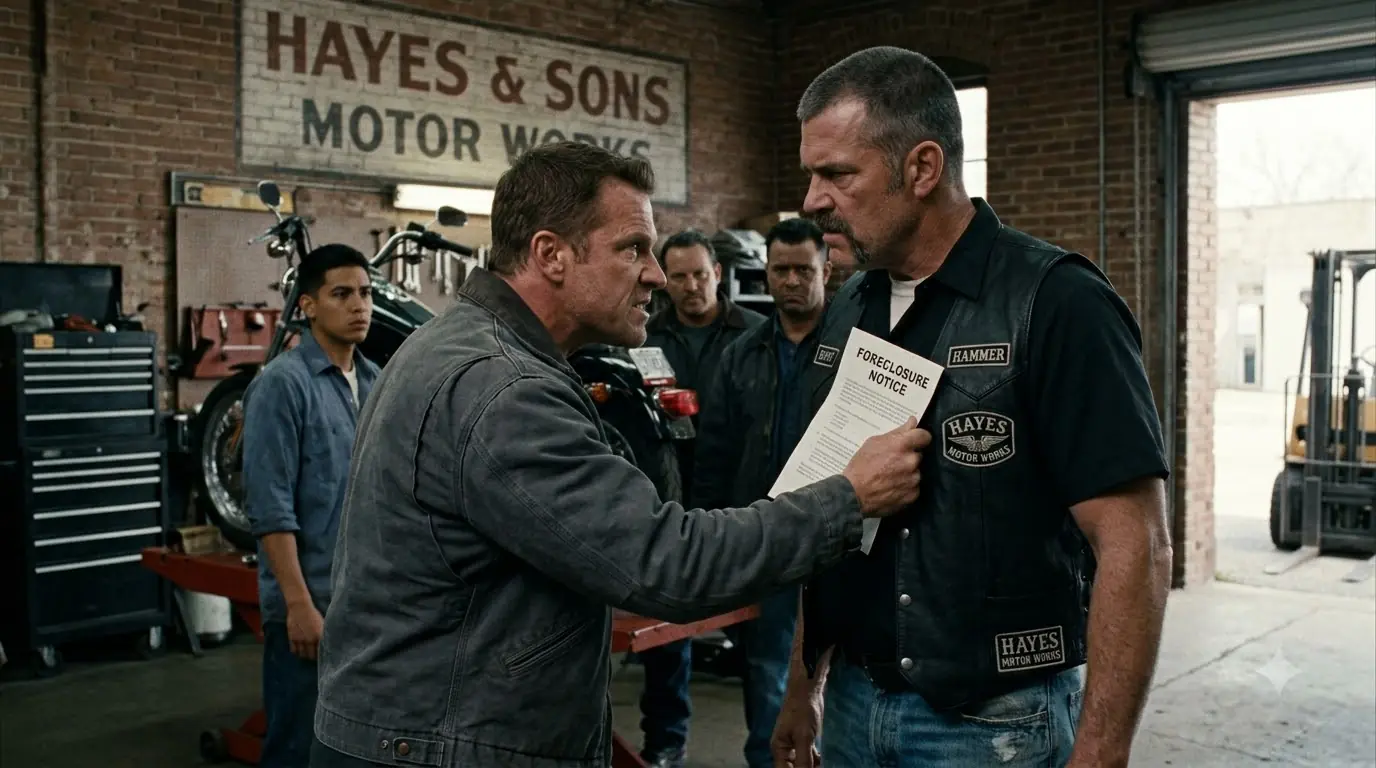
Grant was fifty, six-foot-one, broad through the shoulders, with dark-gray hair buzzed close and a thick moustache that made him look permanently unimpressed. Burn marks dotted his forearms between an old eagle tattoo and a piston wrapped in a ribbon, and grease had settled so deeply into the creases of his hands that no soap completely removed it anymore. He wore a black work shirt with two buttons missing, jeans polished pale at the knees, heavy boots, and a leather cut bearing only two simple patches: HAMMER over the left chest and HAYES MOTOR WORKS beneath it. He had never cared much for spectacle; he cared about machines leaving his shop safer than when they came in.
That morning, he was leaning over a blue Shovelhead on Lift Two when the sound of diesel engines rolled through the open bay. At first Grant assumed it was a parts delivery, but then he saw a white flatbed, a forklift trailer, and a dark pickup with magnetic signs reading CRANE RECOVERY & REPOSSESSION. Five men climbed out, led by Victor Crane, a hard-faced forty-one-year-old with heavy arms, a shaved neck, and the loose grin of somebody who had learned that paperwork could be used like a fist. Victor tucked a folded packet under one arm and walked into the garage without asking permission.
“Bank owns the building,” Victor said.
Grant wiped his hands on a rag and looked past him at the trucks. “No, it doesn’t.”
Victor slapped the packet against his palm. “Paper says otherwise.”
“My loan’s current.”
“Paper says otherwise,” Victor repeated, enjoying the line more the second time.
Grant took the pages. The letterhead belonged to Missouri River Commercial Bank, and the foreclosure notice claimed three missed payments over the previous five months, enough—according to the document—to trigger acceleration of the loan and immediate possession after default notice. Grant read the dates twice because he knew them. He had stood at the same teller window every month with a cashier’s check or certified deposit slip, and every receipt was filed in a metal box inside his desk.
“I have receipts,” he said.
Victor shrugged. “You can show them to somebody who cares.”
Grant stared at him. “You’re standing inside a customer repair shop with a forklift outside. You’d better start caring.”
Victor walked deeper into the garage, looking at the lifts, toolboxes, customer motorcycles, and framed photographs above the bench. “Whole place smells like dead engines.”
“Still smells better than you.”
One of the repo workers laughed before catching himself. Victor’s eyes settled on Grant’s cut. “Take it off.”
Grant frowned. “Why?”
“We’re removing bank property.”
“The vest isn’t bank property.”
Victor smiled. “Neither will your pride be in ten minutes.”
The young mechanic sweeping near the paint booth, twenty-three-year-old Danny Ortiz, stopped moving. Grant gave him a glance that meant stay out of it. He had three employees, two customers due within the hour, and ten motorcycles on the property that had nothing to do with the bank. He did not need a brawl; he needed time to put the receipts in front of somebody who could read them.
Grant went into the office, opened the bottom drawer of his desk, and pulled out a gray metal cash box. Victor followed close enough to make the act feel like a search. Inside were tax statements, insurance papers, supplier invoices, and a row of deposit receipts bound by rubber bands. Grant found the bank bundle, flipped through it, and held up the three months named in the foreclosure notice.
“January twenty-eighth. February twenty-fifth. March thirty-first,” Grant said. “All paid.”
Victor barely looked. “Not my department.”