The letter had promised a man named Gerald Cobb. It described him as steady, hardworking, and eager for a wife who understood that frontier life asked more than it gave back. Inez Pearson had read that letter so many times the paper had gone soft at the fold lines.
The ink was slightly smeared where her thumb always rested when she reached the part about the house he was building. A real house, he had written, with a proper kitchen and a porch that faces the morning sun. She had believed every word of it.
Gerald Cobb was not at the station when the train pulled into Tallow Creek. He was not at the post office, either, or the general store, or anywhere along the short stretch of packed dirt that passed for a main street in this town. Inez stood on the platform with a single trunk and a hat.
The wind immediately decided it didn't respect her, and then she waited. An hour passed, then another. The station master, a thin man with ink-stained fingers and the expression of someone who had delivered bad news before, finally told her plainly that Gerald Cobb had left Tallow Creek nearly three weeks prior.
No forwarding address. No word left behind for anyone. Least of all for the woman he had written to, courted through letters, and sent a train ticket. Inez didn't cry.
She had learned early in life that crying required an audience willing to be moved, and the station master had already gone back inside. She stood on that platform alone for another few minutes, watching the train pull away as though it were taking the last reasonable version of her future with it.
Then she picked up her trunk, settled her hat against the wind, and walked toward town. She found work the same afternoon. May Hollis ran the only boarding house in Tallow Creek and had the particular gift of reading a person's situation without making them feel read.
She was a wide woman with strong hands, a permanent squint from years of working near a hot stove, and a soft spot for people in obvious trouble that she disguised as practicality. She offered Inez a small room at the back of the house, three meals a day, and a modest wage in exchange for cooking, cleaning, and managing the needs of whoever happened to be staying. Inez accepted without negotiation.
She had twelve cents to her name and a trunk full of clothes suited for a rancher's wife. Practical enough, but not much use to a woman suddenly and completely on her own. That had been six weeks ago.
By the time October settled cold and golden over Tallow Creek, Inez had learned May's boarding house the way you learn a piece of music, not by reading it, but by playing it until your hands remember without being told. She knew which floorboard creaked outside room four.
She knew Mr. Aldridge in room two took his coffee without sugar and his pride without question, and that he would rather sit with an empty cup than ask for more. She knew the wind came hard from the north just before dawn, and rattled the kitchen window in a way that sounded, if you were still half asleep, almost like someone knocking to be let in.
The work was honest, and the days were full, and Inez told herself that was enough. Most mornings, she believed it. Yet what she hadn't resolved, what lived quietly at the back of her mind the way an unanswered letter sits on a desk, was what came next.
Tallow Creek was not where she had imagined her life settling. It was the kind of town that felt temporary, even to people who had lived there twenty years, a place men passed through more often than they stayed in. And Inez had always believed, perhaps foolishly, that she was meant to stay somewhere, to build something that lasted, to belong to a place the way a tree belongs to its ground, not by force, but by root.
She just hadn't found that place yet. And at twenty-six, with no family left to return to, and no clear road forward, that uncertainty sat heavier some evenings than others. She had almost entirely stopped thinking about Gerald Cobb. Almost.
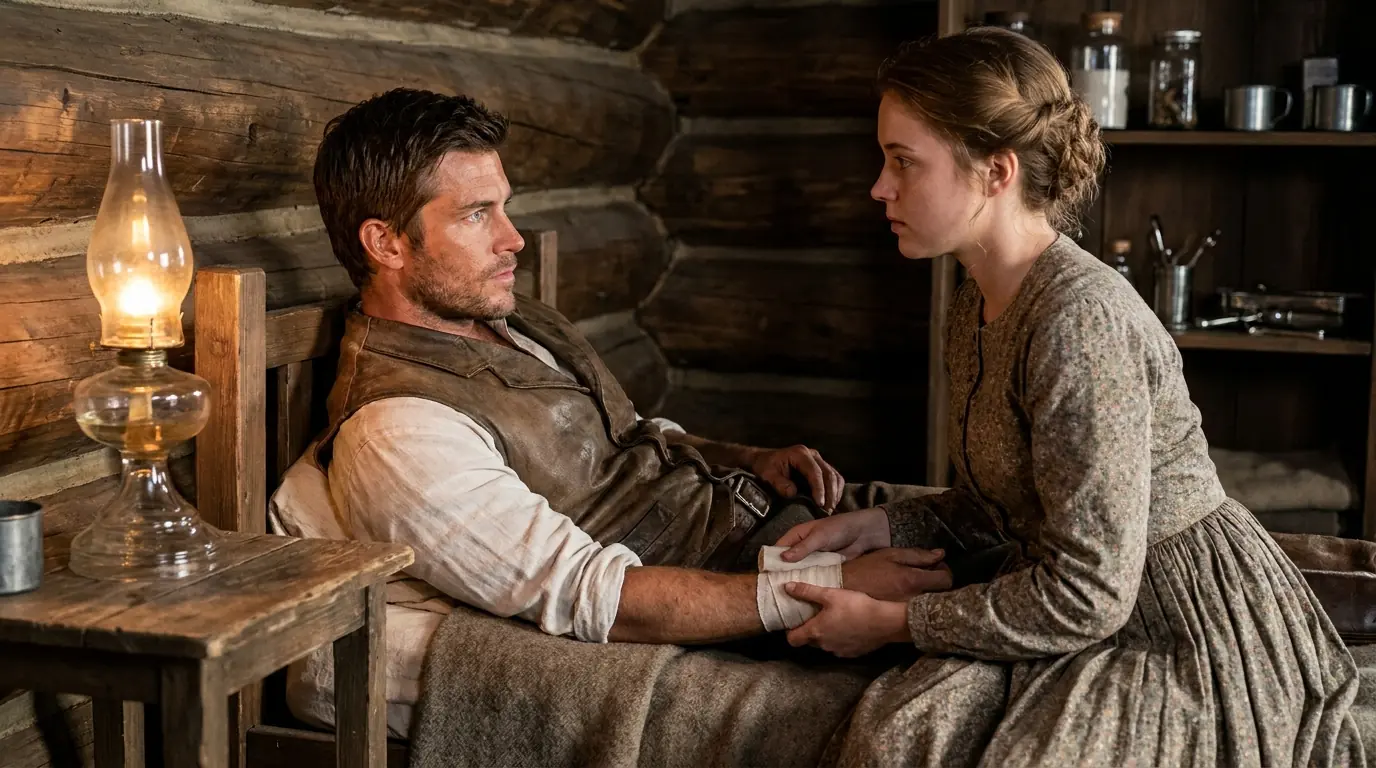
It was a Tuesday evening when they brought Harrison Westbrook in. Two men carried him through the front door just as Inez was laying the supper table, and the way they were carrying him, one arm draped over each shoulder, his boot heels dragging lines in the floorboards, told her immediately that this wasn't drink.
Drunk men protested being carried. They had opinions about it. This one was silent in the particular way of someone whose body had made all the decisions and left his mind with nothing left to manage.
He was tall, even sagging between two men, dark-haired, unshaved for at least a week, with the kind of face that weather and time had worked on without being specific about how long. He could have been thirty-five or fifty, and Inez would not have been able to say which.
"Room three," she said. Nothing more was needed. Inez had not trained as a nurse. What she knew about tending wounds, she had learned from her mother, who had learned it from necessity, the way most frontier women learned most things.
She knew to clean a wound before dressing it. She knew infection announced itself through heat and smell long before it showed in color. She knew that a man in genuine pain would often insist he felt fine, and that you had to watch his hands rather than listen to his words to understand the truth of it.
Harrison Westbrook's hands, when she cleaned the wound that first night, were completely still. That surprised her. Most men gripped something when they were hurting, a bedpost, a fistful of blanket, their own knee.
He simply lay with his hands open at his sides, staring at the ceiling above him, and breathing slowly and deliberately through whatever the cleaning cost him. "This will need several days to close properly," she told him, keeping her voice even.
"I know," he said. His voice was lower than she expected, and unhurried in a way that had nothing to do with weakness. "Is there family I should send word to?"
A pause followed. Not the pause of a man searching for an answer, the pause of a man deciding exactly how much of an answer to offer. "No," he said. Inez didn't push.
She finished the dressing, washed her hands in the basin by the window, and left him to sleep. But she stood in the hallway outside room three a moment longer than the task required, her hand still resting on the doorframe. There had been something in that pause, and something that felt less like a simple answer, and considerably more like a door being pulled carefully, quietly shut.
Over the following three days, Harrison Westbrook said very little and observed a great deal. Inez noticed this because she was, by nature, the same kind of person. She recognized it the way you sometimes recognize in another person a habit you have never had a name for in yourself.
He watched the room when she brought his meals. He watched the window and whatever moved beyond it. He watched her hands when she changed his dressing, not in any way that made her uncomfortable, but with the focused, quiet attention of a man who cataloged details out of long habit.
On the third morning, without any particular lead-up, he said, "You're not from here." "No," Inez said, smoothing the edge of the fresh bandage. "Missouri," she added after a moment. "Originally."
She glanced up. "You?" His pause this time was shorter, but still deliberate, considered. "West of here," he said.
It was, she would think later, almost certainly true. It was also, she would come to understand, one of the most carefully constructed non-answers she had ever been handed. Truthful enough to satisfy, vague enough to reveal nothing.
On the fourth evening, Inez brought his supper and found him sitting up for the first time, back against the headboard, watching the last of the daylight going slow and amber over the rooftops. He looked better. The color had returned to his face, and the tightness around his eyes had eased into something closer to rest.
"You'll be able to move around tomorrow," she said, setting the tray down on the side table carefully. "Thank you," he said. And then, after a beat of silence that felt intentional rather than empty. "For all of it."
People said those words often enough that they had worn smooth with use. But Harrison Westbrook said them the way a person says something they have been holding for several days, turning it over quietly, making certain they meant it before letting it go. Inez nodded.
She moved toward the door. "Miss Pearson." She stopped. She had introduced herself only as Inez on the first night.
She turned slowly. "May mentioned it," he said, reading her expression before she could arrange it. "I wasn't prying. I just wanted you to know that."
Inez looked at him for a moment. This quiet, careful man who had offered almost nothing about himself, and yet had gone out of his way to explain that he hadn't been gathering information about her. "I didn't think you were," she said. And she meant it.
She left him to his supper. But in the hallway, she paused again, her fingers resting lightly against the wall. A man that deliberate about how he was perceived was either concealing something or he had been misjudged enough times that honesty had become a kind of armor he wore out of self-preservation rather than virtue.
She didn't know which was true. She wasn't entirely certain it mattered yet. But standing there in that quiet hallway with the day going dark around her, Inez realized she wanted to find out.
That wanting, unhurried, unasked for, but then entirely unexpected, was the most present she had felt since stepping off that train six weeks ago with twelve cents, a worn letter, and a future that had vanished before she ever arrived. Harrison was on his feet by Thursday morning.
Inez heard him before she saw him. The slow, careful creak of floorboards in the hallway just after sunrise. The kind of movement that belonged to a man testing his own limits before anyone else was awake to witness it.
She was already in the kitchen when he appeared in the doorway, one hand resting against the frame, dressed and boot-shod as though he intended the day to believe he was perfectly fine. He was not perfectly fine. She could see that plainly.
But she didn't say so. "Coffee's on," she said instead, and turned back to the stove. He sat at the far end of the kitchen table without being invited, which told her he was a man accustomed to making himself at home in unfamiliar places, not out of arrogance, but out of long practice.
He wrapped both hands around the cup she set in front of him and looked out the window at the pale early light coming over the rooftops. They sat in silence for several minutes. It was not an uncomfortable silence.
That, more than anything, surprised her. "You don't have to stay on my account," Inez said eventually, refilling her own cup. "May won't charge you past today if you're well enough to ride."
Harrison looked at her. "Is that your way of saying I should go?" "It's my way of saying you have the option." He considered that.
"And if I'm not in a particular hurry?" Inez set the coffee pot down. "Then May charges by the week, meals included."
Something moved at the corner of his mouth, not quite a smile, but the place where one lived when it wasn't being used. "Fair enough," he said. He stayed. But he didn't explain why, and Inez didn't ask.
Over the days that followed, Harrison Westbrook became a quiet, undemanding presence in May's boardinghouse. The kind of guest who made his own bed without being reminded, who carried wood in from the pile without being asked, and who had a way of making himself useful without drawing attention to the fact that he was doing it.
May approved of him immediately and without reservation, which was not a thing she extended to most people. "Decent man," she told Inez one afternoon, as though delivering a verdict after long deliberation. "Carrying something heavy, but decent."
Inez didn't disagree. She had arrived at the same conclusion through different observation. What she noticed most was the way Harrison existed in stillness.
While most men who came through Tallow Creek carried their restlessness visibly in the way they drummed fingers on tabletops, pushed back chairs too hard, looked toward doors, Harrison was still in the way of someone who had made a long, private peace with waiting. Or perhaps not peace, exactly. Perhaps simply endurance.
She wondered, more than once, what he was waiting for. It was on a quiet Saturday afternoon that the first thread began to loosen. Inez was mending a tear in one of the curtains from room two when a man she didn't recognize came through the front door of the boardinghouse without knocking.
He was broad-shouldered, trail-dusty, and wearing the particular expression of someone who had ridden a long way with a specific purpose. He looked around the front room slowly, and then his eyes landed on Harrison, who was sitting near the window reading a newspaper he had folded to a precise quarter size.
Something shifted in the stranger's expression, a quick flash of recognition followed almost immediately by relief. "Westbrook," he said. Harrison lowered the newspaper with the unhurried deliberateness of a man who had heard his name said in that particular tone before and had decided some time ago not to let it move him.
"Dillard," he said. Inez kept her eyes on the curtain in her lap, but her hands had gone still. The man named Dillard crossed the room and sat across from Harrison without being offered a seat.
He was quiet for a moment, working the brim of his hat between his fingers. "Your brother's been asking," he said, low enough that Inez might not have caught it if the room hadn't been so quiet. "About the deed. What about what you intend to do?"
"My intentions haven't changed," Harrison said. "He says they have to. Says the bank won't wait past the first of the year." Dillard paused.
"He needs your signature, Harrison. Whether you're done with that place or not, your name is still on half of it." A silence followed that had weight to it, the kind that pressed against the walls of a room.
"Tell him I'll consider it," Harrison said finally. Dillard looked at him for a long moment, then nodded once, stood, and left without another word. The front door closed behind him, and the room settled back into its ordinary quiet.
Harrison refolded the newspaper. He did not look in Inez's direction. She returned to the curtain in her lap and said nothing.
But the word deed sat in the back of her mind for the rest of the afternoon, quiet and unresolved, like a question she hadn't yet decided whether she had the right to ask. That evening after supper, Harrison found her on the back porch.
She was sitting on the top step with a cup of tea going cold in her hands, watching the last light leave the sky in long horizontal strips of orange and gray. He came out quietly and stood at the edge of the porch, looking out at the same sky. And for a while, neither of them said anything.
"I owe you an explanation," he said at last. "You don't," Inez said. "Not to me."
"Maybe not." He was quiet for a moment. "But I'd like to offer one anyway." She waited.
"I grew up on a ranch," he said, west of here. Large spread. Been in my family a long time. He said it plainly, without pride or apology.
"My father passed two years ago. Left the ranch to my brother and me, equal share." He stopped, chose his next words carefully. "We don't agree on much. Haven't for a long time."
"After my father's funeral, things were said that couldn't be unsaid. I walked away, thought distance would settle it." "Did it?" Inez asked.
He looked at her then. "No," he said. "It just moved the problem further down the road."
Inez turned her cup slowly between her palms. "And now the road has caught up." "Seems that way."
The sky had gone deep blue at its edges, the first stars showing faint and uncertain. Somewhere down the street, a door closed and a dog barked twice and went quiet. "Can I ask you something?" Inez said.
"Yes." "Do you want to go back?" The question landed between them and stayed there.
Harrison didn't answer immediately. He looked out at the darkening street, and his jaw set in that particular way of someone sorting through something complicated. "Part of me does," he said finally.
"The part that remembers what it felt like before everything went wrong." He paused. "The rest of me isn't sure that part can be trusted."
Inez considered that for a moment. "That sounds like a man who still cares about something he's been pretending not to care about." He looked at her with an expression she hadn't seen on him before.
Not quite surprise, but something adjacent to it. The look of a person who has been accurately described by someone who had no obvious reason to see them that clearly. He didn't respond right away.
When he did, it was quiet. "You're perceptive," he said. "I've had time to practice," she replied. "Being overlooked gives you that."
It came out before she had decided to say it. She didn't look at him when it landed. But Harrison turned toward her slowly.
And when she finally glanced up, he wasn't wearing the polite expression she expected. He was looking at her the way he looked at everything. With that steady, unhurried attention.
As though what she had just said mattered enough to be received properly. "Whoever left you standing on that platform," he said. And his voice was careful and low, "was a fool."
Inez felt something shift in her chest. Small and quiet. Like a window opening in a room that had been closed too long.
She looked back at the stars rather than at him. "Maybe," she said softly. "Or maybe it worked out the way it was supposed to."
The following morning brought a letter. It arrived with the early post, addressed to Harrison Westbrook in care of May's boarding house. Which meant someone had known exactly where to find him.
He read it at the kitchen table while Inez made breakfast, his face giving nothing away. But when he folded it and set it down, his hand rested on top of it for just a moment too long.
"I need to ride out," he said. "Few days, maybe more." Inez kept her attention on the pan in front of her.
"All right." "I'll be back," he said. And then, as though he understood that was an easy thing to say and a harder thing to mean, he added, "I want to be back."
She turned to look at him then. He was already watching her. That quiet directness she had come to recognize as simply the way he was.
Not performance, not strategy. Just honesty arriving without ceremony. "Then come back," she said simply.
He nodded once. He took his hat from the hook by the door. Just before he stepped outside into the cold morning air, he paused with his hand on the door frame.
The same frame she had stood in the very first night, watching him lie still and silent while she dressed a wound she hadn't caused. He didn't say anything else. But the pause itself said something that neither of them was quite ready to put into words yet.
The door closed behind him. The kitchen was quiet. Inez stood at the stove for a long moment, her hand resting still on the handle of the pan, looking at the place where he had been.
She didn't know what was waiting for him forty miles west. She didn't know what his brother had said at a graveside two years ago that had driven a man like Harrison Westbrook off his own land. She didn't know what the letter had said or what he would find when he got there or whether the version of him that returned, if he returned, would be the same one who had just stood in that doorway.
What she knew was simpler than all of that. And more inconvenient. She was going to miss him.
Already before he had even cleared the edge of town, she was going to miss him in a way that had no sensible explanation given how little time had passed and how little had actually been said between them. She turned back to the stove and finished making breakfast for a table that would have one fewer person at it this morning.
Outside the window, the sound of hoofbeats moved west along the road, steady and unhurried. And then faded into the wide morning silence of Tallow Creek. He was gone for eleven days.
Inez did not count them deliberately. She simply noticed, the way you notice weather, that the days had a different quality to them while Harrison was away. Not worse, exactly.
Just quieter in a way that had nothing to do with noise. May noticed, too. Though she said nothing directly.
She had a talent for observing things and filing them away without comment, which Inez had come to appreciate deeply. It was May who made sure the coffee was always made in the mornings. And May who kept Inez busy enough during the days that the hours moved at a reasonable pace.
But in the evenings, when the boarding house settled into its night sounds and the other guests retreated to their rooms, the back porch felt larger than it had before. On the sixth day, a brief note arrived.
It said only, still here. Longer than expected. Inez read it twice, set it on the kitchen window sill, and went back to work.
On the eleventh day, just before supper, she heard hoofbeats on the road. She didn't go to the door. She stayed at the stove and listened to the sound of boots on the porch steps.
The familiar weight of a knock she somehow already recognized. May answered it. And Inez heard the low exchange of voices in the front room.
May's practical warmth. Harrison's unhurried tone. Then footsteps in the hallway.
He appeared in the kitchen doorway, looking trail-worn and tired in the particular way of someone who has carried something heavy over a long distance. Not just in miles, but in the way decisions weigh on a person when they finally make them. His jaw was unshaved again.
There was a weariness around his eyes that hadn't been there before. But he was there. "You came back," Inez said, keeping her voice even.
"I said I would," he replied. She turned to look at him properly. "How did it go?"
He was quiet for a moment, leaning against the door frame with his arms crossed. Not defensively, but in the way of someone who needed the support while they chose their words. "I signed the papers," he said.
"The bank gets what it needs. My brother keeps the house and the north pasture. I take the south range and the water rights." He paused. "It's not what either of us wanted, but it's done."
"And your brother?" Harrison's expression shifted. Something complicated moving through it. Like clouds crossing a landscape without settling.
"We talked," he said. "First real conversation in two years. It wasn't easy." He looked at the floor briefly, then back at her.
"I don't know if it fixed anything, but it was honest. That's more than we managed at my father's funeral." Inez turned back to the stove and stirred the pot in front of her, giving him the space that kind of admission required.
"That takes courage," she said quietly. "Going back." "Or stubbornness," he said. "The two are hard to tell apart sometimes."
He sat at the kitchen table while she finished supper. And the ease with which he settled back into that chair, as though the eleven days had been an interruption rather than a departure, said something that neither of them commented on directly. May joined them for the meal and carried most of the conversation with her customary efficiency.
Asking Harrison practical questions about road conditions and weather coming in from the west. Harrison answered everything plainly and asked after Mr. Aldridge's health and whether the window in room four had been fixed yet. It was ordinary.
It was entirely ordinary. And yet beneath the ordinariness of it, something had shifted in the room. A quiet rearrangement.
Like furniture moved just slightly. Enough that the light fell differently on everything. After May excused herself and the dishes were cleared, Harrison and Inez were left alone at the table with the remains of the evening and the low sound of wind working its way through the eaves outside.
"There's something I need to tell you," Harrison said. Inez folded her hands on the table. "All right."
"The south range I kept," he said. "It's not a small piece of land. The ranch my family built, what I walked away from, it's one of the largest spreads in this part of the territory."
He said it without ceremony. Not the same way he said everything. "I wasn't hiding it from you to deceive you.
I was hiding it from everyone because I didn't want it to be the first thing people saw when they looked at me." A pause. "It usually is."
Inez was quiet for a moment. Outside, the wind shifted and the kitchen lamp flickered once and steadied. "Is that why you never said?" she asked.
"Partly." He looked at her directly. "And partly because it didn't feel like the most important thing about me. Not here. Not with you."
The words settled between them with a weight that was not heavy, but permanent. The kind of thing said once and then simply true from that point forward. Inez looked at him for a long time.
At the tired, careful, quietly honest face of a man who had spent two years making himself invisible. And then somehow, in a borrowed room in a town he had only passed through by accident, had let himself be seen. "It isn't," she said finally.
"The most important thing." Something in his expression eased. Not dramatically. Just the way a man's shoulders come down when he sets something heavy on the ground after carrying it longer than he should have.
What followed was not sudden. It did not arrive in a single moment of clarity or confession. It came the way most true things come.
Gradually. Then all at once. And only recognizable in retrospect as the inevitable shape it had always been moving toward.
Harrison began helping Inez with the morning work. Not because she needed the help particularly. But because the mornings had become his favorite part of the day.
And the kitchen was where she was. They fell into an easy rhythm. Coffee first.
Then the bread. And then whatever the day required. And the conversation between them grew slowly from cautious and considered into something more natural.
More willing to wander. He told her about the ranch. Not the size of it.
Or the history of it. But the particular things. The way the south pasture looked after rain.
The sound the creek made in early spring. A ridge on the eastern boundary where you could see four counties on a clear day. He described it the way a person describes something they love.
But have been afraid to admit loving. She told him about Missouri. About her mother.
Who had died when Inez was nineteen. And her father. Who had followed two years later.
Leaving her with a small inheritance that had gone to practical things. And then to the train ticket that had brought her here. She told him about the letter from Gerald Cobb.
And the platform. And the twelve cents. And she told it plainly.
Without self-pity. The way she had come to understand her own story. Not as a tragedy.
But as a series of events that had led her. By an unlikely and indirect route. To exactly where she was sitting.
Harrison listened to all of it. The way he listened to everything. Fully.
Without hurry. "You deserved better than that," he said when she finished. "I got better than that," she said.
And she meant it simply. Without performance. As a statement of fact about the present.
Rather than a consolation for the past. He asked her to walk with him on a Saturday morning in late November. When the air had gone sharp and clean.
And the cottonwoods along the edge of town had dropped the last of their leaves. But they walked without particular destination. Which was itself a kind of answer to a question neither of them had formally asked yet.
Harrison walked with his hands in his coat pockets. And Inez walked with hers tucked into her sleeves against the cold. And when their arms brushed once at the edge of a narrow path.
Neither of them moved apart. "I'd like to show you the ranch," he said. After a comfortable stretch of silence.
Inez glanced at him. "Show me?" "The south range. The ridge I told you about."
He was looking straight ahead. But there was a careful quality to his voice that she recognized as Harrison Westbrook working up to something. "I've been thinking about what it would take to make it a real home again.
Not just land. A home." He paused.
"I can't quite picture it without picturing you in it." The cottonwood leaves moved along the path ahead of them. Dry and quiet.
Inez was still for a moment. Then she said, "That is either the most practical proposal I've ever heard. Or the most romantic one."
"Which would you prefer it to be?" he asked. She looked at him then. This quiet and complicated and entirely decent man.
And she felt something settle in her chest. Warm and certain. And without a single trace of the doubt that had followed her off that train platform six weeks ago.
"Both," she said. "At the same time." "Somehow."
He stopped walking. She stopped beside him. He turned to face her fully.
And when he reached out and took her hand from her sleeve. Carefully. As though he understood that some things needed to be held gently in the beginning.
She let him. "Then both it is," he said. They were married on the fifteenth of December in the small church at the edge of Tallow Creek.
With May Hollis as witness. And Mr. Aldridge in the second pew. Looking quietly pleased with himself.
For reasons nobody entirely understood. The following spring, Inez stood on the ridge Harrison had described. The one on the eastern boundary of the south range.
Where four counties were visible on a clear day. The morning was cold and bright. The kind of morning that makes the world look newly arrived.
Harrison stood beside her with his hand resting at the small of her back. And below them, the ranch spread out wide and unhurried in every direction. The creek catching the early light in long silver lines through the valley.
It looked, she thought, exactly as he had described it. And it looked like a place where things could last.