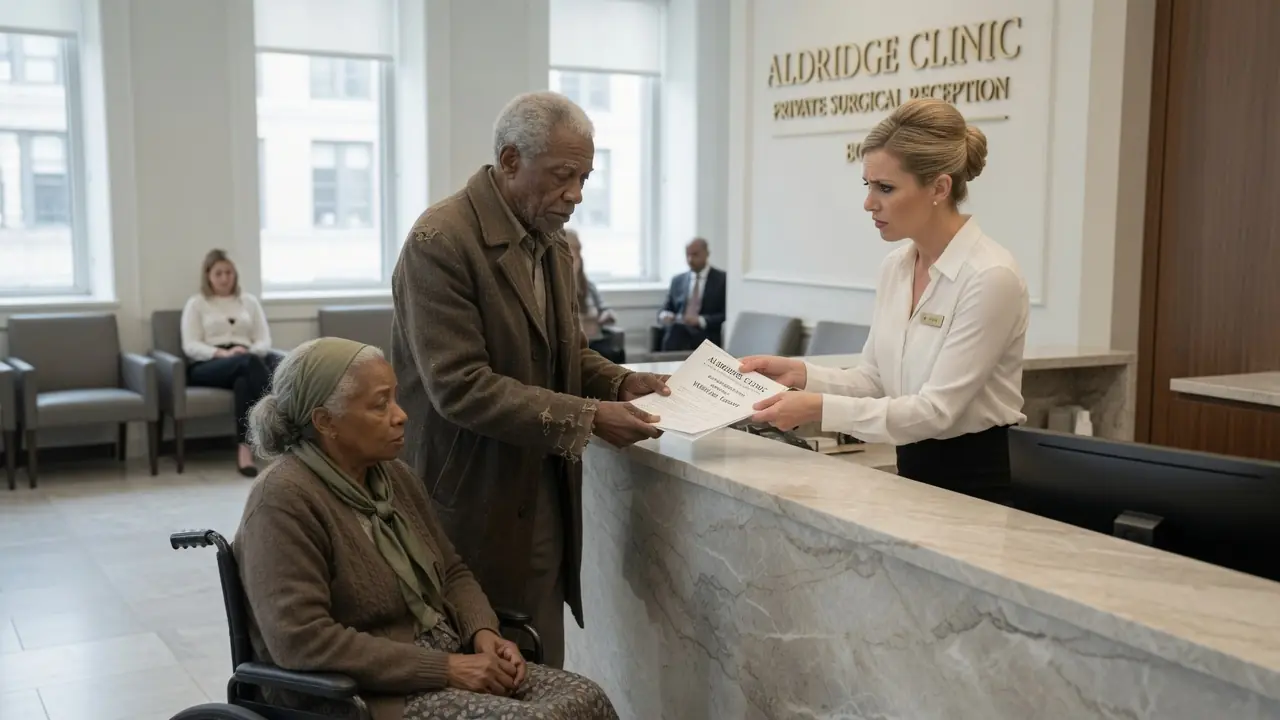
The receptionist slid the folder back across the stone counter and crossed a name off the morning surgery list before the man in front of her had finished speaking. "Financial verification pending." Brenda Mott said, tapping the line where Loretta Whitfield's procedure had been scheduled for 7:00. "I'm afraid we can't bring her back until that clears."
Behind her, mounted on the pale marble wall, a brass plaque caught the light. She had stood with her back to it every shift for 2 years. She had never once read it. Samuel Whitfield set his hand gently on the counter. He was 70 years old, silver at the temples, in a charcoal suit that fit the way good suits fit men who had stopped trying to impress anyone decades ago. Beside him, in a soft wheelchair, his wife Loretta sat with her hands folded in her lap, a green scarf knotted at her throat, her face already tightening with the old, familiar shame.
"My wife's procedure was booked 3 weeks ago." Samuel said, his voice warm and even, "and it was paid in full." Brenda offered a thin, practiced smile that never reached her eyes. "Sir, this is our concierge surgical wing. It's for self-pay patients who've gone through our financial review. I think there may be some confusion. The community clinic that takes insurance is in the building next door. People do mix them up."
A man in a cashmere overcoat came through the glass doors behind them, gave his name, and was waved straight back toward the private waiting suite without a single question. Brenda smiled at him, a real smile this time, and turned back to the Whitfields with the other one. Samuel watched all of it without changing his expression. He had worn this kind of moment his whole life, the invisible armor of a man in rooms that had quietly decided he did not belong in them. He had learned a long time ago that anger only gave people like Brenda the story they already wanted to tell.
So, he did not raise his voice. He reached into his coat, took out his phone, and laid it flat on the stone. On the screen was the confirmation. Whitfield, Loretta, paid in full, procedure scheduled, 7:00, cleared. Brenda glanced at it, then frowned. Her fingers went to the keyboard and started hammering, fast and irritated, hunting for the error she was certain had to be there. People like this did not pay cash for the concierge wing. There had to be a glitch, a duplicate, a name pulled from somewhere it shouldn't be, the system showing a flag.
"We're not going anywhere." He said quietly, and his hands settled over hers on the armrest. Then, to Brenda, still calm, "Her procedure was approved by a surgeon. Tell me which physician signed the cancellation, and write the reason for the delay somewhere I can read it." Something in how he said it. The precision of it. The ease with the words made Brenda pause for half a second. Then her certainty closed back over her like a door.
"I'm just following our intake safety policy." She said. "People in your situation get confused about which wing they're in all the time. Let me bring our patient relations manager down. She can walk you over to the verification desk on the lower level." The lower level? The verification desk. Each phrase a soft hand on the back. Steering them toward the exit.
Loretta's surgery had been weeks in the planning. A delay was not an inconvenience. A delay was a risk to her heart. And the woman behind the counter was treating it like a billing dispute with a couple who had wandered into the wrong room. Samuel did not move toward the lower level. He did not move at all. "My wife has a scheduled procedure." He said. "And a heart that doesn't have time for your verification desk. We'll wait right here."
Brenda's jaw tightened. She reached for the phone to call the manager. The way she always did when someone refused to disappear on cue. And as she lifted the receiver Samuel let his eyes drift. Just once. To the brass plaque on the wall behind her head. The one she had stood in front of for two years and never read. He knew exactly what it said. He had every reason to. But he wasn't going to be the one to tell her.
Brenda Mott did the thing she always did when someone refused to leave. She made it official. "I'm placing this file on financial verification hold." She announced. Loud enough for the waiting area to hear. As if saying it to the room made it true. She clicked a field on her screen and Loretta's 7:00 slot turned gray. "Per safety policy, until it clears, she can't be brought back."
It was a clean move. The kind she had made a hundred times. One soft phrase, no raised voice, and a couple she had decided didn't belong was quietly pushed out of the schedule and toward the door. The policy did most of the work. She just had to point it at the right people. From a chair near the window, a man in a cashmere overcoat lowered his newspaper. Gerald Pierce had been coming to the Aldridge for years, and he knew exactly how this counter worked because it had always worked in his favor.
"Brenda," he said, "their file's showing cleared. I can see the green from here." He gestured at her own monitor. "You ran my billing after my procedure last month, not before. Why not bring them back and sort the paperwork later, the way you do for the rest of us?" Brenda's smile went flat. "Mr. Pierce, I appreciate that, but I manage intake safety for this wing. I'm not going to compromise it."
"Safety," Gerald repeated, and let the words sit there a moment before he went back to his paper. He did not look convinced, and he made sure she saw it. Then a second voice came from the corridor behind the desk, and this one was not a guest. Nurse David Okafor had come up to collect his next patient. He was already in surgical scrubs, a tablet under one arm. He stopped at Brenda's shoulder. Read the gray line on her screen, and his face changed.
"This patient was approved for surgery last week," he said. "Dr. Reyes signed off himself. I prepped her chart this morning." He looked at the field Brenda had just toggled. "I'm not going to write unverified on a chart that's already been cleared by a surgeon. That's not a billing note. That's a medical record." "It's an intake matter. Not a clinical one." Brenda said.
"Delaying an approved cardiac case isn't an intake matter." Okafor said evenly. "It's a clinical one. I won't sign it." For the first time, the certainty behind the counter cracked, just slightly. Through all of it, Samuel Whitfield had said nothing about who he was. He simply asked the questions of a man who knew this kind of building from the inside out.
"Which physician has authority to cancel an approved slot?" He asked. "Does your policy require that signature before the slot is released? Or after?" He was not guessing. He knew the answers. He was watching Brenda discover that she did not. She reached for the phone. "I'm calling my manager." "Call the medical director." Samuel said. "Not patient relations. The physician in charge of this wing."
Loretta, hands trembling now, lifted her own phone and called her daughter. Aisha Whitfield-Brooks did not arrive in a luxury SUV. And she did not threaten to buy anything. She was the chief of cardiology at a hospital across the city. And she answered on the second ring. When her mother explained in a small voice that her surgery had been put on hold at the counter, Aisha's tone did not rise. It sharpened.
"Put me on with whoever placed the hold." She said. And then, when Brenda took the phone with obvious reluctance, "My name is Dr. Whitfield-Brooks. I want to be clear about something before this goes any further. Denying or delaying access to an approved procedure based on a patient's appearance isn't a policy question. It's a civil rights one. And this clinic has obligations under it. I'd like to speak with your medical director. Now."
Brenda's hand had gone tight around the receiver. "I'm sure that won't be necessary." "It's already necessary." Aisha said. Minutes later. A door opened down the corridor and Dr. Elliot Hargrove came toward the desk, the clinic's medical director. Gray-suited, unhurried, the look of a man pulled out of something important. "What's the issue here? Brenda." He asked.
She started in on intake safety, on verification, on a couple who'd likely wandered in from the wrong wing. Hargrove listened with half an ear, his eyes moving over the screen. Then they dropped to the name printed at the top of the chart. Whitfield. He stopped. He read it again. Then, slowly, almost involuntarily, his gaze lifted past Brenda's shoulder to the brass plaque on the wall behind her. The one she had stood in front of every shift for 2 years and never once read.
The color went out of his face. He looked at the plaque. He looked at the calm, silver-haired man standing at the counter beside a wheelchair, and he understood, all at once, exactly whose surgery his receptionist had just tried to cancel. "Oh. No." Hargrove said quietly.
Dr. Hargrove reached past Brenda, turned the brass plaque slightly on its mount so the whole desk could see it, and let the room read what she never had. The Whitfield Cardiac Technique. Established in honor of Dr. Samuel Whitfield, whose work made this wing possible. The man Brenda had been about to walk down to the verification desk was the surgeon who had invented the procedure the Aldridge Clinic put on its brochures.
He had not come here to be treated. He had come to sit beside his wife while someone repaired her heart. No one gasped. The quiet that settled over the desk was a slower heavier thing. The quiet of trained people realizing they had nearly let one receptionist certainty cancel the surgery of the founder's wife.
Nurse Okafor looked at the plaque. Then at Samuel. And something in his shoulders eased. As if a thing he'd suspected had finally been named. Brenda's eyes moved from the plaque to Samuel and back. And the blood drained out of her face by degrees. "I didn't" she started. "There was no way for me to know who."
"That's the part I want you to sit with." Samuel said. He did not raise his voice. He did not lean across the counter. He stood exactly as he had when he walked in. Calm. Unbothered by her panic. "I didn't need you to know who I am for my wife to deserve her surgery on time." He said. "If my name weren't on that wall. You'd still have sent us downstairs. You'd have done it just the same. So tell me. How many people did you send down there who didn't have a name on a plaque to save them?"
Brenda had no answer. There wasn't one. And then the way people do when the floor goes out from under them. She reached for the one thing that had always held her up. "Dr. Hargrove." She said. Fast. Now. Her voice climbing. "I've worked this desk for 2 years. I have people who vouch for me. The donors know me by name. If I'm removed over a billing dispute I'll be making calls of my own. There are members here who will not be happy about how I'm being treated."
It was the same move she'd made all morning. The appeal to who she knew. Who mattered. Who would close ranks around her. It had worked her whole career. It did not work now. "The members you're naming," Hargrove said quietly, "are exactly who I'll be answering to when the board asks why an approved cardiac case got canceled at my front desk. You're not a witness I want. Brenda, you're the reason they'll be calling."
He looked at Okafor. "Take Mrs. Whitfield back. She's on schedule. Reyes is waiting." Brenda's hand was still on the counter. Trembling now. The kingdom she thought she ran had taken about 90 seconds to come apart. And she was the last one in the room to feel it fall. "Your badge and your terminal access," Hargrove said, "now you'll be walked out the way you walked people out all morning."
A security escort came. Not to drag anyone, only to stand beside her while she gathered her things. As they led her past the desk, she passed directly under the brass plaque. The one she had stood in front of every shift for 2 years and never once read. She read it now. Her own voice came back to her. The soft phrase she'd used without a second thought all morning. "People like you get confused about which wing they're in." It followed her out the door.
But the consequence did not end with one badge. And Samuel, quietly, made sure of that. "Removing her doesn't fix it," he said. "It just moves it to the next person with the same instinct and a cleaner record. Pull the data. Every chart that got a financial verification hold in this wing over the last 2 years, look at who they were."
The clinic ran the query that afternoon. The pattern came up the way patterns do when no one has been watching for them. Plain and undeniable. The hold had been applied again and again. And it had landed overwhelmingly on patients whose money was somehow always in question. Whose approvals somehow always needed a second look. The truth had been sitting in the records the entire time. It had only needed someone with the standing to demand the search.
The findings went to the state medical board as a review of discriminatory access to care. A heavier thing than any firing. The kind of review that reached past one desk and into the way the whole wing decided who was real. And the clinic changed what had made it possible. An approved surgical slot could no longer be canceled by an intake clerk. It now required a physician's signature. In writing. Before the schedule could move.
Samuel asked for none of it as a prize. He did not threaten to ruin anyone. He asked for two things only. That his wife be cared for on time. And that the pattern be stopped. Both were done. Okafor came around the counter and took the handles of Loretta's wheelchair. She looked up at her husband. And the exhaustion in her face had softened into something steadier.
"You didn't have to make a thing of it." She said gently. "I didn't make a thing of it." Samuel said. "I just wouldn't let them unmake one of us." He walked beside her chair down the corridor. Past the desk. Past the brass plaque with his own name on it. And he did not look at it once. It had hung on that wall for 10 years. He had never needed it to mean anything before today. And he did not need it now.
The doors to the surgical wing opened for the two of them. And they went through together. On time. The way it should have been from the start. His name had been on that wall for a decade. What he had come to prove was not that he mattered. It was that his wife had mattered long before anyone bothered to read a name.