The first thing Caleb Mercer did when he entered St. Anne's Medical Center was count the chairs.
He counted the blue ones near the main doors, the gray ones by the vending machines, and the two empty seats beneath the television that never seemed to show anything except weather reports and hospital advertisements. It was a habit he had developed after his accident, a way of measuring a room before anyone else had the chance to measure him. If he knew where the chairs were, where the exits were, and where the eyes were, he could decide how small he needed to make himself.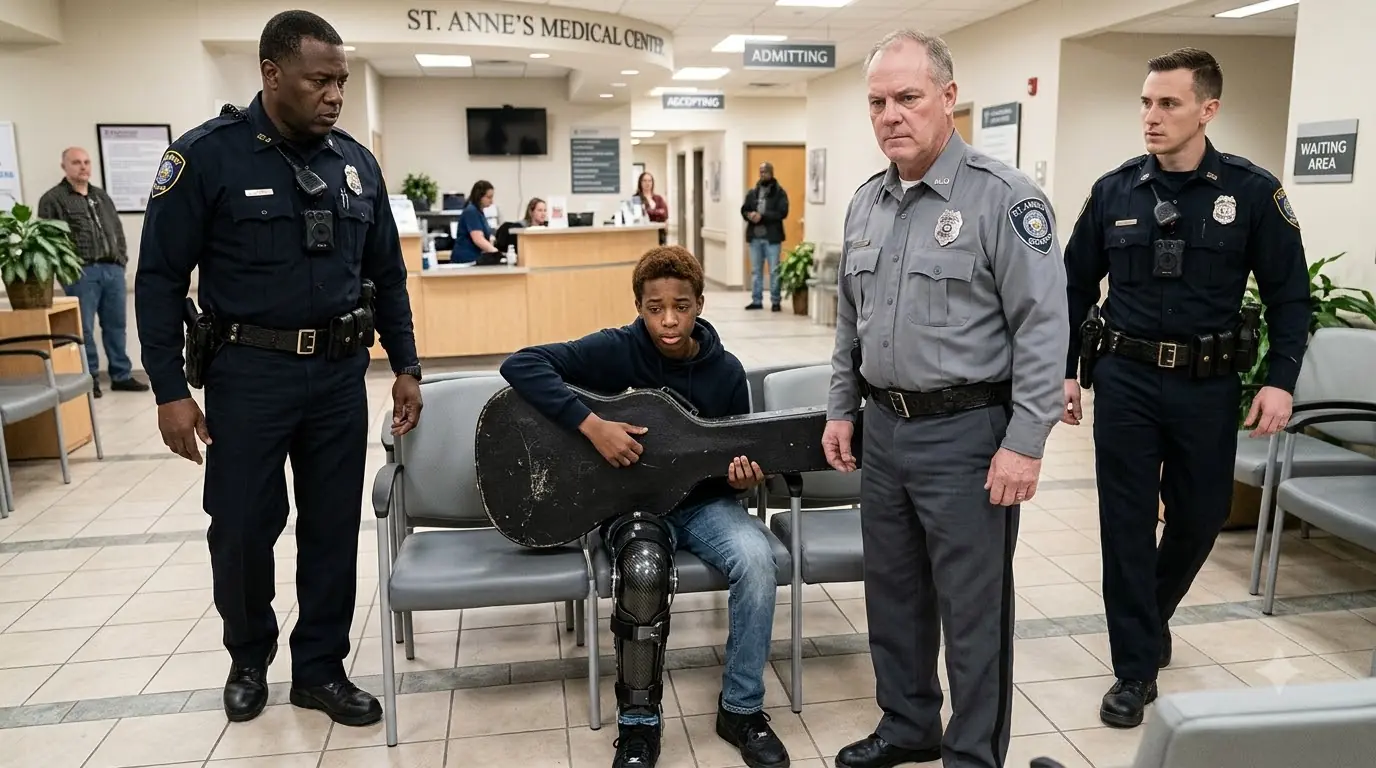
Caleb was fifteen years old, thin in the shoulders, quiet around strangers, and still too young to have learned how many adults could look at a boy and see a problem before they saw a person. His left leg wore a carbon-fiber brace beneath his jeans, the kind that locked at the knee and made every step careful. His right hand stayed curled around the handle of a black guitar case that had once belonged to his father.
The case was too big for him, almost comically so. It bumped against his shin when he walked. The latches were scratched silver, the corners worn white from years of being carried into church halls, barracks lounges, backyard cookouts, and tiny rented rooms wherever Sergeant Daniel Mercer had found a place to sit and play. Inside was a battered 1976 Gibson acoustic with a crack in the finish near the bridge and one small strip of tape on the side where Daniel had written in black marker: Caleb's song, someday.
Caleb had never let anyone peel that tape off.
His mother, Denise Mercer, had an appointment on the fourth floor with a neurologist who had been treating her migraines since Daniel's death. She had wanted Caleb to come upstairs with her, but he hated the fourth-floor waiting room. It was too narrow for his brace, too full of people who stared at his uneven walk and then pretended they had not stared at all. So he had asked to wait in the main lobby.
"I'll be right here," he told her, lowering himself carefully into the chair near the east wall.
Denise hesitated the way mothers do when fear has become part of their breathing. She was thirty-eight, tired around the eyes, and still wore Daniel's dog tags under her blouse even though it had been two years since the folded flag came home. She looked at Caleb's brace, then at the guitar case, then at his face.
"Don't move around too much," she said softly.
Caleb almost smiled. "Mom, I have a guitar case and one good leg. I'm not exactly planning to run laps."
That made her laugh, but only for a second. She leaned down and kissed the top of his head. "Text me if you need anything."
"I will."
After she disappeared into the elevator, Caleb placed the guitar case upright between his shoes and rested both hands on the handle. The lobby moved around him in its ordinary hospital rhythm. Nurses crossed the tile with clipboards. Visitors signed in at the desk. A little boy coughed into his mother's coat. Somewhere down the hall, an intercom asked Dr. Patel to report to radiology.
Caleb liked places with noise because noise gave him cover. Quiet rooms made every movement feel like a performance. In a noisy lobby, nobody had to hear the small metal click his brace made when he shifted his weight. Nobody had to watch him decide how to stand before he stood.
For twenty minutes, no one bothered him.
He opened his phone, checked the message from his guitar teacher, and read the same sentence three times: Your dad would want you to play it Thursday.
The Thursday performance was the reason the guitar was with him. St. Anne's was hosting a small veterans' family fundraiser in its community hall, and Caleb had been asked to play one song in memory of Daniel Mercer, who had served fourteen years in the Army before an investigation into equipment fraud ended with a suspicious roadside crash that the official report called accidental. The word accidental had sat in Caleb's life like a locked door.
He did not know what he believed anymore. He only knew his father had died after asking too many questions, and that before he died, he had recorded something onto an old memory card hidden inside the guitar case lining.
Caleb knew about the memory card.
His mother did not.
Not yet.
Daniel had told him about it during their last video call from Fort Riley, his voice low and serious in a way Caleb had not understood at the time. "If anything happens, buddy, the guitar knows more than people will admit. Don't give it to anyone unless your mom is beside you."
For two years, Caleb had carried that sentence like a stone in his chest. He had not opened the lining because part of him was afraid of what the guitar might know. Another part was afraid it would know nothing, and then the last strange promise from his father would turn into grief with no purpose.
That afternoon, sitting in the hospital lobby, he kept one hand on the case because it was the closest thing he had to holding his father's hand.
That was when Walter Griggs noticed him.
Griggs was the senior security guard on first shift, fifty-one years old, square in the shoulders, with a silver badge clipped too high on his chest and a radio he touched every time he wanted someone to remember he had authority. He had worked at St. Anne's for seven years. The administration called him thorough. Some nurses called him intense. Several families had called him worse in complaints that had gone into a personnel folder and stayed there like dust.
Griggs had a habit of deciding who belonged before anyone told him who they were.
He paused near a column fifteen feet away and watched Caleb.
Caleb saw him out of the corner of his eye and pretended not to. He had learned that skill at thirteen, after the accident left him limping through school hallways where older boys made pirate noises behind him. Look too directly and adults called it attitude. Look down too quickly and they called it guilt. So Caleb stared at his phone and kept his breathing even.
Griggs watched the guitar case.
Then he watched Caleb's hoodie.
Then the brace visible below Caleb's left pant leg.
Then the case again.
A boy with a large black case in a hospital lobby could be carrying anything, Griggs thought. A weapon. Contraband. Something dangerous. The fact that Caleb was sitting quietly did not soften the thought. The fact that he was fifteen did not soften it either. Griggs had spent years teaching himself that suspicion was the same thing as instinct.
He crossed the lobby and stopped in front of Caleb.
"Son, what are you doing sitting here?"
Caleb looked up. "Waiting for my mom."
"What's in the case?"
Caleb blinked. "A guitar."
"Open it."
The words landed harder than they should have.
Caleb tightened his grip on the handle. "Why?"
Griggs's face changed. Not much, but enough. "Because I'm asking."
"It's my dad's guitar. I'm not opening it for no reason."
"You are in a hospital lobby with a large case. That gives me a reason."
Caleb felt heat climb his neck. People nearby had begun to look over. He hated being looked at more than he hated pain. Pain was private if you were careful. Humiliation never stayed private.
"I'm waiting for my mom," he said again. "She's upstairs. I can call her."
"I asked about the case, not your mother."
Caleb looked down at the black latches. The last time someone had opened the case without asking, it had been at Daniel's memorial service. A cousin had taken out the guitar, tuned it badly, and played three chords before Denise walked outside and cried behind the chapel. After that, Caleb stopped letting anyone touch it.
"No," he said.
Griggs stared at him. "Excuse me?"
"I said no. I'm not doing anything wrong."
That was the moment Griggs decided he had been right all along.
He stepped back and put one hand on his radio. "Then you can explain that to the police."
Caleb's stomach dropped. "Police? For a guitar?"
Griggs was already walking toward the security office.
Caleb sat frozen, one hand on the case, the other on his phone. He thought about calling his mother, but his thumb stopped over her name. Denise was in a doctor's appointment. Her blood pressure had been bad all morning. He did not want to scare her over nothing.
But it did not feel like nothing.
Seven minutes later, two police officers entered the lobby.
Officer Patrick Doyle came in first, tall, broad, and moving with the kind of confidence that made chairs seem to get out of his way. Officer Matthew Rollins followed half a step behind, younger, sharper in the face, his hand resting close to his holster before he had even located the person he came to question. Griggs met them near the entrance and pointed.
Caleb saw the finger before he heard the words.
"That's him," Griggs said. "He refused to open the case."
Doyle and Rollins crossed the lobby toward him. Conversations faded. A nurse stopped halfway through signing a clipboard. A man near the vending machine lowered his coffee cup and stared.
Doyle stopped directly in front of Caleb.
"Open the case. Now."
Caleb's mouth went dry. "It's a guitar."
"Then open it."
"I'm waiting for my mom. She'll be down soon."
Rollins stepped closer. "We received a report of a suspicious person with a possible weapon. Open the case or you're going to be arrested for obstruction."
Caleb stared at him, then at the people watching, then at his father's name written in faded marker on the travel tag tied around the handle: Sgt. Daniel Mercer.
"I'm fifteen," Caleb said, his voice shaking despite his effort to control it. "You can't just threaten me because a security guard got nervous."
"You can be fifteen in handcuffs," Doyle said. "Open it."
The lobby went quiet enough for Caleb to hear the small hum of the soda machine.
An older woman three chairs away spoke up. "He's been sitting there doing nothing."
Doyle did not look at her. "Ma'am, stay out of it."
Caleb swallowed. "I can't stand fast. My leg brace locks if I move wrong. Please just call my mom."
Rollins glanced down at the brace, then back at Caleb's face. "Nobody asked you to stand. We asked you to open the case."
"My dad told me not to let anyone open it unless my mom was with me."
That sentence should have slowed the room down. It should have made at least one adult ask why a dead soldier's guitar case mattered so much to a disabled boy waiting in a hospital lobby.
Instead, Doyle reached down.
Caleb grabbed the handle with both hands. "Don't touch it."
Doyle's jaw tightened. "Last warning."
The black case tilted when Doyle pulled it. Caleb pulled back instinctively, not strong enough to win, only desperate enough to make the struggle visible. The brace on his left leg clicked as he shifted. Pain shot up through his hip. He gasped and nearly slid off the chair.
"Stop resisting," Rollins snapped.
"I'm not resisting," Caleb cried. "That's my dad's guitar."
Doyle pried his fingers from the handle. One latch snapped open. Then another.
The sound broke something in Caleb.
"Mom!" he shouted, though he knew she was four floors above him. "Mom!"
Doyle opened the case.
Inside lay the Gibson acoustic, its worn amber wood shining beneath the lobby lights. The cracked finish near the bridge. The old strings. The strip of tape in Daniel Mercer's handwriting.
Caleb's face burned with tears he refused to let fall.
"It's a guitar," he said. "I told you."
Rollins exhaled through his nose and moved his hand away from his holster. Doyle's expression did not soften. Men like Doyle often believed admitting an overreaction made them weaker than the mistake itself.
Griggs stepped forward. "Could still be something hidden inside."
Caleb looked up at him, stunned. "Are you serious?"
The old woman rose from her chair. "This is shameful. That boy said it was a guitar."
A young nurse near the reception desk lifted her phone and began recording.
Caleb reached for the case, but Doyle blocked his hand.
"We're going to inspect it."
"No." Caleb's voice cracked. "You already opened it. You saw it. You don't get to dig through it."
"Son," Doyle said, "you need to calm down."
"I was calm before you all came over here."
For the first time, Rollins looked uncertain. His eyes moved to the tape on the guitar. Caleb's song, someday. Then to Caleb's brace. Then to the growing circle of witnesses.
"Maybe we should wait for the mother," Rollins said quietly.
Doyle shot him a look.
Before anything else could happen, the elevator at the far end of the lobby opened.
Denise Mercer stepped out holding a folded appointment summary in one hand and her purse strap in the other. She saw the crowd first. Then the officers. Then the open guitar case at her son's feet.
Her face changed in a way Caleb had only seen twice in his life: the night the officers came to tell her Daniel was dead, and the morning a school administrator suggested Caleb's limp might make other students uncomfortable during a choir performance.
She crossed the lobby fast.
"What is happening?"
Caleb turned toward her. "Mom, they opened Dad's guitar."
Denise stopped as if the floor had vanished beneath her.
Then she looked at Doyle.
"You opened my husband's guitar case without my permission?"
Doyle tried to speak in his official voice. "Ma'am, we responded to a report of a possible weapon. Your son refused to cooperate."
"My son is fifteen," Denise said. "He is disabled. He was waiting for me in a hospital lobby with his dead father's guitar."
Griggs interjected, "He was suspicious and refused to open the case."
Denise turned on him so sharply that he took half a step back. "Suspicious how?"
"Large case. Sitting alone. Wouldn't answer properly."
"He answered," the older woman said. "He told you it was a guitar."
The nurse recording added, "And he told them his mother was upstairs."
A middle-aged man by the vending machine spoke next. "That guard called police before the boy did anything wrong. I saw him watching him."
Denise's hand went to the dog tags beneath her blouse. She pulled them free and held them in her fist.
"That guitar belonged to Sergeant Daniel Mercer," she said. "My husband. Caleb's father. He died serving this country, and the last thing he left his son was that instrument. You had no right."
Caleb stared at the open case. The lining near the neck compartment had shifted when Doyle opened it. For the first time in two years, he saw the thin edge of something hidden beneath the black fabric.
A memory card.
His father's secret was no longer safe.
Doyle saw Caleb's eyes move.
So did Griggs.
"What's that?" Griggs asked.
Caleb lunged forward as much as his brace allowed, but Doyle reached first and lifted the loose lining with two fingers.
The memory card slipped into view.
Denise went still.
"Caleb," she whispered. "What is that?"
Caleb could barely breathe. "Dad told me the guitar knew more than people would admit."
Nobody spoke.
Then the radio on Doyle's shoulder crackled, harsh and sudden.
"Unit twelve, confirm status. Hospital security reports possible concealed item recovered."
Denise looked from the memory card to the officers.
"Nobody touches that," she said. "Not another person touches anything in that case until my lawyer is here."
Griggs's expression shifted too quickly to hide. For one second, fear crossed his face.
Caleb saw it.
So did Denise.
"You knew," Caleb said quietly.
Griggs's head snapped toward him. "What?"
Caleb pointed at the card. "You weren't scared of a weapon. You were scared of that."
The lobby seemed to hold its breath.
Two years earlier, Daniel Mercer had been killed in what the Army report called a roadside accident outside Lawton, Oklahoma. He had been driving back from a meeting with a private contractor whose company supplied medical transport equipment to military families and veterans' hospitals. The truck had left the road, struck a culvert, and rolled. Daniel died before paramedics arrived.
The file said wet pavement.
It had not rained that day.
Denise had said that sentence to every official who would listen until one of them gently told her grief could make people look for patterns that were not there. After that, she stopped saying it out loud. But Caleb had heard her whisper it at night in the kitchen.
It had not rained that day.
Now, in the middle of St. Anne's lobby, with his father's guitar open and the memory card exposed, Caleb understood that his father had left something behind that other people wanted buried.
Denise called her attorney before Doyle could say another word.
Marcus Hale arrived twenty-six minutes later wearing a charcoal suit and the expression of a man who had expected a civil rights complaint and walked into something darker. He was Denise's cousin, a former prosecutor turned civil attorney who had helped her after Daniel's death when the military investigation closed too quickly. He listened in silence while Caleb explained the video call, the warning, and the hidden card.
Then Marcus looked at the officers, the security guard, and the hospital supervisor who had finally appeared from administration with a face gone pale from legal panic.
"That case is evidence," Marcus said. "The fact that it was opened under threat against a disabled minor is now part of the record. We need the lobby footage preserved, the 911 call preserved, every security report involving my client preserved, and that memory card placed into an evidence bag with a documented chain of custody."
Doyle looked uncomfortable. "We were responding to a call."
"You were responding to a call made by a security guard who had no observable threat to report," Marcus said. "Then you threatened a fifteen-year-old boy with arrest, opened his dead father's guitar case, and exposed potential evidence connected to an unresolved death. I would stop explaining if I were you."
The hospital supervisor, Linda Carroway, spoke quickly. "We will cooperate fully."
Marcus turned to her. "Start by suspending Mr. Griggs immediately."
Griggs stiffened. "You can't suspend me because I followed protocol."
"There was no protocol violation by the child," Linda said, but her voice shook. "Walter, hand me your radio and badge."
For the first time, Griggs looked toward the exits.
Rollins noticed.
"Sir," Rollins said. "Stay where you are."
Griggs's face went red. "I'm not under arrest."
"No," Marcus said. "Not yet."
The memory card changed everything.
By evening, the story had split into two fires. The first was public and immediate: hospital security calls police on disabled fifteen-year-old with guitar case. A nurse's video spread online before St. Anne's could draft its first statement. The clip showed Caleb crying as Doyle opened the case, Denise arriving, witnesses speaking up, and Caleb saying, You were scared of that.
The second fire burned privately through old files.
Marcus had the memory card copied by a forensic technician before anyone else viewed it. On it were six video files and a folder of scanned documents. The first video was Daniel Mercer sitting in his garage, the Gibson guitar visible behind him, his face tired but steady.
"If you're watching this," Daniel said, "then I either got scared enough to hand it over, or I didn't get the chance."
Denise covered her mouth. Caleb sat beside her, both hands locked around the edge of the table.
Daniel explained everything.
A private medical transport contractor named Northline Mobility had been billing St. Anne's Medical Center, the state veterans' program, and several military family assistance funds for adaptive equipment that had never been delivered. Wheelchairs. chair lifts, braces, vehicle modifications, transport chairs, hospital-grade support devices. Items meant for disabled veterans, injured service members, and children of military families had been billed, marked delivered, and then vanished into paperwork.
Daniel had noticed the fraud after Caleb's accident.
The accident had happened nine months before Daniel died. A drunk driver hit the Mercers' car on a two-lane road after a school concert. Caleb survived, but his left leg was permanently damaged. Northline was supposed to provide a custom mobility brace and home ramp through a military family support program. The paperwork said the ramp had been installed and the brace delivered.
Neither had happened.
Daniel started asking questions.
Then other families contacted him.
A veteran waiting for a wheelchair that had been billed twice. A widow charged for a lift chair she never received. A child with cerebral palsy whose transport device existed only in an invoice. The deeper Daniel dug, the more names appeared, and one name surfaced repeatedly in internal St. Anne's security notes: Walter Griggs.
Griggs had previously worked off-duty security for Northline's owner, a man named Calvin Rusk. He had escorted shipments, signed delivery logs as a witness, and filed internal hospital reports that made complaining families look confused, aggressive, or unstable.
Daniel's final video was the shortest.
"If something happens to me," he said, looking directly into the camera, "Caleb, I'm sorry this is on you. I know that's not fair. But your song is in the guitar because I knew you'd protect it. Denise, I love you. Don't let them call me paranoid. Follow the invoices. Follow Griggs. Follow Rusk. And remember what Caleb always says when his brace locks. Slow is still moving."
Denise broke then.
Caleb did not cry.
He stared at his father's face on the screen and felt the shape of the last two years rearrange itself. His father's death was no longer a locked door. It was a hallway, dark and dangerous, but open.
The lawsuit began as a discrimination case.
Within one week, it became a federal investigation.
Marcus filed a civil rights complaint against St. Anne's, Walter Griggs, and the city police department for the treatment of Caleb Mercer in the lobby. He also turned the memory card over to federal investigators, along with Daniel's videos, invoices, names, and delivery logs. The hospital, desperate to separate itself from the widening scandal, released Griggs's personnel file after subpoena.
It was worse than anyone expected.
Griggs had been the subject of five prior complaints. A disabled veteran accused him of following her through the lobby after she questioned a missing wheelchair delivery. A mother of a child with muscular dystrophy said he threatened to remove her from the building when she asked why a medical transport voucher had been denied. A Black grandfather waiting with a guitar after a chapel service reported that Griggs accused him of casing the lobby. A Latino father said Griggs demanded to search his son's therapy bag. Another complaint, filed by a nurse, warned that Griggs seemed unusually interested in Northline's delivery records.
All five complaints had been closed with verbal counseling.
Nothing changed until Caleb's case forced people to look.
Calvin Rusk was arrested three months later at his lake house outside Tulsa. Federal agents seized computers, invoices, storage records, and a locked filing cabinet containing signed delivery confirmations for equipment that had never reached the families who needed it. Griggs was arrested two days after that. His charges included conspiracy, wire fraud, witness intimidation, and making a false police report.
The lobby incident that humiliated Caleb had accidentally exposed the card Griggs had spent two years hoping would never be found.
Officer Doyle was placed on administrative leave for threatening a minor with arrest and mishandling property without probable cause. Rollins, whose body cam showed him urging Doyle to wait for Caleb's mother, received remedial training but was not fired. Doyle resigned before the disciplinary hearing concluded. His name would forever be tied to the image of a fifteen-year-old disabled boy pleading for his father's guitar case.
St. Anne's settled with the Mercer family for $1.8 million and agreed to sweeping reforms: no security call to police without documented behavior, no search of minors' property without guardian involvement except in immediate emergencies, independent review of bias complaints, quarterly audits of security reports, and a public accessibility council made up of disabled patients and family advocates.
Denise used part of the settlement to create the Daniel Mercer Music and Mobility Fund, providing instruments, lessons, braces, ramps, and adaptive equipment to children from military families who had been failed by paperwork. Caleb chose the logo himself: a guitar pick with a small brace etched across it.
The first grant went to a nine-year-old girl whose wheelchair had been delayed for eleven months.
Caleb delivered it himself.
He walked slowly beside the van while volunteers unloaded the chair, his brace clicking under his jeans, the Gibson guitar case strapped across his back. The girl's mother cried so hard she could barely sign the receipt. Caleb understood that kind of crying. It was not weakness. It was the body realizing it could finally set something down.
Six months after Griggs pleaded guilty, Caleb played at the St. Anne's veterans' family fundraiser after all. The hospital had changed its lobby by then. New signs explained patient rights. Security guards wore body cameras. Complaint forms were available at the front desk. None of it made what happened disappear, but Caleb had learned that reform was not magic. Reform was a scar with instructions attached.
He sat on a stool under the community hall lights, the Gibson resting across his lap. Denise stood near the back wall with Daniel's dog tags in her hand. Marcus sat beside her. So did two federal investigators, three nurses, the old woman who had spoken up in the lobby, and the young nurse whose recording had made the truth impossible to bury.
Caleb adjusted the microphone.
"My dad wrote this song before I was born," he said. "He never finished it. So I did."
His hands trembled on the strings at first.
Then the first chord rang out.
It was not perfect. His left hand missed a change halfway through, and his brace clicked when his foot shifted against the stool. But nobody in the room cared. The sound was warm, cracked, stubborn, alive. The kind of sound an old guitar makes when it has survived too much and still chooses to sing.
At the end, Caleb looked down at the strip of tape near the bridge.
Caleb's song, someday.
Someday had finally arrived.
Years later, people would still talk about the case as a lesson in profiling, institutional negligence, and the danger of treating suspicion as proof. St. Anne's would spend years rebuilding trust. Northline Mobility would collapse under federal convictions. Calvin Rusk would go to prison. Walter Griggs would become the name used in training seminars when instructors needed to explain how one biased assumption could uncover a much larger rot.
But Caleb never thought of it that way.
For him, the story was simpler.
A guard saw a boy with a guitar case and imagined a threat. A police officer heard suspicion and turned it into humiliation. A mother stepped out of an elevator and refused to be quiet. A dead father's secret rose from black velvet lining. And a song that had waited two years inside a broken family finally found its way into the air.
The guitar case was not a weapon.
The boy was not a danger.
The brace on his leg was not weakness.
And the object they tried to force open became the thing that opened everything else.