Drop the device and turn around now. You don't belong here. I'm a city contractor and a retired army major. My ID is on my chest. I didn't ask who you think you are.
You fit the call. Working isn't a crime. Officer, you're escalating nothing. Hands behind your back. Last warning.
At 29 years old, Vance was the picture of what the department looked for on paper. Fit, clean, punctual, and eager. But beneath the pressed uniform and the polished boots lay a dangerous cocktail of arrogance and insecurity. He operated under the belief that his authority was absolute and that any question regarding his commands was a personal insult. On a bright Tuesday morning in October, he received a dispatch call regarding a suspicious individual in Centennial Park.
The individual in question was Major Marcus Thorne, a 52-year-old retired US Army Ranger and a highly respected structural engineer. What Vance did next, ignoring protocol escalating a non-existent threat and forcing a disabled combat veteran into the dirt would serve as a stark, expensive reminder of what happens when power is given to those who lack the temperament to wield it. Centennial Park is the crown jewel of the city's downtown district. It spans 40 acres of manicured lawns, walking paths, and historical pavilions. It is a place of peace, usually filled with retirees getting their morning steps in city workers on break and tourists admiring the architecture.
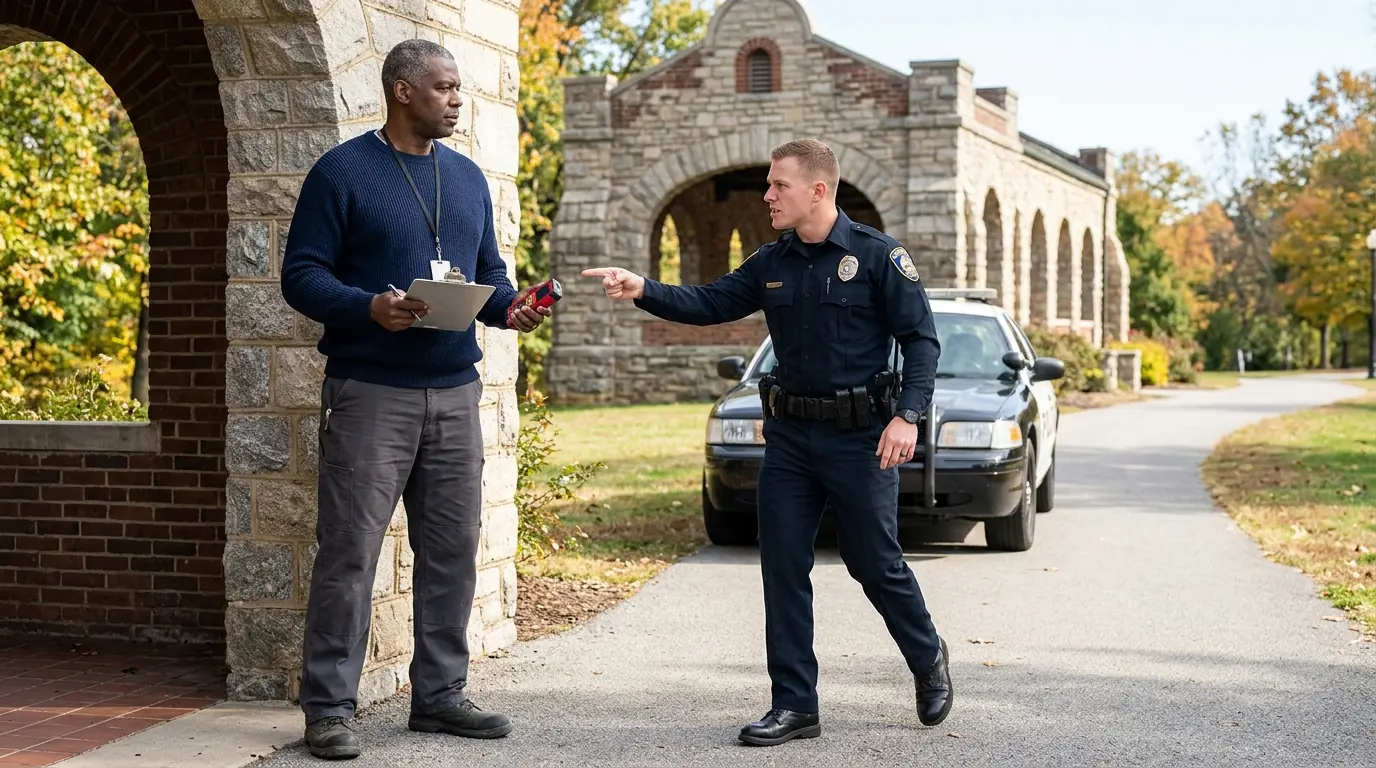
It was 10:15 a.m. The sky was a crisp, cloudless blue, and the autumn leaves were just beginning to turn gold. The morning air was cool, the kind that requires a light jacket. Major Marcus Thorne stood near the north pavilion, a historic stone structure that the city was planning to renovate. Thorne wasn't just any contractor.
He was the lead structural engineer for the project hired specifically for his expertise in historic preservation. Standing at 6'4 with broad shoulders that had carried rucks sacks across deserts and mountains, Thorne was an imposing figure. He was dressed in clean work boots, dark canvas work pants, and a thick navy blue sweater. Around his neck hung a heavyduty lanyard displaying his city contractor identification and his access pass. Thorne was a man of precision.
He had spent 25 years in the army, rising to the rank of major leading men in high stress environments where a single mistake meant death. He had retired with a purple heart and a bronze star carrying shrapnel in his left knee that made standing for long periods painful, though he never complained. He moved with a deliberate calculated slowness that projected calm. On this particular morning, he was using a laser distance measurer, a small handheld digital device to verify the integrity of the pavilion's stone arches. He would point the device at the arch record the number on his clipboard and move to the next angle.
He was focused, professional, and entirely within his rights to be there. He wasn't bothering a soul. He was doing the job the city paid him to do. But to one observer watching from a park bench 50 yards away, Marcus Thorne was a threat. And in her mind, threats needed to be neutralized.
Sheila Redcorn, 55, had lived in the affluent neighborhood bordering Centennial Park for three decades. She considered herself the unofficial guardian of the park's propriety. She was the type of resident who memorized the schedule of the landscape crew and called the city if the grass grew half an inch too high. She spent her morning sitting on her bench watching the world with a suspicious narrowing gaze. When she saw Marcus Thorne, she didn't see an engineer.
She didn't see a grandfather or a veteran. She saw a large black man holding a device she didn't recognize staring intently at a building. In Sheila's worldview, men who looked like Thorne didn't inspect buildings in her neighborhood. They damaged them. She watched him for 5 minutes, her imagination running wild.
Was he casing the pavilion for copper wiring? Was he planning to spray paint graffiti? Was that device in his hand, a weapon? She pulled her phone from her designer handbag, her fingers trembling with self-righteous adrenaline. She dialed 911.
The operator answered with the standard greeting. 911. What is your emergency? Sheila lowered her voice, shielding her mouth with her hand as if Thorne could hear her from 50 yard away. Yes, I'm at Centennial Park near the North Pavilion.
There is a man here behaving very suspiciously. I think he might be planning to break into the maintenance shed or vandalize the structure. The dispatcher asked for a description. He's a black male, Sheila said, emphasizing the race. He's very large, huge.
He's wearing dark clothing and he's holding some kind of black object. He keeps pointing it at the building and looking around. He definitely doesn't belong here. He looks like he's on drugs or something, just standing there staring. The dispatcher asked if he was being aggressive.
Not yet, Sheila lied, adding a dramatic pause. But he looks like he could snap at any moment. I'm afraid to walk past him. Please send someone before he destroys public property. The call was logged.
The nuances of worker or contractor never made it into the dispatch notes. The information relayed to the patrol units was condensed and urgent. Centennial Park North Pavilion. Suspicious black male large build possibly casing the location holding an unknown black object. Caller reports subject appears unstable.
Officer Kyle Vance was three blocks away when the call came over his radio. He hid his lights, though he kept the siren off, wanting to catch the suspect in the act. Vance had been reprimanded twice in the previous year for attitude issues during traffic stops, but he viewed those complaints as the whining of people who didn't respect the law. He considered himself a sheep dog, protecting the flock from the wolves. In his mind, he was already in route to a confrontation with a criminal.
He wasn't going to investigate. He was going to dominate. Vance pulled his cruiser up onto the paved walking path, tires crunching over the gravel, stopping just 20 ft from where Thorne was working. The sudden intrusion of a vehicle in a pedestrian zone, caused several walkers to stop and stare. Vance exited the vehicle, leaving the door open.
He adjusted his belt, resting his hand near his holster, a signal of aggression. He didn't walk with the casual stride of a community officer. He marched with the stiffness of a man looking for a fight. Thorne, hearing the car, turned slowly. He lowered his clipboard, but didn't drop his laser measure.
He watched the officer approach with the same tactical assessment he had used in overseas conflict zones. He saw the tension in Vance's jaw, the bladed stance, the hand hovering near the weapon. Thorne knew immediately that this was not a social call. Hey, Vance shouted, closing the distance rapidly. Back away from the structure hands where I can see them.
Thorne didn't flinch. He didn't raise his hands in surrender, nor did he make any sudden moves. He simply stood his ground, holding his equipment in a non-threatening manner. "Good morning, officer," Thorne said. His voice was a deep baritone, the command voice he had honed over two decades of leading soldiers, calm, resonant, and carrying an authority that usually made junior men straighten up.
"I am conducting a structural inspection for the parks department," he gestured slightly with his left hand toward the lanyard on his chest. "I have my credentials right here. " Vance stopped 10 ft away. The calmness of the man unnerved him. Suspects were supposed to be nervous, apologetic, or running away. They weren't supposed to speak to him like an equal.
I didn't ask for your life story. Vance snapped. I said, "Step away from the building. Drop the object in your right hand. " Now, Thorne sighed internally. He recognized the type.
He had seen young, hot-headed privates like this before, men who mistook volume for leadership. Slowly, deliberately, Thorne bent his knees and placed the laser measure on the grass. He stood back up, dusting his hands. The object is a laser distance measurer officer. It costs $300.
I am placing it down. Thorne looked Vance in the eye. I am Major Marcus Thorne, US Army retired. I am the lead engineer on this renovation project. If you look at the permit on the clipboard or the ID around my neck, we can resolve this misunderstanding immediately.
I don't care what you say you are, Vance retorted, stepping into Thorne's personal space. The size difference was palpable. Thorne had 3 in and 50 lb of muscle on the officer. This physical inferiority seemed to enrage Vance further. We have reports of a suspicious person casing this location.
You fit the description. Large black male loitering. Thorne's expression hardened. Working is not loitering, and I suggest you lower your voice and check my identification before you escalate this any further. Vance's face turned a shade of red.
You don't give orders here. I do. Turn around. Hands behind your back. You're being detained for investigation.
For what crime? Thorne asked, keeping his hands visible but refusing to turn. I have committed no crime. I have identified myself. My vehicle is parked right there with the company logo.
You are making a mistake, son. The word son was the tipping point. Vance's ego couldn't handle the paternal dismissal. That's it. Vance hissed.
Failure to comply. Vance didn't reach for his handcuffs first. He reached for violence. Without a verbal warning, Officer Vance lunged forward. He attempted to grab Thorne's left arm to spin him around.
Thorne reflexively stiffened his arm not to fight, but to maintain his balance. "Do not touch me! " Thorne stated firmly. Vance shouted, "Stop resisting! " and drove his boot hard into the side of Thorne's left knee, the exact spot where the shrapnel scars lay beneath the fabric of his pants. The pain was blinding. Thorne's leg buckled.
It wasn't a takedown born of skill. It was a cheap shot designed to [ __ ]. Thorne groaned a low guttural sound as his equilibrium failed him. He crumbled toward the earth, his hands instinctively going out to break his fall. He hit the ground hard, the dry dirt puffing up around him.
His clipboard clattered against the stone foundation of the pavilion papers scattering in the wind. Vance didn't pause. He jumped onto Thorne's back, driving his knee into the veteran's spine with the full weight of his body. I told you to comply. Vance screamed, playing to an audience that was rapidly gathering.
Give me your hands. Thorne was gasping for air, the weight on his lungs making it difficult to breathe. The pain in his knee was a white hot fire radiating up his thigh. My hands are right here. Thorne gritted out, forcing his arms behind his back.
Despite the agony, he knew that any movement could be interpreted as reaching for a weapon. He had to survive the officer's panic. The scene had attracted a crowd. A group of power walkers, mostly women in their 50s, stopped on the path. A man walking his golden retriever, froze.