Draven Reed had learned early that some people decided who he was before he ever opened his mouth. They looked at his worn sneakers, his faded backpack, the dark skin he carried through every hallway and parking lot, and they built a whole story around him without asking for a single fact. At twelve years old, he already knew how to stand quietly when adults looked at him too long. He knew how to smile politely when someone tightened their grip on a purse. He knew how to make himself smaller in places where he had done nothing wrong.
That Friday afternoon, all he wanted was a ride home.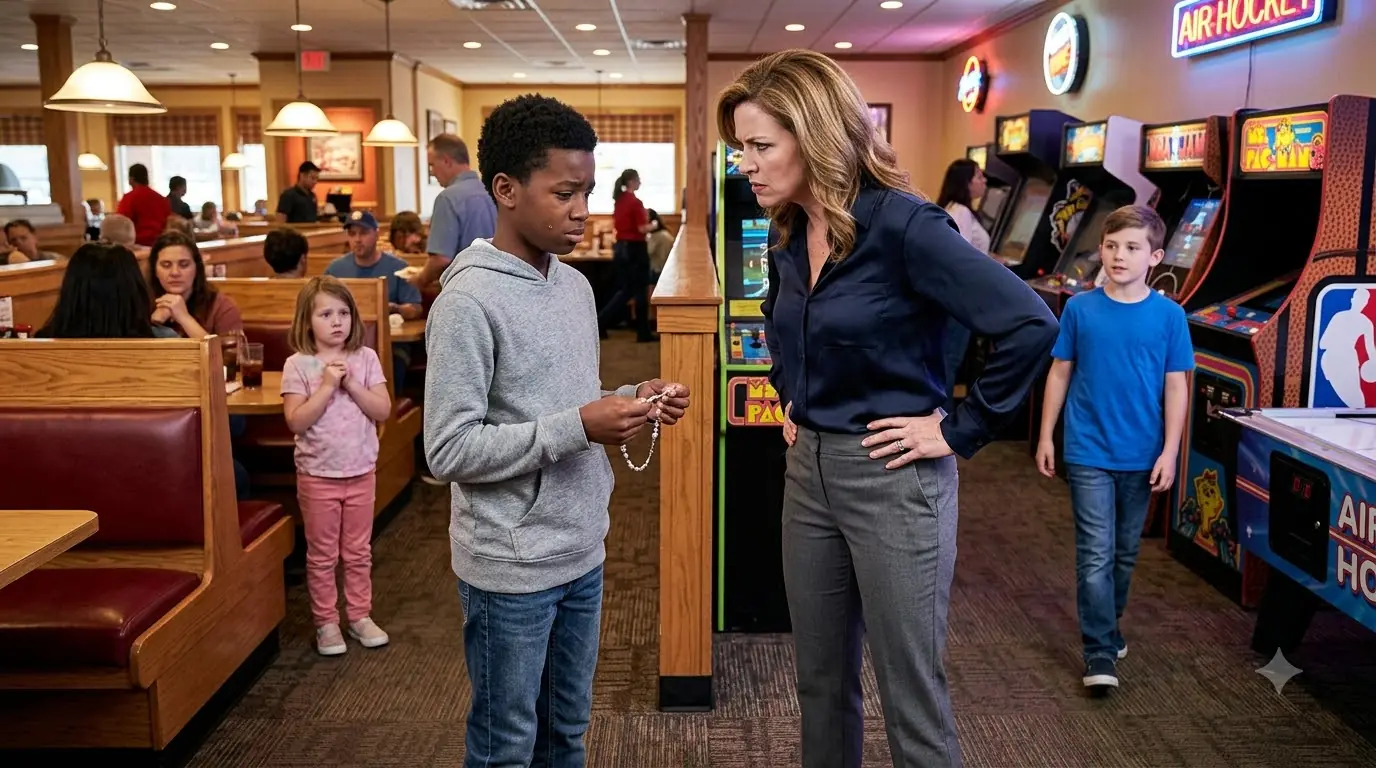
His mother had texted him during last period, apologizing again because the clinic had asked her to stay late. She worked double shifts whenever she could, sometimes cleaning examination rooms after the nurses went home, sometimes covering the front desk when someone called out. Draven never complained. His mother was doing everything alone, and he knew the tiredness in her eyes had his name written inside it.
So when Jackson Wilson offered him a ride, Draven hesitated for only a second before accepting. Jackson was his best friend, the first person at school who had sat beside him at lunch without turning it into a favor. They played basketball at recess, traded comic books, and helped each other with math homework. Jackson was loud where Draven was quiet, messy where Draven was careful, and honest in a way Draven trusted completely.
They were standing outside the middle school near the pickup lane when Jackson spotted his mother’s white SUV rolling toward the curb.
“There she is,” Jackson said, waving both arms as if his mother might somehow miss him. “Come on. I’ll ask her.”
Draven adjusted the strap of his backpack. “Are you sure?”
“Yeah. She’s taking me and Macy to dinner. You can come, too.”
Draven looked toward the SUV. Through the windshield, he saw Mrs. Wilson’s face before she even parked. Her eyes moved from Jackson to Draven, and something in her expression hardened. She wore large sunglasses pushed up on top of her carefully styled hair and a pale blouse that looked too expensive to be near the school’s dusty curb. When Jackson opened the passenger door, she smiled at him. When she looked past him at Draven, the smile disappeared.
“Hi, Mom,” Jackson said. “Can Draven come with us? His mom has to work late.”
Draven gave a small wave. “Hello, Mrs. Wilson.”
Mrs. Wilson looked him up and down, from his backpack to his shoes. “I don’t think that’s a very good idea.”
Jackson frowned. “Why not?”
“Because I don’t really know him.”
“You know him. He’s my best friend.”
Mrs. Wilson lowered her voice, but not enough. “Jackson, he looks like trouble.”
Draven stared at the sidewalk. He felt heat rise into his face, but he kept his hands at his sides.
“Mom,” Jackson said, embarrassed, “Draven isn’t trouble. He gets better grades than me.”
“I doubt that.”
“I do get good grades,” Draven said softly. “I got straight A’s on my last report card.”
Mrs. Wilson’s mouth tightened. “Well, good for you.”
Jackson leaned into the car. “Please, Mom. His mom is working. He just needs a ride.”
Mrs. Wilson sighed as if she had been asked to sacrifice something precious. “Fine. Just this once. But I am not running a charity service.”
He climbed into the back seat beside Macy, Jackson’s six-year-old sister. Macy had a pink bow in her hair and a small stuffed rabbit in her lap. Unlike her mother, she smiled at Draven immediately.
“Hi,” she said. “I’m Macy.”
“I know,” Draven said. “Jackson talks about you all the time.”
“He does?”
“Mostly when you steal his fries.”
Macy giggled. Jackson twisted around from the front seat. “She does steal my fries.”
Mrs. Wilson pulled away from the curb. “Before dinner, we need to stop at the jewelry store. My bracelet is ready.”
“The one Dad gave you?” Jackson asked.
“Yes,” she said, her voice softening for the first time. “It was too loose, so I had it adjusted.”
Jackson turned to Draven. “It’s like the most expensive thing we own. It has diamonds on it.”
“I don’t like to brag,” Mrs. Wilson said, though her tone suggested the opposite, “but it is very expensive. Your father spent a great deal of money on it, and I would be very upset if anything happened to it.”
Draven looked out the window and said nothing. He had already decided to be careful with every word. He would get through dinner, thank Mrs. Wilson, and wait for his mom outside when she arrived. That was all.
The jewelry store was in a small shopping plaza near the restaurant. Glass cases glittered under bright white lights, and a gold sign above the door read Marlowe Fine Jewelry. Mrs. Wilson parked directly in front and turned around in her seat.
“Jackson, take Macy inside and pick up my bracelet. Don’t take too long.”
Jackson unbuckled. “Come on, Draven.”
Mrs. Wilson raised one hand. “Actually, I think it’s better if Draven stays in the car.”
Jackson froze. “Why?”
“I don’t think they want extra children around all that jewelry,” she said. “And besides, this will give Draven and me a chance to get to know each other.”
Draven felt his stomach tighten.
Jackson looked uncertain, but Macy was already tugging his sleeve. “Come on, Jackson. I want to see the sparkly stuff.”
“It’s okay,” Draven said, forcing a smile. “I’ll wait.”
Jackson hesitated, then climbed out with Macy. The moment the door closed, the SUV changed. The air felt smaller, heavier.
Mrs. Wilson looked at Draven through the rearview mirror. “Let me make something clear.”
Draven sat very still.
“My son likes you,” she said. “I don’t know why, but he does. After today, I don’t want the two of you hanging out anymore. Do you understand?”
Draven’s voice came out quiet. “Did I do something wrong?”
“My son is a good boy. I don’t want some little thug corrupting him.”
“I’m not corrupting him.”
“Don’t play innocent with me.” She turned in her seat now, looking directly at him. “I know exactly what this is. You see a respectable family, and you think maybe you can get free rides, free meals, maybe a few handouts.”
“That’s not true. Jackson is really my friend.”
Mrs. Wilson laughed once, cold and short. “Look at you, Draven. Look at him. How could the two of you possibly be friends?”
The words hit harder than if she had shouted. Draven looked down at his hands. He wanted to defend himself, but every answer felt dangerous. He had been taught by his mother not to argue with adults when he was alone, especially adults who had already decided he was guilty of something.
“Don’t say anything about this to Jackson,” Mrs. Wilson said. “I don’t need drama.”
“Yes, ma’am.”
Jackson and Macy returned a few minutes later. Macy bounced into the back seat holding a small velvet box like it contained treasure. Jackson handed it to his mother.
“They polished it,” he said. “It looks brand-new.”
Mrs. Wilson opened the box and gasped. “Oh, it’s beautiful.”
The bracelet was silver and delicate, with tiny diamonds set along the top. Macy leaned forward, eyes wide.
“Mommy, can I hold it?”
“Absolutely not,” Mrs. Wilson said, snapping the box shut. “This is not a toy.”
Macy pouted. Jackson climbed back into the front seat, unaware of what had happened while he was gone. Draven kept his eyes on the window.
They drove to a family restaurant called Parker’s Table, a bright place with red booths, arcade machines near the back, and the smell of pizza, fries, and grilled cheese drifting through the air. Jackson’s mood lifted the moment they walked inside.
“They have the claw machine here,” he told Draven. “And a basketball game. You’re going down.”
Draven smiled despite himself. “You always say that.”
Mrs. Wilson checked in with the hostess and followed them to a booth near the arcade. A young waitress arrived with menus and a friendly smile.
“Hi, everyone. Are we ready to order, or do you need a few minutes?”
“We need a few minutes,” Mrs. Wilson said.
The waitress looked at the children. “They’re adorable. Are they all yours?”
Mrs. Wilson stiffened. “Of course not. Not the little Black boy. He’s just a classmate of my son’s.”
The waitress’s smile faltered. Draven stared at the menu even though the words blurred.
“I’ll give you a few minutes,” the waitress said quietly.
Jackson leaned across the table. “Want to play the basketball game?”
Draven glanced at Mrs. Wilson.
Jackson rolled his eyes. “Come on. It’s fine.”
“Macy stays here,” Mrs. Wilson said, taking her bracelet out of the box and sliding it onto her wrist. “And don’t go too far.”
Jackson and Draven walked to the arcade machines. Jackson fed in quarters, and soon they were laughing as small rubber basketballs bounced off the rim. For a few minutes, Draven forgot the car ride. He forgot Mrs. Wilson’s voice. He forgot how carefully he had been holding himself all afternoon. He was just a kid playing a game with his best friend.
Back at the booth, Macy watched her mother scroll through her phone. The bracelet sparkled against Mrs. Wilson’s wrist each time she moved. Macy’s eyes kept following it. When her mother stood and said she was going to the restroom, Macy nodded without really listening.
The moment Mrs. Wilson walked away, Macy reached across the table and touched the bracelet box. Her mother had left it open beside her purse. Inside was the small repair envelope from the jewelry store, and on the table lay the bracelet itself, removed for a moment before Mrs. Wilson went to wash her hands.
Macy knew she should not touch it. She also knew it looked like something a princess would wear.
She picked it up carefully.
It was heavier than she expected. She held it to her wrist, trying to imagine being grown-up and elegant. Then one end slipped from her small fingers. The bracelet struck the edge of the table, bounced once, and landed on the booth seat.
A tiny diamond chip popped loose and fell onto the red vinyl.
Macy’s face went white.
“No,” she whispered.
At the arcade, Draven turned and saw Macy hunched over the booth, shoulders shaking.
“I’m going to check on her,” he told Jackson.
Jackson was busy trying to beat the high score. “Okay. I’ll get more quarters.”
Draven walked back to the booth. “Macy? What’s wrong?”
She looked up with tears in her eyes. “I broke Mommy’s bracelet.”
Draven’s first thought was fear. His second was to help.
“It’s okay,” he whispered. “It was an accident.”
“She’s going to hate me.”
“No, she won’t.”
“Yes, she will. She said it was expensive.”
Draven sat beside her and looked at the bracelet. The piece had not snapped. One tiny stone had come loose, and the clasp looked bent. He saw the diamond chip on the seat and picked it up carefully.
“Let me see,” he said. “Maybe we can put it back in the box and tell her exactly what happened.”
Macy shook her head fast. “She’ll yell.”
“It’s better to tell the truth.”
He held the bracelet in one hand and the tiny stone in the other. He was looking for the repair envelope when Mrs. Wilson returned.
She stopped at the end of the booth.
“What’s in your hand?”
Draven froze.
“Nothing,” he said before he could think.
Mrs. Wilson’s eyes dropped to the bracelet. Her face twisted with triumph, as if she had been waiting for this moment since the school parking lot.
“Is that my bracelet?”
Draven stood quickly. “I’m really sorry, Mrs. Wilson. I was just trying—”
“You were trying to steal my bracelet.”
“No, ma’am. Macy—”
“I knew you were trouble.” Her voice rose. People at nearby tables turned to look. “I knew it from the second I saw you.”
Jackson rushed back from the arcade. “What’s going on?”
“Your thug friend tried to steal my bracelet.”
“What? Draven wouldn’t steal anything.”
“Don’t be stupid, Jackson. I caught him with it in his hand.”
The waitress hurried over. “Is everything okay?”
Mrs. Wilson pointed at Draven. “I would like you to call the police and have this thief arrested.”
Draven’s heart slammed against his ribs. “Please don’t call the police. I didn’t do anything.”
Jackson stepped in front of him. “Mom, stop. He didn’t steal it.”
“I don’t want you hanging out with him ever again.”
“He’s my best friend.”
“He’s nothing but a little Black deviant.”
The restaurant went quiet.
The waitress’s expression changed from concern to shock. “Ma’am, I need you to calm down.”
“Why are you still standing here?” Mrs. Wilson snapped. “Go call the police.”
“Mom, you can’t do this,” Jackson said.
Mrs. Wilson reached for Draven’s arm. “If no one will help me, I’ll throw him out myself.”
Draven tried to pull back. “Please, you’re hurting me.”
Jackson grabbed his mother’s wrist. “Mom, let go.”
Macy started crying. “Mommy, stop.”
Mrs. Wilson ignored all of them. She tightened her grip, dragging Draven away from the booth as if his body were proof of her accusation.
Then a woman’s voice cut through the restaurant.
“Take your hands off my son.”
Everyone turned.
Draven’s mother stood near the entrance in her clinic uniform, a dark blue scrub top under a worn jacket, her hair pulled back from a long shift. Her face was tired, but her eyes were clear and sharp.
Draven’s breath broke. “Mom.”
Mrs. Wilson released him slowly, as if she had been caught touching a hot stove.
Draven’s mother crossed the room and pulled him gently behind her. “Are you okay?”
He nodded, though his eyes were wet. “I didn’t steal anything.”
“I know you didn’t.”
Mrs. Wilson lifted her chin. “Your son is a thief. I caught him trying to steal my bracelet.”
“That is not true,” Draven said.
“And I believe my son,” his mother replied.
Mrs. Wilson scoffed. “Of course you do.”
Before anyone else could speak, Macy stepped forward, face soaked with tears.
“Mommy,” she whispered. “I took your bracelet.”
Mrs. Wilson looked down at her daughter. “What?”
“I thought it was pretty. I wanted to look at it. I dropped it, and a diamond fell off.” Macy pointed at Draven. “Draven was trying to help me fix it. He told me we should tell the truth.”
Mrs. Wilson stared at her daughter as if the words were in a language she did not understand.
Jackson nodded. “I told you. Draven wouldn’t steal anything.”
Mrs. Wilson’s face reddened. “Macy, you don’t need to lie for him.”
“I’m not lying,” Macy sobbed. “I did it.”
The waitress crossed her arms. The manager had appeared near the counter, watching carefully.
Draven’s mother looked at Mrs. Wilson. “You accused my son, put your hands on him, and called him names in front of an entire restaurant because you refused to believe he could be innocent.”
Mrs. Wilson pointed toward Draven’s backpack. “He’s still a liar.”
Draven blinked. “What?”
Mrs. Wilson grabbed his backpack from the booth before anyone could stop her and unzipped the front pocket. She pulled out a folded test paper.
“Explain this,” she said, holding it up. “Your son told me he was a good student, but he’s failing.”
Draven’s eyes widened. “That isn’t mine.”
Jackson’s face went pale.
Mrs. Wilson turned toward him. “Jackson?”
Jackson swallowed hard. “It’s mine.”
The restaurant seemed to hold its breath.
“I failed the math test,” Jackson said. “I didn’t want you to find out, so I asked Draven to hide it for me until I figured out what to say. My name is on the top.”
Mrs. Wilson looked at the paper. There it was, written clearly: Jackson Wilson.
Her mouth opened, but no defense came out.
Draven wiped his eyes with the back of his hand. Then he looked directly at Mrs. Wilson.
“I know you don’t like me,” he said quietly. “You’ve been judging me all day because I’m Black and because my mom works late. But I’m a good person. I didn’t steal your bracelet. I didn’t break it. And I don’t deserve this.”
Draven’s mother placed one hand on his shoulder. “No, you don’t.”
Mrs. Wilson’s pride fought with the silence around her. For one second, it looked like shame might win. Then her face hardened again.
“I don’t owe him anything,” she said. “This is a free country. I can think and say whatever I want.”
The manager stepped forward.
“You’re right,” he said. “It is a free country.”
Mrs. Wilson looked relieved for half a second.
“And this is a private restaurant,” the manager continued. “We can refuse service to anyone who abuses another guest or uses racist language in our dining room. I’m going to ask you to leave.”
Mrs. Wilson stared at him. “You’re kicking me out?”
“Yes.”
“You can’t do that.”
“We can. And we are.”
The waitress stood beside him. Two kitchen employees had come out from the back. A security guard from the shopping plaza stepped through the door, called by someone at the front counter.
Mrs. Wilson grabbed her purse. “This is outrageous.”
Jackson looked mortified. Macy clung to his hand, still crying.
Draven’s mother turned to Jackson. “You and your sister can wait outside with the guard until your mother is ready to leave. You don’t need to be part of this.”
Jackson looked at Draven. “I’m sorry.”
Draven nodded. “I’ll see you at school.”
Mrs. Wilson stormed toward the door, but the manager stopped her near the entrance.
“You also need to pay for any food already prepared,” he said. “And we will be documenting what happened here.”
She looked around the room. Nobody stood with her. Not the waitress, not the customers, not even her own son. The bracelet box was still on the table, the tiny loose diamond inside it now, safe because Draven had tried to protect it.
For the first time all afternoon, Mrs. Wilson had nothing left to say.
After she left, the restaurant slowly began breathing again. The manager apologized to Draven and his mother. The waitress brought him a glass of water and a plate of fries on the house. Draven’s mother wanted to leave immediately, but Draven shook his head.
“I’m okay,” he said, though his voice trembled.
She studied him. “You don’t have to pretend.”
“I know.” He looked toward the door where Jackson had disappeared. “But Jackson didn’t do it. Macy didn’t mean to. I don’t want them to think I hate them.”
His mother’s face softened with a sadness that came from loving someone too good for a cruel world.
“You have a bigger heart than most adults,” she said.
Draven looked down. “Sometimes I wish I didn’t.”
“I know.” She kissed the top of his head. “But don’t let anyone make you ashamed of it.”
The manager offered them a booth away from the windows. They sat together, and for the first time that day, Draven let himself breathe. His mother ordered him a vegetarian pizza, remembering without asking. When it came, the cheese stretched in long strings, and he laughed for the first time since school.
Outside, Mrs. Wilson sat in her SUV gripping the steering wheel while Jackson and Macy sat silently in the back. She wanted to blame Draven. She wanted to blame the restaurant. She wanted to blame everyone except herself. But Macy’s crying had quieted into small hiccups, and Jackson had turned his face toward the window, refusing to look at her.
“Jackson,” she said.
He didn’t answer.
“I was trying to protect you.”
“No,” he said finally. “You were trying to hate my friend and call it protection.”
Mrs. Wilson flinched as if he had slapped her.
The next Monday, Jackson found Draven near the basketball court before school. He carried the failed math test in one hand and a folded note in the other.
“My mom said I’m grounded,” Jackson said. “And I have to get tutoring.”
Draven tried to smile. “Math is evil.”
Jackson laughed weakly. Then his face grew serious. “I told her everything. About the car. About what she said to you when we went into the jewelry store. About the restaurant.”
Draven looked away.
“I’m sorry I didn’t know sooner,” Jackson said. “And I’m sorry I asked you to hide my test. That made everything worse.”
“It’s okay.”
“No, it’s not.” Jackson held out the note. “Macy made this.”
Draven unfolded it. It was a crayon drawing of three stick figures standing beside a giant pizza. One figure had dark skin and a huge smile. Above it, Macy had written in uneven letters: Thank you for helping me.
Draven smiled for real this time.
Weeks passed. Mrs. Wilson never came back to Parker’s Table. The restaurant staff remembered Draven, and when he came in with his mother after her late shifts, they greeted him by name. Jackson’s mother did not apologize, not in the way she should have, but something in her had been cracked open. Sometimes shame does not turn into goodness right away. Sometimes it only becomes silence, and silence is the first step for people who used to speak cruelty without fear.
Jackson and Draven stayed friends. It was not simple. There were awkward mornings, quiet lunches, and days when Draven wondered whether friendship should hurt that much. But Jackson kept showing up. He defended Draven when other kids repeated rumors. He told the truth even when it made him look bad. He stopped hiding failed tests and started staying after school for help.
Macy never touched anyone’s jewelry without permission again.
And Draven kept carrying his backpack to school, the same old backpack that had once held a failed test that was not his and nearly turned him into a criminal in the eyes of a room full of strangers. He carried books in it now, and pencils, and the crayon drawing Macy had made for him, folded carefully inside a plastic sleeve.
Years later, when Draven thought back on that day, he did not remember the bracelet first. He did not remember the restaurant manager or the security guard or the way Mrs. Wilson’s face changed when her own children told the truth. He remembered his mother’s voice at the entrance.
Take your hands off my son.
Those six words stayed with him longer than the insult, longer than the accusation, longer than the fear. They reminded him that even when someone tried to shrink him into their worst assumption, someone who knew the truth could still walk into the room and call him by what he was.
Her son.
A child.
A good friend.
A good person.
And that should have been enough from the beginning.