The park was almost empty when Jordan Price rolled through the front gate with his scooter tucked under one arm and his phone already recording in the other. Evening light stretched across the concrete paths of Sunshine Park, turning the metal rails and ramps near the playground into long silver lines. The basketball court was empty. The swings moved gently in the breeze. For a sixteen-year-old boy who lived in a crowded apartment with two younger cousins, a tired mother, and walls thin enough to hear every neighbor’s argument, an empty park felt like a gift.
Jordan stopped near the small skate area, propped his phone against the edge of a bench, and checked the frame. His face appeared on the screen, bright-eyed and smiling under a red helmet covered in stickers. He wore a black T-shirt with his channel name printed across the chest, faded jeans with a patch on one knee, and sneakers that had been repaired with white glue twice already. His scooter was scratched from months of practice, but he polished the handlebars every weekend like it was a championship trophy.
“Hey, guys,” he said into the camera, forcing his voice to sound bigger than he felt. “It’s Jordan here with another epic scooter video, and it looks like I’ve got the park all to myself tonight.” He spun the scooter once, caught the handlebars, and grinned. “The weather is amazing, the pavement is clean, and I’m about to try some tricks you already know and love. So let’s get into it.”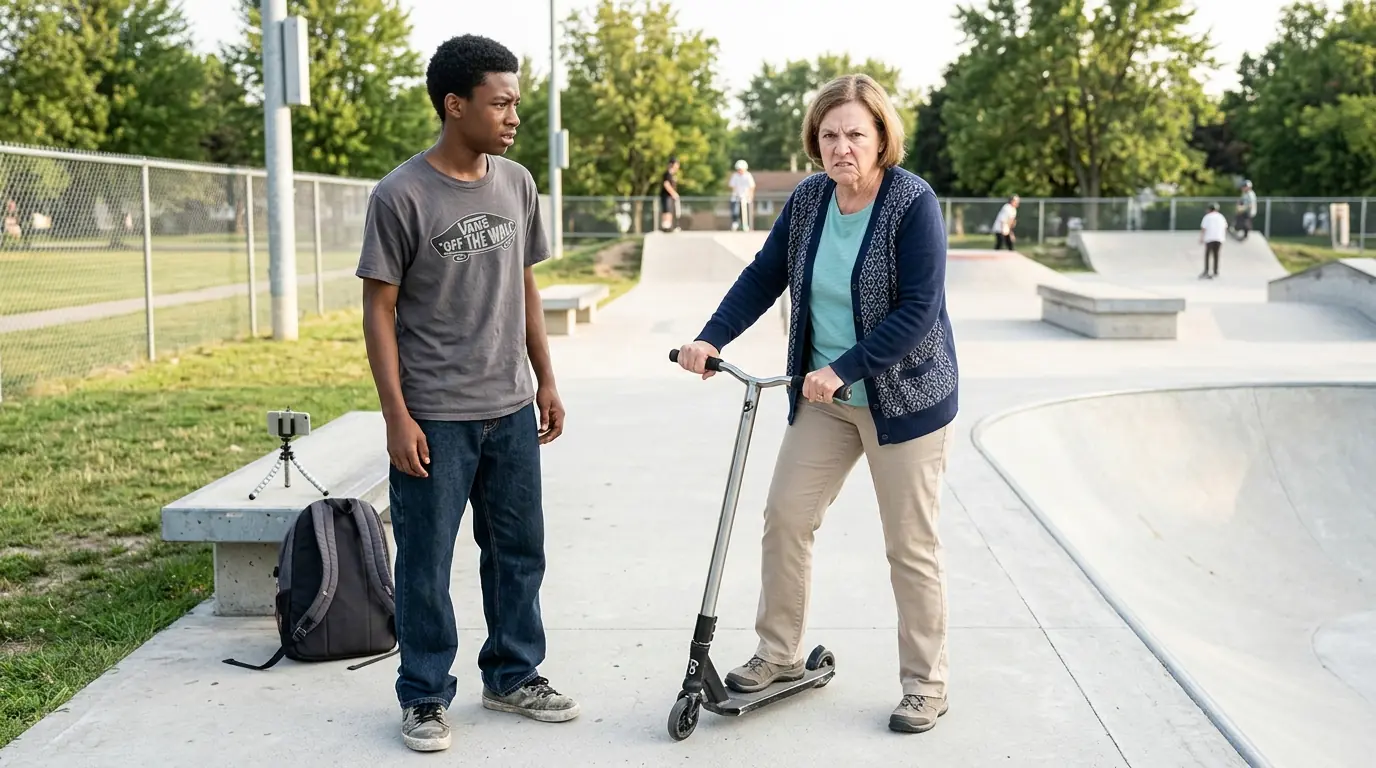
He hit record, rolled back, and pushed off. For those first few minutes, nothing existed except the sound of wheels over concrete, the slap of his shoes against the deck, and the rush of air when he hopped the curb and landed clean. Jordan loved the feeling of leaving the ground, even for a second. It made everything else disappear: the bills his mother worried about, the boys at school who laughed at his patched clothes, the way people sometimes watched him in stores as if he had already stolen something.
He was setting up for another trick when he noticed movement in the corner of his eye. A woman stood near the walking path, staring at him with a disgusted expression like he had dragged mud into her living room. She was older, maybe in her late sixties, with stiff gray hair sprayed into place, pearl earrings, a pale cardigan, and white walking shoes that looked too clean for an actual walk. One hand held a phone. The other clutched a small purse against her stomach.
Jordan slowed his scooter. “Excuse me?”
“What are you doing with that phone?” the woman demanded.
“I’m filming a video,” Jordan said. He pointed to the bench. “Just scooter tricks.”
“Do you even have a permit to film here?”
Jordan blinked. “A permit?”
“Yes, a permit. This is a private park.”
“It’s a city park,” Jordan said carefully. “I’ve been coming here for years. I’m just filming for my channel.”
“I don’t care what it’s for,” she snapped. “Boys like you don’t come to neighborhoods like this to make innocent videos.”
Jordan felt the familiar tightening in his chest. He had learned to recognize the tone before the words came. It was the tone of someone who had already decided he was guilty and was only waiting to pick the crime. He stepped off his scooter, keeping his hands visible because his mother had taught him to be careful when strangers got angry.
“Ma’am, I’m not bothering anybody,” he said. “There’s nobody even here.”
“Don’t talk back to me.” She lifted her phone. “I should call the police.”
“You don’t need to do that.”
“Oh, I don’t?” Her eyes shifted past him, and her face brightened with a cruel kind of relief. “Officer! Officer, I need help.”
A police officer walking near the park entrance turned at the sound of her voice. He was tall, broad-shouldered, and looked tired in the way people looked when they had already heard too many complaints that day. His name tag read Whitaker. He approached with one hand resting near his belt, glancing from the woman to Jordan to the scooter and the phone on the bench.
“What’s going on?” Officer Whitaker asked.
“This boy is filming women in the park,” the woman said immediately. “He was recording me. He’s probably selling images online.”
“He’s lying,” she said. “You know how they are.”
Officer Whitaker looked sharply at her. “Ma’am, slow down.” Then he turned to Jordan. “Son, is that your phone?”
“Yes, sir.”
“May I see what you’re recording?”
Jordan nodded quickly. “Of course.” He walked over, picked up the phone, and handed it to the officer with shaking fingers. “It’s just tricks. I’m trying to build my channel. My mom says if I stay focused on something good, maybe I can get a scholarship one day.”
The officer watched the latest clip. It showed Jordan smiling into the camera, pushing off, jumping the curb, wobbling, laughing at himself, and trying again. The woman did not appear in the video at all. There was no one else in the frame except Jordan and a line of empty benches.
Officer Whitaker handed the phone back. “Looks like scooter videos to me.”
The woman’s lips tightened. “He could have deleted the other footage.”
“Ma’am, I have no evidence of that.”
“He needs to leave.”
“This is a public park.”
“He doesn’t belong here.”
Officer Whitaker’s patience thinned. “That’s enough. He isn’t breaking the law. He said he won’t film you. You can continue your walk, and he can continue using the park.”
The woman turned red. “So you’re just going to let him stay?”
“I’m going to let a kid ride his scooter in a public park, yes.”
Jordan held his scooter close to his side, not sure whether to thank the officer or disappear. The woman stepped closer to him before the officer moved between them.
“This isn’t over,” she hissed at Jordan. “Something is going on here, and I’m going to prove it.”
“Ma’am,” Officer Whitaker said, voice hard now, “do not touch him. Do not threaten him. Go home.”
She stared at Jordan for another long second, then turned and walked away with sharp, furious steps. Jordan exhaled only after she disappeared around the walking path.
“You all right, kid?” the officer asked.
Jordan nodded, though his hands were still shaking. “Yeah.”
“Keep your phone recording when you’re out here,” Officer Whitaker said quietly. “Not because you’re doing anything wrong. Just because sometimes people say things that aren’t true.”
“I know,” Jordan said.
The officer’s face softened a little. “You’ve got talent. Don’t let bitter people make you quit.”
Jordan looked down at his scooter. “I won’t.”
He tried to finish filming, but the fun had drained out of the evening. He recorded two more tricks, packed his phone, and rode home under the streetlights. That night, he did not tell his mother everything. He only said a woman had bothered him and an officer had handled it. His mother, Denise, stopped stirring the pot of rice on the stove and studied him until he looked away.
“Jordan,” she said, “you tell me when people threaten you.”
“She was just old and angry.”
“Old and angry can still be dangerous.”
“I know.”
Denise wiped her hands on a dish towel and walked over to him. She was a nursing assistant who worked double shifts at a rehabilitation center, and exhaustion lived permanently around her eyes. But when it came to her son, there was still steel in her voice. “You belong in that park just as much as anyone else. You understand me?”
Jordan nodded. “Yes, ma’am.”
“And if somebody tries to make you feel small, you remember who you are.”
“I’m Jordan Price,” he said, repeating the line she had made him say since he was little. “And nobody gets to decide my worth but me.”
“That’s right.” She kissed the top of his helmet because he had forgotten to take it off. “Now wash your hands. Dinner’s almost ready.”
For the next few days, Jordan avoided Sunshine Park. He filmed in the apartment parking lot instead, dodging potholes and trash cans while his cousins cheered from the steps. But the pavement was rough, and the space was too small. On the fourth afternoon, after school and homework, he finally grabbed his scooter again.
“You going back to the park?” Denise asked from the couch, where she was folding laundry before her night shift.
“Yeah.”
She looked at him for a long moment. “Phone charged?”
“One hundred percent.”
“Helmet?”
He tapped it.
“Recording?”
“I’ll keep it on.”
Denise nodded. “Then go. Don’t let anybody run you out of a place you have a right to be.”
Jordan smiled. “Yes, ma’am.”
Sunshine Park was empty again when he arrived. The air smelled like cut grass and summer dust. A few cars sat near the far curb, but no one was on the ramps, the swings, or the walking path. Jordan set his phone on the bench, angled it toward the playground structure behind him, and started recording.
“Hey, guys,” he said, the old excitement slowly returning. “Jordan here, and I’ve got the park all to myself again, which means it’s time for more insane scooter videos. Today I’ll be attempting the most treacherous stunt of my entire career.” He pointed dramatically toward the low platform near the playground. “Now, my mom told me to stop attempting dumb stuff after I broke my arm last year, but nothing great was ever accomplished without risk. Remember, don’t try this at home.”
He laughed, rolled back, and pushed forward.
He did not notice the woman standing behind a tree near the walking path. Her name was Evelyn Mercer, and she had spent the last four days stewing over the humiliation of being corrected by a police officer in front of a teenager she had decided did not belong. To Evelyn, the problem was not that she had lied. The problem was that no one had believed her. She had told herself again and again that the boy had to be doing something wrong. He had to be. Boys like him did not come to her neighborhood park to dream. They came to ruin things.
Earlier that afternoon, she had found a small plastic bag near the alley behind the grocery store. She did not know what was inside. She did not care. It looked suspicious, and suspicious was enough. She wrapped it in a tissue, placed it inside her purse, and drove to the park with a plan.
Jordan was practicing near the bench when Evelyn marched toward him.
“What are you doing back here?” she barked.
Jordan flinched and nearly lost his balance. “I’m riding my scooter.”
“I thought I told you there would be consequences if I caught you here again.”
“You don’t own the park,” Jordan said, trying to keep his voice steady. “It’s for everyone.”
“For everyone decent.”
Jordan glanced toward his phone. The red recording light was still on. Remembering Officer Whitaker’s advice, he left it alone.
“This is the only place around here with smooth pavement,” he said. “I’m not bothering you.”
“You’re always bothering someone. You just don’t have the manners to know it.”
“Ma’am, please leave me alone.”
Evelyn’s eyes dropped to his scooter. Before Jordan could move, she grabbed the handlebars.
“Give that back,” he said, panic rising in his voice.
“I told you to leave.”
“You can’t take my scooter.”
“Oh, yes, I can.” She lifted it slightly, forcing Jordan to step closer. “Maybe if I break this, you’ll finally learn.”
“No, please. My mom can’t afford another one.”
“Then you should have thought about that before you disobeyed me.”
Jordan reached for the scooter, but Evelyn jerked it away. He stumbled, caught himself on the bench, and felt tears burn behind his eyes. He hated that she could make him feel like a little kid. He hated that he was scared. He hated that part of him wanted to run.
“Why are you doing this to me?” he asked.
Evelyn leaned close enough for him to smell the sharp perfume on her sweater. “Because people like you need to be taught your place.”
Jordan froze. There it was, the truth behind everything. Not permits. Not cameras. Not the park. Just him. His face. His skin. His presence.
“You’re a miserable old woman,” he said, voice cracking. “You have nothing better to do than make my life miserable.”
“How dare you speak to me that way.”
“Then leave me alone.”
Evelyn shoved the scooter against his chest. He grabbed it, but she kept one hand on the handlebar and used the other to push him backward. Jordan slipped on loose gravel and fell hard onto one knee. Pain shot up his leg.
Evelyn looked down at him with satisfaction. “While you’re down there, maybe you can clean my shoe.”
Jordan stared at her, stunned. “What is wrong with you?”
Before Evelyn could answer, a police cruiser pulled into the park entrance. Jordan felt relief at first, because he recognized the car. Then he saw Officer Whitaker step out with another officer behind him, and relief turned into fear when Evelyn instantly changed her face.
“Officer!” she cried. “Thank goodness you’re here. I want him arrested.”
Whitaker approached slowly, eyes moving over Jordan on the ground, the scooter, Evelyn’s hand still gripping her purse, and the phone on the bench. “We’ve already been through this, ma’am. Unless you have proof he’s committed a crime, there’s nothing I can do.”
“He attacked me.”
Jordan pushed himself up. “No, I didn’t.”
“He’s lying.”
Whitaker raised a hand. “Everyone stop talking for a second.” He looked at Evelyn. “Tell me exactly what happened.”
“I saw him dealing drugs,” Evelyn said. “I called 911. Then I confronted him, and he attacked me.”
Jordan shook his head. “I wasn’t selling anything. I was recording a scooter video. My phone is right there.”
“Check his bag,” Evelyn said quickly. “I bet there are drugs inside.”
Whitaker looked at Jordan. “Son, do you consent to me checking your backpack?”
Jordan swallowed. “Yes, sir. You won’t find anything.”
His backpack sat beside the bench, half open, where he kept a water bottle, a granola bar, and a small screwdriver for his scooter bolts. Whitaker crouched, opened it, and began to search. Jordan watched, confused but not worried. He knew what was in his bag. He had packed it himself.
Then Officer Whitaker stopped.
The second officer stepped closer. “What is it?”
Whitaker slowly lifted a small plastic bag from the front pocket.
Jordan’s stomach dropped. “No. That’s not mine.”
Evelyn gasped theatrically. “See? I told you.”
“That’s not mine,” Jordan repeated, louder now. “She must have put it in there.”
“Oh, now he’s accusing me,” Evelyn said. “Typical.”
Whitaker’s expression changed. The officer who had defended him days earlier now looked trapped between what he wanted to believe and what he was holding in his hand. “Jordan,” he said quietly, “I need you to turn around.”
“No. Please. You know me. You saw what happened last time.”
“I have to take you in until we sort this out.”
“I didn’t do anything.”
“I know you’re scared, but don’t make it worse.”
Jordan backed away one step. “Please don’t arrest me. Please call my mom.”
Evelyn folded her arms. “Now maybe he’ll learn.”
Whitaker gave her a sharp look. “Ma’am, enough.” Then he turned back to Jordan. “Hands behind your back.”
The cuffs clicked around Jordan’s wrists. The sound felt louder than everything else in the park. He stared at the ground, heart pounding, trying not to cry. All he could think about was his mother getting a call at work. His cousins seeing his mugshot. People at school whispering that maybe they had been right about him all along.
As Whitaker guided him toward the cruiser, Jordan suddenly remembered.
“My phone,” he said. “Officer, please. My phone is still recording on the bench. Please grab it. I don’t want it stolen.”
Evelyn went pale.
Whitaker noticed. “Recording?”
Jordan nodded quickly. “I started before she got here. It’s been recording the whole time.”
For the first time since the plastic bag appeared, Whitaker’s eyes sharpened. He turned toward the bench. Evelyn stepped sideways, as if she might reach the phone first, but the second officer blocked her path.
“Don’t touch it,” Whitaker said.
He picked up the phone. The video was still recording. He stopped it, opened the latest clip, and scrubbed backward. Jordan watched from beside the cruiser, barely breathing.
The screen showed Jordan speaking to the camera, pointing at the playground, setting up the trick. It showed Evelyn entering the frame. It showed her grabbing his scooter. It showed her pushing him. It showed Jordan falling. And then, clear as daylight, it showed Evelyn walking to his backpack while Jordan was still on the ground. Her back was to him, but the camera had caught her hand reaching into her purse, pulling out the small plastic bag, and sliding it into the front pocket of his backpack.
Officer Whitaker’s face hardened into something cold.
Evelyn whispered, “That video is misleading.”
Whitaker looked at her. “Misleading?”
“I was trying to keep the neighborhood safe.”
“You planted evidence on a sixteen-year-old boy.”
“He shouldn’t have been here.”
The second officer removed the cuffs from Jordan. His wrists were red, and he rubbed them as tears finally spilled down his cheeks.
Whitaker turned to Evelyn. “Put your hands behind your back.”
“What?”
“You’re under arrest for filing a false police report, tampering with evidence, assault, and attempting to frame a minor.”
“You can’t arrest me.”
“Yes, I can.”
“I was protecting this community.”
“No,” Whitaker said. “You were attacking a child because of your own hatred.”
Evelyn struggled as the second officer cuffed her. She shouted about lawsuits, about property values, about how everyone would regret believing Jordan. But nobody believed her now. A few neighbors had gathered near the park entrance, phones out, watching the woman who had called herself a protector get placed into the back of a cruiser.
Whitaker turned back to Jordan. “I’m sorry.”
Jordan wiped his face with the heel of his hand. “You almost arrested me.”
“I know.”
“You believed her.”
Whitaker lowered his eyes. “I believed what was in the bag before I checked what was on the video. That was wrong.”
Jordan looked toward his phone. “If I hadn’t been recording?”
Whitaker did not answer right away. That silence was answer enough.
Denise arrived fifteen minutes later in her work scrubs, running from the parking lot before the car door had fully closed. When she saw Jordan sitting on the bench with a blanket around his shoulders, she pulled him into her arms so tightly he could hardly breathe.
“What happened?” she demanded, looking at the officers over Jordan’s head.
Whitaker explained everything. He did not soften it. He told her Evelyn had taken Jordan’s scooter, pushed him, planted drugs, and lied to police. He also told her he had started to arrest Jordan before the video proved the truth.
Denise’s face went still. “You put handcuffs on my son.”
“Yes, ma’am.”
“He told you he didn’t do it.”
“Yes, ma’am.”
“And you almost let a woman destroy his life because she knew exactly which lie people would believe.”
Whitaker swallowed. “Yes, ma’am.”
Denise held Jordan closer. “Then I suggest you remember this feeling every time you answer a call about a boy who looks like mine.”
“I will,” he said. “I promise you I will.”
The video spread faster than anyone expected. Jordan posted it that night with a short caption: I just wanted to ride my scooter. By morning, it had thousands of views. By the end of the week, it had millions. People were furious. They watched Evelyn pretend to be frightened. They watched her take his scooter. They watched her push him. They watched her plant the bag. They watched a sixteen-year-old boy nearly lose his freedom because an adult woman decided he did not belong in a public park.
Reporters came to the apartment complex. Denise refused most interviews at first because Jordan was still shaken and she would not let strangers turn his trauma into entertainment. But Jordan surprised her by saying he wanted to speak once. Just once.
He sat beside his mother in front of a local news camera, wearing his red helmet in his lap.
“I’m not a criminal,” he said. His voice trembled, but he kept going. “I’m just a kid who likes scooters. I want to make videos. I want to get good enough to compete someday. I shouldn’t have to prove I’m not dangerous every time I go outside.”
Denise took his hand.
Jordan looked into the camera. “People keep asking why I recorded. I recorded because I was making a scooter video. But now I think everyone should know their rights and protect themselves. Because if the camera hadn’t been on, nobody might have believed me.”
Evelyn Mercer was charged with multiple crimes. At first, she insisted she had done nothing wrong. She claimed she had been confused. Then she claimed the video had been edited. Then her attorney saw the unbroken original file, the metadata, and the park’s security footage from a nearby maintenance building. After that, the excuses stopped.
In court, prosecutors described how Evelyn had targeted Jordan twice, how she had made a false report, how she had used racial assumptions to create danger where there had been none, and how she had attempted to plant evidence on a minor. The judge watched the video in silence. When it ended, the courtroom remained quiet.
Jordan testified with his mother sitting behind him. He described the fear of being grabbed, the humiliation of falling, the terror of seeing handcuffs come toward him, and the way his stomach had dropped when the officer found the bag.
“I thought my life was over,” he said. “And I didn’t even know what was happening.”
Evelyn was convicted. Her sentence included jail time, probation, community service, mandatory counseling, and a court order to stay away from Jordan, his family, and Sunshine Park. The judge also ordered her to attend restorative justice education, though Jordan declined to meet with her. He told his mother he was not ready, and Denise said he did not owe anyone forgiveness on a schedule.
Officer Whitaker requested a review of his own conduct. He could have hidden behind the fact that he had eventually uncovered the truth, but he did not. He told his supervisor he had moved too quickly, placed a frightened child in cuffs without fully considering the context, and nearly let a false accusation become an arrest record. The department used the incident in new training for officers: false reports, planted evidence, youth interactions, and bias in emergency calls.
During one training session months later, Whitaker stood before a room of recruits and played Jordan’s video. When the clip ended, he said, “This is what happens when we respond to someone’s fear without asking whether that fear is based in reality. I almost arrested a child because someone weaponized my authority. Don’t ever forget how dangerous that is.”
Sunshine Park changed, too. The city installed new cameras near the skate area and posted signs reminding visitors that public parks belonged to everyone. A youth scooter program started there on Saturdays, funded by donations from people who had watched Jordan’s video. Local kids showed up with scooters, skateboards, bikes, and helmets. Some were good. Some fell every five seconds. Jordan helped them all.
His channel grew. Not because people wanted to watch him suffer, but because they wanted to watch him keep going. He posted tricks, tutorials, safety tips, and occasional serious videos about standing up for yourself without becoming cruel. A scooter company sent him a new deck after seeing the damage Evelyn had done to his old one. Jordan cried when the package arrived, though he tried to hide it from his cousins.
The first time he returned to Sunshine Park after the trial, he almost turned around at the gate. His hands tightened on the scooter. The bench was still there. The path was still there. The place where he had fallen was still there.
Denise stood beside him. “We can go home.”
Jordan shook his head. “No.”
He set his phone on the bench, adjusted the angle, and pressed record.
“Hey, guys,” he said, voice unsteady at first. “It’s Jordan here. I’m back at Sunshine Park.” He paused, looked toward his mother, then back at the camera. “A lot happened here. But this park didn’t hurt me. Hate did. And I’m not letting hate take this place away from me.”
He picked up his scooter, rolled back, and pushed forward. His first jump was messy. His second was better. By the third, his body remembered what fear had tried to erase. Wheels left the pavement. The scooter rose with him. For one breathless second, he was in the air.
He landed hard, stumbled, and laughed.
Denise clapped from the side of the path. A few younger kids watching near the swings cheered. Jordan rode back to the camera, breathless and smiling.
“Still here,” he said.
Years later, Jordan would say that was the moment he got his park back. Not when Evelyn was arrested. Not when the trial ended. Not when the video went viral. It was that shaky landing, that laugh, that decision to keep riding.
He became a mentor before he became famous. Every Saturday, he taught kids how to balance, how to fall safely, how to tighten their handlebars, and how to keep recording when they needed to protect themselves. He told them talent mattered, but character mattered more. He told them anger could burn you from the inside if you let it. He told them courage was not never being scared; courage was going back to the place where fear found you and proving it did not own you.
At seventeen, Jordan entered his first amateur scooter competition. He did not win. He placed fifth and celebrated like he had taken first because a year earlier he had wondered if he would ever ride in public again. At eighteen, he won a regional event. At nineteen, he started a nonprofit that donated scooters and helmets to kids who could not afford them.
The nonprofit was called Ride Free.
Its first official event took place at Sunshine Park. Officer Whitaker, now assigned to community outreach, volunteered to help block off the street and hand out water. Denise supervised the registration table. Kids lined up with new helmets, laughing so loudly the whole park felt alive.
Jordan stood on the same concrete path where Evelyn had once tried to make him kneel. He looked at the ramps, the benches, the trees, the open space, and the dozens of kids waiting for their turn.
A reporter asked him why he kept coming back to that park.
Jordan smiled. “Because someone tried to tell me I didn’t belong here.”
“And what did you decide?”
He picked up his scooter and looked toward the kids.
“I decided everybody does.”
Then he rolled forward, pushed off, and let the wheels carry him into the place that had once held his fear and now held his freedom.