“Hey, you! Hands up, now, and step away from her,” an officer shouted. Dwayne answered, “Can’t you see I’m trying to stop them from fighting?” but the officer cut him off: “Shut up. We just got a call about a man beating up a woman. I won’t repeat myself—hands up and get on your knees, now.”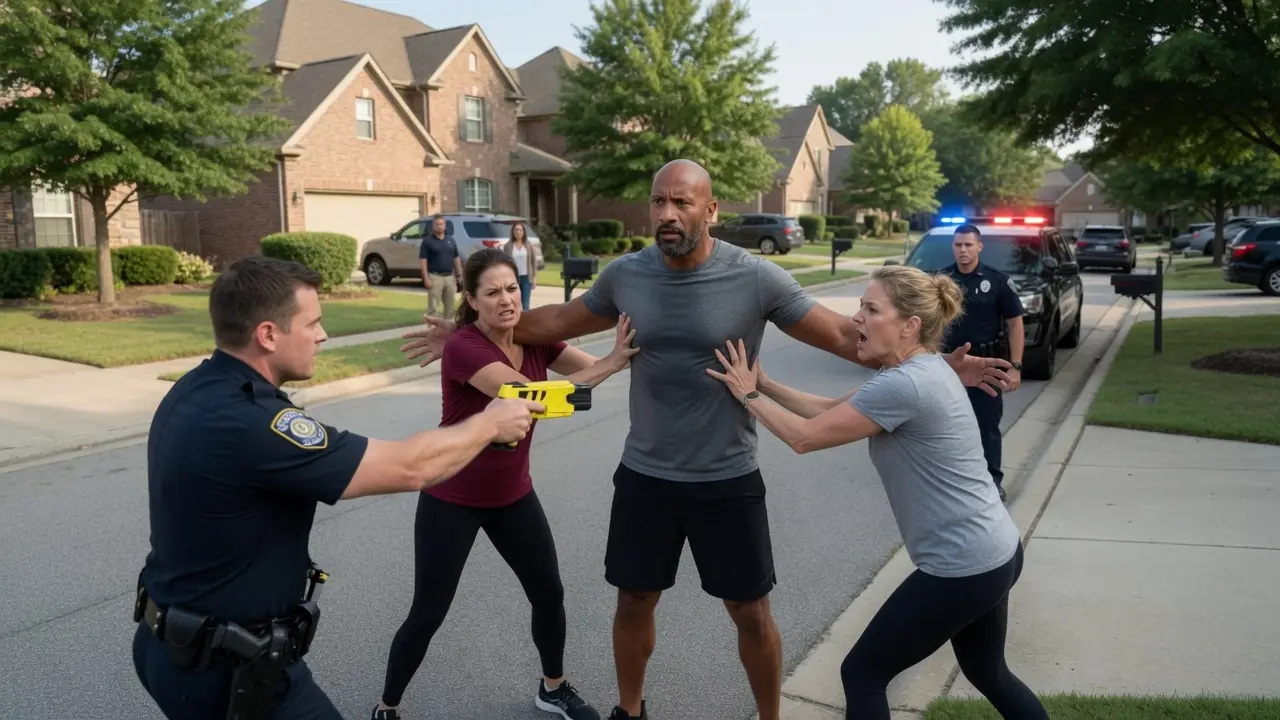
Another woman cried, “Yes, officer, arrest them. This man and the other woman were attacking me,” while Dwayne protested that it was not true before the officer declared, “You’re under arrest for assault.” When two women started fighting on a residential street and nobody stepped in, Dwayne Cole, a man who had just moved to the neighborhood, did what any decent person would do and walked into the middle of the fight to break it up. He was then confronted after Carol Stevens, a woman in her 50s, call 911 from her window and tell police, "a man is beating up a woman." Then, when Officer Kyle Bennett and his partner arrived, Bennett drew his weapon, ordered Dwayne to his knees, and handcuffed him while Carol pointed and said, "That's him."
And Patricia Mills, the woman Dwayne had been holding back, told officers that Dwayne and the woman had been ganging up on her. Dwayne was dragged to the station in handcuffs, saying nothing more after his protests were ignored. What officers Bennett and Marsh, Carol Stevens, and Patricia Mills didn't know, what they would soon find out, was that the man they had just arrested and accused wasn't just a regular citizen. He was the city's newly appointed police chief. Dwayne Cole had moved to the Eastfield neighborhood 2 weeks ago, and in those 2 weeks he had barely introduced himself to more than a handful of people on his street.
He was 46 years old, and he had spent the past 20 years in law enforcement, working his way from patrol officer to detective to deputy chief before being appointed as the new police chief of the Harlow City Police Department. He wasn't scheduled to officially report for duty for another week, and he had used the time before his start date to settle into his new home and learn the neighborhood he would now be living in. He ran every morning without fail, the same 5-mile loop that took him through the residential streets surrounding his house, and it was something he had done for the past 15 years, regardless of the weather or what was happening in his life. That Saturday morning was cool and clear, and Dwayne was coming around the final stretch of his run with about half a mile left to go when he heard the shouting. It started as loud voices, the kind that carried through the still morning air and made heads turn.
And as Dwayne came around the corner onto Maple Street, he saw them immediately. Two women, both in their 40s, standing in the middle of the sidewalk in front of a row of houses, and the argument between them had already gone well past the point of words. the woman, who Dwayne would later learn was named Denise Crawford, was pointing her finger at the woman in front of her, her voice high and sharp. the woman, Patricia Mills, was pointing right back, and her voice was just as loud. Dwayne slowed his pace and looked around the street. There were three people on their front porches watching. Two people across the street had stopped walking and were filming on their phones.
And in less than 2 seconds, the two women were locked in a physical fight, grabbing each other's hair and pulling, pushing, shouting at the tops of their voices. Dwayne looked around the street one more time, saw that nobody was making any move to intervene, and made his decision. He moved toward them quickly, keeping his body controlled and his voice calm, but loud. "Hey, stop. Break it up."
He pushed in between them, using his body as a barrier, and reached out and grabbed Patricia from behind, wrapping both arms around her to pull her back away from Denise. Patricia was still swinging, trying to get past Dwayne toward Denise, and Dwayne held firm, talking steadily as he worked to create distance. "Stop fighting it. It's over. Calm down."
Denise, now a few feet away with Dwayne physically between them, was still in a fighting stance, still shouting. Her chest heaving with adrenaline, Patricia was fighting against Dwayne's grip, her face flushed red from the exertion of the fight and the anger still running through her. Dwayne held her steady and kept his voice authoritative. "It's done. Walk away."
Across the street, on the second floor of a yellow house with white shutters, a window curtain moved. Carol Stevens had been awakened by the noise and had come to her window to see what was happening. She was 57 years old and she had lived on Maple Street for 19 years and in those 19 years she had developed very fixed ideas about her neighborhood and the kinds of people who belonged in it. What she saw from her window was this: a man holding a woman from behind while the woman struggled. And a woman standing nearby in an aggressive posture.
That was all Carol needed to see. She didn't open the window to listen to what was being said. She didn't go downstairs to get a closer look. She didn't consider for a single moment that the man might be breaking up a fight rather than participating in one. She picked up her phone and dialed 911 with the certainty of someone who was absolutely sure about what they had witnessed.
"There's a man attacking a woman on Maple Street." Carol told the dispatcher, her voice urgent. "He's holding her and there's a woman with him. I can see them from my window. You need to send someone right now before it gets worse."
The dispatcher asked for the exact address and Carol gave it quickly. "Please hurry. He's still holding her. I can see it with my own eyes." The call was dispatched immediately and officers Kyle Bennett and Jason Marsh, who were patrolling two streets over, received it within seconds.
Bennett was 31 years old with 4 years on the force and Marsh was 29 with 3 years of experience. They had been partners for 8 months and in those 8 months they had developed a way of responding to calls that prioritized speed and dominance over assessment and de-escalation. When the call came through describing a male suspect holding a female victim, neither of them considered the possibility that the situation might be more complicated than that description suggested. Bennett pulled the cruiser onto Maple Street and saw the scene within seconds of turning the corner. Dwayne was still holding Patricia back, his arms around her torso, her face red, and her body still tense.
Denise had taken a few more steps back, but was still on the sidewalk. Bennett got out of the car before it had fully stopped moving, and his hand went to his service weapon immediately. "Leave the woman alone." Bennett's voice came out like a bark, loud and sharp enough to cut through everything happening on the street. "Hands where I can see them.
Now." Dwayne looked toward the officers, and the confusion on his face was immediately genuine. He released Patricia and stepped back, his hands coming up instinctively. "What? I was breaking up a fight between I said hands up."
Bennett had his weapon drawn now, pointing it directly at Dwayne. "On your knees. Get on your knees right now." And at that exact moment, Carol Stevens came out of her front door and crossed the street at a near run, pointing at Dwayne with her whole arm extended. "That's him.
That's the one I called about. He was beating up that woman right there." Patricia Mills looked at the officers, looked at Carol, and made a decision that took less than a second. The fear and adrenaline of the fight were still running through her, and she saw two police officers with weapons outstanding between her and the man who had been restraining her. She made her calculation.
"Officers, please help me." Patricia's voice shifted into something that sounded like distress rather than aggression. "This man and that woman were both ganging up on me. I was defending myself." Dwayne's voice cut through immediately, direct and clear.
"That is not true. I was breaking up their fight. I don't even know either of them. I just moved to this neighborhood 2 weeks ago." Bennett was already moving toward him.
"On your knees, right now. Hands on your head." Dwayne had 20 years of law enforcement experience, and every single year of that experience told him the same thing in this moment. Arguing was not going to help him. Resisting was not going to help him.
He knew exactly how this worked, and he knew that the only path through this situation that didn't end with him face down on the pavement was compliance. He got on his knees and placed both hands on his head. Bennett moved behind him and Marsh came in from the side and together they pulled Dwayne's arms behind his back and snapped the handcuffs onto his wrists. Dwayne spoke the entire time they were cuffing him, his voice controlled but firm. "I was breaking up a fight between two women.
Nobody else was stepping in. I was trying to help. This is a mistake." Neither officer responded to a single word he said. Carol stood on the sidewalk with her arms folded watching with the satisfied expression of someone who believed they had done something heroic.
Denise had disappeared from the scene entirely. Patricia Mills stood nearby watching as Dwayne was walked to the patrol car and the neighbors who had been watching from their porches and phones continued to watch as the officers put Dwayne in the backseat and closed the door. Dwayne sat in the back of that patrol car and said nothing for the entire drive to the station. He looked out the window and thought about everything he had just experienced, the weapon drawn on him, the order to his knees, the woman he had been trying to help turning against him, the neighbor who had called from her window without knowing anything beyond what her bias told her. He had spent 20 years in law enforcement and he had heard stories like this from community members his entire career.
He had believed them. But experiencing it himself in his own neighborhood on a Saturday morning after a run was something different. When the patrol car pulled into the station, Dwayne still said nothing. He let himself be walked inside, stood at the processing desk, and watched as the officer behind the counter, Sergeant Dave Collins, took his ID and began entering his information into the system. Collins looked at the name on the ID.
He looked again. His hands stopped moving. He looked up at Dwayne sitting in the processing area with handcuffs on and his face had gone completely pale. Sergeant Dave Collins set Dwayne's ID down on the desk slowly and pulled up the department memo on his computer with hands that were noticeably unsteady. The memo had been circulated 2 weeks earlier to every supervisor in the building and it was sitting right there in his inbox with the subject line incoming police chief Dwayne Cole reports for duty in 7 days.
Collins looked at the photo attached to the memo, looked up at Dwayne sitting in the processing area in handcuffs and running clothes, looked back at the photo and felt the blood drain completely from his face. He stood up from his desk, walked quietly to where officers Bennett and Marsh were standing near the entrance, and pulled them both to the side. He turned his computer screen toward them and pointed at the memo without saying a word. Bennett leaned in to read it, and the confidence that had been written all over his face since he arrived at the station vanished immediately. Marsh read it next, and his face went equally pale.
Collins looked at both of them and spoke in a voice that was barely above a whisper. You arrested the new chief. Nobody said anything for a long moment. Then Bennett tried to find something to say. He didn't identify himself.
He never told us who he was. Collins looked at him. Did you give him a chance to? Bennett didn't answer that. Collins walked back to the processing desk, and both officers followed behind him like men walking toward something they couldn't stop.
Collins uncuffed Dwayne himself and spoke in a tone that carried the full weight of what had just happened. Mr. Cole, sir, I sincerely apologize. There has been a serious mistake. You are free to go. Dwayne stood up, rolled his wrists where the handcuffs had been, and collected his belongings from the desk.
He looked at Bennett, then at Marsh, and then back at Collins. He didn't raise his voice. He didn't say anything at all. He just looked at each of them long enough to make sure they understood that his silence was not confusion, picked up his ID, and walked out of the station. The walk back to his house took 20 minutes, and Dwayne used every minute of it to process what he had experienced from start to finish.
The moment Bennett drew his weapon without asking a single question. The moment Carol Stevens came running out pointing at him like she was delivering a verdict she had already decided before she came downstairs. The moment Patricia Mills switched sides so fast it was almost impressive. He had complied with everything because he understood the risk of not complying, and that understanding itself was the problem. A man who had just been trying to help two strangers had to calculate his survival while doing it.
When Dwayne got home, he showered, made coffee, and sat at his desk. Then he opened his laptop, logged into the department's records system using his incoming chief credentials, and started pulling files. He looked up Bennett and Marsh first. What he found over the next 2 hours confirmed his worst expectations. Over the past 6 months, the two officers had made 23 arrests that showed no documented probable cause and followed a clear pattern of targeting men in the same residential districts.
Every single complaint filed against them had been dismissed or left pending without resolution. Then he pulled the incident report from that morning and noted the names of both women, Carol Stevens and Patricia Mills, and documented everything he had witnessed and experienced for his own records. He closed his laptop, finished his coffee, and gave himself exactly 1 week to prepare. 7 days after being handcuffed and walked out of his own future police station in running clothes, Dwayne Cole walked back through those same doors in full dress uniform with his chief's insignia on his collar, his badge pinned to his chest, and a briefcase in his hand that contained everything he had spent the past week preparing. The entire station went quiet the moment he stepped through the entrance.
Officers who had been sitting at desks stood up. Staff members who had been moving through the hallways stopped walking. Everyone in the building understood that the man walking through that door was their new commanding officer, and they stood at attention the way the arrival of a new chief demanded. Everyone except officers Kyle Bennett and Jason Marsh, who weren't standing at attention because they were frozen completely still with expressions on their faces that had gone far past pale and into something closer to terror. They had been dreading this morning since the moment Collins showed them that memo 7 days ago, and now the moment was here, and there was nowhere to go and nothing to say that would change what they had done.
Dwayne walked to the front of the room and stood at the podium that had been set up for his formal address to the department. He looked out at the assembled officers and staff, and when he spoke his voice was calm and clear and carried the authority of someone who had earned every year of the rank he now held. He talked about his vision for the department. He talked about the reforms he was going to implement, the training that would be mandatory for every officer, the community engagement programs he was going to establish, and the accountability structures that were going to be put in place to make sure that complaints were reviewed properly and patterns were identified before they became lawsuits. He spoke for 12 minutes, and the room listened to every word.
And then his tone changed in a way that was subtle but impossible to miss. His voice stayed calm, but the weight behind it shifted into something harder and more deliberate. Seven days ago I was returning from a morning run in my neighborhood when I stopped to break up a fight between two women on the street. No one else intervened. I stepped in because it was the right thing to do, and within 5 minutes of doing that, I was on my knees and handcuffs being transported to the station while the woman I had been trying to help told officers I was the attacker.
The room was absolutely silent. I did not identify myself as incoming chief because I wanted to observe exactly how this department handles situations involving men in this city, and what I experienced that morning confirmed everything I needed to know about why this department requires significant reform. Dwayne looked up from the podium and found Bennett and Marsh standing in the crowd without any difficulty because both of them looked like they had stopped breathing. Officers Bennett and Marsh. His voice was flat and final.
Step forward. Both men stepped forward slowly, and the officers standing around them created a visible space that made their isolation in front of the entire department impossible to miss. Effective immediately, you are both suspended from active duty pending a full internal affairs investigation into your conduct. You will surrender your badges and service weapons before leaving this building today. Neither man spoke.
Dwayne continued without raising his voice by a single degree. My investigation into your records over the past 6 months identified 23 arrests that lack documented probable cause and follow a consistent pattern of targeting men in residential districts. Every complaint filed against you during that period was either dismissed without proper review or left pending without resolution. That pattern ends today and the investigation into your full arrest history will determine what comes next. He looked at both of them for a moment longer then looked back at the room.
This is not how this department will operate going forward. Every one of you in this room will be held to the standard that this community deserves and any officer who cannot meet that standard will not remain in this department. After the address concluded and officers began returning to their duties, Dwayne called two of his senior investigators into his office and gave them the files he had prepared over the past week. The files contained everything his own documented account of the arrest, the incident report, the records of Bennett and Marsh's prior complaints, and the names and addresses of Carol Stevens and Patricia Mills along with his notes on what each of them had done. The investigators had their assignments by noon and the process that Dwayne had spent 7 days quietly and thoroughly preparing was now moving forward with the full authority of the department behind it.
Bennett and Marsh surrendered their badges that afternoon and left the building without saying a word to anyone. The officers who watched them leave understood clearly that the department they had all been working in had changed that morning and that the change was not temporary. The internal affairs investigation into officers Kyle Bennett and Jason Marsh concluded 3 weeks after Dwayne Cole suspended them and the findings were as comprehensive and damning as the records Dwayne had reviewed in the first hours after his arrest. 23 unjust arrests over 6 months, all involving men in residential neighborhoods, all lacking documented probable cause, and all fitting a pattern that internal affairs described in their official report as systematic profiling carried out repeatedly without consequence because the complaint review process had been broken enough to let it continue unchecked. Both officers were terminated immediately upon the conclusion of the investigation.
Their personnel files permanently flagged to prevent employment in any law enforcement capacity anywhere in the state. Bennett was 31 years old when he lost his badge and Marsh was 29, and both of them discovered quickly that termination for profiling findings attached to a chief's own arrest was not the kind of background any security company, government agency, or private firm was willing to overlook. The viral attention the story received after Dwayne's first week address was covered by local and then national media meant their names were searchable and their histories were visible to anyone who looked. Both ended up working jobs far removed from anything connected to authority or public service, and their careers in law enforcement were finished permanently before either of them had reached 35. Carol Stevens was charged with filing a false police report and providing misleading information to law enforcement officers.
She had told the dispatcher that a man was beating a woman when what she had actually seen was a man breaking up a fight, and her deliberate misrepresentation of the situation had directly caused a wrongful arrest. She was convicted, fined $18,000, sentenced to 120 hours of community service, and given a 2-year probation term. Her criminal record followed her immediately, and the neighborhood she had lived in for 19 years became deeply uncomfortable after her role in the incident became public knowledge. Patricia Mills was charged with assault for initiating the physical fight and with providing false information to police officers when she told Bennett and Marsh that Dwayne and Denise had been attacking her. She was convicted on both counts, fined $14,000, and sentenced to 90 hours of community service with 1 year of probation.
The recording taken by a neighbor on their phone, which had been shared widely online, showed clearly that Patricia had thrown the first shove and that her account to the officers had been entirely fabricated to take advantage of a situation she had not caused but had it immediately exploited. Dwayne Cole implemented every reform he had outlined in his first address to the department and he did it with the precision and determination of someone who had spent 20 years understanding exactly where systems fail and exactly how to fix them. Mandatory bias training was completed by every officer within the first 90 days of his command. A new complaint review board with civilian oversight was established and given real authority to investigate and recommend consequences rather than simply filing reports that disappeared into drawers. Quarterly audits of arrest records were introduced to identify patterns before they accumulated into the kind of damage Bennett and Marsh had caused.
Body camera compliance was made non-negotiable with supervisors required to review footage regularly and document their reviews. Within the first year of Dwayne's leadership, complaints of racial profiling against department officers decreased by 61%. Community trust surveys, which the department had never conducted before his arrival, showed a 38% improvement in how residents rated their confidence in the police. Officers who had previously felt untouchable began operating differently because the evidence of what had happened to Bennett and Marsh was a permanent reminder that patterns were now being watched and that the chief watching them had experienced the consequences of those patterns personally. Five years after the morning Dwayne Cole was handcuffed on Maple Street for breaking up a fight, the Harlow City Police Department was used as a model for reform in presentations at law enforcement conferences across the country.
The story of a chief who went undercover in his own neighborhood before his first day and experienced exactly what his community experienced had become one of the most referenced examples of leadership-driven reform in modern policing. Dwayne still lived on Maple Street. He still ran the same five-mile loop every morning. And the neighborhood that had barely known his name when he arrived now knew exactly who he was.