Patricia Taylor noticed the patrol car in her rearview mirror just as she turned off Maple Avenue and into the quiet residential streets of Mango Park. At first, she did not think much of it. Police cars belonged on roads. She had spent enough time around law enforcement training facilities to know that sometimes a cruiser followed behind you for blocks and it meant nothing at all. Still, when the cruiser stayed behind her through one stop sign, then another, then slowed when she slowed, a small warning bell rang in the back of her mind.
She had only moved to Mango Park three weeks earlier. The neighborhood was calm, tree-lined, and expensive enough that every lawn looked professionally trimmed even when it probably was not. Patricia had chosen it because she wanted somewhere safe, quiet, and close to the station where she hoped to begin her career. She had just graduated from the police academy the previous month and had passed her state certification exam the week before. Her official start date with the Mango Park Police Department was still a few weeks away, but Captain Porter had already interviewed her and spoken frankly about the work ahead.
Mango Park had problems. That was how the captain phrased it. He did not hide the complaints, the community distrust, or the old habits he was trying to break inside the department. Patricia respected that honesty. She had grown up believing policing could either protect a community or intimidate it, depending on the character of the people wearing the badge. She wanted to be one of the good ones. She had not expected her first real lesson in Mango Park policing to happen before she even wore the uniform.
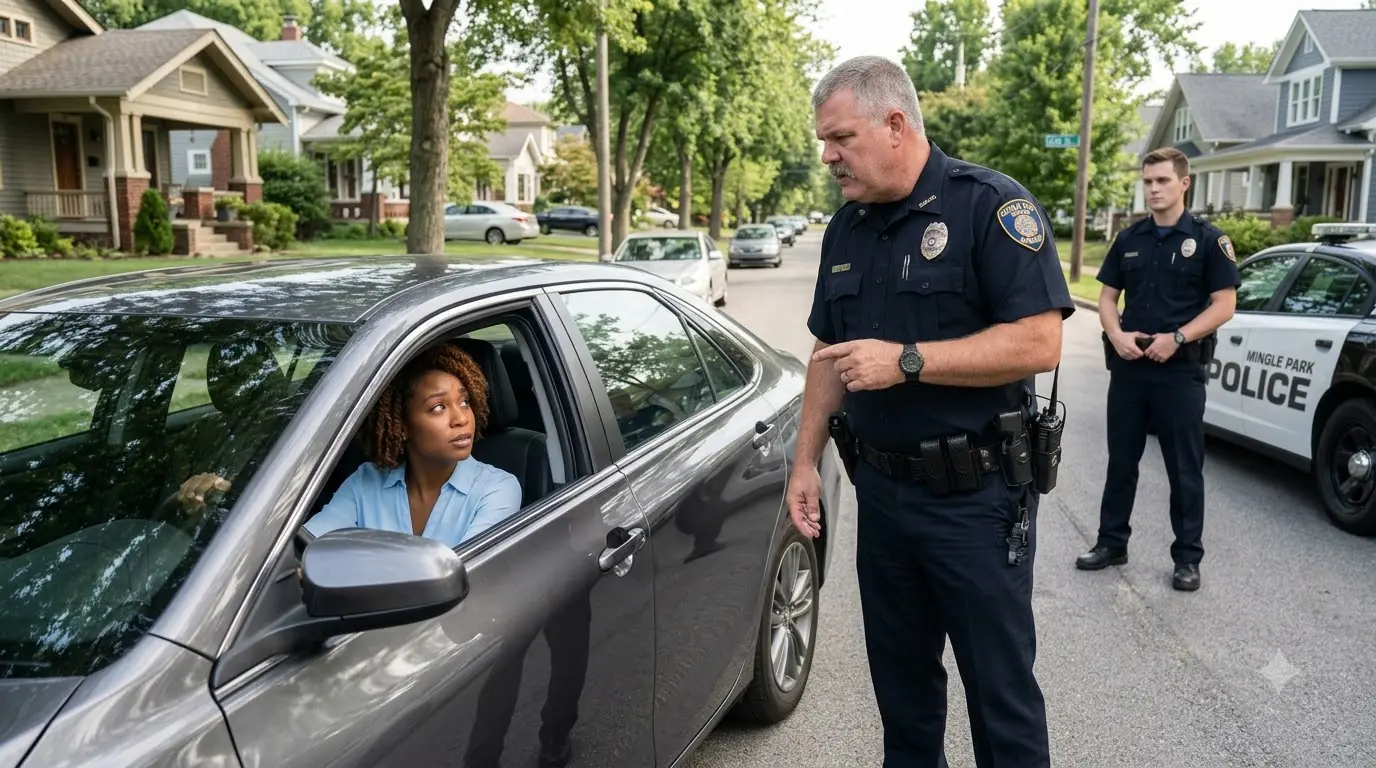
The patrol lights flashed behind her.
Patricia sighed, signaled carefully, and pulled to the curb in front of a row of neat houses with flowering shrubs along the sidewalks. She put the car in park, rolled down her window, and kept both hands visible on the steering wheel. She was not afraid, exactly, but she was alert. The cruiser stopped behind her. Through the side mirror, she saw two officers inside. The passenger officer laughed about something before opening his door.
Officer Glasgow was a heavyset man with a stiff walk and powdered sugar still clinging near the corner of his mouth. He had been sitting in the patrol car with Sergeant Miller moments earlier, eating donuts from a pink cardboard box and complaining about having nothing interesting to do. Then Patricia’s car had passed them, and neither man recognized her. To Glasgow, that alone was enough to follow her. To Miller, it was enough to see whether she belonged.
Glasgow approached the driver’s side with a swagger that seemed practiced in mirrors. He stopped beside Patricia’s window and looked down at her as though he had already decided what kind of person she was.
“Can I see your license and registration, please?” he asked.
Patricia kept her tone steady. “Sure. May I ask why you stopped me?”
“License and registration first.”
She studied him for a second. “Officer, I’m happy to provide them. I’m just asking the reason for the stop.”
Glasgow’s mouth tightened. “Because you look suspicious. That’s why.”
Patricia reached slowly into her bag, pulled out her wallet, and handed over her license. Then she opened the glove compartment and produced her registration. She saw him look from the documents to her face, then back at the documents with an expression of forced discovery.
“Patricia Taylor,” he said. “You live here in Mango Park?”
“Yes.”
“I’ve never seen you around these parts before.”
“I moved recently.”
He tapped the registration with one finger. “The address on your license and the address on your registration don’t match.”
“That’s because I’m in the process of changing everything over,” Patricia said. “I have an appointment with the DMV this Friday.”
“So in the meantime, you’re driving around with mismatched addresses.”
“No, officer. I have thirty days to update my registration after moving. I’ve only been here three weeks.”
His eyes narrowed. “Are you trying to get smart with me?”
“No,” she said. “I’m telling you what the law says.”
Glasgow leaned closer to the window. “You think I don’t know the law?”
“I’m sure you know the law in general,” Patricia replied, keeping her hands still. “But in this specific situation, I am within the legal time limit.”
Behind Glasgow, Sergeant Miller had stepped out of the cruiser and was watching with his arms folded. He did not look concerned. If anything, he seemed entertained. Patricia looked from one officer to the other and felt her patience thinning.
“May I ask again why you stopped me?” she said.
Glasgow gave a short laugh. “I already told you. You look suspicious.”
“Suspicious how?”
“I’ve never seen you around here before.”
“You not seeing me or recognizing me is not reasonable suspicion.”
“That’s your opinion,” he said. “I have my opinion.”
“That’s not how traffic stops work.”
His face flushed. “What you need to do is stop asking so many questions and be quiet.”
Patricia looked at him directly. She had heard stories during academy training, case studies and cautionary examples about unlawful stops, pretextual stops, escalation, ego, and profiling. It felt different when the example was standing at her window wearing a badge.
“It’s obvious you stopped me because you’re racially profiling me,” she said.
Miller shifted slightly near the cruiser, but he still did not intervene.
Glasgow’s expression hardened. “Last warning. Be quiet, or I’m going to arrest you right here.”
“Arrest me?” Patricia said. “Go ahead and arrest me.”
The words came out sharper than she intended, but she did not take them back. Glasgow looked almost pleased, as if she had finally given him the excuse he had been waiting for. He opened her door and ordered her out. Patricia stepped out slowly, her hands visible, her heart beating harder now but her voice still controlled.
“You are making a mistake,” she said.
“Turn around.”
“For what charge?”
“Failure to comply.”
“I have complied with every lawful order.”
He grabbed her wrist and twisted her toward the car. Patricia did not resist, but she did not collapse into fear either. She knew exactly what he was doing. He was trying to make her panic, make her pull away, make her give him a reason to say she had fought him. She breathed through the pain and let him cuff her.
As the metal closed around her wrists, she began reciting calmly.
“You have the right to remain silent. Anything I say can and will be used against me in a court of law. I have the right to an attorney. If I cannot afford one, one will be provided to me. Do I understand the rights as I have read them to myself today? And with that in mind, would I like to proceed to speak with you?”
Glasgow stopped.
Miller’s eyebrows lifted.
Patricia turned her head slightly. “I’m impressed you noticed. That’s the first thing we learned at the academy.”
Glasgow stared at her. “You went to the police academy?”
“Graduated last month,” Patricia said. “Passed my state certification exam last week.”
Miller stepped forward quickly. “Hold on. You’re a certified officer?”
“Officer in training until my start date,” she said. “And I can’t wait to read the headline: Mango Park Police Department racially profiles police officer in training and arrests her for knowing her rights.”
The two men looked at each other. The confidence drained from Glasgow’s face so quickly it almost would have been funny under different circumstances. Miller moved closer and lowered his voice.
“Take those cuffs off her.”
Glasgow hesitated. “She didn’t tell me she was—”
“Take them off,” Miller snapped.
Glasgow unlocked the cuffs. Patricia rubbed her wrists and turned to face them. She could have walked away then, but she had no intention of letting the moment disappear into another quiet little mistake that never got written down.
“Why didn’t you tell me?” Glasgow demanded. “Why didn’t you say you were trained law enforcement?”
“Why should I have to?” Patricia asked. “Would that have changed whether I deserved respect?”
Neither man answered.
“I know the reputation Mango Park Police Department has,” she continued. “Captain Porter told me about it himself. I knew it was bad, but I didn’t realize it was this bad.”
Miller’s face changed at the captain’s name. “You know Captain Porter?”
Patricia gave him a cold smile. “I interviewed with him last week. I start next month.”
Glasgow looked as though someone had pulled the ground out from under him. “You’re joining our department?”
“Yes.”
Miller took Glasgow by the arm and pulled him several steps away, but Patricia could still hear them.