The first thing Jeremiah loved about the fair was the noise.
It rose all around him in bright, messy waves: children laughing near the inflatable slide, parents calling names over the crowd, vendors shouting prices from striped tents, and the little digital chimes coming from the Word Farm Adventure booth every time someone solved a puzzle. To most people, it was just a community event in a city park on a hot Saturday afternoon. To Jeremiah Cole, it felt like a door opening.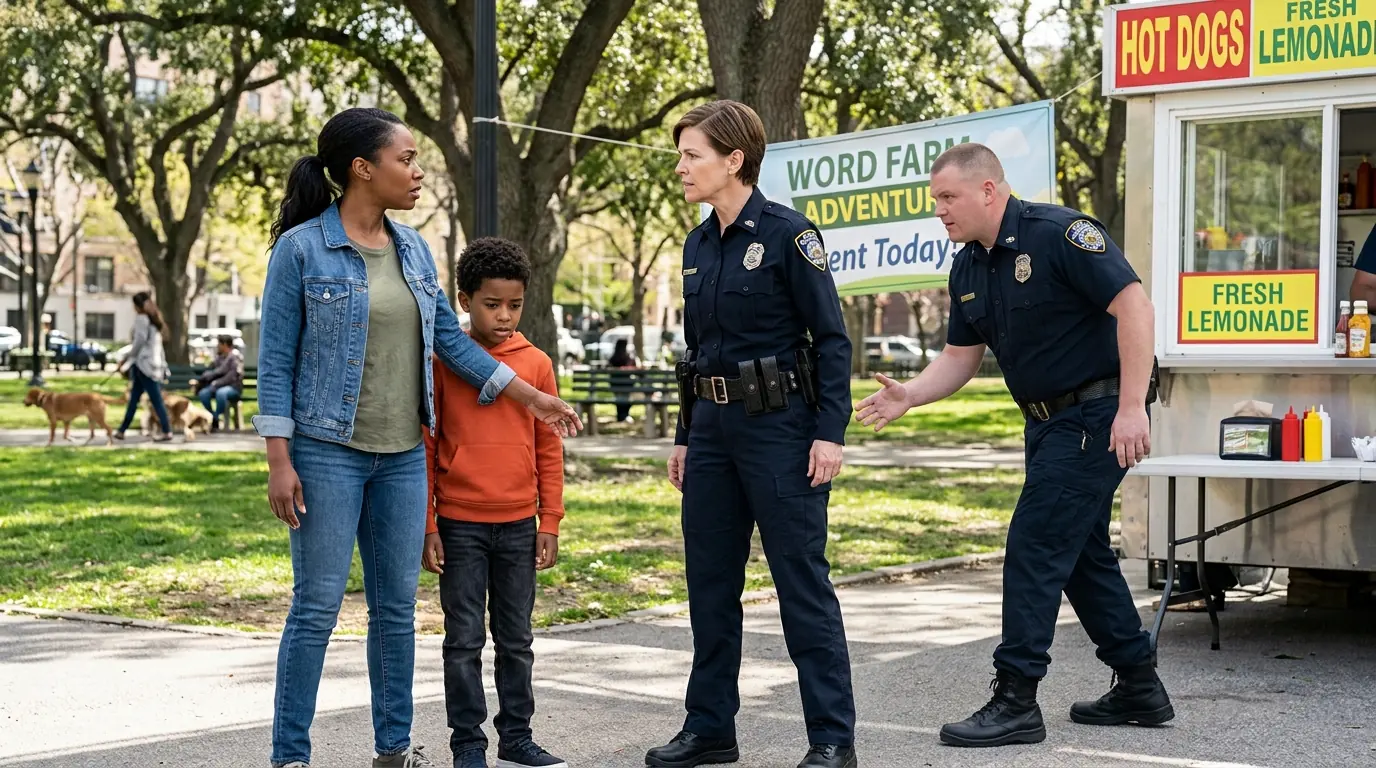
He stood beside his mother at the entrance with both hands gripping the straps of his backpack. He was twelve years old, skinny in the way children get when they grow too fast, with wide, curious eyes and a mind that never stopped turning words around like puzzle pieces. His mother, Simone Cole, kept one hand on his shoulder as they walked through the crowd. She was trying to smile for him, but Jeremiah knew the difference between her real smile and the one she wore when she was worried.
“Are you excited, baby?” she asked.
“Of course, Mom,” Jeremiah said. “I still can’t believe somebody can win a million dollars just by playing Word Farm Adventure.”
Simone laughed softly, but there was a tremble underneath it. “I know. It’s amazing. And even if we don’t win, you’ve already learned so many new words. That matters too, especially because you’re going to college someday. You’ll be the first one in our family to do it.”
Jeremiah smiled at that. He liked when she said it, even though college felt far away, like a city on the other side of a mountain. “Grandma would be proud,” he said.
The smile disappeared from Simone’s face just long enough for Jeremiah to see it. She looked toward the center of the park, where banners stretched between light poles and the biggest sign read: WORD FARM ADVENTURE GRAND CHALLENGE. FIRST PRIZE: $1,000,000.
“What’s wrong?” Jeremiah asked.
Simone shook her head quickly. “Nothing.”
“Mom.”
She looked down at him, then sighed. “It’s just that ever since Grandma got sick, the medical bills have been expensive. I keep taking loans, and I keep telling myself I’ll catch up, but I don’t know how much longer I can keep doing it.”
Jeremiah’s fingers tightened around his backpack straps. His grandmother had been the loudest person in their apartment when she was healthy. She sang while cooking, argued with game show contestants on television, and called Jeremiah her little dictionary because he always corrected people’s spelling. Then cancer had moved into the house like an unwanted guest, stealing her strength, her hair, and finally her voice. She had passed away three months earlier, but the bills had kept arriving as if grief needed receipts.
“We’re going to win,” Jeremiah said.
Simone looked at him with tired love. “That’s a big thing to promise.”
“I’ve been practicing every single day. You have too.”
She nudged his shoulder. “That’s true. We have been working hard.”
“And Grandma said words can open doors.”
“She did.” Simone swallowed. “She also said sometimes doors only open after you kick them.”
Jeremiah grinned. “Then we’ll kick this one.”
Across the park, near the row of temporary security posts, Captain Karen Whitmore watched them come in.
She had been assigned to the event as part of the city’s community safety detail, and she hated it. In her mind, community events were always one bad decision away from chaos. Too many people, too many bags, too many kids running around, too many opportunities for what she liked to call “the wrong element” to show up and ruin things for everybody else.
Her partner, Officer Cletus Reed, stood beside her eating peanuts from a paper cone. He was younger, quieter, and used to letting Karen talk because arguing with her was exhausting.
Karen’s eyes narrowed when she saw Simone and Jeremiah near the entrance.
“Cletus,” she said.
He looked up. “What?”
“Look at this.”
Cletus followed her gaze. “What am I looking at?”
“Those two.”
“The mom and the kid?”
Karen’s jaw tightened. “What are people like them doing at this event?”
Cletus shifted uncomfortably. “Same as everybody else, I guess.”
Karen gave him a look. “Don’t be naive. They’re probably here to steal the prize money or start trouble. My pop always told me, if it’s Black, it’s selling crack.”
Cletus gave a nervous little laugh because he did not know what else to do. “My mom used to say, if it’s Black, you better watch your back.”
They started moving through the crowd, keeping a distance but never taking their eyes off Simone and Jeremiah.
Jeremiah did not notice. He was too busy staring at the booths. Some were decorated like farms, with cardboard barns and plastic sunflowers. Others were shaped like giant books. One booth had a touchscreen spelling race. Another had a table full of wooden letter tiles. Everywhere he looked, people were solving word puzzles, cheering, and collecting small prizes.
“This is amazing,” he whispered.
Simone smiled. “It is.”
Then Jeremiah spotted a food cart with a red umbrella and a sign that read: HOT DOGS, $3 EACH, $5 FOR TWO.
His stomach made a sound loud enough that Simone heard it.
“Can we get a hot dog?” he asked.
“Of course, baby.”
They walked over to the cart. The man behind it had a gray beard, kind eyes, and a voice that sounded like he had spent his whole life laughing.
“How much is it?” Simone asked.
“Three dollars for one hot dog,” the vendor said. “Five dollars for two.”
“That is a great deal,” Simone said, reaching for the small roll of bills in her purse. “Let me get two.”
The vendor held up one hand. “One more thing. Since this is the annual Word Farm Adventure contest, if you can solve this crossword puzzle, you get both hot dogs for free.”
Jeremiah’s face lit up. “For real?”
“For real.” The vendor slid a laminated puzzle across the counter with a dry-erase marker. “You solve it, you eat.”
Simone looked at Jeremiah. “Come on, baby. Let’s get us some free hot dogs.”
Jeremiah took the marker like a champion taking a baton. The puzzle was not easy, but it felt familiar. Word Farm Adventure had trained him to see patterns quickly: missing letters, clue connections, hidden roots, sound shifts. Simone helped with two clues. Jeremiah solved the rest.
While they worked, the vendor leaned forward and talked to the little crowd gathering around them.
“That’s what I love about this app,” he said. “It makes learning feel like a game. You solve crossword puzzles, complete word missions, unlock new levels, restore farms and villas, and before you know it, you’re spelling words you didn’t even know last week.”
Jeremiah filled in the final answer and turned the board around. “Done.”
The vendor checked it, then slapped the counter. “Perfect.”
Simone clapped once. “That’s my baby.”
The vendor handed them two hot dogs wrapped in paper. “Two free hot dogs, courtesy of Word Farm Adventure.”
“Thank you, sir,” Jeremiah said.
“You earned them.”
Simone and Jeremiah had barely taken two steps away from the cart when a sharp voice cut through the air.
“Well, well, well. What do we have here?”
Simone stopped.
Karen Whitmore strode toward them with Cletus behind her. Her uniform was crisp, her badge bright, and her face arranged in the kind of satisfaction people get when they think they have caught someone doing exactly what they expected.
“Just as I suspected,” Karen said. “A bunch of thieves.”
Simone frowned. “Excuse me?”
Karen ignored her and pointed at Jeremiah. “Officer Cletus, arrest that kid.”
Jeremiah’s face went pale. “What?”
Cletus hesitated. “Captain—”
“Do it.”
Simone stepped in front of her son. “What do you think you’re doing?”
Karen squared up to her. “You’re both under arrest for stealing those hot dogs.”
“We didn’t steal anything,” Simone said.
“Don’t lie to me. I know your kind. You people are always stealing things.”
Jeremiah’s voice shook. “We didn’t steal anything.”
Karen pointed toward the hot dogs in their hands. “We watched you. You took those and didn’t pay.”
“We didn’t pay because we won them,” Simone said. “The vendor had a puzzle. We solved it. You can ask him right there.”
Karen’s eyes flashed. “I’ve heard enough.”
Cletus reached for Jeremiah’s arm. Jeremiah stumbled back, terrified, and dropped his hot dog onto the grass.
“Mom,” he cried.
Simone tried to pull him behind her, but Karen grabbed her wrist.
“Don’t make this worse,” Karen snapped.
“Get your hands off me,” Simone said.
“You’re resisting.”
“No, I am protecting my child.”
Karen shoved Simone’s arm behind her back. Cletus, now panicked and following orders more than judgment, snapped a cuff around Jeremiah’s thin wrist. The metal closed too tight. Jeremiah cried out.
“Stop,” Simone screamed. “He’s twelve.”
“That’s what you get for stealing, little monkey boy,” Karen said.
Jeremiah froze as if the words had hit him harder than the cuffs. His eyes filled with tears, but he tried not to cry because he did not want Karen to see she had hurt him.
“You are under arrest,” Cletus said weakly, though his voice did not sound convinced.
A few people nearby stopped walking. Some took out their phones. One woman gasped. The vendor hurried out from behind his cart, but Karen whipped around and shouted, “Stay back.”
Simone looked over her shoulder at her son. “Jeremiah, look at me.”
His lips trembled. “Mom, why are they doing this to us? Did we do something wrong?”
Simone’s heart cracked open. She wanted to tell him no child should ever have to ask that question. She wanted to tell him the world was fair and truth always protected people. But he was standing in handcuffs at a family event because two officers had decided his skin was evidence.
“No, baby,” she said. “We did nothing wrong.”
“Then why?”
She swallowed the anger rising in her throat. “Some people don’t like us because of how we look. They think because we look like this, we must be criminals.”
Jeremiah looked down at his hands. “I don’t think I want to look like this anymore.”
Simone turned fully toward him, even with Karen holding her arm. “Don’t you ever say that again. Do you hear me? You are beautiful. You are smart. You are loved. Don’t let anyone make you hate yourself.”
Karen rolled her eyes. “Save the speech.”
Simone’s voice grew stronger. “I know it’s hard in moments like this, baby, but you have to stay strong. Do you understand me?”
Jeremiah nodded, tears sliding down his cheeks.
Karen looked at Cletus. “Run their IDs. Let’s see what other crimes these people have committed.”
Before Cletus could answer, a deep voice boomed across the grass.
“What is going on here?”
Everyone turned.
A tall man in a navy suit walked toward them with two event staff members behind him. He was in his late fifties, with silver hair, a calm face, and the kind of authority that made people move out of his way without being asked. His name was Harold Watson, and he was the executive director of the foundation hosting the Word Farm Adventure contest.
Karen’s expression changed immediately. “Mr. Watson. We just caught a couple criminals trying to steal hot dogs from your event.”
Harold looked at Simone, then at Jeremiah’s cuffed wrist, then at the dropped hot dog on the grass.
“Trying to steal hot dogs from the event?” he repeated. “Is that true?”
“No, sir,” Simone said. “We solved a puzzle at the hot dog cart. The vendor gave them to us for free.”
Karen scoffed. “They lie through their teeth. Free hot dogs for playing a game? Who would believe that?”
“I would,” Harold said. “Because it’s true.”
Karen blinked. “What?”
“That is one of the event promotions. Several vendors are participating. Solve a puzzle, win a snack. It’s printed in the program.”
The vendor stepped forward, raising both hands. “They solved it perfectly. I gave them the hot dogs.”
Harold’s face hardened. “Release them. Now.”
Karen’s mouth opened. “Sir, I don’t think you understand—”
“I understand perfectly. Release them.”
Cletus unlocked Jeremiah’s cuffs with trembling fingers. When the metal came off, a thin red line circled the boy’s wrist. Simone pulled him into her arms and examined the mark.
“He’s bleeding,” she said, her voice shaking. “Look what you did to my son.”
Harold stepped closer to Karen. “How do you not have compassion for a child?”
Karen looked from Harold to the crowd and realized too many phones were pointed in her direction.
“You can’t blame me,” she said. “I mean, look at them. Anyone would think they were criminals.”
A silence fell so quickly it seemed to suck the sound out of the park.
Harold stared at her. “Excuse me?”
Karen’s face twitched. “I just mean—”
“What exactly do you mean?”
“Well, they just don’t look like the usual people at events like this.”
“You mean because they’re Black.”
Karen said nothing.
Harold’s voice dropped. “I’m calling your supervisor and having you removed from this event.”
“No, sir,” Karen said quickly. “Please don’t do that. It was just a misunderstanding.”
Cletus nodded too fast. “A big misunderstanding.”
Harold looked at the red mark on Jeremiah’s wrist. “A misunderstanding does not leave a child bleeding.”
Karen took a step back. “I promise it won’t happen again.”
Harold stared at her for a long moment. Then he looked at Simone and Jeremiah. He saw the mother trying not to fall apart, the boy trying to be brave, and the crowd trying to decide whether to keep watching or finally do something.
“This is your warning,” Harold said to Karen. “If you bother these people again, I will call your supervisor immediately and file a formal complaint myself.”
Karen forced a nod. “Yes, sir.”
“Leave.”
She turned sharply and marched away, Cletus following behind her like a child who knew he had been part of something wrong but did not yet know how to admit it.
Harold turned to Simone. “I am so sorry.”
“You don’t have to apologize for them,” Simone said quietly. “Unfortunately, we’ve had this kind of treatment before.”
“That doesn’t make it acceptable.”
“No,” Simone said. “It doesn’t.”
Harold crouched slightly so he was closer to Jeremiah’s eye level. “Are you okay, young man?”
Jeremiah rubbed his wrist. “It hurts, but I’m okay.”
“You still participating in the contest?”
Jeremiah glanced at his mother. Simone could see the fear in him. A few minutes earlier, the event had felt like a door. Now it felt like a room where danger might be hiding behind every booth.
But then Jeremiah straightened.
“Yes, sir,” he said. “We’re going to win.”
Harold smiled. “That’s the spirit. Come with me. The contest is about to start.”
He personally escorted Simone and Jeremiah toward the main tent, where rows of tables held tablets loaded with Word Farm Adventure challenges. People whispered as they passed. Some looked ashamed. Others smiled encouragement. The vendor from the hot dog cart ran after them and handed Jeremiah a fresh hot dog wrapped neatly in paper.
“You earned this one too,” he said.
Jeremiah accepted it with a small smile. “Thank you.”
Across the park, Karen stood behind a row of vendor tents with Cletus beside her.
“I can’t believe they got away with it,” she hissed.
Cletus looked toward the main tent. “Mr. Watson said they didn’t do anything wrong.”
“Mr. Watson doesn’t know what he’s talking about. He’s probably under one of their spells.”
Cletus frowned. “Spells?”
“Voodoo spells,” Karen said. “Don’t you know anything? That’s how people like them get ahead. They charm good hardworking people, make everybody feel sorry for them, and then take over everything.”
Cletus stared at her. “Captain, that sounds crazy.”
Karen whipped around. “What did you say?”
“Nothing.”
“What I’m saying,” she continued, “is that if we can’t do our job the right way because everybody is afraid of hurting their feelings, then maybe somebody else can help.”
Cletus followed her gaze to a small purple tent at the edge of the fairgrounds. A painted wooden sign hung over the entrance: MADAME LUCIA — PALM READINGS, DREAM INTERPRETATION, SPIRITUAL GUIDANCE.
“That’s not voodoo,” Cletus said. “That’s just a fortune teller.”
Karen’s eyes narrowed. “Maybe she can tell me how to get those criminals out of here for good.”
“Captain—”
“Stay here. Make sure no more of them cause trouble.”
Cletus watched her walk toward the tent, his stomach twisting.
Inside the main contest tent, Simone and Jeremiah sat side by side. Each contestant had a tablet, a pencil, and a sheet of scratch paper. A digital timer glowed on a large screen at the front. Harold Watson stood on the stage, explaining the rules.
“The first round will test spelling, vocabulary, and pattern recognition,” he said. “The second round will require teams to complete word missions under time pressure. The final round will be a live puzzle duel.”
Jeremiah leaned toward his mother. “We can do this.”
Simone nodded. “Yes, we can.”
The timer began.
For the next twenty minutes, the world shrank to letters. Jeremiah moved quickly, whispering roots and suffixes under his breath. Simone handled the longer vocabulary clues, remembering words they had practiced together at the kitchen table after long shifts and late nights. They worked like a two-person machine, passing answers back and forth, correcting each other, trusting each other.
When the first round ended, their team name, COLE FAMILY, appeared near the top of the leaderboard.
Jeremiah gasped. “Mom, we’re third.”
Simone squeezed his hand. “Grandma would be yelling right now.”
“She’d say we should be first.”
“She would.”
In the purple tent, Karen stood over a small table covered in candles, stones, cards, and strange little objects. A woman with gray hair and calm eyes sat behind it, wearing a deep blue scarf around her shoulders.
“Hello?” Karen called.
The woman looked up. “Officer.”
Karen stiffened. “How do you know I’m an officer?”
“The uniform helps.”
Karen frowned. “Right.”
“I’m Madame Lucia. Sit, if you want guidance.”
Karen sat reluctantly. “I need power.”
Lucia’s eyes sharpened. “That is not usually the first thing people ask for.”
“I don’t have time for games. There are people here who need to be removed, and I need a way to make sure nobody can stop me.”
Lucia studied her face. “Removed?”
Karen leaned forward. “People who don’t belong. People who ruin neighborhoods, events, schools, everything.”
Lucia’s expression hardened. “You mean Black people.”
Karen did not deny it.
Lucia reached slowly for Karen’s right hand. “Let me see.”
Karen pulled back. “What are you doing?”
“Palm reading. You entered a palm reader’s tent.”
“I don’t have time for that.”
“Then you should not have come.”
Karen exhaled sharply and shoved her hand forward.
Lucia traced the lines on her palm. “The left hand represents the life you were given. The right hand represents what you choose to become. Your line here shows anger that has been fed for a long time. This one shows fear pretending to be duty. And this one—”
“I said I don’t have time for this.” Karen snatched her hand back. “I want power.”
Lucia looked toward a shelf behind Karen. “Power always costs something.”
“I’ll give anything.”
The candle nearest Karen flickered though there was no wind.
Lucia’s face changed. “Be careful what you say.”
“I’m not afraid.”
“You should be.”
Karen rolled her eyes and glanced around the tent. On a small desk beside a crystal bowl sat a little figure made of straw, tied with red string. It was crude, no taller than her hand, with two tiny beads for eyes.
Karen picked it up. “What is this?”
Lucia shot to her feet. “Put that down.”
“What’s the big deal? It’s a little straw man.”
“Put it down now.”
Karen smirked. “Maybe he can help me. I wish I could make all of them disappear.”
The tent went cold.
Every candle flame bent toward the straw figure.
Lucia’s voice became a whisper. “What did you say?”
Karen looked around, suddenly less confident. “Nothing.”
“Tell me exactly what you said.”
“I said I wished I could make all those Black people disappear.”
Lucia closed her eyes. “You foolish woman.”
Karen dropped the figure onto the table. “Don’t call me foolish.”
“You came asking for power and touched what you did not understand.” Lucia pointed at the straw figure, which now seemed darker than before. “That is not a toy. It was left here by someone who wanted harm returned to harm. It listens to hatred, and it gives hatred a body.”
Karen laughed, but it came out thin. “Are you trying to scare me?”
Lucia leaned closer. “No. I am trying to warn you.”
The tent fabric snapped as if wind slammed against it, though outside the day was still.
Karen stepped back. “What is happening?”
“Something heard you.”
Outside, the fair continued as if nothing had changed. The second round began. Jeremiah and Simone advanced from third place to second. Then first. People started cheering for them, some because they liked their teamwork, some because they had seen what happened earlier and wanted them to win more than ever.
Cletus stood near the tent entrance, watching Jeremiah solve puzzle after puzzle. He kept seeing the red mark on the boy’s wrist. He kept hearing Karen call him a thief. He kept hearing himself say nothing.
During a break before the final round, he approached Simone carefully.
“Ma’am,” he said.
Simone turned, protective immediately. “What do you want?”
Cletus removed his hat. “I wanted to apologize.”
Jeremiah stepped closer to his mother.
“I should have stopped her,” Cletus said. “I knew something was wrong, and I still followed orders. That was cowardly.”
Simone studied him. “Yes, it was.”
He nodded. “I know.”
Jeremiah looked at his wrist, then at the officer. “Why did you think we stole?”
Cletus struggled for words. “Because I listened to someone who wanted me to believe that.”
“That’s not an answer,” Jeremiah said.
Cletus swallowed. “Because I was wrong. Because I let ugly things people taught me sit in my head without questioning them.”
Simone looked at him for a long moment. “Apologies matter less than what you do after them.”
“Yes, ma’am.”
Before he could say more, a scream came from the far side of the fair.
Everyone turned.
Karen stumbled out of the purple tent, pale and shaking. Behind her, Madame Lucia followed, holding the straw figure with tongs like it was burning hot.
“Keep people back,” Lucia shouted.
Harold Watson hurried over. “What is going on?”
Karen pointed at the figure. “She did something. She cursed me.”
Lucia’s voice rang out. “No. She made a wish with hate in her mouth.”
The crowd murmured. Phones came up again.
Karen backed away, sweating. “This is nonsense.”
But then the screen over the contest stage flickered.
The leaderboard glitched.
One by one, names disappeared from the screen.
Not all names. Only the names of Black contestants.
A horrified silence spread through the tent.
Simone grabbed Jeremiah’s shoulder as COLE FAMILY vanished from first place.
Jeremiah whispered, “Mom.”
Karen stared at the screen, and for one terrible second, triumph flashed across her face.
Lucia saw it. So did Harold. So did Cletus.
Then the straw figure on Lucia’s tongs twitched.
The screen flickered again, and the missing names did not stay gone. They returned one by one, brighter than before. Then a new message appeared across the top in jagged, pulsing letters:
WHAT YOU WISH ON OTHERS RETURNS TO YOU.
Karen’s badge clattered to the ground.
Her radio sparked. Her bodycam turned on by itself, projecting audio through the event speakers. Her voice filled the whole park from the recording inside Lucia’s tent.
“I wish I could make all those Black people disappear.”
Gasps exploded across the crowd.
Karen lunged for her radio, but Cletus stepped in front of her.
“No,” he said.
“Move,” Karen hissed.
“No.”
The recording continued, catching every hateful word she had said. People listened in stunned silence as her secret beliefs became public truth.
Harold Watson’s face was like stone. “Captain Whitmore, you are removed from this event. Officer Reed, call her supervisor. Now.”
Cletus did not hesitate this time. “Yes, sir.”
Karen spun around, wild-eyed. “You can’t do this to me.”
“You did this to yourself,” Simone said.
Karen looked at her with pure hatred, but for once, no one was afraid of her. The power she had wanted had turned against her, not by magic alone, but by exposure. The words she whispered where she thought she was safe had found daylight.
Two senior officers arrived fifteen minutes later. Harold handed them video from dozens of phones, the event program proving the hot dog promotion, and the audio from Karen’s bodycam. Madame Lucia placed the straw figure into a glass jar, sealed it with wax, and carried it away without another word.
Karen was escorted off the grounds. Cletus gave a formal statement admitting what he had seen, what he had failed to stop, and what Karen had said before and after the wrongful detention. By the end of the day, she was suspended pending termination and investigation.
The contest resumed because Harold insisted it should.
“No one,” he said from the stage, “gets to steal joy from children who earned their place here.”
The crowd cheered.
Jeremiah sat back down beside his mother for the final round. His hands shook when the first puzzle appeared. Simone noticed and placed her hand over his.
“We can leave,” she whispered. “You don’t have to prove anything.”
Jeremiah looked at the screen. Then he looked at the crowd. He saw the hot dog vendor giving him a thumbs-up. He saw Cletus standing near the entrance, hat in hand, looking ashamed but alert. He saw Harold Watson watching from the stage. He saw his mother beside him, tired and scared and still unbroken.
“I want to finish,” Jeremiah said.
Simone nodded. “Then we finish.”
The final round was harder than anything they had practiced. The words were longer, the clues trickier, the time shorter. Jeremiah stumbled on “perseverance,” then corrected himself. Simone caught “accountability” with three seconds left. Together they solved “resilience,” “dignity,” “inheritance,” and “justice.”
When the last puzzle loaded, the clue read: The act of standing firm after being treated unfairly.
Jeremiah stared at the blank spaces.
Nine letters.
Simone whispered, “You know this.”
He did.
He typed: STRENGTH.
The answer was wrong.
His heart dropped.
Then he looked again. Nine letters. Standing firm after being treated unfairly.
He deleted it and typed: RESISTING.
Wrong again.
The timer ticked down.
Ten seconds.
Nine.
Eight.
Then he heard his grandmother’s voice in his memory: Baby, sometimes surviving is a word all by itself.
He typed: RESILIENCE.
The screen flashed green.
The tent erupted.
COLE FAMILY — FIRST PLACE.
Simone covered her mouth with both hands. Jeremiah stared at the screen as if afraid it might vanish again.
Harold Watson walked onto the stage holding a ceremonial check so large Jeremiah almost laughed through his tears.
“One million dollars,” Harold announced, “to Simone and Jeremiah Cole.”
Simone hugged her son so tightly he could barely breathe.
“We did it,” Jeremiah whispered.
“No,” Simone said, crying into his hair. “You did it, baby. You opened the door.”
News of what happened spread quickly. By evening, clips from the fair were everywhere: Karen wrongfully arresting a child over free hot dogs, the event director proving their innocence, the strange audio exposing her hatred, and Jeremiah winning the contest after everything he had endured. Some people focused on the bizarre straw figure and the fortune teller. Others focused on the simpler truth: a mother and son had been treated like criminals, and they had answered with dignity and brilliance.
Karen lost her job before the week ended. The department issued a public apology, though Simone knew apologies were only the beginning. Harold Watson helped her file a formal complaint, and Cletus gave testimony that made it impossible for anyone to pretend Karen’s actions were a harmless mistake. The city agreed to review its event policing policies, require anti-bias training, and create a civilian complaint process for incidents involving children.
Cletus requested a transfer to community outreach. He told Simone later that he did not expect forgiveness, but he wanted to spend the rest of his career becoming someone who deserved trust. Simone did not give him easy grace. She simply told him to do the work.
With the prize money, Simone paid off her mother’s medical debts. She set aside enough for Jeremiah’s college fund. Then she used part of it to start the Gloria Cole Literacy Fund, named after the grandmother who had taught them that words could open doors.
The fund bought tablets, books, and learning apps for children in neighborhoods where families could not afford private tutoring or expensive programs. Jeremiah helped design the first workshop himself. He called it “Words Are Keys.” Every Saturday, children gathered in the same community center where Simone once went to ask for help with bills. They solved puzzles, learned spelling, wrote stories, and laughed when Jeremiah made the hardest words sound like secret codes.
Months later, during the fund’s opening event, Harold Watson stood in the back of the room and watched Jeremiah teach a little girl how to spell “resilience.”
“It means you keep going,” Jeremiah told her. “Even when people try to make you feel small.”
The girl nodded seriously. “That’s a big word.”
Jeremiah smiled. “Big words are just small words that practiced.”
Simone heard him and laughed for the first time that day without sadness behind it.
The glass jar with the straw figure never appeared again. Madame Lucia disappeared from the fair circuit by the end of the summer, leaving only rumors behind. Some people said she had been a fraud. Some said she had been exactly what she claimed. Jeremiah did not know what to believe about that part.
But he knew what he had seen.
He had seen hatred try to become power.
He had seen the truth drag it into daylight.
And he had learned that the strongest magic in the world was not a curse, a wish, or a straw figure on a dusty table.
It was a mother who refused to let her son hate himself.
It was a child who kept solving puzzles after being humiliated.
It was a community that finally chose to stand closer instead of looking away.
Years later, when Jeremiah stood on a college stage to accept a scholarship named after his grandmother, he still carried the memory of that day. Not the cuffs. Not the cruel words. Not even the million-dollar check.
He remembered the final clue.
The act of standing firm after being treated unfairly.
Resilience.
And when he looked out at his mother in the front row, crying and smiling at the same time, Jeremiah knew Grandma had been right.
Words opened doors.
But sometimes, you had to be brave enough to walk through them.