Stop right there. We got a call. What are you doing in this neighborhood? Walking home. That's not a crime, officer.
You fit the description. ID. Now you have no reasonable suspicion. Am I detained or free to go?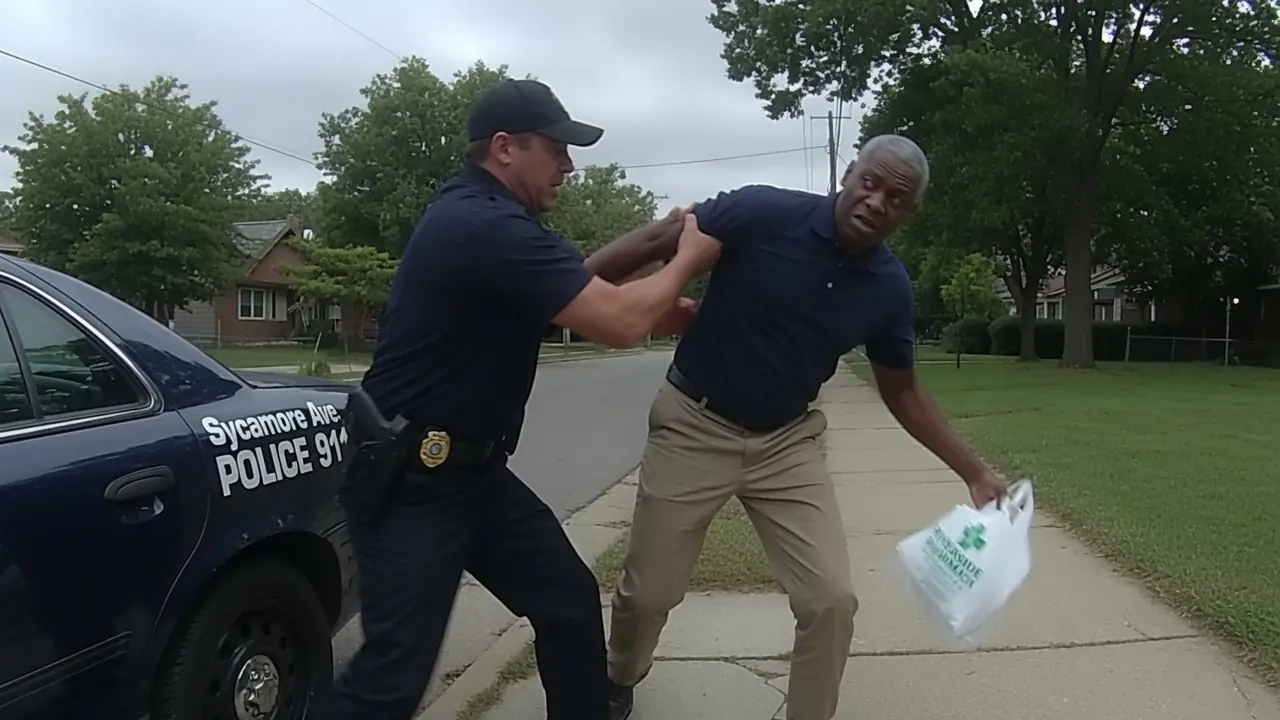
Officer Derek Vance had been wearing the badge of the Chicago Police Department for 6 years when he made the decision that would implode his life and cost the taxpayers of Chicago $6.2 million. He was 32 years old, physically imposing, and carried himself with an arrogance that often masked a dangerous lack of judgment. He believed that the uniform granted him not just authority, but immunity from consequence. On a bright Saturday afternoon in the upscale neighborhood of Highgate, Vance received a dispatch call that seemed routine, a suspicious person report. The subject was described as a man walking slowly and looking at houses.
The subject was Marcus Thorne, a 55-year-old grandfather and a pillar of the legal community who was simply walking home. What Vance did next, ignoring protocol escalating a peaceful encounter and arresting a man who knew the Fourth Amendment better than the entire precinct combined, would become a definitive case study in how bias blinds law enforcement to reality. The Highgate neighborhood is an enclave of manicured lawns, sprawling oak trees, and seven-figure homes on the north side of the city. It is the kind of place where the silence is heavy, broken only by the sound of landscaping crews or the occasional luxury SUV gliding down the pavement.
It was 2:15 p.m. on a Saturday in October. The air was crisp, the sky a piercing blue. Leaves were just beginning to turn gold and crimson. It was a perfect autumn day. Marcus Thorne was walking north on Sycamore Avenue.
He was a man of immense dignity, standing 6'2 with graying hair, close-cropped, and a posture that spoke of decades of discipline. He wore a navy blue polo shirt, khaki slacks, and comfortable walking shoes. In his left hand, he carried a small white paper bag from the local pharmacy. Thorne had lived in Highgate for 12 years.
He and his wife Clara were fixtures at the local community center. He was known by his immediate neighbors as a quiet man who kept an immaculate garden. But to the law enforcement world, Marcus Thorne was a legend. He had served as a federal public defender for the Northern District of Illinois for 25 years. He didn't just practice law; he shaped it.
He had argued before the 7th Circuit Court of Appeals dozens of times. He had dedicated his life to defending the indigent, the forgotten, and the accused against the overwhelming machinery of the state. He knew the Constitution not as a theoretical document, but as a shield that had to be held up daily against government overreach. That Saturday, however, he wasn't a lawyer.
He paused occasionally to admire the architecture of a renovated colonial or to inspect a neighbor's landscaping. He was a free man engaging in the most fundamental liberty of movement. But freedom is fragile when viewed through the lens of prejudice. Two streets over a patrol car turned the corner, rolling slowly, hunting for a problem that didn't exist.
Officer Derek Vance gripped the steering wheel, his eyes scanning the sidewalks. The dispatch computer on his dashboard displayed the details of the 911 call. Suspicious male in his 50s, loitering and peering into driveways. The caller was Elena Higgins, a 53-year-old resident who spent much of her days monitoring her security cameras and neighborhood watch apps. Elena had watched Marcus Thorne pause near her driveway to adjust his shoe.
In her mind, fed by a diet of fear-mongering news and implicit bias, he wasn't a neighbor fixing a lace. He was a scout casing her property for a burglary. She didn't recognize him, despite him living four blocks away. To her, He didn't fit the aesthetic of Highgate.
She dialed 911. "911, what is your emergency? " "It's not an emergency yet, but there's a man walking around my neighborhood who doesn't belong here," Elena said, her voice tight with self-righteous anxiety. "Is he threatening anyone? Is he armed? " the dispatcher asked. "No, but he's walking very slowly. He stopped in front of my house.
He's looking at the windows. We've had break-ins in the city and he looks suspicious. What is he wearing, ma'am? Blue shirt, khakis.
He's holding a bag. Maybe to put stolen items in. Okay, we'll send a unit to check it out. Officer Vance, much like Officer Bartlett in Seattle, had a record that should have precluded him from patrolling diverse communities, or any community for that matter. In his six years, he had accumulated 15 complaints.
Most were for discourtesy verbal abuse or aggressive stops. His file contained notes about rigid thinking and a confrontational demeanor. Yet the union protected him, and the department, short-staffed and weary, looked the other way. Vance viewed himself as a soldier in a war zone, even when that war zone was a quiet suburb on a Saturday afternoon.
When Vance spotted Thorne, his confirmation bias locked into place like a steel trap. He saw a man in a wealthy neighborhood walking slowly. The narrative was already written in his head. This was the suspect. This was the threat.
Thorne, meanwhile, was thinking about his closing arguments for a case involving a young man wrongly accused of wire fraud. He was lost in thought, enjoying the rhythm of his steps. He didn't notice the cruiser creeping up behind him until the engine revved slightly, a predator announcing its presence. The police car pulled alongside him and curbed the tires aggressively, blocking the pedestrian path partially.
Vance rolled down the passenger window. He didn't offer a greeting. He didn't ask if everything was okay. He went straight to command presence. Hey, you hold up a second.
Thorne stopped. He turned his head slowly, his expression calm but guarded. He shifted the pharmacy bag to his other hand. He saw the young officer, the jaw set in aggression, the sunglasses, the arm hanging out the window.
Thorne had cross-examined hundreds of officers just like Derek Vance. He knew the type. He knew the danger. And he knew the law. "Can I help you, officer? " Thorne asked, his voice a deep resonant baritone that had silenced courtrooms.
"Where are you coming from? " Vance asked, ignoring the courtesy. "We got a call about a guy casing houses. " The accusation hung in the air, absurd and insulting. The sunlight seemed to sharpen the shadows, deepening. Marcus Thorne looked at the officer, assessing the situation with the cool detachment of a man who had spent 30 years dissecting police conduct.
"I am walking home from the pharmacy," Thorne said clearly. "I live in this neighborhood. " Vance opened his car door and stepped out. He didn't like the tone. It wasn't fearful. It wasn't submissive.
It was equal. And in Vance's world, a suspect was never an equal. He hitched up his belt, his hand hovering near his holster, a subtle threat of violence that was second nature to him. "You live here?
Which house? " Vance demanded, walking around the front of the cruiser to close the distance. "I don't believe I'm required to provide my address to you, officer. Unless you are accusing me of a crime, I'll be on my way. My wife is waiting for her medication. " Thorne took a half step to turn away. "I didn't say you could leave," Vance barked, stepping onto the sidewalk, blocking Thorne's path.
I'm investigating a suspicious person report. You match the description. male in a blue shirt. So, you're not going anywhere until I figure out who you are. Thorne stood his ground.
He didn't raise his voice. He didn't gesture wildly. Officer, walking on a public sidewalk is not a crime. Being a suspicious person is not a crime without reasonable, articulable suspicion of specific criminal activity. Terry v.
Ohio. You have no probable cause to detain me. " Vance blinked. The legal citation hit him like a physical slap. Most people he stopped, stammered, apologized, or ran.
This man was quoting Supreme Court case law. But instead of pausing to consider that he might be dealing with someone credible, Vance doubled down. His ego couldn't handle the correction. He interpreted the knowledge not as expertise, but as the arrogance of a career criminal who knew how to play the system. "Don't quote law to me," Vance sneered, moving into Thorne's personal space.
"I'm the police. You're the suspect. Now let me see some ID, right now. " "I am not obligated to show you identification," Thorne replied, his eyes locked on Vance's. Illinois has a stop and identify statute, but it only applies if you suspect I have committed, am committing, or am about to commit a crime.
I have done none of those things. I am a citizen walking home. "Am I being detained, or am I free to go? " "You're detained," Vance snapped. Failure to cooperate. Obstructing an investigation.
Obstruction requires a physical act officer. Asserting my Fourth Amendment rights is not obstruction. You are making a mistake—a very expensive mistake. " Vance's face flushed red. He felt the eyes of the neighborhood on him.
He felt his authority slipping away. He couldn't let this man win. He couldn't let him walk away. The psychological dynamic on the sidewalk had shifted dangerously. Officer Vance was no longer policing.
He was hunting for a reason to justify his aggression. He needed this man to be guilty of something, anything, to validate the stop. "Turn around," Vance ordered, unclipping the radio from his shoulder. "Put your hands on the car. " "I will not," Thorne said.
I have not consented to a search and you have no grounds to touch me. "I'm done asking," Vance growled. You're failing to identify. That's an arrestable offense when you're a suspect. "I am a federal public defender," Thorne said, his voice dropping an octave heavy with warning.
My name is Marcus Thorne. I have practiced law in this district for 25 years. I am telling you for your own sake, do not do this. Call your supervisor.
Ask them if they want you to arrest Marcus Thorne for walking on a Saturday. Vance laughed, a short, sharp bark of disbelief. Yeah, right. And I'm the police superintendent, a public defender. You look like you're loitering.
If you were a lawyer, you'd know better than to argue with a cop. It was the ultimate insult born of deep-seated prejudice. Vance couldn't conceive that the man standing before him in casual clothes could be a high-ranking federal officer of the court. To Vance, Thorne was lying.
It was a bluff. I am going to reach into my back pocket to retrieve my wallet, Thorne said slowly, telegraphing his movements to ensure Vance couldn't claim he reached for a weapon. I will show you my credentials and then you will let me go. "Don't move! " Vance yelled, his hand dropping to his taser. "I said, hands on the car. " "I am trying to de-escalate this," Thorne said.
"You are escalating it. " "Why? Because you're not listening to orders. " "Unlawful orders need not be obeyed," Thorne stated. That was the breaking point. Vance lunged forward.
He didn't want ID anymore. He wanted submission. He grabbed Thorne's left arm, the one holding the pharmacy bag. The white paper bag crinkled and tore as Vance wrenched the arm back. A bottle of migraine medicine clattered onto the concrete sidewalk.
"You are under arrest! " Vance shouted. Thorne did not fight back. He knew that any physical resistance, no matter how slight, would be used to justify excessive force. He went limp, allowing his arm to be manipulated, but he raised his voice for the first time, projecting to the houses around them.
"I am not resisting! " Thorne shouted. "I am complying. This officer is assaulting me without cause. Neighbors, please record this. " The commotion had drawn attention. Elena Higgins, the woman who called 911, was peering through her blinds, confused.
This wasn't what she expected. Other neighbors, people who actually knew Thorne, were stepping out onto their porches. A young man across the street, a college student named David, pulled out his phone and started filming. He zoomed in as Vance twisted Thorne's arm behind his back with unnecessary force.
"Stop fighting," Vance yelled for the benefit of the body camera, a common tactic to create a false narrative. "I am standing still," Thorne replied, gritting his teeth against the pain in his shoulder. "I am 55 years old. I am not fighting you. You are hurting me. " Vance kicked Thorne's legs apart and slammed him against the hood of the patrol car.
The heat from the engine radiated through Thorne's trousers. Vance pulled out his handcuffs. Click. Click.
The steel ratcheted tight on Thorne's wrists. "You're done," Vance panted, adrenaline coursing through him. "Resisting arrest, disorderly conduct, failure to ID. " "Check my back pocket," Thorne said, his cheek pressed against the hot metal of the car hood. "Check my wallet. Read the badge. " "I'll check it at the station when we book you," Vance said dismissively.
He patted Thorne down, roughly pulling the wallet out and tossing it onto the passenger seat without opening it. He shoved Thorne into the back of the cruiser. Thorne had to contort his tall frame to fit into the cramped plastic seat. The humiliation was searing.
He was a man who commanded respect in federal courtrooms, a man who judges addressed as Mr. Thorne with deference. Now he was caged like an animal, his wife's medicine lying in the dirt 5 ft away. Through the window, Thorne saw David, the neighbor, with the phone shouting at the officer. "Hey, that's Mr.
Thorne. He lives here. What are you doing? " "Back up! " Vance yelled at the witness. "Interfere and you're next. " Vance got into the driver's seat, slamming the door.
He felt powerful. He felt like he had cleaned up the streets. He had no idea that the video being uploaded to Twitter at that very moment would have 2 million views before the sun went down. "You made a big mistake, pal," Vance said, looking at Thorne in the rearview mirror. Thorne met his eyes.
"Officer, I have defended murderers, drug lords, and terrorists. I ensure they receive fair trials because the Constitution demands it. But when I sue you and the city of Chicago, I will make sure you never wear a uniform again. You have violated my civil rights under color of law.
Title 42, Section 1983. Memorize it. It will be the title of the next chapter of your life. Vance just turned up the radio. The drive to the 19th district station took 15 minutes.
Vance whistled along to a country song, completely oblivious to the gravity of the passenger he was transporting. Thorne sat in silence, cataloging every bump in the road, every minute that passed, calculating the damages. They arrived at the precinct. Vance pulled into the sallyport, hauled Thorne out of the back, and marched him to the booking desk.
The station was busy. Phones were ringing. Officers were typing reports. At the high desk sat Desk Sergeant Miller. Miller was 52, a veteran with tired eyes and a memory like a steel trap.
He had spent years testifying in court, often being grilled by defense attorneys. He looked up as Vance dragged his prisoner in. "What do we have? " Miller asked, looking at paperwork. "Refusal to ID, resisting, disorderly conduct," Vance said proudly.
"Guy was casing houses in Highgate. Tried to lawyer me on the street. Miller looked up. His eyes landed on the prisoner. He squinted.
Then his eyes went wide. He stood up so fast his chair rolled back and hit the wall. "Vance," Miller's voice was a whisper of pure horror. "What did you do? " "I arrested a suspect," Vance said, confused by the reaction.
Miller ran around the desk. "Take those cuffs off now. " "Sarge, he's non-compliant. I haven't processed—" "Take the damn cuffs off, Derek! " Miller roared, his face turning purple. Do you know who this is? Thorne stood tall despite the shackles.
"Hello, Sergeant Miller. It's been a while since the Henderson trial. " Miller looked like he might vomit. "Mr. Thorne, I—I am so sorry. " Vance paused, key in hand.
You know this guy? This guy? Miller pointed a trembling finger at Thorne is the senior federal public defender for the Northern District. He's not a suspect, Vance. He's the man who cross-examined the chief last year and won.
He's a federal officer of the court. Vance froze. The color drained from his face. The arrogance evaporated, replaced by a cold, sick feeling in his gut.
"He—he refused to show ID," Vance stammered. "I told him," Thorne said calmly as the cuffs were unlocked. He rubbed his wrists where red welts were already forming. I told him exactly who I was. I told him he was making a mistake.
He told me I was lying. "Where is his property? " Miller demanded. "In the car," Vance said quietly. "Go get it now. " As Vance ran to the car, Miller turned to Thorne.
Mr. Thorne, please come into the lieutenant's office. Let me get you some water. We can fix this. Thorne looked at Miller with sad eyes.
"Sergeant, you can't fix this. I was kidnapped from my own street. I was assaulted. My wife is at home in pain, waiting for medicine that is currently lying in the gutter on Sycamore Avenue.
This isn't a misunderstanding. This is a systemic failure. " Vance returned with the wallet. Miller snatched it, opened it, and pulled out the federal credentials. The gold shield of the United States courts gleamed under the fluorescent lights. Miller held it up to Vance's face.
You arrested a federal defender for walking. You better call your union rep, son, because your career ended the minute you put hands on him. By the time Marcus Thorne was released without charges, obviously the video titled Chicago cop assaults federal defender had been retweeted 40,000 times. The image of the dignified older man being shoved against a car while neighbors screamed was playing on CNN.
Thorne didn't go home to hide. He went straight to the federal courthouse downtown. He called his team. They didn't need to hire outside counsel. They were the best civil rights lawyers in the city.
The lawsuit filed 3 days later was a masterpiece of legal devastation. It named Officer Derek Vance, the City of Chicago, and the superintendent. It alleged false arrest, excessive force, malicious prosecution, and failure to intervene. But it went deeper.
Thorne's team subpoenaed Vance's disciplinary records. What they found was a pattern of unchecked aggression: 15 complaints, three for discriminatory profiling and two for excessive force against teenagers. Every single one had been marked unfounded or not sustained by internal investigators. Vance was a ticking time bomb that the department had refused to defuse. The deposition of Officer Vance was brutal.
Thorne didn't conduct it himself. That would be a conflict. But his partner, a shark named Sarah Jenkins, did "Officer Vance," Jenkins asked. "When Mr.
Thorne told you he was a federal attorney, why did you not believe him? " "He didn't look like one," Vance mumbled. "He didn't look like one," Jenkins repeated. "What does a federal attorney look like, officer? " "No, I just He was in casual clothes. So, a man in casual clothes cannot be a professional in your mind. "I didn't say that. " "Your actions said that.
You assumed he was a criminal because of his appearance and location. You ignored the law because you believed your badge gave you the power to define reality. Isn't that true? " Vance had no answer. The city's lawyers knew they were dead in the water.
There was no defense. The video was clear. The victim was unimpeachable. The bias was undeniable. They tried to settle for $1 million.
Thorne rejected it. They offered $3 million. Thorne rejected it. This isn't about the money, Thorne told the press on the courthouse steps.
This is about the cost of doing business. If you keep employing officers like Derek Vance, it is going to cost you. It is going to cost you millions. It is going to cost you the trust of the community and today the price is going up. The settlement was finalized 10 months later, $6.2 million.
It was one of the largest payouts for a single-victim wrongful arrest in the city's history. But the money came with conditions demanded by Thorne. First, Derek Vance was fired. Not allowed to resign, fired.
His certification was revoked by the state board, meaning he could never work as a police officer in Illinois again. He was 33, unemployed and unemployable in his chosen field. Second, the department was forced to implement a new policy, the Thorne Rule. It mandated that officers must have clear and convincing evidence of a crime before detaining anyone on private property or residential sidewalks and that failure to identify alone could never be the sole basis for an arrest. Third, a public apology was issued read by the police superintendent on live television.
On the day the settlement was signed, Marcus Thorne sat in his office. His wrists still ached when it rained, the result of nerve damage from the tight cuffs. He looked out the window at the city he had spent his life defending. He thought about the young men he represented every day.
Boys who didn't have federal badges in their pockets. Boys who didn't know Terry v. Ohio. Boys who when stopped by Derek Vance didn't get a settlement. They got a criminal record or a prison sentence or a bullet.
He had won for himself. But he knew the war was far from over. The story of Officer Vance and Marcus Thorne is a stark reminder of the power dynamics that exist on our streets. It shows us that prestige, education, and even federal status are often no protection against deeply rooted bias.
If a federal public defender can be snatched off the street in broad daylight, who is safe? This isn't just about one bad apple. It's about the orchard that let him grow. It's about a system that protects the badge over the citizen until the citizen happens to have the power to fight back.