The black savage like you doesn't belong here. Captain Miller barked like a rabbit dog, then shoved Angela hard into the patrol car under the indifferent stares of the crowd. He sneered as if he had just crushed a lowly creature beneath the heel of power. But only seconds later, the woman wiped the blood from her lips and pulled out something that froze the entire street. She didn't speak. She simply raised it high, her eyes locked on his with a gaze as cold as ice.
Miller staggered back, his face drained of color as if he had just been stripped bare in the middle of the street. A woman making a high-ranking officer tremble like a child. That moment was a slap across the face of an arrogant, rotten system drunk on its own abuse of power. Who is she? And why did a single act bring the whole machine crashing down in seconds? Tulsa, Oklahoma, on a chilly late March afternoon.
The government buildings stood firm in the city center as if they had never once trembled under the weight of any accusation. Sunbeam Cafe, a modest corner spot beside the administrative block, glowed as usual. Its spotless glass panels reflected the warm yellow light from within, cozy yet unsettling. Inside, coffee flowed steadily from the machine. Donuts were lined up neatly behind the counter glass, and the quiet chatter of a few police officers and attorneys ticked like the rhythm of a clock.
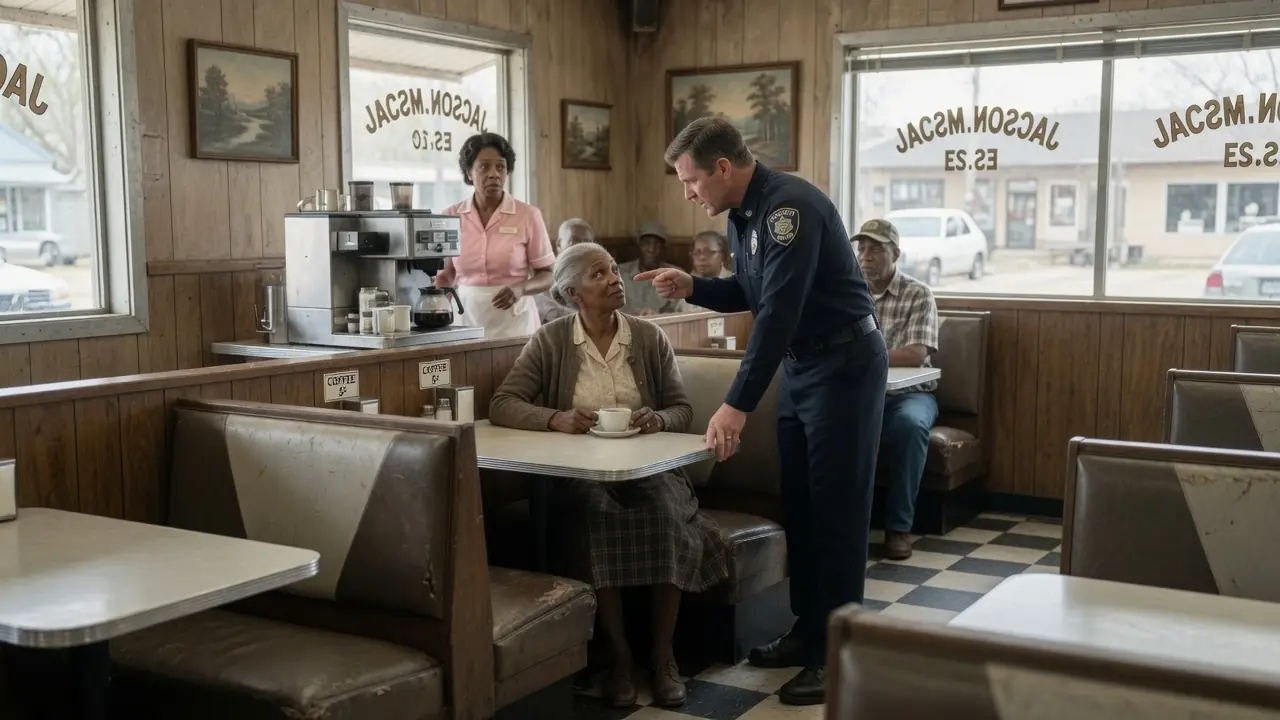
Mary Johnson, a woman in her 60s, a retired janitor, sat in her usual seat by the counter. Her thinning gray hair was neatly pinned in a bun at the nape of her neck, her white blouse buttoned all the way up, a worn yellowed book resting in her hand. She came here every afternoon, always ordered a black coffee, no sugar, and sat quietly where the sunlight sliced through the window pane. No one noticed, but she hadn't missed a single day in the last three months.
Crowley, the arrogant cop from the downtown patrol unit, shoved open the glass door and walked in like he owned the room. He was a regular here, chummy with anyone wearing a badge or a collared shirt. As he reached the counter, he slammed his coffee cup onto the marble surface hot liquid sloshing over the rim. Yet, his eyes never left Mary. His voice cut through the space loud enough for everyone to hear. You stink so bad I feel like puking on my donut.
The air stalled like a guitar string pulled taut, and suddenly let go. Mary didn't turn her head. Not a flinch, just the small coffee cup still resting in her hand, her fingers tightening around the handle, perhaps to keep her wrist from trembling. He laughed, his voice scraping across the countertop like a blade over polished paint. Crowley stepped closer, his left foot leaning into the aisle, then tugged at the tablecloth where Mary sat.
The glass of water beside her coffee tilted, spilling across the table, soaking into the pages of her book and the hem of her blouse. He shook his head with mock regret. Oops, just an accident. Then, standing tall, he grabbed the steaming coffee pot, still releasing clouds of vapor. His eyes squinted, his lips curled into a smirk as if savoring a private joke. Let's see if your skin soaks up flavor like it soaks up pity.
No one moved. No one said a word. His wrist tilted ever so slightly, and the entire pot of dark, thick coffee poured straight down onto Mary's head. The scalding liquid soaked her gray hair streamed down her neck and stained the white blouse in spreading patches. Coffee dripped onto the floor, each drop landing with a hiss beside the metallic clink of a spoon falling into someone's teacup. Then silence.
Mary flinched. Her body jolted as if electrocuted. But she didn't scream, didn't shout, didn't wipe the coffee from her face. Her hands clung tightly to the edges of the wooden chair, trembling as though holding on to something no longer there. Her eyes were hollow, staring straight ahead without seeing as if some ancient memory had been squeezed until it couldn't breathe. Her cheeks turned pale, but strangely her gaze never once pleaded.
The barista behind the counter froze for less than a second, then quickly turned away and disappeared into the back, pretending to grab more napkins. Other customers buried their faces in their phones or acted busy with their lukewarm coffee. The sound of spoons clinking against ceramic continued mechanical, and detached the instinct of people who had learned how to pretend not to see. Crowley straightened up, adjusted his police belt, then turned to the counter like a man who had just completed a duty.
His voice rang out again, louder and clearer this time. Someone get a janitor to clean this mess. A few nearby customers chuckled, sharp, cheap laughs that stung like needles in the ear. Mary remained seated. She didn't wipe herself. She didn't get up. Coffee seeped through her blouse, dripping along the chair and pooling on the floor. The wooden boards darkened the coffee, forming dark stains like black blood in a black and white photo.
The bitter smell of burnt coffee gradually overpowered the scent of pastries. Still, not a single word was spoken. And in that suffocating silence, the shame didn't come from the mouth of the victim. It came from the prolonged silence of those around her. In the corner of the cafe, behind a decorative wooden column, a young man gripped his phone tightly. The screen lit up for only a moment. He didn't move a muscle except for his thumb which tapped the record button.
No screams. No cops intervened. No one stood up. Only a tiny light from a phone. And a woman hair soaked in coffee sitting frozen in a room as silent as a funeral. Some societies operate under a deceptively simple principle. The less you speak up, the safer you stay. Power doesn't need to scream to crush someone. It only needs enough people to witness injustice and still choose to look away.
In a system where business cards, uniforms, and titles are assumed to represent justice, truth often arrives late and sometimes only shows up when someone is big enough to speak without asking permission. The light from a phone in the dark corner of a cafe last night had now spread nationwide. The 2-minute and 37 second clip had been shared millions of times in less than a day. On national television, an emergency press conference was held at the federal headquarters.
Behind the podium stood the American flag in its familiar red, white, and blue. But the voice that came forward was not familiar to most viewers. Nathaniel Johnson, assistant director of the FBI's Central Southern Division, renowned for leading investigations into extremist groups, stood upright, unbowed his gaze steady, and voice unwavering. That woman is my mother, he said without hesitation. You don't need shared blood to be family.
At a private home in northern Tulsa Crowley, the officer who had dumped a pot of coffee over Mary Johnson's head, sat alone on his sofa. The television cast a cold white light onto his face, stretching shadows across the wall behind him. He didn't blink when he heard the name Nathaniel Johnson. His hand gripped the remote until the plastic casing cracked and the batteries clattered to the floor. His lips clenched tight jaw muscles twitching with each breath.
Nathaniel received no support, had no blood relatives, and no one checked in. Mary used her meager cleaning wages, penny by penny, to raise him, even as she herself lived off minimum wage in a cramped, rented room. Crowley slammed his laptop shut after digging through Nathaniel's internal file. In an old report, he recognized a note about the death of Nathaniel's mother. He had once held that misconduct report in his hands, but discarded it because the name beneath bore the blue ink signature of a superior who had protected him in numerous other incidents.
Cold sweat ran down Crowley's spine. The details he thought long buried now resurfaced clear and spreading like oil across a still lake. Mary did not appear on television. Reporters came to her home, but she only sent out a handwritten note. The handwriting was firm, deliberate, without a trace of tremble. I'm not surprised. I'm just sad it took 40 years for someone to listen. The note was enclosed in a small plastic sleeve accompanied by a worn Bible and a photo of Nathaniel at 15, standing beside her on the porch holding his first school application.
A high-ranking officer, one who had sat beside Crowley in many internal meetings, came to him, suggesting he stay out of the spotlight until things cool down. Crowley shot up, kicked the chair back, and screamed, I'm not apologizing to no damn. His voice echoed through the room, slamming against the cold white walls. Outside the window, the last rays of daylight struck the badge lying abandoned on the desk. Its metallic sheen faded with his heaving breath.
That very afternoon, Nathaniel submitted an emergency suspension request to the Tulsa PD. The document offered no drawnout explanation, only the Federal Bureau of Investigation seal and a bolded sentence immediate suspension of Officer James Crowley pending federal investigation under Title 18 USC242. The public release of the document rocked the entire law enforcement community. The first field reporters tweet came less than an hour later. They messed with the wrong one. Over 30,000 shares in 2 hours.
Crowds began forming outside the police station. Some held signs. You don't need blood to be family. You don't need a badge to serve justice. As night fell, Crowley drove away from his home. Headlights swept across empty streets. The car window rolled halfway down. He pulled over to the curb, popped the trunk, and took out a handgun. He didn't aim at anyone, didn't point it at the road. His grip tightened around the handle muzzle pressed against the roof of the car.
The rear view mirror reflected a sweat-soaked face, but his eyes were hollow, as if directionless. He stared into his own reflection. The man who once believed he was untouchable now stranded at a crossroads with no way out. In the distance, faint sirens approached. But he didn't turn around. Only his eyes remained locked on the mirror, confronting what he had avoided all his life, the truth. A discriminatory act doesn't just target the individual. Insulted, it strikes at the collective memory of an entire community long silenced.
Truth isn't always heard, but there are moments when a single video clip can force a nation to confront its own reflection. And this time, people didn't stay silent over a cup of coffee poured on an elderly woman they cried out for every cup spilled across generations. The hidden camera in the young man's hand did exactly what it needed to do. The 2 minute and 37 second clip needed no narration, no background music, no effects, just a raw frame of real sound, real eyes, and real cruelty.
It was posted to Twitter at 2:18 a.m. by the account Justice Watch87, then quickly spread to Reddit under the single headline, This is how they treat our mothers. Within 8 hours, views exceeded 1 million and hashtags like justice for Mary and Tulsa spread across platforms like wildfire after drought. The system wasn't ready for that speed. Crowley certainly wasn't. In the shadows of a house with blinds permanently drawn, he sat before the screen not to monitor reports or track suspects this time, but to scour the public's reaction.
He created an anonymous account commenting under the original video. She's faking it. This was staged. Don't be fooled. He copy pasted variations of the same message across dozens of posts, changing wording, tweaking punctuation, but the meaning stayed the same. Each keystroke like a desperate slash against the tide tightening around his neck. But some things can't be stopped by trembling fingers at a keyboard. A local investigative journalist, previously suspended for unverified reporting, suddenly released three other clips.
Crowley shoving a young man against a wall, choking a woman in a parking lot, and leaning into a 10-year-old child's face before slapping the boy's head like a pet. None of these cases had been pursued. No charges filed. All recorded, archived, and shelved in folders labeled internal confidential. That morning, Mary received an unmarked envelope at her door. Inside was a crumpled sheet of paper scrolled in red ink. Playing victim won't save you from hell. No name, no fingerprints, but the ink was still fresh.
She folded the note, showed it to no one, and placed it in a drawer beneath her eczema ointment. Her frail hands tightened briefly, then released, silent. At the same time, Nathaniel Johnson stepped out of the FBI building with a folder. In front of dozens of reporters, he announced Officer Crowley's official suspension. The order read for acts of misconduct indicating discriminatory behavior against a citizen. And in light of previous allegations of similar nature, the FBI recommends immediate suspension of Mr. James Crowley pending investigation.
This is not just about my mother. It's for the hundreds who've been humiliated the same way. Inside Tulsa PD, the atmosphere cracked. Some internal officers who had stayed silent, who once brushed it off as nothing serious, spoke up in closed door meetings. One said, We can't keep covering this up. Another sent anonymous emails to the press with photos of internal memos redacted beyond recognition. The system began to splinter from within.
A national television network reached out requesting a live interview with Mary. A representative came to her home paperwork and hand contracts promising respect and dignity and a production team ready to frame the show as honoring and humane. She didn't come out. After three knocks, she stood behind the curtain, peering through the sliver. Her eyes weren't red, not dry either, not lowered, not evasive. That gaze said what no one on the crew dared ask. They folded their files and left in silence.
Close to midnight, Mary's home security cameras recorded a stranger in a police hat standing at her gate. He didn't knock, didn't call her name, just stood there for 37 seconds, then turned and walked away. He didn't look directly at the camera, but from that side profile, there was a distinct sensation. It wasn't a threat, but a probe, as if he wanted to know, Was she still afraid? Not all discriminatory acts are written on paper. Often, they reside in how a system decides who to believe, who to ignore, who deserves protection, and who does not.
True discrimination needs no words. It is coded into mechanisms and functions as a normal part of daily life. The image of a strange man in a police cap standing in front of Mary Johnson's gate was extracted from security footage and sent to the Federal Bureau of Investigation just hours after it surfaced. Nathaniel Johnson received the footage while still in a meeting with the state cabinet. The meeting wasn't on the agenda, but the decision reached was unmistakably clear.
He stood up, pulled a file from his breast pocket, and addressed the senior officials. Not just dismissal. I want the FBI to monitor the entire internal affairs of Tulsa Police Department for 90 days. No one objected. No one dared to. Everyone understood this was no longer personal nor about the media. This was an official order and it carried federal power. At the police department's office, Crowley sat in front of a screen.
The light from the computer casting a dark shadow over his face. When federal agents walked in, he didn't look up. They placed a sealed envelope in front of him containing an emergency suspension notice demanding immediate surrender of his weapon and badge. Crowley didn't read it. He scoffed, removed his gun from his belt, and slammed it onto the table, then tore off his badge, and threw it toward the agents like a worthless trinket.
As he left the room, he smashed his phone against the iron door frame, shattering its protective glass. Later that afternoon, Mary appeared in public for the first time since the incident. She wore a wide-brimmed hat to cover the hair she'd lost to burns. She did not answer questions. She didn't read a statement. She simply stood in front of her home for 5 seconds looking at the press crowd that kept their distance.
Her face was expressionless, but her eyes held something different, a still stone-like composure that silenced every unasked question. Her image, silent and had it, appeared on countless front pages the next morning. No headline needed. In a neighbor's video, Mary is seen quietly scrubbing the remaining coffee stains from the old wooden bench. Each wipe was steady, unrushed. Her back more hunched than before, but her hands still retained the muscle memory of someone who had cleaned for a living all her life.
She did not cry, did not speak. Her eyes stared into a blank point in the air as if listening to something unsaid, a silence with no beginning and no need for end. Crowley left the police department and found his way to an old bar a few blocks from downtown. He ordered liquor drank steadily and slammed his glass on the counter each time someone looked his way. I'll be back, he snarled at the bartender, and I'll teach these bastards who makes the law.
The bartender didn't respond. The patrons inched away. No one dared sit near him, but no one stood up either. It was a silence he knew well. Complicit silence. At the same time, a search warrant was issued for Crowley's office. Federal agents moved in, sealing off his computer, physical files, and communication devices. Several documents labeled internal sensitive, began to surface, mostly closed case files marked with handwritten notes like insufficient grounds for action signed by senior leadership.
Unwilling to stop, Crowley filed a counter suit to the Oklahoma State Human Rights Commission, accusing the FBI of discriminating against white officers and manipulating the media to fabricate stories. In the complaint, he described himself as a victim of a coordinated smear campaign attempting to frame Nathaniel's authority as a personal weapon. But the filing was quickly returned with a request for evidence, something he did not have. In response, he blamed the system, then the media, and eventually the traitors from within.
Nathaniel received a special report from the task force reviewing old files. Crowley had ties to a previously undisclosed death. The case had been labeled a workplace accident with no deep investigation, no press conference, and no charges filed. But now, with all eyes on Tulsa, not a single trace could be ignored. By day end, as night blanketed the city unmarked black SUVs parked silently around police headquarters. Office lights still glowed, but inside the air had shifted.
Nothing was under the control of a few uniformed men anymore. And for the first time in years, a man once considered untouchable found himself standing outside the system he had once believed to be invincible. Some systems are not built to uphold justice, but to shield those who know how to manipulate it. In these structures, the ones who commit wrongdoing get promoted while whistleblowers are transferred or silenced for life. It is no longer about individual faults. It is about an entire network that cultivates shields and regenerates violence under the guise of order.
One unannounced morning in front of Tulsa Police Department's headquarters, a large sign board was erected. It bore seven names. Each name was accompanied by a title badge number and the year allegations were filed. All had been internally investigated and dismissed as insufficient grounds for prosecution. On the bottom right of the board was a federal seal and beneath that a handwritten note from the FBI's assistant director. This is not all. These are just the first.
No loudspeakers, no press conference. Yet within an hour, more than 500 people gathered before the board, quietly reading each line, taking photos, then adding with markers, I know the eighth. I once stayed silent. The press followed immediately. A series of investigative reports titled Names Buried in the dark were released simultaneously across major platforms. Each name came with a story once buried in internal memos or dismissed with phrases like lack of evidence.
One of the three names listed was directly linked to the shooting that killed Nathaniel's birth mother when he was just 14. From here on, it was no longer a son's personal response. It had entered the realm of no return, an investigation into a system, including those who built it. Crowley summoned his private attorney in a tense evening meeting. He ordered the preparation of a lawsuit against Nathaniel for defamation and abuse of power. He called it a weaponization of FBI authority to destroy personal reputation.
But the lawyer listened in silence, offering no commitment. Crowley shouted in anger. They're making me the scapegoat. His voice cracked with rage, but no one in the room believed his words carried legal weight. They were the flailing of a man beginning to grasp that everything was slipping away. A few days later, Nathaniel received a handwritten letter from a man long removed from the system, a former officer who had retired nearly two decades prior.
The handwriting was shaky but steady. Your mother once saved me from suicide after a corrupt internal investigation. She told me to live long enough to see real justice. I owe her the truth. Now is the time to pay it back. The letter was never published, but Nathaniel kept it in his coat pocket, bringing it to every closed door meeting as living proof that his mother had saved lives, not with words, but with timely presence.
Crowley held his own press conference in a rented hall standing before an old backdrop bearing the faded police department logo. He raised his voice trying to sound confident. I am a victim of partisan media. They don't want truth. They want a hero and a villain and they chose me as the villain because I didn't bow my head. He looked straight into the camera, but his eyes no longer held their former certainty.
They were the eyes of a man who knew he was standing at the edge of a cliff, still smiling, because no one ever taught him how to fall. Outside Mary's home, someone spray painted the brick wall with black letters, Shut up or die. The message was discovered early in the morning as she stepped out to water her plants. She stared at it for a few seconds, then turned back inside, called no one, and said nothing.
That afternoon, in her small room, she quietly folded the newspaper featuring Crowley's face on the front page and placed it next to the framed photo of Nathaniel's mother. No one knew what she was thinking, but the act, decisive, orderly, without explanation, felt like a ritual, closing the first chapter of silence. The FBI's Central Southern Regional Office received a brown envelope with no return address. Inside was a blurred color photo, but Crowley's face was clearly visible.
He stood next to a corpse skin bluish eyes still open. The room in the photo bore no identifying marks, but the evidence was enough to reopen a death case closed nearly 15 years ago. No one needed to say it aloud. Everyone understood the blame game was over, and what had long been buried was beginning to rise layer by layer without mercy. Some systems are not built to enforce justice, but to shield those who know how to operate them.
In such structures, the ones who commit wrongdoings are promoted while the whistleblowers are transferred or silenced for life. It is no longer about individual misconduct. It is an entire network that nurtures, protects, and regenerates violence under the banner of order. One unannounced morning in front of the Tulsa Police Department's headquarters, a large signboard was erected. On it were seven names.
Each name was listed with rank badge number and the year the misconduct allegation was filed. All had been subjected to internal investigations and concluded as insufficient basis for prosecution. On the bottom right corner of the board was a federal seal and beneath it the handwritten note of the FBI assistant director. This is not all. Just the first few. No loudspeakers, no press conferences.
Yet within just 1 hour, more than 500 people gathered around the board, silently reading each line, taking pictures and writing with marker pens, I know the eighth. I stayed silent. The press jumped in immediately afterward. A series of investigative reports titled Names Hidden in the Dark were simultaneously released across major platforms. Each name carried a story once buried in internal memos or dismissed with the phrase lack of evidence.
One of the three names on the list was directly connected to the shooting that had taken Nathaniel's birth mother when he was 14. From this point on, it was no longer the personal reaction of a grieving son. It had crossed into a point of no return, an investigation of the very system and those who built it. Crowley summoned his private lawyer in a tense evening. He ordered that files be prepared to sue Nathaniel for defamation and abuse of power.
He called it an exploitation of the FBI's name to destroy personal reputation. But the lawyer only listened in silence, making no commitment. Crowley shouted in frustration, They're turning me into a scapegoat. His voice cracked with fury, but no one in the room believed his words carried legal weight. They were the flailing of a man beginning to realize that everything was slipping away.
A few days later, Nathaniel received a handwritten letter from a man no longer in the system, a former officer who had retired nearly 20 years ago. The handwriting was shaky but steady. Your mother once saved me from a suicide attempt after a corrupt internal investigation. She told me to live long enough to see real justice. I owe her the truth. It's time to repay.
The letter was never made public. But Nathaniel kept it in his coat pocket, carrying it into every closed door meeting as living proof that his mother had saved lives not with words, but with her presence at the right moment. Crowley held his own press conference, standing in a rented hall with an old backdrop printed with the police department's logo. He spoke loudly, voice strained to project confidence I am a victim of partisan media.
They don't want the truth. They want a hero and a villain. And they chose me as the villain because I refused to bow. He stared into the camera, but his eyes no longer held the same certainty. They were the eyes of a man standing on the edge of a cliff, still forcing a smile because no one had ever taught him how to fall. In front of Mary's house, someone spray painted the brick wall with black letters, Shut up or die.
The message was discovered early in the morning just as she stepped out to water her plants. She stared at the words for a few seconds, then turned back inside without calling the police or anyone else. That afternoon, in her small room, she quietly took the newspaper featuring Crowley's face on the front page, folded it in half, and placed it next to the framed photo of Nathaniel's mother. No one knew what she was thinking, but the act, decisive, orderly, and without explanation, felt like a ritual, closing the first chapter of silence.
The FBI's Central Southern office received a brown envelope with no return address. Inside was a blurred color photograph, but Crowley's face was still clearly recognizable. He was standing next to a corpse skin, purple, blue eyes still open. The room in the picture was unmarked, but the evidence in the image was enough to reopen a death case that had been closed nearly 15 years ago. No one had to say it aloud. Everyone understood the blame game was over and the things buried deep underground were beginning to rise layer by layer without mercy.
Evil does not always arrive in the form of open aggression. Sometimes it creeps in through the guise of calculated politeness, closed door meetings, and handshakes that leave no trace. A system that is exposed does not collapse immediately. It reacts first restructures itself, strikes back, and does everything it can to preserve the mask that has allowed it to survive for far too long. While the footage of Crowley pouring coffee over Mary was still stirring public outrage, another video suddenly surfaced on an anonymous account.
The angle was cropped, the voice distorted, the background blurred, but it was enough to create a misleading impression. Mary appeared to be yelling at a police officer. The caption below it read, This was before she verbally assaulted a public servant. Despite the poor quality, the video spread rapidly, racking up hundreds of thousands of shares. The media's first reaction was skepticism. The second, as always, was division.
On a conservative news network, a middle-aged white anchor began the segment with a question, Are we being manipulated by an emotionally charged media campaign? He presented a redacted medical file claiming it came from an internal source suggesting that Mary had a history of depression and mild emotional instability. The story was framed as if she were mentally unwell and the cafe incident might have been the result of years of unressed psychological trauma. No verification, no factchecking, but it aired six times that day.
Though Crowley was now separated from the system, he was still active behind the scenes. One evening, he met with a former commander who had overseen urban patrol deployments, the same man who had once certified that Crowley was fit for emergency response. In a room with only the two of them, a list was laid out. On it were the names of individuals connected to Mary's case from the young man who recorded the clip to several independent journalists and the cafe staff on that day. Control the media first, the former commander said.
Don't let them control the narrative. Crowley nodded his face, devoid of emotion. Only calculation remained. Inside the police department, the FBI investigation began to slow. Some members refused to cooperate, citing political threats. Testimony requests were returned, riddled with unreasonable amendments. Nothing was stated outright, but the glances exchanged in meetings carried one shared message. If the system falls, none of us are safe.
An anonymous letter was sent to Oklahoma's largest newspaper. It was brief and typed, If Mary weren't Nathaniel's mother, no one would care. The words weren't insulting, but carried a chilling contempt, as if justice were a gift reserved only for those with connections. The paper decided not to publish an editorial about the letter, claiming it would amplify divisive rhetoric, but the editors kept the original copy, not because they believed in its legal value, but because they knew there was more yet to be revealed.
At the same time, a man in a suit claiming to be an attorney for a justice advocacy group knocked on Mary's door. He spoke gently, carried a folder, and tried to create a friendly atmosphere. But as soon as he asked for her social security number and personal details, Mary silently stood up, opened the door, and motioned for him to leave. Not a word more, not a flicker of emotion. The man stepped out, leaving the folder on the table, but when she returned, it was gone. Security cameras captured nothing. The man had left no trace.
At the FBI office, Nathaniel was reviewing old data when he discovered an internal report from 2015 that had been deleted from the main system. However, the PDF remained intact on a backup server. The report documented aggressive behavior toward unarmed civilians during a routine inspection naming Crowley as part of the team. Ultimately, the report was closed due to no formal victim statement. Nathaniel printed the original, folded it, and added it to his personal case file, the place where he stored all the fragments of truth that had been denied for so many years.
On a private forum, a man claiming to be a former city official began calling to restore the honor of a falsely accused officer. His posts argued that Crowley was merely a victim of timing that all his actions had been exaggerated and if society turns its back on law enforcement chaos becomes law. These posts were quickly circulated by a small but coordinated group with full accounts, bandwidth, and narrative strategy. As night fell over Tulsa, Nathaniel received an email with no sender listed. The subject line read, Just listen, then you'll understand.
Attached was a recording less than a minute long. The background was music and clinking glasses. But Crowley's voice rang out clearly amid the crowd. That was the best damn coffee spill of my life. What followed was laughter. not one but many, as if it had been a war story raised in a toast. There was nothing explicitly cruel in the words, but the callousness in his tone made everything hit bottom. And for the first time, Nathaniel had to sit down, not from fatigue, but from anger so sharp he could no longer stay on his feet.
One of the cruelest forms of racism is its ability to bend the truth before it ever has a chance to form. It doesn't need to destroy evidence. It only needs to make sure no one wants to find it. And if someone does, the system instinctively suspects the seeker, not what is found. Nathaniel sat in front of the computer. The glow of the screen hidden his sleepdeprived eyes. On the screen was an old report titled death by self-inflicted blunt trauma. Case number 07907.
The top right corner read 2007. Name of the victim, Deshaawn Little, 22 years old, residing in North Tulsa. Cause of death was listed as self-inflicted injuries while attempting to evade traffic stop. But attached to the file was a scanned autopsy report clearly noting a skull fracture caused by a hard object. A small footnote read, Injury consistent with impact from police baton. The deeper he read, the more familiar it felt.
This wasn't a stranger's death. He remembered that summer night a small protest in North Tulsa and a silence that fell over the city that evening. He had just entered the FBI academy back then. The incident had passed quickly. No media, no investigation, just a single news line stating a young man died resisting police. Now he was staring at proof that the man responsible had been none other than Crowley.
Inside the file was a handwritten complaint. Once attached, now crossed out with a long red slash over the line, Crowley hit my brother. I saw it with my own eyes. In the margin was a blue ink note. Do not escalate. He's protected. No name, no title. But the handwriting made it clear it didn't come from a civilian. It was internal. Nathaniel accessed the FBI's highlevel archival system using his federal clearance card.
Within the archive, he found a folder with the code name K Fence. It wasn't listed under any open investigation, wasn't overseen by any official department. The folder contained dozens of files, audio recordings, internal emails, unpublished crime scene photos, and internal memos never uploaded to the central system. All were connected to incidents where Crowley had been cleared of responsibility. An anonymous call was patched to Nathaniel's office that same day.
On the other end was an elderly male voice, slow broken without introduction. I was the coroner on that case, he said. I was forced to sign off the death report. I still have the original draft, but I never dared show it. Nathaniel didn't interrupt. The man continued, I can't live any longer pretending I didn't know I was wrong. Word of the case spread within hours of the official file being forwarded to the Oklahoma State Court.
Within 48 hours, the chief judge signed an order to reopen the investigation into Deshaawn Little's death, a case buried for 18 years. A summon was issued for Crowley as the prime suspect. In a quiet corner of her home, Mary Johnson sat by the window. She read a news article shown on a neighbor's phone. She said nothing, just placed her hand on the line bearing the victim's name and opened the notebook beside her.
A new line was written. It wasn't just coffee. It was someone else's blood poured on my head. The handwriting was sharp, unshaken like time etched in iron. The next morning, hundreds of North Tulsa residents marched downtown. They carried wooden signs, banners, and photos of Deshawn. A large placard was held high in the crowd. 2007 didn't die. It was buried alive.
The marchers didn't chant slogans. They walked slowly, silently, but their expressions were unmistakable. They weren't there to ask. They were there to demand. Eventually, an unreleased document leaked a 3minute unedited dash cam clip. In the footage, a patrol car camera captured everything Crowley chasing Deshawn into an empty parking lot, shouting without reading him his rights, then slamming him onto the hood.
A direct baton strike sent Deshawn's head crashing into the metal. He didn't scream. He made a single sound and went limp. Crowley stood there, adjusted his hair, looked straight into the camera, and smirked. The clip ended with the sound of wind and retreating footsteps calm as if nothing had happened. No commentary was needed. A death hidden for nearly two decades had just been dragged into the light.
And this time, no one had the right to call it an accident. The wounds of discrimination aren't always visible or bloody. Some leave no trace, no diagnosis, no report, but they erode memory shred the soul, leaving survivors alive without ever truly living. The system doesn't have to kill it, only needs to ensure its victims are forgotten. That morning, as the leaked recording of Crowley's vile confession still reverberated through the media, a woman stepped up to the podium at the Tulsa Justice Center.
She had no lawyer, no media escort, only an old canvas bag in hand. Her name was Loren Briggs, 39, a former city sanitation worker and a mother who never got to meet her child. Her voice was low, steady, without tremble or raise. I'm not here to sue. I'm not here for money. I'm here to prove that I existed. After a pause, she opened the bag and pulled out a tiny unworn infant onesie.
Without another word, she held it up. The crowd was silent. Camera lenses froze between the morning light and the empty gaze of a mother whose child never came home. The 2013 case file stated that Lorine suffered a premature birth due to a delicate constitution. At the time, she was pulled over while delivering paperwork to the health department. Crowley was the officer.
She testified that he dragged her out of the car for non-cooperative attitude, shoved her, then kicked her in the stomach. 3 days later, she gave birth at Mercy Hospital. The baby lived less than 4 hours. The attending doctor said there was insufficient evidence to link the trauma to the outcome. The patrol car's dash cam was reported malfunctioning. Crowley was questioned about the incident in a closed hearing with federal representatives.
He smirked cold and detached. I don't recall. I see a hundred people a day. Who remembers? No apology, not a blink. Nathaniel Johnson met Lorine privately that afternoon. No reporters, no cameras. In a small office with just the two of them, he said, I'm sorry. The system allowed this to happen. She replied, You owe me nothing, but you owe those who come after me. If this doesn't stop, more children won't be born.
A photo of Lorine from the day she was assaulted taken by a student standing nearby suddenly resurfaced online. In the image, she lay on the roadside clutching her stomach, eyes wide open, blood running from her lips down her chin. It became a new symbol of rage. A caption went viral, not just once, not just one, and definitely not because her body was too weak. That night, a female officer currently serving in Tulsa PD assigned to that scene years ago publicly released her statement.
I saw him kick her in the stomach, but I was new. I was scared. I stayed silent. I don't want to keep being wrong. Her testimony shattered years of police denials. Her recorded statement was delivered directly to the Federal Investigative Office and logged as formal evidence. Finally, a new audio recording leaked from a bar once frequented by Crowley and some former colleagues. In the clip, his voice rose amid the drunken laughter.
Someone asked, Was that pregnant chick's story real? Crowley answered without hesitation, I like breaking weak things, like pregnant women. That sound wasn't just evidence. It was a raw confession that he never regretted it and never thought he was wrong. Loren's case was officially reopened that night. The state prosecutor's office demanded all files related to Crowley from 2010 to 2015 be reopened and transferred to the federal level for independent review.
A senior attorney from Washington was appointed as special counsel to the case. Public sentiment was no longer in waiting mode. They demanded action and this time even the federal government couldn't look away. Lorine declined all interview requests afterward. She returned to her original job cleaning up the city's old neighborhoods quietly as before. But one morning, someone saw her hanging that infant onesie on a bare tree branch outside city hall.
No name plate, no photo, just a small piece of fabric swaying silently in the wind like an accusation that needed no words. By day's end, Nathaniel's personal email received an attachment from an anonymous sender. It was the bar recording. He laughed. He spoke. And this time, everyone heard. Injustice does not stem solely from the actions of the oppressor, but also from the prolonged silence of an entire society.
When a person is rendered invisible long enough, their very existence, if reclaimed at the right moment, becomes a blow to the core of the system that silenced them. Dawn had not yet fully broken. Darkness still lingered on the sidewalks of downtown Tulsa, where Sunbeam Cafe once stood like a small fortress for the privileged. Over 3 weeks had passed since the incident. The cafe was now sealed shut, its windows coated in a thin layer of dust.
No one entered, and no one wished to sit there anymore. But this morning, someone appeared. Mary Johnson, the elderly woman who once had coffee dumped on her head, walked up to the cafe entrance. In her hands was something heavy. The old wooden chair she had sat on the day she was humiliated. She came alone. No cameras, no reporters, no sun escorting her.
She placed the chair precisely where it once stood outside the cafe. Now just a cold, vacant stretch of sidewalk, then bent down and opened a can of white paint. The words she painted were not rushed, but deliberate, each line etched clearly onto the back of the chair I sat here. I will sit here again. Will you? She didn't stay long.
When she finished, she took a step back, looked at the chair for a moment, then turned and walked away. No glance back. Not a single word. A student passing by stopped in his tracks, pulled out his phone, and took a picture. The image was uploaded with a simple caption, She came back. Within 4 hours, it spread across social media.
Major news outlets quickly picked it up. The New York Times ran it on the front page. The chair says nothing, but the whole nation is listening. Crowley, upon seeing the image in a midday broadcast, smashed the windshield of his own car in the parking lot. Rage erupted like the final crack in a face already beyond control. That same day, a Tulsa street artist recreated the chair in white paint on the concrete outside city hall.
No artist signature, just a chair image with the exact same words Mary had written. Locals began placing flowers, handkerchiefs, and cards around the drawing. No one was told to do it. But everyone understood the chair was no longer just a chair. It had become a touchstone of conscience. A national news network, one that rarely allocated time to local stories, unexpectedly devoted a full 15 minutes of live airtime to the image of the chair standing silently in the morning sun.
No commentary, no anchor, only a slow cello score, each note seeming to fall straight into the earth. Viewers sat motionless in front of their screens. Some cried, some stood and silently walked out of the room, but no one turned away from that image. That evening, Mary returned to her small house in North Tulsa. She opened a drawer and took out an old photograph. Nathaniel at 14, skinny, disheveled hair eyes brimming with tears.
In the picture, he sat on her lap, his hand clutching hers like the last lifeline left after the death of his biological mother. Mary sat down, placed the photo on the table without wiping dust or tears. At the same time, Nathaniel stood before the press camera flashes, firing relentlessly. He didn't read a statement. He didn't use political phrasing. That chair is not evidence. It's a pillar of moral clarity.
When my mother no longer has the strength, I will sit in that chair. The crowd didn't cheer. They bowed their heads. A rare kind of quiet respect filled the room uncommon in the usually noisy atmosphere of a press conference. Elsewhere in the city, a mid-ranking officer, who had remained silent since the beginning, entered Nathaniel's office that night. No greeting, no request for protection.
He simply placed a USB drive on the table and said, I don't want to die with this in my chest. Inside the folder was a single file, killlist.txt, an internal encrypted log listing individuals who had been monitored, pressured, or threatened by officers currently or formerly serving in the Tulsa PD. Some names on that list were dead, some missing, and some were still alive simply because they had never spoken up.
Nathaniel didn't open the file immediately. He stared at the USB in his hand as though it weighed more than anything he had ever carried. A list, a confession, a verdict yet to be delivered. And now, a mother had taken her seat not to speak, but to compel the world to listen. A power structure without oversight turns itself into the law. In a society that has long used badges to mask injustice, returning oversight to the people is not just an administrative reform. It is a moral revolution.
That's when people begin to understand truth cannot be defined by a uniform, but by whoever has the courage to protect it. Mary's old chair still sat on the sidewalk outside Sunbeam Cafe when the governor of Oklahoma released a statement on Monday morning. We hereby approve the formation of Tulsa's first civilian oversight council, a citizen-elected body with the authority to audit, investigate, and address misconduct within local law enforcement.
That sentence didn't just end the era of performative internal reviews. It opened a new corridor of power where people were no longer bystanders to their own injuries. Immediately following the announcement, Nathaniel Johnson held a press conference in the grand hall of city hall. At the podium, he didn't read a prepared text. He told a simple story. One night, I came home late. My mother was mending an old scarf burned by hot coffee.
I asked her why she didn't just throw it away. She replied, Because it covered my chest when he poured that on my head. It's not clean anymore, but it's the truth. The entire room went breathless. The old complaint system was immediately suspended. A completely new protocol was introduced. Each claim of police abuse would be forwarded to the civilian oversight council composed of community representatives, civil rights attorneys, trauma psychologists, and a former victim.
The reaction from the old guard came instantly like muscle memory. Just hours after the declaration, an email was leaked. It revealed that a city hall communications adviser had financially supported a group called Support Tulsa's Officers, the same group that had previously circulated disinformation about Mary. Before the media could fully unpack the implications, Crowley reemerged on the investigative radar, not for a threat this time, but for a formal public summons.
The Civilian Oversight Council demanded he appear to answer questions from the public itself, a precedent setting moment in Tulsa's history. But just as this was announced, a masked group held a secret press conference in an empty field outside the city. They held signs, We are the law. No one can judge us. In the dark, a voice echoed through a portable microphone. If today they oversee the police tomorrow, they'll control everything.
The media captured only a few blurry images, but public anxiety grew. The old system wasn't dying quietly. At Mary's house, an unmarked envelope was left on her doorstep. Inside was a photo of the chair burned to ash charred remains still clinging to the pavement and a handwritten message, Burn the chair. Burn the blood. Nathaniel immediately ordered federal protection.
But Mary, as if she'd long been prepared, simply said, I've lived in fear for 40 years. Not anymore. She folded the photo, placed it beside an old Bible on her shelf, then went out to water her plants as usual in an abandoned warehouse on the south side of the city. Civilian security cameras recorded footage of Crowley meeting with three unidentified men. On the table was a printed map of the city's electrical grid.
The main power lines supply routes from the outer substations and even the control hubs for the surveillance system were all marked clearly. One man shook his head. Crowley pointed at a drawing of Mary's chair on the diagram said something and smirked. The meeting ended in 15 minutes, but that map and his eyes continued to pierce through the dark. That night, precisely at midnight, downtown Tulsa experienced a sudden blackout.
Street lights, traffic signals, surveillance systems, even the lights at the Civilian Oversight Council headquarters all went dark. On the last working CCTV feed, the fixed camera across from Sunbeam Cafe froze just as it captured Mary's chair. In the faint glow of emergency lights, it was still visible, isolated, solitary, but unshaken. The chair was no longer merely a place someone once sat. It had become proof of a singular truth.
Even if the system cuts the power burns the symbol and rebuilds the darkness. Once the people have seen the truth, no power on earth can extinguish that light again. Some cities don't bother hiding injustice because they've mastered the art of making it look legal. In places like that, the man with a name plate and the one with his hand in an envelope differ only in how brightly the camera lights shine. People no longer distinguish between true justice and rehearsed performances for the press.
They only know that the more promises are made, the less actually gets done. And as always, the victims are crossed out of the script. Tulsa's new police chief stood at the podium, hand over hard eyes, locked onto the lens like a man who believed every word coming out of his mouth. We will cleanse the ranks. No one is above the law, he declared. And the crowd, those who had suffered, lowered their heads in hope.
But not even 30 hours later, media outlets released an image. That very man shaking hands with the officer who once beat Eden so severely her jaw was broken. The photo was grainy, taken from a security camera, but not. In the chief's hand was a thick envelope and in his eyes a subtle nod just enough for an entire city to understand that justice was a stage and the roles had long been cast.
Eden sat in a small room, the glow from her phone illuminating a face slowly collapsing. She read the headline silently pressing mute as if silencing the world might dull the pain. But the tears came anyway. Not loud, not raging, just falling. each drop a quiet confirmation that justice had been sold again, and this time the buyer was applauding. That very night, the investigative journalist who had first sent Eden the incriminating documents disappeared without a trace.
Police claimed he had lost contact while visiting family. But Eden knew no one vanishes right after emailing evidence about someone sitting in power. The smell rising from it all wasn't coffee. It was rot. People took to the streets. They didn't need megaphones or slogans. They held signs with a single line, This is my city. I won't be silent. But as the crowd neared city hall, tear gas was deployed.
Police and riot gear batons and hand eyes unmoving. Eden was shoved back by the chaos, her cheek stinging from the gas. But there was no fear in her mind, only certainty they would never change unless they were forced to. Two days later, a public forum was held in a cramped community hall. Citizens packed the room, each carrying questions. But just as Eden stepped on stage, the lights went out.
The projector blew a fuse and the mic let out strangled static. Someone had cut the power from inside. When auxiliary lights came on, all she had time to say was a single greeting. Attendees were told to disperse due to technical difficulties. But Eden knew there was nothing technical about it. This was sabotage intentional, calculated, and orchestrated by familiar hands.
Shortly after the handshake clip between the chief and the disgraced officer vanished from all platforms, Twitter, Reddit, YouTube, all returned content not found. Accounts that had posted it were suspended or flagged. Within 12 hours, the evidence was buried faster than it had been born. And inside the precinct, the officer who once slapped Eden, who knocked her unconscious during a patrol, was promoted. The title interim coordinator was awarded for exceptional field experience.
On TV, the mayor stood before cameras, eyes glossy. We are investigating, he said, voice trembling. But beneath the tears, Eden saw nothing but performance. She had seen that same look before in an old photo when her father was falsely convicted right in this very place. The polished suits, the hesitant speeches, they were just costumes for a system rotting from within. An independent paper, the only one that dared reprint the handshake, had its entire run, burned overnight.
The newsroom was defaced with red spray paint reading traitors. Police claimed no leads. The cameras were malfunctioning. Eden passed by the ashes, looking at the scorched remnants, saying nothing. But she understood they weren't burning newspapers. They were burning the truth. That night, Eden used her own blood from a cut she got tearing down fencing during the protest to write on the wall near City Hall. Justice is not your puppet.
The words seeped into the cement, drying like a fracture in a system, pretending to be whole. People passed by in silence. No one spoke, but everyone knew it wasn't a slogan anymore. It was a declaration of war. The next morning, in Eden's rusted mailbox, battered from years of vandalism, was a USB drive with no label, no letter, no sign of who had sent it, just a small, cold object. Her hands trembled as she picked it up, not from fear, but from the knowledge that every great truth begins quietly, exactly like this.
There is a truth few dare speak aloud in class structured societies. The life and death of a person does not weigh the same as that of a man in uniform. Their deaths are processed like minor glitches in procedure, a system malfunction not urgent enough to matter. And so with every siren that wails after a gunshot, officials search for justification instead of asking why it happened at all. A tilted phone camera. Afternoon sunlight flares through the lens.
A young teen lies crumpled on the roadside mouth filled with blood. Hands still raised in a final attempt to call out mom. The bullet entered through his left chest. Blood pulled across the sunlit pavement. There is no soundtrack, no commentary. Everything is clear. He was unarmed, offered no resistance. The officer stands above him, Glock, still in hand, face cold like someone who had practiced this moment many times in a mirror.
One hour later, the district attorney's office held a press conference. A spokesperson in a gray suit holding the mic like a dutiful bureaucrat declared, We have seen no signs of misconduct in the use of force. His face did not flinch. His words did not stutter. Behind him, the crowd remained silent, not out of belief, but out of exhausted familiarity. The person who filmed the clip was arrested 3 hours later, charged with obstruction of justice.
Police seized his phone, escorting him like a thief. A search warrant was signed that very night. Eden heard the news while on her way to the victim's house. She did not stop. Her steps were steady, her hand clutching a plastic bag containing a blood stained bullet. She said nothing, simply placed the bullet on the wooden table in the victim's home in front of the mother who had screamed herself voiceless. She knew that any words now would only insult the grief.
The next day, three major newspapers ran the same headline, Victim had prior drug and theft records. Another article used the phrase previous juvenile arrest as if it justified a public execution in daylight. Under each story were thousands of divided comments. Eden didn't read them. She stared at a leaked text from a junior officer. Handle it like Eden. Whether intentional or not, the words had tipped everything into chaos.
On the third night after the shooting, Eden appeared in the city square. In her hand was the boy's blood soaked shirt, once white, now entirely red. She climbed the Statue of Justice alone and hung the shirt as high as she could reach. She stood there for 15 minutes. No speech, no tears, no trembling. People gathered slowly, saying nothing, lighting candles at the statue's base. The flames flickered silently while national TV kept airing game shows as if nothing had happened.
An elderly white man approached. He pasted a banner on the square's wall. I once stayed silent. Now I'm ashamed. No one asked who he was, but hundreds placed a hand on his shoulder before walking away. Shame needs no biography. The next morning, Eden found a thin sheet of paper tucked under her door, one handwritten sentence in black ink. There is still one living witness. No name, no address, but the line made her heart race.
She turned on the security camera facing her window. The footage timestamped 3:12 a.m. showed a shadow pausing outside her house. A man in a long coat hat pulled low, but his face was unmistakable. He was the one who knocked out three of her teeth stole her spring. He stared straight at the lens. No smirk, no flinch. It was him, the officer, who assaulted her. And now he was present at another death.
She froze the frame at the moment his gaze met the camera. It was no longer just a warning. It was a silent message. I'm still here and you'd better remember. Eden stood still for several minutes. Then she opened her steel cabinet and pulled out the old case file, the one she'd locked away, hoping to never revisit. But hope had no place here anymore. The system was cracking, but those in the shadows were still pouring concrete over the pain of the innocent.
And Eden knew if no one digs, they will keep burying, not with soil, but with press releases, executive orders, declarations of no wrongdoing, and bullets with clear addresses. She replayed the footage slower this time. The light angled just enough to cast a distinct shadow on the sidewalk. The officer stood still like a crease in an old memory, but behind him, another figure emerged, smaller, subtly moving. No clear face, no clear gender, just a silent gate close enough to see, distant enough not to be heard.
Eden couldn't be sure who it was. But she knew one thing. Someone had seen the truth, and they were choosing to step forward. There is nothing more dangerous than a truth about to be spoken by someone the system once buried. The more a society pretends to be just, the more it panics when someone dares to break the silence. Those voices do not demand blood. They only need a working microphone and a room whose doors haven't been locked.
Eden stood on stage at the National Human Rights Conference surrounded by a packed room of scholars, lawyers, and government officials. White lights shone on her face. Her speech had been preapproved. But when she changed her tone, brushed past the written remarks, and named the officer who once assaulted her, the microphone abruptly cut off. Before she could react, every ceiling light went out at once. The room plunged into darkness, and for the first few seconds, only the hum of the air conditioner and the shuffled confusion of feet on carpet could be heard.
A man's voice rose from the back of the room unashamed, Shut her up! Then came the squeal of the mic before it died completely. Someone stood and shouted, Don't let her speak. A few demanded the lights be turned back on, but no one from the organizers responded. The emergency exits wouldn't open. Someone had locked them from the outside. This wasn't technical failure. It was a calculated decision.
Eden didn't move. In the dark, her breathing was the only sound she could control. She heard murmurs, felt the air tighten like it was about to break. Then, unexpectedly, a metallic tapping echoed from stage left. An elderly woman, hair white as snow, slowly stepped into the spotlight. In her hand was a personal speaker mic, one that connected directly to a pocket amplifier. Without waiting for permission, she spoke loudly. Don't let her stand alone.
Just one sentence, but enough to shake the entire room. The first person to turn on their phone flashlight was a student in the back row. Then two more in the center. Within 10 seconds, hundreds of tiny lights ignited, casting a halo around Eden. In that flickering light, her face was fully visible, firm, unshaken, unmoving. She didn't look for another mic. She unfolded the piece of paper in her hand and began to read aloud.
Her voice rang through the silent room, each word sliding across the audience's skin like truth made audible. She recounted the night of the attack. She recalled the officer's whispered threats as her face was slammed into the pavement. She spoke with the precision of someone who had never forgotten, not because she wanted to remember, but because the pain had never left. When the speech ended, the ceiling lights came back on.
The sound system returned, but it was too late. A guest had unintentionally recorded the entire moment, the lights going out, the mic cutting, and the blatant interference. The video was uploaded to a small forum. An hour later, it was deleted from all major platforms, but a copy surfaced on Reddit tagged with sharp leather speak. From Canada to California, users began reposting it. No background music, no edits. Everyone understood this moment.
Didn't need production. A day later, Eden received a fax printed on thin paper. No sender listed. The message was typed in bold, precise lettering. She won't get another chance. Eden wasn't surprised. She folded the paper four times and tucked it into her coat pocket. That night, when she turned on her laptop, she saw an unfamiliar email from an untraceable address. No subject, no text, just one attachment, a copy of her father's speech.
She opened the file. The lines appeared steady neat. That speech had never been read publicly. He wrote it the night before his arrest, a speech prepared for a hearing he would never attend. In it, he spoke of the courage of the forgotten, the patience that went unrewarded, and the price of being decent in a world that demanded submission. Eden reached the final line, her fingers gripping the desk, Italicized as if he'd known his voice might never be heard.
If you're reading this, I might be gone. But voices never die unless we stop speaking. Her laptop screen reflected her eyes dry now, but heavy with a silence too sharp to escape. An hour later, Eden uploaded her own speech to the same form that had spread the video. She added, No caption, no hashtags, just one line. He never got to read his, I will. Not all wounds bleed right away.
Some linger for decades, quietly gnawing at belief eroding dignity and teaching people to live beneath their worth. Racism doesn't only show itself in slurs or senseless bullets. It lives in the way deaths are rewritten, complaints disappear, and those in power unanimously refuse to hear a single testimony. The unidentified man seen at the end of the live stream stood in the shadows outside Tulsa police headquarters. Eden had spotted him briefly during the broadcast just seconds before the screen went blurry.
He didn't give his name. He simply tilted his head toward the camera and uttered a slow confession. I was a witness. Eden didn't know who he was, but she knew she had to return to where it all began. At dawn, under gray skies, Eden stood before police headquarters, the place her father once worked, and where he was beaten to death. In her hand was a yellowed photo showing his face, blood still fresh on his forehead.
She didn't ask for security clearance. Didn't wait. She walked straight into the main hallway toward the conference room. The office of the chief investigator. No one stopped her. No one spoke, but the air thickened like the building itself was holding its breath. She taped the photo to the back of his chair. In red marker, she wrote, He served in this department, too. A young female officer at the side desk began crying.
She stood tore the name tag from her chest and let it fall. The sound hit the floor like the end of something irreversible. Eden didn't acknowledge her. Didn't thank her. Nothing needed to be said. In the elevator to the third floor where internal archives were stored, Eden sliced her palm. Blood dripped onto the cold metal floor. With her finger, she wrote on the elevator wall, Justice bleeds.
A volunteer filmmaker followed behind live streaming every step. Within 24 hours, the video had over 2 million views. No filters, no edits, just one woman walking into the stone gut of the system that had murdered her father and never once apologized. On the third floor, Eden requested access to old case files. At first, the clerk refused, but then an older officer, one who had once served alongside her father, stepped forward.
He entered the room, pulled a key from his shirt pocket. The rest of the transcript details the unfolding investigation, community response, systemic exposure, and pursuit of accountability through federal intervention and public pressure. The events culminate in reforms, reopened cases, and a commitment to ongoing oversight to prevent future abuses. Mary Johnson's quiet resilience and Nathaniel Johnson's actions drive lasting change within the department and broader community structures.