What are you doing out here? I'm headed to class. We got a report about someone messing with cars. So why you came straight to me? Well, you don't look like the students we usually see around this lot.
There it is. Another biased cop here, Marcus Harrington. And in case the name rings a bell on the principal's son. It started like any ordinary afternoon outside Brookside College. A warm breeze, students walking between rows of cars, backpacks bouncing on their shoulders, the familiar chatter of campus life in the background.
But one officer's body camera would later become the center of a firestorm that rocked the entire state. Because in this video, we see a young student, calm, alone, holding nothing but a notebook and a backpack, confronted for simply existing in the wrong place at the wrong time in front of the wrong cop. When the officer steps forward, his tone already sharp, the moment shifts. What are you doing out here? What follows is not just profiling, not just harassment, but an assault that triggers protests, exposes a history of complaints, and ends with a $6 million lawsuit that forces the department to rewrite its entire campus police and policy.
Brookside College, a midsized state university in upstate New York with an enrollment of about 8,000 students. The campus spread across 200 acres of rolling hills, brick buildings dating from the 1960s, newer science facilities, residence halls, athletic fields, and multiple parking lots serving commuter students and faculty. The south parking lot adjacent to the liberal arts building was one of the busiest on campus during afternoon class transitions. It was 2:17 p.m. on a Tuesday in early October. The weather was perfect.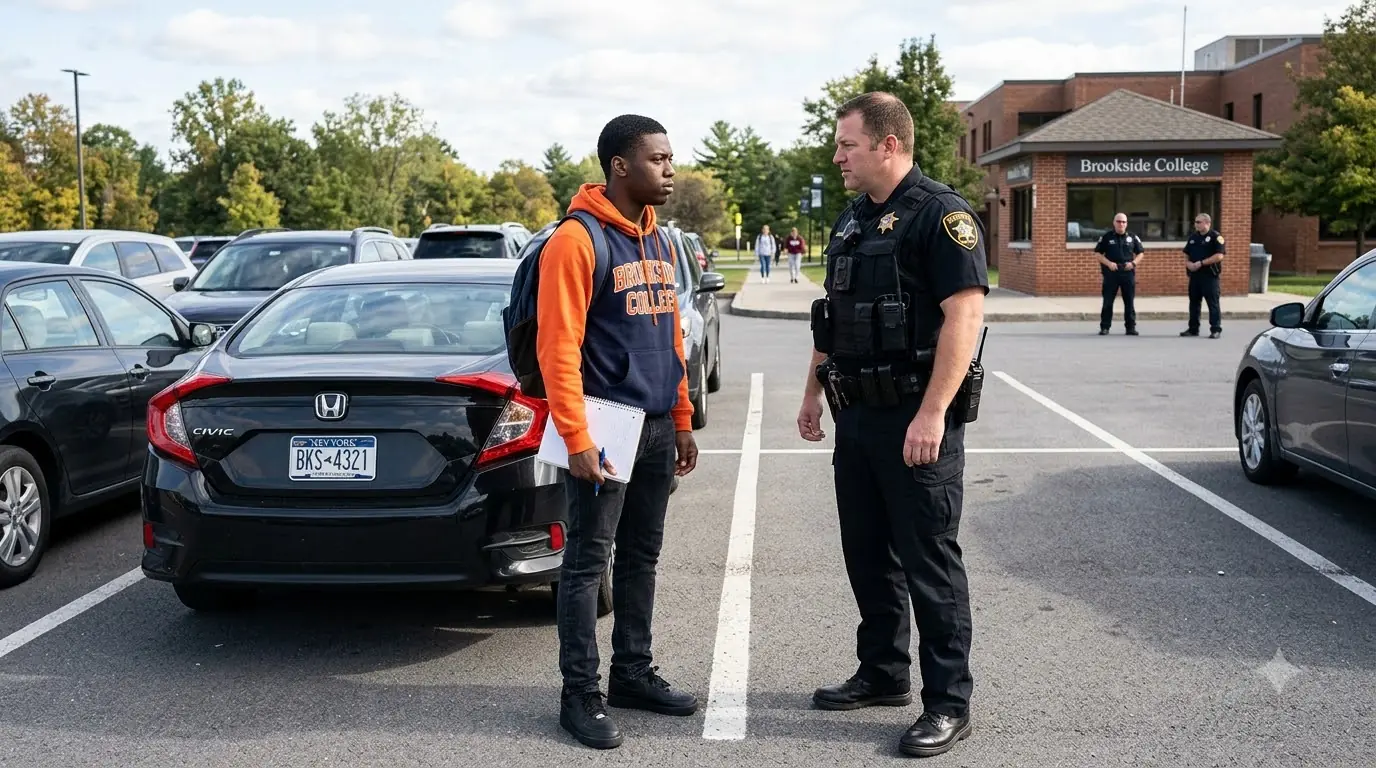
Mid60s, partly cloudy, leaves just beginning to turn colors. Students moved between classes and clusters. Some hurrying, others taking their time. The normal rhythm of campus life. The parking lot was half full.
Cars parked in neat rows, a few students loading or unloading backpacks, heading to or from classes. Marcus Harrington, 21 years old, walked through the parking lot toward the liberal arts building where his 2:30 Introduction to Constitutional Law class was held. He was a junior majoring in political science, carrying a spiral notebook and a pen, his backpack slung over one shoulder. He wore jeans, sneakers, and a Brookside College hoodie. He looked exactly like what he was, a student heading to class.
Marcus was the son of Principal James Harrington, who ran Brookside High School in the same district. His father had worked in education for 2three years, had a reputation for fairness and high standards, and was well known throughout the community. Marcus had grown up in the area, attended Brookside schools his entire life, and was now continuing his education at the local college. Officer Derek Lounen, 42 years old, had been with the county sheriff's department for 16 years. For the past eight months, he'd been assigned to campus patrol after a series of complaints about excessive force and aggressive behavior during regular patrol duties.
He wasn't looking in windows, wasn't trying door handles, wasn't acting furtively. He was just walking. But to Lounen, a male in the parking lot registered as worth investigating. Lounen walked quickly across the parking lot, closing the distance. Hey, what are you doing out here?
Marcus turned, confusion crossing his face. I'm headed to class. Why? Lounen stepped closer, his posture aggressive from the start. We've had reports about someone messing with cars in this lot.
I need to see some ID. Marcus' confusion shifted to frustration. He'd experienced this before. Being questioned for existing in spaces where he had every right to be. Reports about what?
I'm a student here. I'm walking to class. ID now. Marcus pulled out his student ID and driver's license and handed them over. Lounen examined them, his eyes moving between the photo and Marcus's face.
You don't look like the students we usually see around this lot. The meaning was unmistakable. Marcus felt anger rise, but kept his voice controlled. There it is. Another biased cop who can't believe a student belongs on a college campus.
He pointed to his ID. Marcus Harrington. I'm a junior here and I'm the principal's son, principal James Harrington from Brookside High. You want to call and verify that? Instead of backing down, Lounen's expression hardened.
Being challenged, especially by someone invoking authority triggered his worst instincts. This ID could be fake. Lots of people make fake student IDs to access campus facilities. It's not fake. You can verify it with campus security or the registrar's office in about 30 seconds.
Turn around and put your hands on that car. I'm going to search you. Marcus stepped back. You're not searching me. I haven't done anything wrong.
I'm going to class. I said, "Turn around. " Other students were starting to notice the confrontation. Voices lowered. Heads turned. Phones began emerging from pockets.
Two campus security officers hearing raised voices jogged over from the nearby security station. David Chen and Maria Rodriguez, both recognized Marcus immediately. They'd seen him on campus for three years, knew his father from school district events, had chatted with him countless times. Chen called out, "Marcus, everything okay? " Marcus' relief was visible. David, this officer is accusing me of messing with cars.
Can you verify I'm a student here? Before Chen could respond, Lounen stepped between them. This is a law enforcement matter. Campus security has no jurisdiction here. Rodriguez pulled out her radio.
Actually, we have shared jurisdiction on campus property per the agreement with county sheriff, and we can verify that Marcus is a registered student who's been on this campus for three years without any incidents. Lounen's face flushed. I don't care what you say. He fits the description of someone reported suspicious in this area. Chen stepped forward, his voice firm, but professional.
What description? We haven't received any reports about suspicious activity in this lot today. The description I received from who? Through what channel? Because campus security monitors all reports related to campus and we've had zero calls about anything in this lot today.
He ignored him, turning back to Marcus. Last chance. Turn around and put your hands on the car. I'm calling my father. This is harassment.
The moment Marcus reached for his phone, Lounen's hand shot out and grabbed his wrist hard. Marcus instinctively pulled back, a natural reflex to unwanted physical contact. Lounen immediately shouted, "Stop resisting. " Students watching from a distance began recording. At least five phones were out now, capturing different angles. Someone started a live stream that would reach thousands of viewers in minutes.
Rodriguez stepped closer, her voice urgent. Officer, he's not resisting. He was reaching for his phone. You initiated contact. Stay back or I'll arrest you for interfering with a law enforcement officer.
Chen was already on his radio. Central, this is Chen in South. We have a situation with county officer and a student. Requesting supervisor and principal Harrington to respond immediately. Student is the principal's son.
Lounen grabbed Marcus's shoulder and spun him toward a parked car. Marcus tried to step away, not fighting, but refusing to be manhandled. "Get your hands off me. I haven't done anything. " I said, "Stop resisting. " Lounen swept Marcus's legs and slammed him face first across the hood of a Honda Civic. The impact was loud enough that students 20 yards away heard it.
Marcus cried out. The wind knocked from his lungs. Multiple students screamed. Chen shouted, "That's excessive force. Stop. " Rodriguez had her phone out recording, calling into her radio for backup and medical.
Lounen pressed his knee into Marcus's back, wrenching his arms behind him. Marcus was gasping, trying to breathe, his cheek pressed against hot metal. I didn't do anything. I was going to class. Yes or no?
The body cam footage, later released through Legal Discovery, captured everything with brutal clarity. Lounen's knee pressed hard into Marcus' lower back, his hands forcing Marcus' arms at an angle that caused visible pain. Marcus' voice strained and desperate, repeating that he'd done nothing wrong. Then, Lounen drove his knee harder into Marcus's side, targeting his ribs. Marcus cried out, a sharp sound of pain that cut through the ambient noise of the parking lot.
Students watching were crying, shouting at Lounen to stop, but maintaining distance because he'd threatened arrest. A student named Jennifer Woo had started live streaming 30 seconds before the takedown. Her video captured the entire assault from about 15 feet away. The comments section filled instantly. That's Marcus, the principal's kid.
Why is he doing this? Someone called 911. This is police brutality live. Within minutes, her live stream had 3,000 viewers. Within 10 minutes, 15,000.
By the time the incident ended, over 40,000 people had watched it in real time. Campus Security Central had immediately notified Principal Harrington, who was in a meeting at the high school three miles away. He ran to his car and drove to campus, covering the distance in what might have been record time. He arrived 8 minutes after Chen's initial call, his car screeching into the parking lot, and he saw his son handcuffed and sitting on the ground with blood visible on his face from where it had been pressed against the car hood. Principal Harrington ran toward them, his voice a mixture of fury and panic.
Get your hands off my son. You have no authority to detain him. Lounen stood up, positioning himself between the principal and Marcus. Sir, stay back. This individual was acting suspicious and resisted arrest.
That's my son, Marcus Harrington. He's a student at this college. What the hell are you doing? "He fits the description—" "What description? " Harrington's voice carried across the parking lot. Students had formed a wide circle, dozens of them recording.
My son is walking to class. That's not a crime. That's not suspicious, and you assaulted him. Campus Police Lieutenant Sarah Mitchell arrived with two additional officers. She took in the scene immediately.
A student in handcuffs on the ground with visible injuries. An enraged parent who she recognized as a prominent local educator. Campus security officers looking distressed and a county officer who appeared defensive and aggressive. What happened here? Mitchell directed her question to Chen and Rodriguez, not to Lounen.
Chen spoke quickly. Officer Lounen stopped Marcus Harrington, a junior here, claiming he was suspicious. Marcus provided ID, proving he's a student. Officer refused to accept it, attempted an illegal search, and when Marcus tried to call his father, the officer assaulted him. We witnessed the entire thing.
It's on multiple cameras. Mitchell looked at Marcus, still handcuffed on the ground. Get those cuffs off him now. Lounen started to protest. He resisted.
"I said, get the cuffs off. That's not a request. " As soon as the handcuffs came off, Principal Harrington dropped to his knees beside his son, checking his injuries. Marcus's face was scraped and bleeding. His ribs were already bruising. He was shaking, whether from pain or shock or both.
Dad, I didn't do anything. I was just going to class. I know, son. I know. We're going to the hospital right now.
Lieutenant Mitchell turned to Lounen. You're done here. Return to the station immediately and wait for internal affairs. Your shift is over. "This student was—" "I don't want to hear it. " Every word you say right now will be used against you.
Leave now. By 6:00 p.m. that evening, less than 4 hours after the incident, the videos had exploded across social media. Jennifer Woo's live stream had been clipped and posted to Twitter, TikTok, Instagram, and Facebook. Multiple student recordings from different angles had been compiled. Combined views exceeded 40 million by midnight.
The footage was damning. Every angle showed the same story. Marcus walking peacefully, Lounen approaching aggressively, the confrontation escalating without any provocation for Marcus, the violent takedown, the assault, and the audio captured Lounen's words, "You don't look like the students we usually see around this lot. " Student groups organized protests that evening. Over 500 students gathered at the campus center holding signs. Protect students not cops.
Marcus matters. Fire Lounen. Principal Harrington addressed the crowd, his voice thick with emotion. My son is recovering from injuries that never should have happened. He was profiled for being treated as an outsider.
He was assaulted for existing. And this happened at a place of learning where students should feel safe. This officer has a history of violence and complaints that the department ignored. Until that changes, no student is safe. The county sheriff's department issued a statement Tuesday evening.
Quote, "We are aware of an incident involving one of our officers and a student at Brookside College. The matter is under investigation. Officer Lounen has been placed on administrative leave pending the outcome. " End quote. The statement satisfied no one. Students demanded immediate termination.
Faculty released a letter signed by 147 professors calling for Lounen's firing and a review of all police presence on campus. Alumni groups threatened to withhold donations until the department took meaningful action. Local news stations led Wednesday morning broadcasts with the story. By Wednesday afternoon, national outlets had picked it up. CNN, MSNBC, and Fox News all featured the videos discussing police violence, profiling, and campus safety.
Investigative journalists began digging into Lounen's background. What they found was deeply disturbing. His personnel file obtained through freedom of information requests revealed eight excessive force complaints over 16 years, including three where citizens required medical treatment. Three formal profiling allegations, all dismissed with minimal investigation. One previous suspension for using discriminatory slurs during an arrest, reduced to written warning through union negotiation.
Multiple supervisor memos noting concerns about his aggressive approach and poor judgment in escalating situations. Rather than being disciplined or terminated, Lounen had been reassigned to campus patrol. The department had essentially moved a problem officer to a supposedly lower risk assignment, hoping he'd fade into the background. Instead, he'd assaulted a student in front of dozens of witnesses and multiple cameras. Comment yes if you agree.
Within two weeks, the Harrington family retained Naomi Carter from the New York Civil Rights Coalition. Carter had built her career prosecuting police misconduct cases and recognized immediately that this case had everything needed for a decisive victory and meaningful reform. The federal lawsuit filed in U. S. District Court was extensive and meticulously documented.
Count One: Fourth Amendment violation. Unlawful stop and detention. Officer Lounen stopped Marcus without reasonable suspicion of criminal activity. Detained him without legal justification. Count Two: Fourth Amendment violation, unlawful search, attempted to conduct search without consent, probable cause, or warrant.
Count Three: Fourth Amendment violation, excessive force. Physical assault, including takedown, knee to ribs, and forceful restraint, constituted excessive force. Count Four: Fourteenth Amendment violation. Racial profiling, stop, was motivated by bias, as evidenced by Lounen's statement about students who usually are in the parking lot. Count Five: assault and battery, physical violence causing injury with no legal justification.
Count Six: intentional infliction of emotional distress, trauma from being violently assaulted for walking to class. Count Seven: municipal liability, department's pattern of ignoring complaints about Lounen, failure to discipline or terminate despite documented problems, and negligent assignment to campus patrol. The lawsuit sought $10 million in damages, plus comprehensive reforms to campus policing. The deposition phase revealed information that made the department's liability even clearer. Internal emails showed supervisors discussing Lounen's aggression issues and debating whether to terminate him or find him a less visible assignment.
They'd chosen reassignment, prioritizing convenience over public safety. One email from a captain to a lieutenant was particularly damning. Lounen's got another complaint. Getting tired of the paperwork. Can we move him to campus?
Less action there. Less chance for problems. The response, "Good idea. Campus is mostly parking violations and noise complaints should keep him out of trouble. " That email chain would be read aloud in court during trial preparation and would later feature prominently in news coverage. Lounen's deposition was a disaster for the defense.
Carter played the body cam footage and asked him to explain his actions. He claimed Marcus had swung at him, a claim contradicted by every camera angle. He claimed Marcus matched a description of someone suspicious, but couldn't provide any details about that description or who had reported it. He claimed he feared for his safety despite being a trained officer facing an unarmed student holding only a notebook. Campus security officers Chen and Rodriguez testified that they'd witnessed the entire encounter and that Marcus had done nothing to justify detention, search, or use of force.
Students testified they'd heard Lounen make statements suggesting Marcus didn't belong on campus. Medical records documented Marcus' injuries, facial lacerations, bruised ribs, shoulder strain from the forceful restraint. Discovery also revealed text messages between Lounen and other officers containing discriminatory slurs and jokes about cleaning up certain areas of campus. Messages referring to students as outsiders and troublemakers despite no disciplinary records supporting those characterizations. As the trial date approached, the county's legal team grew increasingly desperate.
The evidence was overwhelming. The videos were indefensible. The history of ignored complaints proved institutional negligence. A jury verdict could easily exceed what they were willing to pay and would generate even worse publicity. six months after the parking lot assault, the county agreed to settle $$6 million payment to Marcus Harrington. Officer Derek Lounen was terminated immediately.
His POST certification was permanently revoked for cause. His name was entered into the National Decertification Index. Mandatory anti-bias training was implemented. All officers assigned to campus patrol required to complete quarterly training on implicit bias, de-escalation, and student rights. Campus policing protocols were revised.
New rules limiting officer authority on campus, requiring supervisor approval for any student detention, mandating immediate notification of campus security for all enforcement actions. Independent body-camera monitoring was established. Civilian oversight board granted authority to review all body cam footage from campus patrols and recommend disciplinary action. A public acknowledgment was issued. Written statement acknowledging Officer Lounen's conduct violated Marcus' constitutional rights and department policy.
Officer Derek Lounen's law enforcement career ended at age 42. The body cam footage of him assaulting a student became required viewing in police academies across New York. As an example of how bias and poor judgment destroy careers and violate rights, he filed for bankruptcy within a year. Unable to find employment after his termination became public, his appeals to have his descertification overturned were denied. The National Descertification Index entry ensured he would never work in law enforcement again.
He never issued a public apology. His only statement, released through his attorney, claimed he'd been unfairly vilified for doing his job. The statement generated backlash that led to threats, forcing him to leave the area entirely. Marcus Harrington took a semester off to recover physically and emotionally from the assault. He returned to Brookside College the following spring, continuing his political science degree with a new focus on police reform and civil rights law.
He graduated with honors and was accepted to law school with plans to specialize in civil rights litigation. In an interview during his senior year, he reflected on the experience. All I wanted was to get to class. I was holding a notebook and wearing my school hoodie. Somehow that was a threat.
That's what students deal with, being treated as dangerous for existing in educational spaces. The settlement was about accountability. But the real question is whether anything actually changes. The reforms implemented at Brookside College became a model studied by other universities. Campus police protocols were rewritten to emphasize de-escalation, require supervisor notification for any student stop, and mandate immediate involvement of campus security to verify student status before any enforcement action.
Student complaint procedures were strengthened with an independent review board given authority to investigate and recommend discipline. Body camera footage from all campus interactions became subject to quarterly review by civilian oversight. The changes had measurable impact. Complaints about campus police interactions dropped by 63% in the first year. Student surveys showed increased sense of safety and trust.
Faculty reported improved relationships between students and security personnel. But Marcus' case remained an exception in one critical way. It was documented from multiple angles with clear video evidence that made denial impossible. Most incidents of police misconduct aren't recorded from five different cameras. Most victims don't have parents with community standing who can demand attention.
Most officers with problematic histories aren't forced to face consequences. Principal James Harrington used his platform to advocate for broader police reform, speaking at schoolboard meetings and community forums about the need for accountability systems that identify and remove problem officers before they cause harm. My son survived because he was lucky. Lucky that students recorded it. Lucky that campus security intervened.
Lucky that he had family support. But nobody should need luck to walk to class safely. The parking lot where Marcus was assaulted looks the same as it did that October afternoon. Students still walk between cars, heading to classes, living their college lives. But a plaque was installed near the spot reading, "In recognition that all students deserve safety, dignity, and respect.
May this space remind us of our ongoing responsibility to justice. " The videos remain online, a permanent record of how bias manifests in split-second assumptions and violent enforcement. 40 million views across platforms, hundreds of thousands of comments, a reference point in ongoing discussions about police violence, campus safety, and the presumption that students don't belong in educational spaces. Marcus' case proved that accountability is possible when evidence is overwhelming and pressure is sustained. But it also proved how much must align for that accountability to happen.
Cameras, witnesses, family support, legal resources, media attention, public outrage. Most victims don't have all those factors working in their favor. And so the fight continues case by case, video by video, lawsuit by lawsuit, pushing a system that resists change towards something closer to justice. Marcus Harrington became a symbol of that fight, a reminder that students deserve safety regardless of background and that officers who violate rights must face real consequences.