Stand up, now. I'm sitting in a public park. Tell me what crime you're investigating. Don't lecture me. Hands behind your back.
Touch me without cause, officer, and this city writes a very big check. Officer Kyle Vance had been patrolling the affluent streets of the North Precinct for six years, a period marked by a disturbing number of use-of-force reports that his superiors largely dismissed as the cost of doing business in a tough city. He was 29 years old, built like a linebacker, and carried himself with the swagger of a man who believed the badge on his chest granted him immunity from consequence. He viewed the world through a lens of rigid authority. In his mind, you were either a sheep or a wolf, and he was the sheepdog.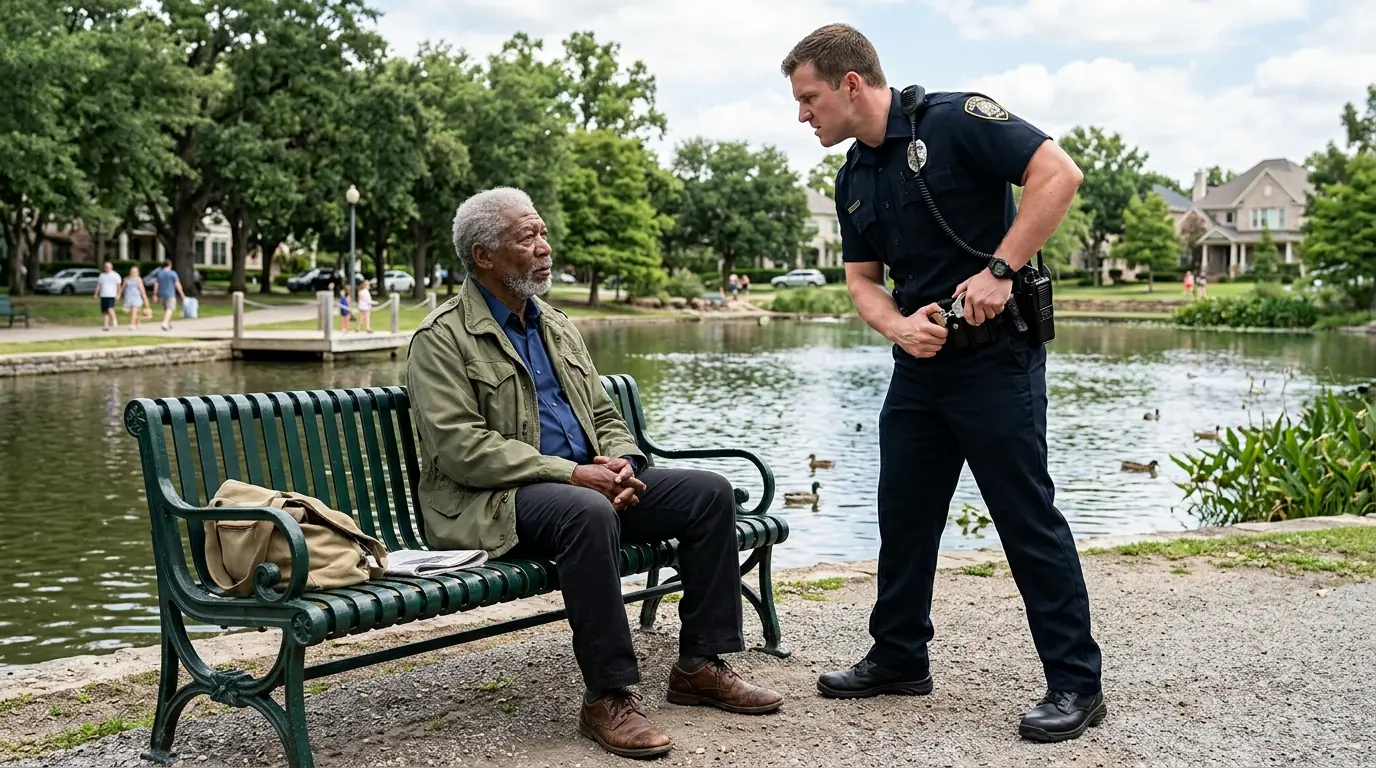
But, on a clear Tuesday morning in October, Kyle Vance walked into a situation that would strip him of that badge, humiliate his department, and cost the city's taxpayers $2.2 million. He was about to learn a lesson that experience should have already taught him. Respect isn't demanded, it's earned. And the man he was about to target had earned more respect in a single year of his youth than Vance would accumulate in a lifetime. Before we dive into this infuriating story, tell us in the comments, where are you watching from today?
If you believe that those who serve our country deserve better than to be harassed in the streets they fought to defend, please hit that subscribe button. We bring you these stories because accountability only happens when the truth is shared. The incident took place in Oakwood Park, a pristine stretch of green space in one of the city's most rapidly gentrifying neighborhoods. It was the kind of park where the grass was manicured weekly, the benches were freshly painted iron, and the morning air smelled of expensive espresso and jasmine. At 10:15 a.m., the sun was cutting through the autumn leaves, casting long golden shadows across the walking paths.
It was peaceful, quiet, a perfect morning for Elias Thorne. Elias was 74 years old. He was a man of routine and quiet dignity, wearing a faded olive drab field jacket that had seen better decades, a crisp button-down shirt, and polished leather shoes. He sat on a bench facing the duck pond, a position he claimed every Tuesday and Thursday when the weather held. Elias wasn't homeless, though the frayed cuffs of his jacket might have suggested a lack of vanity to the unobservant eye.
He was a retired postal worker with a pension, a homeowner who had lived in the city for 50 years, and more importantly, a man who carried shrapnel in his left shoulder from the siege of Khe San in 1968. He was a decorated Marine, a recipient of the Silver Star for gallantry in action, a man who had pulled three wounded brothers out of a rice paddy while taking enemy fire. But, to the untrained eye of a cynical observer, he was just an old black man sitting alone in a neighborhood that had become increasingly white and wealthy. Elias was simply breathing. He was watching the light dance on the water, perhaps remembering friends who never made it to 74, or perhaps just deciding what he would make for dinner.
He wasn't speaking to anyone. He wasn't soliciting money. He was existing. But, in Oakwood Park, existing while black and elderly was apparently enough to trigger the anxieties of the neighborhood's self-appointed guardians. And the guardian on duty that morning was Margaret "Meg" Sterling.
Meg Sterling was 52 years old, a real estate staging consultant who had moved to the Oakwood district three years earlier. She was the type of resident who attended every city council meeting to complain about neighborhood character and posted frequently on the community crime watch app about suspicious vehicles that usually turned out to be delivery drivers or contractors. Meg prided herself on being vigilant. She believed that the safety of her street depended entirely on her ability to spot things that didn't belong. And as she walked her purebred Weimaraner past the duck pond that Tuesday, her eyes locked onto Elias Thorne.
To Meg, Elias didn't fit the aesthetic of Oakwood Park. He wasn't wearing activewear. He wasn't pushing a stroller. He was sitting still wearing an old military coat that she interpreted not as a badge of service, but as a sign of vagrancy. She slowed her pace, watching him from behind her designer sunglasses.
Was he planning to accost a jogger? Her imagination, fueled by cable news and implicit bias, began to construct a narrative of danger. She walked past him once, clutching her dog's leash tighter, waiting for him to do something aggressive. Elias didn't even look at her. He remained lost in thought.
This lack of acknowledgement somehow annoyed her more. It felt like defiance. She walked another 50 yards, then stopped behind a large oak tree. She pulled out her phone. This is the moment where bias transforms into a weapon.
Meg didn't call the non-emergency line to ask for a welfare check. She dialed 911. 911, what is your emergency? Yes, I'm at Oakwood Park near the north entrance. There's a man here who is making people very uncomfortable. Meg said, her voice pitching up an octave to simulate distress.
Is he armed? Is he threatening anyone? The dispatcher asked. He's he's loitering. He's been sitting on that bench for over an hour watching the houses.
Meg lied. He looks like he might be mentally unstable or on drugs. He's wearing a dirty old army jacket and he's muttering to himself. I don't feel safe walking my dog. Ma'am, has he approached you?
No, but the way he's looking around, it's predatory. We have a lot of mothers with children in this park. Someone needs to come check him out before something happens. He clearly doesn't live here. That phrase, he clearly doesn't live here, was the cornerstone of Meg's worldview.
It was a boundary line drawn in her mind separating the entitled from the intruder. The call was logged as a suspicious person / potential loitering, and the dispatch went out to the nearest unit. Officer Kyle Vance was three blocks away, finishing a lukewarm coffee in his cruiser. When the call came over the radio, "Suspicious male subject refusing to leave, possibly intoxicated, Oakwood Park. " Vance perked up.
He had been bored all morning. A suspicious male sounded like an opportunity for action, an opportunity to exert the authority he felt was constantly being eroded by public scrutiny. He didn't hear a request to investigate. He heard a mandate to remove. Vance checked his computer terminal.
The caller had described an older black male in a military jacket. Vance scoffed. "Stolen valor or just a bum? " he muttered to himself. In his six years on the force, Vance had developed a reputation among his peers.
Some called him proactive, a euphemism for aggressive. Others, particularly the older sergeants who had survived decades of policing by talking people down rather than riling them up, called him a liability. Vance had 12 complaints on his file. Five for discourtesy, four for bias-based policing, and three for excessive use of force. All had been cleared or resulted in minor retraining, protected by the dense bureaucracy of the department and a union rep who was skilled at burying paperwork.
He turned on his lights, not the siren, just the lights to cut through the intersection. He was already writing the report in his head. "Subject was belligerent. Subject refused to comply. Subject was removed for public safety.
" He arrived at the park at 10:23 a.m., pulling his cruiser up onto the curb, a tactical parking job designed to intimidate. He stepped out, adjusting his utility belt, checking the fit of his sunglasses. He scanned the area and saw the target immediately. Elias Thorne hadn't moved. He was still watching the ducks enjoying the warmth of the sun on his face, oblivious to the fact that his peace was about to be shattered.
Vance began his approach, his hand resting habitually near his holster, his stride long and purposeful. He didn't see a grandfather. He didn't see a veteran. He saw a problem that needed to be solved. Do you think dispatchers should be trained to filter out bias-based calls before sending armed officers?
Let us know your thoughts in the comments below. Vance stopped 5 feet from the bench, blocking the sun. Elias sensed the shadow and looked up, shielding his eyes with a weathered hand. He saw the silhouette of the officer, the dark uniform, the glare of the badge. He didn't flinch.
He had stared down men who wanted to kill him in the jungles of Southeast Asia. A 29-year-old municipal police officer did not inspire fear in him. He inspired caution. Yes, Elias knew the reality of being a black man in America, but not fear. "Can I help you, officer?
" Elias asked, his voice gravelly and calm. "We've got reports of a suspicious individual disturbing the peace. " Vance said, his voice loud, projected for an audience that wasn't there. "That you. " Elias looked around the empty patch of grass.
"I haven't said a word to anyone, son. Just sitting here. " "Don't call me, son. " Vance snapped, stepping closer. "I'm Officer Vance, and the report says you've been loitering here for hours, casing the neighborhood.
" Elias chuckled softly, a dry sound. "Loitering? " "In a public park? I didn't know sitting was a crime in this city. I've been coming to this bench since before you were born.
" "Do you live in this neighborhood? " Vance demanded. "I live in the city. I pay my taxes. That makes this my park as much as anyone else's.
" "That's not what I asked. I asked for your address. Let me see some ID. " This was the pivot point. The moment where a good officer would have de-escalated, realized the absurdity of the complaint, and wished the man a good day.
But, Vance wasn't a good officer. He was a man who viewed a question as an insult. "I'm not showing you my ID. " Elias said, turning his gaze back to the pond. "I haven't committed a crime.
I'm not being detained. Unless you can tell me what statute I violated by sitting on a bench, I suggest you let me be. " Vance's face reddened. The refusal felt like a slap. "I am conducting an investigation.
When I ask for ID, you provide it. That's how this works. Now, stand up. " "I'm comfortable right here. " "I said, stand up.
" Vance's voice boomed across the park. A few people had stopped now. A woman pushing a stroller paused on the path about 30 yards away. A young man walking a golden retriever took the earbuds out of his ears. They sensed the tension.
The aggression was entirely one-sided. "Officer. " Elias said, his tone dropping, becoming serious. "I am a 74-year-old man. I am tired.
I am sitting. You have no probable cause to harass me. I suggest you go find some real criminals. " "Last warning. " Vance said, reaching for his handcuffs.
"Stand up and provide identification, or I will place you under arrest for obstruction and disorderly conduct. " "Obstruction of what? " Elias asked, genuinely baffled by the officer's ignorance of the law. "Obstruction of a sunny morning. " Vance lunged.
He didn't guide Elias up. He grabbed the lapel of the vintage field jacket and yanked. Elias let out a sharp gasp of pain, not from the movement, but from the torque on his left shoulder. The shoulder where a piece of North Vietnamese shrapnel had shattered the bone 50 years ago. "Watch the shoulder.
" Elias shouted, the first time he had raised his voice. "I have an injury. " "Stop resisting. " Vance yelled, the standard refrain used to justify escalation. He spun the elderly man around, forcing him chest first against the back of the bench.
"I'm not resisting. " Elias gritted out, his face pressed against the iron slats. "I'm telling you I have a disability. " The witnesses were moving closer now. The young man with the dog had his phone out.
"Hey. " he yelled. "He's an old man. What are you doing? " Vance ignored the bystander.
He wrenched Elias's arms behind his back. The shoulder joint popped audibly. Elias groaned, a sound of deep grinding pain. Vance slapped the handcuffs on, click, click, tightening them until they bit into the thin skin of Elias's wrists. "You're making a mistake.
" Elias whispered, breathless from the pain. "You are making a hell of a mistake. " "You should have thought of that before you decided to be a smart-ass. " Vance hissed in his ear. He hauled Elias up from the bench, roughly handling him like a sack of laundry.
"I served this country. " Elias said, trying to stand straight despite the handcuffs pulling his shoulders into an agonizing arch. "I wore a uniform with honor. You're disgracing yours. " "Yeah, sure, stolen valor.
I see the jacket. " Vance sneered. "Let's go. " He marched Elias across the grass toward the cruiser. Elias stumbled once, his balance unsteady, and Vance shoved him forward to keep him moving.
The young man filming the encounter shouted again. "Officer. What is his crime? He was just sitting there. I saw him.
" "Back off, or you're next. " Vance shouted over his shoulder, a threat that was captured clearly on the video recording that would soon be viewed by millions. Vance shoved Elias into the back of the patrol car. The hard plastic seat was unforgiving. Elias had to twist his body to accommodate his painful shoulder.
Vance slammed the door, the sound echoing like a gunshot in the quiet park. He walked around to the driver's side, feeling a surge of adrenaline. He had won. He had cleared the park. He had asserted dominance.
He had no idea that he had just arrested a man whose name was etched on a plaque in the very city hall where Vance received his paychecks. The ride to the precinct was short. Elias sat in silence, closing his eyes, practicing the breathing techniques he had learned decades ago to manage pain. He didn't plead. He didn't cry.
He waited. He knew how the system worked, and he knew that while the street belonged to the bully with the gun, the station belonged to the paperwork. And the paperwork was where the truth lived. Vance pulled into the sally port of the Fourth Precinct, humming to himself. He pulled Elias out of the car again with unnecessary roughness and guided him into the booking area.
The station was busy, phones ringing, officers typing reports. At the main desk sat Sergeant Thomas Miller. Miller was 58, a 30-year veteran of the force, and a former Army Ranger who had served in Panama and the Gulf. He was the kind of cop Vance hated, meticulous, fair, and utterly unimpressed by cowboy antics. Miller looked up as Vance dragged Elias toward the bench.
He saw the handcuffs. He saw the pained grimace on the older man's face. And then, he saw the jacket. Not just the jacket. He saw the patch on the shoulder.
The First Marine Division. And he saw the ring on Elias's finger, which Vance had missed or ignored. "Vance, what do you have? " Miller asked, his voice low. "Disorderly conduct, obstruction, failure to ID.
" Vance rattled off. "Refused to leave the park, caused a scene, resisted arrest. " Miller stood up. He looked at Elias. He looked past the frayed clothes and saw the posture.
The man was handcuffed in pain, but he stood with a spine of steel. "Sir. " Miller said to Elias, ignoring Vance. "Are you injured? " "My shoulder.
" Elias said quietly. "Old war wound. The officer didn't seem to care. " Miller's eyes narrowed. He looked at Vance.
"Uncuff him, now. " "Sarge, he's non-compliant. I haven't processed him yet. " "I said, take the damn cuffs off, Vance. " Miller roared, a sound that silenced the entire booking room.
Vance blinked, startled. He fumbled for his keys and unlocked the cuffs. Elias brought his arms forward slowly, wincing as the blood rushed back. He rubbed his wrists, which were red and abraded. "May I see your identification now, sir?
" Miller asked gently. "Just so we can clear this up. " Elias reached into his back pocket with a trembling hand and pulled out a worn leather wallet. He handed it to Miller. Miller opened it.
He saw the driver's license. And behind it, he saw the Department of Veterans Affairs ID card. And tucked in the fold, a laminated card that some older vets carried, a copy of their DD214 discharge papers, shrunk down. Miller read the text. Elias James Thorne, Sergeant, U.
S. Marine Corps, Silver Star, two Purple Hearts, Vietnam Service Medal. Miller looked up, his face draining of color. He looked at Elias with an expression of profound mortification. Then, he looked at Vance with eyes that could have welded steel.
"Vance. " Miller said, his voice trembling with suppressed rage. "Do you know who this is? " "Some vagrant who wouldn't listen. " Vance muttered, though he was beginning to sense the temperature in the room dropping.
"This vagrant. " Miller spat the word. "Is a Silver Star recipient. He is a decorated war hero. And you arrested him for sitting on a bench.
" "I. " "The caller said he was loitering. " Vance stammered. "Did you verify a crime? " Miller stepped out from behind the desk.
"Did you see him commit a crime, or did you just grab an elderly man and tear his shoulder out because you wanted to play tough guy? " "He refused ID. " "It is not a crime to sit in a park, you idiot. " Miller yelled. He turned to Elias.
"Mr. Thorne, on behalf of this department, I am ashamed. I am deeply, deeply sorry. We are going to get you medical attention immediately. " "I don't need a medic. " Elias said, his voice steady.
"I need to know why I was treated like an insurgent in my own city. " "You have every right to ask that. " Miller said. He pointed at Vance. "Badge, gun on the desk.
Now. " "Sarge, come on for a disorderly. " "You just committed assault and false imprisonment under color of authority on a protected veteran. You violated about 12 department policies and federal civil rights law. Put the gun on the desk before I take it off you myself.
" Vance's arrogance evaporated. He looked around the room. Other officers were staring at him, shaking their heads. The blue wall of silence does not protect you when you abuse a legend. Slowly, hands shaking, Vance unholstered his weapon and placed it on the counter.
Should police departments have a mandatory zero-tolerance policy for officers who escalate non-violent situations? Drop a yes or no in the comments. Elias was released without charges within 10 minutes. The captain of the precinct came down personally to apologize, offering to drive Elias home. Elias declined.
"I'll take a taxi. " he said. "I've been in enough police cars for one day. " But the story didn't end there. The young man with the dog, a freelance web developer named Josh, had uploaded the video to Twitter and TikTok before Vance's cruiser had even reached the station.
The caption read, "Racist cop arrests elderly black veteran for sitting on a bench. " "Watch him ignore the man's cry about his injury. " By 5:00 p.m., the video had 2 million views. By the next morning, it was on national news. The visual was impossible to defend a young white officer aggressively manhandling a calm elderly black man while bystanders pleaded for him to stop.
The internet sleuths went to work. They identified Kyle Vance within hours. They dug up his previous complaints. They found photos of him wearing Punisher skull patches on his tactical gear, further cementing the image of a rogue cop. But they didn't stop at Vance.
They wanted the caller. The 911 call was released three days later under a Freedom of Information Act request filed by a local civil rights attorney. Meg Sterling's frantic, exaggerated voice played across every news station in the state. "He doesn't live here. " she had said.
The internet quickly found out that not only did Elias live in the city, but he had lived there 20 years longer than Meg. He had been delivering mail to those very houses when they were still middle-class family homes, long before they were flipped into million-dollar estates. The backlash against Meg was swift and severe. Her real estate firm fired her within 48 hours to distance themselves from the PR disaster. She was removed from the neighborhood HOA board.
Neighbors who had previously nodded at her in the street now turned away. She had weaponized the police against an innocent man, and the recoil had knocked her flat. Officer Kyle Vance was placed on administrative leave, but the video was too damning for the usual union delay tactics to work. The internal affairs investigation was concluded in record time. The reasonableness standard that often protects officers failed Vance because there was no reasonable suspicion of a crime.
He had manufactured the conflict. Three weeks after the arrest, Kyle Vance was terminated for cause. The chief of police announced that Vance's certification would be revoked, preventing him from ever working as a police officer in the state again. At 29, his career was over, buried under the weight of his own hubris. But justice for Elias Thorne required more than a firing.
It required acknowledgement of the harm done. Prominent civil rights attorney David Freeman took Elias's case. The lawsuit filed against the city and Officer Vance was scathing. It alleged Fourth Amendment violations, excessive force, assault, battery, and false arrest. It cited the long-term damage to Elias's shoulder, which required surgery to repair the rotator cuff Vance had reinjured.
It cited the emotional distress of a man who had survived war only to be humiliated in peace. The city's lawyers took one look at the deposition tape of Elias Thorne, calm, articulate, heartbreakingly honest, and knew they couldn't go to trial. A jury would destroy them. They would look at this grandfather, this hero, and they would empty the city's coffers to apologize to him. Ten months after the incident, the city settled for $2.2 million.
It was one of the largest individual settlements for a non-fatal police misconduct case in the city's history. Elias Thorne didn't buy a new house. He didn't buy a fancy car. He used a portion of the money to fix the roof of the home he'd lived in for 40 years. He donated a significant sum to a legal defense fund for veterans who had been mistreated by law enforcement.
And he set up a scholarship fund for students from his neighborhood. Six months after the settlement on a warm Tuesday in April, Elias Thorne put on his field jacket. It had been dry-cleaned and repaired. He walked slowly to Oakwood Park. The bench was there.
The ducks were there. He sat down. A patrol car drove by slowly. The officer inside, a young woman, slowed down. She looked at Elias.
She nodded respectfully. Elias nodded back. He sat there for an hour, reclaiming the peace that had been stolen from him. This story isn't just about a bad cop or a nervous neighbor. It's about the assumptions we make.
It's about who we think belongs in our spaces. Kyle Vance and Meg Sterling looked at Elias Thorne and saw a threat because they couldn't imagine that an old black man in a military coat was the most honorable person in that zip code. They saw his skin and his age and assumed he was less than. The $2.2 million settlement is accountability, yes. But the real tragedy is that it took a viral video and a lawsuit to prove that Elias Thorne had the right to sit on a bench.
We have to ask ourselves how many Elias Thornes are out there who didn't have a witness with a camera? How many veterans are treated like criminals in the country they served?