Step away from him. Hands up. Drop the weapon. Officer, listen. That's his gun, not mine.
He pulled it on a cashier. I took it from him and pushed him down. Get your hand off that gun and back away. It's in my waistband. Secure it.
I just don't want him grabbing it. I'm not trying. Police officer Scott Harland responded to an armed robbery at Riverside Mall and immediately drew his weapon when he saw Anthony Walker, a man, pinning a man to the ground with a gun visible in his waistband, ignoring the terrified customers who screamed that Walker had just disarmed the armed robber and saved everyone's lives. Harland ordered Walker to release the suspect. And when multiple witnesses shouted that Walker was the hero who stopped the robbery, Harland shut them all down and arrested Walker anyway, believing the white robbers lie that Walker was actually the criminal, then let the real armed robber walk free without checking a single piece of security footage.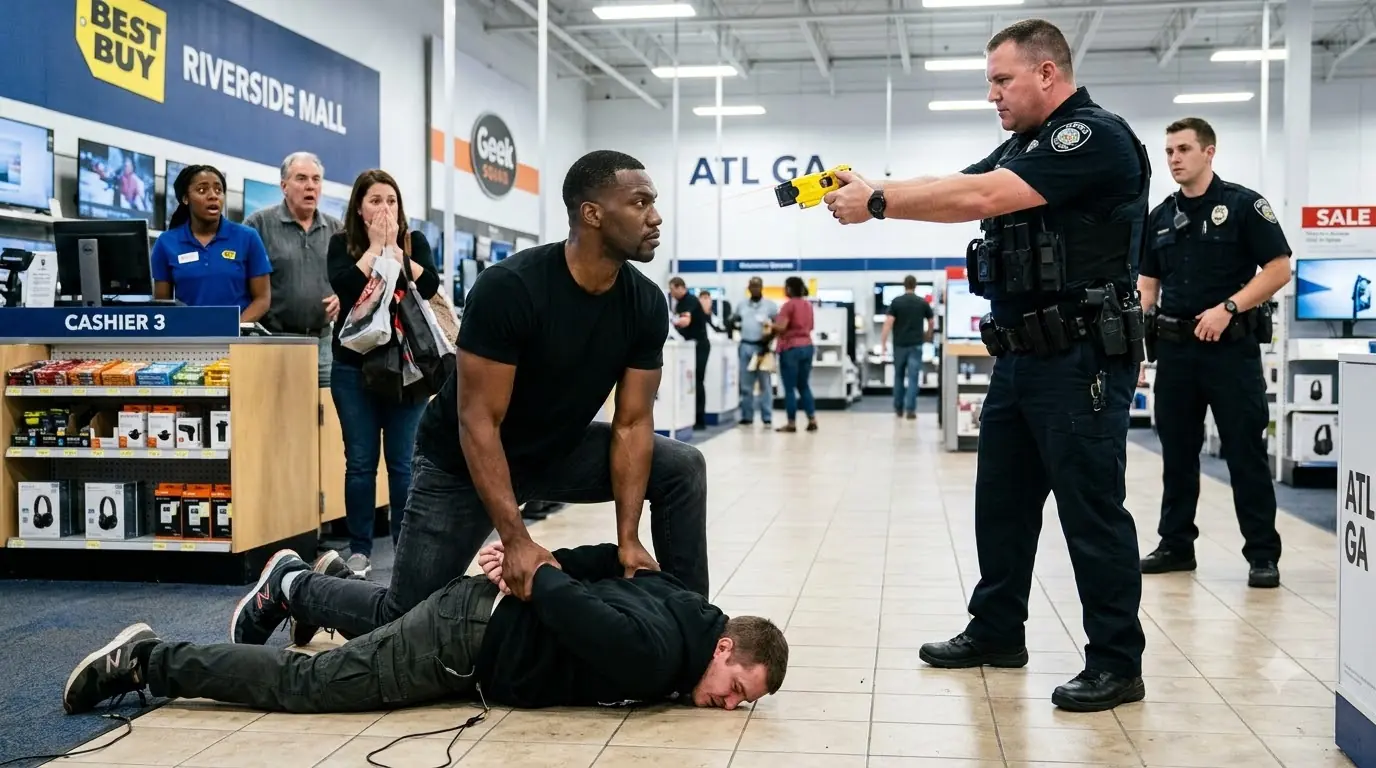
Despite his junior partner, Officer Thomas Grant begging him to verify the facts first. Walker, an active duty Delta Force operator, spent six hours in a holding cell protesting his innocence while the dangerous criminal he'd risked his life to stop walked the streets as a free man. All because Officer Harland's racism made it impossible for him to imagine a man being the hero and a man being the criminal. What Harland didn't know is that Anthony Walker was one of the military's most elite and decorated special operators whose commanding officer would see the viral video of his wrongful arrest within hours. Before we go further, what city or country are you watching from?
Drop it in the comments. We love seeing where you're tuning in from. If you believe stopping an armed robbery while blacks shouldn't get you arrested, then like this video and subscribe. Anthony Walker pulled into the parking lot of Riverside Mall at exactly 2:15 on a Tuesday afternoon with one simple goal. Get in, grab a birthday gift for his younger sister, maybe pick up a phone charger since his was fraying at the cable, and get out within 20 minutes.
At 34 years old, Walker had spent the last 12 years serving his country as a Delta Force operator, completing classified missions in some of the most dangerous places on Earth, earning commendations and medals that would never be publicly displayed because the operations themselves were too sensitive to acknowledge. He was on 2 weeks of leave after returning from an assignment overseas that he couldn't discuss with anyone outside his unit, and he'd promised his sister he'd be at her birthday dinner that evening with a gift in hand. Walker walked through the mall entrance wearing civilian clothes, dark jeans, a plain black t-shirt, and running shoes, looking like any other shopper enjoying a quiet Tuesday. He checked his phone as he walked, scrolling through a text from his sister, reminding him she wanted noise-canceling headphones, the expensive kind she'd been hinting about for months. Walker smiled and headed toward the electronic store near the center of the mall, completely unaware that in less than 5 minutes his life would be turned upside down.
The electronic store was moderately busy with about eight customers browsing through aisles of phones, tablets, and accessories. Walker walked toward the headphone display at the back of the store, scanning the brands, and price tags. He was comparing two different models when he heard a voice shout from the front of the store. Everyone, get on the ground now. This is a robbery.
Walker's head snapped up and his Delta Force training kicked in instantly. A male in his early 30s, wearing a black hoodie and a mask covering the lower half of his face, stood near the cash register, pointing a semi-automatic handgun at the young cashier. A woman who looked barely 20 years old and was frozen in terror. The other customers in the store immediately dropped to the floor, some screaming, others silent with fear. Walker dropped into a crouch behind a display shelf, his mind already processing the tactical situation with the speed and precision that had kept him alive through dozens of combat operations.
He assessed the threat in seconds. The robber's stance was amateur, feet too close together, no proper shooting platform. The gun was held at an awkward angle, finger on the trigger, but the grip was wrong. The man's hands were shaking. His head kept swiveling around to check the store, which meant he was nervous and inexperienced.
This wasn't a professional. This was someone desperate and dangerous, but untrained, which in some ways made him more unpredictable. Open the register," the robber screamed at the cashier, his voice cracking with adrenaline. "Put all the cash in a bag. Do it now or I'll shoot you. " The cashier's hands trembled at as she fumbled with the register, hitting the wrong buttons twice before it finally opened with a mechanical ding.
Walker began moving. He stayed low, using the display shelves as cover, closing the distance between himself and the robber, step by silent step. His years of training in close quarters combat and hostage rescue scenarios made this almost a routine. Assess the threat, identify the moment of opportunity, execute with precision. He moved between aisles, his footsteps silent on the tile floor, keeping displays between himself and the robber's line of sight.
The robber was completely focused on the cashier and the money, which was exactly what Walker needed. The young woman finished filling the bag and held it out with both hands, tears streaming down her face. The robber reached for the bag with his left hand while his right hand held the gun. And in that critical moment, he lowered the weapon slightly, his attention divided between the money and maintaining control of the firearm. Walker moved like lightning.
He covered the final 12 ft in less than two seconds. His hand shooting out to grab the robber's gun wrist with iron grip strength honed by years of military training. Walker twisted the wrist hard and fast, a professional disarming technique that forced the robber's finger off the trigger and rotated the barrel away from anyone in the store. The robber let out a shocked cry as Walker simultaneously swept his legs out from under him with a perfectly executed takedown, driving the man face first into the floor with controlled violence. The gun clattered across the tile.
Walker kept his knee planted firmly in the robber's back, wrenching both of the man's arms behind him in a control hold that made escape impossible. The entire sequence from Walker's first movement to the robber being pinned on the ground took less than 4 seconds. It was textbook Delta Force close quarters combat. It was executed with the precision of someone who had done this hundreds of times in training and real operations. Walker reached over and grabbed the fallen gun, immediately engaging the safety with practice muscle memory before tucking it into his waistband at the small of his back, keeping it secure and away from the suspect.
The robber struggled beneath him, but Walker's weight and positioning made resistance futile. "Someone call the police! " Walker shouted, not knowing that the woman near the entrance had already made that call almost 2 minutes ago when the robbery first started. They're already on the way, the woman called back, her phone still pressed to her ear. The other customers slowly began to rise from the floor, their faces showing a mixture of shock, relief, and awe. The cashier leaned against the counter, breathing hard, her hands still shaking.
A teenage girl near the display of phone cases had her phone out and was recording everything, her fingers steady despite the adrenaline. She was a social media influencer with over 400,000 followers, and she'd just witnessed something incredible. Walker kept the robber pinned and waited. In his Delta Force career, he detained high-value targets in foreign countries, secured hostile combatants under fire, and completed mission objectives that would never be publicly acknowledged. Holding down an amateur armed robber in a shopping mall while waiting for local police should have been the easiest thing he'd done all year.
Less than 3 minutes later, the sound of heavy footsteps approaching from the mall corridor outside the store. Two police officers burst through the entrance with their weapons drawn. Officer Scott Harland in front, a man in his early 40s with 15 years on the force. And right behind him, Officer Thomas Grant, a younger officer in his late 20s with only three years of experience who looked to Harland for guidance on every call. Harland's eyes swept the scene and locked onto the image in front of him.
A man in civilian clothes pinning a man to the ground and a gun clearly visible tucked into the man's waistband. Harland's brain processed this through the filter of 15 years of ingrained bias and prejudice, and his conclusion was immediate and certain. "Step away from him," Harland shouted, his service weapon aimed directly at Walker. "Drop the weapon. Get your hands where I can see them now. " Walker looked up at the officer, still maintaining his control hold on the robber beneath him.
Officer, this man just attempted to rob this store at gunpoint. I disarmed him and I'm holding him for you. The weapon in my waistband is his gun. I secured it after taking him down. Before Walker could say another word, the customers erupted in a chorus of voices.
He saved us, the cashier screamed. That man stopped the robbery. Another customer shouted. "The white guy is the criminal. " Someone else yelled. "He's the hero," the teenage influencer called out, still recording everything on her phone.
Harland's face twisted with irritation. Everyone, shut up. I'll handle this. Grant stood behind Harland, his weapon also drawn, but his expression uncertain as he looked at the terrified faces of the customers, all telling the same story. "Sir, maybe we should listen to what they're I said I'll handle it. " Harland snapped at his partner.
Walker kept his voice calm and professional. "Officer, I understand this looks confusing, but I'm telling you the facts. This man," he pressed down slightly on the robber's back, walked into the store, pulled a gun, and demanded money from the cashier. I'm a trained professional. I disarmed him and restrained him.
The gun you see in my waistband is the weapon I took from him. I put it on safety and secured it. I'm not a threat. Ask any of these witnesses. The customers immediately started talking over each other again.
All saying variations of the same thing. Walker was the hero. The man was the robber. Walker had saved their lives. I told everyone to be quiet.
Harland roared, his weapon still pointed at Walker. Now I'm going to give you one chance. reach behind you very slowly. Take that gun out with two fingers and place it on the ground in front of you. Then I want you to release that man and put your hands on your head. " Walker took a slow breath, recognizing that this officer wasn't listening to reason or evidence. He carefully reached behind his back, pulled the gun out using just his thumb and index finger on the grip, and set it on the floor.
Then he slowly slid it away from himself across the tile. Grant immediately moved forward and secured the weapon while Harland kept his gun trained on Walker. Now release him and put your hands on your head, Harland ordered. Walker released his grip on the robber and raised his hand, placing them on top of his head. The moment Walker's weight lifted, the robber, whose name was Ryan Caldwell, though Walker didn't know it yet, scrambled to his feet, seeing an opportunity in the confusion.
Harland moved in fast, grabbing the Walker's arm and forcing him to turn around. Grant holstered the secured weapon and moved to help Harland, though his face showed clear uncertainty about what they were doing. Harland wrenched Walker's arms down behind his back and slapped handcuffs on his wrists with unnecessary force. "You're under arrest," Harland said. "For what? " Walker demanded, his voice still controlled, but edged with anger.
"I stopped a robbery. Ask these people. Ask the cashier. " The cashier stepped forward, tears still on her face. "Officers, please, you have to listen. That man saved my life.
The white guy in the hoodie is the one who tried to rob us. He had the gun. This man disarmed him and held him down until you got here. Multiple other customers shouted their agreement, all trying to tell the same story, but Harland wasn't listening to any of them. He saw what his racist mind told him to see.
A man with a gun, a victim, and confused witnesses who didn't understand what they'd actually witnessed. Ryan Caldwell, the actual armed robber, stood near the counter and realized with growing excitement that these police officers thought Walker was the criminal. His mind raced and he made a split-second decision to play into their assumptions. Officers, "Thank God you're here," Caldwell said, his voice shaking with false emotion. "That man tried to rob the store.
He had a gun. I tried to stop him, but he overpowered me. That's why he had me on the ground. " Walker's head snapped toward Caldwell in disbelief. "That's a lie. You're the robber.
You held this entire store at gunpoint. " Grant looked between Walker and Caldwell, then at the customers who were all shouting that Walker was telling the truth. "Sir. " Grant said to Harland quietly. Maybe we should check the security cameras before we we don't need cameras. Harland cut him off. I can see exactly what happened here.
Caldwell pressed his advantage, stepping closer to the officers and lowering his voice like he was sharing a confidence. Officers, I think some of these people might be working with him. That's why they're backing up his story. I saw some of them leave right after you arrived. They ran out scared.
I think they were his accomplices. That was all Harland needed to hear. His jaw set with certainty and he tightened his grip on Walker's arm. Everyone needs to leave the store right now or you'll all be arrested as potential accessories. The customers erupted in protest.
This is insane. You're arresting the wrong man. Check the cameras. He's a hero. Harland started shouting over them.
Leave now. This is a crime scene. If you don't exit immediately, you'll be detained. The teenage influencer kept her phone up, still recording as customers were forced toward the exit. This is wrong, she shouted.
You're letting the criminal go. Put that phone down or you're next. Harland barked at her. She lowered the phone but kept recording from her hip as she was pushed out of the store with the other customers. Within 2 minutes, the store was empty except for Harland, Grant, Walker in handcuffs, and Ryan Caldwell, the armed robber, who couldn't believe his incredible luck.
Caldwell kept playing his role. Officers, thank you for catching him. Can I go now? He hurt my arm when he attacked me. I need to get it checked out.
Grant looked at his superior officer with barely concealed disbelief. Sir, we need to verify his story first. We should review the security footage. We should take statements from the witnesses. The cashier seemed very certain that Harland's face flushed with anger at being questioned by his junior partner.
Officer Grant, I've been doing this job for 15 years. I know what I'm seeing. man with a gun, victim trying to stop a crime. The witnesses were scared and confused. This man, he shook Walker roughly, is the criminal. This man, he gestured to Caldwell, tried to be a hero and got hurt for his trouble.
But sir, Grant tried again. That's enough, Harland snapped. You want to question my judgment? You've been on the force 3 years. I've seen hundreds of these situations.
Trust me, the footage will show exactly what I already know. Walker's voice cut through the tension hard and cold. You're making the biggest mistake of your career. That man is a dangerous criminal. I'm active duty military.
Check my ID. Call my command. And for God's sake, check the security cameras before you let him walk out of here. Harland ignored him completely and turned to Caldwell. Sir, you're free to go.
We'll need a statement from you later. Here's my card. Caldwell took the card with hands that had been shaking with fear 10 minutes ago when he was robbing the store, but were now steady with relief and disbelief. He'd been caught red-handed by someone who clearly knew what they were doing, and now the police were letting him walk away free. He headed toward the exit before they could change their minds.
Grant made one last attempt. Sir, please just let me pull up the security footage. It'll take 2 minutes. We can verify everything before anyone leaves. Harland turned on his partner with barely controlled fury.
Officer Grant, if you question my authority one more time on this call, you'll be writing parking tickets for the next year. Do you understand me? Grant's mouth closed. He was three years into his career and still probationary in many ways, going against a 15-year veteran, could end his future on the force. He said nothing.
Ryan Caldwell, wanted for six armed robberies across three counties over the past 4 months, a violent criminal who had terrorized dozens of victims, walked out of Riverside Mall, a free man, because officer Scott Harland's racism was stronger than his duty to verify the facts. Harland dragged Walker toward the exit. Let's go. You're being booked for armed robbery, assault, and anything else I can think of. Walker was forced into the back of the patrol car and driven to the police station.
He demanded to speak to a supervisor. He demanded to call his commanding officer. He told them he was Delta Force. He told them to check the mall security footage. Nobody listened.
They processed him like any other criminal, took his belongings, photographed him, fingerprinted him, and threw him into a holding cell. Walker sat on the metal bench and watched the door lock behind him, knowing that somewhere Ryan Caldwell was free and likely planning his next robbery. Meanwhile, the teenage influencer who had recorded everything sat in her car in the mall parking lot and uploaded the video to her social media accounts. The caption read, "Cops arrest hero who stopped armed robbery and let criminal go free. This man saved our lives and they handcuffed him.
Share this everywhere. Hash. Justice for a hero. Ash Riverside Mall. The video started spreading immediately.
Within 30 minutes, the mall's official social media team saw it trending and checked their own security footage. What they saw made them sick. They downloaded the full video showing Anthony Walker heroically disarming the robber and posted it as a comment under the influencers video with the caption, "Security footage from our cameras. This man is a hero. The police arrested the wrong person. " Within 3 hours, the combined videos had 5 million views.
Within 6 hours, they reached the desk of a colonel in Delta Force command, who recognized Master Sergeant Anthony Walker immediately and picked up his phone with a face like thunder. Officer Scott Harland's career in freedom had just begun their countdown to zero. Anthony Walker sat in holding cell number 12 at the city police station, staring at the concrete walls that had become his world for the past 4 hours. He had asked to speak to a supervisor seven times. He had demanded to call his commanding officer nine times.
He had told every guard who passed by that he was active duty Delta Force and they were holding the wrong man. Each time the response was the same, either complete silence or a dismissive laugh, followed by, "Sure you are, buddy. " One guard had stopped at his cell door around hour three and smirked at him. "Military, huh? What are you, a Navy Seal, too? Maybe a superhero? " The guard walked away laughing while Walker sat there knowing that Ryan Caldwell, the actual armed robber, was somewhere out there free to hurt more people because a racist cop couldn't imagine a man being the hero.
At the mall, the teenage influencer whose name was Jessica Martinez sat in the food court with her phone blowing up with notifications. The video she'd posted of Walker being arrested while customers screamed that he was innocent had reached 2 million views in just 2 hours. The comment section was on fire with outrage. People were tagging news stations, civil rights organizations, and local politicians demanding answers about why a hero was arrested while the criminal walked free. Then the Riverside Mall official account posted their comment with the security footage, and everything exploded.
The crystal-clear surveillance video showed the entire incident from multiple angles. Ryan Caldwell entering the store, pulling the gun, threatening the cashier, and then Anthony Walker moving with professional precision to disarm him and take him down in a textbook special forces maneuver. The footage showed Walker securing the weapon and holding Caldwell safely until police arrived. Then it showed officers Harland and Grant entering. Harland immediately pointing his gun at Walker and the chaotic arrest that followed while customers frantically tried to explain their truth.
Jessica's phone rang. It was a producer from a national news network asking if they could interview her and use her footage. She said yes immediately and told them everything she'd witnessed. Within the hour, three major news stations were running the story with headlines like, "Hero arrested after stopping armed robbery and police let criminal go free, arrest man who saved lives. " The video reached social media platforms across the country. People shared it with outrage and disbelief.
The hashtagfree Anthony Walker started trending even though most people didn't know his name yet. The early posts simply called him #MallHero. Civil rights attorneys were already calling the police station demanding information. Local activists were organizing outside the station with signs, but the video also reached someone else. At exactly 6 hours and 14 minutes after Walker's arrest, a colonel whose name and face were classified for national security reasons sat in his office at Fort Bragg reviewing deployment schedules when an aid knocked on his door.
"Sir, you need to see this immediately," the aid said, handing him a tablet. "It's Master Sergeant Walker. " The colonel took the tablet and watched the mall security footage showing Walker disarming the robber with the kind of professional efficiency that only came from years of elite special operations training. Then he watched the cell phone video showing Walker being arrested while witnesses screamed the truth that the officers refused to hear. The colonel's jaw clenched tighter with each passing second. "How long has he been detained? " the colonel asked, his voice dangerously quiet.
"Approximately 6 hours, sir. We just confirmed his location at the city police station on 4th Street. The colonel set down the tablet and picked up his secure phone. He dialed a number that connected him directly to the police chief's personal cell phone, a number that most people didn't even know existed. The phone rang twice before police chief Robert Morrison answered.
"This is Chief Morrison. " "Chief Morrison, this is Colonel Hayes from United States Special Operations Command," the Colonel said, his voice carrying the weight of absolute authority. You are currently holding one of my operators, Master Sergeant Anthony Walker. He was wrongfully arrested approximately 6 hours ago after stopping an armed robbery at Riverside Mall. You will release him immediately and have him standing outside your station within 30 minutes, or you will be dealing with the Department of Defense, the FBI, the Justice Department, and a media crisis that will end your career and destroy your department's reputation. Do I make myself perfectly clear?
Chief Morrison's blood went cold. He'd been home having dinner with his family when his phone rang. And now he was hearing that his department had arrested a Delta Force operator. "Sir, I wasn't aware of the situation. Let me look into You have 30 minutes," the colonel interrupted.
"And Chief Morrison, the criminal your officer released is named Ryan Caldwell. He's wanted for six armed robberies across three counties. Your officer let a dangerous felon walk free while arresting a decorated war hero. I suggest you start figuring out how to fix this disaster. " The colonel hung up. Chief Morrison immediately called the station and within seconds the entire building erupted into controlled chaos.
The desk sergeant pulled Walker's arrest record and found exactly what the colonel had described. He watched the mall security footage that was now public and felt his stomach drop. They had arrested a hero and released a wanted criminal and it was all on video with millions of views. The shift commander ran to the holding cells. Release Anthony Walker immediately.
Get him out now. Walker was brought out of his cell and the shift commander stood in front of him looking pale and shaken. Master Sergeant Walker, there has been a terrible mistake. You're being released immediately. On behalf of the department, I apologize for this error.
Walker's face was stone cold. An error? Your officer arrested me for stopping a robbery. He ignored eight witnesses. He believed the criminal's lie without checking a single fact.
He let a dangerous man walk free. and you held me in that cell for 6 hours while I told you repeatedly that you had the wrong man. Walker's voice dropped to something hard and final. This wasn't an error. This was racism and someone is going to pay for it. The shift commander had no response because he knew Walker was absolutely right.
They returned Walker's belongings, his wallet, his phone, his keys. His phone showed 63 missed calls and over 200 text messages. Several were from his Delta Force command. Many were from news organizations. Some were from his family who had seen the viral video and were terrified.
Chief Morrison arrived at the station 28 minutes after the colonel's call. He found Walker standing in the lobby, no longer in handcuffs, but his face showed the exhaustion and anger of a man who had been treated like a criminal for doing the right thing. Master Sergeant Walker, I'm Chief Morrison. I cannot express how deeply sorry I am for what happened to you today. This department failed you in the worst possible way.
Walker looked at the chief with eyes that had seen combat and violence and injustice around the world, but had never expected to experience it in his own country after saving American lives. Where is officer Harland? He's been suspended pending investigation. We're initiating termination proceedings. And the robber he let go free.
Morrison's face tightened. We have units searching for Ryan Caldwell now. We've issued a warrant for his arrest. 6 hours too late, Walker said quietly. He could be three counties away by now.
He could have hurt someone else. All because your officer saw a man and decided I must be the criminal. Morrison had no defense because there was no defense. Master Sergeant Walker, we will cooperate fully with any legal action you choose to pursue. You deserve justice.
Walker pulled out his phone and made a call. This is Master Sergeant Anthony Walker. I need to speak with Sarah Chen. He waited a moment. Miss Chen, I need a civil rights attorney.
I was just arrested for stopping an armed robbery while the police let the actual criminal go free. Yes, it's all on video. Millions of views already. I'm filing a federal lawsuit and I want to make sure this never happens to anyone else. He hung up and looked at Chief Morrison.
You'll be hearing from my attorney and from the Department of Defense and from every news organization in the country. What happened today doesn't end with an apology. Walker walked out of the police station into a crowd of reporters and cameras and protesters holding signs that read, "Justice for the hero and arrest the right man. " He was free, but his fight for accountability was just beginning. Officer Scott Harland sat in his living room watching the news coverage of his own racist mistake go viral with 40 million views and climbing. Realizing his entire life was about to collapse around him, Sarah Chen took Anthony Walker's case within two hours of his release and immediately filed a federal civil rights lawsuit seeking $18.3 million in damages.
She also did something that would prove devastating for officer Scott Harland. She subpoenaed his entire 15-year career record, and what she found made her blood boil. Harland had 17 excessive force complaints filed against him over his career. 14 of those complaints came from black or Hispanic suspects. He had 16 wrongful arrest complaints in his file.
13 were filed by minorities. Every single complaint had been dismissed or resulted in nothing more than a written warning that went into his file and was promptly ignored. The pattern was undeniable and had been documented for over a decade, but nobody in the department had ever taken action to stop him. Chen also discovered something worse. She pulled records of every arrest Harland had made over the past 5 years and found that 42% of his arrests of black suspects were later dismissed due to lack of evidence or procedural errors.
The number for white suspects was 11%. Harland had been systematically targeting minorities, making bad arrests, and the department had let it continue year after year. But the most damaging evidence came from the mall security footage combined with the body camera footage from both officers. The mall cameras showed everything in perfect clarity. Walker's professional disarming technique, his careful securing of the weapon, his calm waiting for police, and then Harland's immediate assumption that the man must be the criminal despite eight witnesses screaming the opposite.
The body camera footage from officer Thomas Grant's chest camera showed something even more revealing. Grant's camera had captured the audio of him begging Harland multiple times to check the security footage before making any arrests. The audio clearly recorded Grant saying, "Sir, we should verify the facts first. " And, "Sir, please, we need to check the cameras. " And, "Sir, all the witnesses are saying the same thing. " And it captured Harland's responses. Dismissive, angry, absolutely certain in his racist assumptions. The breaking point came when Chen obtained Ryan Caldwell's criminal record.
Caldwell wasn't just a random robber. He was wanted for six armed robberies across three counties over 4 months. He had a violent history going back 12 years. Police had been searching for him for months. His photograph had been circulated to every police department in the region.
And officer Scott Harland, who should have recognized him from the wanted bulletins, had looked directly at a wanted violent felon and let him walk free because Harland's racism wouldn't allow him to believe a man could be innocent. 3 days after Walker's release, Ryan Caldwell was finally captured after attempting another armed robbery at a convenience store 15 mi away. During that robbery, he shot the store clerk in the shoulder when the man moved too slowly, opening the register. The clerk survived, but he would carry that bullet wound and the trauma for the rest of his life. Chen made sure that fact was included in Walker's lawsuit.
Officer Harland's racist decision to free Caldwell directly led to another violent crime and another victim. The state attorney general reviewed all the evidence and announced that criminal charges would be filed against officer Scott Harland. The charges were serious. false arrest, official misconduct, obstruction of justice for failing to review available evidence, and aiding in abetting a fugitive for releasing a wanted criminal. Combined, Harland faced up to 25 years in prison. Anthony Walker's full military record was declassified enough for public release, and what the media discovered made Harland's actions even more unforgivable.
Walker wasn't just any Delta Force operator. He was one of the most decorated active duty special forces soldiers in the United States military. 12 years of service, three combat deployments to Afghanistan, two to Iraq, and multiple classified operations that would never be fully disclosed to the public. Walker had earned the silver star for valor after he single-handedly held off an enemy attack while evacuating wounded soldiers under fire. He had two bronze stars for heroic achievement in combat operations.
He had the Purple Heart after being wounded by an IED blast that killed two of his teammates. He had personally trained Allied forces in counterterrorism tactics in seven different countries. The Department of Defense considered him a national strategic asset. One of the elite warriors who operated in the shadows keeping the country safe. This was the man officer Scott Harland had thrown in a cell like a common criminal because his skin color didn't match Harland's mental image of what a hero should look like.
Chen arranged a press conference and Anthony Walker appeared in his military dress, uniform with 12 years of ribbons and medals displayed on his chest. The room fell silent as he stepped up to the microphone, his bearing showing every bit of the discipline and professionalism that had made him an elite warrior. "My name is Master Sergeant Anthony Walker, United States Army Delta Force," he began, his voice steady and clear. "On Tuesday afternoon, I stopped an armed robbery at Riverside Mall. I used my military training to disarm a dangerous criminal and protect innocent lives.
I held that criminal and waited for police to arrive so he could be arrested and prosecuted. Instead, I was arrested. The criminal was released, and for 6 hours, I sat in a cell while officer Scott Harland's racism was valued more than the truth. Walker paused and let that sink in. Eight witnesses told officer Harland I was the hero.
The cashier whose life I saved begged him to listen. His own partner asked him to check the security cameras. Officer Harland ignored all of it because when he looked at me, he didn't see a soldier who has served his country for 12 years. He didn't see a man who stopped the violent crime. He saw a man.
And in his mind, that automatically made me the criminal. The reporters were silent. Cameras recording every word. Officer Harland's racism didn't just hurt me. It freed Ryan Caldwell, a wanted violent criminal.
3 days after Harland let him walk out of that mall, Caldwell shot an innocent store clerk during another robbery. That man is alive, but he will carry that bullet wound forever. That happened because Officer Harland's prejudice was stronger than his duty to verify the facts. Walker's voice hardened into something cold and final. I have fought enemies overseas.
I have been shot at, blown up, and wounded in service to this country. I never expected that when I came home and saved American lives, I would be treated like a criminal by the very people who were supposed to serve and protect. Officer Harland saw my skin color and his racism, made every decision after that. He will answer for it in criminal court. He will answer for it in civil court.
And he will answer for it by spending the next 20 years of his life in a prison cell thinking about the hero he arrested and the criminal he freed. Walker stepped away from the microphone and the room erupted in questions, but he didn't answer any of them. He'd said everything that needed to be said. His attorney would handle the rest. Officer Scott Harland watched the press conference from his living room where he'd been suspended without pay, knowing that his career was over.
His freedom was about to end, and his name would forever be associated with one of the most clear-cut cases of racist policing ever caught on camera. The trial would prove Walker right about everything. But first, the consequences would have to unfold in their devastating entirety. Officer Scott Harland's criminal trial began 4 months after Anthony Walker's wrongful arrest and lasted 3 weeks. The prosecution presented overwhelming evidence.
The mall security footage showing Walker's heroic actions in crystal-clear detail. Body camera audio of officer Thomas Grant begging Harland to check the facts before making arrests. Testimony from all eight witnesses who had screamed that Walker was innocent, and Harland's 15-year history of complaints, showing a clear pattern of racial bias that the department had ignored. The defense tried to argue that Harland had made a split-second judgment call in a high pressure situation and simply made an honest mistake. But the prosecution destroyed that argument by playing the body camera audio where Grant had given Harland multiple opportunities to verify the truth and Harland had refused every single time, stating clearly that his mind was already made up based on what he saw.
A man with a gun. The jury deliberated for 7 hours and returned guilty verdicts on all charges: false arrest, official misconduct, obstruction of justice, and aiding and abetting of fugitive. Harland sat motionless as the verdicts were read, his face pale and empty, knowing his life as he'd known it was finished. At sentencing two weeks later, the judge showed no mercy. Officer Harland, you were given a badge and the public's trust to serve and protect all citizens equally.
Instead, you allowed your racial prejudice to dictate your actions in the worst possible way. You arrested a decorated war hero who had just saved innocent lives. You freed a dangerous, wanted criminal who went on to shoot another victim. Your racism endangered the community, betrayed the badge you wore, and destroyed the public's faith in law enforcement. The judge paused and looked directly at Harland.
This sentence must reflect the severity of your misconduct and send a clear message that racism and policing will not be tolerated. I hereby sentence you to 20 years in state prison with the possibility of parole after serving 16 years. Harland was led away in handcuffs to begin his sentence. At 43 years old, he would be 59 at his earliest possible release. His wife had already filed for divorce.
His two teenage children refused to speak to him. He'd lost his pension, his benefits, and his freedom. The video of him arresting Walker while witnesses screamed the truth had been viewed over 100 million times worldwide and was now used in police academies across the country as the definitive example of how racial bias destroys lives and careers. The city settled Anthony Walker's federal lawsuit for the full $18.3 million rather than face a jury trial where the damages could have been even higher. The settlement was the largest wrongful arrest payout in the state's history.
As part of the agreement, the city was required to implement sweeping reforms, mandatory racial bias training for all officers, body cameras that could not be turned off during any interaction, an independent civilian oversight board to investigate all excessive force and wrongful arrest complaints. immediate termination for any officer with a documented pattern of racial bias complaints and quarterly public reports on arrest statistics broken down by race. Police Chief Robert Morrison was forced to resign in disgrace. Internal affairs conducted a departmentwide review and found 41 officers with complaint patterns similar to Harland's. Multiple excessive force or wrongful arrest complaints filed primarily by minority citizens, all dismissed or minimally disciplined. 28 of those officers were fired.
13 were given final warnings and placed on probation. The entire department command structure was reorganized from top to bottom. Officer Thomas Grant, the junior partner who had repeatedly tried to get Harland to check the facts, was promoted and given a commendation for attempting to prevent the wrongful arrest despite pressure from his superior officer. He became an advocate for police reform within the department and helped develop new training protocols on implicit bias and evidence verification. Ryan Caldwell, the armed robber Harland had freed, was convicted of seven counts of armed robbery, including the shooting of the convenience store clerk and sentenced to 40 years in federal prison without possibility of parole.
During his sentencing hearing, the judge specifically noted that Caldwell should have been arrested at Riverside Mall and that officer Harland's failure to do his job had directly enabled Caldwell to commit another violent crime. Anthony Walker returned to active duty with Delta Force and continued his career serving his country in classified operations around the world. He was promoted to sergeant major in recognition of both his heroism at the mall and his dignified response to the injustice that followed. He used $10 million of his settlement to establish the Courage and Justice Foundation, a nonprofit organization that provided legal assistance to victims of police misconduct and wrongful arrests with special focus on minority communities who often lacked resources to fight back against systemic injustice. The foundation helped over 300 people in its first four years, many of them individuals who had been wrongfully arrested by officers with documented histories of racial bias, but had been too afraid or too poor to seek justice.
Walker's case had opened the door for others to come forward, and the foundation made sure they had the support they needed to hold corrupt officers accountable. Walker also became a national speaker on civil rights and police accountability, traveling to police departments and universities across the country to share his story and advocate for reform. He appeared before congressional committees and helped shape federal legislation on police oversight and accountability measures. 5 years after his wrongful arrest, Walker was serving as a command sergeant major in Delta Force, one of the highest enlisted ranks in special operations. His foundation had grown into a national organization with chapters in 12 states.
Harland was still in prison serving his sentence with 11 years remaining before parole eligibility. Known among inmates as the racist cop who arrested a war hero and got exactly what he deserved. The body camera footage and security video from Walker's arrest remains some of the most widely viewed examples of racial profiling in American policing history shown in training academies, college courses, and civil rights seminars as proof that racial bias doesn't just hurt individuals. It corrupts justice, endangers communities, and destroys the lives of those who practice it. The lesson was brutal and public.
Officer Scott Harland saw a man save lives, and his racism made him see a criminal instead of a hero. That decision cost him 20 years of freedom, cost the city $18.3 million, cost Ryan Caldwell's next victim a bullet wound that would never fully heal, and exposed a police department's decades-long failure to address systemic racial bias in its ranks. Anthony Walker had stopped an armed robbery while on leave from serving his country. He was arrested for being black while doing the right thing, but his refusal to let that injustice stand silently had forced an entire system to confront its failures and implement real change.
If this story proves that even decorated war heroes can be victims of racial profiling, share it with everyone who needs to understand that racism and policing destroys trust, endangers communities, and must be confronted with accountability and consequences. What reforms would prevent officers from ignoring evidence and arresting based on bias instead of facts? Drop your ideas in the comments below. And if you believe heroes deserve justice regardless of their skin color, subscribe because we're exposing more stories where courage meets injustice and fighting back creates change that saves lives and transforms broken systems forever.