The laughter began before seventy-year-old Isaiah Turner had finished picking up his belongings.
A paper cup rolled beneath a bench.
His folded towel landed beside it.
The small brown bag containing everything the prison allowed him to possess had split along one side, spilling a toothbrush, two paperback books, and a faded cloth bracelet onto the concrete floor.
Standing over him was Raymond Pike, the unofficial ruler of Cell Block C.
Raymond was thirty-eight, tall, heavily built, and surrounded by four men who laughed whenever he did. Inside Rockland State Prison, that was often enough to make someone powerful.
He looked down at Isaiah, who had fallen to one knee after being shoved.
“You move slowly, Grandpa.”
More laughter traveled through the corridor.
Dozens of inmates watched from railings and cell doors.
Some stared openly.
Others lowered their eyes, pretending not to notice. They had learned that witnessing humiliation was safer than interrupting it.
Isaiah placed one hand against the floor.
His fingers were thick and marked with old scars. Calluses covered the first two knuckles of each hand.
Nobody paid attention to them.
He rose carefully.
He did not curse.
He did not glare at Raymond.
He picked up the toothbrush, towel, and books before retrieving the bracelet.
Raymond stepped into his path.
“You don’t have anything to say?”
Isaiah examined the torn paper bag.
“About what?”
The answer was quiet.
Raymond’s smile narrowed.
“About me putting you on the floor.”
“You pushed me.”
“And?”
Isaiah met his eyes.
“And now I’m standing.”
For one second, the corridor became completely silent.
Then several inmates laughed again, uncertain whether the old man had made a joke.
Raymond did not find it amusing.
He moved closer until only a few inches separated them.
“You should learn how things work here.”
Isaiah adjusted the cloth bracelet around his wrist.
“Perhaps.”
Raymond waited for more.
Nothing came.
The old inmate walked around him and continued toward intake processing.
At the far end of the corridor, prison counselor Natalie Ward stood holding a transfer folder.
She had witnessed the shove.
She had also just reached the section of Isaiah Turner’s record that changed the meaning of everything she had seen.
Former national karate competitor. Three-time state champion. Certified instructor for forty-two years. Recipient of the Governor’s Civilian Service Medal for youth rehabilitation work.
Natalie read the lines again.
Then she looked toward Isaiah.
He appeared thin beneath the orange uniform. His gray hair was closely trimmed. Deep lines crossed his face, and one shoulder rested slightly lower than the other.
Nothing about him seemed threatening.
That was precisely what made the file difficult to reconcile with the man in front of her.
Correctional Officer Samuel Hayes approached.
“What happened?”
“Pike shoved the new arrival.”
“Any injury?”
“He says no.”
Samuel looked toward Raymond and his men.
“No closed fist. No strike. We can document intimidation, but unless Turner reports it—”
Natalie handed him the file.
“Read this.”
Samuel scanned the first page.
His expression changed.
He glanced back toward Isaiah.
“That old man?”
“Yes.”
Samuel read further.
“He ran a youth center?”
“For almost thirty years.”
“What brought him here?”
“That section is sealed.”
Samuel closed the folder.
Across the corridor, Raymond continued laughing with his friends.
None of them knew the elderly man they had selected as entertainment had spent most of his life teaching people how not to fight.
Isaiah was assigned to share a cell with Leonard Shaw.
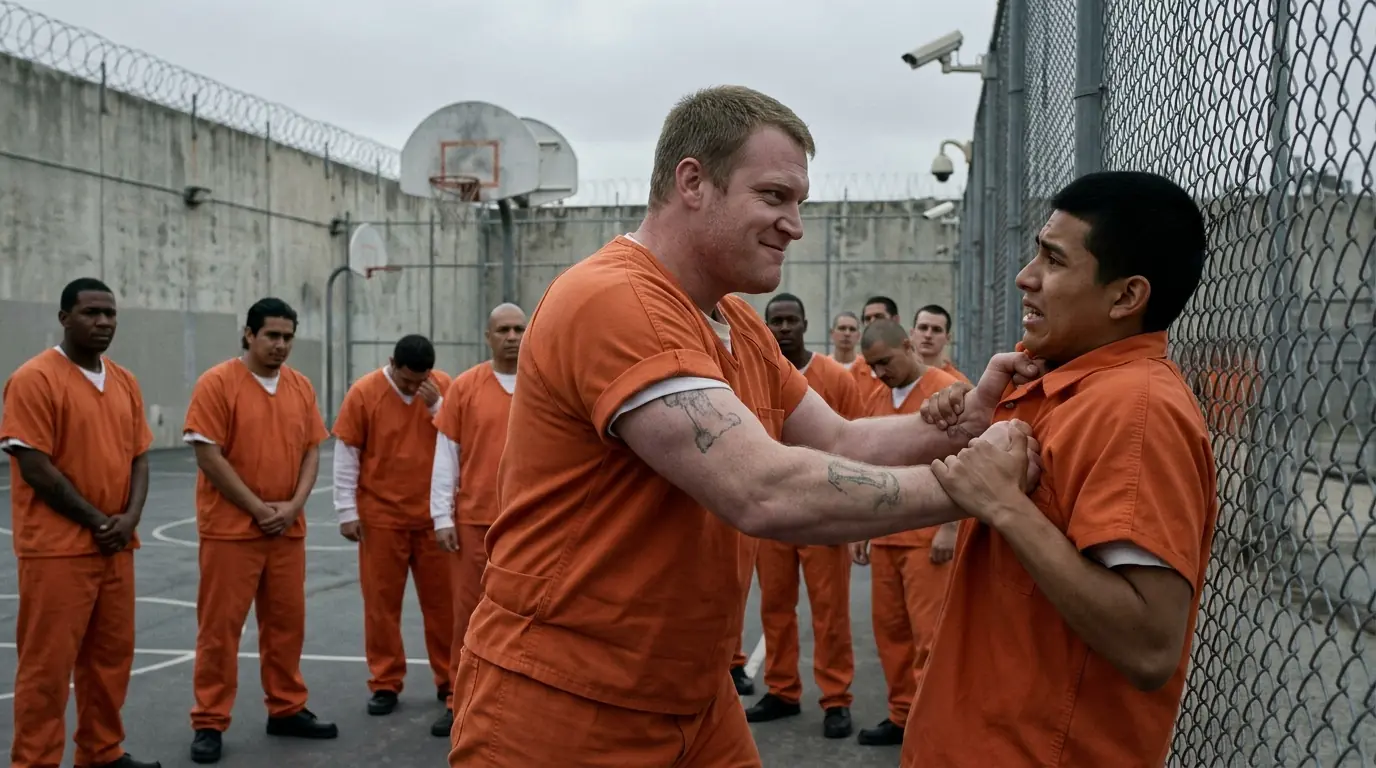
Leonard had been incarcerated for twelve years. He was forty-six, watchful, and experienced enough to understand that prison reputations were often built on incomplete information.
He had seen Isaiah fall.
More importantly, he had seen how he stood.
Most men who were shoved unexpectedly reacted in one of three ways.
They raised their hands.
They stumbled backward.
Or they froze.
Isaiah had done none of those things.
Even while losing balance, he tucked one foot beneath himself and protected his head. His fall had been controlled. His eyes never left Raymond’s shoulders and hands.
Leonard had once served in the Army.
He recognized trained awareness.
Inside the cell, Isaiah placed his two books on the small metal shelf.
One was a worn Bible.
The other was a collection of poems by Langston Hughes.
He folded the towel, positioned the toothbrush beside the sink, and sat on the lower bunk.
Leonard watched.
“You always arrange things like that?”
“It prevents searching for them later.”
“You’re not worried about what happened outside?”
Isaiah opened the poetry book.
“Worry does not improve a situation.”
“Raymond Pike doesn’t stop after one shove.”
Isaiah turned a page.
“Then he will become tired.”
Leonard gave a short laugh.
“You don’t understand. Pike controls this block.”
“No one controls as much as he believes.”
The response made Leonard study him more closely.
“How did you stay so calm?”
Isaiah closed the book.
“When I was young, I thought strength meant answering every challenge.”
“And now?”
“Now I understand that most challenges are invitations to become someone else’s entertainment.”
Leonard sat on the opposite bunk.
“You some kind of preacher?”
“No.”
“You talk like one.”
“I taught children.”
“That explains even less.”
Isaiah smiled faintly.
Outside, a steel door closed.
The sound traveled through the cell block like thunder.
The following morning, Isaiah made his bed before the wake-up announcement finished playing.
He folded the blanket into precise corners.
He washed, dressed, and sat quietly until the doors unlocked.
Leonard observed him from the upper bunk.
Most new prisoners appeared exhausted after their first night. They woke repeatedly, startled by footsteps, shouting, and metal striking metal.
Isaiah looked rested.
During breakfast, whispers followed him.
Raymond had already reshaped the previous afternoon into a story that strengthened his position.
According to the version spreading through Block C, the old man had begged not to be hit.
Isaiah had said nothing of the kind.
Accuracy mattered less than repetition.
He carried his tray toward a table near the windows.
Leonard followed.
“You realize everybody is watching.”
“I noticed.”
“Doesn’t bother you?”
“Being watched and being known are different things.”
Across the cafeteria, Raymond leaned back in his chair.
His companions included Trevor Lane, Calvin Moss, and a broad inmate everyone called Bones.
They laughed while looking toward Isaiah.
Officer Samuel Hayes watched from the wall.
He had spent part of the night reading the transfer file.
Isaiah Turner began karate training at eighteen after being assaulted outside a bus station.
He competed throughout his twenties and early thirties.
At thirty-four, he won his third state championship.
Then he stopped competing.
Instead, he opened a small martial-arts school in a neighborhood where gang recruitment had become common.
The school charged families only what they could afford.
Some paid nothing.
Isaiah required students to finish homework before training. He attended court hearings, visited schools, and helped young men find employment.
Over four decades, hundreds passed through his program.
Police reports showed almost no violence connected to him.
The sealed legal file remained the unanswered question.
Why would a man with that history be transferred into a maximum-security facility?
Samuel watched Isaiah thank the kitchen worker before sitting down.
Raymond approached several minutes later.
He rested one hand on the empty chair across from Isaiah.
“You took my seat.”
Isaiah looked at the chair.
“Were you sitting here?”
“Everybody knows this is my table.”
“The table belongs to the prison.”
Conversations nearby became quieter.
Raymond smiled.
“You’re trying to be clever.”
“No.”
“Then move.”
Leonard leaned forward, but Isaiah lifted one hand slightly.
The motion told him to remain seated.
Isaiah looked at Raymond.
“There are six empty chairs at your table.”
“I want this one.”
“Then sit.”
Raymond had expected refusal or retreat.
The offer confused him.
He pulled the chair back and lowered himself into it.
For several seconds, nobody spoke.
Isaiah continued eating.
Raymond tapped one finger against the table.
“You know what your problem is?”
“No.”
“You think being quiet makes you better than everybody.”
Isaiah swallowed before answering.
“Quiet only means I am not speaking.”
“You don’t fear me.”
The statement was not a question.
Isaiah looked directly at him.
“I do not know you well enough to fear you.”
Several inmates nearby hid smiles.
Raymond’s jaw tightened.
“You’ll know me.”
“Perhaps that is what you need.”
“What does that mean?”
Isaiah set down his fork.
“People who are certain of their strength rarely spend so much time announcing it.”
The cafeteria went still.
Officer Samuel Hayes moved closer.
Raymond stared at the old man.
For a brief moment, anger overcame judgment.
Then he saw Samuel approaching and stood.
“This isn’t finished.”
Isaiah picked up his plastic cup.
“Most unnecessary things aren’t.”
Raymond walked away.
Leonard released the breath he had been holding.
“You enjoy making dangerous men angry?”
“I answered honestly.”
“In here, honesty can get you hurt.”
“So can pretending.”
During recreation that afternoon, Isaiah chose a quiet area beneath an old sycamore tree.
Most inmates gathered around basketball courts and weight benches.
Isaiah stood alone.
He closed his eyes and began moving.
His exercises were slow.
One foot shifted.
His hips turned.
His hands rose and lowered through the air.
To an untrained observer, it looked like gentle stretching.
Leonard recognized something else.
Every motion protected a vulnerable point.
Every stance remained balanced.
Isaiah’s weight shifted without his heels dragging across the ground.
Officer Samuel Hayes watched from the perimeter.
He had seen boxers shadow-fight and former soldiers exercise.
Isaiah’s movements were different.
They contained no performance.
He was not practicing for an audience.
The discipline had become as ordinary to him as breathing.
Raymond noticed people watching.
That bothered him more than Isaiah’s words.
Attention inside Block C functioned like currency. Raymond controlled it by creating fear, spectacle, and anticipation.
Now inmates were studying a quiet old man who had done almost nothing.
Raymond called Trevor and Bones aside.
“What’s everybody staring at?”
Trevor shrugged.
“They think the old man knows something.”
“He knows how to stretch.”
Bones laughed.
Raymond did not.
“Tomorrow, we settle it.”
The next day, Isaiah was assigned to maintenance work.
He cleaned tables, organized supplies, and helped another elderly inmate move a heavy box.
Raymond watched from the equipment-room entrance.
Every staff member who spoke with Isaiah appeared to lower their voice.
Not because they feared him.
Because his manner encouraged respect.
That distinction irritated Raymond.
Before lunch, he spoke with Trevor and Bones.
“Today.”
“What are we doing?” Trevor asked.
“Nothing serious.”
Raymond looked toward Isaiah.
“Just reminding everyone who matters.”
The dining hall filled shortly after noon.
Isaiah carried his tray toward the windows again.
Leonard sat beside him.
“You feel that?” Leonard whispered.
“What?”
“Everybody waiting.”
Isaiah looked around.
Several inmates quickly lowered their eyes.
“People spend too much time anticipating trouble.”
“Sometimes trouble deserves anticipation.”
Raymond crossed the room.
He stopped beside the table.
“You’ve become popular.”
Isaiah placed his cup down.
“I don’t believe popularity exists here.”
“You know what I mean.”
“Then say what you mean.”
Raymond leaned forward.
“People keep talking about you.”
“That seems to be their decision.”
“They think you’re special.”
“I haven’t told them that.”
Raymond smiled.
“I don’t see anything special.”
Isaiah folded his hands.
“You are looking for strength in the wrong places.”
Raymond’s smile disappeared.
Officer Samuel Hayes watched from across the room.
He expected Raymond to reach for Isaiah.
Instead, the lunch bell ended the confrontation.
The inmates began returning trays.
Raymond stepped back.
“Yard this afternoon.”
Isaiah stood.
“I was already planning to go.”
By recreation period, tension had spread through the block.
Groups formed along the yard’s perimeter.
Nobody admitted waiting for a confrontation, but very few people paid attention to the basketball game.
Isaiah sat beneath the sycamore tree repairing a loose seam in his work glove.
Leonard brought two cups of water.
“They’re coming.”
Isaiah accepted one cup.
“People often approach a closed door because they expect it to open eventually.”
“This isn’t philosophy class.”
“No.”
Leonard looked across the yard.
Raymond stood with his men near the basketball court.
“You could ask for protective housing.”
“I do not need it.”
“You sure?”
Isaiah threaded the plastic needle through the glove.
“Being safe and being protected are not always the same.”
Before Leonard could answer, shouting erupted near the basketball court.
A nineteen-year-old inmate named Kevin Bailey had chased a loose ball and collided with Trevor Lane.
Kevin stepped back immediately.
“Sorry, man. I didn’t see you.”
Trevor grabbed the front of his shirt.
“You blind?”
“It was an accident.”
Raymond approached slowly.
Inmates moved aside.
Kevin looked around for help.
Nobody stepped forward.
Officer Samuel Hayes began crossing the yard, but he remained too far away to prevent the situation from escalating immediately.
Leonard saw Isaiah watching.
“Don’t.”
Isaiah placed the glove on the bench.
“This is not about me.”
“That’s why I’m telling you not to.”
Isaiah stood.
He walked toward the crowd without urgency.
The conversations stopped as he approached.
Raymond turned.
“Well, look who decided to join us.”
Isaiah looked first at Kevin.
“Are you injured?”
Kevin shook his head.
Trevor tightened his grip.
“He disrespected me.”
“He apologized.”
“Wasn’t talking to you.”
Isaiah met Trevor’s eyes.
“You are speaking loudly enough for everyone.”
Raymond stepped forward.
“You think you can tell people what to do now?”
“No.”
“Then walk away.”
Isaiah looked toward Kevin.
“He made a mistake. He apologized. Anything more is not correction.”
“What is it?” Raymond asked.
“Performance.”
Several inmates reacted quietly.
Raymond’s face darkened.
He moved closer.
“You really want to challenge me in front of everybody?”
Isaiah’s shoulders remained relaxed.
“I am asking you to let him go.”
“Or what?”
“There does not need to be an ‘or.’”
Raymond laughed.
“That’s not how this place works.”
“It works that way only because everyone agrees to pretend it must.”
Officer Samuel Hayes was almost there.
Then Trevor shoved Kevin backward.
Kevin’s heel caught on a crack in the pavement.
He began falling toward the edge of a concrete bench.
Isaiah moved.
One moment, he stood beside Raymond.
The next, his left hand supported Kevin’s shoulder while his right guided the young man’s arm.
Isaiah turned his own body slightly and redirected the fall.
Kevin landed on his feet.
The movement lasted less than a second.
No strike.
No dramatic spin.
No visible effort.
Yet every experienced observer understood what they had witnessed.
Isaiah had covered nearly four feet of distance before anyone else reacted.
His timing was exact.
His balance never shifted.
Officer Samuel Hayes stopped.
Leonard stared.
Raymond’s expression changed.
Isaiah released Kevin.
“You all right?”
“Yes, sir.”
“Step away.”
Kevin obeyed.
Raymond looked from the old man to the distance he had crossed.
“That supposed to impress me?”
“No.”
Raymond shoved him.
This time, Isaiah did not fall.
His foot slid half a step backward.
His body absorbed the force.
Raymond pushed again, harder.
Isaiah’s hand touched his wrist.
There was no visible struggle.
Raymond suddenly turned sideways and found himself bent slightly forward, his arm controlled near the elbow.
Isaiah had not struck him.
He had not twisted hard enough to injure him.
But Raymond could not move without causing himself pain.
The yard became silent.
Isaiah spoke quietly enough that only the men nearest him heard clearly.
“I do not want to hurt you.”
Raymond’s breathing changed.
“Let go.”
“I will.”
Isaiah eased the pressure.
Raymond pulled free and stepped backward.
Humiliation crossed his face.
He raised one fist.
Officer Samuel Hayes arrived.
“Pike!”
Raymond stopped.
Samuel positioned himself between them.
“Against the wall.”
“He put his hands on me.”
“You shoved him twice.”
“He attacked me.”
“No,” Samuel said. “He prevented you from hurting yourself.”
Several officers entered the yard.
Counselor Natalie Ward followed, holding Isaiah’s transfer folder.
Raymond looked around at the witnesses.
Nobody laughed.
Nobody lowered their eyes.
The fear supporting his position had cracked.
Natalie stopped near Samuel.
“Mr. Turner, are you injured?”
“No.”
“Mr. Pike?”
Raymond rubbed his wrist.
“He assaulted me.”
Samuel looked toward the surveillance cameras.
“We’ll review it.”
Natalie opened the folder.
She had spent the morning requesting permission to read Isaiah’s sealed legal summary.
The information finally arrived thirty minutes before recreation.
Now she understood why a respected instructor had entered prison.
Three months earlier, Isaiah’s seventeen-year-old grandson, Malik, was attacked outside the youth center Isaiah once operated.
Three armed men attempted to force the boy into a vehicle over a gang-related debt belonging to Malik’s older brother.
Isaiah intervened.
He disarmed one attacker and restrained another.
The third man produced a handgun.
During the struggle, the weapon discharged.
The attacker died.
Two witnesses fled.
A security camera captured only part of the confrontation.
Prosecutors initially charged Isaiah with second-degree murder.
His public defender negotiated a plea to manslaughter after warning that a jury might see an experienced martial artist as someone who should have been able to avoid deadly force.
Isaiah accepted the agreement to spare Malik from testifying publicly against gang members.
He entered prison not because he lost control.
He entered because he protected a child and refused to expose that child to further danger.
Natalie closed the folder.
She would not reveal those facts in the yard.
They belonged to Isaiah.
But she could not continue watching people mistake restraint for weakness.
“Mr. Pike,” she said, “you should understand something before making another decision.”
Raymond glared at her.
“Mr. Turner spent more than forty years teaching martial arts.”
The inmates reacted.
Natalie continued.
“He was a three-time state champion and a nationally ranked competitor.”
Raymond looked toward Isaiah.
The old man seemed almost embarrassed by the announcement.
“He could have injured you,” Natalie said. “He chose not to.”
Raymond’s face hardened.
“He got lucky.”
Isaiah looked at him.
“No.”
The word carried no pride.
Only certainty.
Officer Samuel Hayes ordered Raymond and Trevor back to the housing unit.
Raymond hesitated.
For years, people had moved when he looked at them.
Now everyone waited to see whether he would obey.
He turned and walked.
The yard remained quiet after he left.
Kevin approached Isaiah.
“Thank you.”
Isaiah picked up the work glove from the bench.
“You apologized for your mistake. That should have ended it.”
“I thought he was going to hurt me.”
“He wanted everyone to believe he could.”
“What’s the difference?”
Isaiah looked toward Raymond disappearing through the door.
“One is strength. The other is dependence.”
That evening, Block C felt different.
No official announcement explained the change.
No fight had occurred.
No emergency alarm had sounded.
But inmates who once moved aside for Raymond no longer did so as quickly.
His friends sat near him without laughing.
Attention had shifted.
Isaiah returned to his cell and placed the repaired glove on the shelf.
Leonard closed the door behind them.
“Three-time state champion?”
“It was a long time ago.”
“You could’ve put him on the ground the first day.”
“Yes.”
“Why didn’t you?”
Isaiah sat on the lower bunk.
“Because he pushed me.”
Leonard waited.
“That’s it?”
“Pain and danger are different things.”
“He humiliated you.”
“Only if I agreed to carry it.”
Leonard shook his head.
“I’ve been here twelve years. I thought respect came from making people afraid.”
“Fear can change behavior.”
Isaiah touched the faded bracelet around his wrist.
“It cannot change a heart.”
Leonard read the embroidered words.
STRENGTH BEGINS WITH PATIENCE.
“Who gave you that?”
“My first instructor.”
“What happened to him?”
“He died thirty-one years ago.”
“You still wear it?”
“He gave it to me after I lost a tournament.”
“Why after a loss?”
“I blamed the judges. He told me I had become more interested in proving I was strong than becoming disciplined.”
Isaiah smiled at the memory.
“He said losing had shown him more about me than winning ever did.”
Across the housing unit, Raymond sat alone at his usual table.
His wrist was not injured.
His pride was.
Trevor attempted a joke about the old man’s age.
Raymond did not respond.
He kept replaying the moment Isaiah touched his wrist.
There had been no anger in the old man’s face.
That disturbed him most.
People who fought Raymond usually hated him.
Hatred made them predictable.
Isaiah had controlled him without needing to punish him.
Two nights later, Raymond approached Isaiah’s cell.
Leonard stood immediately.
Raymond raised both hands.
“I’m not here for trouble.”
Isaiah looked up from his book.
“What do you need?”
Raymond glanced toward Leonard.
“Can we talk?”
Leonard remained near the wall.
Isaiah closed the book.
“You may speak.”
Raymond rested one shoulder against the bars.
“You made me look weak.”
“No.”
“Everybody saw it.”
“They saw you stopped.”
“Same thing.”
Isaiah studied him.
“Why does their opinion matter so much?”
Raymond laughed bitterly.
“You don’t understand this place.”
“I understand people.”
“You don’t know me.”
“That is true.”
Raymond’s expression shifted.
“My first week here, three men put me in the hospital.”
Isaiah waited.
“When I came back, I decided nobody would ever see me afraid again.”
“So you made other people afraid.”
“It worked.”
“For how long?”
Raymond looked across the block.
His group sat several tables away, watching him.
“Until you arrived.”
“I did not take anything from you.”
“You took the room.”
Isaiah shook his head.
“The room was never yours.”
Raymond’s jaw tightened, but he did not walk away.
“What would you have done?”
“When?”
“My first week.”
Isaiah considered the question.
“Survived.”
“That’s what I did.”
“Yes.”
“Then what’s your problem?”
“You never stopped surviving.”
Raymond looked at him.
Isaiah continued.
“What protects you in one moment can imprison you in the next. Fear helped you endure an attack. Then you built your entire identity around making sure nobody saw the frightened man beneath it.”
Raymond looked toward the floor.
For the first time since Isaiah’s arrival, he appeared tired rather than dangerous.
“I don’t know how to be anything else.”
“That is more honest than most people ever become.”
Raymond looked up.
“You going to teach me karate?”
“No.”
“Why not?”
“You do not need another way to control people.”
Isaiah reopened his book.
“You need to learn how to sit in a room without controlling it.”
Raymond almost smiled.
“That sounds harder.”
“It is.”
Over the following weeks, Isaiah began leading a voluntary morning exercise group.
At first, only Leonard and Kevin attended.
They met in a corner of the recreation yard.
Isaiah taught breathing, balance, and simple movements designed for health rather than fighting.
Several older inmates joined.
Then younger ones.
Samuel Hayes obtained approval for a formal wellness program.
Natalie helped arrange mats and additional time in the multipurpose room.
Isaiah required anyone attending to follow three rules.
No boasting.
No intimidation.
No using what they learned against another inmate.
Anyone violating the rules was removed.
Raymond watched from a distance for nearly two weeks.
Then he appeared one morning.
Conversations stopped.
Isaiah pointed toward an empty place in the back row.
Raymond stood there.
Nobody commented.
The first lesson contained no punches.
Isaiah asked the group to stand still for three minutes.
Raymond lasted forty seconds before shifting.
“This is pointless.”
Isaiah looked toward him.
“Then it should be easy.”
Several inmates smiled.
Raymond stayed.
A month later, the atmosphere in Block C had begun changing.
Conflicts still occurred.
Prison did not become peaceful because one elderly inmate taught breathing exercises.
But several men began walking away from provocations that once would have become fights.
Kevin stopped eating alone.
Leonard applied for a peer-counseling program.
Even Raymond’s behavior changed.
He did not become gentle overnight.
He still spoke harshly.
He still struggled when people challenged him.
But he no longer needed every room to become silent when he entered.
One afternoon, a new inmate mocked Isaiah during recreation.
Before Isaiah could respond, Raymond stepped forward.
The old pattern appeared in his posture.
Shoulders raised.
Hands ready.
Isaiah called his name.
Raymond stopped.
He took one breath.
Then another.
He stepped back.
The new inmate laughed.
“You scared?”
Raymond looked at Isaiah.
Then he answered.
“No. I’m tired of proving I’m not.”
For Isaiah, that moment mattered more than any tournament victory.
Six months after his arrival, a state appeals court reviewed his case.
New security footage recovered from a nearby business showed the full confrontation outside the youth center.
It revealed the armed men attempting to force Malik into their vehicle.
It showed Isaiah retreating repeatedly.
It showed the gunman firing first.
The surviving attackers had also been arrested in connection with another kidnapping and eventually admitted what happened.
Isaiah’s conviction was vacated.
He received the news inside Natalie Ward’s office.
“You’re going home,” she said.
Isaiah sat quietly.
Natalie expected relief, tears, or disbelief.
Instead, he looked through the window toward the prison yard.
“When?”
“Within forty-eight hours.”
He nodded.
“You don’t seem happy.”
“I am.”
“Then what is it?”
“There are people here who believed I would remain.”
Natalie understood.
“The program can continue.”
“Who will lead it?”
“We can train someone.”
Isaiah looked toward Block C.
“I know someone.”
Raymond refused at first.
“I’m not teaching anybody.”
“You have been attending longer than most.”
“That doesn’t make me an instructor.”
“No.”
Isaiah handed him the faded bracelet.
Raymond stared at it.
“I can’t take this.”
“You are not keeping it.”
“What am I doing?”
“Wearing it until someone else needs the lesson.”
Raymond read the words.
“Strength begins with patience.”
“You still have much to learn.”
Raymond almost laughed.
“So do you.”
“Yes.”
That answer convinced him.
On Isaiah’s final morning, inmates lined the corridor.
No officer ordered them there.
Leonard stood outside the cell holding the same kind of paper bag Isaiah carried on arrival.
This one did not tear.
Kevin shook his hand.
Samuel Hayes offered a respectful nod.
Natalie waited near the exit.
Raymond stood at the end of the corridor.
The faded bracelet circled his wrist.
“You know everybody expects a speech,” Raymond said.
Isaiah looked along the block.
“Then they will be disappointed.”
A few inmates laughed.
Raymond lowered his voice.
“You could’ve destroyed me.”
Isaiah shook his head.
“You were already destroying yourself.”
“And you think I can change?”
Isaiah looked toward the morning light beyond the security doors.
“Every sunrise offers the opportunity.”
“That sounds easy.”
“The opportunity is easy.”
Isaiah met his eyes.
“The decision is not.”
The final steel door opened.
Isaiah walked through it carrying his books, towel, toothbrush, and the same quiet dignity with which he had entered.
Outside, Malik waited beside a car.
The seventeen-year-old had grown taller during his grandfather’s imprisonment.
When he saw Isaiah, he ran forward.
Isaiah dropped the paper bag and embraced him.
For the first time since entering Rockland State Prison, the old man allowed his composure to break.
He cried against his grandson’s shoulder.
Inside Block C, Raymond led the morning group.
He stood at the front of the multipurpose room wearing the faded bracelet.
Leonard, Kevin, and twelve other inmates waited.
Raymond looked toward them.
Several months earlier, he would have begun by demanding silence.
Instead, he waited until the room became quiet on its own.
“Three minutes,” he said.
A younger inmate groaned.
“That’s all we’re doing?”
Raymond remembered his first lesson.
“If it’s pointless, it should be easy.”
The men smiled.
Then they stood still.
Outside the prison walls, Isaiah climbed into the car beside Malik.
He did not know whether every man he left behind would change.
Some would not.
He did not know whether Raymond’s patience would survive the next insult, disappointment, or act of fear.
Change was not a single decision.
It was a choice repeated until it became character.
The prison had expected Isaiah Turner to prove his strength through violence.
Raymond had pushed him.
Mocked him.
Challenged him in front of everyone.
Isaiah possessed the ability to end those confrontations in seconds.
Instead, he did something far more difficult.
He refused to become the man everyone expected.
And by refusing, he showed an entire prison that the strongest person in the room was not the one who could force others to kneel.
It was the one who could stand calmly, protect someone weaker, and leave without needing anyone to fear him.