Colter Thorne rode out before sunrise, just as he had done every winter since inheriting the Thorne ranch.
The frost lay silver over the sagebrush, turning the valley into a cold, glittering plain. His stallion’s breath rose in steady white clouds as they moved along the ridge trail above the cottonwood draw. The sky was pale and hard, the kind of blue that only appeared on mornings when the cold had teeth.
Colter was not a man given to wandering thoughts.
His life ran on order.
Water rights.
Fence lines.
Grazing rotations.
Timber counts.
Men in Ash Hollow liked to call him fortunate, but anyone who had ever ridden fence with Colter knew luck had nothing to do with the Thorne spread becoming the strongest ranch in the northern territory. Luck did not mend rails in freezing rain. Luck did not track cattle through snowstorms. Luck did not turn poor soil into profitable range.
Discipline did.
And if there was one thing Colter Thorne trusted more than any man, it was discipline.
That morning’s ride was meant to be ordinary. Every year, after the first hard freeze, he inspected the far reaches of his property, checking for broken rails, washed-out gullies, trespassers, fallen timber, or anything else that might become trouble if ignored.
A ranch this size did not run on hope.
It ran on vigilance.
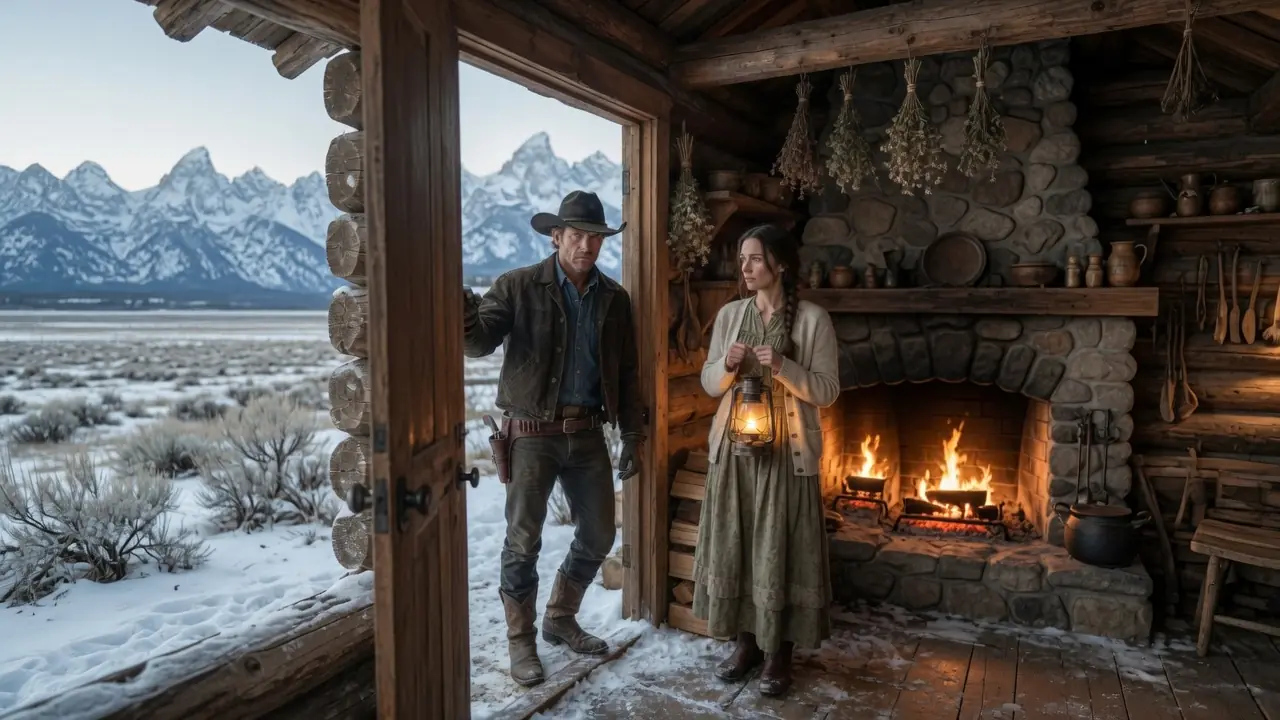
He guided his horse toward the old timber cabin hidden below the ridge.
Most people did not even know it existed. It sat tucked inside a fold of the land behind juniper, stone, and winter-bare brush. Decades earlier, a trapper had built it, lived there for a time, and then vanished into one of the many endings frontier men often met without witnesses.
Since then, the cabin had belonged mostly to weather.
The roof sagged.
The porch leaned.
The door hung half crooked from one rusted hinge.
Colter had meant to tear it down for years, but there were always more urgent matters. Cattle needed moving. Hands needed paying. Water needed defending. A broken cabin deep in the draw could wait.
Except that morning...
It was not empty.
Smoke rose from the chimney.
A thin, clean column.
Not wild.
Not careless.
Someone inside knew how to bank a fire.
Colter narrowed his eyes.
This was Thorne land.
No one lived on Thorne land without his permission.
He nudged his horse forward, quiet and controlled. The closer he came, the more details revealed themselves. Firewood stacked neatly near the door. A patched window. Fresh mud sealing gaps between logs. A new latch carved into the old frame.
Whoever lived here had not merely crawled inside for shelter.
Hard.
Colter dismounted, boots crunching over frost, and approached the door.
He raised his hand to knock.
Before his knuckles touched wood, the door opened.
A woman stood there holding a lantern in one hand and a piece of firewood tucked under one arm, as if she had simply paused mid-chore.
She was not startled.
She did not shrink.
She did not apologize.
Her eyes met his with level calm.
“Morning,” she said.
Her voice was steady as cold creek water.
Colter straightened.
“I reckon you didn’t expect company.”
“No,” she replied. “But I heard your horse before you reached the clearing.”
That answer interested him more than it should have.
Most trespassers either lied, begged, or ran.
This woman did none of those things.
“This is Thorne land,” Colter said. “I aim to know who’s living on it.”
“My name is Lydia Harrowell,” she answered. “And I’m not here to cause trouble.”
Colter studied her.
She carried herself unlike most people he had met on the frontier. Not proud, exactly. Not timid either. There was a quiet steadiness in her, the kind a person earned after standing alone too long and learning not to bend just because the world pushed.
She stepped aside.
“Since you’re here,” she said, “you might as well come in out of the cold.”
Colter hesitated.
Not because he feared her.
Because he had expected excuses.
Not hospitality.
Still, curiosity outweighed caution.
He stepped inside.
The cabin surprised him.
It remained rough, certainly. The walls were gray with age, the floorboards uneven, the ceiling low enough that Colter had to duck near the rafters. But it no longer felt abandoned. A woven rug lay near the hearth. A small table sat beneath the patched window, its legs leveled with stacked stones. Herbs hung drying from a beam. A kettle warmed by the fire.
Everything was clean.
Everything had purpose.
“You fixed the roof,” Colter said.
“Best I could.”
“You hauled the timber yourself?”
“I don’t see anyone else around to do it.”
There was no bitterness in the answer.
Only fact.
Colter respected fact.
He removed his gloves.
“You understand this cabin is on my property.”
“I do.”
“Most folks ask before settling on another man’s land.”
Lydia set the firewood beside the hearth.
“Most folks have somewhere else to go.”
Again, no self-pity.
That caught him off guard.
People with nothing often carried emptiness like an open wound. Lydia carried hers like a tool, something to manage, not drown in.
“How long do you plan on staying?” he asked.
“Long enough to get back on my feet.”
“I don’t offer charity.”
“I didn’t ask for any.”
Their eyes held.
For the first time that morning, Colter nearly smiled.
“What brought you here?”
Lydia did not answer right away.
She poured water into a tin cup and set it near the fire.
Then she said, “I needed somewhere no one would look for me.”
Colter’s gaze sharpened.
“Running from the law?”
“No.”
“Then from what?”
“The kind of trouble the law doesn’t bother with.”
That was all she offered.
Colter did not press.
Truth came in layers. Forcing it too soon usually broke it.
He put his gloves back on.
“I’ll be plain, Miss Harrowell. You living here puts me in a position I have to address.”
She nodded once.
“Tell me what you want, and I’ll abide by it.”
Not a plea.
Not a challenge.
A practical answer.
Colter stepped back toward the door.
“I’ll think on it.”
Lydia’s expression softened slightly.
“That is fair.”
As Colter rode away, he looked back once.
The cabin stood small beneath the ridge, smoke rising clean from the chimney.
Lydia Harrowell had not merely taken shelter there.
She had taken root.
And Colter Thorne did not ignore things that took root on his land.
By dawn the next morning, he had written a contract.
Business had always made sense to Colter. Feelings were unpredictable. Agreements were not. If Lydia was going to remain on his land, then the matter needed structure.
When he arrived at the cabin, she was outside splitting wood.
Each swing of the axe was clean and efficient.
No wasted motion.
She paused when she saw him.
“You came back.”
“I said I would think on it. Thinking’s done.”
She set the axe aside.
Colter unfolded the paper.
“You may stay through winter,” he said, “provided you work for the ranch.”
“What kind of work?”
“Fence surveys. Water source checks. Remote inspections. Places too far or time-consuming for my regular crew during winter.”
Lydia listened carefully.
“In exchange?”
“Shelter. Legal standing. If anyone asks why you’re here, you work for me.”
For the first time, something like relief moved through her face.
“May I read it?”
Colter handed her the paper.
She read every line twice.
“You wrote this yourself?”
“I did.”
“You’re a precise man, Mr. Thorne.”
“Precision keeps a ranch standing.”
She handed it back.
“One correction.”
Colter lifted an eyebrow.
Few people corrected him.
“What correction?”
“Add a clause ending the agreement after winter with no obligation on either side.”
“You planning to leave?”
“I’m planning to have choices.”
That answer settled something in him.
Colter took a pencil from his coat and added the clause against his saddle.
Lydia read it again.
Then signed.
Lydia Maryn Harrowell.
Colter signed beneath her.
“That settles it,” he said. “You’re here with my permission now.”
She handed the agreement back.
“You keep it. I’ll honor what I signed.”
“I know you will.”
The words came before he thought better of them.
But he meant them.
That winter, Lydia proved useful in ways Colter had not expected.
She marked broken fence lines with careful notes. She found a hidden washout before spring runoff made it dangerous. She repaired a small footbridge near the creek before any ranch hand could be sent. She wasted no words, made no excuses, and never asked for more than the agreement allowed.
Colter began visiting more often.
At first, always for ranch business.
Then sometimes with no urgent reason at all.
A question about the eastern fence.
A delivery of nails.
An extra sack of flour he claimed had been ordered by mistake.
Lydia never called it charity.
He never called it kindness.
They both preferred dignity.
Then came Founder's Day in Ash Hollow.
Colter arrived at noon, because men of his standing did not get to avoid public duty. He shook hands, nodded to ranchers, tolerated merchants angling for favors, and listened with measured patience while the schoolmistress tried to convince him to fund more winter supplies.
He was near the vendor tents when he heard a name that stopped him.
Crozier.
Two men spoke behind a canvas stall, low but not low enough.
“I’m telling you, Crozier’s buying up claims again.”
“Forged papers?”
“Saw one myself. Widow near Blue Ridge swears she never signed away her land.”
Colter did not move closer.
He did not need to.
Crozier was the kind of man frontier towns always seemed to produce eventually. A land broker with clean boots, dirty hands, and a talent for turning desperation into profit.
A widow near Blue Ridge.
A forged deed.
A woman who needed somewhere no one would look.
Lydia’s words returned.
The kind of trouble the law doesn’t bother with.
The next morning, Colter rode to the cabin.
Lydia was stacking firewood.
“This isn’t a work visit,” he said.
She looked at him carefully.
“What did you hear?”
“Crozier.”
For the first time since he had met her, Lydia’s composure cracked.
Only slightly.
Only in the tightening of her fingers against the woodpile.
“You know him,” Colter said.
“Everyone who has lost more than they should knows someone like him.”
“Tell me.”
He did not command.
He made room.
After a long silence, Lydia spoke.
“My husband died two winters ago. He left me a small plot near Blue Ridge. Nothing grand. Enough to plant. Enough to live.”
She looked toward the ridge.
“I tried to keep it.”
“Crozier came?”
“Yes. Said there were debts. Said there were claims. He wanted me to sign papers. I refused.”
“And?”
“One morning men were tearing down my fence. They had documents saying I had forfeited the land.”
“You never signed.”
“No.”
“Couldn’t fight it?”
“With what?” Lydia asked softly. “Lawyers cost money. The sheriff said the papers looked proper. Neighbors didn’t want trouble. Folks see a widow alone and assume she is confused.”
Colter’s jaw tightened.
“Or lying.”
“Yes.”
“Do you have proof?”
“My word.”
He looked at her.
“Your word has weight with me.”
She blinked, once.
“Why involve yourself?”
“Because you work under my name now. And because Crozier has been stealing from people who cannot afford to stop him.”
Lydia searched his face.
“What do you need from me?”
“Dates. Names. Details. Everything you remember.”
She nodded.
“All right.”
Colter did not act quickly.
He acted correctly.
The next morning, he rode into Ash Hollow and went directly to the land recorder’s office. Samuel Darrington, the county recorder, looked up from a stack of ledgers.
“Colter. You buying more land?”
“Not today.”
He requested every Blue Ridge transfer from the past year.
There it was.
A forfeiture deed.
Lydia Maryn Harrowell.
The signature was wrong.
Not even close to the one on Colter’s winter contract.
“Who filed it?” Colter asked.
Samuel adjusted his spectacles.
“Crozier.”
“Was the signature verified?”
Samuel gave a dry laugh.
“People trust stamped papers more than people.”
Colter closed the ledger.
“Where is he?”
“Behind the livery, last I heard.”
Colter found Crozier two hours later.
Tall, narrow, and smug, with a hat pulled low and two riders beside him who looked as clean as snakes.
“Well,” Crozier drawled. “Colter Thorne.”
“You filed a forged forfeiture deed under Lydia Harrowell’s name.”
Crozier’s smile faltered.
“Careful with accusations.”
Colter stepped closer.
“I am careful.”
He pulled out copies of both signatures.
“One is hers. One is yours.”
“I don’t need to shout proof in the street,” Colter said evenly. “I have money, standing, legal counsel, and enough patience to pull apart every deed you have filed from here to the territorial line.”
Crozier swallowed.
Colter’s voice remained quiet.
“You will sign a correction today. You will void the deed. You will leave this county. If you refuse, I will spend whatever is required to destroy every fraudulent claim you have touched.”
Crozier stared at him.
Sometimes power was not loud.
Sometimes it was a man who could afford to mean every word.
By sundown, the correction was filed.
Lydia’s land was hers again.
But Colter was not finished.
Three days later, Lydia heard wagon wheels outside the cabin.
Colter arrived with a freight wagon loaded with lumber, shingles, nails, glass, tools, and stone.
She stood in the doorway.
“Expecting to build a town, Mr. Thorne?”
“A cabin.”
“This one already stands.”
“Barely.”
She looked at the wagon.
“For whom?”
“You.”
Her face closed immediately.
“I don’t take charity.”
“I don’t offer it.”
He handed her another contract.
“A long-term position. Land consultant. One year at a time, renewed only if you choose. Wages included. Housing included.”
Lydia read the paper.
Twice.
“You’ve thought of everything.”
“I tried.”
“Why?”
Colter looked toward the ridge above the meadow, where sunlight struck the higher ground.
“Because you do clean work. Because you tell the truth. Because you rebuilt a place most people would abandon.”
He paused.
“And because a woman who has spent this long surviving deserves something built to last.”
Lydia lowered the paper.
For a while, she did not speak.
Then she signed.
Construction began the next morning.
Colter’s crew built quickly, but Lydia worked beside them every day. She hauled boards, marked measurements, corrected sloppy cuts, and earned the respect of men who had expected to treat her as Colter’s obligation.
By spring, the new cabin stood on higher ground, with a stone foundation, south-facing windows, a strong roof, and a porch overlooking the meadow.
On the day it was finished, Lydia stood beside Colter in silence.
The wind moved softly through new timber.
“It’s a fine house,” she said.
“It is.”
“You know I may still leave someday.”
“I wrote that into the contract.”
She almost smiled.
“I noticed.”
Colter looked toward the open land.
“Choices matter.”
Lydia nodded slowly.
“Yes. They do.”
Years later, people in Ash Hollow would tell stories about how Colter Thorne found a woman living in an abandoned cabin and turned her into one of the most respected land consultants in the territory.
They always told it wrong.
Colter had not rescued Lydia Harrowell.
She had already rescued herself.
He had simply been wise enough to recognize a woman of worth before the rest of the world knew where to look.
And Lydia, who had once needed a place no one would find her, eventually became the person everyone on the Thorne ranch trusted to find what others missed.
Broken fences.
Hidden springs.
Forged deeds.
Weak foundations.
And sometimes...
the quiet beginning of a life strong enough to stand through winter.