On a freezing winter night, a poor young man walked out of work, exhausted and shivering. Suddenly, he saw a luxury car stalled in the fog. Its elderly driver sitting helplessly inside. Most people would have just kept walking, but he stepped forward using his bare hands in the bitter cold to fix the car.
What he didn't know was that the old man was a billionaire, and what happened next would change his family's life forever. The wind cut through Milbrook like a knife that Tuesday night in February in upstate New York. Malik Johnson pulled his thin jacket tighter as he stepped out of Tony's diner. The bell giving one last tired jingle. 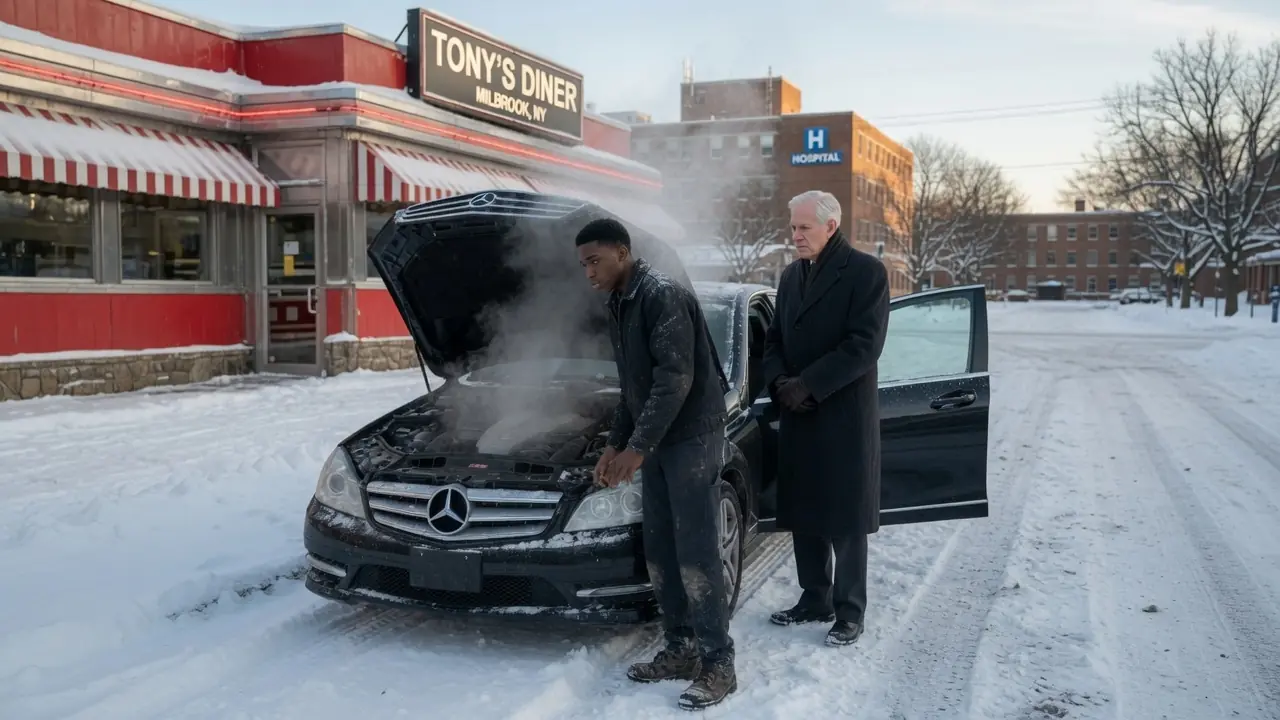
The neon sign for St. Mary's Hospital across the street flickered through falling snow, a reminder that even on cold nights, some people dealt with worse than sore feet and long shifts. At 23, Malik had gotten used to these nights. Standing on cracked linoleum for 8 hours, the smell of grease following him home, tips barely covering bus fare to the apartment he shared with his mom and little brother. But he never complained.
Not out loud. His breath formed white clouds as he walked toward the bus stop. That's when he saw it. A black Mercedes-Benz dead on Maple Street, steam rising from under its hood. Through the driver's window, an older man in an expensive wool coat hunched over the steering wheel.
Most people would have kept walking. Getting involved with strangers wasn't smart. But his mom's voice echoed, "When you see someone hurting, you help. That's what makes us human." George Whitmore had built his fortune on reading people quickly.
A young man approaching his car on a deserted street made him lock the doors with a sharp click. Malik saw the fear. He could keep walking. Instead, he raised both hands, palms out.
"Hey," he called out. "Your car broke down." George rolled down his window just enough to speak. "I'm fine." "Doesn't look fine. That's coolant and steam. Your engine's overheating." Malik looked up and down the empty street.
"I've called for assistance." "Look, I know you don't know me, but it's 18°. Your car is dead, and that tow truck's probably an hour away." George stared at him. This wasn't what he'd expected.
"What are you suggesting?" "Pop the hood. Let me take a look." "Are you a mechanic?" "When you grow up like I did, you learn to fix whatever breaks. Can't afford not to." Something in his tone made George pause.
After internal debate, he pulled the hood release. "Thank you," Malik said simply. Steam billowed up when he lifted the hood. He stepped back, waiting for it to clear, then leaned in with focused attention.
"Good news and bad news. Bad news is your upper radiator hose split. Probably the cold made the rubber get brittle. Good news is it's not a big split." "How do you fix it?" "Need to let this cool down first. Engine's too hot. Then patch the hose with electrical tape. Add some water. Won't be pretty, but it'll get you home."
They waited in awkward silence. Finally, Malik tested the temperature and nodded. He pulled tape from his backpack, removed his gloves, exposing his hands to bitter cold. George watched as he worked methodically, wrapping the split hose.
"I'll be damned. Should get you home. Keep an eye on that gauge. Get that hose replaced tomorrow. This is just a band-aid." "What do I owe you?" Malik was already stepping away. "Nothing. Just glad I could help."
George reached for his wallet, but Malik was walking away, hands in pockets, heading toward the bus stop. He turned once. "Drive safe. Roads are slippery." George sat in his warming car, watching the young man disappear.
In 72 years, he'd never encountered anything like that. Help without strings attached, no angle, no expectation. As he drove home to his house in the hills, the same hills overlooking St. Mary's where his cardiologist, Dr. Hassan, had been monitoring his blood pressure, George found himself thinking about tired eyes and red fingers.
Three days later, George had gotten the hose fixed at Hartley's garage. The mechanic was surprised by the repair. Whoever did this knew what they were doing. Probably saved you from cracking your engine block.
Now George found his mind wandering back to Tuesday night. To the way the young man had approached with hands visible, worked without complaint. Walked away expecting nothing. Across town, Malik was stacking boxes at Peterson's Hardware, his second job.
His phone buzzed. "Mom's appointment moved to 3:30. Can you still drive her, Dante?" He looked at the clock. "Yeah, I got it." Their mom, Linda Johnson, had been fighting heart disease for 3 years.
The doctors at St. Mary's had been talking about surgery, a valve replacement their insurance would only partially cover. Even with insurance, they'd be looking at 40,000 out of pocket. Twenty minutes later, he was helping his mom into their 2004 Honda Civic.
"You sure you can afford to leave work early?" Linda asked. "Mom, the bus takes an hour and a half each way. I can spare 2 hours." "What did I do to deserve you boys? Must have been all that praying, though Dante's still on probation."
That earned a laugh as he started the car. St. Mary's was 15 minutes across town. As they walked toward the main entrance, he noticed the black Mercedes and the older man being helped out by paramedics, his face gray with pain.
George had been in his office when chest pain started, sharp radiating down his left arm with crushing pressure. When pain worsened, even his stubborn pride couldn't ignore the obvious. He had driven himself to St. Mary's partly because it was closest, partly because Dr. Hassan had been his cardiologist for years.
Now being wheeled through emergency doors, he was thinking calling an ambulance might have been smarter. "Mr. Whitmore, I'm Dr. Hassan. You're having a heart attack. We need cardiac catheterization immediately." "Is there someone we should call?" a nurse asked.
"Emergency contact." George opened his mouth, then stopped. "No," he said quietly. "There's no one to call." Upstairs in cardiology, Malik sat with his mom.
Dr. Martinez was running behind. The echo results look good, she told Linda later, pulling up images. Medication is controlling blood pressure well. Ejection fraction improved to 45%.
Malik felt tension leave his shoulders. However, we're still looking at valve replacement within the next year. The aortic valve is deteriorating faster than hoped. "What timeline?" Malik asked.
"Six months, maybe less. Not emergency yet, but we don't want to wait until it becomes one." Driving home, Linda was quiet, running numbers. Even with a loan, we'll figure it out.
Malik said though for the first time, he wasn't sure that was true. That night, Malik found himself staring at college applications he downloaded months ago, always stopping at financial aid sections. Every time he started, the same thought.
Even with partial aid, his family needed every dollar he could earn. College was for people who could afford to dream. Monday morning brought news that would change everything. "5:30 a.m. Mom in ER. Come now," Dante texted.
Malik drove through empty streets to St. Mary's, pushing through emergency doors with his heart pounding. Dante was in the waiting area, pajama pants and winter coat. She woke up around 3:00, chest hurt real bad, different than usual.
Couldn't catch her breath. Paramedics said her heart rate was all over the place. She's stable now. Been back there for 2 hours.
They won't tell me anything because I'm not 18. At the main desk, a nurse explained Linda was undergoing tests. Good news, conscious and alert. Concerning heart rhythm dangerously irregular.
By 10:00 a.m., they'd been waiting 7 hours when commotion started in emergency. Raised voices, then someone shouting. "I don't need anyone touching me. Where am I?" "Sir, you're in the hospital. You had a heart attack."
"Heart attack? Impossible. I have a board meeting. Where's my phone?" Emergency doors burst open. A familiar figure stumbled into the waiting area. Older man in hospital gown, dragging IV pole, looking confused and scared.
Recognition hit like a shock. The man from Tuesday night. George Whitmore was experiencing post anesthetic confusion from surgery 3 days earlier. In his mind, he'd gone to sleep Friday afternoon and woken Monday morning with no memory of the weekend.
"Sir, you need to come back to your room," a nurse said gently. "I'm fine," George protested, but his legs were shaking, face pale. That's when he saw Malik.
Recognition cleared the confusion momentarily. "You," George said, pointing with trembling finger. "You're the one who." Then his legs gave out. Malik was moving before he realized it.
Fifteen feet felt like slow motion. The older man's eyes rolling back, knees buckling, IV pole clattering. Malik caught him just before he hit the tile floor. One arm around George's waist, the other supporting his head.
As medical staff rushed over, Malik found himself holding the man's hand. "He's unconscious," Malik told the first nurse. "Pulse weak but steady. Did he hit his head?" "No, I caught him. He recognized me, said something, then went down."
They wheeled George toward elevators. Malik stared after them long after doors closed. "Who was that?" Dante asked. "Just someone I helped a few days ago. His car broke down."
Before Malik could say more, Dr. Chen approached the Johnson family. She's stable, but this episode was more serious than before. Her heart went into atrial fibrillation, irregular rhythm that prevented effective pumping. We've got her back in normal rhythm, but this indicates her condition is progressing faster than hoped.
"What does that mean?" "The valve replacement can't wait. We're looking at weeks, not months." There are programs, Dr. Chen continued.
They spent two hours with Linda until she fell asleep. As they prepared to leave, Malik made a decision. "Wait downstairs. I'll be right back." He took the elevator up to the cardiac unit.
At the nurse's station, room 314. "He's awake now. Confusion has cleared." George was sitting up, looking older, but undeniably himself. When he saw Malik, his expression shifted through recognition, surprise, embarrassment, gratitude.
"I was hoping I'd see you again, though not under these circumstances." "How are you feeling?" "Like someone cracked my chest open, which according to doctors is pretty much what happened." He studied Malik's face.
"What are you doing here?" "My mom, she's downstairs in cardiac observation." George's expression softened. "Is she all right?" "She will be. Needs surgery, but she'll be all right."
"I never thanked you," George said finally. "Nothing to thank me for." "There's everything to thank you for. I've been thinking about Tuesday night, about what you did, about why." "Anyone would have done the same."
"No, they wouldn't have. I wouldn't have." "Well, I should let you rest." "Wait, your mother. The surgery she needs. What kind?" "Heart valve replacement." "Why?" "Expensive procedure."
"Yeah, more than we can handle." George was quiet, gazing out the window. "I owe you a debt." "You don't owe me anything." "I owe you my life."
The doctor said if I'd kept driving that night, if the engine had overheated completely, I probably would have pulled over and tried to walk for help in that weather at my age with an underlying heart condition I didn't know I had. Malik hadn't thought about it that way.
"Like I said, anyone would have done the same, but everyone didn't. You did, and now I'm alive, and your mother needs help." George paused. "I want to help pay for your mother's surgery."
"I can't accept that." "Why not?" "Because it's too much. Because we barely know each other." "Maybe that's exactly what people should do," George said quietly.
They looked at each other across the hospital room. "This isn't charity. This is me paying a debt. You saved my life Tuesday night. Now, let me help save your mother's." George was quiet, gazing at falling snow.
"72 years old. Built a company. Made more money than I could spend. And when I had a heart attack, you know what I realized? There was no one to call, no one who would have missed me."
"I've spent my life building walls, protecting myself, trusting no one, very successful and very alone." He looked back at Malik. "Tuesday night, you showed me something I'd forgotten existed. Kindness without agenda. I want to be that kind of person for someone else."
"I need to talk to my family first, of course. But Malik, don't let pride get in the way of your mother's health." As Malik left George's room, he felt the weight of an impossible decision pressing down on him.
The cafeteria coffee was terrible, but it gave Malik's hands something to do while his mind raced. The guy from Tuesday night, George, he wants to pay for mom's surgery. All of it. That's what he said.
"So, what's the catch?" "I don't know. Maybe there isn't one." "There's always a catch." They went to talk to Linda, who listened without interruption.
"What do you think?" she asked. "I think it sounds too good to be true. But maybe we don't have the luxury of being suspicious." Linda reached for his hand.
"What does your gut tell you about this man?" Malik thought about Tuesday night, about George's fear giving way to gratitude, about him calling Malik's name in confusion. "I think he's lonely. I think helping us makes him feel less alone."
"That's not necessarily bad," Linda said. "Sometimes the best help comes from people who understand what it's like to need something." She squeezed his hand.
"I've been poor my whole life. I know what it's like to need help and be too proud to ask. But you know what I've learned? Sometimes pride is just fear wearing fancy clothes."
"So what are you saying?" "I'm saying maybe this George fellow is scared, too. Maybe he's afraid that if he doesn't help someone, he's going to die as alone as he's lived." Malik called George's number.
"Can you come down to my mom's room? I think we should all talk together." When George appeared 20 minutes later, he looked nervous. Gone was the confident businessman.
This was just an older man uncertain about whether he was welcome. "Mrs. Johnson, I'm George Whitmore." "Linda, and thank you for wanting to help us." For the next hour, they talked not about money or obligation, but about family, fear, what it meant to help and be helped.
George talked about his empty house, about building a successful business while failing to build relationships. Linda talked about raising boys alone. Constant worry something would happen before they were grown.
"I can accept your help," Linda said finally. "My pride isn't worth my life. And my boys need me around. But I need to know what you expect in return."
"I expect nothing, but I hope for something." "What's that?" "I hope this is the beginning of learning how to be useful instead of just wealthy. I hope your family might teach me what it means to care about people."
"You want to be part of our lives." "I'd like to try if you'll let me." "There are conditions," Linda said. "First, this goes through proper channels. Hospital, financial services, social workers, whatever paperwork they need."
"Absolutely." "Second, you don't get to swoop in and fix all our problems. We're not your charity project." "Understood." "Third, if you're going to be around, you're going to be really around. Not just good times. Family means showing up when things are hard, too."
George nodded. "I think I'd like that very much." The next days passed in paperwork and phone calls. George's offer went through St. Mary's financial services, requiring Linda's signed authorization and multiple forms for hospital policy and HIPAA requirements.
A social worker met with the family to ensure they understood options and weren't being coerced. George visited every day, bringing books, staying for hours, even when Linda was too tired to talk. When Dante mentioned test stress, George quietly arranged a tutor.
When Malik worried about missing work, George suggested maybe it was time to think about school again. "I've been thinking about what comes after the surgery," George said one evening.
"I've spent my whole life building things, buildings, companies, wealth, but I've never built anything that mattered to anyone but me." He pulled out a folder. "I've been working with my lawyers on something. A scholarship program for students from families like yours to start. Maybe 10 a year, full ride to any state school, plus living expenses."
"That's a lot of money," Malik said. "It's a good use of money, but I want to do it right. I need people who understand what these families face. I need partners, not employees." He looked at Linda.
"I'd like you to help me run it part-time at first. Director of family services." "You're asking me to change my entire life." "I'm asking you to use everything you've learned about helping people but on a bigger scale."
"And Malik, if he wants it, student coordinator, help identify candidates, design the program, mentor scholarship recipients while taking his own classes if he's interested." The program would pay a salary, a good one.
But Malik felt familiar tightness in his chest. The same feeling he got looking at college applications. "I don't know. I've never done anything like that." "What if you are good at it?" George countered.
"You helped a stranger without thinking twice. You understood what I needed before I did. Those aren't classroom skills." Linda reached for her son's hand. "Baby, you've been putting your life on hold for 2 years. Maybe it's time to think about what you want for yourself."
"What do you want from Malik?" She interrupted gently. "Not for us, for you." The question hung in the air. "I don't know. I forgot to think about what comes after we're okay."
"Well," George said, "you don't have to decide now. But sometimes the best way to take care of people you love is to take care of yourself, too." Thursday morning, the surgery went flawlessly.
Doctor Chen emerged after 3 and 1/2 hours. The valve replacement was successful. Linda's heart was beating strong and steady. Recovery should be smooth and complete.
George had stayed through the entire procedure, looking as nervous as if Linda were his own family. When Dr. Chen delivered good news, his relief was as profound as anything Malik felt.
Later, as Linda slept off anesthesia, George spoke quietly. "I'd like to ask if you'd consider letting me be part of your family. Not trying to replace anyone, just addition, not substitution."
Malik looked at this man who'd somehow become essential to their lives. "I think mom would say family isn't about blood, it's about showing up." George smiled and for the first time in decades, he understood what home felt like.
The seasons had a way of surprising you in upstate New York. One day you're scraping ice off windshields, the next you're watching kids play basketball in shorts. Six months had passed since that cold February night, and spring had transformed more than just Milbrook.
Linda Johnson was among those emerging into new life. The surgery had been transformative in ways none of them had expected. "You know what's funny," Linda said one Saturday afternoon, sitting on apartment steps with George, watching Malik and Dante shoot baskets.
"Six months ago, if someone told me I'd be friends with a billionaire, I'd have said they were crazy." George smiled. "Six months ago, if someone told me I'd be spending Saturdays in public housing, I'd have said the same."
"But you know what's not funny? How natural it feels now." The transformation hadn't been without challenges. Two months earlier, George had nearly ruined everything. During family dinner, Dante was stressed about SAT.
George trying to help had said, "Don't worry about scores. I know people on admissions committees. I can make some calls." The room went silent.
Malik sat down his fork. "George," Linda had said dangerously quiet, "What did we talk about?" "I'm sorry. I didn't mean. I was just trying to help by buying my way."
Malik had asked. Linda had been firm but not unkind. "We're not your project to fix. We're people with our own dignity." George had gone home that night, certain he destroyed everything.
For 3 days, he didn't call or visit. On the fourth day, when he finally worked up courage to drive by their apartment, he saw an ambulance outside. His heart stopped.
Had Linda's condition worsened? Was this his fault? The stress of their argument. But it was Mrs. Rodriguez from 2B. Having chest pains, false alarm, thankfully.
Still seeing that ambulance made George realize something. He wasn't just afraid of being rejected by the Johnsons. He was terrified of losing the only real family he'd ever known.
That's when Malik had called. "We need to talk." He'd found the whole family waiting with coffee and Linda's cookies. For 2 hours, they'd talked honestly about money and power and the difference between helping and controlling.
"We know you meant well," Linda had said. "But good intentions don't erase impact." But then came the real test. Two weeks later, the hospital called with complications, not medical, but bureaucratic.
The insurance company was questioning the large payment, demanding additional documentation. There were forms, delays, the possibility that Linda's surgery could be postponed again. George's first instinct was to call his lawyers, throw his weight around, make demands.
Instead, he asked Malik, "What do you need me to do?" Together, they spent two frustrating days at insurance offices and hospital billing departments. George watched Malik navigate bureaucracy with patience and dignity, never losing his temper, never giving up.
And Malik watched George learn to be helpful instead of controlling, to follow rather than lead. When the paperwork finally cleared, George understood something new. Being useful meant showing up for the boring, frustrating parts, too.
"I want to do better," George had said. "Finally, but I might need coaching." Malik had smiled. "Lucky for you, we're pretty good teachers."
That conversation changed everything. George stopped trying to fix everything and started asking what help was actually wanted. Now those lessons had borne fruit. The Whitmore Foundation for Educational Excellence held its first scholarship ceremony at Milbrook Community College.
"The thing about opportunity," Malik told the room full of families, "is that it's not just about the person receiving it. When someone gets a chance to build a better life, that chance ripples out to their family, their community, their children who haven't been born yet."
He looked at faces reflecting his own journey. "But the thing about kindness is that it works the same way. One person helping another create circles that keep growing." Each scholarship represented more than tuition.
Linda had insisted on mentorship, career guidance, ongoing support. Malik had created peer programs where current recipients helped guide new ones. After the ceremony, George found himself with Linda and Malik watching families celebrate.
"You know what I realized today," Linda said. "This isn't about paying back a debt anymore. It's about what comes next." George nodded. "It's about what was always possible."
"People helping people." "So, what does come next?" Malik asked. "More of this. 50 scholarships next year, 100 the year after. Programs in Albany, Buffalo, maybe Rochester."
"That's a lot of families," Malik said. "That's a lot of opportunities and a lot of people who go on to help others just like you help me." That evening at Romanos, their Saturday tradition, George looked around at the normal human chaos and felt something he'd never experienced.
Belonging not to a place or position, but to community. "You know what I keep thinking about?" Linda said as they waited for their table. "That night in the hospital when you asked what I expected in return. I remember I said I wanted you to be really around not just for good times."
"I wanted you to show up when things were hard too." Linda smiled. "You passed that test when Dante was stressed. When Malik was doubting himself. When I was scared about surgery. When you messed up with that admissions comment."
"You didn't run. You stayed and did the work." George felt his throat tighten. "Thank you for letting me." Later, George pulled out an envelope.
"Spring break," he said as Malik opened plane tickets to Florida. "I thought maybe it was time I learned what a real family vacation feels like." Linda laughed. "George Whitmore, are you asking us to teach you how to build sand castles?"
"Among other things." As they walked home through spring evening, past the diner where Malik had worked, past the hospital where they'd learned what it meant to take care of each other, George thought about seeds and forests, and how kindness spreads in directions you never see coming.
Behind them, Milbrook settled into Saturday night quiet. The scholarship ceremony had ended, but its effects would ripple outward for generations. Ten students who would graduate college, start careers, raise families, and help others in turn.
And in the space between what had been and what could be, four people who'd found each other in unlikely circumstances continued building something that would last. A family bound not by blood, but by choice, not by obligation, but by love.
Sometimes that's all it takes to change the world. One person helping another. One act of kindness, creating circles that spread far beyond anything you could plan. And sometimes, if you're very lucky, you get to watch those circles grow.
The winter had been hard, but it was over now. Spring had come to Milbrook, and with it the promise that even the coldest nights can lead to the warmest days, if you're brave enough to help a stranger, and wise enough to let them help you back.