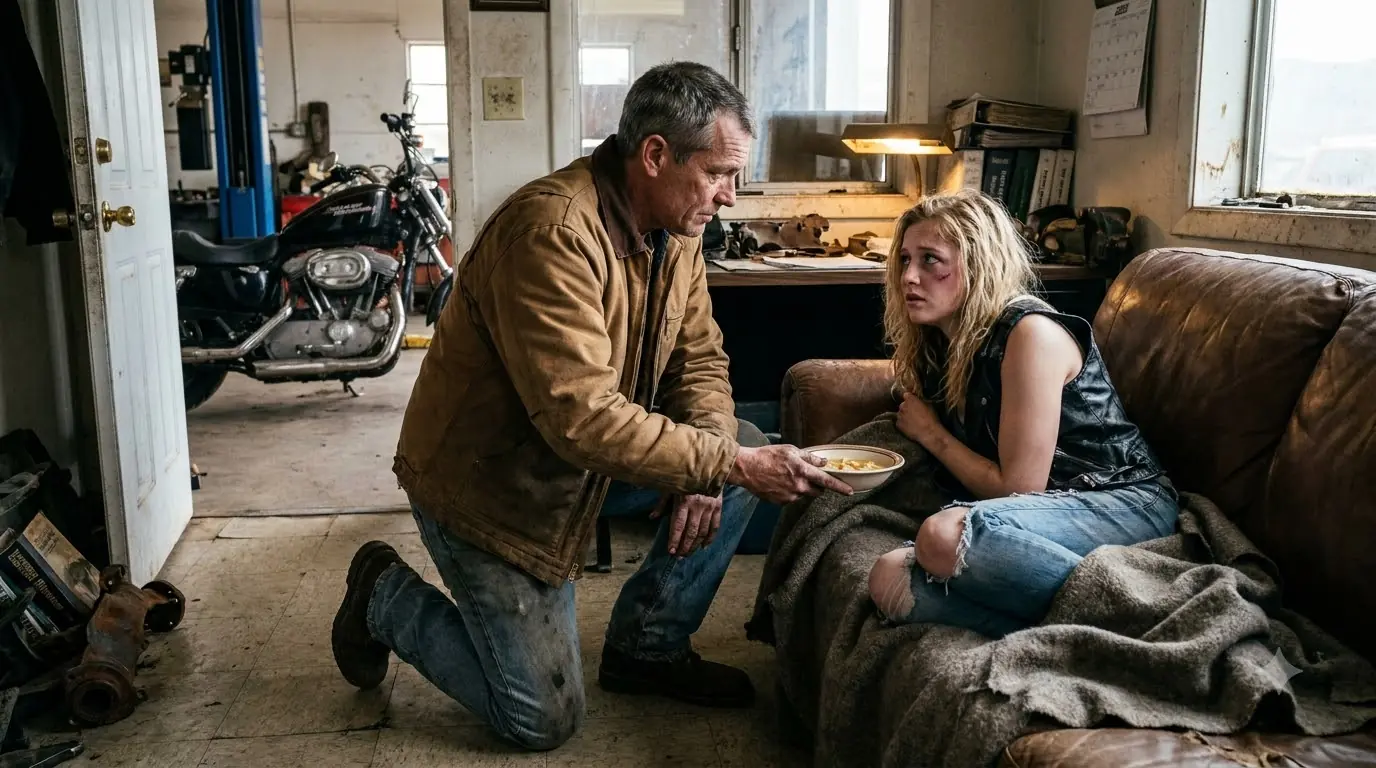
He had been expecting trouble, though not an army of it. Three days earlier, two men in a silver pickup had asked whether he was sheltering a young woman with a scar above her eyebrow. One had offered five thousand dollars for information; the other had casually crushed Walter's mailbox beneath his boot when Walter refused to answer. Yesterday someone had cut the telephone line beside the shop, and that morning a black SUV had followed him halfway to town. Now more than a hundred bikers were turning off the highway toward his property, their headlights flashing through the dust, and Walter could think of only one reason they had come. They had found the girl.
Behind the shop, in a little bedroom that had once belonged to his daughter, nineteen-year-old Lily Quinn was trying to stand without leaning against the wall. Her ribs still hurt when she breathed too deeply, and the stitched cut above her eyebrow pulled whenever she frowned. She heard the engines and went white. Walter told her to lock the bedroom door, then checked the rifle with hands that shook more from exhaustion than fear. He had already buried one daughter; he would not hand another young woman to strangers who meant her harm.
The motorcycles stopped outside his sagging fence in uneven rows, filling the shoulder and stretching back toward the road. Most riders remained seated, but seven broad-shouldered men in weathered leather vests walked forward behind a leader with a gray beard and a scar crossing his chin. He wore a faded black patch that read IRON HARBOR RIDERS, and he held both hands where Walter could see them. His name, Walter would learn, was Gabriel Rourke, and he had been looking for Lily for twenty-three days. At that moment he was only a stranger at the head of a crowd large enough to swallow Walter's entire world.
"One more step and I'll consider you a threat," Walter shouted, lifting the rifle toward the gravel in front of the men. Gabriel stopped immediately. Several bikers stiffened, but Gabriel raised a hand without looking back, and nobody moved. "We're looking for someone," he called. "A young woman. Nineteen. Brown hair. Her name is Lily." Walter felt his heart sink. "Then you can keep looking," he answered. "There isn't anybody here for you to take."
Gabriel studied the rifle, then Walter's worn work boots and the little house behind him. "We don't want to hurt anyone," he said. "We're worried about her." Walter barked a bitter laugh. "That's what the last men said before they tore my mailbox off its post." The leader's expression changed. "What men?" Walter tightened his grip. "Don't play games with me. Your friends came first. Now you brought the whole pack." Gabriel turned toward the riders, as if silently counting how many mistakes might already have been made.
Then the shop door opened behind Walter. Lily stood there in one of his daughter's old blue sweaters, her left hand wrapped around the doorframe, her face drained of color. She saw the riders and made a strangled sound. Walter swung around, alarmed that she had exposed herself, but she was staring at the man in front. Gabriel took one unsteady step forward and stopped as though an invisible wall had caught him. "Lily?" he whispered. The young woman began to cry. "Uncle Gabe."
Walter did not lower the rifle immediately. The leader's eyes were wet, but tears were easy to imitate, and Walter had lived long enough to know that affection could be used as a weapon. Lily descended the porch steps slowly, ignoring Walter's warning, and walked toward Gabriel. He sank to one knee before she reached him, as if trying to make himself smaller. She put her arms around his shoulders, and he held her with a care that seemed almost impossible for a man his size. Behind them, more than a hundred engines ticked as they cooled, and not a single rider spoke.
"I thought they killed you," Gabriel said against her hair. Lily shook her head. "They tried." He drew back and saw the bruises along her jaw, the bandage beneath her collar, and the way she favored her right leg. His face hardened. "Who did this?" Walter stepped closer, rifle still in his hands. Lily grabbed Gabriel's vest before he could turn. "Not him," she said fiercely. "Walter saved me. If he hadn't found me, I wouldn't be standing here." Gabriel looked at the old man with a different expression, one that held both gratitude and a question he was afraid to ask.
"Why did you aim a rifle at us?" Gabriel asked quietly. Walter finally pointed the barrel toward the ground. "Because a girl was scared in my house, and I thought you were the reason." Gabriel nodded once. "Fair enough." He stood and offered his hand, but Walter did not take it yet. He looked beyond Gabriel at the enormous line of motorcycles, then back at Lily. "Before anybody gets comfortable," he said, "you'd better tell me why men with guns have been hunting this child across Nevada."
Twenty-three days earlier, Lily had been working as an assistant bookkeeper at a commercial storage facility outside Henderson. She had taken the job after finishing a community-college certificate and moving into a small apartment with a roommate. The owner, a charming investor named Conrad Bell, called her his most reliable employee because she stayed late and never forgot a number. Lily had believed him when he said the business stored medical equipment and restaurant supplies for regional distributors. She stopped believing him on a Thursday night when she opened the wrong spreadsheet.
She was reconciling an invoice that listed refrigerated containers as ordinary warehouse units when she found a separate schedule of deliveries made under invented company names. Several shipments had no legitimate recipient, and the same six-digit amounts appeared in different accounts as consulting fees. Lily copied the discrepancies to a flash drive, planning to ask her supervisor about them the next morning. Before she could leave, she heard Conrad talking behind his closed office door. He was telling someone that a witness from a previous delivery had disappeared and that the next problem would be handled more carefully.
Lily did what frightened people sometimes do when their minds cannot yet accept danger: she went home and tried to persuade herself she had misunderstood. But when she returned the next day, her desk had been searched, her access badge no longer worked, and a security guard she had never met offered to drive her to Conrad's private office. She refused and walked toward the bus stop. Two men followed her. The last thing she remembered clearly was a van door sliding open and a hand clamping around her arm.
For eleven days she was held in a vacant roadside motel being renovated north of Las Vegas. The men demanded the flash drive and wanted to know whether she had sent copies to the police. Lily told them she had lost it, and when they threatened her she gave them the password to an old laptop instead. She escaped during a power failure, crawled through a service window, and ran into the desert with no shoes and almost no water. She had chosen the direction of a distant tower light, thinking it marked a town. Instead it led her into the empty foothills above Walter's property.
Walter found her beside an abandoned water tank at dusk, curled beneath a sheet of corrugated metal. He had driven up the wash looking for a missing toolbox that had bounced out of his truck. At first he thought the movement was a coyote, and he nearly kept driving. Then he saw a bare foot in the dust and stopped so sharply that the engine stalled. Lily was conscious only long enough to whisper, "Don't tell the men in the silver truck," before her eyes rolled shut.
Walter had worked as a mechanic for forty-seven years, not a doctor. He wrapped Lily in his jacket, called emergency services from the only patch of road where his phone still found a signal, and drove her toward the county clinic. At the clinic, a physician treated dehydration, a fractured rib, infected abrasions, and a concussion, and a nurse documented the injuries. Lily panicked when a deputy appeared in the corridor, insisting one of her captors had worn a badge clipped to his belt. The deputy offered to step outside while the physician explained the reporting process and Lily's options. With the medical staff's help, Walter arranged for her to recover in a confidential temporary location while investigators checked the allegation.
The arrangement lasted less than a day. A man who claimed to be Lily's uncle arrived at the clinic with forged identification and demanded access to her room. The nurse refused, but the stranger knew details that had never been released publicly, including the exact location of Lily's injuries. Walter happened to be waiting to drive Lily to a follow-up appointment when he heard the argument. He took her out through a staff exit with the physician's consent and brought her to his repair shop, where the closest neighbor lived three miles away.
Walter told Gabriel all this inside the garage, where a small electric fan stirred the warm air and Lily sat with a glass of water between both hands. Gabriel listened without interrupting. His companions stood outside at his instruction, leaving only a broad older rider named Calvin "Doc" Moreno, a former paramedic, and a younger woman named Renee Price, the club's treasurer and an attorney. Walter watched them carefully. Their presence did not make the garage feel safe yet, but it made the conversation feel less like an interrogation.
"Lily's father was my younger brother," Gabriel said when Walter finished. "Daniel Quinn died four years ago. He founded our first chapter with six men and a promise that nobody's family would be left alone when trouble came." He rubbed a hand over his beard. "Lily didn't want club people watching over her all the time. She wanted to build a life that belonged to her, and we respected that." Lily stared into her water. "I should have called you before I started asking questions," she said. Gabriel shook his head. "You should've been able to go to work without being hunted. Those aren't the same thing."
He explained that Lily's roommate had called him after she failed to come home. The roommate found Lily's phone in a kitchen drawer and a note that said, in Lily's handwriting, "If anything goes wrong, find the red ledger." Gabriel had spent the first week searching hospitals and police reports, then learned that a private investigator had been paid to spread a story that Lily had stolen company money and fled. The Iron Harbor Riders began checking routes north of Las Vegas, riding in small groups and handing out missing-person flyers. Their numbers grew when riders from neighboring chapters volunteered. That morning a truck driver had reported seeing a young woman matching Lily's description near Walter's road.
"And you thought arriving with a hundred motorcycles would make her feel safe?" Walter asked. Gabriel looked embarrassed for the first time. "No," he admitted. "I thought if the men looking for her saw us first, they'd think twice." Walter glanced toward the yard. "You nearly got yourself shot." Gabriel accepted that without argument. "I should've sent two people to knock on the door. I'm sorry." Walter finally shook his hand. The gesture was brief, but Lily released a breath she seemed to have been holding since the engines appeared.
Renee opened a notebook and asked Lily what she remembered about the men who had held her. Lily described the silver pickup, a dark-haired man with a burn scar at his wrist, and a second man called Pierce. She remembered a motel corridor that smelled of new paint and a sign for a shuttered swimming pool. Renee wrote down each detail, separating what Lily had seen from what she had overheard. "You don't have to solve this for us today," she said. "But there are people we can call who won't depend on Conrad Bell's friends at the county level."
Lily hesitated. "I didn't bring the drive," she said. "I hid it before they took me." Gabriel leaned forward, but she raised a hand. "I need you to understand something first. The files weren't just fake invoices. They were lists of people. Drivers. Addresses. Payments to someone inside the county office. I think a woman got hurt because she tried to report them." Walter looked at the bandage above her eyebrow. "And they'll hurt another one if they can," he said. Lily nodded.
The red ledger was not a book at all. It was a red plastic case used for computer backup drives, hidden in a storage locker Lily rented under her own name. Before her abduction she had left a spare key with her roommate, then forgotten the arrangement in the chaos of her escape. Gabriel's expression brightened until Renee stopped him. "We don't send a parade to retrieve evidence," she said. "We call the investigator handling the missing-person case and arrange a documented transfer." Gabriel grunted. "You're no fun." "That's why the evidence survives court," Renee replied.
Walter was about to offer everyone coffee when a motorcycle horn sounded twice from the road. A rider appeared at the doorway, breathing hard. "Silver pickup," he told Gabriel. "Two men inside. They passed the highway turnoff, then came back. There's another vehicle behind them." Walter felt the familiar cold pressure settle beneath his ribs. The men who had broken his mailbox had returned, and this time they would find more than an old mechanic waiting for them.
Gabriel moved toward the door, but Walter caught his sleeve. "No heroics on my land," he said. "Not with her here." Gabriel turned. "Agreed." He instructed the riders to keep the driveway clear, remain visible, and call the state police with the vehicles' descriptions. A dozen riders moved their motorcycles farther from the entrance so an ambulance or patrol car could get through. Others stayed where they were, helmets on, watching the highway without approaching the strangers. The spectacle was intimidating enough without anyone touching a weapon.
The silver pickup slowed outside the fence. Walter recognized the driver, a narrow-faced man with mirrored sunglasses, and the passenger who had crushed the mailbox. They stared at the bikes, then at Gabriel standing beside Walter. For one hopeful second, Walter thought they would keep driving. Instead the pickup stopped, and the passenger lowered his window. "Mr. Hayes," he called. "We need to speak to you about property you've been concealing." Walter looked at the shattered mailbox leaning beside the gate. "You owe me thirty-eight dollars before we discuss anything."
The passenger's smile vanished. "This is serious." Gabriel stepped forward only far enough to be seen. "Then you can speak to the state troopers who are on their way." The man looked over the rows of leather vests and appeared to reconsider his options. "We have legal authority to retrieve stolen business records," he said. Renee walked up holding her phone, already recording. "Then show us a court order," she replied. "And identify your employer." The driver put the pickup in gear. The tires spun briefly in the dust, and the vehicle disappeared toward the highway.
Walter watched until it was gone. "They'll be back," he said. Renee looked at the footage on her phone. "Probably. But now we've got faces, a plate, and a recorded claim about stolen records." Lily emerged from the garage with Doc beside her. "The passenger," she whispered. "That's Pierce." Gabriel's jaw tightened, and for a moment Walter saw how easily the afternoon could turn ugly. He put one hand on the older biker's arm. "Don't make her watch another man lose control," he said. Gabriel swallowed whatever he had been about to say.
The state police arrived forty minutes later, followed by a detective from a regional investigative unit. Renee had called a colleague who specialized in organized financial crime and had verified the unit's contact information through official channels. The detective, a careful woman named Tessa Ward, interviewed Lily privately in the house with a victim advocate present. She collected the clinic's documentation with Lily's consent and took Walter's statement about the threatening visitors. When she stepped back outside, she told Gabriel that his riders could remain on public roads but should not interfere with the investigation.
"We're not going anywhere until she's safe," Gabriel answered. "Then help me by making this place less crowded," Ward said. "She needs a quiet night, not a festival." Gabriel looked across the lot and nodded. Within an hour most of the convoy had dispersed to nearby campgrounds and motels, leaving six trusted riders to help Walter repair the damaged fence and keep ordinary watch from the public road. The sudden quiet felt strange after so much thunder. Walter found himself missing the engines only because silence gave him more room to worry.
That evening, Lily sat at the kitchen table eating a grilled-cheese sandwich Walter had burned on one side. Gabriel was on the porch speaking to Ward by phone, and Doc had gone into town for groceries. Walter set a bowl of tomato soup beside Lily and pretended not to notice her staring at the empty chair across from her. "You can ask," he said. Lily looked up. "Ask what?" "Whatever you've been carrying around since you saw the photograph on the mantel."
The photograph showed Walter's daughter, Emily, at twenty, smiling beside a yellow dirt bike in front of the garage. She had the same restless energy Lily once had, and nearly the same age when Walter lost her. Emily had been killed in a highway collision twelve years earlier after stopping to help a stranded driver. Walter's wife, June, died two years after that, and the shop had slowly become a place where he repaired other people's vehicles because he no longer knew how to repair anything in his own life. He had not told Lily those details, but she had noticed the dustless photograph and the room kept ready for someone who would never return.
"Did she like motorcycles?" Lily asked. Walter looked toward the mantel. "Loved them. Drove me crazy. Said I was afraid of anything I couldn't fix with a wrench." Lily smiled faintly. "Was she right?" Walter considered the question. "Mostly." He sat across from her and broke his sandwich in half. "I couldn't help her that night. When I found you by the tank, I thought maybe the world had handed me one more chance to do something useful." Lily's eyes filled. "You did more than something useful," she said. "You came back for me."
Walter remembered the moment at the water tank when he had nearly driven away. It troubled him more than the threats because he could see how little had separated a living girl from another grave in the desert. "I almost missed you," he admitted. Lily shook her head. "But you didn't." She reached across the table and covered his hand with hers. Walter had spent years avoiding that kind of touch because it made him remember what was missing. This time he let his hand stay beneath hers.
The next morning, Lily's roommate, Harper Sloan, arrived with Detective Ward. Harper was twenty, wore her hair in a short copper bob, and carried a canvas bag so tightly her knuckles had gone white. She ran to Lily and hugged her without asking permission, then pulled away to make sure the embrace had not hurt her ribs. Harper had spent three weeks imagining terrible outcomes, and relief made her both angry and tearful. "You left me a note about a red ledger," she said. "I thought you were talking about that awful accounting class." Lily managed a laugh. "I wish I had been."
Harper produced the locker key from a zipped pocket in the bag. Ward photographed it, recorded where Harper had kept it, and arranged for a warrant to search the unit. Lily explained that she had copied files to the drive but had not opened every folder before she was taken. One folder had been named WILLOW, another EXIT ACCOUNTS, and a third simply carried a date from two years earlier. Gabriel listened from the doorway, unusually silent. "My brother's accident was two years before that," he said. Lily looked at him. "Uncle Gabe, don't. We don't know what any of it means yet."
Daniel Quinn had died in a motorcycle collision outside Las Vegas four years earlier. Police concluded that a delivery truck crossed the centerline, and the driver, who was later found intoxicated, pleaded guilty. Gabriel had accepted the official account because there had been witnesses, photographs, and a court hearing. Still, Daniel had been investigating thefts from a charity warehouse in the months before his death, and Gabriel had never understood why his brother's notes disappeared after the crash. The date on Lily's drive made him remember questions he had learned to live without answering.
Ward refused to promise that the cases were connected. "Coincidences exist," she told him. "So do records that get mislabeled. We follow what we can verify." Gabriel nodded, though Walter could see the effort it cost him. Lily was watching her uncle with an expression Walter recognized from the years after Emily died: fear that grief would turn the living into an afterthought. Walter invited Gabriel outside to help him replace a cracked radiator hose. He did not know how else to keep a strong man occupied while waiting for facts.
They worked shoulder to shoulder in the open bay, Gabriel passing tools and Walter complaining about modern engine design. After twenty minutes Gabriel admitted that Daniel had been the only person who could make him laugh when he was furious. Walter told him Emily had once painted his toolbox pink because he kept losing it in the shop. Gabriel smiled, then grew serious. "I thought if I brought enough men, nothing could happen to her," he said. Walter tightened a clamp. "A crowd can't undo fear. Sometimes it just gives fear a louder voice." Gabriel looked toward the house. "You're right."
By late afternoon Ward had recovered the red case from the storage locker. It contained a drive and a folded sheet of paper covered in Lily's handwritten numbers. Forensic specialists copied the files without changing the originals and began tracing the transactions. Several invoices matched shipments to companies already under federal investigation for labor trafficking and illegal disposal of hazardous industrial materials. The records also listed payments to a security contractor that had employed the men seen at Walter's gate. The evidence was serious, but it would take time to establish which individuals knew what the money supported.
One entry disturbed Lily more than the rest. A payment had been made to a consulting firm under the name Northstar Safety, and the account number matched a deposit she had seen in Conrad Bell's private ledger. Northstar had been founded by a former deputy named Martin Keene, who had served as a witness in Daniel Quinn's crash investigation. Gabriel stared at the name for a long time. Ward warned him not to confront Keene, and he promised he would not. Walter watched the promise settle over him like a heavy coat.
The following days tested everyone more than the dramatic arrival of the motorcycles had. Lily had nightmares and struggled to sleep without a lamp on. Walter's repair business nearly stopped because he spent so much time driving her to medical appointments and speaking with investigators. Gabriel offered to pay his bills, but Walter refused cash and grew angry when a delivery truck arrived carrying expensive replacement tools. "I told you I didn't save her for a reward," he said, standing in the doorway with his arms folded. Gabriel looked genuinely confused. "I know. I thought you needed them."
Walter pointed toward a rusted bench. "What I need is that old lathe working and a customer who pays on time." Gabriel considered this. The next morning he arrived with a motorcycle whose clutch had been slipping for months and asked Walter for a written estimate. By lunchtime three other riders had booked repairs, each paying a deposit like ordinary customers. Walter grumbled about their noisy exhausts and their tendency to lean on his clean work surfaces. Privately, he was relieved that they had listened to what he actually wanted.
One Friday evening, a stranger arrived at the shop alone. He wore a pale blue shirt, polished boots, and a watch too expensive for the car he drove. Walter recognized Conrad Bell from the photograph Lily had shown Ward. Bell parked outside the gate and called across the yard that he wanted to discuss a misunderstanding. Walter told him the property was closed. Bell smiled as if they were old friends. "I believe you have a young employee of mine staying here. She's confused. I can help her."
Walter felt the familiar anger rise. "You can talk to the detective handling her case." Bell's smile sharpened. "You think these bikers will protect you forever? They ride away. They have lives. You have a shop that could burn down in a dry wind." Walter took a slow step forward, then stopped himself. "Are you threatening me?" he asked. Bell glanced toward a small camera Gabriel had helped Walter install beside the office door. "I'm explaining how fragile old buildings can be," he said. Then he got back into his car and drove away.
Walter called Ward immediately and preserved the recording. Lily listened to the exchange later with a blanket wrapped around her shoulders. She was shaking, but she did not hide her face. "That's his voice," she said. "That's the voice I heard outside the motel room." Ward added the statement to the case and requested additional protective measures. Gabriel wanted to place riders at every road into the valley. Lily asked him instead to sit beside her while she wrote down what she remembered. He sat for two hours and did not interrupt once.
The real breakthrough came from a woman named Nora Ellis, a former dispatch coordinator who had worked for Bell's warehouse operation. After investigators contacted her, Nora admitted she had falsified delivery timestamps because her supervisor threatened to ruin her immigration sponsorship paperwork. She had kept copies of the original dispatch logs and could identify the drivers who moved the containers. She also recognized Martin Keene as the man who instructed security personnel to retrieve Lily's drive. Her testimony connected the financial records to actual movements of vehicles and people, turning suspicious spreadsheets into a pattern investigators could prove.
But Nora had something else. Two years earlier she had received a damaged phone from a driver who claimed it belonged to a man killed on a motorcycle. She had stored it in a drawer because she was afraid to throw it away. The phone contained photographs of an unsecured warehouse entrance and a short recording of Daniel Quinn speaking to someone about missing relief supplies. The recording ended before any confrontation, and investigators cautioned Gabriel that it did not prove Daniel had been murdered. It did, however, show that Daniel had been investigating one of Bell's subcontractors shortly before his fatal crash.
Gabriel sat on Walter's porch after hearing the news, staring at the mountains as the light faded. "I told myself he was reckless," he said. "It made losing him easier to explain." Walter lowered himself into the chair beside him. "I told myself Emily should've kept driving," he answered. "As if blaming a dead person gives you control over what happened." Gabriel rubbed his face. "Does it ever stop?" Walter looked toward the kitchen window, where Lily and Harper were laughing over something on a phone. "Not all at once. Sometimes somebody gives you a reason to look up again."
On Sunday morning, Walter found a folded paper tucked beneath the windshield wiper of his truck. It showed a photograph of Lily standing outside the clinic and carried four words printed in block capitals: YOU CANNOT KEEP HER. He called Ward before touching the paper further. By noon, patrol vehicles were making additional passes along the road, and a temporary security system had been installed at the shop. Walter hated the feeling of being watched even by people trying to help. Lily apologized for bringing danger to his door, and he stopped her before she could finish.
"The people doing this brought danger," he said. "You brought yourself, and you were worth opening the door for." Lily pressed her lips together. "What if they hurt you because of me?" Walter glanced at the photograph of Emily on the mantel. "Then we'll keep doing what sensible people do. We ask for help, we keep records, and we don't make ourselves easy targets. I already tried standing alone with a rifle. It wasn't my finest idea." Lily laughed despite her fear. It was the first time Walter had heard her laugh without immediately looking toward the window.
That night, a storm crossed the valley. Lightning flashed behind the mountains, and rain struck the tin roof hard enough to drown out conversation. At 11:14 the power failed, leaving the shop dark except for the emergency lights Gabriel had installed. Walter was checking the fuse panel when a crash sounded from the storage shed. He hurried to the back door and saw flames climbing the side of the building. Someone had thrown an incendiary bottle through the broken window and fled into the rain.
Walter shouted for Lily to stay inside and called emergency services. Gabriel, who had been sleeping in a trailer on the far side of the property, ran toward the shop with two riders and a fire extinguisher. They kept clear of the burning shed and used extinguishers only on the small flames spreading toward the main garage while waiting for firefighters. Walter tried to drag a fuel can away from the wall, but Gabriel caught his shoulder and pulled him back. "Tools can be replaced," he shouted over the rain. "You can't."
The fire crew arrived in twelve minutes and prevented the blaze from reaching the house. The shed was destroyed, along with spare parts Walter had collected over decades, and smoke blackened the rear wall of the garage. Investigators found fragments of a bottle and traces of accelerant. A neighbor's security camera showed a dark sedan speeding away minutes before the fire, but the plate was obscured by mud. Walter stood in the rain staring at the wreckage, his shirt soaked through, while Lily cried against Gabriel's shoulder.
The next morning, Walter discovered that the fire had consumed a wooden chest containing June's letters and several photographs of Emily. He sat on the floor of the damaged shed and sifted through ash with gloved hands, finding only a warped metal clasp. For the first time since Lily had arrived, he wished he had driven past the water tank. The thought shamed him immediately, but he could not deny it. He had opened his home to a stranger and now had lost some of the last things his wife and daughter had touched.
Lily found him there. She knelt beside him and saw the clasp in his palm. "I'm sorry," she whispered. Walter wanted to say that it was fine, that nothing important had been lost, but the lie would have insulted them both. "It hurts," he admitted. "Those letters were all I had left in her handwriting." Lily began to cry again. Walter put an arm around her shoulders. "That doesn't mean I wish you weren't here," he said. "It means doing the right thing can cost more than we expected."
Gabriel offered to replace the shed, but Walter asked for time before making decisions. Renee helped him document the losses for his insurer, while Doc arranged for a local clinic to review Lily's injuries and trauma symptoms. Riders from neighboring chapters sent offers of labor, lumber, and equipment, but Gabriel insisted that nothing be delivered without Walter's permission. The distinction mattered. For weeks Walter had felt that powerful people were trying to decide his life for him; now a large group of men was learning to ask what he wanted instead.
A week after the fire, investigators arrested Pierce on charges connected to Lily's abduction. He had been identified through traffic records and Nora's dispatch logs, and a search of his apartment produced clothing matching the clinic surveillance footage. Pierce initially refused to speak. After learning that Bell's accounts were being examined, he admitted helping hold Lily at the motel and named Keene as the person who had arranged the location. He also described Bell's visit to Walter's property and said the fire had been ordered to frighten the old mechanic into handing over the girl.
Bell was arrested two days later on charges that included kidnapping conspiracy, witness intimidation, and financial offenses. Keene was taken into custody following a separate search that uncovered messages about retrieving the drive and suppressing Nora's testimony. Investigators emphasized that the criminal cases would take months, possibly years, to resolve. The investigation into Daniel's death was reopened for review, but no one promised Gabriel a particular result. He accepted that uncertainty because Lily was alive, and he finally understood that protecting her mattered more than winning an argument with the past.
The news crews arrived at Walter's gate before breakfast. They wanted photographs of the rifle, the burned shed, and the place where the motorcycles had filled the valley. One reporter asked Walter whether he had felt heroic standing against an entire biker club. Walter looked at her camera and shook his head. "I felt scared," he said. "I thought those men were going to hurt someone who'd already been hurt enough. Turns out I was wrong about them, and right about not letting strangers take her." He refused to pose with the rifle.
Another reporter asked Gabriel whether the club had ridden in to settle a score. Gabriel looked toward Lily, who was standing beside Walter with her arm in a sling. "We rode in because a member of our family was missing," he answered. "An old man had already done the hardest part. He stopped for someone nobody else saw." When the reporter asked whether Walter would receive a cash reward, Gabriel smiled slightly. "He won't take one. We've tried. He keeps sending us invoices for actual work instead."
Walter's shop became busy almost by accident. Riders booked routine maintenance and paid ordinary rates, and local customers who had assumed the old garage was closed began stopping by again. Walter hired a young apprentice named Mateo Cruz, whose father had lost his job when a trucking company folded. Mateo was patient, eager, and more skilled with modern diagnostics than Walter wanted to admit. Their arguments about engine sensors could be heard across the lot, followed by laughter neither man expected. The business remained modest, but Walter no longer worried every month about losing the property.
Lily spent the winter in a protected apartment near her college, attending counseling and rebuilding her routines. She returned to classes part-time, determined to finish the accounting program she had nearly abandoned. Harper stayed close, and Gabriel learned to call before visiting instead of appearing at her door with half the club. Lily did not want to be known forever as the girl who had escaped. She wanted to be the woman who understood what had happened and could help prevent it from happening to someone else.
When the first hearing approached, she was frightened enough to consider withdrawing. She called Walter late one night and told him she could not bear the thought of seeing Bell again. Walter sat at his kitchen table and listened while the refrigerator hummed. "You don't owe the world a performance," he said. "You can talk to your advocate about what you're ready for. Whatever you decide, nobody gets to say you weren't brave." Lily was quiet for a long time. "You were brave when you stood in front of all those motorcycles," she answered. Walter snorted. "I was a stubborn old fool with a rifle. Don't confuse the two."
Lily testified with support from the prosecutor's victim-witness office. She described the warehouse records, the abduction, the motel, and the escape without embellishing the details she could not remember. The defense challenged her recollection of dates, but the dispatch logs and forensic records supported the central sequence. Walter sat behind her with Gabriel and Harper, their presence steady rather than dramatic. When Lily finished, she walked past Bell without looking at him and sat between the two men who had helped her survive.
The legal process moved slowly. Pierce eventually entered a guilty plea to kidnapping and related offenses, while Bell and Keene contested the charges against them. Financial investigators identified additional victims and recovered funds through civil proceedings. The review of Daniel Quinn's crash found evidence that one witness had concealed a business relationship with Keene, but it did not establish that the collision had been intentionally caused. Gabriel was disappointed, yet he did not let the unanswered question swallow the years he still had with Lily.
In early spring, Walter received a package with no return address. Inside was a small album containing photographs of Emily that he had never seen. A note from her former best friend explained that she had heard about the fire and remembered the pictures stored in her attic. There was Emily at a county fair, Emily asleep beside a puppy, Emily grinning beneath a motorcycle helmet that looked too large for her head. Walter turned each page slowly, feeling grief and gratitude arrive together. He called the woman to thank her and found that he could speak his daughter's name without losing his voice.
The riders returned to the valley in April, though not all at once. Gabriel had arranged a charity repair day with Walter's permission, and the event drew forty motorcycles, a few local families, and a truck loaded with donated parts. Walter spent the morning teaching teenagers how to check tire pressure and recognize worn brake pads. Lily worked at the registration table with Harper, smiling whenever someone called her by name without asking about the kidnapping. A local photographer took a picture of Walter standing between Lily and Gabriel, his hands dirty and his face creased with a reluctant grin.
That afternoon Gabriel approached him with a folder. Walter's shoulders stiffened. "If that's another envelope full of money, you can turn around." Gabriel laughed. "It's a contract. The club wants you to service our bikes for the next two years. Regular rates, deposits, no favors, and a clause saying we have to call before we show up in groups larger than six." Walter opened the folder and read every page. "You let Renee write this?" he asked. "She said you'd trust paper more than promises," Gabriel replied. Walter signed beneath the last paragraph.
There was one more thing Gabriel wanted to do. He led Walter around the side of the garage, where Mateo had been working on a project behind a canvas screen. Beneath it stood Emily's old yellow dirt bike, which Walter had left rusting for years because he could not bear to repair it. Mateo had rebuilt the carburetor and replaced the cables using parts Walter had approved, while Gabriel had paid for the work through the shop's books. The paint remained scratched, and the dent in the fuel tank was untouched. Walter stared at the motorcycle, unable to speak.
"We didn't want to make it new," Gabriel said. "Mateo thought you might want it running again." Walter reached for the handlebar and felt the old rubber grip beneath his palm. Emily had once promised to teach him how to ride it without stalling. He had told her he was too old to learn, and she had laughed in his face. "She'd hate how long this took," he whispered. Gabriel stood beside him without offering comfort he could not give.
Lily came around the corner and saw the bike. "Is that hers?" she asked. Walter nodded. She touched the yellow tank with one finger, then looked at him. "Can we start it?" Walter glanced at Gabriel, who smiled. Mateo rolled the bike into the open, checked that everyone was clear, and started the engine. Its small, uneven growl sounded nothing like the thunder of the convoy. Walter closed his eyes for a moment and heard Emily laughing somewhere in memory.
He did not ride that day. Instead he sat on the low wall outside the shop while Lily told him about her plans to finish school and work with a nonprofit that helped people report financial abuse. She wanted to learn how to read the numbers that powerful people hoped nobody would question. Walter said he did not understand half of what she was studying. Lily grinned. "You taught me how to listen for a bad bearing. I can teach you how to read a balance sheet." He looked at the signed service contract in his hand. "Seems fair."
As evening settled over the valley, the riders prepared to leave. Walter stood by the gate, watching them pull on helmets and check their lights. Gabriel approached with his gloves tucked into his belt. "You know," he said, "when we came down that road, I thought the worst thing we'd find was another empty building." Walter looked toward the house, where Lily and Harper were packing leftovers into containers. "I thought the worst thing I'd find was a hundred men who wanted to hurt her," he replied. Gabriel smiled sadly. "We were both scared of the wrong thing."
"Not entirely," Walter said. "There were people worth being afraid of. We just had to learn which ones." He offered his hand, and Gabriel took it. Then, to Walter's surprise, the biker pulled him into a brief embrace. Walter endured it with a theatrical sigh. "You keep doing that, people will think I like you." Gabriel laughed. "We'd never damage your reputation."
Lily stepped onto the porch as the engines started. She was healthier now, her hair pulled back from the faint scar above her eyebrow, and she wore Emily's old blue sweater because Walter had told her she could keep it. She raised one hand toward the riders, then turned and called, "Walter, are you coming to my graduation next year?" He looked at her as if the question were ridiculous. "Somebody's got to make sure you don't trip walking across that stage," he answered. She laughed and ran down the steps to hug him.
The motorcycles rolled out in small groups, leaving the valley quiet enough for Walter to hear the wind through the wire fence. He stood beside Lily until the last red taillight vanished beyond the bend. Months earlier he had found a wounded stranger in the desert and brought her home because he could not bear to leave her alone. He had nearly lost his shop, and he had faced a crowd of bikers with a rifle because he misunderstood who had come for her. Yet standing there now, with Lily's arm linked through his and a living engine waiting in the garage, he felt something he had not felt since June died. The house behind him was no longer merely a place where he remembered his family; it was a place where someone might come back.
On the kitchen wall, beneath the photographs of June and Emily, Walter hung the picture taken at the repair day. Gabriel looked too large for the frame, Lily was laughing, and Walter himself seemed irritated by the camera. He studied it every morning while his coffee brewed, often remembering the afternoon when the desert shook with motorcycles and he believed the world had finally come to take the last thing he could protect. He had been wrong about the men at his gate, but not about the girl in his house. She had needed someone to stand between her and fear, and he had discovered that he did not have to stand there alone.