The well was supposed to be dry. That was the first thing everyone told Malachi Brooks before he signed the papers for the abandoned ranch outside rural New Mexico. Dry well, cracked soil, broken windmill, useless fences, old farmhouse barely standing, and land so hard even weeds looked tired trying to grow there. The county clerk called it a reclamation transfer, but everybody in town called it free land because no sensible farmer wanted it.
Malachi did not argue with them because free was the only price he could afford. Three months earlier, he had lost his small leased farm near Clovis after two bad seasons, a failed irrigation pump, and a lender who stopped believing in promises. His wife, Hannah, had taken their two children to stay with her sister in Oklahoma until he could put something solid under their feet again. Malachi had promised her he would not chase another hopeless piece of ground, but desperation makes poor men hear opportunity where other people hear warning.
He arrived at the ranch in a dusty white pickup with a cracked windshield, a toolbox behind the seat, a roll of wire in the bed, and everything he owned packed in plastic bins. The farmhouse sat low against the desert, its paint peeled down to gray boards and its porch sagging in the middle. A broken windmill leaned beside the well, frozen at an angle like it had been trying to leave and failed. The cattle pen was empty, the water trough was dry, and the fence line looked less like a boundary than a suggestion.
Still, Malachi saw what desperate farmers always see first: possibility. The soil was poor on top, but not dead. There were mesquite roots, scattered grama grass, and a shallow wash that might carry runoff if he could slow the water before it vanished. He walked the property with a notebook in his hand, writing down fence repairs, windmill parts, brush clearing, soil amendments, and the impossible list of things a ranch needed before it could become a ranch again.
On the third afternoon, he went to the old well. He had avoided it at first because the county paperwork said it had been dry for nearly twenty years. The deed included a warning that no water rights were guaranteed, no well function was guaranteed, and no claim could be made against the county if the property proved unworkable. Malachi read that sentence four times before signing, because it sounded like a legal way of saying, don’t blame us when this place breaks you.
He tied a rope to a dented metal bucket and lowered it into the dark stone circle. The bucket dropped for a long time, scraping once against the inner wall, then falling again until the rope slackened. Malachi expected it to hit dirt or old debris at the bottom. Instead, he heard a quiet splash.
He froze with both hands on the rope. The sound was small, but to a farmer who had lost everything to dry land, it was louder than thunder. He lowered the bucket deeper, waited, then began pulling. The rope came back heavier than it should have.
When the bucket rose into the sun, Malachi set it down on the cracked ground and stared. Clear water shivered inside, cold enough that mist clung to the metal rim for a moment. At the bottom of the bucket, beneath the water, something small and gold caught the light. He reached in and pulled out a coin.
It was not like any coin he had seen. It was heavy, worn smooth on one side, marked with symbols that looked official but unfamiliar. The metal seemed too dense for its size, and it held a strange warmth against his palm despite coming from cold water. Malachi turned it over, feeling both hope and unease climb his spine at the same time.
Water meant survival. Water meant he could call Hannah and tell her this land was not dead. Water meant gardens, cattle, maybe even a little alfalfa if he could repair the pump and prove the well flow was steady. But the coin meant the well had been used for something, and abandoned places rarely gave gifts without stories attached.
He was still standing there with the coin in his hand when he heard an engine. A dusty farm utility vehicle rolled down the old track from the east fence, moving slowly, cautious over the ruts. The woman driving it wore a denim work shirt, tan canvas chore jacket, dark jeans, gloves, and the expression of someone who had come because she expected trouble. She stopped twenty yards from the well and stepped out without cutting the engine.
“Malachi Brooks?” she asked.
“That’s me.”
“Cora Maddox.” She nodded toward the land beyond the fence. “I own the spread east of here.”
Malachi slipped the coin partly into his fist. “I’m just checking the well.”
Cora looked at the bucket, then at his hand. Her face changed so quickly he might have missed it if he had not been watching. “I wouldn’t lower that rope again if I were you,” she said. The words were quiet, but they carried the weight of a warning she had given before and failed to make stick.
“Folks said this well was dry,” Malachi said.
“That’s what Sterling Boon believed before this ranch swallowed his life.”
Malachi looked toward the broken farmhouse. “Sterling Boon was the last owner?”
“The last one anybody remembers talking to,” Cora said. “He took this place nearly twenty years ago under the same kind of county transfer you signed. Poor man, proud man, thought he could bring a dead ranch back if he worked harder than the drought.” She stepped closer to the well but did not touch the stones. “Six weeks later, he was gone.”
“Gone where?”
“Nobody knows.” Cora glanced toward the house. “His coffee cup was still on the kitchen table. Clothes still hanging by the bedroom door. Truck still parked beside the shed. Men who mean to leave usually take something with them.”
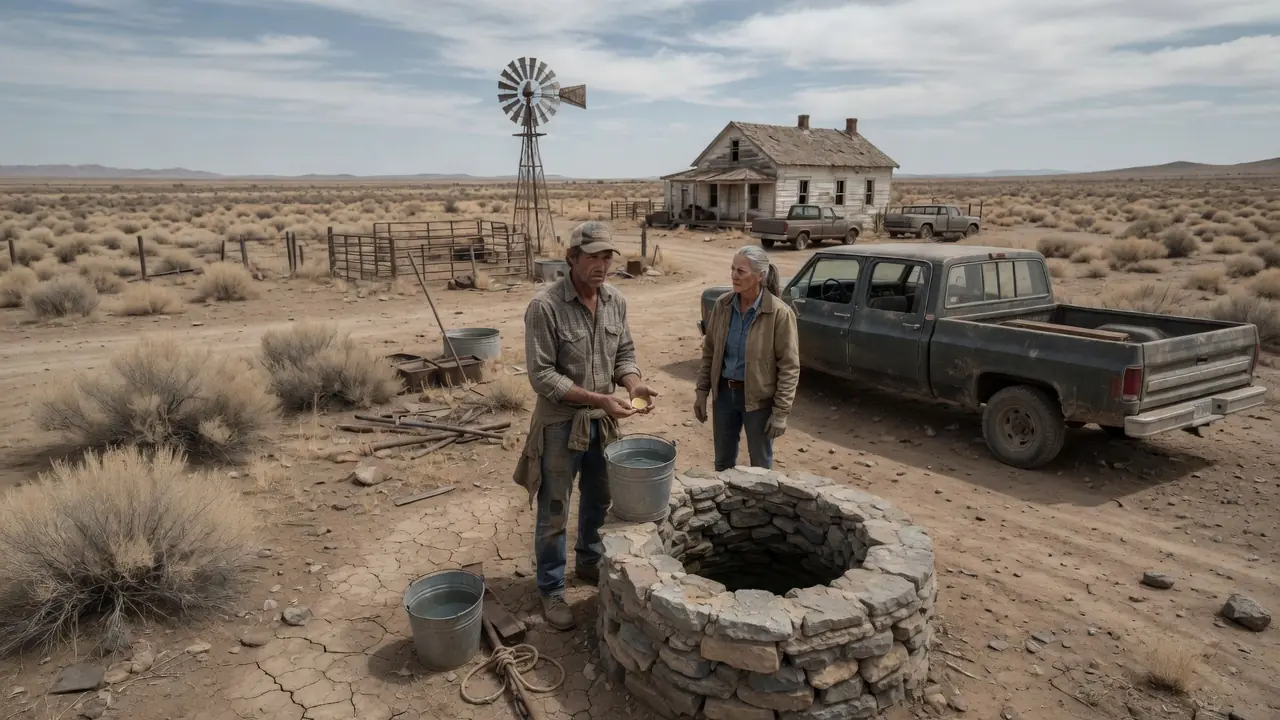
Malachi felt the coin warming in his fist. “Maybe he got scared.”
“Sterling was too stubborn to scare easy,” Cora said. “But after he started pulling coins from that well, he changed. Stopped buying feed in town, stopped answering when neighbors stopped by, started talking about hidden wealth and the people watching him from the hills.”
“That sounds like rumor.”
“So did the dry well,” Cora replied.
Malachi looked at the water again. The bucket sat on the dirt like evidence against every warning he had been given. He wanted Cora to be wrong. He needed her to be wrong, because a working well could mean his family coming back and his children running through a yard that belonged to them. A strange coin did not outweigh cold water, at least not yet.
Cora reached into her jacket pocket and pulled out a small cloth bundle. She opened it carefully, revealing another coin nearly identical to the one in Malachi’s hand. “I found this on my property three days after Sterling disappeared,” she said. “Buried in the dirt floor of my chicken coop, like somebody wanted me to find it.”
Malachi stared at the coin. The same unusual weight, the same worn shine, the same markings that seemed half official and half foreign. “Why would it be in your chicken coop?”
“I’ve been asking that for twenty years.”
“What did the sheriff say?”
Cora gave a dry laugh. “The sheriff said Sterling probably ran off, and the coin was none of my concern. Then he told me not to go poking around abandoned wells unless I wanted trouble.” She wrapped the coin again and tucked it away. “That was when I understood trouble already had a badge, or a friend with one.”
Malachi turned back to the well. The rope lay over the stone rim, still damp from the bucket. Everything in him wanted to lower it again. One coin could be an accident, but if there were more, he might finally have money for pump parts, seed, fencing, maybe even a lawyer to check the land transfer properly.
“You’re thinking like Sterling,” Cora said.
“I’m thinking like a man with no money.”
“That’s exactly how the well gets men to listen.”
Malachi looked at her sharply. “Wells don’t get men to do anything.”
“No,” Cora said. “But people do. And somebody used that well long before you signed your name at the county office.”
The sentence stayed with him after Cora drove away. He promised her he would not climb down before checking the house, the county records, and the old pump line. It was a promise made honestly and broken before sunset. The water kept calling to his common sense, not like a ghost, not like magic, but like something every broke farmer understands: proof that survival might be buried one more bucket down.
At dusk, Malachi lowered the bucket again. This time it came up with more water and two smaller coins lying at the bottom. He set them on the wellstone, then lowered a flashlight on a rope. The beam swung below, touching damp stone, old scratch marks, and something that looked like a ledge thirty feet down.
His heart began pounding. Someone had worked inside that well. Not by accident, not by dropping loose coins into water, but carefully, repeatedly, using the stone wall like a hiding place. Malachi tied the rope around his waist, tested the knot, and climbed down using old iron footholds set into the inner wall.
The air grew cool around him. The deeper he went, the more the outside world shrank into a bright circle above his head. His boots touched a stone ledge just above the waterline, and his flashlight showed tool marks in the wall. Behind a loose section of stone, something metal reflected back at him.
He pried it free with a screwdriver from his belt. It was a small rusted lockbox wrapped in oilcloth and wedged deep enough that no bucket would have lifted it. He carried it up carefully, arms shaking by the time he climbed over the rim. The sun had dropped low, and the ranch lay in purple shadow.
Inside the lockbox was a packet of papers sealed in plastic, a brittle notebook, and a letter written in a shaky hand. The letter began with a name: Sterling Boon. Malachi sat on the wellstone and read while the desert wind moved through the dry brush.
“To whoever finds this, the coins are not treasure. They are bait.”
Malachi read the line twice.
Sterling wrote that the ranch had been used for years as a hiding place in a water-smuggling and land-fraud scheme. The gold coins were old payment pieces, planted or hidden to draw desperate claimants deeper into the property. The real value was not the coins, but the records Sterling had found linking county officials, private investors, and water brokers who had secretly redirected groundwater rights from abandoned ranches to commercial buyers.
Malachi’s mouth went dry. Water rights were worth more than gold in New Mexico. A poor man could own land and still lose everything if someone else controlled the water under it. If Sterling had discovered that the well was active and illegally hidden, then the ranch was not worthless at all.
The notebook contained dates, names, vehicle descriptions, and references to an old church foundation north of the property. Sterling had written that he had hidden the full records there because he believed someone searched the house while he slept. The final page held one sentence that made Malachi stand up and look toward the hills. “If I disappear, it means they know I found the water.”
A branch snapped behind the empty cattle pen.
Malachi shut the box and killed the flashlight. For a long second, the ranch seemed silent except for the wind. Then he heard voices near the old pump shed. Low voices, careful voices, the kind made by men who expected to be alone.
He moved toward the farmhouse, holding the lockbox against his ribs. His pickup was parked near the front, too exposed, and his horse trailer was empty because he had sold the last mare months ago. The only working engine close enough was his truck, but two shadows stood between him and the driveway.
Malachi slipped through the back door of the farmhouse. Inside, Sterling Boon’s life still lingered under dust: a coffee mug on the table, a jacket hanging by a nail, boots beside the bedroom wall, old feed receipts stacked under a cracked lamp. It looked less like a house abandoned by choice and more like a life interrupted mid-breath. Malachi crouched near the kitchen window and watched three men approach the well.
The one in front wore a dark ranch jacket and carried himself like an owner, not a worker. The two behind him moved with the quiet efficiency of hired security. They did not look around in confusion. They went straight to the well and shone a light inside.
“He found it,” one of them said.
“Of course he did,” the leader answered. “Broke farmers always look where hope tells them to look.”
Malachi felt anger cut through the fear. He had been called broke before, desperate before, foolish before. But hearing a stranger describe poverty like a tool they could use against him made something inside him harden. He backed away from the window, searching the house for another way out.
In the small bedroom, he found newer boards against the old floor. One was loose, not nailed, only fitted into place. Beneath it was a canvas satchel wrapped in plastic. Sterling again. The man had planned for someone like Malachi, or maybe for himself if he got one more chance.
Inside the satchel were copies of land deeds, water surveys, county transfer maps, and photographs of trucks loading equipment near the old church foundation. There were names written in Sterling’s handwriting, including two county water officials, a developer from Albuquerque, and a private drilling company. At the bottom was a flash drive sealed in a plastic sleeve, newer than the rest and marked with black tape.
Malachi stared at it. Sterling had not vanished twenty years ago, then. Someone after him had updated the cache. That meant the scheme had continued, and someone else had tried to leave proof.
The front door creaked.
Malachi grabbed the satchel, slipped through the bedroom window, and dropped into dry weeds behind the house. He ran low toward the abandoned cattle pen as voices rose inside. A flashlight beam swept over the porch, then the yard, then the shed. He reached his pickup, eased the door open, and slid inside without turning on the dome light.
The engine coughed once before catching. The sound tore the night open. Men shouted behind him, and Malachi slammed the truck into gear, fishtailing through dust as he took the back track north instead of the driveway. His headlights bounced over ruts, brush scraping both doors while the lockbox and satchel slid across the passenger seat.
He did not drive toward town. If Cora was right about the sheriff, town was the wrong direction. He drove east, cutting across two dry washes and a cattle trail until Cora Maddox’s ranch lights appeared in the distance. She came out before he reached the porch, shotgun low at her side, gray hair loose from sleep, face sharp under the porch light.
“I found Sterling’s papers,” Malachi said before she could speak.
Cora looked past him at the dark road. “Were you followed?”
“I don’t know.”
“Then get inside.”
They spread the papers across Cora’s kitchen table. Her ranch house smelled like coffee, dust, and hay, and the practical order of it made Malachi feel how close he had come to losing control of his own story. Cora read the letter without interrupting, then read the maps, then sat down slowly. The anger on her face was not surprise; it was confirmation.
“I knew the water table never dropped the way they said,” she whispered. “My east pasture lost pressure the same year Sterling disappeared. The county told me it was drought.”
“Was it?”
“Partly. But drought was the excuse, not the whole cause.”
Cora opened an old file cabinet and pulled out her own records: water bills, pressure readings, pump repairs, letters to county offices, unanswered complaints, and photographs of dry troughs from years when neighboring commercial properties somehow expanded irrigation. Malachi watched her line them up with Sterling’s maps. Piece by piece, the deserted ranch became the center of something much bigger than hidden coins.
At dawn, they drove to Santa Rosa, not the nearest town. Cora knew a retired water rights attorney there named Evelyn Price, a woman who had helped her late husband settle a grazing dispute years earlier. Evelyn was seventy-two, sharp as barbed wire, and unimpressed by drama until she saw the documents. Then she locked her office door and told her assistant to cancel her morning.
“This is not a treasure story,” Evelyn said after two hours. “This is theft.”
Malachi sat across from her in his dusty plaid shirt, hands folded, feeling suddenly larger and smaller at the same time. “Can it be proven?”
“With the right experts, yes. With the wrong sheriff, no.” Evelyn tapped the flash drive. “We take this to the state water engineer’s office, federal land investigators, and one newspaper reporter I trust because he enjoys making powerful people uncomfortable.”
Cora looked at Malachi. “Once this starts, it won’t stay quiet.”
Malachi thought of Hannah and the children in Oklahoma. He thought of the farm he had lost, the men at the bank who had looked at him like failure was contagious, the county clerk sliding free land across the desk like a joke. He thought of the well water shining in the bucket and the way those men had laughed about broke farmers following hope. “Quiet hasn’t done much for me,” he said.
The investigation moved faster than Malachi expected and slower than he wanted. Inspectors came to the ranch with equipment, legal authority, and faces that told him they had already heard enough to take the matter seriously. They tested the well, checked old drilling records, surveyed pipelines that had been buried under brush, and traced unauthorized diversions running from the abandoned ranch toward private holding tanks miles away. The dry well was not dry because nature had emptied it; it had been hidden, capped, and manipulated to keep claimants away while others profited from the water.
The gold coins turned out to be antique payment pieces from an earlier smuggling scheme, but the newer crime was water. Water transferred under false abandonment claims. Water sold through shell companies. Water stolen from poor ranchers who could not afford engineers, lawyers, or years of appeals.
Malachi gave statements three times. Cora gave five. Evelyn stood beside them through every interview, correcting wording, demanding copies, and reminding officials that poor farmers were citizens, not scenery. When one investigator asked Malachi why he had climbed into a dangerous old well alone, Evelyn answered before he could.
“Because your offices told men like him the land was worthless,” she said. “Worthless land makes desperate people dig.”
Six weeks later, arrests began. Not all at once, and not with the satisfaction stories usually promise, but in paperwork, warrants, sealed files, and resigned officials escorted from offices they had treated like private businesses. The developer from Albuquerque was charged. Two water district employees were suspended pending trial. A county official who had approved multiple abandoned-ranch transfers suddenly retired, then learned retirement did not protect him from subpoenas.
Malachi called Hannah the day the state confirmed the ranch had valid water rights. He stood beside the well with his truck parked behind him, one hand on the stone rim. For a few seconds after he told her, she said nothing. Then he heard her crying softly through the phone.
“Is it real this time?” she asked.
Malachi looked into the well, where clean water reflected a circle of sky. “It’s real,” he said. “Not easy. But real.”
Hannah came back two weeks later with the children and a rented trailer full of secondhand furniture. Their son, Eli, ran straight to the empty cattle pen and asked if they could get goats before they got cows. Their daughter, May, stood at the well beside Malachi and looked down with wide eyes. Hannah stepped beside him and took his hand without saying anything for a long while.
The ranch did not become beautiful overnight. Free land never does. Malachi rebuilt the windmill with used parts, repaired the fence one section at a time, cleared brush, fixed the trough, tested soil, and planted a small patch of drought-tolerant forage near the lower wash. Cora brought over a young heifer she said was “too stubborn for polite company,” which Malachi understood as a gift.
He used part of the reward money to buy a better pump and part to pay off the debts that had followed him from his old farm. The rest went into the ranch, not because he trusted land more than money, but because land with water and honest title was the first thing in years that felt like a future. Hannah started keeping books at the kitchen table, labeling folders with a seriousness that made Malachi smile. The children learned quickly that ranch chores did not care whether they were excited to live there.
The old gold coin stayed in a small frame on the kitchen wall. Not as treasure, not as luck, but as a warning. Under it, Hannah wrote in neat letters: “Bait is not the same as blessing.” Malachi liked that because it was true of more than coins.
Three months after the investigation became public, Sterling Boon’s niece came to the ranch. She was a schoolteacher from Arizona who had grown up believing her uncle had abandoned the family. Malachi walked her to the well and showed her the letter. She read it with both hands shaking, then sat on the stone rim and cried for a man she had been taught to resent.
“He didn’t run,” she said.
“No,” Malachi answered. “He tried to tell the truth.”
Samuel Delaney’s grandson came later, carrying a photograph of a stern-faced man beside a windmill from long before Malachi was born. The families of vanished men, ruined ranchers, and cheated landowners began appearing one by one, drawn by the same thing that had drawn Malachi at first: the chance that the dry place might finally give something back. This time, what it gave was not coins. It gave records, answers, and the possibility of repair.
A year after Malachi signed for the ranch, the county held a public hearing under pressure from the state. Malachi wore his cleanest plaid shirt, a worn trucker cap in his hands, and boots still dusty because the pump had needed attention that morning. He spoke for less than five minutes. He told them poor farmers did not need pity, only honest paperwork, working wells, and officials who did not sell their future behind closed doors.
Cora spoke after him. Evelyn spoke after Cora. Then Hannah stood and spoke about what it felt like to leave with two children because a family could not survive another season of promises. By the end, the room was silent in the way rooms become when truth finally has witnesses.
The ranch changed slowly after that. The farmhouse got new porch boards, then new windows, then paint. The cattle pen held three cows by spring, then six by fall. The old wash carried water during monsoon season after Malachi built rock checks and small berms the way a conservation agent taught him.
Every evening, he walked to the well before supper. Sometimes he lowered the bucket just to hear the splash. Sometimes he stood there without doing anything, listening to the windmill turn, the pump hum, the cattle shift, and his children laughing somewhere near the house. The sound of a working place was better than any coin.
People still told the story wrong. They said a poor farmer found treasure in a dry well and became rich. Malachi never cared for that version, because it made the coin the miracle and ignored the work. The truth was that he found water, danger, evidence, neighbors, and the courage to keep asking questions after fear told him to leave.
He did not become rich the way greedy men imagine richness. He became rich in water pressure, clear title, honest records, repaired fences, supper with his family, and mornings when the land needed him and he was glad to be needed. He became rich in the knowledge that the ranch no one wanted had not been dead. It had been hidden.
On the first anniversary of taking possession, Malachi stood beside the well with Hannah, Eli, May, Cora, and Evelyn. They lowered a new bucket together, pulled it up full, and passed a tin cup from hand to hand. The water was cold and clean. Malachi drank last, looking across the ranch that had almost broken every man who came before him.
“What did you really find down there?” Eli asked.
Malachi looked at the well, then at the house, then at the fields beginning to green along the wash. He thought about the coin, the lockbox, Sterling’s letter, the papers, the fear, the chase, the hearings, and the long slow labor of making land live again. Then he smiled.
“Not treasure,” he said. “A chance.”
And for a poor farmer, that had always been worth more than gold.