The clippers were still buzzing when the first officer pointed a rifle through the glass door.
Inside Jungle Cuts, eleven-year-old Noah Bennett sat frozen beneath a black barber cape, one side of his haircut finished and the other still thick around his ear. His barber, twenty-three-year-old Malik Harris, stood behind him holding the clippers in midair.
Nobody understood what was happening.
One moment, music played softly from the speakers. Men talked about basketball, school, work, and whose barbecue sauce had won the neighborhood cookout. Children spun slowly in empty chairs while their parents told them to stop.
The next moment, blue lights covered the windows.
Then came the shouting.
“Hands where we can see them!”
“Everybody stay still!”
“Do not reach for anything!”
Malik switched off the clippers and placed them carefully on the counter.
Noah looked toward his father, who was waiting on a bench near the front window. Andre Bennett raised both hands immediately.
“What’s going on?” Andre asked.
An officer outside struck the glass with one gloved hand.
“Face away from us!”
“There are children in here,” someone called.
“Everybody out! One at a time!”
Teal Weaver stepped from the office at the back of the shop.
At forty-two, Teal had owned Jungle Cuts for nearly nine years. She was a small woman with tightly braided hair, gold-framed glasses, and the composed voice of someone accustomed to calming loud rooms without raising her own volume.
She saw the officers.
Saw the rifles.
Saw the terrified children.
And understood immediately that whatever happened next could destroy more than one afternoon.
“Everyone listen to me,” she said.
The room quieted enough to hear her.
“Keep your hands visible. Move slowly. Do exactly what they say.”
A mother near the shampoo stations pulled her six-year-old daughter close.
The child began crying.
Teal walked toward the entrance with both hands raised.
“I’m the owner,” she called through the glass. “There are families and children inside.”
“Open the door and step back!”
“The door is unlocked.”
“Step away from it!”
Teal obeyed.
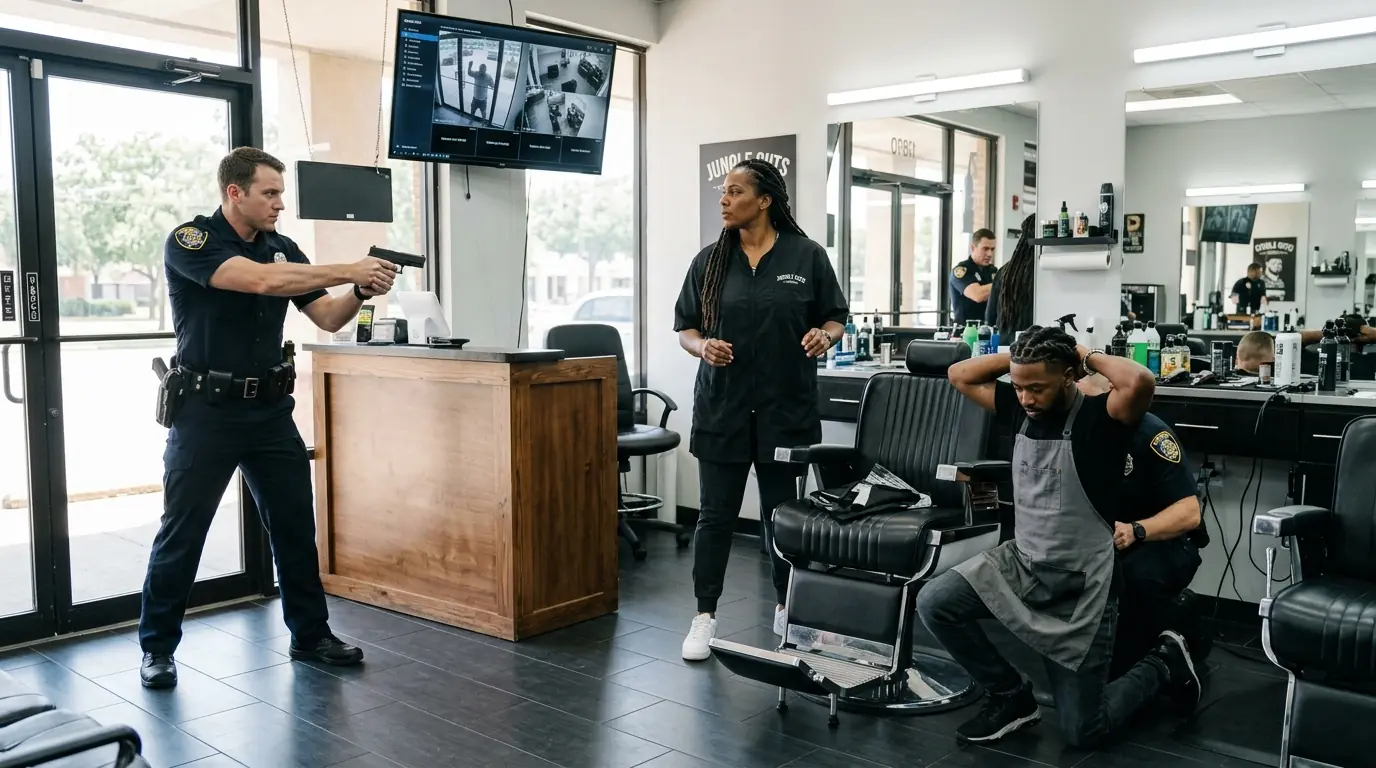
Two officers entered first.
Their weapons swept across the room.
One barrel passed over the mirrors, the product shelves, and the framed photographs on the walls. Another moved toward the waiting area, where three children stood beside their parents.
Noah watched the rifle pass in his direction.
He lowered his face beneath the cape.
Andre took one step toward his son.
“Sir, stop moving!”
“That’s my child.”
“Put your hands on the back of your head!”
Andre complied.
An officer moved behind him and pulled his arms down.
“What are you doing?” Andre asked.
“Hands behind your back.”
“I haven’t done anything.”
“Stop resisting.”
“I’m not resisting.”
The handcuffs closed around his wrists.
Noah lifted his head.
“Dad?”
Andre turned instinctively.
The officer tightened his hold.
“Face forward.”
“He’s scared.”
“Then cooperate.”
Andre looked toward Noah.
“I’m okay,” he said. “You stay right there.”
The boy did not believe him.
Across the shop, Malik was ordered to lie face-down beside his workstation. A customer still wearing a white cutting cape was placed on his knees near the wall.
Another barber, Reggie Cole, stood with both palms pressed against the mirror while an officer searched his waistband.
“What are we being detained for?” Reggie asked.
“We’ll explain when the scene is secure.”
“What scene?”
“Stop talking.”
Teal remained near the center of the shop.
“Officer, nobody here is armed.”
“You don’t know what information we received.”
“This is my business. I know who is inside.”
“Turn around.”
Teal did not move immediately.
The officer’s voice sharpened.
“Turn around and put your hands behind your back.”
“I am trying to keep these children calm.”
“You can do that after we secure you.”
Teal looked toward the mothers, fathers, barbers, and customers who trusted her.
Then she turned.
The officer placed her in handcuffs.
No one inside Jungle Cuts was under arrest.
No officer had yet identified a weapon.
No evidence of a crime had been found.
But to the people outside, none of that was visible.
What they saw was a line of patrol vehicles in front of the shop.
They saw barbers and customers being led out with their hands raised.
They saw Teal Weaver, the owner, placed against a police cruiser while officers searched her building.
Phones appeared almost immediately.
A teenager across the street recorded through the fence of the high school.
A woman leaving the pharmacy slowed her car and filmed.
A delivery driver posted a short video online with the caption:
Police raid barbershop across from Westfield High.
Before the officers had finished clearing the first room, the video had begun spreading.
Teal had opened Jungle Cuts because she wanted a place that felt safe.
Not fashionable.
Not exclusive.
Safe.
Her father had cut hair in their kitchen when she was a child. Men from the neighborhood sat beneath an old bedsheet while he worked with a pair of clippers plugged into an extension cord.
Teal remembered the conversations more clearly than the haircuts.
Men discussed jobs they had lost and jobs they hoped to find. Teenagers asked questions they were too embarrassed to ask their parents. Fathers brought sons who had stopped speaking to them and found that sitting side by side made silence easier.
A barbershop was never only a barbershop.
After working for several salon chains, Teal saved enough money to lease a narrow storefront across from Westfield High School.
The first year nearly ended her dream.
A barber she hired caused a confrontation on his first day. Two customers argued, a chair was damaged, and a video posted online made the shop look like a place where fights happened regularly.
Teal fired the barber and paid for the repairs herself.
Three years later, one of her longest-serving barbers, Marcus Hill, died unexpectedly from a heart condition after closing the shop one evening. His empty chair remained covered for a month.
Police had visited the building before.
Once, officers came looking for teenagers who had damaged cars in the school parking lot.
Another time, a special-needs adult who regularly jogged along the street went missing, and officers asked whether anyone in the shop had seen him.
On one occasion, Teal called police herself after several teenagers refused to leave and began threatening customers.
Every visit created rumors.
People driving past saw patrol cars and formed their own explanations.
Drugs.
Fighting.
Gang activity.
Trouble.
Teal spent years trying to build a reputation strong enough to survive assumptions.
She sponsored youth basketball uniforms.
She gave free haircuts before the first day of school.
Every December, Jungle Cuts collected coats and toys for local families.
Students who maintained good grades received discounted cuts.
A retired teacher sat near the entrance on Saturdays and helped children with homework while they waited.
The shop was not perfect.
No real place was.
But it belonged to the community.
That Saturday afternoon, every chair was occupied.
A college student waited for a haircut before a job interview.
A father brought both sons for their monthly cuts.
An elderly customer slept beneath a warm towel near the shampoo station.
There were four children under twelve inside.
Twenty minutes before police arrived, a man Teal did not recognize approached the side entrance.
The side door was normally used by employees and delivery workers. A small coded lockbox beside it held a spare key for emergencies.
Security footage later showed the man pulling hard on the lockbox.
When it did not open, he struck it with the palm of his hand.
Then he pulled again.
Malik noticed through the back window.
“Somebody’s messing with the side door,” he told Teal.
She walked into the service hallway and looked through the glass.
The stranger wore a gray hooded sweatshirt despite the heat. He had a short beard and a red baseball cap.
Teal opened the inner door but kept the security door locked.
“Can I help you?”
“I left my phone in there.”
“In here?”
“Yeah.”
“When?”
“Last night.”
“We weren’t open last night.”
The man glanced toward the lockbox.
“Maybe it was earlier.”
“What kind of phone?”
“Black.”
Teal waited.
He did not offer anything more.
“What’s your name?”
“Why?”
“Because you’re pulling on my lockbox and claiming you left something inside my business.”
The man stepped closer.
“Just let me look.”
“No.”
“You calling me a liar?”
“I’m asking you to leave.”
He grabbed the security-door handle and shook it.
Several customers heard the noise.
Reggie moved into the hallway.
“Everything okay?”
The stranger saw him and released the handle.
“You all act like you own the block.”
Teal looked directly at him.
“I own this business. Leave the property.”
The man backed away.
He pointed at her through the glass.
“You’re going to regret that.”
Then he walked toward the parking lot.
Teal watched until he disappeared between two vehicles.
She considered calling police.
Instead, she photographed the damaged lockbox and told Malik to keep the side door secured.
She did not know the man would call 911 from a prepaid phone seven minutes later.
She did not hear him tell the dispatcher that several armed men were holding people inside the barbershop.
She did not know he described rifles, screaming children, and a man bleeding near the back door.
By the time the call reached patrol units, it had been classified as a possible armed hostage situation.
The responding officers did not know about the lockbox.
They did not know about the stranger.
They knew only that an anonymous caller claimed armed people were inside Jungle Cuts with children.
That information explained the rifles.
It did not erase what happened after officers arrived.
Sergeant Daniel Price was the first supervisor on the scene.
He had served in the department for fifteen years and responded to two genuine active-shooter incidents. One occurred at a warehouse. The other began as a domestic dispute inside a restaurant.
In both cases, early information had been incomplete.
In one case, hesitation cost a life.
Daniel carried that memory every time a call mentioned a gun.
When he reached Jungle Cuts, he saw customers moving behind the windows.
He did not see visible weapons.
He did not hear screaming.
The shop appeared busy but ordinary.
Then dispatch repeated the caller’s claim that at least two armed men were inside.
Daniel made his decision.
Treat the threat as real until proven otherwise.
Officers surrounded the entrances.
Daniel ordered everyone removed and detained while the building was searched.
From a tactical perspective, the plan was clear.
From inside the shop, it felt like an invasion.
Barbers were separated from customers.
Adults were handcuffed without explanation.
Children stood against walls while officers pointed weapons through the room.
One officer shouted at Malik after he asked whether he could move Noah away from the barber chair.
Another kicked a pair of clippers aside because he mistook the cord in Malik’s hand for an object he had been ordered to drop.
Teal repeatedly asked officers to let the mothers take their children outside.
No one answered.
The search lasted nine minutes.
To those in handcuffs, it felt much longer.
Officers opened cabinets, closets, the supply room, and Teal’s office.
They found scissors.
Razors.
Electric clippers.
Hair products.
A small refrigerator containing bottled water and children’s juice.
No rifles.
No injured hostages.
No blood.
No crime.
Daniel stood in the back hallway looking at the damaged lockbox when Officer Lena Morales approached.
“Building is clear.”
“Any weapons?”
“Nothing beyond normal barber tools.”
“Victims?”
“None.”
Daniel looked through the side-door window.
The security camera above it pointed toward the parking lot.
“Get the owner.”
Teal was brought inside still wearing handcuffs.
Daniel pointed toward the lockbox.
“What happened here?”
“A man tried to pull it open.”
“When?”
“About twenty minutes before you arrived.”
“Did he enter the shop?”
“No.”
“Did he have a weapon?”
“Not that I saw.”
“Did he threaten anyone?”
“He said I would regret making him leave.”
Daniel stared at the damaged metal.
“Do you have cameras?”
“Every entrance.”
He asked an officer to remove Teal’s handcuffs.
The metal opened with a click.
Teal rubbed her wrists.
“Now take them off everyone else.”
“We still need to finish—”
“There is no weapon. There is no hostage. You searched my building.”
Daniel looked toward the shop.
Andre remained cuffed beside the front window while Noah watched from the barber chair.
The child’s face stayed partly hidden beneath the black cape.
Daniel felt the scene shift inside him.
The anonymous call had created the emergency.
But now that the information no longer matched reality, continuing the same level of force would create a different kind of danger.
“Release them,” he ordered.
The handcuffs came off.
No one relaxed.
The officers lowered their weapons.
No one forgot where the barrels had been.
Andre went immediately to Noah.
The child climbed out of the chair and pressed himself against his father.
“Did they arrest you?”
“No.”
“Why did they put those things on you?”
Andre looked toward the officers.
He had no answer that would make sense to an eleven-year-old.
“They were confused,” he said finally.
“About what?”
Andre placed one hand on the back of Noah’s head.
“About who was dangerous.”
Across the shop, Malik picked up his clippers.
The plastic casing had cracked when the officer kicked them.
He turned them over in his hands.
“These cost three hundred dollars.”
No one responded.
Teal walked toward Daniel.
“Are we free to open?”
“You may resume business once we finish taking statements.”
“Are any of us suspected of a crime?”
“No.”
“Was anyone arrested?”
“No.”
“Then I need you to say that outside.”
Daniel looked toward the windows.
At least twenty people now stood in the parking lot recording.
“That isn’t standard procedure.”
“Neither is what just happened in here.”
“We responded to a report of armed people and hostages.”
“And you found neither.”
“The caller provided detailed information.”
“The caller lied.”
“We don’t know that yet.”
Teal pointed toward the security system.
“You will.”
Daniel studied her.
Her voice remained controlled.
That control made the accusation harder to dismiss.
“You led my customers out in handcuffs,” she said. “People are filming. By tonight, half this city will believe you raided us for drugs or guns.”
“We cannot control what people post online.”
“You can control what you say when you leave.”
Daniel did not answer immediately.
Teal continued.
“You arrived because of incomplete information. The people outside have incomplete information now. Are you going to correct that, or are you going to leave us to carry the damage?”
Daniel looked toward Officer Morales.
She gave the smallest nod.
Ten minutes later, Daniel stood in front of the shop and addressed the people recording.
“We responded to a report of a possible armed incident inside this business,” he said. “Our search found no weapons, no injured persons, and no evidence that the owner, employees, or customers committed any crime. No one associated with Jungle Cuts has been arrested or charged.”
The statement appeared online within minutes.
It did not travel as quickly as the first video.
Bad news rarely needed help.
Corrections did.
Jungle Cuts reopened after the police left.
Teal considered closing for the day.
Then Noah asked whether Malik could finish his haircut.
Malik looked at the damaged clippers.
“I have another pair.”
Andre gave his son a choice.
“We can go home.”
Noah looked toward the windows.
People outside still watched.
Some held phones.
He sat back in the chair.
“I want to finish.”
Malik placed a fresh cape around him.
The music remained off.
The first sound inside the shop was the buzz of replacement clippers.
One by one, other customers returned to their chairs.
A mother sat beside her daughter rather than across the room.
Reggie swept hair from the floor where officers had made him lie down.
Teal stood behind the front counter and watched everyone attempt to act normally.
Nothing felt normal.
When Malik finished, he turned Noah toward the mirror.
The haircut was clean.
Sharp around the sides.
Even across the top.
“What do you think?” Malik asked.
Noah stared at his reflection.
Then he looked toward the front door.
“Do police think barbers are bad?”
The room became quiet again.
Malik opened his mouth but could not find an answer.
Teal walked over.
She crouched beside the chair.
“No,” she said. “Police received information that made them believe someone here might be dangerous.”
“But nobody was.”
“No.”
“Then why did they point guns?”
Teal looked at Andre.
He left the answer to her.
“Sometimes people become afraid before they understand what they’re looking at,” she said.
Noah frowned.
“Are they supposed to do that?”
“They are supposed to protect people.”
“Did they protect us?”
Teal looked around the shop.
At Malik’s broken clippers.
At the red marks around Andre’s wrists.
At the little girl who refused to release her mother’s hand.
“Not as well as they should have,” she said.
Noah nodded slowly.
It was not a comforting answer.
But it was honest.
By evening, Teal’s phone would not stop ringing.
Some calls came from customers checking on the barbers.
Others came from people demanding to know what crime had occurred.
One caller asked whether drugs had been found.
Another said he would never bring his children near a business that attracted “that kind of police response.”
Teal’s sister found three social-media posts claiming multiple arrests had taken place.
None were true.
Teal sat in her office after closing and wrote a public statement.
She explained that no employee or customer had been arrested, charged, or found involved in criminal activity.
She described the unknown man pulling on the lockbox.
She explained why the staff had refused him entry.
She acknowledged that law enforcement responded based on information officers received but asked the community not to spread false claims.
Then she wrote the sentence that mattered most to her.
Jungle Cuts was created as a safe place for our clients, our staff, and the children who grow up in these chairs. One false report should not erase nine years of service.
She posted it shortly before midnight.
The response surprised her.
Parents shared photographs of their children receiving first haircuts at Jungle Cuts.
Former employees wrote about Teal helping them through difficult years.
Teachers described students arriving at school on Mondays proud of haircuts they received for free.
Marcus Hill’s widow posted a photograph of his covered chair after his death.
This shop carried my family when we could not carry ourselves.
By morning, the support posts outnumbered the rumors.
But the body-camera footage had not yet been released.
When it became public two weeks later, everything changed again.
Viewers saw the rifles.
They saw Andre handcuffed while Noah watched.
They saw Teal trying to explain that children were present.
They heard an officer tell Reggie to stop talking after he asked why he was detained.
They saw the empty shop being searched.
They also heard the information officers had received.
Possible hostages.
Armed suspects.
A man bleeding near the rear entrance.
The footage did not provide a simple story.
The officers had not invented the call.
The people inside had done nothing wrong.
Both things were true.
What angered Teal was how long it took for the officers to respond to what they could see rather than what the caller had said.
Within seconds of entering, they saw children receiving haircuts.
They saw no wounded victim.
They saw no one threatening anyone.
Yet the entire shop was still treated as hostile.
The department announced an internal review.
Teal received invitations from news programs, activists, and attorneys.
She declined most of them.
She did not want Jungle Cuts reduced to a symbol in someone else’s argument.
She wanted three things.
The false caller identified.
The department to acknowledge how the response affected the children.
A policy requiring officers to reassess threat information as soon as a scene contradicted what dispatch had reported.
Detectives eventually traced the anonymous call.
The prepaid phone had been purchased with a debit card.
Security video from a gas station showed the buyer.
It was the man in the gray hoodie.
His name was Curtis Vale.
He had no phone inside Jungle Cuts.
He had approached the lockbox because he believed the spare key might allow him to enter through the side door and steal cash after closing.
When Teal confronted him, he left angry and humiliated.
He called police to punish the business.
Curtis later admitted he invented the rifles and hostages because he believed officers would respond faster.
He did not expect the call to become a major incident.
Few people who light matches expect to see the whole building burn.
Curtis was arrested for filing the false report and attempting to unlawfully enter the business.
News of the arrest helped restore Jungle Cuts’ reputation.
It did not erase what the children remembered.
Noah began ducking whenever police sirens passed his family’s car.
The six-year-old girl near the shampoo station had nightmares about men entering her house with guns.
Malik stopped working near the front window.
Andre filed a formal complaint regarding the handcuffing and the officer’s refusal to let him comfort his son.
Teal attended a meeting with Police Chief Evelyn Ross and Sergeant Daniel Price.
Daniel arrived without his uniform.
He looked different in a plain blue shirt.
Less like authority.
More like a tired man trying to explain a decision that had looked clear from inside a patrol car and terrible from inside a barbershop.
“We believed there were armed suspects and children being held,” he said.
“I understand the call,” Teal replied. “I don’t understand why you kept believing it after you entered.”
Daniel looked at the table.
“That is the part I’ve been reviewing.”
“You saw barbers cutting hair.”
“Yes.”
“You saw customers in chairs.”
“Yes.”
“You saw children.”
“Yes.”
“How long before you found no injured person?”
“Within the first minute.”
“How long before you removed the handcuffs?”
“Approximately eleven minutes.”
Teal leaned back.
“That is ten minutes in which what you saw did not matter as much as what an anonymous stranger told you.”
Daniel did not argue.
Chief Ross placed the body-camera timeline on the table.
“We are changing the response protocol,” she said. “High-risk calls will still receive a high-risk response. But once officers enter, the scene commander must document an immediate reassessment based on observable conditions.”
“Will that stop rifles from being pointed into a room with children?”
“It should reduce the time weapons remain directed at compliant civilians once no immediate threat is visible.”
Teal shook her head.
“That sounds like policy language.”
“It is.”
“Children don’t remember policy language.”
Chief Ross met her eyes.
“No. They remember fear.”
The admission changed the room.
Teal had expected defense.
Not understanding.
Daniel spoke next.
“I saw your son—”
“He was not my son.”
“Sorry. Noah. I saw him after the scene.”
Teal waited.
“He looked at me as though I was the danger.”
“You were holding a rifle.”
“Yes.”
Daniel folded his hands.
“I’ve spent my career believing that if I entered forcefully enough, I could prevent someone from being hurt. That day, force became the thing hurting people.”
Teal studied him.
An apology did not repair trust.
But refusing to hear one would not protect the next child.
“What are you going to do with that realization?” she asked.
Daniel answered carefully.
“Teach it.”
The department later used the Jungle Cuts footage in scenario training.
Officers watched the dispatch report first.
Then the body-camera video.
They were asked to identify the exact moment the perceived threat should have been reassessed.
Some chose the moment officers saw children in barber chairs.
Others chose the first room search showing no weapons or victims.
The instructors paused the video when Andre reached toward Noah and was handcuffed.
“What is the threat?” they asked.
No one could identify one.
A year later, Daniel visited Jungle Cuts in uniform.
He did not arrive with lights.
He came alone.
The shop was full.
Conversations paused when he entered.
Teal looked up from the counter.
“Can I help you?”
“I need a haircut.”
Several customers glanced at one another.
Teal pointed toward Malik’s chair.
“He has an opening.”
Daniel sat.
Malik placed the cape around him.
“What are we doing?”
“Short on the sides.”
“You trust me near your head with sharp objects?”
Daniel looked at him through the mirror.
“I’m trying to.”
Malik switched on the clippers.
The room slowly resumed talking.
Noah was there with Andre, waiting for his monthly cut.
He watched Daniel for several minutes before approaching.
“You were here that day.”
Daniel turned his head slightly.
Malik guided it forward again.
“Don’t move.”
“Yes,” Daniel said. “I was.”
“You had the big gun.”
“Yes.”
“Do you still think we’re dangerous?”
Daniel looked at Noah through the mirror.
“No.”
“How do you know?”
“Because I looked again.”
Noah considered the answer.
“You should have looked sooner.”
Daniel nodded.
“You’re right.”
Noah returned to his father.
Malik continued the haircut.
When it was finished, Daniel paid twice the listed price.
Malik handed half back.
“You don’t buy forgiveness with tips.”
“I know.”
“Then what’s this?”
“For the clippers my officer broke.”
Malik looked at the money.
The damaged pair still sat on a shelf above his station.
He kept them there deliberately.
Not as a trophy.
As evidence.
He accepted the payment.
“Next time, ask before you kick something.”
“Next time, I will.”
Jungle Cuts remained open.
The business survived the rumors, the videos, and the weeks when strangers drove slowly past just to stare.
The damaged lockbox was never replaced.
Teal mounted it inside the shop near the community bulletin board.
Beneath it, she placed a small sign.
Incomplete information can unlock dangerous assumptions. Ask what is true before deciding who is dangerous.
Parents still brought children.
Students still came before dances and graduation photographs.
The retired teacher continued helping with homework on Saturdays.
A framed photograph of Marcus Hill remained near his old chair.
The shop was not famous for long.
Public attention moved to the next outrage, the next video, the next argument.
Teal preferred it that way.
She had never wanted Jungle Cuts to become known as the barbershop police stormed.
She wanted it known as the place where a child could sit in a chair, hear the clippers begin, and know the adults around him would keep him safe.
One Saturday afternoon, almost two years after the incident, Noah returned alone for the first time.
Andre dropped him at the door and went to run errands.
Noah was taller now.
His voice had begun changing.
He sat in Malik’s chair and described exactly how he wanted his haircut.
Halfway through, a patrol car stopped outside.
Noah’s shoulders tightened.
Malik noticed in the mirror.
The officer entered carrying a stack of missing-person flyers for a teenager from the neighborhood.
He asked permission to place them near the entrance.
Teal agreed.
The officer thanked her and left.
No guns.
No shouting.
No handcuffs.
Just a question and an answer.
Noah watched the patrol car drive away.
Then his shoulders relaxed.
Malik turned the chair slightly.
“You good?”
Noah nodded.
“Yeah.”
The clippers resumed buzzing.
Outside, cars passed along the street.
Students crossed from the high school.
People came and went without stopping to wonder what kind of place Jungle Cuts might be.
Inside, the shop sounded exactly as Teal had always intended.
Laughter.
Conversation.
Children asking impatiently when it would be their turn.
Clippers moving steadily through hair.
A business continuing because the people inside refused to let one frightening morning become the only story anyone remembered.