The folded American flag struck the wet pavement before Daniel Mercer did.
The wooden case hit the curb first.
Its glass front shattered with a sharp crack, scattering fragments across the gutter. The folded triangle slipped free, struck the rainwater, and began absorbing the gray mixture of mud, road salt, and dead leaves running along the edge of Willow Creek Road.
Three feet away, Daniel’s body locked beneath the force of the Taser.
His legs gave out.
His shoulder struck the asphalt.
For five full seconds, electricity seized every muscle in his body while two police officers shouted commands he could not physically obey.
“Hands behind your back!”
“Stop reaching!”
“Don’t move!”
Daniel heard them as though they were yelling from the far end of a tunnel.
The only thing he could see clearly was the flag.
Maya’s flag.
The one that had covered his wife’s casket less than an hour earlier.
When the electrical cycle ended, Daniel dragged in a ragged breath and reached toward it.
Not toward the umbrella lying ten feet away.
Not toward the inside pocket of his Marine dress uniform.
Toward the red, white, and blue fabric soaking in the gutter.
Officer Calvin Reese drove a knee into the center of Daniel’s back.
“Hands behind you!”
Daniel’s cheek pressed against the freezing road.
“I’m not fighting,” he gasped.
His fingers remained extended toward the flag.
“I’m not fighting. Please… that belongs to my wife.”
Reese pulled Daniel’s arm backward.
The steel cuff closed around his wrist.
Beside them, Officer Evan Parker stood frozen with the Taser still raised, watching the decorated man on the ground sob over a piece of cloth he had mistaken for evidence.
Then the sound of diesel engines rolled down the cemetery road.
It began as a low vibration beneath the pavement.
Within seconds, headlights appeared through the rain.
Three pickup trucks came around the bend, moving faster than anyone should have driven on the slick road. The lead truck stopped diagonally in front of the police cruiser. The other two came to rest behind it, leaving little room for the patrol vehicle to leave.
The doors opened.
Twelve men stepped into the rain.
Every one of them wore the dark blue uniform of the United States Marine Corps.
Captain Raymond Cole closed the driver’s door of the lead truck and looked toward Daniel.
His eyes moved from the handcuff to Reese’s knee.
Then to the broken case.
Then to the burial flag in the gutter.
When he spoke, he did not shout.
“Take your hands off my Marine.”
An hour earlier, Daniel Mercer had stood beside an open grave beneath an Illinois sky the color of old steel.
Rain moved through Oakwood Cemetery in a fine, persistent mist.
It collected on the shoulders of his dress blues and ran in small streams along the brim of his white cover. Medals rested above his heart: a Silver Star, a Purple Heart, a Navy and Marine Corps Achievement Medal, and ribbons representing three combat deployments.
None of them helped him stand upright.
The casket in front of him contained Maya Mercer, his wife of six years.
She had not died in combat.
For three years, she had fought leukemia from hospital rooms, infusion centers, and the narrow bed they kept near the living-room window during her final months.
Daniel had spent most of his adult life learning how to locate danger, measure it, and move through it.
Cancer did not obey those rules.
It could not be intimidated.
It did not care that Daniel had survived an ambush outside Fallujah or carried an injured radio operator through gunfire in Helmand Province.
It took Maya slowly.
First her strength.
Then her hair.
Then the appetite that had once made her steal food from Daniel’s plate while insisting she was not hungry.
Finally, it took her breath.
Daniel was beside her when the monitor flattened into one continuous tone.
Maya’s final clear sentence had come the night before.
“Promise me you’ll keep breathing.”
Daniel had tried to smile.
“That sounds simple.”
“It won’t be.”
She had known him too well.
At the cemetery, an honor guard lifted the flag from the casket and folded it with exact, measured movements.
The final triangle was placed inside a wooden display case Maya’s father had built by hand.
A Marine chaplain presented it to Daniel.
“On behalf of the President of the United States, the Commandant of the Marine Corps, and a grateful nation, please accept this flag as a symbol of our appreciation for your wife’s devotion and sacrifice.”
Maya had never worn a uniform.
But she had moved from base to base, endured deployments, cared for wounded Marines’ families, and spent years supporting the people Daniel called brothers.
The flag honored more than military service.
It honored the life that had stood beside it.
Daniel held the case against his chest.
Captain Raymond Cole waited until the other mourners began walking toward their vehicles.
“The boys are going to the VFW hall,” Raymond said. “Ride with us.”
Daniel stared at the fresh earth.
“I need a minute.”
“You don’t need to be alone.”
“I’m not going far.”
“The hall is two miles down Willow Creek.”
“I’ll walk.”
Raymond studied his face.
Daniel had barely slept in four days.
“You sure?”
Daniel nodded.
“I need the air.”
Raymond did not believe him.
But grief had stripped Daniel of nearly every choice during the past three years. Raymond would not take away another one.
“All right,” he said. “We’ll go slowly.”
Daniel looked at him.
“I said I want to be alone.”
“We’re headed the same direction.”
Daniel almost argued.
Then he lacked the energy.
Raymond squeezed his shoulder.
“Take your time.”
Willow Creek Road wound down from the cemetery through one of the wealthiest residential areas in the county.
Stone walls bordered large properties hidden behind iron gates. Decorative lamps illuminated driveways longer than some city blocks. Security cameras turned quietly from pillars and trees.
Daniel walked along the shoulder.
He carried Maya’s flag case against his chest and a long black umbrella in his other hand.
He never opened it.
The cold rain soaked through his uniform.
His polished shoes filled with water.
He kept walking.
Maya’s voice moved in and out of his mind.
Her laugh in the kitchen.
Her whisper in the hospital.
Her final request.
Keep breathing.
Halfway down the hill, a wave of grief tightened around his chest.
Daniel stopped beside a stone wall.
He leaned against it, trying to draw air into his lungs.
His body had responded this way twice since Maya died.
The doctors called it a panic response.
Daniel thought of it as the moment his body remembered what his mind was trying not to understand.
He closed his eyes.
“I’m trying, May.”
A silver sedan slowed across the road.
Inside was a man named Gregory Latham.
Gregory chaired the Willow Creek Neighborhood Safety Committee, an organization with no law-enforcement authority but a large email list and a private online group.
He had lived in the subdivision for nineteen years.
He knew which delivery companies were approved at the gate.
He photographed unfamiliar vehicles.
He once followed a teenage landscaper because the young man was wearing a hooded sweatshirt near the community mailbox.
Gregory looked at Daniel through the rain.
He saw a tall Black man wearing a dark uniform he did not recognize.
He saw decorations on Daniel’s chest but interpreted them as tactical equipment.
He saw the glass-fronted box.
He saw the closed umbrella.
And he saw Daniel leaning against the wall, breathing heavily.
Gregory did not lower his window.
He did not ask whether Daniel needed help.
He called 911.
“There’s a suspicious man near the cemetery entrance,” he said.
“What is he doing?”
“Pacing. Acting agitated.”
“Can you describe him?”
“Large male. Dark tactical clothing.”
“Do you see a weapon?”
Gregory narrowed his eyes.
“He’s carrying something long and black. It may be a rifle.”
“Are you certain?”
“I can’t see clearly through the rain, but yes. It looks like a long gun.”
The dispatcher coded the call as a possible armed subject.
Gregory’s uncertainty disappeared from the summary.
What reached the officers was simple:
Suspicious male in tactical clothing. Possible rifle. Behaving erratically near Willow Creek estates.
Officer Calvin Reese had served fifteen years with the Glenhaven Police Department.
He had received commendations for traffic enforcement and two written warnings for aggressive conduct.
His supervisors described him as decisive.
Several residents described him differently.
Reese believed hesitation endangered officers.
He also believed the wealthy Willow Creek district demanded fast results. Complaints from those residents reached the mayor, the police chief, and local news stations more quickly than calls from other neighborhoods.
When the dispatch came through, Reese turned toward his rookie partner.
“That’s the mayor’s neighborhood.”
Evan Parker accelerated.
“Backup is eight minutes away.”
“We won’t wait if he’s armed.”
They reached Daniel less than three minutes later.
Parker stopped the cruiser abruptly, partly blocking the shoulder.
Reese activated the spotlight.
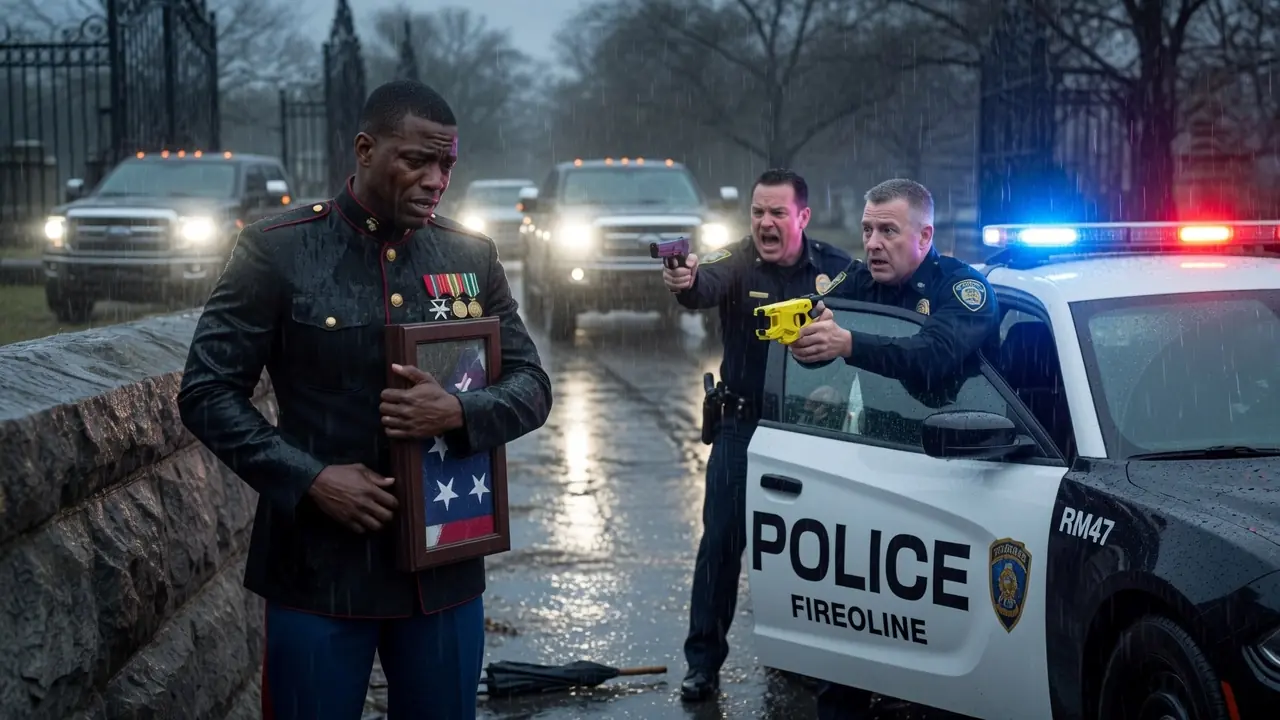
White light struck Daniel directly in the face.
The sudden glare and siren pushed him back fifteen years.
For one instant he was standing at a nighttime checkpoint in Iraq, hearing warning shots and Arabic voices through dust.
He froze.
Reese exited with his pistol drawn.
“Show me your hands!”
Daniel blinked into the light.
“What?”
“Drop the weapon!”
Daniel looked at the umbrella.
He released it immediately.
It struck the road.
“It’s an umbrella.”
“Get on your knees!”
Daniel tightened his arm around the flag case.
“I’m coming from a funeral.”
“Put the box down.”
“I can’t.”
“Put it down now.”
“It has my wife’s flag in it.”
Parker moved behind the cruiser door and raised his Taser.
His academy training told him to watch Daniel’s hands.
His fear told him every motion might be the last warning he received.
Reese advanced.
“Place the box on the ground and get on your knees.”
Daniel looked at the water moving along the curb.
“I’m not putting it in the mud.”
“Do it!”
“My wife was buried today.”
“I don’t care what story you’re telling. Follow the command.”
Daniel’s grief briefly sharpened into anger.
“It isn’t a story.”
Reese raised his pistol higher.
Daniel saw the barrel clearly for the first time.
His anger vanished.
“My name is Gunnery Sergeant Daniel Mercer. United States Marine Corps. My identification is inside my jacket.”
“Keep your hands visible.”
“I can show you.”
“Do not reach.”
Daniel shifted the case into his left arm.
His right hand moved slowly toward the inside pocket of his uniform.
Parker saw only movement toward a concealed area.
“He’s reaching!”
Daniel stopped.
The Taser fired almost immediately.
Captain Raymond Cole had not intended to follow closely.
He and eleven Marines left the cemetery in three trucks, allowing Daniel several minutes of space.
Raymond believed they would collect him near the VFW hall if he changed his mind.
Then the men saw police lights through the rain.
Sergeant Isaac Bennett, seated beside Raymond, leaned forward.
“That’s Daniel.”
They watched the Taser strike him.
Raymond accelerated.
By the time the trucks stopped, Reese had Daniel facedown and Parker was fastening a cuff around his wrist.
The burial flag lay in the gutter.
Isaac was out of the truck before the engine stopped.
Raymond caught his arm.
“No one touches the officers.”
Isaac’s face tightened.
“They shot him.”
“I know.”
“They put Maya’s flag in the street.”
“I see it.”
“Ray—”
“We do this right.”
The Marines spread out behind him, but they did not form a tactical assault line.
They kept their hands visible.
Several began recording.
One called 911 and calmly requested a supervisor and medical assistance for a Taser deployment.
Raymond approached.
“Take your hands off my Marine.”
Reese rose partly from Daniel’s back but kept his pistol directed toward the group.
“Stay back. Active investigation.”
“You have a handcuffed man under your knee.”
“He matched the description of an armed subject.”
Raymond pointed toward the umbrella.
“That?”
“He made a furtive movement.”
“He told you he was reaching for identification.”
“You weren’t here for the commands.”
“We arrived before you put the first cuff on him.”
Parker stared at the Marines’ uniforms.
His breathing became shallow.
Isaac walked slowly toward the gutter.
“Do not touch anything,” Reese warned.
“That is a burial flag.”
“It may be evidence.”
Isaac looked at him.
The expression on his face made Parker lower the Taser.
Isaac knelt among the broken glass.
He carefully gathered the wet flag and lifted it from the runoff. A sharp edge cut his thumb, but he did not react.
He folded the fabric as best he could without placing it back on the ground.
Then he held it against his chest.
Daniel turned his face toward him.
“Ike…”
“I’ve got it.”
Daniel’s eyes closed.
“They broke her case.”
Isaac swallowed.
“I know.”
Reese looked from the flag to Daniel’s medals.
For the first time, uncertainty entered his posture.
Parker whispered, “Sir, maybe we should wait for the supervisor.”
Reese snapped toward him.
“Maintain cover.”
A silver Mercedes rolled slowly from the cemetery direction.
Gregory Latham lowered his window.
“Officers, I made the call.”
Raymond turned.
Gregory pointed toward the umbrella.
“I thought that was a rifle.”
Raymond walked closer to the Mercedes, stopping several feet away.
“You thought.”
“It was raining.”
“You reported certainty.”
“I said it might be a weapon.”
“The dispatcher told them he had a rifle.”
“That isn’t my fault.”
Raymond’s voice remained controlled.
“You saw a man wearing military dress blues walking away from a military funeral.”
“I didn’t know what the uniform was.”
“You saw a Black man in your neighborhood and supplied the rest.”
Gregory’s face reddened.
“That is an unfair accusation.”
“Then stay and explain your call to the supervisor.”
Gregory reached toward the gear selector.
Two Marines moved behind the vehicle, not touching it but preventing him from reversing safely.
“Move away from my car.”
Raymond looked at them.
“Give him space.”
The Marines stepped back.
Gregory remained.
Leaving immediately after initiating an armed response no longer seemed wise.
Chief Adrian Wallace arrived seven minutes later.
He came in an unmarked SUV with a watch commander and two additional officers.
Adrian had spent twenty-eight years in law enforcement.
Before that, he had served six years in the Marine Corps.
He recognized the uniforms before he exited.
He also recognized Daniel.
Daniel’s father had been Adrian’s platoon sergeant during the Gulf War.
Adrian had attended Daniel and Maya’s wedding.
He had received a funeral notice but had been unable to attend because of an emergency budget meeting.
The scene in front of him required no explanation.
Daniel lay facedown.
One wrist was cuffed.
Reese’s knee remained against his lower back.
Isaac held a wet American flag.
The shattered case lay in the road.
An umbrella rested beneath the spotlight.
Adrian approached slowly.
“Officer Reese, remove your knee.”
“Chief, we have an armed-subject call.”
“I see the alleged weapon.”
“He reached inside his jacket.”
“Remove your knee.”
Reese obeyed.
“Unlock the cuff.”
“We haven’t completed the investigation.”
Adrian looked toward Daniel.
“Gunnery Sergeant Mercer, do you have any weapons on you?”
“No, sir.”
“May Officer Parker check the outside of your uniform for a weapon?”
Daniel’s voice broke.
“Yes.”
Parker performed a brief pat-down with trembling hands.
“No weapon.”
“Unlock him.”
The cuff came off.
Raymond and Isaac helped Daniel sit up.
Medical personnel were still approaching, so Adrian instructed him not to stand.
Daniel stared at the wet flag in Isaac’s hands.
“Give it to me.”
Isaac placed it carefully across his arms.
Daniel held the fabric to his chest.
He did not look at the officers.
Adrian crouched beside him.
“Daniel.”
Daniel’s eyes lifted.
Recognition appeared slowly.
“Chief Wallace.”
“I am so sorry.”
Daniel looked down again.
“They thought her flag was stolen property.”
Adrian had no response that would help.
He turned toward Reese.
“Secure your firearm.”
“Chief—”
“Now.”
Reese holstered it.
“You and Officer Parker are relieved from field duty pending review. The watch commander will collect your equipment and transport you separately.”
Reese stared at him.
“You’re suspending me at the scene?”
“I am removing you from a scene where you can no longer exercise sound judgment.”
“I followed a priority call.”
“You arrived at a priority call. What you did afterward will be determined by the evidence.”
Adrian looked toward the body cameras.
“Do not deactivate, mute, or alter those recordings.”
Then he addressed Gregory.
“Mr. Latham, an officer will take a complete statement regarding your 911 call.”
“Am I under arrest?”
“No.”
Gregory appeared relieved.
“That may change if evidence establishes that you knowingly supplied false information. At present, you will remain available and answer truthfully.”
“I made a mistake.”
Adrian glanced at Daniel.
“Yes.”
Daniel was transported to the hospital.
Raymond rode with him.
The Marines followed.
Doctors removed the Taser probes and treated cuts from broken glass, bruising from the fall, and strain to Daniel’s shoulder.
The electrical discharge had not caused permanent physical injury.
The rest was harder to measure.
At the hospital, Daniel refused to release the flag.
A nurse offered a clean sheet to wrap around it.
He allowed her to place the cloth beneath his hands but would not let anyone carry it away.
Raymond sat beside the bed.
“We’ll replace the case.”
Daniel stared toward the wall.
“It was the last thing they gave me.”
“The flag is still here.”
“It isn’t the same.”
“No.”
Raymond did not tell him it would be all right.
Maya had said that because she was dying and needed Daniel to believe survival remained possible.
Raymond would not repeat it carelessly.
“We’ll stay,” he said instead.
Daniel nodded.
The other Marines waited in the corridor.
Some remained in dress blues.
Others had removed soaked jackets and draped them over chairs.
No one went to the VFW hall.
Food arrived and went untouched.
Near midnight, Daniel finally slept.
Isaac sat outside the room with the broken flag case resting beside him.
The department’s internal investigation began before sunrise.
Investigators collected body-camera footage, dash-camera video, dispatch recordings, photographs, medical records, and Gregory’s original 911 call.
The audio was less definite than the dispatch summary.
Gregory repeatedly said the object “looked like” a rifle.
He also described Daniel’s dress blues as tactical clothing.
He did not explicitly mention race in the call.
But investigators examined whether his assumptions had shaped the description and whether dispatch had failed to preserve uncertainty.
The officers’ conduct received separate scrutiny.
The investigation found that Reese was justified in approaching cautiously based on the information provided.
Drawing a firearm during the initial contact was not automatically outside policy.
The central questions involved what occurred after Daniel dropped the umbrella, identified the case as a burial flag, and attempted to explain his uniform.
Body-camera footage showed Reese interrupting Daniel repeatedly.
It showed Daniel verbally identifying himself as a Marine and stating that his identification was in his breast pocket.
It showed Parker firing the Taser less than one second after shouting that Daniel was reaching.
Daniel was not advancing.
He was not holding the alleged weapon.
No officer had clearly instructed him to keep his hand away from the pocket after he announced his intention to retrieve identification.
Reese’s report described Daniel as aggressively resisting on the ground.
Video showed Daniel moving one arm toward the flag while crying and apologizing to his deceased wife.
The report did not mention the funeral.
It did not mention the medals.
It did not mention the umbrella until several paragraphs later.
The chief placed Reese on administrative leave.
Parker was removed from patrol and returned to remedial training while investigators determined whether fear, poor instruction, or inadequate supervision had contributed to the deployment.
The dispatcher also received corrective action for converting a possible weapon into a confirmed long gun in the priority broadcast.
Gregory was not arrested at dawn.
The law required evidence of intentional falsehood, not merely a terrible assumption.
Prosecutors declined to charge him after concluding they could not prove beyond a reasonable doubt that he knowingly fabricated the report.
Daniel found that decision painful but unsurprising.
A person could cause enormous harm through fear and prejudice without crossing the exact line required for a criminal conviction.
Gregory faced other consequences.
His neighborhood committee removed him as chair.
The 911 audio became public.
Residents heard the confidence with which he transformed a grieving veteran into an armed threat.
He issued a written apology.
Daniel did not respond.
Officer Parker requested a meeting several weeks later.
Daniel initially refused.
Then Maya’s father encouraged him to reconsider.
“You don’t owe him forgiveness,” the older man said. “But you may want him to remember your face rather than just the incident number.”
They met in a conference room at the police station.
Parker entered without a uniform.
He looked younger than Daniel remembered.
“I’m sorry,” he said.
Daniel did not answer.
Parker placed both hands on the table.
“I was afraid.”
“So was I.”
“I thought you were reaching for a gun.”
“I told you what I was reaching for.”
“I heard you, but everything was happening fast.”
“It was fast for you.”
Daniel leaned forward.
“For me, that moment lasted long enough to watch my wife’s flag fall into a gutter.”
Parker’s eyes filled.
“I know.”
“No, you watched a video. I watched the last thing from her funeral break because you panicked.”
Parker lowered his head.
“I shouldn’t have fired.”
Daniel looked at him for several seconds.
“Why did you?”
“My training said hands are dangerous. Reese was yelling. The call said rifle. When you moved, all I saw was the pocket.”
“You stopped seeing me.”
“Yes.”
“That is the problem.”
Parker nodded.
“I’m trying to make sure it never happens again.”
Daniel did not forgive him that day.
He also did not tell him forgiveness was impossible.
He stood.
“Then learn to listen before fear finishes the story for you.”
Reese’s disciplinary hearing lasted several months.
The department sustained findings for unnecessary escalation, inaccurate reporting, failure to reassess changing circumstances, and excessive restraint after the Taser deployment.
His previous disciplinary history affected the decision.
He was terminated.
The police union appealed.
An arbitrator later upheld most of the findings and the dismissal.
No federal criminal charges were filed.
Daniel pursued a civil claim against the city.
The case ended in a settlement that included compensation, payment for treatment, an independent review of armed-subject response policies, and mandatory instruction on communicating with people experiencing grief, panic, or combat-related trauma.
Daniel insisted that the training not become a ceremonial presentation about respecting veterans.
“What happened would have been wrong if I had never served,” he told the city attorney. “The medals only made people pay attention afterward.”
That sentence became central to the reform agreement.
A civilian did not need a Silver Star to deserve careful assessment.
A burial flag did not need to belong to a Marine family to remain sacred.
And a person walking in a wealthy neighborhood did not need to prove social status before police treated his explanation as information rather than defiance.
The damaged flag case was repaired by Marines from Daniel’s unit.
They could have purchased a new one.
Instead, Maya’s father asked them to preserve the original wood.
They replaced the broken glass and reinforced the cracked corner with a narrow brass plate.
On the plate, they engraved:
MAYA MERCER
SHE STOOD WITH THOSE WHO SERVED
The flag itself was professionally cleaned and refolded.
A small stain near one white stripe could not be completely removed.
Daniel chose to keep it visible.
He placed the case in the living room beside a photograph from their wedding.
For months, he could not look at it without hearing the Taser discharge.
Gradually, other memories returned.
Maya dancing barefoot while cooking.
Maya arguing with a doctor twice her size.
Maya laughing when Daniel tried to assemble furniture without instructions.
The worst day no longer owned every object connected to her.
One year after Maya’s death, Daniel returned to Oakwood Cemetery.
Rain had fallen that morning, but by afternoon the sky cleared.
Raymond, Isaac, and several Marines waited near the road.
They did not crowd him.
Daniel placed flowers beside Maya’s headstone.
“I kept breathing,” he said.
The sentence felt both honest and incomplete.
Breathing had not meant living well every day.
It had meant waking.
Eating when reminded.
Attending therapy.
Answering Raymond’s calls.
Learning that grief could exist beside laughter without betraying the person who died.
When he returned to Willow Creek Road, Daniel stopped near the place where the case had shattered.
The stone wall remained.
The streetlamp had been replaced.
Cars passed without slowing.
Isaac stood beside him.
“You want to go?”
“In a minute.”
Daniel looked toward the gutter.
Nothing marked the location.
That seemed appropriate.
The road did not need a monument to the worst thing that had happened there.
The repaired flag case waited in Raymond’s truck.
Daniel had brought it deliberately.
He opened the door and lifted it out.
For a moment, he stood on the shoulder holding Maya’s flag exactly as he had one year earlier.
No spotlight struck him.
No command ordered him to drop it.
No frightened stranger decided what he must be before asking who he was.
Raymond approached.
“You okay?”
Daniel looked at the case.
“No.”
Raymond nodded.
It was the correct answer.
Daniel continued.
“But I’m here.”
The Marines formed no tactical line around him.
They simply walked beside him down the road.
The first time, Daniel had believed he needed to carry grief alone because it belonged to him.
Now he understood that some burdens remained personal even when others helped bear their weight.
Maya’s death was his loss.
The road was his memory.
But the men beside him could still keep him from falling.
They walked slowly toward the waiting trucks.
The repaired glass reflected the late-afternoon sky.
Inside, the folded flag rested securely, its shape precise despite the faint stain that remained.
Daniel no longer saw that stain as desecration.
It was evidence.
Not of the officers.
Not of Gregory.
Of survival.
The flag had fallen into broken glass and dirty water.
It had been lifted carefully.
Cleaned.
Refolded.
Protected again.
It was not untouched.
Neither was Daniel.
But both had endured the road.