Sit down, boy. You ain't going nowhere. Officer Jake Thompson's boot slams into Devon Williams' shoulder, sending the 17-year-old crashing to his knees on the concrete sidewalk. The word boy echoes across Peachtree Street like a slap. "Look what we got here, folks," Thompson announces to the gathering crowd, his voice dripping with mock authority.
He grabs Devon's honor roll certificate and waves it mockingly. Another little gang banger playing dress up as a good student. Thompson deliberately steps on Devon's college acceptance letter, grinding it into the dirty pavement with his heel. Bet mommy and daddy are really proud of their little drug dealer, huh, boy?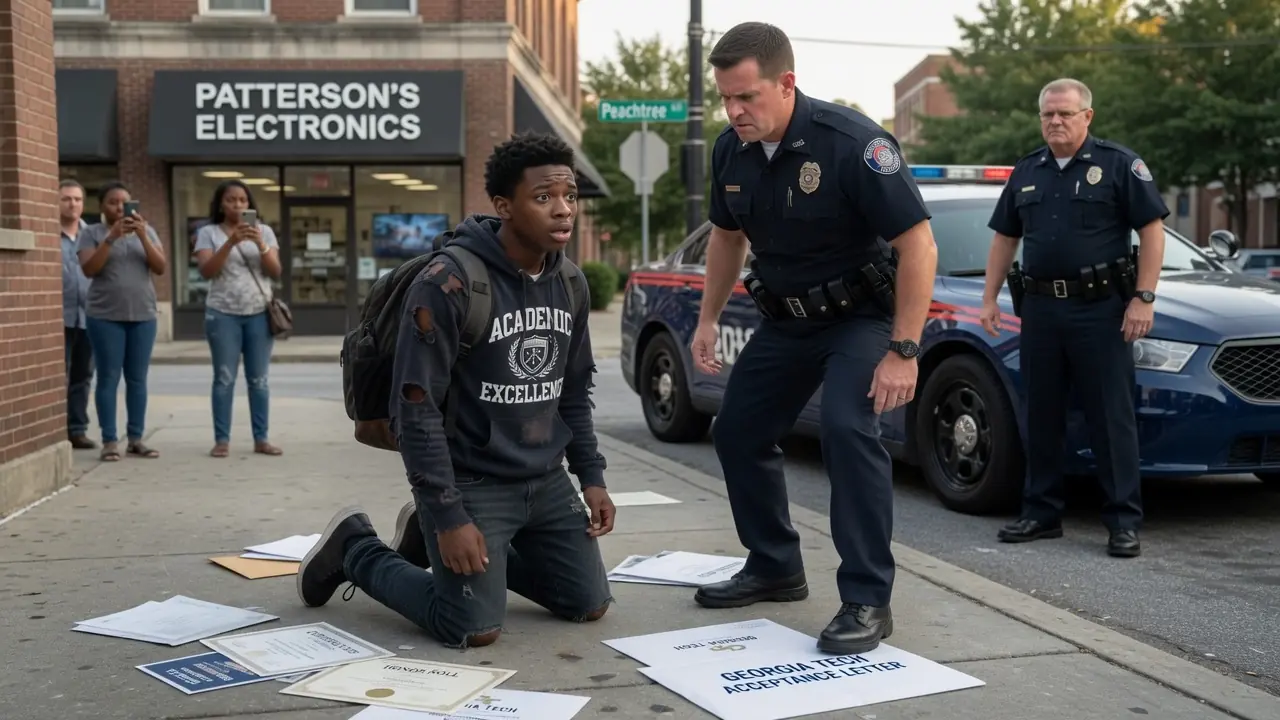
Devon's face burns with humiliation as dozens of strangers pull out phones to record what they assume is a legitimate arrest. His academic excellence hoodie is torn at the shoulder from Thompson's shove. Please, sir. I haven't done anything wrong. Devon whispers, but Thompson just laughs.
Shut your mouth when I'm talking, boy. You speak when I tell you to speak. Have you ever watched someone's soul get crushed in public while everyone just stood there filming? Thirty minutes earlier, Devon Williams walked confidently down Peachtree Street, his backpack heavy with dreams.
Fresh from his Saturday SAT prep class, the 17-year-old honor student had Georgia Tech acceptance letters and scholarship offers tucked safely inside his bag alongside constitutional law textbooks. Devon paused outside Patterson's Electronics to check his phone. A text from Mom glowed on the screen. Meeting's running late at Fort McPherson. Pick you up at 4:00 p.m. sharp.
Love you, baby. He smiled, knowing his mother was probably buried in military legal briefs again. She never talked much about her work, only that she helped solve important problems for the Army. Three blocks away, Officer Jake Thompson sat in his patrol car, scrolling through his phone with visible agitation.
The headline on his screen read, "Atlanta PD Faces Federal Investigation for Racial Profiling." His name appeared in the third paragraph as an officer under scrutiny for multiple civilian complaints. "This is complete garbage," Thompson muttered to his partner, Officer Rick Morrison. "Twelve years I've been cleaning up these streets, and now these bleeding-heart activists want to destroy my career over a few complaints."
Morrison shifted uncomfortably in the passenger seat. He had heard the locker room stories about Thompson's creative policing methods, the planted evidence, the intimidation tactics, and the way Thompson seemed to target young men with an almost personal vendetta. "Maybe we should just stick to routine calls today, Jake," Morrison suggested quietly.
"Keep things simple until this investigation blows over." Thompson's face hardened. "Simple? You know what's simple, Rick? Reminding this neighborhood exactly who's in charge."
His radio crackled with a routine call about suspicious activity near the courthouse district.
Thompson's eyes lit up with opportunity. "Perfect timing," he said, starting the engine. "Time to show these people that badges still mean something in this city." As they drove toward downtown, Thompson spotted Devon walking alone with his headphones in. The teenager's confident stride and expensive-looking backpack immediately triggered something ugly in Thompson's mind. Everything about Devon screamed privileged to the bitter officer: the academic achievements, the college-prep materials, and the obvious pride in his accomplishments.
"That kid looks like trouble to me," Thompson announced, pulling the patrol car to the curb. Morrison glanced at Devon and saw nothing but a student walking home. No erratic behavior, no suspicious activity, just a teenager minding his own business. "Jake, he's just walking.
He hasn't done anything wrong." "They never look like they're doing anything wrong," Thompson replied coldly. "That's what makes them dangerous."
Thompson rolled down his window as Devon approached a crosswalk. "Hey, you. Come here." The command was sharp and authoritative, designed to establish dominance immediately. Devon removed his earbuds and approached the patrol car respectfully, just as his mother had taught him.
"Yes, officer. Is there a problem?" The politeness in Devon's voice seemed to irritate Thompson even more. "What's your name, kid?" "Devon Williams, sir. I'm just walking home from SAT prep class."
"And where exactly is home?" "Cascade Heights, sir. My mom's picking me up at four." Devon glanced at his phone. "She should be here in about twenty minutes." Thompson noticed the expensive phone, the quality of Devon's clothes, and the casual mention of a responsible parent. All of it fed into his growing resentment. This kid had everything Thompson felt he deserved: respect, opportunity, and a bright future.
"Step out where I can see you properly," Thompson ordered, his hand moving to rest on his weapon. "And keep your hands visible." Devon's polite demeanor faltered slightly. "Officer, I don't understand. Have I done something wrong?" "Don't question me, kid.
Just do what I tell you to do." Morrison watched the exchange with growing unease. There was no legal justification for what Thompson was doing, no reasonable suspicion, no probable cause, only a power trip disguised as police work. As Devon complied with the order, Thompson got out of the patrol car with exaggerated authority. Several passersby began to notice the scene unfolding. Mrs.
Henderson, who ran the flower shop across the street, paused her sweeping to watch. James Patterson emerged from his electronics store, instinctively sensing something was not right. "Turn around and put your hands on the wall," Thompson commanded, gesturing toward Patterson's brick storefront. "Sir, can you please tell me what this is about?" Devon's voice remained respectful, but fear was beginning to creep in.
"I have my student ID if you need to verify who I am." Thompson's response was swift and brutal. "I said turn around, boy. Don't make me repeat myself again." The word hit Devon like a physical blow. He had heard his grandfather's stories about that word, about the way it was used to strip dignity from men for generations. Now it was being used against him in broad daylight by a police officer sworn to protect and serve.
Patterson stepped closer, his phone already recording. Something about the officer's tone, the unnecessary aggression, and the public humiliation of a kid he had known for years felt terribly wrong. Devon slowly turned toward the wall, his hands shaking as he placed them against the brick. Behind him, he could hear more people gathering, their conversations creating a buzz of anticipation.
Some seemed concerned for him. Others appeared to be enjoying the spectacle of a bad kid getting caught. Thompson began an aggressive pat-down, far more invasive than the situation required. His hands searched Devon's pockets, his waistband, and anywhere he might conceivably hide contraband. "Clean so far," Thompson announced loudly to the crowd.
"But they're getting smarter these days. Let's check the backpack." Devon's stomach dropped. His backpack contained nothing but academic materials, textbooks, homework, college applications, and the acceptance letters he was so proud of. Something in Thompson's tone suggested that innocence would not matter.
As Thompson unzipped the bag, Devon's phone buzzed with another text from his mother. The message was brief but would soon prove prophetic. Meeting ended early. On my way now. GPS shows twelve minutes out.
Devon could not see the message. His face was pressed against the cold brick wall while a corrupt police officer prepared to destroy his life in front of a growing crowd of strangers. The trap was set. The audience was gathered.
Officer Jake Thompson was about to make the biggest mistake of his career. Thompson dumped Devon's backpack contents onto the sidewalk with deliberate roughness. Honor roll certificates scattered like fallen leaves. College acceptance letters from Georgia Tech, Emory, and Morehouse landed in puddles from the morning rain. A thick constitutional law textbook thudded against the concrete.
"Well, well, well," Thompson announced to the growing crowd, kicking Devon's scholarship paperwork with his boot. "Look at all this fancy school stuff. Really impressive, kid." James Patterson pushed closer, his phone camera capturing everything. He had known Devon for three years as a regular customer who came in weekly to buy school supplies and electronics for projects.
The kid was always polite and always paid in cash he had earned from tutoring younger students. "Officer, that young man is one of my best customers," Patterson called out. "He's a good kid, an honor student. He's never been in any trouble." Thompson whirled around, his face flushed with anger. "Sir, I need you to step back right now, or you'll be arrested for interfering with police business." The threat silenced Patterson momentarily, but he kept recording.
Something about this felt orchestrated, performed for the crowd rather than conducted for justice. Thompson continued searching through Devon's belongings, growing more frustrated with each innocent item he discovered: advanced calculus homework, a letter of recommendation from Devon's physics teacher, and an acceptance letter to a summer internship program at the CDC. "Where is it?" Thompson muttered under his breath, loud enough for Devon to hear but not the crowd. "Where is what, sir?" Devon asked, his voice barely above a whisper.
"I don't have anything illegal." "Don't play dumb with me, boy," Thompson snarled. "I can smell marijuana from here."
Devon's eyes widened in confusion and fear. He had never touched drugs in his life. His mother had raised him with military discipline and clear expectations about making smart choices. "Officer, I think there's been a serious mistake," Devon said, his voice cracking slightly.
"I've never used drugs. You can call my mother. She'll vouch for me. Her name is Colonel Diana Williams." Thompson laughed mockingly.
"Oh, sure, kid. And I suppose your daddy is the president, too."
Morrison shifted nervously beside the patrol car. He had watched Thompson plant evidence before, usually small amounts of marijuana or pills that would disappear from the evidence locker weeks later, but this was different. This was being recorded by multiple witnesses in broad daylight. "Jake," Morrison said quietly.
"Maybe we should just—" "Shut up, Rick," Thompson snapped. "I'm conducting a lawful search here."
Mrs. Henderson from the flower shop approached cautiously. "Young man," she said to Devon, "isn't your mother the lady in uniform who comes to school events?
The one with all the medals?" "Yes, ma'am," Devon replied gratefully. "She's an Army colonel. She's supposed to pick me up in ten minutes." Thompson's jaw clenched. The last thing he needed was some military parent showing up and asking questions, but he was too committed now, too invested in this public demonstration of his authority. "I don't care if your mother is Wonder Woman," Thompson announced loudly.
"If you're carrying drugs, you're going to jail." He walked back to the patrol car, ostensibly to get evidence bags. Morrison saw him reach into the glove compartment where Thompson kept his insurance policy: small bags of various substances for situations exactly like this one. The crowd watched as Thompson returned with a small plastic bag containing suspicious powder. Patterson's camera had caught something crucial.
Thompson had retrieved the bag from the patrol car, not from Devon's belongings. "Well, well, well," Thompson said, holding the bag high for everyone to see. "Look what was hiding in your backpack, kid." Devon's face drained of color. "That's not mine. I've never seen that before in my life." "Save it for the judge, dealer," Thompson replied coldly, pulling out his handcuffs.
The crowd's mood shifted dramatically. People who had been sympathetic to Devon moments earlier now stared at him with disgust and disappointment. The contrast between his academic achievements and the apparent drug possession created cognitive dissonance that most resolved by assuming the worst. "Another fake honor student," someone muttered.
"They're all the same underneath," another voice added. Devon felt his world collapsing as Thompson grabbed his wrists roughly. "Please," he whispered desperately. "Please just call my mother, Colonel Diana Williams at Fort McPherson. She'll be here any minute."
Thompson was already beginning the arrest process, speaking loudly for the crowd's benefit.
"You have the right to remain silent." In the distance, a military vehicle with small American flags turned onto Peachtree Street, moving with purpose toward the growing commotion. Thompson slammed the handcuffs onto Devon's wrists with unnecessary force, the metal clicking like a death sentence. "Anything you say can and will be used against you in a court of law," he recited with theatrical authority, ensuring every word carried to the back of the growing crowd. Devon's eyes filled with tears of frustration and terror.
"Officer Thompson, please. I'm telling you the truth. That's not mine. I don't do drugs. I'm going to Georgia Tech in the fall on a full academic scholarship." "Yeah, well, not anymore you're not," Thompson replied with a cruel smile.
"Georgia Tech doesn't take drug dealers. Maybe you should have thought about that before you decided to start slinging dope."
The words hit Devon like physical blows. Four years of perfect grades, countless hours of studying, volunteer work, and leadership activities were being destroyed in front of thirty strangers who now looked at him with contempt and disappointment. Thompson turned to address the crowd like a politician at a rally.
"This is what we're dealing with, folks. They look innocent on the outside. Honor roll certificates, college applications, all the right paperwork, but underneath they're still criminals."
Several people in the crowd nodded approvingly. A woman with a designer purse shook her head sadly. "It's always the ones you least expect," she said loudly enough for everyone to hear.
"My daughter goes to King High School, too. These drug dealers are everywhere now." An elderly man with a walking cane spoke up. "Thank God we have officers like you keeping our streets safe. These kids think their fancy grades give them a free pass to break the law."
Patterson pushed forward with his phone still recording.
"Officer, I've known this young man for three years. He comes into my store every week to buy school supplies and computer equipment for school projects. He's never shown any signs of drug use or criminal behavior." Thompson's face reddened with anger. "Sir, I warned you once about interfering. Step back now, or you'll be arrested for obstruction of justice." Patterson stood his ground.
"I saw you take that bag from your patrol car, not from his backpack. I have it all on video."
The crowd murmured uncertainly. Some people started looking more carefully at Patterson's phone, wondering what he had captured. Thompson felt control slipping away and compensated with more aggression.
"That's a serious accusation, sir," Thompson said, his voice dangerous and low. "Are you suggesting that I, a twelve-year veteran of the Atlanta Police Department, planted evidence on this suspect?" "I'm not suggesting anything," Patterson replied firmly. "I'm stating what I recorded. You retrieved that bag from your vehicle, not from his belongings."
Thompson stepped closer to Patterson, using his size and uniform to intimidate. "Let me tell you something, store owner.
I've been cleaning up these streets since before you opened your little electronics shop. I know drug dealers when I see them, and I know how they operate." Morrison's radio crackled suddenly with an urgent dispatch. "All units be advised, we have a high-priority visitor en route to Precinct Seven. Colonel Williams from Fort McPherson requested immediate—" The transmission cut off in static.
Morrison's face drained of color. He grabbed Thompson's arm. "Jake, did you hear that? Colonel Williams. That's the name the kid keeps saying." Thompson brushed him off angrily.
"So what? Probably some desk jockey pushing papers. I'm not backing down from some weekend warrior who thinks rank means something on my streets." Devon's phone buzzed in his pocket, but with his hands cuffed behind his back, he could not reach it. The text from his mother read, "The meeting ended early.
GPS shows six minutes out. Are you at the pickup spot?"
Mrs. Henderson approached cautiously. "Officer, I work at the school district administration office. I've seen this boy's mother at awards ceremonies.
She's definitely military, and she's definitely high-ranking. Lots of medals and ribbons. She gives speeches about constitutional law." Thompson's confidence wavered slightly, but his pride and the watching crowd pushed him forward. "I don't care if she's a general.
This kid had drugs, and he's going to jail. Period."
He opened the patrol car door and began forcing Devon inside. "Get in there, dealer. Time to see what the inside of a cell looks like." Devon stumbled as Thompson shoved him, his shoulder striking the door frame painfully. "Please, Officer Thompson, my mother is Colonel Diana Williams.
She's a JAG officer, a military lawyer. She prosecutes federal crimes. She'll be here any minute. Just wait five minutes."
"JAG officer?" Morrison repeated nervously.
"Jake, JAG officers are serious business. They prosecute military crimes. They know federal law inside and out, if she really is his mother." Thompson slammed the car door with Devon inside. "I don't care if she's the attorney general. This punk had drugs, and I'm not letting him walk just because Mommy wears a uniform."
The crowd watched as Thompson strutted around the patrol car, clearly enjoying the attention and applause from some onlookers.
He had made this arrest as public and humiliating as possible, ensuring maximum damage to Devon's reputation. "Let this be a lesson to everyone watching," Thompson announced, his voice carrying like a preacher's. "The Atlanta Police Department doesn't play favorites. Rich or poor, honor student or dropout, suburban kid or street kid, if you break the law, you face the consequences."
More applause rippled through the crowd.
A construction worker shouted, "That's how you do it, officer." A teenage girl livestreaming on social media commented to her followers, "Y'all, I'm watching this honor student get arrested for drugs right now. It's crazy how you can't trust anyone these days." Thompson basked in the approval, feeding off the power and control he felt in this moment. This was why he became a cop: for moments like this, when he could make a real difference and when people respected his authority. Inside the patrol car, Devon sat helplessly, watching his reputation being destroyed in real time. Through the window, he could see people recording videos that would probably be posted online within minutes.
His name, his face, his school, everything would be associated with drug dealing. His phone buzzed again. Another text from his mother read, "Traffic heavier than expected. Four minutes out.
Can you see our pickup spot from where you are?"
A young woman with an Emory Law School T-shirt pushed through the crowd. "Officer, this doesn't seem right. Where's your probable cause for the search? Did you see him commit a crime?" Thompson turned to her with practiced authority. "Ma'am, I don't need to explain police procedure to civilians.
This suspect was acting suspiciously, and my search revealed illegal narcotics. That's all you need to know."
"But what suspicious behavior?" she pressed. "I was watching from across the street. He was just walking and listening to music." "Are you a lawyer?" Thompson asked mockingly.
"Actually, yes. I'm a third-year law student, and this looks like an illegal search and seizure." Thompson's face hardened. "Well, counselor, when you pass the bar and start working in the real world, maybe you'll understand how police work actually functions."
Patterson continued recording, documenting everything. He noticed other people in the crowd starting to look uncomfortable as the reality of what they were witnessing began to sink in. The aggressive nature of the arrest, the lack of any actual evidence of wrongdoing, and the officer's obvious enjoyment of the humiliation all felt wrong.
Morrison kept glancing nervously down the street. Something about that radio call bothered him deeply. Fort McPherson was a major military installation. If Devon's mother really was a colonel stationed there, especially a JAG officer, this situation could escalate far beyond a simple drug arrest.
Thompson got on his radio to request backup transportation. "Dispatch, I need a second unit for prisoner transport. I want to make sure this arrest is handled by the book." He paused dramatically for the crowd's benefit. "And I want everyone to see that justice doesn't discriminate."
The irony of his words was not lost on Patterson, who continued recording everything. Thompson was so focused on his performance for the crowd that he had failed to notice the military vehicle that had just turned onto their street, moving with unmistakable purpose toward the scene.
Devon sat in the back of the patrol car, his hands numb from the tight handcuffs, watching his future evaporate. Everything he had worked for, everything his mother had sacrificed for, and everything they had built together was being destroyed by one corrupt officer's need to feel powerful. Help was coming. It would soon turn Officer Thompson's moment of triumph into the beginning of his downfall.
The military vehicle was now three blocks away and closing fast. It pulled up directly behind the patrol car with unmistakable authority. The engine shut off with mechanical precision, and for a moment, complete silence fell over Peachtree Street. Even the construction noise from the nearby building site seemed to pause in anticipation. Thompson was finishing his radio call when Morrison grabbed his shoulder hard.
"Jake, you need to see this right now." The driver's door opened with a sharp click, and a figure stepped out who commanded immediate attention. Colonel Diana Williams emerged in full Army dress uniform. This was not just any military outfit. The silver eagles of a full colonel gleamed prominently on her shoulders, accompanied by rows of ribbons indicating years of distinguished service, combat deployments, and legal expertise.
Her bearing was unmistakable: the straight spine, measured steps, and calm confidence of someone accustomed to command. Every detail of her appearance spoke of authority, from the perfectly pressed uniform and spit-shined boots to the expert marksmanship badge and the Judge Advocate General's Corps insignia identifying her as a military lawyer. The crowd fell completely silent, instinctively recognizing the presence of real authority. Some people began lowering their phones, suddenly feeling foolish for recording what they had assumed was a routine drug arrest. Thompson's cocky smirk faltered as he took in the sight, but his pride and the watching crowd made backing down impossible.
"Ma'am, this is an active crime scene. I'm going to need you to move your vehicle and clear the area immediately." "Officer Thompson." Her voice cut through his words like a precision instrument, calm, clear, and carrying the absolute authority of someone who had commanded soldiers in combat zones. "You will release my son immediately."
The words hit the crowd like a thunderclap. Murmurs rippled through the onlookers as they realized this was the very Colonel Williams Devon had been desperately trying to tell them about.
Thompson's face drained of color, but his mouth kept moving on autopilot. "Your son? Ma'am, I don't know what this kid told you, but he was found in possession of illegal narcotics. I'm just doing my job here."
Diana stepped past him toward the patrol car, her movement deliberate and controlled. She did not rush or panic.
She did not need to. Every step radiated barely contained fury wrapped in military discipline. "Devon," she said through the car window, her voice gentle but strong. "Are you hurt, baby?" Devon, tears streaming down his face, shook his head.
"Mom, they planted drugs on me. I swear on my life I didn't do anything wrong. He took a bag from his car and said it was mine." "I know, son. I know exactly what happened here." Diana's voice remained calm, but when she turned back to Thompson, her eyes were cold. "Officer Thompson, you have exactly thirty seconds to explain why my honor student son, who has never had so much as a detention, is handcuffed in the back of your patrol car."
Thompson tried to rally his authority, puffing out his chest.
"Ma'am, with all due respect to your rank, your son was found in possession of illegal narcotics. Military rank doesn't change civilian law. I don't care if you're a colonel or a general." The crowd watched the exchange with growing fascination. The power dynamic was shifting before their eyes, and they could feel the tension crackling in the air.
Diana pulled out her phone with deliberate precision and speed-dialed a number. "Captain Rodriguez, this is Colonel Diana Williams. I'm at the corner of Peachtree and Ellis, and I need you here immediately. Yes, ma'am. It's about Officer Thompson.
No, Captain. This is Priority One. Drop everything and get here now." She hung up and addressed Thompson directly, her voice rising enough for the entire crowd to hear every word. "Officer Thompson, I am a Judge Advocate General with the United States Army.
I have prosecuted federal crimes in military court for fifteen years. I know the Constitution better than you know your own badge number." Thompson's swagger was crumbling, but he doubled down desperately. "Look, Colonel, I appreciate your service, but this is a civilian matter. Your military authority doesn't extend to my jurisdiction."
"You're absolutely right," Diana replied with a cold smile. "My military authority means nothing here.
My fifteen years as a federal prosecutor, my expertise in constitutional law, and my knowledge of civil rights violations are what will destroy your career." The crowd had gone completely silent, hanging on every word. Patterson stepped forward with his phone. "Colonel, ma'am, I have video of the entire incident. That officer planted evidence on your son.
I recorded him taking the bag from his patrol car, not from Devon's backpack."
Diana's expression hardened into something that would have made seasoned sergeants step back. "Show me that video right now." As Patterson played the footage on his phone, the crowd pressed closer to see. The video clearly showed Thompson retrieving the bag from his patrol car's glove compartment before claiming to discover it among Devon's belongings. The evidence was undeniable and damning. Gasps and angry murmurs rippled through the onlookers as the truth became crystal clear.
"Oh my God," someone whispered. "He really did plant it." "That's completely fake," another voice added with disgust. "That cop is dirty." A woman who had been supporting Thompson earlier now looked horrified. "I can't believe I was cheering for this.
That poor boy."
The same people who had been applauding Thompson's arrest five minutes earlier were now staring at him with disgust and betrayal. The mood shift was palpable and immediate. Diana's voice projected with the authority of someone who had commanded respect in the world's most dangerous places. "Officer Thompson, you have just committed evidence tampering, false imprisonment, and violation of civil rights under color of law. All federal felonies.
You did this in front of thirty witnesses and multiple cameras."
Thompson's face was now bright red, sweat beading on his forehead despite the cool afternoon air. His voice cracked as he tried to maintain control. "Look, lady, I don't care what your rank is in the Army. This is my beat, my jurisdiction." "Colonel." Diana stepped closer to Thompson, and despite being six inches shorter, her presence made him seem to physically shrink.
"You will address me as Colonel."
"And you're absolutely right about one thing. My rank doesn't matter here. What matters is that you are a corrupt police officer who just destroyed his own career by framing an innocent teenager." Morrison finally found his voice, his hands visibly shaking. "Jake, this has gone too far. We need to call this off.
Let the kid go, and maybe we can work something out." "Shut up, Rick," Thompson snapped, but his authority was completely gone. The crowd was now openly hostile, with people shouting, "Free the kid!" and "Crooked cop!" Some were already posting the videos online with hashtags such as #CorruptCop and #JusticeForDevon. A woman in the crowd called out, "Officer, you should be ashamed of yourself. That's somebody's child you're destroying." An elderly man shook his head sadly.
"Twelve years on the force, and this is what you do? Plant drugs on kids? Disgraceful."
The teenage girl who had been livestreaming frantically typed updates. "Y'all are not going to believe this. This corrupt cop just got exposed by the kid's mom, who is literally an Army colonel." A second patrol car arrived with lights flashing and sirens wailing.
Captain Sarah Rodriguez emerged, took one look at the scene, and understood immediately: Diana in full military dress uniform, the hostile crowd, Thompson's panicked expression, and Morrison backing away from his partner. "Colonel Williams," Rodriguez said formally, her voice carrying the respect due to both Diana's rank and the obvious gravity of the situation. "Captain Rodriguez," Diana replied with military precision. "I want Officer Thompson arrested immediately for evidence tampering, false imprisonment, civil rights violations, and deprivation of rights under color of law.
I have video evidence, thirty witnesses, and a very clear case of police misconduct that will be referred to federal authorities."
Rodriguez looked at Thompson with obvious disgust and disappointment. This was not the first complaint about Thompson, but it was certainly the most public and well-documented. She had been dreading this moment for months. "Officer Thompson, you're under arrest. Remove the handcuffs from the young man immediately and place your hands behind your back."
"Captain, you can't be serious," Thompson protested, his voice rising to nearly a shout.
"I was just doing my job. This is all a big misunderstanding. The kid had drugs." "Your job doesn't include planting evidence on minors," Rodriguez replied coldly. "It certainly doesn't include violating the civil rights of honor students.
Hands behind your back now."
The crowd erupted in applause and cheers as Devon was finally released from the patrol car. He stumbled slightly, his legs weak from fear and adrenaline, then ran straight into his mother's arms, sobbing with relief and residual terror. Diana held her son tightly, one hand stroking his hair while the other remained clenched in barely controlled fury. "It's over, baby. Mama's here.
You're safe now. Nobody's going to hurt you."
Thompson, now in handcuffs himself, looked around desperately for support but found none. Even Morrison was shaking his head in disgust and disappointment, clearly planning to distance himself from his partner's actions. "This isn't over!" Thompson shouted as Rodriguez led him toward her patrol car.
"I have friends in high places. I have connections throughout this department. You can't do this to me."
Diana's response was swift, final, and devastating. She looked directly at Thompson with the cold precision of a prosecutor delivering a closing argument. "Officer Thompson, I am the high places, and your connections just ran out." The crowd cheered even louder as Thompson was placed in the back of Captain Rodriguez's patrol car.
The irony was not lost on anyone. The corrupt officer who had just humiliated an innocent teenager was now experiencing the same treatment, but with actual justification. Six months later, the consequences had unfolded exactly as Diana promised. Officer Jake Thompson was convicted on all federal charges in United States District Court and sentenced to four years in federal prison.
The FBI investigation that followed his arrest revealed a systematic pattern of evidence planting and racial profiling that led to twenty-three previous arrests being overturned and dozens of wrongful-conviction lawsuits. Morrison, who cooperated fully with federal investigators and testified against his former partner, received a suspended sentence and was permanently dismissed from law enforcement. He now works as a security guard at a shopping mall, his law-enforcement career destroyed by his complicity in Thompson's crimes. Devon Williams walked across the stage at his high school graduation as valedictorian, accepting his diploma to thunderous applause from a crowd that included his mother in dress uniform. That fall, he entered Georgia Tech on a full academic scholarship, majoring in computer engineering with a minor in constitutional law.
The civil lawsuit against the Atlanta Police Department resulted in a $3.2 million settlement for Devon and his family. Rather than keep the money, Devon established the Justice for All Scholarship Fund, providing full college scholarships to students who had experienced police misconduct or false accusations. At a police reform conference in downtown Atlanta, Devon stood at the podium where he had been invited to speak. The same intersection where his nightmare occurred was visible through the conference center windows.
"That day changed my life," he told the audience of police chiefs, civil rights advocates, and community leaders. "Not because of what Officer Thompson did to me, but because I learned that when you have people who love you and fight for you, injustice doesn't have to win."
Diana, now promoted to brigadier general, partly due to her handling of the incident and subsequent advocacy work, sat in the front row, beaming with pride as her son spoke. "My mother taught me that courage isn't the absence of fear," Devon continued. "It's doing what's right even when you're terrified. Mr.
Patterson showed that courage when he kept recording despite being threatened. Captain Rodriguez showed it when she arrested a fellow officer. My mother showed it every day of my life."
The audience gave Devon a standing ovation as he concluded his remarks with a challenge. "We can't change what happened to me, but we can make sure it doesn't happen to other kids.
That's why I'm dedicating my life to developing technology that makes police accountability automatic and transparent." Captain Rodriguez, who had been promoted to deputy chief, implemented sweeping reforms throughout the Atlanta Police Department. Body cameras became mandatory for all officers, with footage automatically uploaded to secure servers that officers could not access or delete. A civilian oversight board was established with real investigative powers and the authority to recommend prosecutions. "The Thompson case was a wake-up call," Rodriguez explained to reporters. "We had to face the fact that we had officers who saw the badge as a license to abuse power rather than a responsibility to serve justice."
James Patterson's electronics store became an unlikely symbol of civic courage.
The Atlanta City Council recognized him with a proclamation for extraordinary courage in documenting injustice and speaking truth to power. His store now displays a small plaque reading, "Courage Witnessed Here," where one person's decision to record the truth helped restore faith in accountability. Patterson expanded his store to include a community education center where he teaches digital literacy and citizens' rights workshops. "People need to know their rights," he explains to visitors.
"They need to know that recording police interactions can protect both citizens and good officers." The intersection of Peachtree and Ellis, where Devon's ordeal occurred, became the site of an annual Community Courage Day celebration. Local schools bring students to learn about civil rights, police accountability, and the power of ordinary citizens to make a difference. Thompson, serving his sentence at a federal minimum-security facility, was eventually offered the chance to participate in a restorative justice program. In a carefully supervised meeting with Devon and Diana at the prison, he formally apologized for his actions. "I let my prejudices and my anger corrupt everything I was supposed to stand for," Thompson said, his voice barely above a whisper.
"I'm sorry it doesn't fix what I did to you, Devon, but I want you to know I'm getting counseling, and I understand now how wrong I was and how much damage I caused."
Devon's response surprised everyone in the room with its maturity and grace. "Officer Thompson, I forgive you. Not because what you did was okay, but because holding on to anger won't help either of us move forward. I hope you use this time to become a better person." Diana watched her son with obvious pride.
The frightened teenager from that day had grown into a young man of remarkable character and wisdom. The incident sparked national conversations about implicit bias, the importance of recording police interactions, and the power of community witnesses. #JusticeForDevon became a rallying cry for police reform advocates, while #StandUpSpeakOut encouraged bystanders to safely document and report police misconduct. Devon's story was featured in documentaries, news programs, and academic studies about police reform, but he remained focused on his studies and his mission to create technological solutions for accountability. Diana and Devon now travel together, speaking at schools, community centers, and law-enforcement academies about constitutional rights education and the importance of strong support systems. Their presentations always emphasize that justice is possible when communities come together to stand against abuse of power.
"My son's experience taught me something important," Diana tells audiences. "Rank and privilege gave me tools to fight back that many families don't have. That's why we can't be satisfied with justice for just Devon. We have to work for justice for everyone."
The final scene of this chapter occurred on a crisp autumn afternoon at Georgia Tech.
Devon walked across campus carrying a prototype of the police-accountability device he had been developing, a tamper-proof system that automatically records and uploads police interactions to multiple secure servers. Diana visited him on campus, both of them walking past a group of diverse students studying constitutional law in the student center. Many of these students had been inspired by Devon's story to pursue careers in civil rights law, criminal justice reform, and police accountability. "Mom," Devon said as they sat on a bench overlooking the Atlanta skyline, "do you think Officer Thompson really changed?" Diana considered the question carefully. "I think people can change when they face real consequences and do the hard work of examining their prejudices.
Whether he has or not, the important thing is that the system worked this time because people like Mr. Patterson and Captain Rodriguez chose to do the right thing."
She paused, watching students walk by with their backpacks full of dreams, just as Devon had been carrying his dreams that day six months ago. "More importantly," Diana continued, "you're using your experience to make sure other kids don't have to go through what you did. That's how we really win, not just by surviving injustice, but by preventing it from happening to others."
Devon smiled, his hand unconsciously touching the scholarship fund check in his pocket, another donation to help a student whose dreams had been threatened by misconduct.
"Justice isn't just about punishment, is it?" he asked. "No, baby," Diana replied. "Justice is about making sure everyone gets the chance to fulfill their potential, and that's exactly what you're doing."
This story is not just about one corrupt police officer or one family's triumph over injustice. It is about the extraordinary power people possess to stand up when they witness wrongdoing and the critical importance of recording, speaking up, and supporting one another in moments when courage matters most. Devon Williams represents thousands of young people who face police misconduct every year across America.
His mother's rank and legal expertise gave their family unique tools to fight back. The real heroes of this story are everyday people such as James Patterson, who chose to record what they saw and speak truth to power even when threatened with arrest. The transformation was not only in Officer Thompson's eventual acknowledgment of wrongdoing. It was also in an entire community that learned to see past its initial assumptions and recognize injustice while it was happening.
The same people who initially supported Thompson's arrest became the voices demanding his prosecution once they understood the truth. According to the National Registry of Exonerations, more than 3,400 people have been exonerated of crimes in the United States since 1989, with police misconduct being a contributing factor in 54 percent of those cases. Body cameras and civilian recordings have been crucial in documenting and preventing wrongful convictions, but they only work when people have the courage to use them. The Innocence Project reports that more than 375 people sentenced to death have been exonerated since 1973, with many cases involving evidence tampering or false testimony by law enforcement. Stories like Devon's, while fictional, represent very real struggles faced by families across America every day.
People can make a difference in their own communities by knowing their rights during police encounters. The ACLU's Know Your Rights resources provide guidance about constitutional protections. Understanding those protections is the first step in protecting yourself and others. Police interactions can also be recorded safely when witnessed from an appropriate distance without interfering with police work or placing anyone in danger.
Such footage can become evidence that prevents a wrongful conviction or exposes misconduct. Speaking up, as James Patterson did, can matter. People should not assume someone else will help. Safe intervention may consist simply of witnessing and telling the truth. Communities can also support police accountability measures by contacting representatives about mandatory body cameras, civilian oversight boards, bias training, and other reforms.
Real change happens when communities consistently demand it from elected officials. People can also become involved locally in criminal justice reform by attending city council meetings, joining community oversight committees, and supporting organizations working for police reform. Democracy works best when citizens participate actively in holding institutions accountable. Devon Williams is now studying at Georgia Tech and developing technology to make police accountability automatic and transparent.
His scholarship fund has already helped twelve students whose lives were disrupted by police misconduct. His mother continues serving as a brigadier general while advocating for criminal justice reform. Their story demonstrates that when communities stand together against injustice, meaningful change is possible. Justice is not only about what happens in courtrooms. It is also about what happens when ordinary people choose to do extraordinary things in everyday moments.
People have more power than they realize to make a difference in someone's life. The change people want to see begins with the choices they make when they think no one is watching. Be someone's James Patterson. Be someone's Diana Williams. Be the person who stands up when it matters most.