The first patrol car passed the recording studio without slowing.
The second stopped in the middle of the street.
By the time the third arrived, Marcus Reed understood that whatever happened next would have very little to do with anything he and his friends had actually done.
It was the summer of 1989, and the afternoon heat had turned the pavement outside Southline Sound into a sheet of black glass. The studio occupied the rear half of a converted warehouse in Carson, California, between an auto-body shop and a company that manufactured restaurant freezers.
There was no sign above the door.
Only a hand-painted number on the brick wall and a silver sedan parked beside a loading dock.
Marcus stood near the entrance with three other members of the group.
Andre Coleman had stepped outside to smoke and clear his ears after four hours behind the mixing board.
Darius Lane was drinking warm soda from a paper cup.
Leon Banks leaned against the wall, tapping a rhythm against his thigh while he waited for the others to decide whether the next verse needed another take.
They were young.
Marcus was twenty-one.
Andre had just turned twenty-four.
Darius and Leon were both nineteen.
They wore dark jeans, athletic shoes, gold chains, and baseball caps. Marcus had a small pager clipped to his belt because the group’s manager insisted that serious artists needed to be reachable.
None of them carried weapons.
None of them were drinking alcohol.
They had not been fighting, shouting at passing cars, or blocking the sidewalk.
They were discussing music.
The lead patrol car reversed suddenly and stopped near the loading dock.
Two officers stepped out.
A second cruiser pulled behind it.
Then a third.
Seven officers in total.
Andre lowered the cigarette.
“What is this?”
Marcus looked toward the studio door.
“Everybody stay calm.”
The oldest officer approached with his right hand resting on his holster.
His nameplate read BRIGGS.
He was thick through the neck and shoulders, with pale skin reddened by the sun. He looked at the four young men the way a man looked at a locked door he had already decided to force open.
“You boys lost?”
Marcus kept his hands visible.
“No, sir.”
“What are you doing here?”
“We work here.”
Briggs glanced toward the unmarked warehouse.
“You work here.”
“Yes.”
“Doing what?”
Andre answered from beside the wall.
“Recording.”
Briggs laughed.
The other officers smiled.
“Recording what?”
“Music.”
“What kind of music?”
Marcus looked at the officer.
“Why?”
The amusement left Briggs’s face.
“What did you say?”
“I asked why you need to know what kind of music.”
Briggs stepped closer.
“Because I asked.”
Leon shifted his weight.
A younger officer noticed.
“Hands where I can see them.”
Leon raised both hands.
“They are where you can see them.”
Briggs’s attention moved from one face to another.
“You got identification?”
“Inside,” Marcus said.
“Inside where?”
“The studio.”
Briggs looked toward the steel door.
“You expect me to believe this is a studio?”
The door opened before Marcus could answer.
Owen Callahan stepped outside.
At thirty-seven, Owen had already spent fifteen years working around musicians. He had managed rock bands, soul singers, and one country act that disappeared after a disastrous tour through Nevada.
He wore khaki trousers, a white shirt with the sleeves rolled to his elbows, and reading glasses pushed onto the top of his head.
“What is going on?” he asked.
Briggs did not look at him.
“You stay where you are.”
“These men are working with me.”
The officer turned slowly.
“With you?”
“Yes. We are in the middle of a recording session.”
Briggs looked back toward Marcus.
“What are they, backup dancers?”
Andre’s jaw tightened.
Owen walked down the two concrete steps.
“They are recording artists.”
One of the officers laughed.
“Artists.”
“Yes.”
Briggs shook his head.
“Rap is not art.”
Owen stared at him.
“I do not remember asking for your review.”
The laughter stopped.
Briggs turned fully toward him.
“Who are you?”
“Their manager.”
“Then you are wasting your time.”
Owen’s voice hardened.
“That is my decision.”
Briggs pointed toward Marcus and the others.
“These your clients?”
“Yes.”
“They look like gang members.”
“They look like four musicians standing outside their workplace.”
Briggs stepped closer.
“You a lawyer too?”
“No.”
“Then go back inside.”
“I am not leaving them alone with seven armed officers who have not identified a crime.”
A strange stillness settled over the loading dock.
Traffic continued at the far end of the street.
Somewhere inside the warehouse, an unfinished drum loop repeated faintly through the wall.
Briggs faced Marcus again.
“On the ground.”
Marcus did not move.
“What?”
“You heard me. All four of you. On the ground.”
“For what?”
The younger officer nearest Leon drew his baton.
“Get down.”
Darius lifted both hands higher.
“We haven’t done anything.”
Briggs moved with sudden force.
He shoved Marcus in the chest.
Marcus stumbled backward into Andre.
“On the ground now.”
The other officers closed in.
Leon was forced against the brick wall before being pulled down by his shoulders.
Darius dropped his cup and lowered himself carefully.
Andre cursed under his breath.
An officer kicked his feet apart.
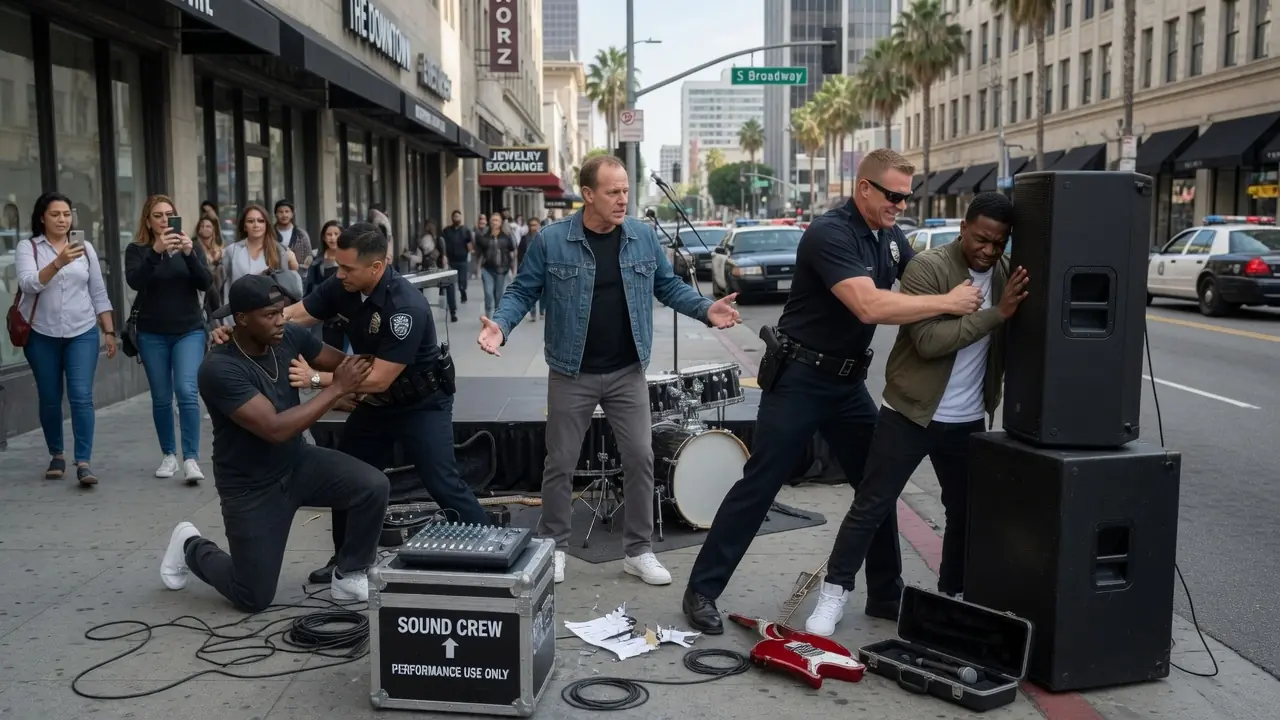
Marcus felt a knee press between his shoulder blades.
The pavement burned through his shirt.
“Hands behind your head,” Briggs ordered.
Marcus interlocked his fingers.
Beside him, Leon’s cheek rested against the concrete.
Darius breathed rapidly.
Andre remained completely still.
Seven officers stood over four unarmed musicians.
Owen stepped forward.
“What are you doing?”
“Officer safety,” Briggs said.
“Safety from what?”
“Possible gang activity.”
“What activity?”
Briggs pointed toward the gold chain around Marcus’s neck.
“Look at them.”
Owen’s face changed.
The officer had finally said the quiet part plainly.
“I am looking at them,” Owen replied. “I see young men working.”
“You see what you are paid to see.”
“And you see what gives you permission to behave like this.”
Briggs walked toward him.
“Step back.”
“Tell me what law they broke.”
“You need to control your people.”
“They are not my property.”
“Then tell them to stop acting like animals.”
Marcus closed his eyes.
He felt Andre’s body tense several feet away.
Owen heard it too.
Every officer heard it.
No one objected.
Owen stepped closer until Briggs could see the anger in his face.
“You will let them stand.”
“You do not give orders here.”
“No. But I know the mayor’s chief of staff, the city attorney, and three members of the civilian review board.”
Briggs smiled.
“Everybody knows someone.”
“I also know the owner of this building, who installed cameras after equipment was stolen last year.”
The officer looked toward the roof.
A security camera sat beneath the metal overhang.
Its red indicator light was visible.
Briggs’s smile weakened.
Owen pointed toward it.
“It has recorded everything since the first cruiser stopped.”
For several seconds, no one spoke.
Then a dispatcher’s voice cracked through one of the radios.
Briggs looked toward the other officers.
“Run their names.”
“You have no names,” Owen said.
“We will.”
Briggs crouched beside Marcus.
“What do people call you?”
Marcus turned his face enough to look at him.
“My name is Marcus Reed.”
“Street name?”
“I do not have one.”
“You expect me to believe that?”
“I do not care what you believe.”
Briggs grabbed the back of his shirt.
“You want to go to jail?”
“For standing outside?”
“For resisting.”
Marcus looked at the knee pressing into his back.
“I am face-down with my hands on my head.”
The younger officer above him shifted uncomfortably.
Owen took another step.
“Remove your knee from him.”
Briggs stood.
“You want your artists arrested?”
“I want your badge number.”
“You can read.”
“I want you to say it for the camera.”
The officer looked toward the security lens again.
His next decision was not mercy.
It was calculation.
He motioned toward the other officers.
“Let them up.”
The pressure lifted from Marcus’s back.
He rose slowly.
Dust marked his shirt.
Leon’s lower lip had split against the pavement.
Darius rubbed one wrist where an officer’s boot had pressed against it.
Andre stood last.
He looked directly at Briggs.
Owen touched his arm.
“Inside.”
Andre did not move.
Briggs noticed.
“You got something to say?”
Andre’s voice came low.
“You already heard it.”
“What was that?”
Marcus stepped between them.
“Come on.”
Briggs laughed.
“That is right. Listen to your boss.”
Owen’s eyes narrowed.
Marcus gripped Andre’s shoulder and guided him toward the door.
Leon and Darius followed.
As they reached the steps, Briggs called after them.
“Keep your boys under control.”
Marcus stopped.
The word boys was not unusual.
That was why it carried so much history.
Andre turned.
Owen pushed the door open.
“Inside. All of you.”
Briggs called again.
“You heard what your master said.”
The loading dock became silent.
Even the younger officers looked toward their sergeant.
Owen’s hand remained on the door.
Marcus saw the conflict in his manager’s face—the desire to answer and the understanding that any answer could place four young men inside police cars.
“Go inside,” Owen said quietly.
This time, they did.
The steel door closed behind them.
For several seconds, no one in the studio spoke.
The unfinished beat continued through the speakers.
A hard kick drum.
A sharp snare.
The same eight-bar loop repeating again and again.
Darius walked toward the small restroom.
Leon sat on the edge of the mixing table and touched his bleeding lip.
Owen remained near the door, listening until the patrol cars finally drove away.
Andre threw his cigarette pack across the room.
It struck the wall and burst open.
“We should have done something.”
“We did,” Owen said.
“What? We got on the ground.”
“We stayed out of jail.”
“That is not doing something.”
Marcus walked toward the control room.
“What did you want us to do? Fight seven cops?”
Andre followed him.
“I wanted not to feel like that.”
Marcus turned.
“You think I wanted it?”
“You told us to get down.”
“Because they had guns.”
“They always have guns.”
“Exactly.”
Andre stared at him.
The anger in the room had no direction.
That made it more dangerous.
Leon spoke from behind them.
“They called us animals.”
Nobody answered.
“They did not even ask our names first.”
Darius returned from the restroom with cold water on a paper towel.
He handed it to Leon.
“My mother is going to see this.”
Owen looked toward him.
“The cut?”
“The whole thing. If that tape gets out, she is going to see me lying on concrete while some man puts his boot near my head.”
His voice broke slightly.
“She already thinks this music is going to get me killed.”
Marcus sat inside the recording booth.
Through the glass, he could see the microphone suspended from a metal arm.
Half an hour earlier, they had been arguing about a chorus.
Now the unfinished song felt small.
Andre entered the control room and stopped the looping beat.
Silence filled the studio.
Then Marcus said, “Play it again.”
Andre looked toward him.
“The track?”
“Yes.”
Andre pressed the button.
The drums returned.
Marcus closed his eyes.
He heard Briggs’s voice.
You boys lost?
Street name?
Rap is not art.
Animals.
Master.
The phrases settled into the rhythm.
Not as direct quotations.
As pressure.
He reached for a notebook.
Owen watched through the glass.
“What are you doing?”
Marcus did not look up.
“Writing down what happened before they tell us what happened.”
That sentence changed the room.
Andre lowered himself into the producer’s chair.
He restarted the beat from the beginning.
Darius leaned over the console.
Leon pressed the wet towel against his lip and listened.
Marcus wrote quickly.
Not polished lines.
Fragments.
Hands on concrete.
Seven shadows for four men.
A badge deciding what a face means.
A report written before the questions.
A city that called silence peace.
He crossed out half the words.
Andre adjusted the bass.
The original track had been designed for a club record.
He slowed it.
Removed the bright keyboard.
Added a low mechanical sound that resembled a helicopter passing far overhead.
Leon entered the booth.
“My verse starts with the ground.”
Marcus nodded.
“What about it?”
“How hot it was.”
“Write that.”
Darius pulled a chair closer.
“I want the part where he looked at the camera.”
Andre glanced back.
“When Owen told him.”
“Yeah. He was not scared of being wrong. He was scared of being seen.”
Marcus looked up from the notebook.
“That is the song.”
Owen stepped into the control room.
“No names.”
Andre stared at him.
“What?”
“You cannot name the officers.”
“Why not?”
“Because the label’s attorneys will bury the record before anyone hears it.”
“The camera has them.”
“And you have no contract protecting you from a defamation suit.”
Marcus looked toward Owen.
“You want us to make it polite?”
“No.”
Owen removed his glasses.
“I want you to make it impossible to dismiss.”
The four musicians listened.
“Do not write only about Briggs,” Owen continued. “He will call himself one bad officer. The department will say he had a difficult afternoon. Write about the system that let seven men stand there and accept what he was doing.”
Leon lowered the towel.
“What about the cops who did not say anything?”
“Especially them.”
Andre turned back toward the console.
“Run it.”
The first take was too fast.
Marcus shouted every line.
The words collided.
Andre stopped the recording.
“You sound angry.”
“I am angry.”
“I know. But anger alone makes them stop listening.”
Marcus removed the headphones.
“What do you want?”
“I want them to hear every word.”
Marcus stared through the glass.
Andre restarted the track.
This time, Marcus lowered his voice.
He described a patrol car following too long.
A question asked after guilt had already been decided.
Hands above heads.
Bodies forced down.
A boot creating obedience and calling it safety.
The verse never threatened an officer.
It did something more dangerous.
It described him accurately.
Leon recorded next.
His lip had swollen, changing the sound of certain words. He refused to wait for it to heal.
His verse focused on the word boy.
How it could sound harmless when spoken from one man to another.
How it changed when carried through generations of forced obedience.
How a uniform could turn one syllable into a reminder of who was expected to lower his eyes.
Darius’s verse was quieter.
He wrote about his mother.
About imagining her watching the recording.
About shame belonging to the person on the ground, even when the wrongdoing belonged to the person standing over him.
Andre completed the final verse himself.
He described the moment Briggs saw the camera and changed.
The officer had not discovered compassion.
He had discovered evidence.
They recorded until nearly two in the morning.
By then, the song had a title.
WHEN THE LIGHT IS ON
Owen stood near the back wall while the final mix played.
No one moved.
The track ended with eight seconds of silence.
Then came the sound of the studio’s steel door closing.
Andre looked toward Marcus.
“That stays.”
Marcus nodded.
The label rejected the song the following morning.
Victor Shaw, the head of artist development, listened through the first verse before removing his headphones.
“No.”
Owen folded his arms.
“You did not finish it.”
“I heard enough.”
“What is the problem?”
“It is hostile.”
“It describes something that happened.”
“It attacks law enforcement.”
“It attacks abuse.”
Victor leaned back in his chair.
“Those distinctions are easy inside a studio. They are not easy when radio stations receive complaints.”
Marcus sat beside Andre at the conference table.
Leon and Darius remained near the door.
Victor looked toward them.
“You are trying to build careers. Your first serious release cannot be a declaration of war.”
“It is not war,” Marcus said.
“The chorus repeats that a badge does not make a lie true.”
“Exactly.”
“Is it false?”
Victor exhaled.
“That is not the point.”
“It is the only point.”
Owen placed a videocassette on the table.
“This is security footage from outside the studio.”
Victor stared at it.
“Does it show the officers?”
“All seven.”
“The label has not reviewed this.”
“You should.”
“I do not need to.”
“Why?”
“Because footage does not make the song commercially safe.”
Marcus stood.
“Commercially safe.”
Victor looked at him.
“Yes.”
“We were not safe.”
“That is not how records are released.”
Andre rose too.
“Then do not release it.”
Owen turned toward him.
“Andre.”
“No. We can press it ourselves.”
“With what money?”
“The money we saved for the tour van.”
Darius looked alarmed.
“That is all we have.”
Andre faced him.
“What is the van for if we have nothing worth taking anywhere?”
The label gave them forty-eight hours to reconsider.
They used the time to make copies.
A college radio host played the track after midnight.
A record-store owner duplicated fifty cassettes and sold them from beneath the counter.
Someone connected the studio’s audio output to the security footage and created a rough video.
Within a week, copies had spread across Los Angeles County.
The reaction was immediate.
Police unions condemned the song without acknowledging the video.
Talk-radio hosts called the musicians dangerous.
A newspaper columnist described them as “angry young men exploiting a routine encounter.”
Then the complete footage aired on a local television station.
Viewers saw four young men standing peacefully.
They saw the officers arrive.
They heard Briggs dismiss rap music.
They watched Marcus and the others forced onto the pavement.
They heard the word animals.
They heard the final insult as the group entered the studio.
The department announced an internal review.
Sergeant Harold Briggs described the officers’ actions as a temporary detention based on a report of possible gang activity.
No such report existed.
Dispatch records showed the officers had stopped because Briggs saw “four suspicious males near an industrial building.”
The building owner confirmed that Southline Sound had leased the property legally for two years.
The officers had never contacted him before drawing conclusions.
Owen filed a formal complaint.
Civil-rights attorneys contacted the group.
The city offered a settlement on the condition that the musicians avoid discussing the case publicly.
Marcus read the proposed agreement.
“They want us to take money and pretend the song is fiction.”
Owen nodded.
“That is the price.”
“How much?”
“Enough to buy a better studio.”
Andre shook his head.
“No.”
Darius looked toward him.
“Easy for you to say.”
The room became quiet.
Darius continued.
“My mother is behind on rent. We have no health insurance. Leon needed stitches and did not go because it cost money.”
Leon touched the healing cut near his lip.
Darius looked at Marcus.
“We can tell the truth and still survive.”
Marcus understood.
Principle sounded different when spoken by someone whose electricity would remain on regardless of the decision.
They negotiated.
The city removed the silence clause.
The settlement covered legal costs, medical expenses, and damages for the unlawful detention.
It did not require the officers to admit wrongdoing.
Briggs received a two-week suspension.
The younger officers received written warnings.
The department called the outcome corrective action.
The group called it proof that some truths could be priced more easily than accepted.
Their record label eventually released WHEN THE LIGHT IS ON after public demand made refusal more expensive than courage.
The song was banned by several stations.
Others played it constantly.
Young people recorded it from the radio onto blank tapes.
Parents argued about it.
Police officers denounced it.
A few listened privately.
The song did not make Marcus and the others instantly wealthy.
It did not end aggressive policing.
It did not protect every young man who encountered an officer determined to be feared.
But it gave language to an experience people had been told was isolated.
Listeners called from neighborhoods across the country.
A mechanic in Detroit described being searched outside his own garage.
A college student in Atlanta said police forced him onto the sidewalk because he matched the description of a suspect whose only listed characteristic was Black.
A nurse from Baltimore wrote that an officer refused to believe the car she drove belonged to her.
Different cities.
Different uniforms.
The same assumptions.
The song made them sound connected.
That frightened institutions more than anger did.
Briggs left the department two years later after another complaint involving unnecessary force.
He claimed the public had become hostile toward police.
In retirement, he continued insisting the Southline incident had been misunderstood.
He never acknowledged that the most accurate account of his conduct came from the young men he said were incapable of making art.
Miles of distance eventually formed between the musicians too.
Success created new pressures.
Money divided friendships.
Andre wanted control over production.
Marcus wanted more political material.
Leon struggled with fame and left the group for nearly a year.
Darius became the first to purchase a home for his mother.
Their lives did not become a perfect story of brotherhood.
Real relationships rarely survived without damage.
But whenever they performed WHEN THE LIGHT IS ON, they returned to that afternoon.
The pavement.
The boot.
The unfinished beat waiting behind the studio door.
Years later, Marcus visited a university class studying music and social protest.
A student asked whether he had known the song would become important while they recorded it.
“No,” Marcus said.
“What did you think it would become?”
“Evidence.”
The student frowned.
“Evidence of what?”
“That we were there.”
Marcus looked across the room.
“That we understood what was happening to us. That we did not accept someone else’s report as the final version.”
Another student asked whether the officers inspired the song.
Marcus shook his head.
“They caused the incident. They did not create the art.”
“What is the difference?”
“The art came from what we decided to do afterward.”
He explained that humiliation often tried to isolate its target.
It told the person on the ground that the shame belonged to him.
The song moved the shame back where it belonged.
To the men who abused authority.
To the officers who watched.
To the system that treated silence as loyalty.
Owen Callahan kept the original security tape inside a fireproof box for the rest of his life.
The recording degraded with age.
The image flickered.
The colors faded.
But one moment remained clear.
Sergeant Briggs looking toward the camera.
Before he saw it, he behaved as if nothing outside his own report would matter.
After he saw it, he ordered the musicians released.
That was why the group chose the title.
The camera did not make the four young men innocent.
It did not create their rights.
It only introduced consequences into a place where the officers assumed none existed.
The light was on.
Someone was watching.
The truth had somewhere to go.
Decades later, new generations discovered the song.
Some heard only anger.
Others heard fear beneath it.
The deepest listeners heard discipline.
Four young men had been humiliated in public.
They possessed every reason to shout without direction.
Instead, they returned to work.
They turned memory into rhythm.
They transformed an officer’s contempt into words he could no longer control.
That did not make the abuse worthwhile.
No song could justify what happened on the pavement.
Art did not redeem cruelty.
It refused to let cruelty write the ending.
The officers had arrived expecting to find gang members trespassing in an industrial district.
They found musicians.
Then they treated the musicians like criminals until a camera forced them to reconsider.
That night, those same young men stood around a microphone and created something no baton, report, suspension, or public statement could place back inside the room.
The police had ordered them onto the ground.
The song carried their voices far beyond it.