No one paid much attention to the tall Black man standing beneath the stone awning of the Stanton Grand Hotel until three police cruisers converged on the curb in front of him. Within seconds, an ordinary Friday evening in downtown Arlington became the kind of public spectacle that made pedestrians slow down, strangers raise their phones, and people who knew nothing about the situation begin forming opinions anyway. The man in the charcoal overcoat did not run, argue, or reach into his pockets as officers surrounded him, yet the metal cuffs still appeared before anyone had identified an actual crime. What none of the officers understood was that two black SUVs were already three blocks away carrying the colleagues who would recognize him immediately.
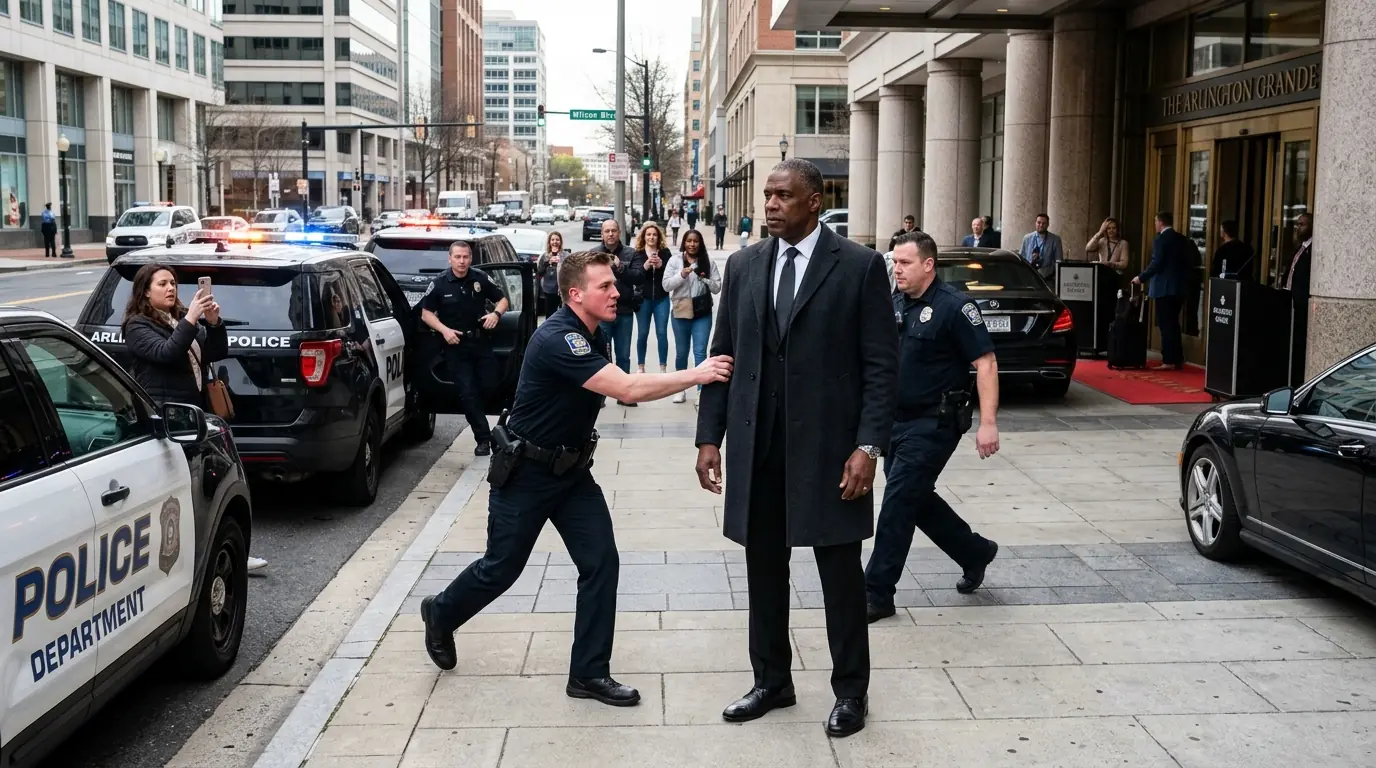
His name was Isaiah Monroe, and at fifty-seven he had spent thirty-five years learning what happened when people made important decisions before they possessed enough information. He had entered the Army at twenty-two after graduating from Howard University and completing ROTC, then built a career through intelligence assignments, overseas commands, disaster-response operations, and years of work coordinating military support with civilian agencies. Three months earlier the Senate had confirmed his promotion to lieutenant general, and the Pentagon had assigned him to lead the newly reorganized Atlantic Regional Readiness Command, a three-star position responsible for coordinating thousands of military personnel across several states during major emergencies. None of that was visible beneath his simple coat, dark slacks, polished shoes, and the reading glasses he kept in his breast pocket.
Isaiah preferred it that way whenever circumstances allowed. Uniforms changed conversations before the first word was spoken, and three silver stars changed them even more, which was useful in command meetings but increasingly exhausting everywhere else. His late wife, Camille, had once teased him that after making general he had become incapable of buying toothpaste without someone calling him sir, and after her death five years earlier he became even more protective of the few places where he could simply be Isaiah. That Friday, he had deliberately asked his security team to drop him a block from the hotel so he could walk the remaining distance alone before an evening summit filled his next six hours with titles.
The summit was supposed to begin at six, and Isaiah had arrived early because lateness had annoyed him since his first platoon leader assignment. Arlington’s mayor, fire chief, emergency-management director, several hospital executives, federal security officials, and Police Chief Marisol Vega were already inside the hotel for a closed session on regional crisis coordination. Isaiah was scheduled to deliver the opening remarks and then participate in a private dinner where everyone would discuss lessons from recent hurricanes, cyberattacks, infrastructure failures, and mass-casualty exercises. At five sixteen, none of those people knew their guest of honor was standing outside because his deputy’s vehicle had been delayed by traffic.
Isaiah checked his phone, saw a message from Major General Claire Whitaker saying she was four minutes away, and placed the device back inside his coat. He could have walked into the lobby and waited there, but the evening air was pleasant, the sidewalks were busy, and he had spent nearly ten hours in windowless offices before arriving. A hotel employee had placed small evergreen trees in brass planters beside the entrance, taxis glided through the circular driveway, and office workers crossed the street carrying takeaway coffee while Christmas decorations flickered to life along storefront windows. Isaiah stood near one planter and watched the city move.
Eleanor Price noticed him while waiting for her husband outside a nearby restaurant. She was sixty-two, white, recently retired from an insurance company, and carrying the kind of anxiety that had worsened since someone broke into her daughter’s car six months earlier. Isaiah did nothing to her, spoke to no one, and never approached the hotel vehicles, but Eleanor saw him glance several times toward the street while remaining alone beside the luxury entrance. Instead of interpreting those glances as someone waiting for transportation, she began wondering why a man she did not associate with the hotel had been standing there so long.
Officer Thomas Nolan happened to be parked twenty yards away in a marked Arlington patrol vehicle assigned to the downtown corridor. Nolan was forty, white, eleven years into police work, and well known for what supervisors called proactive contacts, a phrase that appeared positively in evaluations even though some colleagues privately believed his instincts sometimes became conclusions too quickly. Eleanor walked toward his cruiser, tapped lightly on the passenger window, and told him there was a man outside the Stanton Grand who had been “watching everything.” When Nolan asked what the man had actually done, Eleanor said she was not sure but added, “He just doesn’t look like he belongs there.”
The sentence should have remained exactly what it was, the uncertain impression of a private citizen. It was not a description of theft, assault, trespassing, threatening behavior, attempted vehicle entry, or any other specific offense. Nolan nevertheless looked through his windshield, saw Isaiah standing near the hotel entrance, and experienced the familiar internal click of a theory forming before an investigation had begun. He radioed that he was checking a suspicious person outside the Stanton Grand and stepped from the cruiser.
Isaiah noticed him approaching and automatically moved both hands away from his coat pockets. That habit had nothing to do with rank and everything to do with being a Black man who had grown up in Baltimore during years when his father taught him to make police encounters as visually uncomplicated as possible. Nolan stopped four feet away and said, “What are you doing here?” without greeting him or explaining that a citizen had raised a concern. Isaiah answered, “Waiting for colleagues who are arriving for an event inside.”
Nolan looked toward the hotel doors and then back at him. “What event?” he asked, and Isaiah said, “A regional security meeting.” Nolan’s eyes narrowed as if the answer had created rather than reduced suspicion, and he asked Isaiah to identify himself. Isaiah gave his name without hesitation.
“Identification,” Nolan said. Isaiah asked, “Are you requesting it or are you detaining me?” Nolan disliked the question immediately. “If you have nothing to hide, show me identification and we’ll be done,” he replied, shifting his stance slightly.
Isaiah felt the first flicker of irritation but did not move. “I’m willing to show you who I am,” he said, “but I’d like to understand why I’m being questioned.” Nolan told him there had been reports of suspicious activity around the hotel, using the plural even though the only information he possessed came from Eleanor. Isaiah glanced toward the crowded sidewalk and asked, “What activity are you investigating?”
“You standing here watching cars.” Isaiah looked toward the valet lane. “I’m waiting for a vehicle.”
Nolan’s expression hardened. “Reach slowly.” Isaiah nodded before moving one hand toward the inside of his coat.
That was when a second cruiser turned rapidly into the hotel driveway. Officer Brandon Pike stepped out before the vehicle had fully settled, having heard Nolan’s suspicious-person check over the radio and decided to assist because downtown calls near major hotels sometimes escalated quickly. Pike was thirty-two, white, physically imposing, and already carrying tension from a long shift that had included a fight outside a sports bar and an arrest involving a concealed knife. He saw Isaiah reaching inside his coat before hearing the explanation.
“Hands where I can see them,” Pike shouted. Isaiah immediately stopped and raised both hands.
The command attracted everyone nearby. Conversations slowed, valet attendants turned around, and a couple walking into the hotel stopped with one foot inside the revolving door. Isaiah looked toward Pike and said, “Your partner asked me to retrieve identification.” Nolan could have resolved the confusion immediately.
Instead he said, “He’s being difficult.” Pike moved closer.
“Turn around.” Isaiah stayed exactly where he was.
“Why?” The single word changed Pike’s face.
“Because I told you.” Isaiah answered, “That is not an explanation.”
Pike stepped within arm’s reach. “You want to make this harder than it has to be?” Isaiah looked at both officers and said, “I’m standing outside a hotel waiting for colleagues, I gave my name, and I was reaching for identification because Officer Nolan requested it.” Nolan folded his arms.
“He keeps trying to run the encounter.” Isaiah almost smiled despite himself.
“No, Officer, I’m trying to understand it.” Pike told him to stop talking.
A third cruiser appeared because Nolan had quietly requested another unit after Isaiah asked whether he was detained. Officer Elena Foster parked behind Pike and approached at a slower pace, immediately noticing the gathering crowd. She had worked with Nolan often enough to recognize when his shoulders tightened in the way they did when he believed someone was challenging his authority. Foster looked from Isaiah’s raised hands to the hotel entrance and asked, “What do we have?”
“Possible casing,” Nolan answered. Foster frowned.
“Casing what?” Nolan gestured vaguely toward the hotel.
“Vehicles, entrance, maybe guests.” Isaiah looked directly at Foster.
“I have touched no vehicle, approached no guest, and attempted to enter nothing.” Foster looked toward Nolan.
“Did somebody report that?” Nolan said, “Caller said he was suspicious.”
Eleanor remained near the corner, watching from behind oversized sunglasses. She heard Nolan describe her concern as if she had reported specific criminal behavior and felt the first uncomfortable realization that her words had grown after leaving her mouth. She had told him Isaiah was watching the area and looked out of place, but she had not seen him testing doors or following guests. Her husband had still not arrived, yet she suddenly wanted to leave.
Pike ordered Isaiah to turn around again. Isaiah asked, “Am I detained?” Pike answered, “You are now.”
“For what suspected crime?” Pike said, “Suspicious activity.”
Isaiah’s eyes moved toward Nolan. “That is not a crime.” Pike grabbed his right wrist.
Several phones rose in the crowd. Someone near the valet stand whispered, “He was literally just standing there.” Foster heard it.
Isaiah did not pull away. Years of commanding soldiers in places where one wrong movement could produce gunfire had taught him that physical self-control was not surrender but preservation of options. “Officer,” he said as Pike moved his arm behind his back, “I am not resisting you.” Pike replied, “Then stop tensing.”
“I am balancing.” Nolan took Isaiah’s other wrist.
The cuffs closed. Cold steel pressed into skin that had carried three-star insignia less than four hours earlier, and for one surreal second Isaiah’s mind focused on how small the mechanism sounded. A click, another click, and the crowded sidewalk suddenly treated him differently.
People who had been merely curious began creating distance. One mother guided her teenage daughter behind her. A hotel guest stepped around the group without making eye contact.
Isaiah understood what the cuffs communicated. Whatever no one knew, police apparently knew enough to restrain him. His entire public identity had been rewritten in seconds by two pieces of metal.
Pike began patting him down. Isaiah said, “I do not consent to a search beyond whatever lawful safety frisk you believe is justified.” Pike replied, “You’re in no position to dictate terms.”
“Correct.” Isaiah’s voice remained even.
“That’s why I’m making the lack of consent clear.” Foster looked at him more carefully.
Nolan reached inside Isaiah’s coat and removed the leather credential holder Isaiah had been trying to retrieve. The first item visible was his Virginia driver’s license, which showed the name Isaiah David Monroe and an Arlington address. Behind it sat his Department of Defense Common Access Card identifying him as active-duty Army. Nolan flipped it open, looked at it for less than two seconds, and said, “Could be fake.”
Isaiah’s expression changed. Until then his frustration had been directed mainly at the inconvenience and humiliation of the encounter, but the casual dismissal of an official credential before anyone attempted verification created a deeper disappointment. “Read it,” he said.
“I did.” Nolan placed the holder inside his own jacket.
“No, you glanced at it.” Isaiah turned his head slightly.
“Read the rank.” Nolan ignored him.
Pike started guiding Isaiah toward the cruiser. “You can explain everything downtown.” Foster finally stepped closer.
“Wait.” Pike looked at her.
“What?” Foster asked Nolan whether he had run Isaiah’s name.
“Not yet.” Foster stared.
“So why are we transporting?” Nolan answered, “He’s detained, not arrested.”
Isaiah looked at her. “Then please tell me what facts currently justify moving me from the place you found me.”
Nolan snapped, “You don’t get to interrogate us.” Isaiah said, “I’m asking because I’m the person in handcuffs.”
Foster reached for her radio. “I’m running him.” Nolan frowned.
“I’ve got it.” She answered, “Then run it.”
A man recording from the hotel steps quietly said, “Good.” Pike turned toward him and ordered him to stay back.
The man raised one hand. “I’m twenty feet away.” Foster looked toward Pike.
“He’s fine there.” Pike said nothing.
Isaiah appreciated the small intervention. It did not remove the cuffs.
Dispatch responded with Isaiah’s driver information. Valid license, no warrants, no criminal history returned through the initial check, and the Arlington address matched what was printed on the card. Foster asked dispatch to verify whether a military identification credential could be confirmed through ordinary law-enforcement channels.
Nolan looked irritated. “We don’t need to turn this into a Pentagon investigation.” Isaiah answered, “No one asked you to.”
Pike glanced at him. “You’re military?” Isaiah nodded.
“Yes.” Pike asked, “What do you do?”
Isaiah looked toward Nolan’s pocket. “Apparently something printed on the identification your partner chose not to read.”
Pike’s jaw tightened again. “There’s the attitude.” Isaiah exhaled slowly.
“My attitude has not created a crime.” Foster looked away to hide an involuntary reaction.
Dispatch said military credentials could not be fully authenticated through the same database as state licenses but advised contacting the Department of Defense law-enforcement liaison if necessary. Foster repeated the information. Nolan said, “That’ll take forever.”
Isaiah answered, “It will take less time than transporting me.” Nolan ignored him.
A hotel manager emerged from the revolving door. His name was Richard Hammond, and he had been checking arrangements for the security summit upstairs when a concierge reported police activity outside. He recognized Isaiah from the event briefing photograph immediately, but the angle and distance made him hesitate because the man in handcuffs did not fit the image his mind expected. Then Isaiah turned his face.
Richard stopped. “Oh, God.”
Foster heard him. “Sir, stay back.”
Richard raised both hands. “Officer, that man is expected inside.” Nolan turned.
“For what?” Richard swallowed.
“The National Regional Security Summit.” Pike looked toward Isaiah.
“You said regional security meeting.” Isaiah answered, “Yes.”
Nolan asked Richard, “What’s his role?” Richard hesitated because Isaiah’s exact attendance list had been treated as restricted event information, though not classified.
“He is a principal guest.” Nolan narrowed his eyes.
“What does that mean?” Richard said, “It means please call your supervisor.”
Nolan’s face flushed. “Everybody suddenly wants to supervise police.” Richard stepped backward.
“I’m not telling you how to do your job.” He looked at Isaiah.
“I’m telling you your job may become significantly harder if you don’t slow down.” Isaiah closed his eyes briefly.
“Richard, don’t do that.” The hotel manager looked surprised.
Isaiah continued, “My occupation is irrelevant to whether they have lawful grounds now.” Richard nodded.
“Yes, sir.” Pike caught the honorific.
“Sir?” Richard immediately realized what he had done.
Nolan looked between them. “Who is this guy?”
Isaiah answered, “Isaiah Monroe.” Nolan said, “I know the name.”
“Then perhaps that is enough to verify.” Nolan looked frustrated rather than reassured.
That response unsettled Foster. She had entered policing because she believed uncertainty should shrink when information accumulated, and she could now feel the opposite happening beside her. Every fact supporting Isaiah’s explanation seemed to make Nolan more determined to find something else.
She requested a patrol supervisor. Nolan turned sharply.
“I did not ask for one.” Foster replied, “I am asking.”
Pike muttered, “This is getting ridiculous.” Isaiah looked at him.