The moment Chief Warren Gol flicked the lighter and touched that flame to the edge of a document, stamped with the seal of the National Security Agency, he stopped being a small-town bully playing king of his county. He became a federal criminal. He just didn't know it yet.
And somewhere in the woods behind his precinct, a row of black SUVs was already rolling. It was a Tuesday in late October, and the two-lane highway cutting through Pel Creek, Alabama, was the kind of road that only showed up on paper maps.
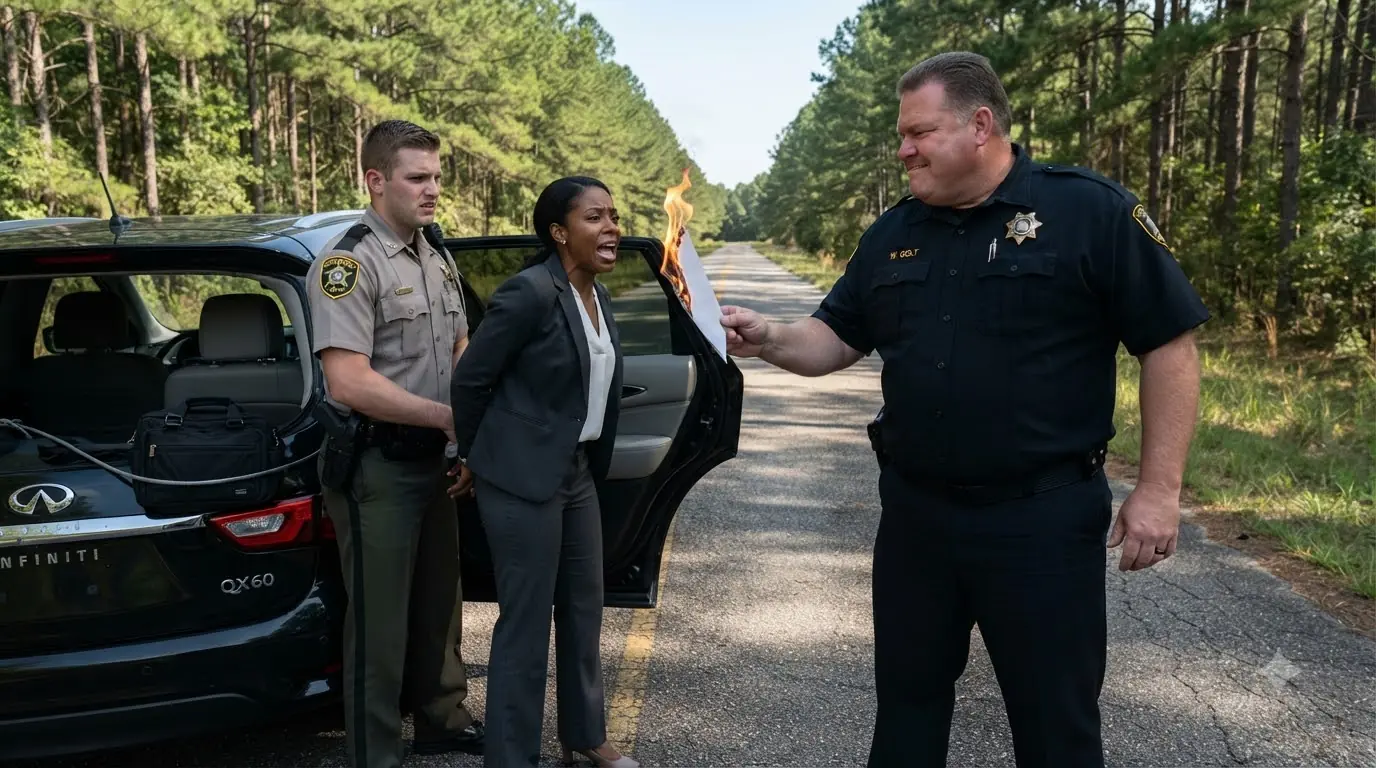
No exits, no rest stops, no cell signal on most carriers, just pine trees pressing in from both shoulders and the occasional rusted speed limit sign that nobody paid much attention to. The sky overhead was a flat oyster gray, the kind that carried the promise of cold rain before nightfall. Immani Townsend noticed the missing cell bars on her phone the moment she turned off State Route 41 and began the final leg of her drive.
She set the phone face down on the center console and kept both hands on the wheel of her leased black Infiniti QX60. At 44, Immani was a woman who had spent the last 16 years operating in spaces most Americans didn't know existed.
She held a graduate degree in applied mathematics from MIT, a second graduate degree in signals intelligence from the National Defense Intelligence College, and a classified personnel file at Fort Meade that ran to several hundred pages. Her official title, the one on her government ID, was Deputy Section Chief, Cyber Operations Division, National Security Agency. In practice, she was the person other intelligence officers called when a problem had become too complicated for everyone else. She was dressed the way she always dressed when traveling between facilities, dark slacks, a charcoal blazer over a simple white blouse, low heels, unremarkable, invisible. A professional woman driving through the middle of nowhere on a weekday afternoon.
On the back seat, secured with a steel cable threaded through the handle and looped around the seat post anchor, sat a rigid-sided black messenger bag. Inside the bag were two things. A personally assigned encrypted laptop and a sealed government courier envelope marked with a red diagonal stripe. A classification level that required a biometric unlock and a chain of custody log that had been physically signed at Fort Meade at a regional NSA relay facility in Birmingham and was awaiting one final signature at a classified signals processing station tucked into 30,000 acres of Alabama timber country.
A station that on every publicly available map was listed as a fiber-optic maintenance depot owned by a shell holding company in Delaware. Immani was 12 minutes from that final signature when the lights came on in her rearview mirror. She looked up, blue and white flashes, a Pel Creek municipal police cruiser. She exhaled through her nose, slowed the Infiniti smoothly, and pulled onto the gravel shoulder.
Gravel crunching under the tires like crushed glass. She put the car in park, turned off the engine, placed both hands on the steering wheel at 10 and 2, where any approaching officer could see them clearly. She had done this before. She knew how to do this well.
The driver's door of the cruiser opened, and Chief Warren Gol unfolded himself from behind the wheel. He was a big man, wide through the shoulders, gone soft around the middle, with a florid complexion that suggested high blood pressure and a fondness for red meat. He had the unhurried, swaggering gait of a man who had never in his professional life considered the possibility that he might be wrong about something. Behind him, a younger officer, Deputy Cory Sloan, 26, trim, visibly uncomfortable, stepped out and hung back near the cruiser's hood with his thumbs hooked in his belt.
Gol took his time. He circled the back of the Infiniti deliberately, running a meaty finger along the tailgate. He looked at the plates. He peered through the rear window.