The first thing Sergeant Wade Mercer said when he looked through my backyard gate was, “Everybody keep your hands where I can see them.”
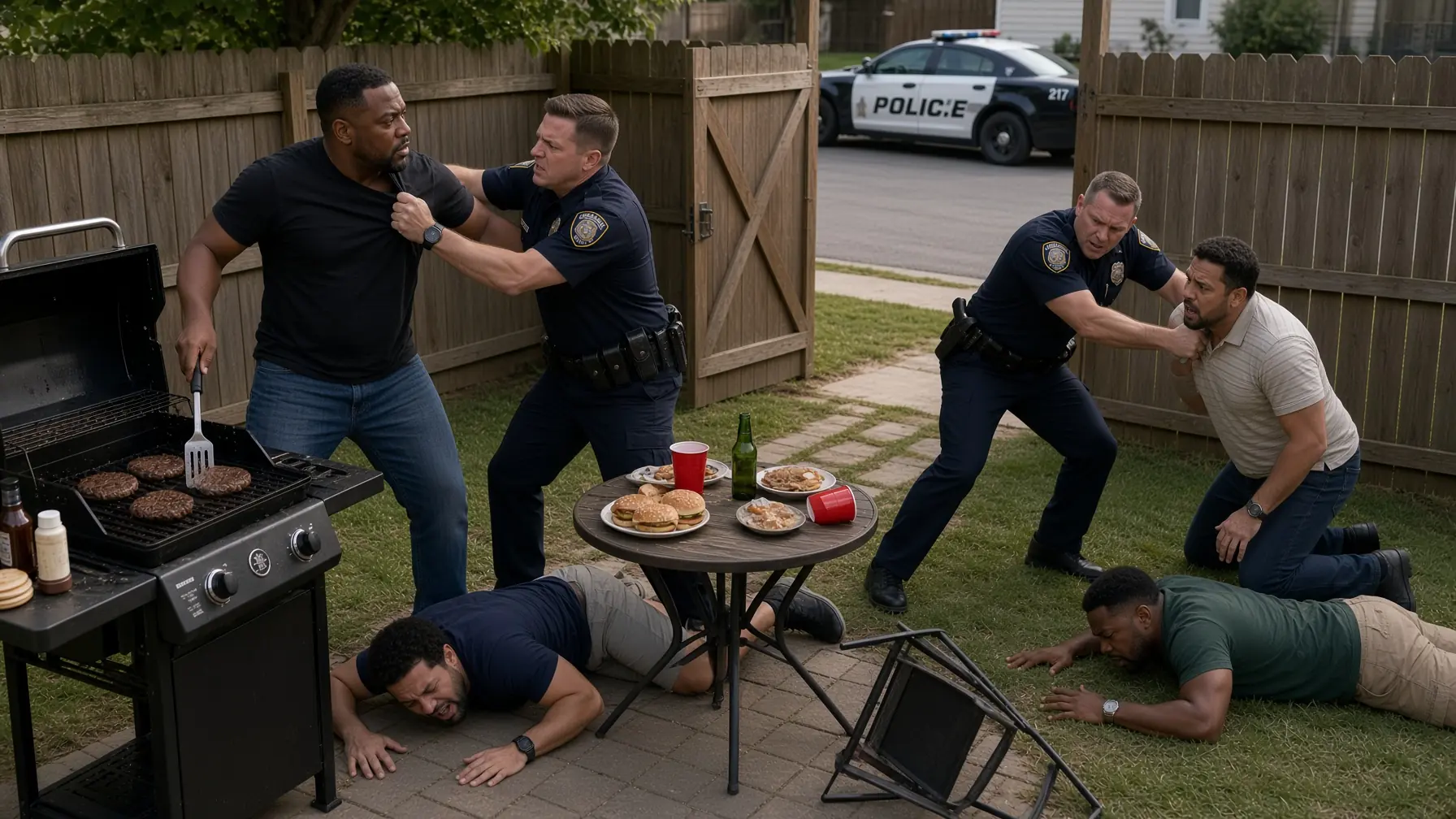
For a few seconds, none of us moved.
Not because we were refusing.
Because the command made absolutely no sense.
Darnell Cole was standing beside the grill holding a pair of metal tongs. Isaiah Price had half a hamburger in his hand. Terrence Brooks—Ty to everybody who knew him—was sitting backward in one of my folding chairs, arguing that the Cleveland Browns could still ruin a perfectly good season even when nobody expected them to win anything. I was near the patio table opening a bag of ice.
Four Black men.
Four folding chairs.
One grill.
A cooler.
A bowl of potato salad.
Three unopened beers and one partly finished bottle sitting beside Darnell.
That was the entire scene.
There was no music playing.
Nobody was fighting.
Nobody had a weapon in his hand.
Nobody had been standing near the fence before the two police officers arrived.
Yet Sergeant Mercer had one palm near his holster and the other extended toward us as though he had interrupted something far more dangerous than lunch.
The younger officer behind him looked less certain.
He was maybe twenty-six, slim, clean-shaven, with FOSTER printed above his right breast pocket. His body camera blinked red. Mercer’s did not.
I raised both hands slowly.
“Officer, this is my property.”
Mercer looked at me.
“Name?”
“Marcus Reed.”
“Everybody else?”
Ty started to answer.
Mercer pointed at him.
“I didn’t ask you.”
Ty’s mouth closed.
That was when the afternoon stopped feeling strange and started feeling dangerous.
My name is Marcus Reed. I was thirty-nine years old that summer, an electrical foreman for a commercial contractor in Clearwater Springs, Virginia. I had spent fifteen years wiring schools, hospitals, warehouses, and office buildings throughout the county. Four months earlier, after more than a decade of renting, saving, working overtime, and telling myself I would buy “next year,” I had finally closed on a two-story brick house at 247 Maple Ridge Lane.
It was the first home I had ever owned.
Not inherited.
Not shared.
Not a temporary stop until a landlord raised the rent again.
Mine.
The house sat in a quiet development built in the late 1980s, the kind of neighborhood where lawns were trimmed on Saturdays and people left trash cans beside garages until Monday morning. It was not gated. There was no private security. The streets belonged to the city, and the wooden fence around my backyard had been one of the reasons I bought the place.
I wanted somewhere my friends could come over without us worrying about whose apartment neighbor worked nights.
That Saturday was the first time all four of us had managed the same day off in months.
Ty repaired heavy equipment for the county highway department. Darnell taught eighth-grade history. Isaiah was a respiratory therapist at St. Vincent Medical Center. I worked construction.
None of those occupations should have mattered.
Later, people kept mentioning them as though respectable jobs somehow proved we had not deserved what happened.
I never liked that.
We could have been unemployed.
We could have worked night shifts stocking grocery shelves.
We could have been nineteen instead of pushing forty.
The question should have remained the same.
What had police actually seen that gave them reason to treat us like criminals?
At 3:37 that afternoon, the answer was nothing.
I did not know that yet.
All I knew was Sergeant Wade Mercer had entered my fenced backyard without asking permission and was now ordering four grown men to place their hands where he could see them.
I kept mine raised.
“What’s the call?”
“Noise complaint.”
I looked around.
The only sound beyond our voices was grease popping on the grill.
“We don’t have music.”
Mercer’s eyes moved toward the cooler.
“Complaint mentioned drinking too.”
Ty said, “Is that illegal now?”
I glanced at him.
He stopped.
Mercer stepped farther onto the patio.
“That attitude is what turns simple calls into problems.”
I asked, “Are we being detained?”
He stared at me.
“What did you say?”
“I asked whether we’re being detained.”
The younger officer, Foster, looked toward Mercer.
Mercer smiled without humor.
“You one of those guys who watches lawyer videos online?”
“No. I’m asking because you entered my property and started giving commands.”
“I’m investigating a disturbance.”
“What disturbance?”
Mercer’s eyes narrowed.
“Let me explain something. We received a report about a group of males causing a problem in a residential neighborhood. Possible drinking. Possible narcotics activity. Possible gang involvement. I get here and you immediately start challenging me.”
For the first time, all four of us became completely still.
Darnell lowered the tongs.
“Gang involvement?”
Mercer looked at him.
“You have something to say?”
Darnell’s voice remained calm.
“I’m trying to understand how burgers became gang activity.”
Mercer ignored him and turned back toward me.
“Identification.”
“For what?”
“For everyone.”
Isaiah slowly placed his hamburger on a paper plate.
“Officer, our wallets are inside.”
Mercer pointed toward the house.
“Nobody goes inside.”
“Then how do you want our IDs?”
That simple question visibly irritated him.
The rookie spoke quietly.
“Sergeant, we can get names verbally and—”
Mercer looked over his shoulder.
“Foster.”
The rookie stopped.
Mercer turned back to us.
“One at a time. Homeowner first. You go get identification. Everyone else stays where I can see them.”
I did not move.
“What crime are you investigating?”
He stepped closer.
“Last warning.”
“Warning for what?”
“Interfering with an investigation.”
“What am I doing that interferes?”
That was the moment everything changed.
Mercer moved into my space.
Not enough to touch me.
Enough that I could smell coffee on his breath.
“You need to decide whether being difficult is worth spending your Saturday in cuffs.”
My heartbeat changed.
Behind me, Ty stood.
Not quickly.
Not aggressively.
He simply stood.
Mercer turned immediately.
“Sit down.”
Ty stared at him.
“Why?”
“Because I told you.”
“That’s not a reason.”
Mercer reached for his handcuffs.
Isaiah spoke sharply.
“Ty, sit.”
Ty looked toward him.
Then at me.
I nodded.
He sat.
The rookie officer released a breath I do not think he realized he was holding.
Mercer looked at us for several seconds.
Then pointed at the cooler.
“What’s in there?”
“Beer,” I said. “Water. Ice.”
“Anything else?”
“Hamburger meat.”
He looked toward a black duffel bag near Darnell’s chair.
“That yours?”
Darnell nodded.
“Gym bag.”
“Open it.”
Darnell’s expression changed.
“No.”
Mercer almost smiled.
“Why not?”
“Because you just asked to search my bag and I said no.”
“That isn’t what I asked.”
“It sounded exactly like what you asked.”
Mercer looked toward Foster.
“You hearing this?”
Foster hesitated.
“Yes, Sergeant.”
“Document refusal.”
That phrase stayed with me.
Not because refusing a voluntary search was wrong.
Because Mercer said it as though Darnell had just supplied evidence.
He turned toward me.
“Open the cooler.”
“No.”
“Why?”
“Same reason.”
Mercer stared.
Then he reached for it himself.
I stepped sideways without thinking.
Not toward him.
Into the space between the cooler and the patio table.
Mercer’s hand immediately went to my chest.
“Back up.”
“I’m standing in my own yard.”
“Back up.”
“You asked to search something. I said no.”
His second hand grabbed my wrist.
Everything inside me wanted to pull away.
I did not.
That decision probably saved me from a worse charge.
“Hands behind your back.”
“What am I under arrest for?”
“Obstruction.”
“How am I obstructing?”
“You physically interfered with a lawful investigation.”
“I did not touch you.”
“You stepped between me and evidence.”
“What evidence?”
Mercer twisted my wrist behind me.
Pain shot through my shoulder.
Ty stood again.
Foster moved toward him.
“Sir, stay back.”
Ty lifted both hands.
“He didn’t do anything.”
“Stay back.”
Darnell put the tongs on the grill.
Isaiah moved away from the table.
Nobody shouted.
Nobody rushed.
Nobody threatened.
That detail would become extremely important later because Sergeant Mercer’s report described the next thirty seconds very differently.
According to him, my three friends “closed distance in an aggressive manner,” forcing officers to establish a defensive perimeter.
According to what actually happened, they stood approximately twelve feet away with their hands visible while a veteran police officer handcuffed me for refusing permission to search my cooler.
Mercer tightened the cuffs.
Then he opened the cooler.
He moved water bottles.
Beer.
Ice.
Nothing else.
He looked almost annoyed.
Then he turned toward Darnell’s bag.
Darnell said, “I’m still not consenting.”
Mercer opened it anyway.
Shoes.
A towel.
Deodorant.
A paperback history book.
No drugs.
No weapons.
Nothing illegal.
Mercer zipped it halfway closed.
Then he looked toward my back door.
“Anybody else inside?”
“No.”
“Mind if we check?”
I almost laughed.
“I think we’ve established the answer.”
He did not find that amusing.
Five minutes later, I was sitting in the back of a patrol car outside the first house I had ever owned.
People watched from windows.
A woman walking a golden retriever stopped across the street.
A teenager on a bicycle slowed down.
Ty, Darnell, and Isaiah remained in my yard while Foster took their names.
Mercer stood near his cruiser talking into his radio.
I could not hear everything.
One phrase came through the open front window.
“Group was noncompliant from the start.”