The Incident at UA Police Training Grounds Family Day
“Is that some kind of joke?” The voice was young, sharp, and laced with the casual arrogance of a hero cadet who had never known a day of true doubt. It cut through the warm afternoon air at the UA Hero Police Academy’s annual family day. A bubble of manufactured peace filled with the scent of grilled food and the distant sounds of quirk training demonstrations.
Officer Cadet Miller, his fresh provisional hero license gleaming on his chest, gestured with a half-eaten skewer toward the old man’s forearm.
“Seriously, what is that supposed to be? A drunken doodle from some back-alley fight in the old days?”
Randall Bishop, eighty-two years old, didn’t flinch. He sat on a simple park bench, a solitary island in a sea of young hero families. His back was straight, his hands resting on his knees. His gaze remained fixed on a group of children chasing a soccer ball across the training field. Their laughter was a sound he had once thought he would never hear again.
He had come here not for the celebration, but for the quiet hum of belonging, a frequency only a place like this could broadcast.
Another cadet, younger still, snickered.
“Looks like a worm trying to eat a bottle cap, sir.”
Miller took a step closer, his shadow falling over Randall. The festive noise around them seemed to dim, the world shrinking to the space between the young cadet’s polished boots and Randall’s worn shoes. He leaned in, his voice dropping to a conspiratorial whisper that was loud enough for everyone nearby to hear.
“Hey, old timer, a little friendly advice. You might want to cover that thing up. It’s a little embarrassing for the rest of us. Sets a bad example for the new recruits. You know, the Hero Commission’s got standards now.”
The small circle of cadets around Miller laughed. They were a pack brimming with the invincible energy of youth and rigorous training. They saw the world in black and white, in pass or fail, in strength and weakness. Before them, they saw only weakness. They saw a frail old man with tired eyes and skin like wrinkled parchment. They saw a faded, blurry tattoo on a withered arm, a messy blue-black coil of ink that looked ancient and meaningless. It was a relic, and in their world of cutting-edge quirks and modern hero work, relics were meant for museums, not active hero police grounds.
“It has its meaning,” Randall said, his voice a low, gravelly rasp.
Miller smirked, his confidence swelling with what he perceived as a victory.
“Oh, I bet it does. I bet you’ve got a lot of stories. How you and your buddies took down a whole villain organization with a single quirk, right?”
He straightened up and addressed his friends.
“These old-timers, they love their war stories. Problem is, after a few decades, they can’t tell the truth from the fiction they’ve been spinning at the retirement home.”
The insult hung in the air, thick and ugly. A few onlookers, drawn by the confrontation, shifted uncomfortably. A mother pulled her child a little closer. This was not part of the carefully curated fun of the day. This was something real, something sour.
“Show me your ID,” Miller demanded, his tone shifting from mockery to official. He was flexing the only authority he had. “Let’s see if you’re even authorized to be here. We have to be careful about stolen valor.”
The accusation was the final stone cast. Stolen valor. It was the ultimate sin in their world, a betrayal of the trust and sacrifice that bound them all together. To them, Randall Bishop, with his quiet demeanor and his strange, indecipherable tattoo, was an anomaly. He didn’t fit their image of a hero. Heroes were loud. Heroes were proud. Heroes had stories they were eager to tell. This man was just quiet.
Randall reached into his back pocket. His movements were slow and deliberate. He pulled out a worn leather wallet, the kind that molds itself to a man’s shape over a lifetime. He fumbled with the clasp, his fingers stiff with age. Miller let out an impatient sigh, shifting his weight from foot to foot. He was used to speed, to efficiency, to immediate compliance. The old man’s slowness grated on him, another sign of his obsolescence.
As Randall opened the wallet, a faded corner of a photograph peeked out, a ghost of a young man’s face. For a fleeting second, the image seemed to pull Randall away from the sunny training ground. He wasn’t there anymore. The world went silent, replaced by the humid, oppressive heat of a ruined city block at night. The air was thick with the smell of smoke and decay. The only light came from a single flickering streetlamp.
A brother in arms, his face slick with sweat and streaked with dirt, was holding his arm. The sting was sharp, rhythmic. A piece of sharpened metal dipped in a crude ink made of soot and blood. He could hear their captain’s voice, a low whisper that was more powerful than a shout.
“They will never know our names. They will never find our bodies. But they will know we were here. This mark is our stone, our memory.”
The symbol taking shape on his skin was a coiled serpent, its fangs clenched around a single solitary star. A pact made in the heart of darkness. A promise to a ghost unit that would soon be erased from history. He blinked and the battlefield was gone. The bright afternoon sun was in his eyes.
Sergeant Miller was staring at him, his hand outstretched, palm up, demanding. The moment of memory, the flash of a life lived in the shadows, had passed unnoticed by anyone but him.
Nearby, a woman named Sarah clutched her phone, her knuckles white. She was a hero support staff member, and she had seen her share of bravado, but this was different. This was cruelty. She had been trying to get a picture of her son on the training wall when the raised voices drew her attention. She watched the young cadets puffing out their chests, preening for each other at the expense of an old man’s dignity. It made her stomach turn.
She knew she couldn’t intervene directly. It would only make things worse. But she couldn’t just stand there and do nothing. She remembered a conversation with her father, a retired top hero commissioner, a man who had forgotten more about hero work than these young cadets would ever know. He had always told her, “Respect isn’t about the license on the chest, it’s about the miles on the soul.”
She quickly dialed his number.
“Dad,” she said, keeping her voice low. “I’m at the family day at UA. There’s a group of cadets here, and they’re—”
Her father’s voice on the other end was calm, but she could hear the steel underneath.
“What’s going on, honey?”
She described the scene, the mockery, the insults, the demand for an ID.
“They’re making fun of his tattoo. Dad, it’s old and faded. It looks like a snake with a star.”
There was a sharp intake of breath on the other end of the line, followed by a long, dead silence. For a moment, Sarah thought the call had dropped.
“Dad, are you there?”
“Sarah,” he said, and his voice was completely different. It was tight, urgent, stripped of all warmth. “Describe the man. What’s his name?”
“I don’t know,” she whispered.
Just then, Miller’s voice carried across the lawn.
“Come on, old man. The ID. Let’s see it. What’s your name?”
“Randall Bishop.”
“Never heard of you.”
Sarah relayed the name to her father.
“His name is Randall Bishop.”
The silence that followed was even more profound than the first. When her father spoke again, his voice was a choked whisper.
“Oh my God, Sarah, listen to me. Do not let that man leave. Do whatever you have to do, but keep him there. I’m making a call. You have no idea who you’re looking at.”
The line went dead. Sarah stood frozen, her heart pounding. The crowd around the confrontation was growing. A circle of silent witnesses to a humiliation that was rapidly approaching its peak.
She looked at Randall Bishop, at his quiet dignity in the face of such arrogance, and a chilling realization washed over her. The young cadets thought they were the predators cornering their prey. They had no idea they were a group of children poking a sleeping dragon.
The phone call from retired Hero Commissioner Wallace hit the academy director’s office like a lightning strike. The aide on duty, a young pro hero accustomed to scheduling meetings and fielding calls from the Hero Public Safety Commission, was not prepared for the raw urgency in Wallace’s voice.
“I don’t care if he’s in a meeting with the Symbol of Peace himself,” Wallace barked, his voice cracking with an emotion the aide couldn’t place. “You get Director Nezu on this line right now. Tell him it’s about Night Adder.”
“Sir, I’m not familiar with that—”
“You don’t have to be familiar with it, son. Just say the name.”
The aide, rattled, put the call on hold and burst into the director’s inner sanctum without knocking. Director Nezu, a figure whose calm intellect was etched onto the very soul of the academy, looked up from a stack of reports, his eyes dark with annoyance.
“This had better be a matter of national security,” he said.
“Sir, I have retired Commissioner Wallace on the line. He’s extremely agitated. He said to tell you it’s about Night Adder and that a man named Randall Bishop is on the main training field.”
The effect of those words was immediate and terrifying. The color drained from Director Nezu’s face. His small paws tightened on the desk.
“My God,” the director whispered. “He’s alive.”
The formidable leader was gone, replaced by a being staring into the abyss of his own history. He stood up so quickly his chair scraped loudly against the floor.
“Get my vehicle! Scramble the academy honor guard. I want them on the training field in five minutes. Get the historical archives lead. Tell them to bring the sealed files on Operation Night Adder. And get the Hero Course Department Head and his entire senior staff. I want them standing on that field when I get there. Move.”
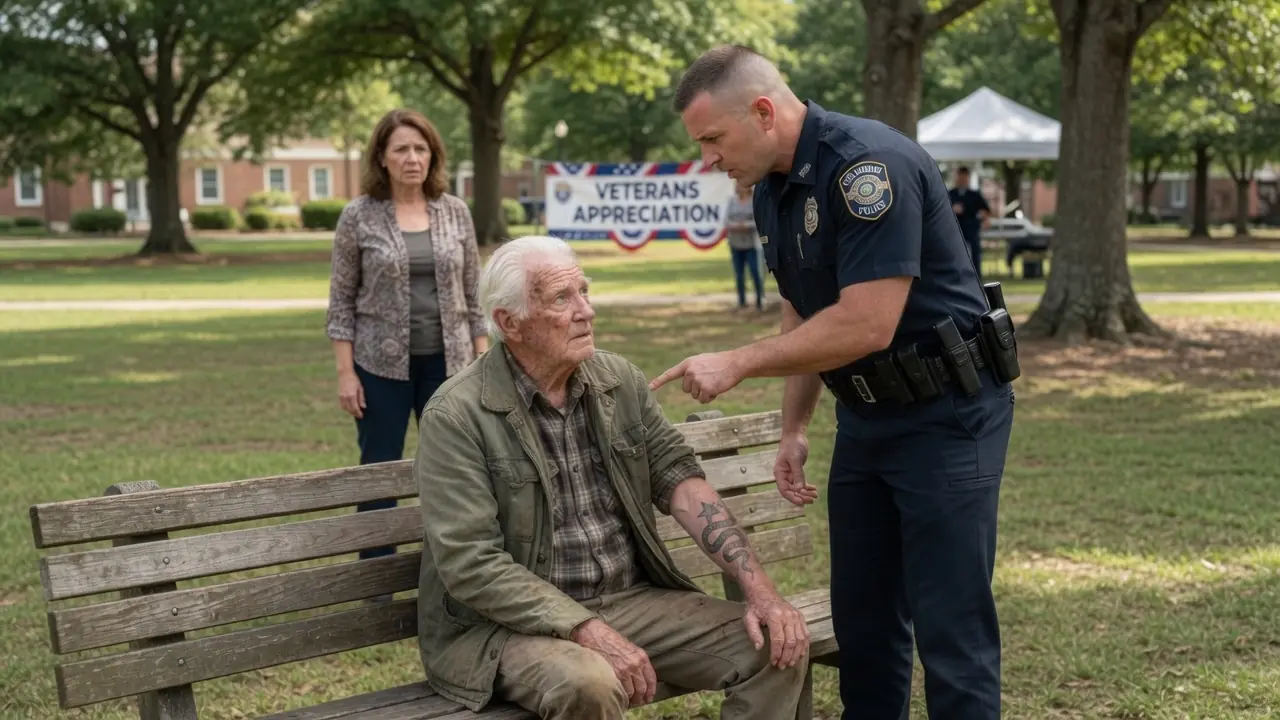
Back on the sun-drenched field, Officer Cadet Miller’s patience had finally evaporated. Randall Bishop’s silent refusal to be intimidated, his calm defiance, had worn through Miller’s thin veneer of professional control. He saw it as a personal challenge, a rejection of his authority in front of his men and a growing crowd of onlookers.
“All right, that’s it,” Miller snapped, taking a step forward. He reached out, his intention clear. He was going to grab the old man’s arm and physically escort him from the premises.
“You’re done, old timer. You’re causing a public disturbance. I think it’s time we took a little walk. Maybe a trip to the Hero Commission for a checkup is in order. See if your head’s on straight.”
It was the ultimate overreach, a threat wrapped in a condescending insult to suggest a man of Randall’s age was senile, to physically lay hands on him. It was a line that should never have been crossed. A collective gasp rippled through the crowd.
Sarah, the woman on the phone, felt a surge of cold dread. This was escalating far beyond mockery. Just as Miller’s fingers were about to close around Randall’s arm, a sound cut through the air, sharp and insistent. It wasn’t the festive music or the sounds of training. It was the wail of sirens growing closer at an alarming rate. These were not ordinary sirens. They were the distinct, authoritative blare of the academy command convoy.
Heads turned. All eyes swiveled toward the main road. A fleet of black vehicles led by two security cars with lights flashing was speeding toward them. They didn’t slow down. They drove directly onto the grass of the training field, scattering families who had been picnicking.
The vehicles screeched to a halt less than fifty feet from the confrontation. Doors flew open before the cars had fully stopped. Security personnel in crisp uniforms fanned out, creating a wide, impenetrable perimeter. They moved with silent, intimidating efficiency that immediately changed the entire atmosphere of the event. The festive air vanished, replaced by a tense, electric silence.
From the lead vehicle, a small white figure emerged. Director Nezu. He was flanked by his aide, the academy’s top hero instructors, and a handful of other grim-faced senior staff. They moved across the grass like a force of nature, their eyes fixed on the small drama unfolding by the bench. The crowd parted for them as if by an invisible hand.
Officer Cadet Miller and his group snapped to attention. Their bodies rigid, their faces a comical mask of shock, confusion, and dawning terror.
Director Nezu strode past the petrified cadets as if they were statues. He didn’t give them a single glance. His entire focus, his entire world, was the old man sitting on the bench. He stopped a few feet from Randall Bishop.
For a long moment, the two looked at each other. An eighty-two-year-old retired hero and the director of the most prestigious hero academy, separated by decades, but connected by a history that no one else there could possibly understand. The director’s usually calm expression softened. He took in the faded blue-black tattoo on Randall’s forearm. The coiled serpent. The single star held in its fangs. It was exactly as the sealed archives had described it.
Then, in an act that sent a shock wave through the silent crowd, Director Nezu drew himself up and executed the sharpest, most meaningful bow of respect, followed by a formal hero salute. His voice, usually light and analytical, was clear and resonant, filled with an emotion that bordered on reverence.
“Sergeant Bishop,” he said, his voice carrying across the stunned silence. “It is an honor, sir.”
He held the salute, a gesture of pure, unadulterated respect. Slowly, painfully, Randall Bishop rose to his feet. He met the director’s gaze, and with a weary grace that spoke of battles both seen and unseen, he returned the salute.
The gesture was a bridge across fifty years of forgotten history. Director Nezu dropped the salute and turned to face the crowd, his eyes sweeping over the onlookers, the families, and finally settling with the weight of an avalanche on Officer Cadet Miller and his group.
A senior instructor stepped forward, handing the director a thin file.
“For those of you who don’t know,” the director began, his voice now cold as steel, “you are looking at a living legend. You are looking at the last surviving member of a unit that, until this morning, was considered a ghost. Hero Public Safety Commission — Covert Operations Group. Task Force Night Adder.”
He let the name hang in the air. It meant nothing to most, but to the hero historians and senior staff present, it was the stuff of myth. A unit so secret its records were ordered sealed for fifty years. A unit that officially never existed. A unit comprised of the toughest heroes this society has ever produced. Sent on missions that no one else would dare undertake.
He opened the file.
“In the chaos following the emergence of quirks, during one of the darkest periods of villain uprisings, a critical intelligence operative was captured deep in enemy territory. He carried information that, if it fell into villain hands, would have compromised the entire hero network. It would have cost thousands of lives.”
The director paused, his eyes finding Randall’s.
“The Commission authorized a rescue, but it was deemed a suicide mission. No conventional team could get in and out. So they sent Night Adder. A twelve-man team. They were inserted deep behind enemy lines with one objective: get the operative. They were surrounded, outnumbered a hundred to one. For three days, they fought. They fought until their quirks were exhausted. They fought with everything they had.”
He looked down at the paper, though he didn’t need it.
“They got the operative. They got him to the extraction point, but the unit was overrun. The official record states the entire team was wiped out. Lost in action. Their names were erased. Their mission buried. All for the sake of public safety.”
He looked up.
“But the record was wrong. One man survived. Wounded. Alone. Hunted for weeks. He made his way through the chaos and back to safety.”
He gestured toward Randall.
“This man. Retired Hero Randall Bishop.”
A wave of awe and shame washed over the crowd. People were openly weeping. The young cadets looked as though they had been physically struck. The faded tattoo was not a drunken mistake. It was a tombstone. It was a battle flag. It was the last vestige of a brotherhood of ghosts.
The director closed the file with a sharp snap. His gaze, now burning with a cold fire, fell upon Officer Cadet Miller.
“You,” he said, his voice dropping to a low, dangerous tone. “You and your cadets. You wear the provisional hero license. You stand here on this sacred ground, and you dare to disrespect a man who embodies every value that license is supposed to represent.”
He took a step toward them. They flinched.
“You think you know hardship? You think you understand sacrifice? You are not fit to stand in this man’s shadow. Your arrogance today has brought shame upon this academy, upon the hero profession, and upon the memory of every hero who fought in the shadows for what you so clearly take for granted.”
He gestured to the academy’s command staff.
“Take their names. Every single one of them. They will be confined to quarters, and they will each write a ten-thousand-word report on the history of Covert Operations with a specific focus on Task Force Night Adder. They will deliver it in person to Retired Hero Bishop’s home with a formal written apology.”
He turned back to Randall, his expression softening once more.
“Sir, I—”
Randall raised a hand, stopping him.
“Director,” he said, his voice quiet but firm, carrying a wisdom that shamed all the anger in the air. “They’re just kids. Full of fire and ambition. We were the same once. It’s easy to forget when you’re that young that the license doesn’t make the hero. The hero makes the license.”
His words were not an excuse. They were a lesson. A lesson in humility, grace, and the quiet strength that defined his entire life. As he spoke, the image of the tattoo seemed to sharpen in the afternoon light.
The story of what happened on the training grounds at UA spread like wildfire. The support staff member, Sarah, wrote a detailed account that was shared widely. National news outlets picked it up. The Hero Public Safety Commission, facing a public relations situation and a genuine outpouring of support for the forgotten hero, moved swiftly.
Within a week, a formal ceremony was held. In front of the entire academy, Director Nezu awarded Randall Bishop long-overdue recognitions for his service. A new training module on hero history and the importance of respecting veterans of all eras was mandated for all incoming cadets, starting with the hero course.
A few weeks later, Randall was sitting in his usual booth at a quiet local café when the bell above the door jingled. A young man in civilian clothes walked in looking uncertain. He scanned the room and his eyes landed on Randall. It was Miller.
He approached the booth, his posture no longer arrogant, but hesitant, humbled. He stood by the table.
“Sir. Retired Hero Bishop.”
Randall looked up and nodded.
“Son. Sit down.”
Miller slid into the booth. He looked exhausted. He placed a thick, bound report on the table between them.
“This is my report, sir. And my formal apology.”
Randall pushed it aside gently.
“I don’t need to read it. I only need to know if you understand it.”
“I do, sir,” Miller said, his voice quiet. “I understand now. But if you don’t mind me asking… I want to know about the people you served with. What were they like?”
And so, Randall Bishop began to talk. Not of grand battles or secret operations, but of small, human moments. He told stories about comrades who shared their last rations, about leaders who kept morale alive in the darkest times. He spoke their names, bringing the ghosts back to life, not as legends, but as people.
For an hour, the young cadet listened, his preconceived notions of heroism being dismantled and rebuilt into something truer, something more profound. When Randall finished, Miller simply nodded, his eyes filled with a new understanding.
He stood up, placed money on the table for the coffee.
“Sir. Thank you.”
He turned and walked out of the café, a different man than the one who had walked in. The mark on Randall’s arm was no longer just ink. It was a living reminder that true heroes often walk among us quietly, their greatest battles hidden from the world, waiting for the right moment to be remembered.