The key had barely entered the lock when every streetlight in Silver Pines went dark.
One moment, the quiet Maryland neighborhood glowed beneath orderly rows of porch lamps. The next, the entire street vanished into blackness.
Maya Williams felt her phone vibrate in her coat pocket.
No signal.
The security application on the screen disconnected. A second warning appeared on the watch around her wrist.
SECURE SYSTEM COMPROMISED.
Then another line flashed beneath it.
AUTOMATIC DELETION IN 24 HOURS.
Maya stared at the red countdown for only a second.
A flashlight beam struck her face.
“You there. Put the key down.”
Two uniformed officers were approaching the porch.
The older one came first. His nameplate read SERGEANT COLE BARRETT. He carried a flashlight in one hand and a collapsible baton in the other.
The younger officer, Daniel Mercer, moved behind Maya and positioned himself between her and the driveway.
Maya kept the key in the lock.
“You are standing on private property,” she said.
Barrett stopped at the bottom of the steps.
“Then prove it.”
“This is my house.”
“That is what people say when they are caught entering property that does not belong to them.”
Maya looked past him toward the patrol car. Its computer screen was glowing. Barrett’s radio also remained active.
The civilian network was down.
The police network was not.
Under her arm, Maya carried a leather envelope containing the recorded deed, closing papers, inspection report, utility transfer and vehicle registration. She could have ended an ordinary misunderstanding in seconds.
But nothing about this felt ordinary.
The power had failed at the exact moment she touched the lock. Her security system had detected an outside access attempt. Two officers had appeared before she could enter.
Barrett pointed at the envelope.
“What is that?”
“Property documents.”
“Show them to me.”
“You can verify ownership through county records.”
“Our system is unavailable.”
Maya glanced toward the glowing computer inside the patrol vehicle.
“Your mobile terminal appears to be working.”
Mercer followed her gaze.
Barrett noticed.
“Why are you watching our equipment?”
“Because my phone and home security system failed while your radio and computer remained active.”
“We received a burglary complaint.”
“What exactly did the caller report?”
“I will ask the questions.”
“Did anyone report a broken window?”
Barrett did not answer.
“A damaged door?”
Silence.
“Someone forcing entry?”
Barrett stepped onto the porch.
“What is your name?”
“Maya Williams.”
“Identification.”
“My wallet is inside.”
“That is not helpful.”
“My name appears on the deed, vehicle registration and utility records. You can verify all three.”
“Then you should have no problem showing us the papers.”
Maya held the envelope beneath her arm.
“Am I being detained?”
Barrett’s expression tightened.
“You are making this more difficult than it needs to be.”
“The situation became difficult when the neighborhood lost communication and two officers arrived before I entered my own home.”
A porch light flickered to life across the street.
An elderly woman emerged carrying a thick navy binder.
“That is the woman I called about,” she announced.
She crossed the street with quick, purposeful steps.
“I am Evelyn Crane, president of the Silver Pines Homeowners Association.”
Maya looked at her.
“What did you report?”
“I saw someone trying to enter the Vance property.”
“With a key?”
Evelyn hesitated.
“Yes.”
“Did you see me damage anything?”
“No.”
“Did you see me force my way inside?”
“No, but the association was not properly informed about the transfer.”
“The association does not determine legal ownership.”
Evelyn opened the binder. Its pages had already been divided by colored tabs. One section was marked with the initials H.V.
Harold Vance.
The former owner.
Maya had purchased the property because of Harold, although neither Evelyn nor the officers were supposed to know why.
Barrett pointed at Maya’s envelope.
“Open it.”
“No.”
“You said the ownership papers are inside.”
“They are.”
“Then show them.”
“I will show them after you explain the legal basis for preventing me from entering.”
Barrett gave a thin smile.
“You are too young to understand how complicated property disputes can become.”
“I read every document before signing it.”
“The transfer may still be under review.”
“The closing was completed on October fourteenth.”
“October twelfth,” Barrett corrected immediately.
Mercer looked at him.
So did Maya.
“How do you know the exact date?”
Barrett paused.
“Dispatch gave it to us.”
“You said the system was unavailable.”
“We received preliminary information earlier.”
“Then dispatch already confirmed the property was sold.”
Barrett tightened his grip on the baton.
“Stop trying to control the conversation.”
“I am asking why you knew the closing date before checking my documents.”
“Put the key on the porch.”
“Do you have a warrant?”
“No.”
“Evidence of forced entry?”
“We have a complaint.”
“A complaint about a woman using a key.”
Barrett stepped between Maya and the door.
Behind him, Mercer moved one hand toward the inside of his uniform shirt.
Maya heard a soft electronic click.
He had activated a personal recording device.
Perhaps he believed he was documenting an uncooperative homeowner. Perhaps he wanted protection from a complaint.
Either way, he had just created something Barrett could not completely control.
A low vibration came from behind the foyer wall.
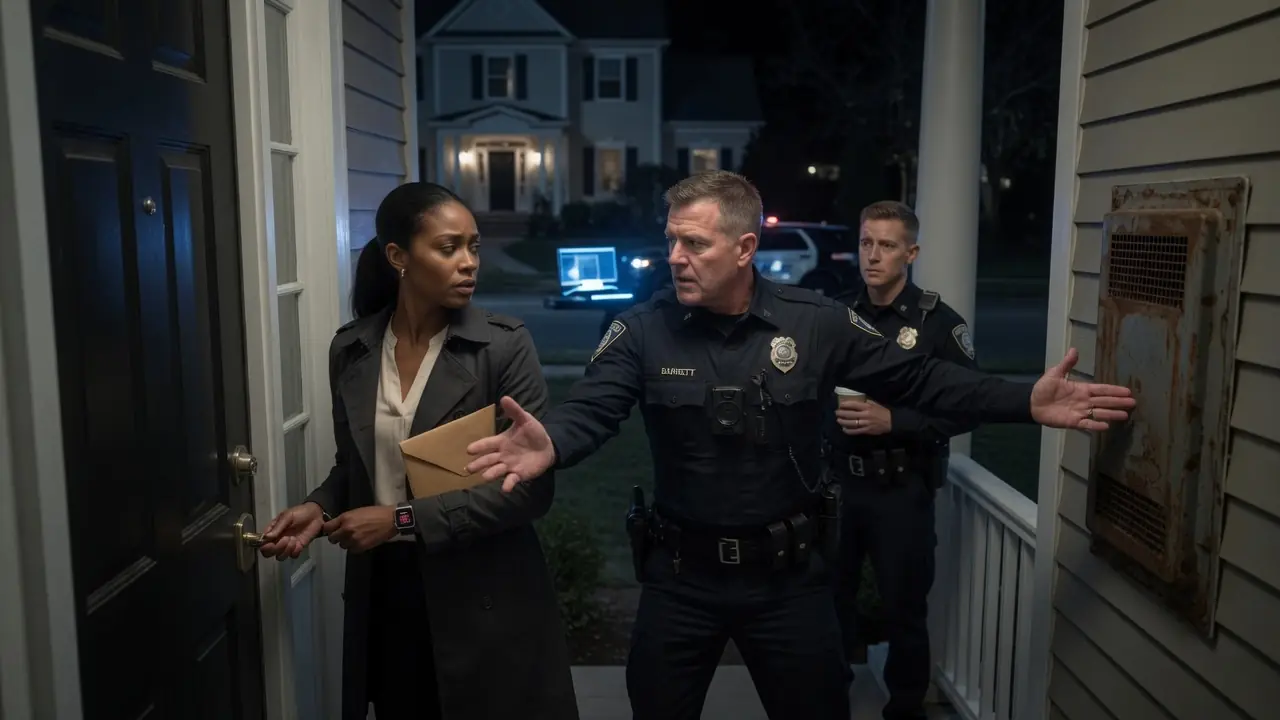
Barrett immediately turned toward the old heating controls beside the entrance.
The reaction was too fast and too specific.
“What is behind that panel?” he asked.
Maya studied him.
“You came here because of a burglary report. Why are you asking about equipment inside the house?”
“I heard something.”
“A mechanical relay.”
“What kind?”
Maya did not answer.
Barrett had looked toward the panel before checking whether anyone was inside. He was not searching for an intruder.
He was searching for a device.
Maya decided to test him.
“Harold never trusted anything connected to the main electrical system.”
Barrett’s eyes returned to the heating controls.
“You knew Harold Vance?” she asked.
“Everyone in Silver Pines knew him.”
“Did you?”
“That is not relevant.”
“It becomes relevant if you came here looking for something he left behind.”
Mercer looked from Maya to his sergeant.
Barrett raised his voice.
“Put down the key and step away from the door.”
“You still have not established that a crime occurred.”
“You are refusing a lawful order.”
“You have not explained what makes it lawful.”
The countdown on Maya’s watch showed twenty-three hours and forty-one minutes.
Another vibration came from inside the wall.
A new warning appeared.
UNAUTHORIZED REMOTE ACCESS DETECTED.
Barrett looked at the front door.
Maya understood.
Someone was already trying to reach the hidden system from outside the property.
Barrett lifted his baton across the path.
“This is your last chance. Prove the house belongs to you.”
“You already know it does.”
Evelyn opened the binder wider.
“The homeowners association has preservation concerns involving the property.”
“Signed by whom?” Maya asked.
“The association’s legal committee.”
“Who chairs that committee?”
Evelyn’s mouth opened, but no answer came.
Maya had already noticed a contractor’s name printed in the lower corner of one page. The same company appeared in financial reports connected to Harold Vance.
“What time did you call the police?” Maya asked.
“A few minutes ago.”
“Before or after the outage?”
Evelyn looked at Barrett.
“I do not remember.”
“If you called before the outage, the timing matters. If you called afterward, their response was unusually fast.”
Barrett stepped between them.
“You are not interviewing the witness.”
“I am asking how two officers arrived the moment communication failed.”
Mercer shifted behind Maya.
The hidden recorder remained active.
Barrett told him to stay near the steps.
Maya looked toward the patrol vehicle.
“Officer Mercer can run the address.”
Mercer nodded slightly.
“The mobile terminal still has a connection.”
Barrett turned on him.
“Stay where you are.”
“The signal is weak, Sergeant, but it is active.”
“Do not question me in front of a civilian.”
Maya watched Mercer’s expression change.
He had expected a simple verification to end the encounter.
Barrett’s refusal made that impossible.
“Why are you preventing him from checking?” Maya asked.
“Because I am handling this scene.”
“You are preventing the quickest way to resolve it.”
Barrett tapped the baton against his palm.
“You do not direct my officers.”
“No, but your officer is the only person suggesting normal procedure.”
Another faint vibration came from the wall.
This time, Barrett tried not to look toward the heating panel.
The effort confirmed he knew Maya had noticed.
“You arrived for a burglary,” she said. “Then you mentioned Harold Vance. Now you are asking about concealed equipment. Those are three different explanations.”
Barrett pointed toward the railing.
“Place both hands there.”
“Am I under arrest?”
“You are temporarily detained.”
“For what conduct?”
“Obstruction.”
“What duty did I obstruct?”
“You refused instructions.”
“An instruction is not automatically lawful because an officer gives it.”
Barrett’s jaw tightened.
Mercer spoke carefully.
“Sergeant, we could still confirm ownership.”
“I told you not to move.”
Barrett stepped closer to Maya.
“Last instruction. Put down the key.”
Maya did not move.
“Get a warrant.”
He reached for her wrist.
Maya allowed him to take it.
“I am not resisting.”
“Hands behind your back.”
“I am not resisting, but I do not consent to detention or entry.”
Mercer approached reluctantly and took her other arm.
“Officer Mercer,” Maya said, “before you close those cuffs, ask him what crime I committed.”
Mercer looked at Barrett.
“Apply the cuffs.”
The first cuff closed around Maya’s left wrist.
Barrett secured the second.
Maya turned her head toward Mercer.
“Remember the exact time.”
Without thinking, Mercer looked at his watch.
“Ten twenty-eight and fifty-six seconds.”
Barrett glared at him.
“Why did you answer her?”
“She asked for the time.”
“The time matters,” Maya said.
Barrett removed the leather envelope from beneath her arm and took the key.
“You do not have permission to take either.”
“They are being held during the investigation.”
“Then inventory them.”
He did not.
Mercer looked toward the patrol car.
“She is secured. We can verify the address now.”
Barrett stared at the key.
“That is no longer the priority.”
He unlocked the door and entered.
He did not announce himself.
He did not search the corners or call out for a possible intruder.
He walked directly to the wall beside the heating controls.
Using the end of his baton, he pried loose a narrow panel.
“That is not a protective check,” Maya said from the porch.
Barrett ignored her.
Behind the panel were old wires and a small relay box.
No drive.
For one brief second, disappointment crossed his face.
Then he moved into the home office.
He opened desk drawers, searched beneath shelves and pressed his fingers along the wall beside the electrical outlets.
Mercer remained near the doorway with Maya.
“What is he looking for?” he whispered.
“Ask him.”
“I am asking you.”
“You are recording this. You already know his explanation does not match his actions.”
Mercer’s face tightened.
“I do not know what you mean.”
“You looked at your pocket whenever the timeline became important. Do not turn it off.”
Inside the office, Barrett opened another cabinet.
Maya decided to test him again.
“Harold preferred the basement.”
Barrett stopped.
His head turned toward the rear staircase.
Maya had never inspected the basement herself. She did not know where the drive had been hidden.
She only needed to know whether Barrett possessed a search pattern.
He returned to the foyer.
“How well did you know Vance?”
“Well enough to know you are following instructions.”
Barrett ordered Mercer to place her in the patrol car.
Before Maya was taken away, she looked at the leather envelope beneath Barrett’s arm.
“You demanded proof. Open it in front of your officer.”
Barrett remained still.
“The first page contains the recorded deed,” Maya continued. “Read it aloud.”
“It will be examined at the station.”
“You are avoiding it because it proves the ownership dispute is false.”
Mercer looked at the envelope.
“We could check the first page, Sergeant.”
Barrett faced him.
“Do you want to take over this scene?”
“No.”
“Then follow the instruction.”
Mercer lowered his eyes.
Maya saw the choice he had made.
He knew verification was possible.
He chose obedience anyway.
During the drive to the station, Barrett began dictating his report.
“Subject refused repeated lawful commands. Subject interfered with an active burglary investigation and attempted to access a disputed residence.”
“The ownership documents are under your arm,” Maya said from the back seat.
Barrett continued.
“Officers heard movement inside and conducted a limited protective check.”
“You entered before claiming you heard movement.”
“Possible evidence of tampering was observed near the heating controls.”
“You removed the panel yourself.”
Barrett stopped dictating and looked at Mercer.
“The first clear report usually becomes the truth. Understand?”
Mercer touched the recording device beneath his shirt.
“Yes, Sergeant.”
Maya watched him through the partition.
He had recorded the real order of events.
Now he had to decide whether the official report or the hidden recording would survive.
At the station, Barrett placed Maya in Interview Room Two.
The overhead lights worked, but the camera near the ceiling was dark.
“Is that recording?” Maya asked.
“The outage affected the system.”
She looked through the open doorway. A green indicator shone on the emergency generator panel.
“The station has backup power.”
Barrett ignored her and pushed a printed form across the table.
“This authorizes us to examine the property and materials connected to the Vance investigation.”
Maya read the heading.
“This is a consent form.”
“It confirms your cooperation.”
“It says I gave permission fifteen minutes before you entered. It also says I voluntarily handed you the key.”
“Sign it, and we can resolve this without additional charges.”
“The time is false. The sequence is false. The description of the key is false.”
“You are focusing on details that do not matter.”
“They matter because they turn an illegal entry into a voluntary search.”
Barrett leaned over the table.
“What did Harold Vance leave in that house?”
Maya remained silent.
“Documents?”
Nothing.
“A storage device?”
She watched his face.
“Municipal records?”
“You arrived for a burglary call,” she said. “Now you are questioning me about financial records.”
“You know more than you are saying.”
“So do you.”
Maya demanded to call an attorney.
Barrett placed a station phone on the table but kept it on speaker.
Marcus Hale answered the second ring.
“This is Hale.”
“I need advice concerning a property transfer,” Maya said.
Marcus understood the coded language immediately.
“What happened?”
“The seller entered the property before delivery. The contract expires within twenty-four hours.”
“Was access forced?”
“The buyer’s key was taken after consent was refused.”
“Is there an independent witness?”
Maya looked at Mercer.
“A young contractor may have photographed the invoice.”
Mercer lifted his eyes.
Marcus’s voice remained calm.
“Do not sign anything you would not want read aloud. Preserve every document, recording and access log connected to the detention.”
Barrett ended the call.
“You finished.”
“No. You ended it when he mentioned preservation.”
Barrett pushed the form toward her again.
“Sign.”
“Activate the camera.”
“It is offline.”
“Then move us to a working room.”
“This room is sufficient.”
Mercer stood near the door.
His hand moved toward the recorder and stopped.
Barrett noticed.
He ordered Mercer to leave and bring coffee.
Inside the break room, Mercer removed the small device and reviewed the footage.
He saw Barrett correct the closing date before dispatch confirmation.
He heard Maya refuse consent.
He watched Barrett remove the heating panel and later describe it as preexisting tampering.
He heard his own voice announce the exact time the second cuff closed.
Mercer paused the recording.
His father had spent almost thirty years in county law enforcement. Every Sunday evening, the older man polished his duty shoes at the kitchen table.
The uniform can become dirty during the work, he used to say.
The oath cannot.
Mercer had heard the words so many times they had become background noise.
Now, for the first time, he understood them.
Barrett entered the break room.
“What are you watching?”
“Training footage.”
“Show me.”
“It is not important.”
“Then you should have no problem showing me.”
Mercer slipped the device into his pocket.
“I was reviewing my own mistakes.”
Barrett studied him.
“You recorded the porch.”
“No.”
The lie came quickly.
Barrett moved closer.
“Personal recordings complicate clean police work. A partner does not preserve every imperfect sentence. A partner remembers why the sentence was necessary.”
“Was entering the house necessary?”
Barrett’s expression changed.
“We believed evidence was being destroyed.”
“That was not part of the call.”
“The situation developed.”
“What evidence?”
Barrett stepped closer.
“You are asking the same questions she is.”
“She owns the house.”
“We have not verified that.”
“Her deed is in your office.”
“Documents can be false.”
“Then why not check them?”
“Because this is larger than a deed.”
The answer escaped before Barrett could stop it.
Mercer returned to the interview room without deleting the recording.
Maya was writing a timeline on a legal pad.
No warrant presented.
No emergency identified.
No evidence of forced entry.
Consent refused.
Home entered after detention.
Heating panel opened by Sergeant Barrett.
A lieutenant named Paul Grady entered and read the page.
“Why is the interview camera off?” he asked.
“Power issue,” Barrett replied.
Grady looked at the working lights.
Then Maya demanded that he examine the deed.
Barrett resisted.
“Bring me the envelope, Cole,” Grady said.
“They may be fraudulent.”
“Then let me see them.”
Barrett’s phone vibrated. The screen displayed the name Martin Sloan, the municipal technology administrator whose signature appeared on Harold’s employment records.
Barrett asked Grady to speak outside.
When Barrett returned alone, his face was calm but his movements were sharper.
“The lieutenant assigned the matter to me,” he said.
Mercer looked at him.
“Did he review the deed?”
“That is not your concern.”
“It confirms ownership, does it not?”
Barrett stepped close.
“Delete any unofficial recording connected to this incident.”
“I do not have one.”
“Make certain that remains true.”
Then Barrett turned toward Maya.
“No one will read your report if the drive disappears before morning.”
Silence filled the room.
Maya waited one second.
“What drive?”
Barrett realized his mistake.
“The patrol drive. System logs.”
“You were speaking about the house.”
Before he could answer, footsteps approached.
A firm voice sounded in the hallway.
“I need Sergeant Cole Barrett and the officer responsible for preserving tonight’s dispatch records.”
Barrett opened the door.
Marcus Hale stood outside in a dark suit, holding a leather briefcase. Two federal investigators waited behind him.
Marcus raised a court order.
“No one deletes anything.”
“This is a local matter,” Barrett said.
“It became a federal preservation matter when someone attempted to alter records connected to an active investigation.”
One investigator examined the interview system.
“The station has backup power. This camera was disabled manually.”
Barrett stepped forward.
“You do not have authority to inspect department equipment.”
“The order covers dispatch records, interview systems, access logs, mobile terminals and any recording device used during this detention.”
Mercer lowered his eyes toward his pocket.
Barrett saw the movement.
Marcus entered and placed his briefcase on the table.
Barrett pointed at Maya.
“Your client is being detained for obstruction and possible possession of stolen municipal property.”
Marcus looked at the dark camera.
Then he faced Maya.
“Madam Acting Deputy Director, the secure channel has been restored.”
No one moved.
Mercer stared at her.
Barrett’s shoulders became rigid.
“Deputy director of what?” Mercer asked.
Marcus answered quietly.
“The Federal Bureau of Investigation.”
Barrett recovered quickly.
“She concealed her identity.”
Maya stood.
“I gave you my name.”
“You allowed us to believe you were an ordinary civilian.”
“I was an ordinary civilian standing at my own door. My title was not required for my rights to apply.”
Marcus explained that the FBI had been conducting a compartmented public-corruption investigation involving municipal contracts, private security firms and possible law-enforcement interference.
Harold Vance, a former city accountant, had hidden an encrypted drive inside the house before his death.
It contained financial ledgers, recordings, payment schedules and communications linked to the network.
Only a limited group knew the house had been identified.
Maya had purchased it to recover the device without exposing a protected witness.
“If I had identified myself on the porch,” she said, “the network would have known the investigation had reached the property.”
Barrett folded his arms.
“You expect us to believe you stayed in handcuffs to protect someone?”
“My title could have ended the detention. It also could have exposed a person whose life depended on remaining hidden.”
Mercer touched the recorder beneath his shirt.
Marcus looked at him.
“Officer Mercer, do you possess any unofficial recording?”
Mercer looked at Barrett.
Then at Maya.
“I need a lawyer.”
Marcus nodded.
“That is the correct answer.”
Barrett’s voice hardened.
“Daniel, give me the device.”
Mercer stepped backward.
“I need counsel.”
Marcus positioned himself between them.
“The recording is now potential federal evidence. It will enter an independent chain of custody.”
Maya spoke calmly.
“Do not allow one person to control the only copy.”
Mercer looked at her.
“Will making copies protect me?”
“No,” Maya answered honestly. “It will make harming you useless.”
Agent Adrian Cole documented the device and created three verified copies.
One went to Marcus’s legal office.
One was transferred under seal to a federal court.
The third entered an encrypted archive set to release automatically if Mercer failed to confirm his safety.
When the recording played, the room heard everything.
Barrett correcting the closing date.
Maya refusing consent.
The handcuff timestamp.
The unlawful entry.
The heating panel being opened.
Barrett’s statement in the patrol car.
The first clear report usually becomes the truth.
Then another section played.
“If the unit is not recovered before morning,” Barrett’s recorded voice said, “begin the clean option.”
Barrett stared at the screen.
Maya raised her wrist.
The countdown had dropped below twelve hours.
A secure call came from Special Agent Lena Ortiz at the house.
“We found the probable compartment,” she said. “The drive is active, but remote deletion attempts are increasing.”
The federal team returned to Silver Pines.
Barrett arrived carrying an administrative inspection order signed by the city attorney. Its digital timestamp showed it had been created after he entered the house.
Near the heating controls, Lena established a secure connection to the hidden drive.
Barrett removed a small black device from his belt.
A signal jammer.
Agent Cole ordered him to stop.
Barrett activated it.
Lena’s screen went dark.
Maya’s watch flashed red.
AUTHENTICATION INTERRUPTED.
AUTOMATIC DELETION IN 60 MINUTES.
“The final key is with the protected witness,” Lena said.
Marcus looked at Maya.
“Can we contact them?”
“Not directly,” Maya answered. “Any live response could reveal the location.”
“Without the key, we may lose the drive.”
“A case can be rebuilt. A dead witness cannot.”
Lena examined Mercer’s original recording.
Beneath the voices recorded while Barrett opened the wall were regular electronic tones.
Four short signals.
One long signal.
There was also the rhythm of Barrett’s baton striking the panel.
Two taps.
A pause.
Three taps.
One tap.
Four taps.
The sounds were not random.
Harold had used them as part of a hidden authentication process.
Lena compared the rhythm to codes in Harold’s municipal files. The first layer accepted a department number.
The second required a date.
Mercer remembered Barrett tapping the patrol door after saying the report would become the truth.
The pattern was one-two, one-two.
Harold’s final audit had been filed on December twelfth.
Lena entered 1212.
The first verification turned green.
But the final layer required a four-digit invoice sequence.
They found the numbers in a redevelopment payment file.
Two. Three. One. Four.
The system rejected it.
Only one attempt remained.
The countdown showed eighteen minutes.
Maya studied the electronic waveform.
“The baton identified the numbers,” she said. “The tones identify the order.”
The long tone came second.
The system appeared to begin from the second number and move backward through the pattern.
Lena rearranged the sequence.
Three. Two. Four. One.
Eleven minutes remained.
She entered 3241.
The screen remained frozen for several seconds.
Then it turned green.
FINAL AUTHENTICATION ACCEPTED.
The data began transferring to three independent federal servers.
Barrett activated the jammer again.
The transfer slowed.
The countdown reached six minutes.
The final file had not copied.
It contained the complete ledger and the names of every recipient.
Mercer stared at the jammer’s removable battery.
Barrett saw him.
“Do not do it, Daniel.”
Mercer stepped closer.
“Think about your father,” Barrett warned.
“I am.”
Mercer reached forward, pressed the release tab and pulled the battery free.
Agent Cole seized the jammer.
The signal returned.
The last file began transferring.
Barrett looked at Mercer.
“You just ended your career.”
Mercer raised the recording device.
“You taught me that whoever writes the report controls the truth.”
The countdown reached seven seconds.
The progress bar reached completion.
Three server confirmations appeared.
Mercer looked at Barrett.
“But this time, the truth made copies.”
The local drive erased itself when the clock reached zero.
The evidence remained intact on all three servers.
Barrett was detained without resistance.
His phone, baton, access card, handcuffs and jammer were sealed in separate evidence bags.
Maya stepped away from the workstation.
“For the record, I am recusing myself from every charging, search and prosecution decision connected to this case.”
Months of investigation followed.
The copied files revealed payments from construction companies to local officials, consulting firms and police supervisors. The city technology administrator had arranged targeted outages and deletion commands. The police chief had approved false inspections that allowed officers to enter properties connected to disputed contracts.
Evelyn Crane admitted Barrett had instructed her to monitor the house and call if anyone entered. She had known the ownership dispute was false.
The signal jammer’s log showed it had been used twice that night—first during the original blackout, then during the federal recovery.
Barrett’s administrative inspection order had been backdated.
Mercer’s recording proved that Barrett had known the closing date before verification, entered without consent and discussed the deletion deadline before the hidden drive was discovered.
At trial, Barrett’s attorney argued that he had acted to preserve municipal evidence.
Prosecutors answered with his own voice.
The first clear report usually becomes the truth.
The jury heard the statement twice.
Barrett was convicted of unlawful detention, illegal entry, falsification of official records, obstruction, evidence tampering, witness intimidation, bribery and conspiracy.
The police chief later pleaded guilty.
The technology administrator admitted ordering the outages.
Two contractors were charged with fraud and bribery.
The investigation into Harold Vance’s death was reopened.
Mercer also faced consequences.
He admitted he had helped detain Maya after the legal justification collapsed. He had lied about the recording and had considered deleting it.
He received no complete immunity.
However, his decision to preserve the original file and disable the jammer kept him out of prison.
He lost his badge and left law enforcement permanently.
Later, he joined a nonprofit that taught public employees how to report misconduct and preserve digital evidence safely.
When a reporter called him a hero, Mercer shook his head.
“A hero would have acted before the second cuff closed.”
The independent review of Maya’s conduct lasted nearly six months.
Investigators examined whether she had abused her authority, delayed identification for personal advantage or endangered the public to protect an operation.
They concluded that she had remained silent to protect a witness, had not directed her own prosecution and had recused herself from every legal decision afterward.
She remained acting deputy director.
Maya refused requests for a large press conference.
Instead, she released one written statement.
Justice is not fair merely because it eventually arrives. It becomes fair only when the law protects the person with no title as carefully as it protects the person whose title makes headlines.
One year later, Maya still owned the Silver Pines house.
The heating system had been replaced, but the false wall remained.
Inside her study, the empty hard drive sat inside a glass case.
A small plaque rested beneath it.
THE ONLY COPY IS THE FIRST THING CORRUPTION LOOKS FOR.
The house became a quiet meeting place for whistleblowers, attorneys, retired public employees and digital investigators.
One evening, Mercer stood outside the front door.
He did not knock immediately.
When Maya opened it, he kept his eyes lowered.
“I do not know whether I have the right to come inside.”
“The last time you stood here,” Maya said, “you followed someone else’s decision.”
“I know.”
“And this time?”
“This time, I am asking.”
Maya opened the door wider.
The gesture did not erase what he had done.
It recognized what he had finally learned.
Cole Barrett had cut the power across Silver Pines because he believed the truth existed inside one hidden machine.
For years, he had learned how to lose reports, change timestamps, frighten witnesses and make false statements sound official.
Harold Vance had prepared for that.
So had Maya.
The truth did not survive because powerful people promised to protect it.
It survived because one frightened officer chose not to press delete.
Then he made another copy.
And another.
By sunrise, the hidden drive was empty.
The evidence was not.
For the first time in many years, no one in Silver Pines possessed enough power to erase the truth.
Tôi có thể tiếp tục chuyển bản này thành kịch bản video 1 scene cao trào theo đúng phong cách bạn thường dùng.