"Step away from the mailboxes. Hands where I can see them. Now." "I live here. I'm retrieving my mail.
What's your lawful reason to detain me?" "I don't need a lecture. ID right now or you're going in cuffs." "Touch me without probable cause and you'll be explaining it in federal court." Officer Derek Vance had been wearing the badge of the Metro Police Department for just over 6 years when he made the decision that would implode his life, strip him of his pension, and force the city to write a check for $910,000.
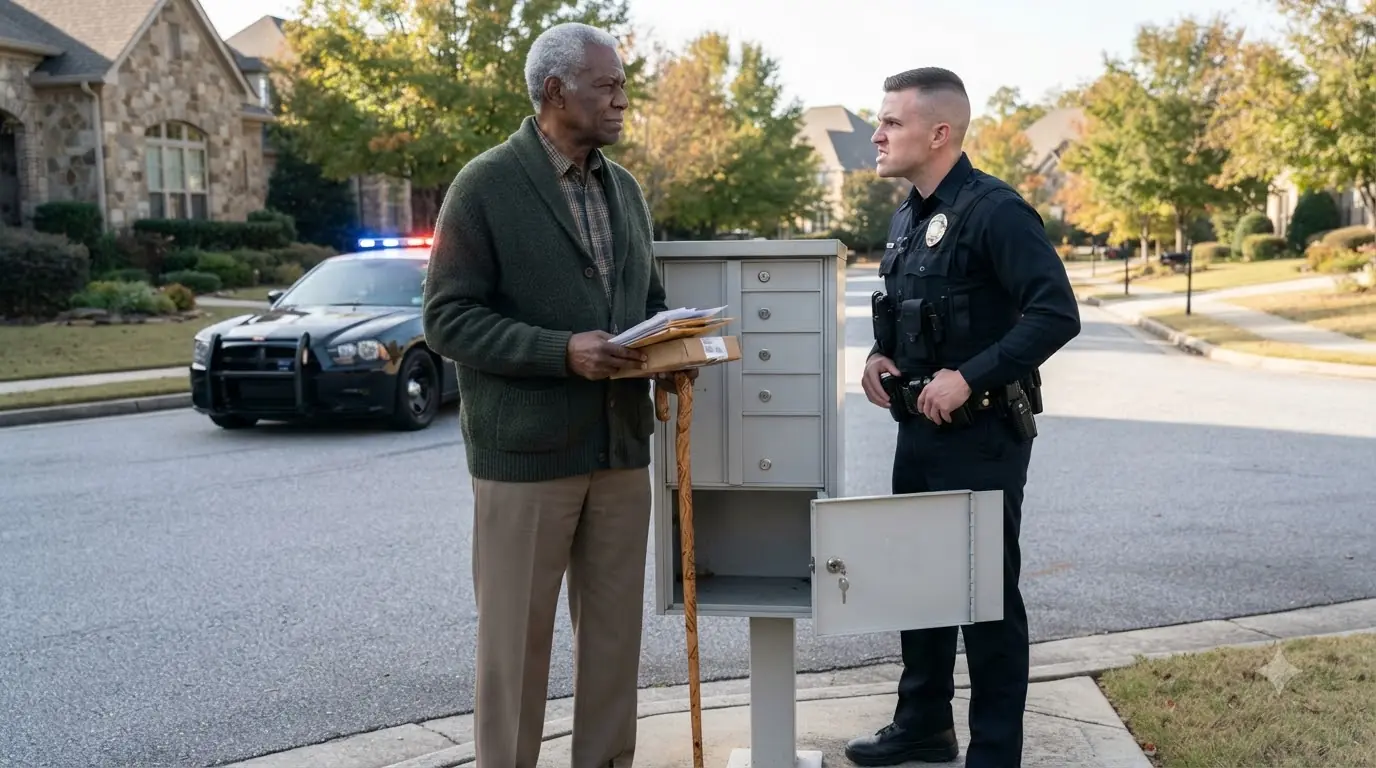
He was 29 years old, possessing a confident stride and a high and tight haircut that signaled his complete dedication to the force. He was the type of officer who believed that every interaction was a contest of dominance, a test of wills that he was determined never to lose. But on a crisp, sun-drenched Tuesday morning in October, he wasn't entering a contest. He was walking into a trap of his own making, fueled by arrogance and a fundamental inability to look past his own bias. The incident that would dominate headlines and cable news cycles began not with a bank robbery or a violent assault, but with an elderly man walking to a mailbox.
Silverleaf Estates is one of those neighborhoods where the lawns are manicured to the millimeter and the silence is heavy with money. It is a place of winding cul-de-sacs, three-car garages, and residents who value their privacy above all else. At 10:45 a.m., the sun was high and bright, casting long, sharp shadows across the pavement. The air smelled of freshly cut grass and impending autumn. It was the kind of morning that retired folks live for: peaceful, slow, and undisturbed.
Judge Elias Thorne was 74 years old. He had moved to Silverleaf 2 years prior, seeking a quiet sanctuary after four decades of service to the United States judicial system. Thorne was a man of routine and rigid discipline. He walked with a heavy, hand-carved oak cane, not because he was infirm, but because an old knee injury from his youth occasionally flared up in the damp. He was a man of immense stature, both physically and professionally.
Tall, with broad shoulders that had not slumped with age and a face carved from granite, he carried himself with an air of absolute, unshakable authority. On this particular morning, Judge Thorne was expecting a package, a rare first edition of a legal commentary he had been tracking down for months. He checked his watch, a simple analog piece, and decided to walk down the long driveway to the community cluster mailboxes at the end of the cul-de-sac. He wore a heavy wool cardigan over a button-down shirt and pressed slacks. He looked exactly like what he was, a wealthy, retired gentleman enjoying his property.
He didn't look like a threat. He didn't look like a criminal. But to the eyes watching him from behind lace curtains three houses down, Elias Thorne looked like something else entirely. He looked like he didn't belong. And in Silverleaf Estates, not belonging was treated as a crime in itself.
To understand the magnitude of the mistake that was about to unfold, you have to understand the man walking down that driveway. Elias Thorne wasn't just a retiree, he was a legend in the federal court system. He had spent 15 years as a federal prosecutor dismantling organized crime syndicates in the 1980s before being appointed as a federal magistrate judge, a position he held with distinction for 25 years. His courtroom was known as a place of absolute decorum. Lawyers trembled before him, not because he was loud, but because he was precise.
He knew the Constitution better than most people knew their own children's names. He had written landmark opinions on search and seizure, on probable cause, and on the civil rights of the accused. He was a man who had dedicated his entire life to the rule of law. Patricia Wayland, however, knew none of this. Patricia was 52 years old, a woman with too much time and a surplus of anxious energy.
She had lived in Silverleaf for 10 years and had appointed herself the unofficial guardian of the neighborhood's sanctity. She spent her mornings monitoring the street from her front bay window, logging license plate numbers of unfamiliar contractors and delivery trucks. She was the administrator of the neighborhood social media group, where she frequently posted warnings about suspicious characters that usually turned out to be utility workers or visiting relatives. When Patricia saw Elias Thorne walking toward the cluster mailboxes, her mind immediately latched onto a narrative she had seen on the evening news. Porch pirates.