The woman came out of the hedge at Fenner's Cross so fast that the black horse went up on his hind legs and she caught the bridle anyway with both hands in the rain. She said,
"Take me with you."
Hector Renwick got the horse down and held him. It was a quarter past eleven o'clock at night on the worst road in the county and she was bare-headed, soaked to the skin with one sleeve torn open at the shoulder and no bonnet and no box and no shoes fit for a mile of it.
"Move away from his head," he said.
"I won't."
"You will be trodden on."
"Then I shall be trodden on," said the woman and did not let go.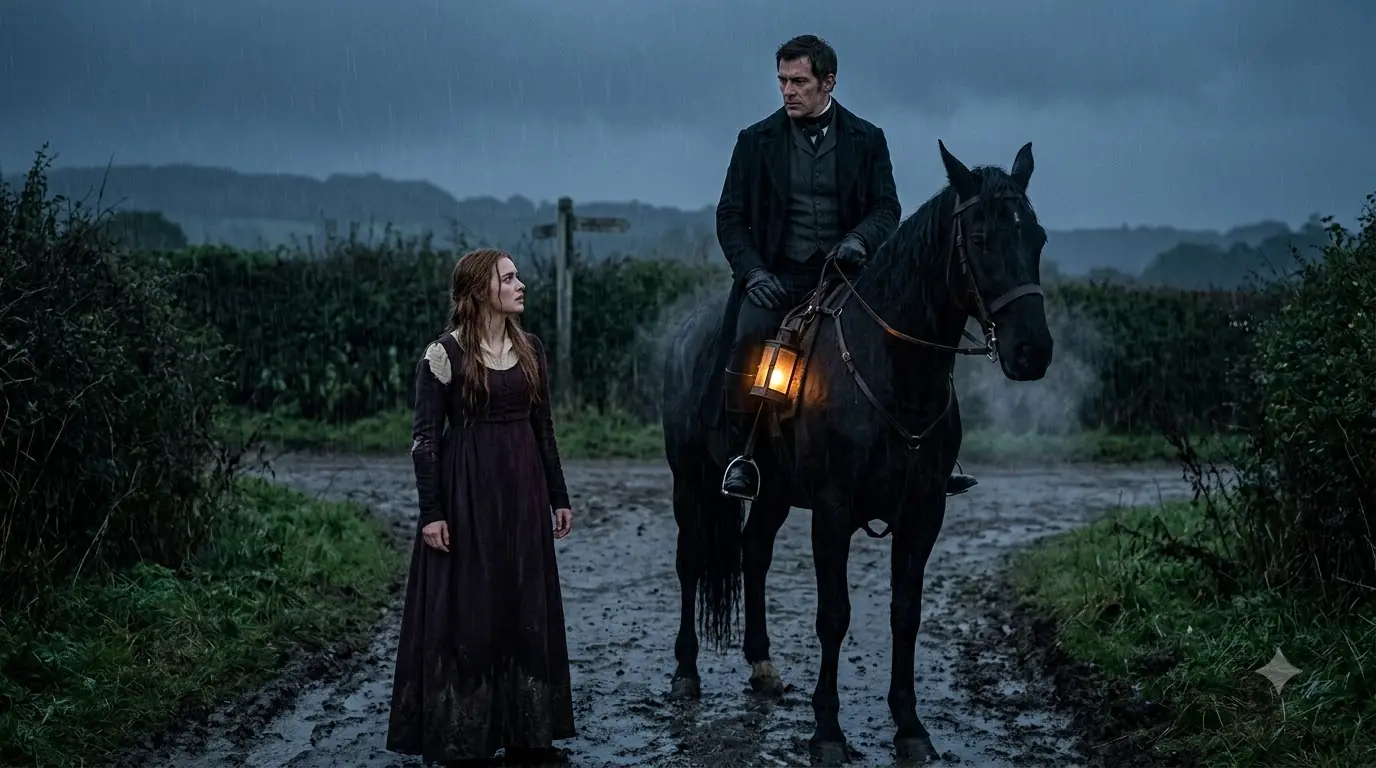
He looked down at her. The rain had plastered her hair flat and there was a mark rising along her cheekbone that had not been made by a hedge and her wrist where her hand gripped the rein was ringed with four bruises in the shape of somebody's fingers.
"Where are you going?" said Hector.
"Away from Markset."
"That is not an answer. Who are you running from?"
"My uncle," she said, "and the man he has sold me to and a chaise that is coming for me at six o'clock in the morning and I would rather go up behind a stranger on a dark road than be in Markset church at eight o'clock."
Her chin was shaking and her voice was not.
"I know what you must think."
"I have nothing to give you and I am not offering anything and I know exactly how this looks. Take me as far as the turnpike and put me down and I will never say your name. I have not told you my name."
"No," she agreed.
"You have not."
Hector Renwick had been called the Black Duke of Thurlstone for eleven years by people who had never spoken to him and he had let them because a hard name kept his tenants' rents honest and his sister's memory quiet. He was not on the whole a man women ran toward. He put down his hand.
"Foot on my boot," he said.
"Give me your wrist, the other one."
She was up behind him in three seconds which told him she had ridden double before on a farm as a girl. He turned the horse's head away from the turnpike and toward the fell. That is the wrong road, she said.
"It is my road."
Her name was Lettice Quill. She got it out in pieces over four miles with her forehead against his shoulder blade and her teeth going. Her father had been a horse dealer at Sowerby and had died owing money. Her mother had left her ninety pounds in trust and her mother's brother held the trust. Her mother's brother was Barnabas Quill and Barnabas Quill owed four hundred pounds to a man named Silas Horne of Markset who lent money at rates that were spoken of in that country the way people speak of weather that kills stock.
Mr. Hone offered to take the debt out in a wife, she said.
"My uncle signed the settlement on Tuesday."
"He said I ought to be grateful because I am twenty and plain and there was nothing else to be done with me."
"You are of age."
"He cannot marry you against your will."
"No, said Lettice Quill."
"He cannot marry me."
"He can hold my ninety pounds and turn me out of the only house I have and Mr. Hone can do the rest and Mr. Hone has done the rest before."
She was quiet for a moment. There is a stone in Markset churchyard with his first wife's name on it and no age cut under it and the parish does not talk about her.
"When I said no on Tuesday, my uncle held me against the wall by the wrist until I said something else."
"That is when I stopped arguing and started counting the hours," hector said nothing for the length of a field.
There will be gates in a moment, he said at last.
"When we come through them, do not be alarmed by the size of the house."
She was silent so long he thought she had fainted.
"Whose house?"
Said Lettice Quill.
"Mine."
Mrs. Denby met them in the stable yard with a lamp and a face like a closed door and inside of 10 minutes had the girl out of his hands entirely. Hot water, dry linen, the blue room at the end of the west passage with a fire already going and a bolt on the inside of the door.
"You will tell her about the bolt," Hector said.
"Your Grace, you will tell her, Mrs. Denby, in those words, that it is on the inside, that it is hers, that nobody in this house has a key to it, including me."
Mrs. Denby's face changed a little.
"I shall tell her, Your Grace," she said.
He did not sleep. He sat in the library with the fire down to red and his boots still wet and thought about a thing he had spent twenty-six years not thinking about. He had been twelve years old when his sister Adela was married. She had been seventeen. There had been a settlement and a great deal of talk about how fortunate it was, and Hector had stood on the stairs at Thurlstone in a new coat and watched her get into a carriage with a man who had a pleasant voice and small eyes.
And Adela had looked back at him through the glass with an expression he had not been able to read at 12 and had understood perfectly ever since. She was dead at twenty. The account given was a fall. He had been 15 and a boy and there had been nobody to ask and everybody had been so very sorry. He had come into the title at twenty-four and had spent the eleven years since being feared, which was useful, and being of no earthly good to anyone, which was not.
At six o'clock in the morning a chaise went past the end of the Thurlstone drive on the Markset road going fast. At noon Silas Horne came up it. Horne was a soft-spoken man in a good coat with a leather folder under his arm and he laid his papers on the library table one by one in order like a man dealing cards. The settlement, the bond. An account of four hundred eleven pounds and a second sheet showing what the 411 would become by Lady Day.
"Your Grace has been imposed upon," he said.
"The young woman is romantic. There is an engagement freely entered. She is of age and she has refused you."
"She has an uncle, Your Grace, and the uncle has an opinion, and the uncle has her mother's money."
Horne smiled.
"I am a patient man. She has no home. She will come to it."
The Duke of Thurlstone wrote a draft on his bank for four hundred eleven pounds, put it on the settlement, and pushed both across the table.
"Take that, he said, and go and do not come back onto this land."
Horne took it. Horne went. And Hector stood at the window feeling for perhaps ninety seconds extremely satisfied with himself. Lettice Quill was in the doorway.
"You have paid him, she said."
"I have."
"Then what am I now?"
Her face was white.
"On Tuesday I was worth four hundred pounds to my uncle."
"Today I am worth 411 to you."
"You have not freed me, Your Grace."
"You have bought the debt and moved the ledger to a better house."
She was shaking.
"I would rather have been put down at the turnpike."
Hector opened his mouth to say something about gratitude and did not say it because his sister had looked back at him through carriage glass twenty-six years ago and he had never once since been able to pretend that a man's good intentions were the same as a woman's freedom.
"You are right, he said."
She blinked.
"Sit down, said Hector."
"I will do it properly and you will tell me when it is wrong."
It took nine days. Her mother's trust was examined by his own attorney and found to have been mismanaged. Barnabas Quill was given the choice of restoring the ninety pounds with interest or answering for it in Chancery and restored it within the week. The debt Hector had paid was canceled and burned in the library great with Lettice holding one corner of it. And a paper was drawn settling on Miss Lettice Quill absolutely and in her own right the tenancy of the old lodge at Thirl and 40 pounds a year for her life unconditional revocable by nobody, dependent on nothing.
"Why?" she said when he gave it to her.
"So that everything you do after today," said Hector, "you will have done because you chose it."
She walked down to Thirl Village on the 11th morning with a basket and Mrs. Denby's list, along a lane she had walked six times that week. She did not come back. They found the basket in the lane at four o'clock and the marks of a chaise turned hard about, and a boy from the smithy who had seen two men and heard a woman call out. Hector had thirty men on that road inside the hour, and he took the moss road himself, alone. Because it was the only way off Thirl to the Markset Turnpike, and because a stranger driving it in the dark would not know that the Black Peat Mosses came up to the very edge of the metal for 2 miles together, with nothing to mark them but a line of white stones that a hard rain buries.
He found the stones scattered at the second mile and the wheel marks going off, and heard the horses before he saw anything at all. The chaise was thirty feet out in the moss, canted over, going down slowly, the way things go down in peat without hurry and without any possibility of argument. One man was already floundering back toward the road, the other was gone into the dark on foot. The near horse had been cut loose and was standing to its hocks and screaming. Lettice Quill was on the roof of the chaise with her back against the rail.
Hector went back for hurdles. There was a sheepfold a quarter mile on, and he tore it apart with his hands, and he laid them out flat on the moss one in front of another on his knees, with the rope from his saddle round his own chest, and the other end round a thorn root on the bank. And he went out over that black ground at a crawl while the lanterns came up behind him along the road. The last eight feet there were no more hurdles.
"Do not stand up," he said.
"Lie flat and come to me and do not put your feet down. I can't feel my hands."
"You do not need them."
"Come to me, Lettice."
She came. He got the rope round her under the arms and shouted, and they were both dragged in over the moss on their faces like a pair of drowned dogs, and he did not let go of her wrist for any part of it. The chaise was gone by the time they had her on the bank. Silas Horne was taken at the March Set Tollgate the following morning by the constables and Barnabas Quill three days after that, and the business went to the spring assizes, and Hector gave his evidence and stood the whole time with his hat in his hand and did not once look across the court because Lettice had asked him not to. She was six weeks getting her strength back.
He sat with her badly in the way of a man who has never learned to be in a room without commanding it. He read her the estate accounts because he had nothing else, and she said they were the most soothing thing she had ever heard. Somewhere in the fourth week he told her about Adela, all of it out loud for the first time in twenty-six years, and Lettice Quill held his hand in both of hers and did not say one word, and that was the end of him. He asked her in April at Fenner's Cross. He had contrived to be riding that way with her and had contrived it very obviously, and she was laughing at him before he had the words half out.
"I am 15 years older than you," said the Duke of Thurlstone, "and hard company, and this country calls me a black-tempered man, and the whole of it is deserved. You have 40 pounds a year and a house of your own and a name nobody can take from you, and you may say no this morning and be no worse off than you were at breakfast. Say it if you mean it. But I have loved you since you would not go of my horse's head in the rain, and I have been eleven years being feared and would very much rather, for the rest of my life, be known."
Lettice Quill sat her mare at the crossroads a moment.
"Your Grace," she said, "take me with you."
They were married in June at Thirl. She wore her mother's ring and no jewels of his, which he had learned by then not to argue about. There is a stone at Fenner's Cross, set on the verge where four ways meet, cut with two dates and no explanation, and travelers ask about at the inn and are told it is something to do with the Duke. He rides there in November every year, in the rain if there is rain. He is not alone now.
The Duchess of Thurlstone comes with him on the black horse's daughter, and they sit a while at the crossroads without saying much, and then they turn for home together up the road that is his and hers and has been from the first night. When a soaked and bruised woman with nothing in the world caught his bridle in both hands and asked a feared stranger for the one thing he had never in his life been asked for, and he found that he had it to give.