Isaiah Brooks had learned early that some rooms decided who you were before you opened your mouth.
At eighteen, he knew the look. It was the quick glance at his worn shoes before someone met his eyes, the hesitation when he handed over cash in small bills, the way a receptionist’s voice changed when he said he had no private instructor to list on an application. He had seen that look in stores, offices, waiting rooms, and once at a church fundraiser where a woman had asked if he was there to clear the tables. Usually he ignored it. Usually there was work to do.
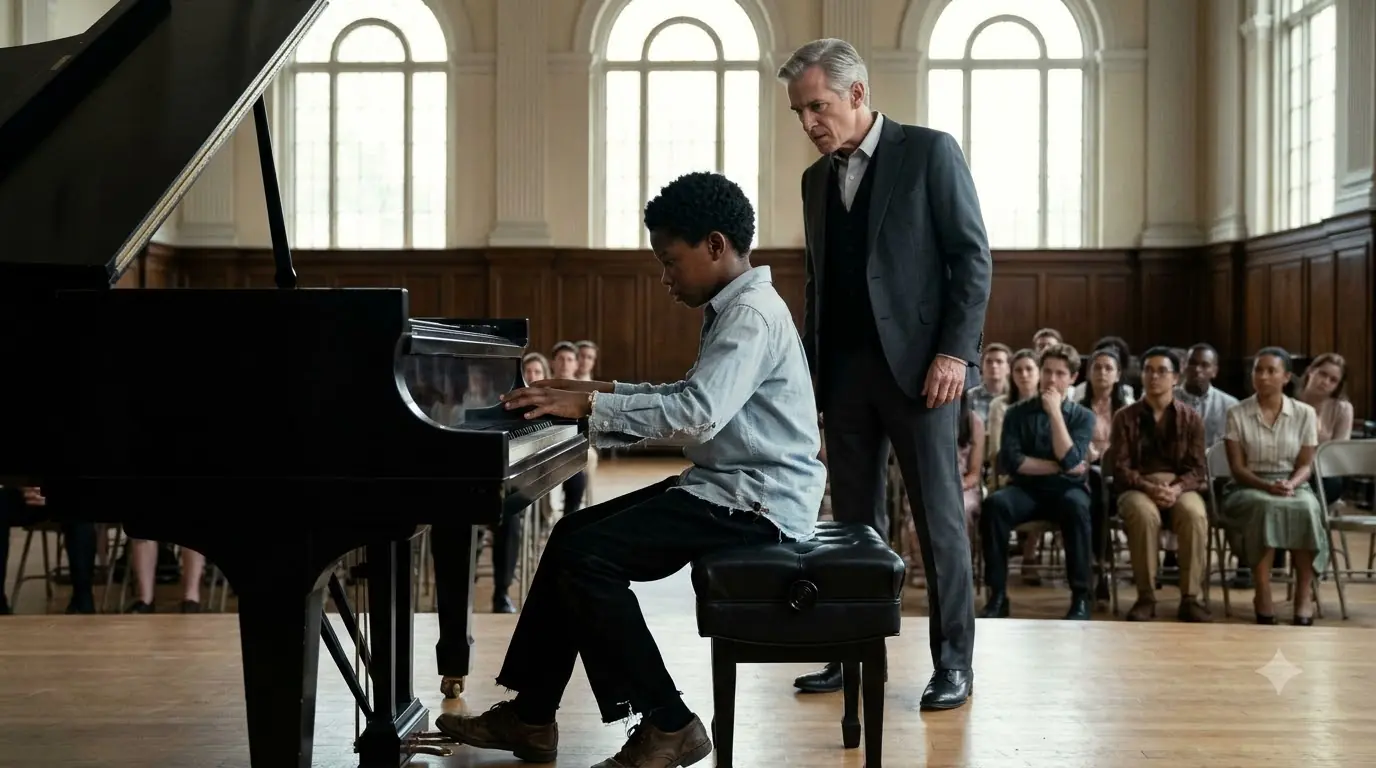
That July morning, however, the room contained a nine-foot concert grand piano, fifty-seven young musicians, and Dr. Preston Vale, a man whose recommendation could open nearly any conservatory door on the East Coast.
Vale looked at Isaiah’s hands as if they were evidence of a mistake.
“Where did you study?” he asked.
Isaiah stood near the last row of folding chairs in the rehearsal hall of the Franklin Arts Center. “Mostly at home, sir.”
“Mostly?”
“I’m self-taught.”
A few students glanced at one another. One boy smiled without meaning to. Another girl lowered her eyes.
Vale did not smile. “Self-taught students develop bad habits faster than good ones.”
Isaiah nodded once. “Yes, sir.”
Vale stepped closer. His gaze dropped to the pale scar across Isaiah’s right knuckle and the calluses along his fingers. “And what exactly do you do when you’re not teaching yourself concert piano?”
“I unload trucks in the mornings. I work evenings at a diner.”
The room changed.
Isaiah felt it. Not laughter yet. Something worse—the silent rearranging of status. Around him sat students who had arrived with instrument technicians, parents carrying garment bags, and résumés listing competitions in cities Isaiah had never visited. He had arrived by bus with a backpack, a lunch wrapped in foil, and one clean shirt his grandmother had ironed before sunrise.
Vale reached for Isaiah’s right hand without asking permission. He turned the palm upward and stared at the rough skin.
“These are laborer’s hands,” he said.
Isaiah pulled his hand back.
For the first time, Vale’s tone sharpened. “Did I tell you to move?”
The room went still.
Isaiah’s jaw tightened. “No, sir.”
Vale took a folded handkerchief from his pocket and wiped his own fingers as though touching Isaiah had left something on them. A few students shifted in their chairs. No one spoke.
Then Vale looked toward the polished grand at the front of the hall.
“You claim you belong in an advanced institute.”
“I said I can play.”
Vale’s head turned slowly back toward him. “What?”
Isaiah heard his grandmother’s voice in his memory: If you know the truth, say it plain.
“I can play.”
A ripple moved through the class.
Vale’s face hardened. “Then show us.”
He caught Isaiah by the upper arm and marched him toward the piano. It was not a gentle gesture disguised as guidance. His grip hurt. When Isaiah slowed, Vale pushed him forward hard enough that the edge of the bench struck the back of his knees.
“Sit.”
Isaiah sat.
Vale took out his phone, turned on the camera, and propped it against the music rack. “Since confidence seems to be your strongest qualification, perhaps the class should see what confidence sounds like without training.”
Someone gave a nervous laugh.
Isaiah looked at the keys.
For a few seconds, he almost stood up and left.