The man in seat 5A did not move. 211 strangers looked everywhere except at him. His hands stayed flat on his knee. Still, too still. The kind of still that comes from years of practice. The woman beside him lifted her purse into her lap and wrapped both arms around it. On the back of his leather jacket, two words stitched in curved letters. Everyone saw them. Almost nobody understood them. Then the nose came up one degree, maybe two, and it stayed there. Nobody felt it except him. The engine pitch dropped half a beat, then came back so fast only a man who had once lived inside that sound would catch it. His eyes opened. The intercom chimed. A flight attendant's voice far too calm for what she was about to say.
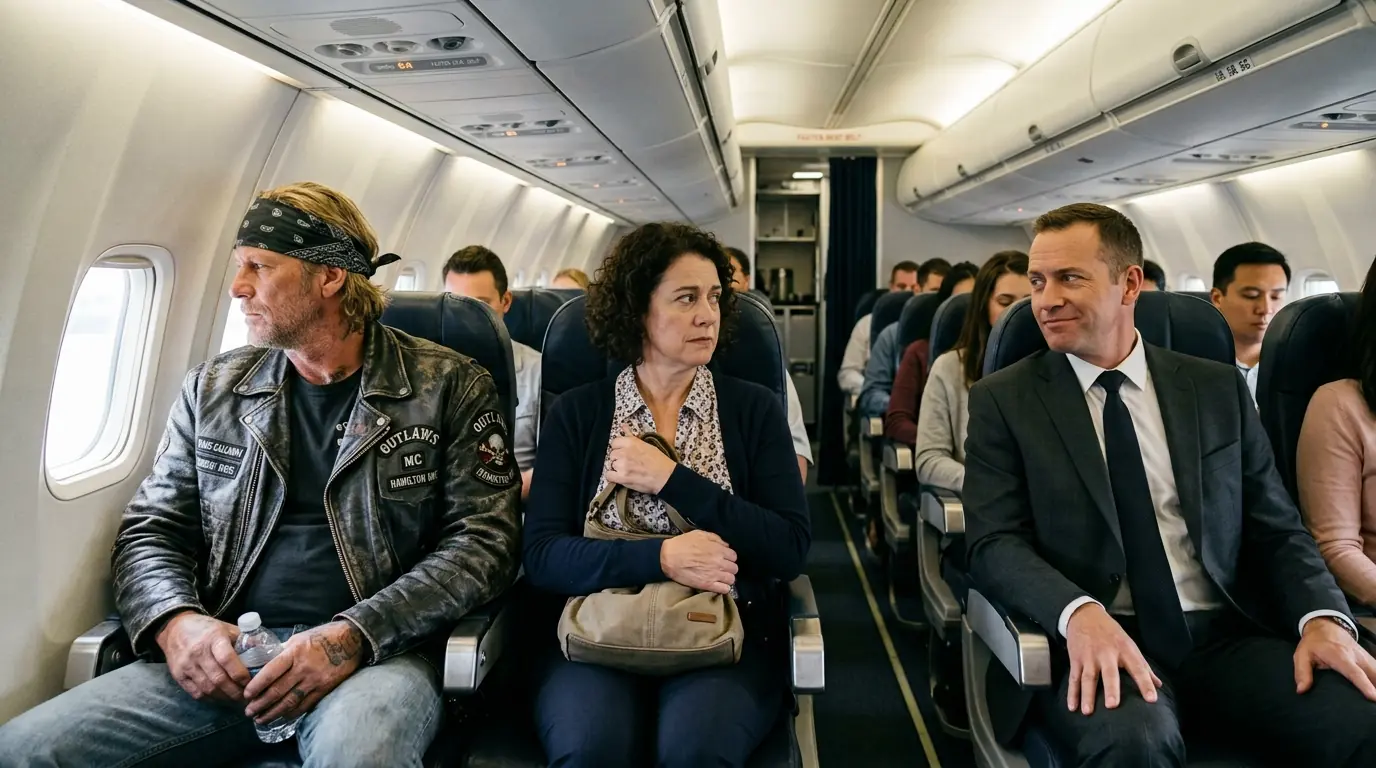
In the whole cabin, not one person stood up. The man in seat 5A reached down for his seat belt. The click was very loud in the silence. The man in seat 5A did not move. His hand stayed flat on his knee. Still too still. The kind of still that comes from years of practice. Years of learning exactly how much stillness a room can survive before it turns on you. Around him, 211 strangers looked everywhere except at him. The overhead bins, their phones, the seat back pocket in front of them like it held the answer to something. Anything. Anything but the man in the leather jacket with the patch on his shoulder and the silence coming off him like heat off a highway in August. Wade Callaway closed his eyes and somewhere behind those eyes, a voice, small, 13 years old and 3,000 m away. Not really speaking, just remembered. Just carried the way certain things get carried whether you want them or not. No, he thought. Not this, not me. But we're getting ahead of ourselves because 4 hours before that thought, 4 hours before the seat belt light chimed on for the last time, before the word Mayday ever left anyone's mouth, there was just a man walking down a jet bridge in Denver, Colorado, carrying a duffel bag and 39 years of being looked at wrong. Let's start there. The gate agent at C47 didn't even glance up when Wade handed her his boarding pass, which was fine, which was actually the best case scenario as far as Wade was concerned. No glance meant no assumption. No assumption meant no story forming behind someone's eyes about who he was and what he might do. He'd take invisible overjudged every time, except invisibility never lasted past the jet bridge. He felt it start the second he stepped through the aircraft door. The little shift in air pressure that had nothing to do with altitude. The way a flight attendants smile tightened by exactly one degree. The way a father two rows back pulled his son's backpack closer like Wade might reach out and take it just for sport. 6'2 sunworn face. A jaw that hadn't seen a razor in 3 days and didn't plan to anytime soon. Blonde hair pushed back under a faded bandana that had seen more miles than most people's entire lives. And on the back of his jacket stitched in curved letters that everyone recognized and almost nobody understood, two words. Two words that did all the talking before Wade ever opened his mouth. He made his way down the narrow aisle. Ducking, apologizing with his body more than his words. A woman pulled her elbows and like he carried something contagious. A businessman across the aisle actually leaned back. Physically leaned back like Wade's shadow alone might cost him something. Near the rear of the plane, a teenager lifted a phone. Wade heard the click. He didn't turn around. He'd learned that a long time ago. You don't turn around. Turning around just gives the moment a second act. Better to let it die where it started. Seat 5A window. He shoved the duffel into the overhead bin, folded himself down into the seat, and let out a breath he felt like he'd been holding since the TSA line. Since the metal detector went off on his belt buckle, and a 22-year-old agent looked at him with a face that had already decided the outcome before the wand ever swept his chest. The woman in 5B had been reading a paperback. Some thriller with a knife on the cover. The kind of book you buy in an airport bookstore because the cover promises you something the flight itself can't. The second Wade lowered himself into the seat beside her. She went still, not casual, still not settling in for the flight. Still, pray still. Wade had seen it before in hallways, in parking lots, in the eyes of a cashier three registers down, deciding not to make eye contact. He knew what it looked like when a person's whole nervous system quietly, politely screamed. She reached down, slow, deliberate, pulled her purse off the floor, set it in her lap, wrapped both arms around it like it held something more valuable than a wallet and a half empty pack of gum. Wade saw it. Of course he saw it. He always saw it. Ma'am, he said quiet, almost gentle bag safer on the floor. Gets tangled in the seat belt up there. She didn't answer. She turned her whole body 2 in toward the aisle, lifted the paper back higher. A wall made of pulp fiction and fear. Wade nodded to himself. "All right," he thought. "That's how it's going to be," he turned to the window. Outside, ground crew moved bags in the cold. A deicing truck rolled past, trailing steam that curled and vanished against the sky the color of old nickel. Ordinary things. Small things. Wade focused on the small things because focusing on small things was the only trick he had left for staying calm. And staying calm used to be the only thing standing between him and a body bag. But that was another life. That life belonged to a man named Captain Callaway. And Captain Callaway didn't exist anymore. Wade had buried him 5 years ago. Walked away from the grave without looking back. Or so he told himself. On good days, on days when the lie held, he reached into his jacket, pulled out a photograph, soft at the corners from a thousand handlings. A little girl, maybe 8 years old, gapped with it, grinning, holding up a crayon drawing of a stick figure on a motorcycle underneath in wobbly orange letters. My dad, her name was Ruby, she was 13 now, waiting for him in Anchorage. And Wade had made her a promise the way you only make a promise to a child once. Not a whole life spent breaking it into smaller and smaller pieces. Just once, whole, unbroken. Never again, baby. No more not coming home. He tucked the photo back over his heart and closed his eyes. He did not know yet that in 90 minutes that promise was going to be tested in a way no hospital hallway could have prepared him for. The man in seat 4C had been watching Wade since the moment he boarded. He was old, mid80s, maybe older, a spine that refused to bend, even while everything else about him had begun folding gently inward with age. The way old houses settle. Wool cardigan button wrong on the top hole. The kind of small mistake that happens when a man's fingers don't listen to him the way they used to. Small brass wings pinned to the collar. The kind of pin most people wouldn't look at twice. The kind that meant everything to the two or three people on any given flight who understood exactly what it cost to earn one. His eyes were pale, ice blue, sharp in a way that had nothing to do with his hearing aid or his trembling hands, and they'd been fixed on the biker in 5A for a long, long time, not with fear, with recognition. Interesting, the old man murmured, mostly to himself, and turned his gaze back toward the window. His name was Harlen Vas. 40 years ago, he'd flown cargo and personnel transports out of airfields most maps didn't bother naming anymore. Places that existed on flight logs and nowhere else. His hands trembled now. His hearing had mostly gone soft around the edges, turning half the world into a murmur he had to lean into. But one thing had never left him. The ability to spot another pilot in a crowd of civilians. It wasn't the jacket. It wasn't the tattoos climbing out from under his sleeve. Dark ink gone slightly green. With time, the way old ink always does. It was the way the younger man had moved down that aisle. The way his eyes had swept the exit rose, counted them, clocked the flight attendants, all of it, and maybe 3 seconds without breaking stride. The way a man checks a room for the door before he ever sits down in it. Civilians don't do that, Harlon thought. That boy's flown something and not for fun. He filed the observation away the way old soldiers learned to file everything away. Said nothing, but he kept one eye on seat 5A. All the same, the way you keep an eye on weather that hasn't decided what it's going to do yet. The flight attendant working the forward cabin was named Denise Carr, 11 years in the air, which meant she had learned to read a cabin the way a sailor reads a swell before it breaks. She could feel the mood of 200 strangers the second she stepped through the door. Could tell before the wheels even left the ground whether a flight was going to be easy or whether it was going to be five long hours of somebody's bad day radiating outward like heat off asphalt. Flight 1487 felt tense. And Denise knew exactly why. She'd watched the whole cabin recall from the man in 5A. Watched it happen in real time. Seat by seat like a wave rolling backward through a crowd at a concert. And something in her chest tightened because in 11 years and roughly 4,000 flights, Denise had learned a rule that never once let her down. The passengers everyone was scared of. They were almost never the ones who caused trouble. The trouble came from the polished ones. The men in tailored suits who thought turbulence rules didn't apply to them personally, who snapped their fingers at her like she was furniture with a pulse. The quiet ones who' had six drinks in the terminal bar before boarding and thought nobody noticed. Not the rough-l lookinging ones, not the tattooed ones, not the bikers. Nine times out of 10, they were the ones who lifted a stranger's bag into the overhead bin without being asked, said, "Thank you, ma'am," like they meant it, fell asleep in 10 minutes, and gave you no trouble at all, snoring softly against the window while the rest of the cabin fought over armrests. Denise made her way down the aisle, running through her pre-flight checks. When she reached row five, she stopped, looked directly at Wade, smiled, a real smile, not the airline one, not the one trained into her during a week in a windowless classroom in Atlanta. Can I get you anything before we push back? Coffee, water. Wade looked up and for half a second something flickered across his face. Surprise. Not that she'd offered, that she'd looked at him, that she meant it. Coffee' be great, he said. Black, "Thank you. You got it. " She moved on down the aisle. But Wade watched her go, and for the first time since he'd boarded, some of the tightness went out of his shoulders. Just an inch. Just enough to notice if you were the kind of person who noticed things like that. Most people weren't. Wade always was. The woman in 5B noticed the exchange, too. Noticed the flight attendant had smiled at the biker. Something in Pauline Bishop's face said she didn't understand it. Didn't approve of it. A third grade teacher for 31 years. And here she was silently failing her own lesson plan in real time. The one taped to the wall of her classroom that she'd read out loud to 8-year-olds every September for three decades. Don't judge a book by its cover. Wade noticed her noticing. He almost said something. Almost. Then he thought of Ruby and the promise. And how the fastest way to prove every one of these strangers right about him would be to open his mouth and give them exactly what they were expecting. A raised voice, a hard word, something to write home about. So he didn't. He turned back to the window, watched the deicing truck finish its pass on the wing, the spray fanning out and freezing into something that looked for a moment almost beautiful, and waited for the plane to take him home. They pushed back at 6:47 a.m. Somewhere over eastern Colorado. The seat belt sign chimed off, and the cabin exhaled the way cabins always do. Trays came down, headphones went in. The particular hush of 200 strangers agreeing without discussion to pretend none of them existed to each other for the next four and a half hours. Wade didn't sleep. He never slept on planes. Old habit. The kind of habit that used to keep men alive. You don't sleep in a place you haven't secured. You don't sleep when the exits aren't yours to control. 12 years of training doesn't leave a man just because he traded the flight suit for a leather jacket. Instead, he watched the wing, watched the clouds slide by underneath like something poured out and left to cool. And somewhere in the quiet hum of the engines, his mind did the thing it always did when it had nothing else to hold on to. It went back 5 years earlier. A hospital hallway that smelled like antiseptic and bad coffee. Fluorescent light doing that thing fluorescent light does at 3 in the morning. Buzzing so quietly you only notice it once everything else has gone silent. He was still Captain Callaway then. Still had the crew cut. Still had the calluses on his hands from a yolk he'd been flying for 12 years. He hadn't slept in 31 hours. His flight suit was still half zipped because there hadn't been time. There was never time in that life. Time was something other people had in that life. There was only the next 60 seconds and whatever they demanded of you. And his ex-wife Carol, her name was Carol. Though for one disorienting second, his memory kept snagging on Denise, the flight attendant's name. Some cruel little trick the mind plays when two women occupy the same emotional real estate 5 years apart. Carol was standing at the far end of the hallway with her arms crossed and her eyes red and a look on her face that said she had already made her decision before Wade ever walked through those doors. Because that was the day. That was the day the phone call came through. 6 hours after touchdown. 6 hours after the debrief. 6 hours after Wade had sat in a windowless room and answered questions from men whose faces he could no longer remember, but whose voices he could still hear, clear as radio static, asking him to walk through the decision, step by step, second by second, as if repetition might change what had already happened. The decision that got Danny Reyes killed. Not WDE's fault, they told him officially on paper. In the report that got filed and stamped and buried in a drawer somewhere in a building with no windows, in a filing cabinet nobody would ever open again unless a lawyer made them. Not officially his fault, but the intel had come through WDE's channel. The call had been WDs to make. And when the smoke cleared and the debrief ended and the paperwork was signed, there was a flag draped box being loaded onto a transport plane. And there was a young widow standing on a tarmac in Texas who didn't know yet that her husband wasn't coming home. And there was Wade Callaway standing 3 ft away from her, saying nothing because there was nothing a man could say that would matter. There has never in the history of the world been a sentence that fixed that particular kind of silence. He carried that hallway differently than he carried anything else. He carried it the way you carry a stone in your boot. Something you learn to walk around instead of walking on. Something that never stops being there no matter how many miles you put between yourself and the day it got in. And that was the day, standing outside a different hospital hours later with an eight-year-old girl's small hand in his that Wade Callaway made the only promise of his life he'd sworn to keep no matter what it cost him. He'd knelt down right there in the hallway. Ruby's face pale, scared, not understanding half of what was happening around her, only understanding that her father's hands were shaking and that had never happened before. Not once, not in her whole life. Her father's hands did not shake. That was simply a law of nature, as fixed as gravity, until suddenly it wasn't. "Baby," he'd said. "I'm done," she'd looked at him. Waiting. "No more danger," he said. "No more not coming home. I promise you. I promise. " Two words. The heaviest two words he'd ever said in his life. Heavier than any word he'd said into a radio at 30,000 ft with a wing on fire. And for 5 years he'd kept them. 5 years of trading a cockpit for an open road. Trading a call sign for a road name. Trading 12 years of training for a life. Where the biggest risk he took most days was choosing which diner to stop at off the interstate or whether the storm rolling in over the mesa was worth outr running or worth waiting out under an overpass with a thermos of gas station coffee. It wasn't running. He told himself that every single day it wasn't running. It was keeping a promise. Except except somewhere in the quiet part of his mind, a part he rarely let speak, there was a different word for it. A word that started with an R and wasn't running. It was hiding. The seat belt sign chimed back on 40 minutes into the flight somewhere over the vast white nothing of the Yukon. A landscape so featureless it looked less like Earth and more like the idea of Earth sketched in white and left unfinished. By itself, that was nothing. Turbulence routine. Denise Carr's voice came over the intercom, calm and practiced, asking everyone to return to their seats. But Wade felt something else, something the other 210 people on that plane didn't feel because they hadn't spent 10,000 hours learning to feel it. The nose came up, just a degree, maybe two, and it stayed there. WDE's eyes opened. He didn't move his head, didn't sit up, didn't do anything that would draw attention. He just listened to the engines, to the airframe, to the thousand tiny changes in pitch and pressure that most human beings never consciously register in their entire lives. The way a man who has spent 30 years on the ocean can tell you weather is coming before a single cloud appears. And what he heard was an aircraft doing something a well-flown aircraft has no business doing. The air speed felt wrong. There was a hesitation in the way the plane answered the air. A sluggishness like a car was something dragging beneath the chassis that the driver hasn't noticed yet, but will the moment they try to accelerate. Probably nothing, he told himself. You're not that man anymore. Let it go. He tried. He genuinely tried. For Rose's back, a passenger's window shade was up. If Wade had turned to look, he would have seen the right engine trailing a thin, wavering line of gray, almost invisible against the white sky. Easy to mistake for a whisp of cloud if you didn't know what you were looking for. He didn't turn to look, but he heard it. A drop in pitch, a flutter barely there, gone almost as soon as it started. And every cell in his body that used to belong to Captain Callaway came instantly silently awake. Across the aisle, Harlon Voss felt it, too. The old pilot's head lifted. His pale eyes found WDE's face, and what he saw there confirmed everything he'd suspected since the man walked down that aisle. The biker wasn't relaxed anymore. The biker was listening. Up in the cockpit, first officer Miles Duncan was trying very hard not to panic. 31 years old, four years with the airline, just under 3,000 flight hours, which was enough to be good. Not nearly enough to be calm. When the master caution panel lit up like a switchboard, and the man in the left seat, Captain Gene Whitfield, said a word Miles had never once heard him say in 18 months of flying together. Something in his stomach dropped faster than the altimeter. That's not right, Whitfield said, staring at the engine instruments. 58 years old, 30 years in the left seat, the kind of captain who'd flown into weather that grounded lesser pilots, and never once raised his voice doing it. A man Miles had watched on more than one occasion talk a nervous passenger through a rough landing over the PA in a voice so steady it should have been bottled and sold. Number two's losing oil pressure fast. Confirmed, Miles said, his own voice tighter than he wanted it to be. Oil pressure dropping. Temps climbing. Run the checklist. Miles's hands found the quick reference handbook. He was flipping toward the tabmarked engine when Whitfield went quiet in a way that made Miles look up. The captain's face had changed. His mouth was open. No words coming out. His left hand had risen unbidden and pressed flat against his own chest. "Jeen," Miles said. "Jean, you okay? " Whitfield didn't answer. His eyes had gone wide, then unfocused. A thin sheen of sweat broke across his forehead in the space of two seconds, like something had reached inside him and turned a valve. Jean, Captain Gene Whitfield, 30 years and 18,000 flight hours, and never once a raised voice made a small choking sound and slumped sideways against the cockpit door, unconscious. For one full second, Miles Duncan sat frozen, staring at his captain's slack face. While beside him, a dying engine climbed steadily toward the temperature at which it would begin quite literally to come apart. Then his training kicked in. He did three things very fast. He keyed the intercom to the cabin. He hit the call button for the lead flight attendant and he grabbed the yolk with both hands as the aircraft, no longer held by the man who had been flying it began slowly to descend. In the cabin, Denise Carr's phone rang at the forward galley. The second she heard Miles's voice, she knew. 11 years, 4,000 flights. She had never once heard a first officer sound like that. Denise, I need you up here now. On my way, and I need you to find out if there's a doctor on board. His voice cracked just slightly. Just enough. And anybody with flight experience. Anybody, military, private, anything right now? Denise's hand tightened around the phone. Her stomach dropped in a way that had nothing to do with the aircraft's descent. Understood, she said. Her voice did not shake. 11 years had taught her that her voice was the last thing on this airplane allowed to shake. On my way. She hung up, took one breath, reached for the cabin intercom, and every passenger on flight 1487 heard the chime, and then heard the voice of a flight attendant working very hard to sound like nothing at all was wrong. Ladies and gentlemen, we're experiencing a medical situation in the flight deck. If there is a doctor or medical professional on board, please press your call button immediately. " She paused. Her voice caught for a single heartbeat before she pushed on. Additionally, if there is anyone on board with piloting experience of any kind, military, commercial, or private, the flight crew is requesting your assistance. Please identify yourself to the nearest flight attendant. Thank you. The cabin, which had been murmuring nervously about turbulence, went absolutely silent. The kind of silence that has weight that presses down on your ears. Denise hung up the intercom and started down the aisle, scanning faces as she walked, and she watched the same thing happen that Wade had watched happen his entire adult life. 211 people looked around, searching, waiting for someone else, anyone else, to be the one who stood up. Not one of them moved. Wade Callaway sat perfectly still in seat 5A, staring at the seat back in front of him. No, not this. Not me. I made a promise. The words of the announcement were still hanging in the recycled air, the way certain sentences do, refusing to dissolve. Anyone with piloting experience, military, commercial, private, he had all three. He had more of the first than almost anyone on this plane could imagine in their worst dreams. He had landed aircraft with holes punched clean through the fuselage. He had landed aircraft with the smell of smoke already filling the cockpit, praying the fire stayed behind the firewall long enough to matter. He had flown things and landed things and walked away from things that men twice his rank would have refused to attempt. And he had walked away from every single one of those landings. And that walking away had cost him things. Sleep, a marriage, years he didn't get back. And then it had cost him Danny Reyes. And then standing in a hospital hallway, it had almost cost him his daughter's trust in the only parent she had left. I can't stand up, he thought. If I stand up, I break it. If I stand up, I might not come home. And she's 13 and she has no one else. And I swore beside him, Polling Bishop pressed her own call button, not because she was a pilot, because she was frightened, because the plane felt wrong now, and everyone on it knew it, and the silence in the cabin had turned from awkward to something considerably worse. The particular silence of 200 strangers doing math they don't want to do. WDE felt the aircraft's nose come up again. Somewhere up front, Miles Duncan was fighting to hold altitude with one engine dying and a body slumped against the cockpit door. And Wade's hands resting on his knees curled slowly into fists. Not me, please. Not me. But Harland Voss had been watching. The old pilot unbuckled his seat belt, a thing they'd been explicitly told not to do. And with enormous effort gripping the seedbacks with hands that trembled the way old hands do, he turned himself around in seat 4C until he was facing the man in 5A. "Son," he said. Wade didn't look at him. "Son, look at me. " Slowly, unwillingly, Wade turned his head. The old man's pale eyes held his. And when Harlen Vos spoke, his voice was thin and cracked with age. But there was steel underneath it. The steel of a man who had once given orders and been obeyed without question in rooms far colder than this one. I watched you board this airplane. Harlon said, "You counted the exits before you sat down. You clocked every door. You looked at that flight attendant and figured out which one was in charge in about a second and a half. " He leaned closer. His hand spotted and shaking gripped the top of Wade's seat. I flew for over 30 years. Son, I know what I'm looking at. You're mistaken. Wade said. No. Harland said. I'm not. And neither are you. He nodded toward the front of the plane. You've heard that engine change 10 minutes before that girl made her announcement. I watched you hear it. Everybody else in this cabin is scared. You're not scared, son. You're calculating. There's a difference. And only one kind of man knows exactly what that difference feels like. WDE said nothing. His whole body had gone rigid. Harlon's voice dropped. Gentler now, almost kind. People don't lose years of training just because they stopped wearing the uniform. He said, "You can put on a leather jacket. You can grow the beard. You can ride your motorcycle and tell yourself you're somebody new. But when that door opens and the plane starts to fall, the man you were is the man who's going to be sitting in that seat. That's just the truth of it. " The plane dropped. Suddenly, a stomach lifting jolt. A woman too rows back cried out. A child began to wail. Somewhere near the wing, a bag came loose from an overhead bin and thumped to the floor. Wade closed his eyes. Behind his eyelids, he saw Ruby's face. Gap tooththeed, 8 years old. My dad in Crayon, and then he saw her at 13, waiting at the arrivals gate in Anchorage, waiting for a plane that if he sat here and did nothing, might never land. And underneath that image, something else surfaced. Something he'd been keeping submerged for years. Held down with both hands like a man drowning his own reflection in a lake he'd sworn never to look into again. Danny Reyes, the intel that was wrong, the call that was his to make. The tarmac, the widow, the box. He understood in that moment the thing that had been hiding underneath his promise the whole time. He had promised Ruby he'd always come home. But there were 211 people on this airplane. And every single one of them had someone waiting at some gate somewhere. A mother, a husband, a sister who still texted good morning every single day, whether or not it got answered. 211 people with daughters and husbands and mothers and sons. And the only man on board who could give all of them a chance to come home was sitting in seat 5A, eyes closed, hiding from himself. If I don't stand up, he thought, and this plane goes down and I could have done something. How do I come home to her? How do I look at my daughter knowing I let 200 people not come home just to keep a promise she wouldn't even want me to keep? The answer arrived quietly, the way the most important answers always do, not with thunder, was something closer to a hand on the shoulder. She wouldn't want this. She'd want me to be the man she drew in crayon. WDE opened his eyes. Denise car had reached row five on her second desperate pass down the aisle and she was about to move past when the man in the leather jacket, the man everyone had been afraid of, the man whose photo the teenager in the back had already texted to three group chats, reached out and touched her sleeve. She stopped. He looked up at her. And the thing that struck Denise in that moment, the thing she would tell people about for the rest of her life was that the fear was completely gone from his face. Everyone else on this airplane was drowning in it. But the biker in 5A looked calm, terribly, impossibly calm. "Ma'am," Wade said quietly. "I can fly this airplane. " Denise stared at him around them, heads turned. Pauline Bishop lowered her paper back. The businessman across the aisle went still. The whole forward cabin, which had somehow heard the words despite the engine noise and the hush and the fear, seemed to hold its breath all at once. "I'm sorry," Denise said. "Not disbelief exactly. Just the automatic reflex of a woman who' spent 11 years being trained to doublech checkck everything, to never take a claim at face value at 30,000 ft. " Wade unbuckled his seat belt. The click was very loud in the silence. I was a combat pilot, he said. United States Air Force, 12 years. I've got more hours and more emergencies than the man up front's got hours total. No offense to him, but right now that's what matters. He held her gaze. Your first officer asked for anybody with flight experience. I'm your anybody. Take me up front now. For one heartbeat, Denise Carr did the math that every human being on that airplane had been doing silently for the last 20 minutes. She looked at the jacket, the beard, the patch, the tattoos climbing up his neck, and some ancient stupid part of her hesitated. The part trained by every horror movie and every news segment and every whispered warning from a mother who never met a single biker in her life. Then 11 years and 4,000 flights spoke louder. "The polished ones caused the trouble. The rough ones help you lift the bag. " "Come with me," she said. Wade stood. 211 people watched the biker they had spent 4 hours despising rise out of seat 5A step into the aisle and walk steady unhurried certain toward the front of a falling airplane. Pollen Bishop watched him go, her arms still wrapped around her purse. And as the leather jacket disappeared through the forward curtain, she looked down at her own hands, at her white knuckles, at the way she guarded her little bag against the man, who was at this very moment walking toward the cockpit to try to save her life. Something in her face crumpled. She had never in her life felt so small. "Oh, God," she whispered to no one. "What have I? " she didn't finish. Behind her, Harlen Vos settled back into for 4C, buckled his belt with shaking hands, closed his eyes, and smiled a small private smile. The smile of a man who has just watched one more time before the end of his life another pilot stand up when it counted. "Give him hell, son," he murmured. The forward curtain closed behind Denise, and she led Wade the six short steps to the cockpit door. Knock the coat and knock. And Wade Callaway, biker, outlaw, father, ghost of a man he had spent 5 years trying to bury, felt the last of the leather jacket version of himself fall away layer by layer. With every step down that narrow aisle, each step a little more weight sliding off his shoulders. Each step, a little more of the man he used to be climbing back into the frame. By the time the cockpit door opened, the man standing in the doorway wasn't WDE the biker anymore. He was Captain Callaway. And Captain Callaway took one look through that open door at the unconscious body slumped against the sidewall at the terrified young first officer white knuckling the yolk at the master caution panel glowing red. At the altimeter unwinding like a clock running backward. And the calm that settled over him was the deepest calm he had felt in five years. "First officer," he said. His voice filled the small space. Level absolute. My name's Wade Callaway. I've got 12 years military time. I've done this before. He held Miles Duncan's eyes. I need you to talk to me and I need you to trust me. And between the two of us, we are going to put this airplane on the ground. You copy? Miles Duncan, 31 years old, 3,000 hours more frightened than he had ever been in his life, looked up at the tattooed stranger filling the cockpit doorway. The last man on earth he would have expected and heard something in that voice that made his own hands stop shaking. Yeah. Miles breathed. "Yeah, I copy. Get in here. Please get in here. " Wade stepped over the threshold and somewhere 20,000 ft below, the frozen white ground of the Yukon reached up and the man everyone had misjudged sat down in the cockpit of a dying airplane and for the first time in 5 years put his hands on the controls. The cockpit door sealed shut behind him with a soft pneumatic hiss. "And just like that, Wade Callaway's whole world shrank down to a space the size of a closet. " "Talk to me," he said, dropping into the empty left seat where Whitfield should have been. His hands found the yolk before his eyes even finished sweeping the panel. "Everything fast. What do we have? " Number two engine, Miles said, the words tumbling out of him. Oil pressure went to zero about 4 minutes ago. Temp spiked. I think it seized or seizing. I had the checklist open when Jean when the captain he just his voice broke. He grabbed his chest and went down. He's not answering. I couldn't do the engine and hold the plane and check on him all at ou did fine. Wade said you held the airplane. That's the only job that mattered. And you did it. Look at me. Miles looked at him. You're not alone anymore. Something in the younger man's chest unlocked. Copy. Good. WDE's eyes swept the instrument panel, cataloging, sorting, filing information the way he'd been trained to do a lifetime ago. The way you never really forget how to ride a bike. Only this bike could kill 200 people if he got it wrong. Now, number two, shut it down. Full shutdown right now before it comes apart and takes the wing with it. You know the memory items? Yeah. Yeah, I then do them. I've got the airplane. You run the shutdown. Go. You've got the airplane. Miles repeated and let go of the yoke. And Wade felt the full weight of the crippled jet transfer into his hands. And in that first second of contact, everything Wade had told himself for 5 years that he was done, that he was somebody new that the pilot in him was dead and buried in a hospital hallway came apart like wet paper. The airplane spoke to him through his palms, through the soles of his boots, through some part of his nervous system that had never actually forgotten anything at all, that had simply been waiting, patient as stone, for someone to finally ask it to remember. It was sick, dragging, wanting to roll toward the dead engine, wanting to sink. But it was flying. It was still flying. I've had worse than this, he thought. I've flown worse than this on fire. Fuel control number two cut off. Miles called out. His hands moving now. Training taking over. Firewall shut off. Valve closed. Fire. He checked. I don't have a fire light. No fire. Thank God for small things, Wade muttered. He fed in left rudder. Steady pressure with his boot, holding the nose against the pull of the dead engine. The yolk went easier under his hands. Okay, she's controllable. Ugly, but controllable. What's the other engine doing? Number one. Number one looks good. Temps normal. Pressure normal. Then we've got a flying airplane. Wade said one engine and a flying airplane. People have landed with less. He glanced sideways, just a fraction of a second at the slumped body against the sidewall. Gene Whitfield's face was gray, his head lulling with the motion of the aircraft, the way a sleeping man's head lols, except this was not sleep, and everyone in that cockpit knew it. "Is he breathing? " Miles looked. His face went slack with dread. I I can't tell. I can't tell from here. Wade keyed the interphone without taking his eyes off the instruments. Denise, you there? The flight attendant's voice came back instantly right outside the door. I need two things and I need them yesterday. One, get me that doctor, if you found one, into this cockpit for the captain. Two, prep that cabin for a possible emergency landing. Not now. Soon. But I want them ready. Can you do that? The doctor's already up. I've got him standing by and the cabin's been braced since the captain went down. A beat. Sir, who am I talking to right now? Wade almost smiled. You're talking to the biker from 5A, ma'am. There was the smallest pause on the line. Then, copy that 5A. Bring us home. The line clicked off. And in that one exchange, something happened that Wade didn't have time to notice, but that Miles Duncan noticed and never forgot for the rest of his career. The terror that had been sitting in his own chest like a stone had shrunk down to something he could breathe around because the man in the leather jacket wasn't panicking. The man in the leather jacket was making a plan. Okay, Wade said. First thing, where are we and where are we going? Pull up the nearest field. Talk to me about weather, runway length, everything. Miles's fingers flew across the flight management computer. Nearest suitable is okay. We've got a regional field about 40 mi behind us and south, but the runway's short. 7,000 ft. I don't love it. Single engine. What's ahead of us on our route? Fairbanks, big field, long runways. But it's 110 mi out. Weey did the math in his head fast the way he used to do it with fuel and enemy radar and a heartbeat all pressing in at once. 110 mi single engine descending. A captain possibly dying in the seat behind him or 40 mi back to a short strip he didn't trust. How's our fuel? Good. We're heavy. We tankered for Anchorage. Then Fairbanks, Wade said. Long runway, emergency equipment, room to be wrong. He glanced at Miles. You agree? This is your airline, your airplane, your call as much as mine. You agree? And that question, that one question from a stranger who could have simply seized command and never once asked, did more for Miles Duncan in that moment than any reassurance could have. Because it told him he was still a pilot, still part of this, not a passenger in his own cockpit. I agree, Miles said. And his voice was steadier than it had been since Whitfield fell. Fairbanks long runway. I'll get us the frequency and declare, declare it loud, Wade said. Mayday, not pan pan. I want every truck they've got rolling before we're on the ground. Go. Miles keyed the radio. Anchorage center. This is He gave the flight number. Then for the first time in his career, he said the word every pilot drills for and dreads in equal measure. Mayday. Mayday. Mayday. We have an engine failure. Number two shutdown. And we have an incapacitated captain. Medical emergency in the cockpit. Requesting immediate vectors and priority to Fairbanks. Souls on board 211 and standby on fuel. There was half a second of dead air. Then the controller came back and to his credit, his voice didn't change at all. Aircraft declaring Mayday anchorage center. Roger. You are cleared. Direct Fairbanks. Descend and maintain as required. I'm clearing the airspace ahead of you now. Say the nature of the medical emergency. Captain's unconscious. Possible cardiac. We've got a physician passenger with him. Copy. Emergency services will be standing by. Say your And now, just barely. The controller's professionalism cracked because he'd pulled up the crew roster. Say again, your flight deck crew. My paperwork shows one captain, one first officer. Miles looked at Wade. Wade took the radio. Anchorage. The man flying your airplane is Wade Callaway, former United States Air Force. I'm a rated pilot, 12 years, more emergency time than I'd like to talk about, and I was a passenger in seat 5A until about 90 seconds ago. He let that sit for exactly 1 second. Your first officer is flying the radios and the systems. I'm flying the airplane and we are a crew. We're going to need vectors and we're going to need everybody on the ground to stay calm. Can you give me a clean approach into Fairbanks? The controller, a man named Hal Brennan, 31 years in the chair, who would tell this story at his retirement party for the rest of his life, who would in fact tell it so many times that his grandchildren could recite it back to him, took a breath, and did the thing he'd been trained never to do. He editorialized, "Mr. Callaway. He said, "I've got you a clean approach and I've got the whole sky cleared out in front of you and whoever the hell you are, welcome aboard. Let's get these people home. " Wade almost laughed. Almost. Copy anchorage. Thank you. He handed the radio back to Miles. Put both hands back on the yolk and behind him the cockpit door opened and the doctor came in. He was younger than Wade expected, maybe 40, with the calm, tired eyes of a man who' worked a lot of night shifts and stopped being surprised by most things a long time ago. The way emergency rooms teach you that surprise is a luxury you can't afford at 2:00 in the morning. I'm Dr. Amir Malik, he said, already dropping to his knees beside Jean Whitfield. Emergency medicine. What happened? Grabbed his chest, went unconscious four or five minutes ago," Miles said over his shoulder. "He hasn't moved. " Malik pressed two fingers to the captain's throat. His face didn't change. But Wade, who had spent a career reading faces under pressure, saw the exact half second when the doctor found what he was looking for, and it wasn't good. "He's got a pulse," Malik said. Weak, fast, threddy. He's breathing, but it's shallow. He looked up. This is a cardiac event almost certainly. He needs a hospital. No, not in an hour. Fastest I can get him to a hospital is Fairbanks. Wade said, "That's the whole ball game document. That's the fastest I've got. Can you keep him alive that long? " Malik looked up at the back of the biker's head, at the leather, the tattoos, the bandana, and if he felt any surprise at all about who was flying the plane, he didn't show it. How long? 40 minutes. Maybe less if they let me push it. Then push it, Malik said and turned back to his patient. I'll keep him alive. You keep us in the air. Deal. Deal. And for a moment, just a moment, the whole cockpit found its rhythm. The doctor working the captain, the first officer working the systems, the biker working the airplane, three strangers who 11 minutes earlier had never met, bound now by the only thing that mattered. 211 people who wanted to see their families again. Then the airplane lurched. Sudden violent a hard jaw to the right that snapped every head in the cockpit sideways. The master caution screamed and a new light flared red on the panel. And Miles Duncan said the two worst words a pilot can say. "Oh no, talk to me. " Wade said, already on the rudder, already fighting the yaw. Miles, talk to me. What is that? Number one. Miles's voice had gone white. It's the oil pressure on number one is dropping. Our good engine. Our only engine. It's dropping. Just like number two did. For one terrible second, the entire cockpit went silent except for the whale of the alarm. Two engines, the same failure on two different engines. Within 20 minutes of each other. WDE's mind, the cold, analytical part of it that had kept him alive through 12 years of war, seized on the one thing that didn't make sense. That's not a coincidence. Engines don't fail identically by accident, he said. Miles, what did we do before number two went? What did we change? Talk me through the last hour. Nothing. We It was a normal climb. We leveled off. Everything was fuel, Wade said. Think about the fuel. What's the fuel doing? What did the captain do with the fuel? And Miles Duncan, 31 years old, drowning, reaching down into 3,000 hours of training, pulled up the one memory that would save 211 lives. He balanced the tanks. Miles breathed. About an hour ago, Jean said the fuel was running uneven and he opened the crossfeed to balance it. He opened the crossfeed and he Oh god. He never closed it. We've been feeding both engines off off contaminated fuel. Contaminated fuel. Wade finished and it all snapped into place. There's water or junk in one tank. And the second the captain cross-fed it, it started poisoning both engines. Number two got the worst of it first. Now number one's drinking it. His hands were flying now. Close the crossfeed. Isolate the tanks. Feed number one off whichever side didn't kill number two. Which side was it? Right tank. Miles said hands moving. Number two is on the right. The right tank's the bad one. Cross feed closing. Isolating feeding number one off the left tank only. He stared at the gauge and the whole cockpit stared with him because if the left tank was clean, they lived and if it wasn't, they had about 90 seconds to make peace with it. The oil pressure on number one wavered, dropped another notch, held. Then slowly, agonizingly, it began to climb back toward normal. "It's coming back," Miles whispered. It's coming back. The pressure is coming back. Don't celebrate, Wade said sharply. Though relief had flooded his own chest like warm water. That engine drank some bad fuel. It might be fine and it might quit on us with no warning. From the second on, we fly this airplane like number one could die any moment. Copy. Copy. Doc. Wade still didn't turn his head. How's the captain holding? Dr. Malik's voice was tight. Barely. Whatever you're about to do, do it gentle. His heart can't take a rough ride. Wade almost laughed at that. A dry, exhausted sound. Gentle, he repeated. One engine, contaminated fuel, and a heart attack in the jump seat. And he wants gentle. He glanced at Miles. You hear that, first officer? We're flying a hospital now. Smooth as glass all the way down. Smooth as glass, Miles said. And somewhere behind the cockpit door, 211 strangers sat in a cabin that had gone quiet the way cabins go quiet when the people in it can feel without being told that something is very wrong. They didn't know about the contaminated fuel. Didn't know about the second engine. Didn't know that 90 miles ahead, a wall of weather was already forming, already moving south, already going to make the next 30 minutes the hardest of Wade Callaway's entire life. All they knew was what Denise Carr had told them, that there was a medical situation, that a qualified pilot was assisting, that they should stay calm and stay braced. But they could feel the airplane sinking, feel it yawning, feel the wrongness of it, the way you can feel a stranger watching you before you ever turn around. And in seat 5B, a woman who had clutched her purse against the biker was crying silently, both hands pressed over her mouth. Because Denise had let one thing slip when she passed by, that the man now flying the plane was the passenger from row 5. And Pauline Bishop knew exactly which passenger that was. Somewhere up in the front of that dying airplane, a man in a leather jacket held the controls of a hospital in the sky. A daughter's photograph tucked over his heart, a promise broken, and in the same breath somehow beginning to be kept. And behind him, unseen, a storm was already gathering. The storm didn't announce itself. Storms never do. Not the real ones. The real ones just arrive. Quiet at first, a smudge of gray on the horizon. That could be anything. Weather, shadow, nothing at all. Except it wasn't nothing. 60 miles out from Fairbanks, Miles Duncan watched the radar paint a line of red and yellow creeping down from the north and something cold settled behind his ribs that had nothing to do with the cabin temperature. Wait, I see it. It's moving faster than the forecast said. I know. Wade Callaway kept his hands steady on the yolk, kept his voice level because the cockpit only worked if the man flying the airplane sounded like a man who already knew how this ended. Even when he didn't, especially when he didn't, he keyed the radio. Anchorage say the weather at Fairbanks. How Brennan's voice came back and something in it had changed. The easy confidence from 20 minutes ago had thinned out into something tighter. Something a controller's voice only gets when he's watching numbers on a screen that he wishes he wasn't watching. Callaway, I'm not going to lie to you. That weather's ahead of schedule. Ceiling at Fairbanks is dropping. You had 40 minutes of clear. You've got maybe 20 now. Winds picking up, starting to shift crosswind on you. You need to fly it like you mean it. WDE's jaw tightened. 20 minutes. Miles, can we make Fairbanks in 20 minutes? Miles ran the numbers. And his silence was its own answer. It's going to be close, he said finally. Real close. And if the Crosswind builds much more single engine into a short window with a captain who can't take a rough landing, he looked at Wade. I'm not going to sugarcoat it. This is the hard part. Everything up till now was easy compared to this. Wade looked out the front glass at the gray wall building on the horizon. At the airport somewhere behind it, that meant survival. At the shrinking window of clear air standing between him and 21 people getting to go home. And then he did something he hadn't done in 5 years. He reached into his jacket, pulled out the photograph, wedged it into the corner of the instrument panel where he could see it without looking away from anything that mattered. Ruby, 8 years old. My dad in crayon. What's that? Miles asked. That's my reason, Wade said. Everybody's got a reason. That one's mine. He put both hands back on the yolk and his voice dropped into a register Miles hadn't heard from him yet. Lower, harder, absolutely certain. The voice of a man who has looked at a bad situation more than once in his life and simply decided it isn't going to beat him. All right, first officer, here's how this goes. We're going to beat that storm to the runway. We're going to fly the smoothest, cleanest single engine approach that Field has ever seen. Gentle enough that the captain's heart doesn't skip a beat. And we are going to put 21 people back on the ground with their families tonight. He glanced one last time at the photograph. Every one of them, he said softly, is going to come home because that's the promise now. Not just me, all of them. Miles Duncan stared at the man in the leather jacket. The biker everyone had ignored the outlaw. The whole cabin had feared the ghost of a captain who'd risen out of seat 5A and felt something he hadn't felt since Gene Whitfield collapsed 40 minutes ago. He felt like they were going to make it. Fairbanks in sight, he said, his voice thick. I've got the field dead ahead through the gap in the weather. Runway's clear. Trucks are rolling. They're waiting for us. Then let's go get it, Wade said. And he pointed the nose of the dying airplane at the narrowing seam of clear sky. For the first 30 seconds, it went exactly the way Wade wanted it to. Then the crosswind found them. It hit the tail like a shove from an open hand. The airplane skidded sideways in the sky. Wade felt it try to weather vein try to swing its nose off the line he'd drawn toward the runway. His boot came down on the rudder before his mind finished registering the drift. "Wifting on us," Miles said, watching the instruments. "It was down the runway 90 seconds ago. Now it's coming across 15 knots, gusting higher. I feel it," Wade said through his teeth. Anchorage. What's the surface wind at Fairbanks? Give me a number. How Brennan's voice tighter now. Latest I've got is 270 at 18, gusting 26. That's a crosswind on your runway. Right at the edge of what that airplane's certified for, and it's building. Miles looked at Wade. He didn't have to say the thing they were both thinking. Certified crosswind limits were written for two good engines, two healthy pilots, a calm day, a long runway. They had one engine, a stranger flying it, a shaken first officer beside him, contaminated fuel that could cough at any second, a captain in the jump seat whose heart was hanging by a thread. That's a lot of crosswind for a single engine approach. Miles said quietly. It is. Wade agreed. He didn't lie to the kid. He'd learned a long time ago that you don't lie to the man in the seat next to you when the stakes are this high. You tell him the truth and then you tell him you're going to beat it anyway. It's a lot of crosswind and we're going to land in it because the alternative is turning around and flying an hour to another field with a coughing engine and a dying captain. And I'm not doing that. We land here. We land in the crosswind. I've landed in worse. When? Miles asked. It wasn't a challenge. It was almost a plea. He wanted to believe him. WDE's mind went uninvited to a runway lit by burning fuel drums, a dust storm rolling in from the east, and tracer fire crossing the sky like something out of a nightmare he'd stopped having only because he'd stopped letting himself sleep long enough to have it. Somewhere I don't like to talk about, he said instead. Compared to that, this is a Sunday drive. He almost smiled. The wind's the only thing trying to kill us today, Miles. Just the wind and the wind's never beaten me yet. That got a shaky laugh out of the younger man. And that laugh, that single cracked exhausted laugh in the middle of the worst hour of Miles Duncan's life did more good in that cockpit than any checklist could have. Behind them, Dr. Malik had one hand braced against the sidewall, the other pressed flat against Gene Whitfield's chest, feeling the fluttering, uneven rhythm under his palm. How long? He said, how long until we're down? I need a number. 12 minutes, Wade said. Give or take. His heart's getting worse, Malik said flatly. I'll be honest with you both because you've been honest with me. He's slipping. The rhythm's going ragged. If this landing is rough, if you slam it down, if you have to go around and try again, I don't think his heart takes it. He looked at Wade. You get one shot. You understand me? This can't be a landing where you touch down, decide you don't like it, and go around and try it again. There is no again. Not for him. The words landed in the cockpit like a stone dropped into still water. One shot. No go around. Single engine building crosswind. A shrinking weather window. A runway he'd never flown into an airplane he'd never flown before 90 minutes ago. And now no second chance. Wade Callaway took one long breath. Copy, he said. One shot. I hear you document. And something in his voice made both other men look at him because the fear that should have been there wasn't. There was only that terrible bottomless calm. The calm Harlon Vos had seen and named back in the cabin the calm of a man who had lived his whole adult life inside moments exactly like this one. And in that calm for just a heartbeat something old surfaced. Not a memory exactly, more like a shadow of one. A tarmac in Texas. A different kind of one shot, a different kind of no again. And a young widow who never got a second chance either because the decision that took her husband from her had only ever needed to be made once. "I got the flying wrong once," some old voice in him whispered. "What if this is the day I get it wrong twice, no? " He told it back. "Flat, final. " That was intel. This is instruments. I have never once gotten the flying wrong. And then because there wasn't room in that cockpit for a man arguing with his own ghosts, he folded the thought away. The way he learned to fold away everything that couldn't help him in the next 90 seconds. Later he told himself, "Grieve later. Fly now. " Miles Wade said, "New plan. We don't do a normal approach. Can't afford a normal approach. Not with one shot. Okay, you're going to be my second set of eyes, my second set of hands, and you are going to call out everything. Every airspeed, every altitude, every windshift, every warning. The second you see it, don't wait for me to ask. If that engine so much as burps, you tell me. If the wind swings, you tell me. I'm going to be flying this airplane with everything I've got. And I need you to be my instruments. Can you do that? I can do that. I know you can. You've done everything right for the last hour. Now do this one last thing right and we all go home. WDED's eyes were locked forward on the gray mc where the runway was hiding. Get me the approach setup. Gear when I call for it, not before. Flaps and stages. I'll call each one and keep talking to Anchorage. I want that runway ours only. Ours. And I want every truck they've got sitting on the grass waiting for us. Miles's hands moved. And for the next four minutes, the cockpit became a single organism. Two men breathing as one, calling and answering. The biker flying, the first officer feeding him the sky and numbers. 10 miles. Copy 10. Descending through 4,000 on the glide path. Little high. Correcting. Bring it down easy. Don't chase it. Wind swinging back. Coming down the runway a little more. I feel it. That's a gift. Take it. 8 miles. Trucks are on the grass. Anchorage confirms the runway's ours. Beautiful. Gear down. Gear down. Miles's hand hit the lever. The whole airplane groaned as the landing gear extended into the slipstream. Three green lights blinked on. Gear down and locked. Three green flaps to approach. Flaps to approach. Speed checks. And it was going well. It was going so well that Wade let himself believe for about 90 seconds that they were going to steal this one clean. That the wind was going to hold and the engine was going to hold and he was going to grease this crippled airplane onto the runway. And it was going to be against every possible odd easy. That was when the storm arrived early. It didn't build, didn't creep. It slammed the field like a fist. The clear seam Wade had been threading closed in an instant, and the world outside the windscreen went from gray to nothing at all. A solid wall of driving snow and cloud that swallowed the runway. I'm IMC, Wade said sharply, his voice snapping tight. I've got no runway. I've got nothing. Where'd it go? Where's my runway? It's there. It's still there. We're four miles out. Dead on the center line, Miles said, his own voice climbing but holding. You're on the instruments now, Wade. Fly the instruments. The runway's right where it's supposed to be. You just can't see it yet. Anchorage. Wade barked. The field just went to 000. The weather's on top of us early. Talk to me. Is that runway still open? How Brennan's voice came back fast and grim. Callaway. That squall line beat the forecast by 15 minutes. Fairbanks just went below minimums. Below minimums. Everything in the cockpit seemed to stop. Below minimums meant the weather was so bad that the rules said no airplane was allowed to attempt a landing. It meant a normal flight on a normal day. Turned around right now and went somewhere else. But there was no somewhere else. There was a coughing engine and a dying captain and one shot. "Anch anchorage," Wade said very quietly. "Very evenly. Is there another field I can reach? Anywhere with better weather that my engine and my captain can survive getting to? " A pause. He could hear Brennan working, pulling up weather and fuel and distances. "No," Brennan said finally, his voice cracked. "No, Callaway. Everything in range is the same whether or worse and nothing's close enough for your situation. Fairbanks is your field. Fairbanks below minimums is your field. I'm sorry. I wish to God I had better news for you. And there it was. The bottom of the well below minimums weather. One shot. No alternate. No second chance. No way out but down through a wall of white he couldn't see through. Onto a runway he couldn't see in a crosswind at the edge of the airplane's limits with an engine that might quit and a captain who might die if he so much as bumped it on. Miles Duncan turned and looked at the man in the leather jacket. His face had gone the color of ash. Wade, he said, "What do we do? " For a moment, one single human moment, Wade Callaway closed his eyes. And in the darkness behind his eyelids, he wasn't in the cockpit anymore. He was in a hospital hallway 5 years ago. On the worst night of his life, kneeling in front of a little girl with a gap in her teeth. He heard his own voice making the promise, "No more danger, baby. No more not coming home. I promise you. " He saw her face. He saw the crayon drawing and then in the dark he heard the answer he'd found back in seat 5A. The thing that had gotten him out of the chair in the first place. She'd want me to be the man she drew. Wade opened his eyes. We fly it down. He said, "Wade, it's below minimums. We can't see the We fly it down. " Wade repeated. And his voice was steel now. Was iron was the voice of Captain Callaway on the worst night of a war most people would never read about in any book. Listen to me, both of you. I have landed airplanes I couldn't see out of. I have flown approaches to fields that weren't even supposed to exist. The runway is right where the instruments say it is. The instruments don't lie. I don't need to see the runway to fly to the runway. I need to trust the numbers. And fly the numbers. And at the very last second, when we break out of this soup, a few hundred feet off the deck, that runway is going to be sitting right there in front of us, exactly where it's supposed to be, and I'm going to land on it. He looked at Miles, but I can't do it looking at gauges and looking outside both. So, here's the deal. I fly the instruments. You watch for the ground. The second, the instant you see runway, you see lights, you see anything you call it, runway in sight. You be my eyes for the outside world and I'll fly us to the spot where the outside world shows up. Can you do that? Miles Duncan looked at the wall of white swallowing the windscreen. Looked at the impossible thing this man was asking him to do. Looked at the strange absolute calm in the biker's face. And he made a decision. And he would be proud of for the rest of his life. He decided to trust him. Runway in sight, Miles said. The second I see it, I've got you. Anchorage, Wade said. We're landing at Fairbanks. Below minimums or not. It's the only shot my captain's got. And it's the only field my engine can make. Roll every truck you've got and say a prayer. We're coming down. There was a silence on the frequency and then hell Brennan 31 years in the chair did the only thing left to do. Fairbanks is all yours Callaway he said his voice thick winds 270 at 20 gusting 28 every truck's rolling and Wade bring them home bring them all home that's the plan Wade said. He glanced once more at the photograph of his daughter wedged in the corner of his eye. And he wrapped both hands around the yolk. And he began to fly the numbers. Three miles called on glide path on center line. Speed's good. Flaps full. Flaps full. Speed checks. We're configured to land. Talk to me about the wind. 270 at 20. Gusting. There's a gust. 27. Crosswind from the left. I've got it. And Wade did have it. He crabbed the nose into the wind, holding the airplane pointed slightly off the runway heading so the crosswind wouldn't blow them sideways off the center line. Flying an invisible line down toward an invisible runway. Trusting the numbers, trusting the instruments, trusting 12 years and 10,000 hours and every terrible night that had made him who he was. 2 miles Descending through 800 ft, the airplane bucked in the turbulence. Wade rode it, hands soft and firm at once. Correcting. Correcting. Always correcting. One mile 500 ft behind him. Dr. Malik had stopped talking. Both hands on the captain now, eyes closed, lips moving, praying for the first time in a long time. 400 ft. Nothing but white outside the glass. 300 ft. Nothing. 200 ft. Wade. I've got nothing. I can't see. Keep looking. Wade said dead calm. It's there. Keep looking. 150 ft. And Wade felt the whole weight of it pressed down on him at once. 211 souls. A dying captain. A daughter waiting in Anchorage. A promise broken and halfkept and being kept fully right now in this exact second. Whether Ruby ever understood it or not. He did not flinch. He did not blink. He held the crippled airplane rock steady on the numbers as the ground rushed up unseen beneath him. And in the deepest, coldest, calmst part of himself, he thought a single clear thought. Come on, show me the runway. 100 ft. And then Miles Duncan screamed the two most beautiful words in the English language. Runway in sight. Runway dead ahead. We're on it. We're right on the center line. Wade. We're on it. The wall of white tore open and there it was. The runway, its lights blazing up through the snow, sitting exactly precisely, impossibly where the instruments had promised it would be. Dead ahead, close rushing up. I've got it, Wade shouted, and every ounce of him came alive at once. The crab coming out, the wing dropping into the wind, the rudder straightening the nose, all of it in one fluid motion that no checklist could ever teach. That only 10,000 hours could put into a man's hands and the airplane came down through the last 100 ft in the screaming crosswind. One engine turning, a captain's life in the balance. A little girl's face in the corner of his eye, and the wheels touched the runway. They touched so softly that for half a second, nobody in the cockpit believed it had actually happened. So gentle that Dr. Malik, hands still on the dying captain's chest, felt the touchdown as nothing more than a whisper, a kiss, the lightest settling of weight onto wheels. The kind of landing a healthy heart wouldn't have noticed. The kind of failing one could survive. We're down, Miles breathed. Oh my god, we're down. We're down. Not yet, Wade said, standing on the brakes, feeding in rudder, fighting the crosswind that was still trying to shove them off the icy runway. Keeping the nose straight, bleeding off the speed. Not till we stop. Talk to me. Keep me on the center line. Center line's good. You're tracking straight. Brakes are working. We're slowing. The airplane thundered down the runway through the snow. Decelerating, the engine's roar dying back, the whole crippled mass of it coming under control. Slower, slower, until at last, at the far end of the runway, in the middle of the storm, with the red and blue lights of a dozen emergency trucks flashing through the white all around them, flight 1487 rolled to a full and complete stop, and the cockpit went silent. For a moment, none of the three men could speak. Then Dr. Malik said in a voice full of wonder, "His heart's still going. That landing, I never felt a touchdown. His heart never skipped. You did it. You actually did it. " Miles Duncan put his face in his hands and made a sound that was half laugh, half sobb, and his shoulders shook. And Wade Callaway sat in the captain's seat with his hands still on the controls, staring out at the flashing lights in the snow. And slowly, slowly, he let go of the yolk. His hands were steady. He reached up and took the photograph of his daughter off the panel and looked at it for a long moment. The gap to grin, the crayon letters. My dad. I came home, he said quietly. To her, to himself. To the ghost of the man he tried for 5 years to bury. I broke the promise and I still came home. And I brought everybody else home, too. He pressed the photograph to his lips for just a second, then tucked it back into his jacket over his heart. Where it belong, the paramedics came first. Through the forward door before the jet bridge was even fully locked into place. Two of them, a gurnie, moving fast and quiet, the way emergency people move when they know exactly how much time they don't have. Wade stepped back from the cockpit doorway. Let them pass without a word. They had Gene Whitfield strapped and moving in under 90 seconds. Dr. Malik walked alongside, one hand still on the captain's wrist, talking low and fast to the lead paramedic, handing over everything he knew about the last 90 minutes in the space of about 30 seconds. At the door, Whitfield's eyes fluttered open. Just for a moment, he looked up at the ceiling of the airplane he'd flown for 30 years, looked at the faces around him, and then his eyes found Wade. The leather jacket, the tattoos, the face of a man he had never met. And something moved in the captain's expression. Confusion first, then slowly something else. Something that looked almost like recognition, like the part of him that was still a pilot understood, even through the fog of a heart attack, exactly what had happened while he was gone. Did you? Whitfield's voice was barely a breath. Did somebody land my airplane? Wade crouched down beside the gurnie. So the old captain didn't have to raise his voice. Yes, sir, he said. Everybody's safe. All 211, Whitfield closed his eyes, and the faintest, most exhausted smile crossed his gray face. "Good," he managed. "Good landing. Smooth as glass, Wade said, and meant it. Good, Whitfield said again, and let the paramedics carry him away. Wade stood and watched him go, and something tightened in his chest he didn't have a name for wasn't grief. Wasn't relief, something in between. The particular ache of one pilot watching another be carried off his own airplane, knowing that the landing he was proudest of in his whole career was one the other man would never remember him making. Then Denise car touched his arm. She'd been standing behind him this whole time. And when he turned, he saw that her eyes were red. Her professional composure, the composure she'd held for 211 people for 93 minutes straight, had finally come undone now that it was safe to let it. "Hey," Wade said. "Hey, you did good. You kept that cabin together. I didn't do anything," Denise said. Her voice shook on every word. "You did everything," Wade said firmly. Same way he'd said it to Miles. Because it was true and because he needed her to hear it the same way Miles had needed to hear it. The cabin was calm because you made it calm. The captain's alive because the doctor was there because you found him. I just flew the airplane. The airplane was the easy part. Denise laughed. A watery broken sound. That is the most insane thing anyone has ever said to me. Before Wade could answer, a sound began. Started as a murmur. Low building like a wave gathering itself before it breaks. He could hear it through the open forward door coming from the cabin behind the curtain. Voices, many voices rising together in a way that wasn't panic and wasn't conversation, something else entirely. Denise looked at the curtain. They know, she said. I told them who flew us down when I made the PA. I told them it was the passenger from row 5. Denise, Wade said, warning in his voice. They wanted to know, she said simply. They had a right to know. And she reached past him, pulled the curtain aside. He didn't want to go through it. He stood at the forward end of that aisle and felt the full weight of 200 pairs of eyes settle on him all at once. And every atom in him said to step back, say nothing, let them be plain, and go home and forget him the same way the world had always forgotten him the second the leather jacket came into view. But the sound coming through that curtain stopped him because it wasn't jering. It wasn't the nervous silence of people who'd spent four hours avoiding him. It was applause, sustained, fullthroated, 200 people rising and rising until it filled the entire cabin, rattled off the overhead bins, hit him in the chest like a physical force. He stood in the doorway and let it wash over him. And the only thing he was sure of in that moment was that he was not going to cry. He had not cried since the night he made his daughter that promise. And he was not going to cry now. Not here. Not in front of 200 strangers. He was almost succeeding. Then he saw the woman from seat 5B on her feet. Three rows back, looking directly at him with a face so open and raw and devastated with shame that it hit him harder than anything else that had happened in the last 90 minutes. I'm sorry, Pauline Bishop said, she said it across the noise, and the whole length of those three rows went quiet to hear it. I'm so sorry I judged you. I never gave you a single chance. She stopped, pressed her lips together hard. Tried again. You saved my life. You saved every one of us. And I never even looked at you like a person. The applause had died down. The cabin was listening now. Wade looked at her for a long moment. Looked at the purse she'd left on the floor. When she got to her feet, and he remembered every single time in his life a version of that gesture had been directed at him. Every step back, every crossed arm, every whisper, he felt all of it at once. And then he let all of it go. "Ma'am," he said. "When this plane lands, nobody goes home wondering if they did the right thing. " "That includes you. " He held her gaze. "You go home. You hug whoever's waiting for you. We're good. " Pauline pressed her hand to her mouth and sat back down. The woman beside her put an arm around her shoulders. Somewhere near the middle of the cabin, a man in a suit, who had leaned back from Wade 4 hours earlier, stood up, too, awkward and a little too formal, and simply said, "Thank you. " The two words landing heavier than anything else he could have offered. Miles Duncan was waiting at the edge of the gate area later, hands in his pockets, wearing the look of a man who has just had the defining day of his career and isn't sure yet whether he's supposed to feel proud or terrified or both. At the same time, forever probably. Hey, Wade said. Hey, you need to go home. I keep seeing it, Miles said, staring at the floor. Then looked up the panel the captain going down that moment when the weather closed and I couldn't I didn't know if that doesn't go away said quietly not the first time not completely but it changes becomes something you carry differently he met the younger man's eyes you did your job today Miles under the worst possible conditions with no backup in an emergency mergency nobody could have prepared you for. You held the airplane. You ran the checklists. You called the runway at exactly the right second. You were a first officer in the truest sense of that word. Miles's throat worked. He swallowed hard. I was terrified. I know, Wade said. That's what makes it mean something. He stuck out his hand. Go home. Hug whoever you've got. Come back to it when you're ready. Miles shook it. Held on a moment longer than he needed to. Are you going to keep flying? Wade looked at him. He thought about the feeling of the controls coming alive under his hands. He thought about a house he hadn't known he missed until he was standing back in the doorway. I don't know yet, he said honestly. I've got a 13-year-old waiting for me, and I've got some things to figure out. He let go of Miles's hand, but I'm not ruling anything out. They kept him in a back room at the airlines operations office for the better part of the afternoon. Rita Doss sat at the head of the table. FA 50some reading glasses pushed up on her head. The expression of someone who had handled crisis before, but maybe not exactly this particular flavor of crisis. Beside her, an airline vice president who'd flown and still wearing his overcoat. Two more FAA staffers whose names Wade didn't catch. A woman with a recorder. A silent lawyer in the corner named Burke who said almost nothing the entire time. Wade sat down without being invited to which seemed to surprise everyone except Doss. "Mr. Callaway," she said. Miss Doss, Wade said, because he'd been in enough military briefings to know how to read a name plate. You've got the tablet open and the recorder ready before we walked in. So, you're either FAA or NTSB and you look like FAA. A very brief pause. You were Air Force combat pilot 12 years then nothing for 5 years. Before you ask, Wade said. He put his hands flat on the table. Yes, I'm aware of what I did today. Yes, I flew a commercial aircraft without the required certifications. Yes, I violated multiple regulations. And yes, I would do it again. He held her gaze. So, if you're looking for an apology, you've got the wrong room. But if you want the full debrief, every second of it, I'm here. I'll give you everything. The airline VP leaned forward. Mr. Callaway, I want to be clear that the airlines position, your airlines position, WDE said without looking at him, is that without me, 211 of your passengers and crew are in a wreckage field right now instead of calling their families. So, whatever position you walked in here with, I'd adjust it before you say it out loud. A silence with some weight to it. But Rita Doss was looking at Wade with something different now. Something that had moved past the bureaucratic distance she'd walked in with. She'd been a pilot herself once before the desk. And she could read a debrief the way some man can read a room full of liars. "Tell me about the fuel," she said. He told her about the fuel, the crossfeed, the contamination, the way he'd caught it when number one began to drop. Told it flat, precise, minute by minute, the language of a cockpit debrief. No drama, no self-justification, just the facts and the reasons for the decisions. He told it the way a man tells it when he stood in debrief rooms before and knows the only currency worth spending is accuracy. When he was done, Doss was quiet a moment. The crossfeed contamination, she said. You caught it faster than most commercial crews would have. I've had worse, Wade said. Military habit and the approach below minimums. One engine crosswind at the top of the certified limit. You made the call to continue below minimums. That's a violation, Wade said. I know what it is, and I made the call because the alternate options were all worse, and the captain wouldn't have survived the time it took to reach a clear field. And the engine was borderline enough, I wasn't willing to trust it for another 100 miles. He met her eyes. I made the call. I would have made in the Air Force in the same situation. The rule book says no. The situation said there's no other choice. In 12 years, that math never gets easier, but the answer is always the same. Doss wrote something down. The landing, she said. What about it? Dr. Malik's report, the paramedics report says Captain Whitfield experienced no additional cardiac stress during the landing. They're describing it as she checked her notes imperceptible. The roughest point of the entire approach was the crosswind correction at about 200 ft. Single moderate yaw followed by complete stabilization. I had Miles calling out the center line. Wade said, "We had a good team. " Doss set her pen down, looked at him a long moment, then looked at Miles, who had stayed nearby the whole afternoon, hovering by the door like a man who wasn't ready to be finished with the day yet. Then back at Wade, Mr. Callaway, she said, I've been in this job 19 years. I have debriefed a lot of flights. I have read a lot of incident reports and I want to say something to you that will be off the record until I decide it isn't. She glanced at the woman with the recorder who paused it. What you did today, the decision-making, the crew coordination, the fuel diagnosis, the below minimums approach, the landing. It is not what I expected to be walking into when they told me a biker from seat 5A flew a jet into a storm with one engine. A pause. I expected to be managing a disaster of a different kind. I was wrong. The room was very still. The FA has a process for everything, including this. She continued, "Your certificates are going to need review. The below minimums call is going to need to be examined by people who outrank me. There are questions about liability and authorization that Burke here is going to want to manage. She indicated the silent lawyer. None of that changes what happened today. And none of it changes what I just told you. Wade nodded. Then Dolls did something he hadn't expected. She picked her pen back up, wrote something on a card, slid it across the table to him. That's my direct line. She said, "When this process runs its course, and it will run its course, that's not a threat. It's just how it works. You call me because a man who can do what you did today in a machine he's never flown under those conditions is the kind of man this industry should not lose. " He looked at the card, then at her. "Thank you," he said. "It came out simpler than he intended and more honest than he'd planned. I'm not sure I want to go back to flying. I'm not sure I'm the same man I was before today. But thank you. You don't have to be the same man. " Doss said, "You just have to decide who you want to be next. " It was way thought the second time in one day someone had given him exactly the answer he needed before he'd even known he was asking the question. They talked for a while longer. Lawyers talked. The airline VP talked. More FAA people came in with more questions. Wade answered everything. Repeated nothing. Corrected two factual errors in other people's tellings of the story. At no point did he raise his voice. Miles sat beside him through most of it. Twice jumped in to confirm details. Once very quietly told the airline VP that if anyone in this room tried to make Wade Callaway the problem here, Miles was going to have a conversation with the press that the airline would not enjoy. Wade hadn't asked him to say that. Miles said it anyway, and when Wade looked at him, the younger man shrugged. The elaborate casualness of someone who had decided in the last few hours exactly which kind of pilot he wanted to be for the rest of his career. It was late in that long afternoon while the lawyers argued quietly among themselves about liability language and Wade sat with his hands folded on the table waiting for something to happen that his phone buzzed against his leg. A name he hadn't expected. Colonel Ross. Gary Ross, retired now, WDE's old commanding officer. The man who had signed the discharge papers 5 years ago. The man who had known everything, the mission, the intel failure, the promise to Ruby, and had never once tried to talk him out of walking away. 5 years of silence. And now this. Wade stepped out of the room into the hallway. Answered Callaway. Wade. Ross's voice, older now, rougher, saw the news, every word of it, the crossfeed call, the below minimums approach, the landing, a pause. You all right, son? Getting there, Wade said. I need to tell you something. Ross said should have told you 5 years ago. Didn't know how. WDE's chest tightened because he already knew. Some part of him already knew the way you know a storm is coming before the sky changes that whatever came next was going to change something. The mission Ross said race the intel you acted on that night it didn't come from where we told you it came from. Wade said nothing couldn't. There was a compromise upstream. Ross said a source that had already been turned. Command knew within 72 hours they buried it. Buried it because admitting it meant admitting the entire operation had been running on bad information for a month before that night meant admitting a lot of people made a lot of decisions on it. Not just you, Gary. You've been carrying that call like it was yours alone for 5 years. Ross said it wasn't. You made the right decision with the information you had. The information was wrong. That's not on you. That was never on you. And I should have told you the day you walked out of my office instead of letting you carry it out the door. WDE stood in that hallway, fluorescent lights, the smell of airport coffee, and felt something shift inside him that had been locked in place for 5 years. Not gone, not erased, but different. Why now? Wade said, voice rough. Because I saw the news, Ross said. Saw what you did today. Saw a man stand up when nobody else would. And I thought if he can do that, carrying what he thinks he's carrying. Imagine what he does once he knows the truth. A long silence on the line. I'm sorry, Wade. Ross said. I'm sorry it took me this long. Wade closed his eyes. Thank you, he said, because it was the only thing big enough and small enough to say at the same time. Go home, Ross said. Go see your girl. And Wade, yeah, you were always the best I ever flew with. Don't waste it twice. The line went quiet. Wade stood in the hallway a long moment. Something loosening in his chest that had been wound tight for 5 years. Not healed. Not all at once, but loosening, he walked back into the room, sat back down, and finished the debrief like a man who had somewhere in the last 3 minutes put down something heavy he hadn't realized he was still carrying. When it finally ended, and Wade stepped out of the operations room into the terminal, the light outside had gone the particular gray gold of a northern afternoon sliding toward evening. Hours now since the wheels had touched down. Hours since a plane full of strangers had gone. From silence to sirens to something that looked from a distance almost like peace. And the gate area outside had something in it that hadn't been there before. Passengers not deplaning passengers not rushing to their connection passengers. People who had been on flight 1487 who had collected their bags, called their families, done everything they needed to do, and then come back. 60, maybe 70 of them, filling the gate area, sitting, standing, leaning against walls. The particular exhausted, relieved, slightly dazed look of people who have faced something enormous and come out the other side and don't quite know what to do with the feeling yet. When Wade came through the door, they went quiet. He stopped walking. Nobody said anything. Then an older man in the back, heavy set, a ball cap pulled low, started clapping slowly, first like a heartbeat. Then the people around him picked it up. Then the people around them built and built until the gate area filled with it. Not the shocked reflexive applause from the airplane. Something considered deliberate. The applause of people who' had hours to sit with what happened and decided to come back and give it anyway. Wade stood in the middle of it. And this time he didn't fight the feeling. He just stood in it and let it be real. A woman pressed through the crowd, middle-aged, dark coat, had been in the back of the plane. "He didn't know her name. " "My daughter's getting married next month," she said very simply. "I need you to know that. " He shook her hand. "Congratulations," she nodded. Step back. Someone else came forward. "Older man. " No words, just a handshake held a beat longer than necessary. The grip of a man who understood something and wanted Wade to know he did. Then a young mother, toddler on her hip, and the toddler held out a drawing, airport crayon on a napkin, wild and wobbly, clearly an airplane, clearly a stick figure in the cockpit. Underneath in the mother's handwriting, in the child's voice, the man who flew us home. Wade took it carefully, held it next to his heart for a moment, right over the pocket where his daughter's photo lived. Something in his chest turned over quietly. "Tell her thank you," he said to the mother. "She has no idea what happened," the mother said, eyes wet. She just saw you walk out of the cockpit and said, "Mama, that man has wings on his jacket. " She paused. "She's not wrong, is she? " He looked down at the patch on his shoulder. "Wings? " he said, and almost smiled. "Yeah, I guess she's right. " Then the crowd shifted and Denise car was there. Off duty now, uniform jacket exchanged for a sweater. Her composed, professional face finally completely undone. She put her arms around him. The way a person holds on after something terrible has passed. Not gently, hard, certain. The way you hold on to proof. You good? She asked into his shoulder. Working on it, he said. She laughed, stepped back, looked at him with clear eyes. For what it's worth, she said, I knew when you touched my sleeve. I already knew it was going to be okay. How? Because scared men don't touch your sleeve like that, she said. They grab, they pull, they demand. You touched my sleeve like a man who knew exactly what he was doing and just wanted someone to know he was ready to do it. Behind her. Harlen Voss worked his way through the crowd with his cane. Slow, steady, people stepped aside for him with the automatic respect age sometimes commands without asking for it. He reached Wade, stopped, looked up at him with those pale eyes that had seen decades of sky. Told you, Harlon said. You did, Wade said. People don't lose years of training just because they stop wearing the uniform. The old man's jaw shifted. How's it feel being back in the seat? Wade thought about it. Thought about the moment the controls came alive under his hands. The way the airplane had talked to him. The way his body had remembered things his mind hadn't known it still knew. It felt like, he said slowly, coming home to a house you didn't know you missed. Until you were standing in the doorway. Harlon nodded, something settling in his old face. Then don't stay away so long next time, he said. He patted WDE's arm once, twice. The way you pat the arm of someone who has proven something important and turned, made his slow, careful way back through the crowd, came tapping softly on the tile, a sound that seemed somehow like the closing of a much older door. Wade found a quiet gate a while later, away from the news cameras still working the terminal, away from the lingering passengers slowly dispersing back into their ordinary lives. He sat with his duffel between his feet, the napkin drawing tucked into his jacket beside his daughter's photograph. Rita Doss's card in his breast pocket. And he tried to figure out what he felt. It turned out to be complicated. There was relief. Obviously, the enormous animal relief of something terrible ending without the worst outcome. The particular exhaustion that only comes when your body has been running on pure adrenaline for 90 minutes and the adrenaline finally completely stops. His hands, the hands that had held steady on the controls through a crosswind approach below minimums in a storm with no visibility, trembled now slightly, now that there was nothing left to hold. That was normal. He knew that was normal. The body waits until you don't need it anymore. Then it falls apart just long enough to remind you it was scared the whole time. But underneath the relief, there was something harder to name. Something that had cracked open the moment Rita Doss slid her card across the table. Something that had cracked further with a phone call from a man he hadn't spoken to in 5 years. For 5 years, Wade had told himself a story. I was a pilot. I chose to stop. Stopping was the right choice. And the man I was before is gone. He told it so many times, so completely he'd almost believed it. Poured it over his grief and his guilt like concrete. Built a life on top of it. The road, the brothers, the weekends with Ruby. It had been a good life. He didn't have a word against it. But today, in the space of a few hours, the concrete had cracked. And what had come up through it wasn't the ghost he buried. It was something alive. Something that had never stopped being alive. He just stopped letting himself feel it. His phone rang. An unrecognized number. Washington DC C area code. He almost let it go to voicemail. Then he answered, "Callaway. " Mr. Callaway. The voice on the other end was measured. Deliberate. The voice of someone accustomed to choosing words with precision. My name is Frank Torres. I'm calling from the FAA's Office of Aviation Safety. I won't take much of your time tonight. I know what kind of day you've had. A pause. I've spent the last several hours on the phone with Rita Doss, with Hal Brennan and Anchorage Center, with Dr. Malik with first officer Duncan. I've also pulled your Air Force records which are substantial. Mr. Torres, Wade said carefully. Let me get to the point. Torres said, "What you did today was technically unauthorized. It also prevented what would almost certainly have been a catastrophic loss of life. " Those two facts create an interesting situation for us. Another pause. There is a process, not a common one, by which the FAA can, in cases of exceptional demonstrated competency under emergency conditions, expedite the review of commercial certifications. Normally, this takes months, sometimes years. Torres's voice shifted just slightly. I've been authorized to tell you that in your case, we would like to move considerably faster than that. Wade had stopped walking. What does considerably mean? It means if you want to fly again, commercially, professionally, in any capacity, that door is open to you. I'll have Rita send you the details. She's been advocating for you since she walked out of that debrief loudly. Something in Torres's voice that might have been amusement, she said, and I'm quoting directly. We would be idiots to lose this man again. I tend to agree with her. Wade Callaway stood in the terminal, phone at his ear, and he thought about everything the day had taken apart and everything it had put back together. "I'll call her," he said. "Welcome back, Captain Callaway. " Torres said. The line went quiet. Wade sat with the phone in his hand for a long moment. Then he called Ruby. It rang once. "Dad," her voice hit him like the landing. Sudden real physical. Dad, oh my god, I saw it on the news. They said a plane declared an emergency and then somebody said a passenger flew it and I knew. I don't know how I knew, but I knew it was you. Hey, baby. His own voice came out rougher than he wanted. I'm okay on the ground. Everybody's safe. Were you a breath? Did you really, Dad? Were you the one who flew it? One beat. The thing he'd been dreading since the moment he'd stood up out of seat 5A had finally arrived. And he hadn't fully figured out how to say it. He decided his daughter had earned a straight answer. Yeah, he said. I was. Silence on the line. You broke your promise. Three words. 13 years old. Put together like a knife. I did, Wade said. I broke it. Another silence longer. Are you hurt? Ruby asked. No, not a scratch. Is everyone okay on the plane? Everyone's okay. The captain's on his way to the hospital, but he's alive. A very long pause. And then Ruby Callaway, 13 years old, daughter of a biker and the ghost of a pilot, said something that unmade her father completely. I'm glad you broke it, she said. Small, fierce, certain. I'm so glad you broke it, Dad, because if you didn't, all those people. She stopped. He could hear her breathing, gathering herself. You couldn't sit there. I know you couldn't. I wouldn't want you to. A pause. When are you coming? He closed his eyes. There's some stuff I have to deal with first. FA the airline. Could be a while longer. I'll wait, she said immediately. I'm not leaving. I'll wait as long as it takes. Ruby, go do what you have to do. She said, voice quiet now. Absolutely steady. The voice of someone older than 13. I'll be here. I've always been here. He stood with the phone pressed to his ear in the emptying gate area of the terminal and felt the last piece of something come loose inside him, something heavier than the leather jacket, heavier than the patch, heavier than any mile he'd ever put behind him. "I love you, baby girl," he said. "I love you, too, Dad," she said. "Now go. " He hung up and for a long moment Wade Callaway simply sat there, phone still warm in his hand, the terminal noise washing over him like water over stone, and let himself feel all the way down that the worst was finally truly over. The flight to Anchorage was short, shorter than it had any right to be, given everything that had happened before it. Wade sat in seat 1A this time, no charge, courtesy of a ticket agent, who had looked up his name on the screen, and gone very quiet, before very quickly finding him the best seat on the plane. He slept briefly, for the first time since Denver, woke when the wheels touched down, and for one disoriented half second, his hand reached for a yoke that wasn't there. Then he remembered where he was. He was the last one off the plane and he didn't have to look for her because she found him first through the barrier before the security guard could say anything about it. Running flat out the way only a 13-year-old can run. All legs and certainty and absolute no doubt about it urgency. She hit him so hard he took a step back. Then his arms closed around her and he just held on. She didn't say anything for a long time. Neither did he. He could feel her shaking just slightly. The tremor that's left over after you've been terrified for hours and then relieved and then finally allowed to let the shaking out because the person you were terrified for is holding you. He tightened his arms and let her shake. I watched it. She said finally into his jacket. On the news. They had a reporter at Fairbanks showed the plane, the trucks, the storm. They said a passenger flew it. A pause. I knew it was you before they said your name. How? She pulled back just far enough to look up at him. Her face teared fierce. Absolutely his. Because you're you, Dad, she said. Because when something goes wrong and someone needs help, you don't sit down. You stand up. You've always been like that. Even when you were pretending not to be. He looked at his daughter at the face he'd been flying toward for 93 minutes. At the gap that wasn't there anymore because she was 13 now and her baby teeth were gone. But her eyes were exactly the same. I broke it, he said. I broke the promise, Dad. Her voice was patient, exasperated, the way only a teenagers can be. I was eight when you made that promise. I'm 13 now. I'm different. She looked at him steadily. You made that promise because you thought keeping yourself safe was the most important thing you could do for me. But the most important thing you can do for me is be the person you actually are, not a person you made up to stay safe. She reached up, put a hand flat against his chest over the pocket where the photograph lived. I know what's in there, she said. I know you carry that picture, and I know why. She held his gaze. That picture was never asking you to be less. It never was. Wade Callaway stood in the Anchorage arrivals hall in a worn leather jacket with wings stitched across the back and looked at his daughter and had nothing to say, which was fine because she wasn't done. "Are you going to fly again? " she asked. "Direct, no preamble. " 13 years old, asking the exact right question. He thought about Rita Doss's card, about Colonel Ross' voice on the phone, about the way the airplane had spoken to him through his palms after 5 years of silence. I don't know yet, he said. Maybe. Ruby tilted her head. Good, she said. Maybe is better than never. She took his hand the way she used to when she was small and started walking him toward the exit. And he let her lead. One condition, she said, not looking at him. What's that? If you go back to flying, you teach me. Not now. When I'm old enough, you teach me. Something moved through Wade's chest that he recognized. He'd felt it once before on the flight deck of a plane he'd brought out of a storm. And he'd felt it the first time he'd soloed at 22 years old. And he'd felt it the night Ruby was born. It was the feeling of something beginning. "Deal," he said. She squeezed his hand once hard, then let go with the casualness of a teenager who has gotten exactly what she wanted and pulled out her phone with the other hand already texting someone, a friend probably, or an aunt, someone who'd been worrying. And Wade walked beside her, watched her type, and thought, not for the first time and not for the last, that she was so far ahead of him it was almost funny. Outside the terminal, under a sky already going dark, with early winter stars, a commercial airliner crossed high overhead, catching the last of the light on its wings, drawing a clean white line across the deepening blue. Wade Callaway watched it until it was gone. Then he put his arm around his daughter's shoulders, and together they walked toward whatever came next. The man in seat 5A did not move. 211 strangers looked everywhere except at him. His hands stayed flat on his knee. Still, too still. The kind of still that comes from years of practice.
The woman beside him lifted her purse into her lap and wrapped both arms around it. On the back of his leather jacket, two words stitched in curved letters. Everyone saw them. Almost nobody understood them. Then the nose came up one degree, maybe two, and it stayed there.
Nobody felt it except him. The engine pitch dropped half a beat, then came back so fast only a man who had once lived inside that sound would catch it. His eyes opened. The intercom chimed. A flight attendant's voice far too calm for what she was about to say.
In the whole cabin, not one person stood up. The man in seat 5A reached down for his seat belt. The click was very loud in the silence. The man in seat 5A did not move. His hand stayed flat on his knee.
Still too still. The kind of still that comes from years of practice. Years of learning exactly how much stillness a room can survive before it turns on you. Around him, 211 strangers looked everywhere except at him. The overhead bins, their phones, the seat back pocket in front of them like it held the answer to something.
Anything. Anything but the man in the leather jacket with the patch on his shoulder and the silence coming off him like heat off a highway in August. Wade Callaway closed his eyes and somewhere behind those eyes, a voice, small, 13 years old and 3,000 m away. Not really speaking, just remembered. Just carried the way certain things get carried whether you want them or not.
No, he thought. Not this, not me. But we're getting ahead of ourselves because 4 hours before that thought, 4 hours before the seat belt light chimed on for the last time, before the word Mayday ever left anyone's mouth, there was just a man walking down a jet bridge in Denver, Colorado, carrying a duffel bag and 39 years of being looked at wrong. Let's start there. The gate agent at C47 didn't even glance up when Wade handed her his boarding pass, which was fine, which was actually the best case scenario as far as Wade was concerned.
No glance meant no assumption. No assumption meant no story forming behind someone's eyes about who he was and what he might do. He'd take invisible overjudged every time, except invisibility never lasted past the jet bridge. He felt it start the second he stepped through the aircraft door. The little shift in air pressure that had nothing to do with altitude.
The way a flight attendants smile tightened by exactly one degree. The way a father two rows back pulled his son's backpack closer like Wade might reach out and take it just for sport. 6'2 sunworn face. A jaw that hadn't seen a razor in 3 days and didn't plan to anytime soon. Blonde hair pushed back under a faded bandana that had seen more miles than most people's entire lives.
And on the back of his jacket stitched in curved letters that everyone recognized and almost nobody understood, two words. Two words that did all the talking before Wade ever opened his mouth. He made his way down the narrow aisle. Ducking, apologizing with his body more than his words. A woman pulled her elbows and like he carried something contagious.
A businessman across the aisle actually leaned back. Physically leaned back like Wade's shadow alone might cost him something. Near the rear of the plane, a teenager lifted a phone. Wade heard the click. He didn't turn around.
He'd learned that a long time ago. You don't turn around. Turning around just gives the moment a second act. Better to let it die where it started. Seat 5A window.
He shoved the duffel into the overhead bin, folded himself down into the seat, and let out a breath he felt like he'd been holding since the TSA line. Since the metal detector went off on his belt buckle, and a 22-year-old agent looked at him with a face that had already decided the outcome before the wand ever swept his chest. The woman in 5B had been reading a paperback. Some thriller with a knife on the cover. The kind of book you buy in an airport bookstore because the cover promises you something the flight itself can't.
The second Wade lowered himself into the seat beside her. She went still, not casual, still not settling in for the flight. Still, pray still. Wade had seen it before in hallways, in parking lots, in the eyes of a cashier three registers down, deciding not to make eye contact. He knew what it looked like when a person's whole nervous system quietly, politely screamed.
She reached down, slow, deliberate, pulled her purse off the floor, set it in her lap, wrapped both arms around it like it held something more valuable than a wallet and a half empty pack of gum. Wade saw it. Of course he saw it. He always saw it. Ma'am, he said quiet, almost gentle bag safer on the floor.
Gets tangled in the seat belt up there. She didn't answer. She turned her whole body 2 in toward the aisle, lifted the paper back higher. A wall made of pulp fiction and fear. Wade nodded to himself.
"All right," he thought. "That's how it's going to be," he turned to the window. Outside, ground crew moved bags in the cold. A deicing truck rolled past, trailing steam that curled and vanished against the sky the color of old nickel. Ordinary things.