The oak at Riverside Park had been dying quietly for years, but almost no one noticed.
Stone Mercer noticed.
He had spent fourteen years working for Louisville’s urban forestry division before the constant budget cuts, ignored hazard reports, and one preventable death finally pushed him out. Now he ran Mercer Cycle and Motor near the river, a brick building where motorcycles and the smell of motor oil replaced chainsaws and the scent of fresh-cut wood. He still carried the habit of reading trees the way other men read traffic. A healthy tree moved as one. A dying one moved like it was trying to hide pain.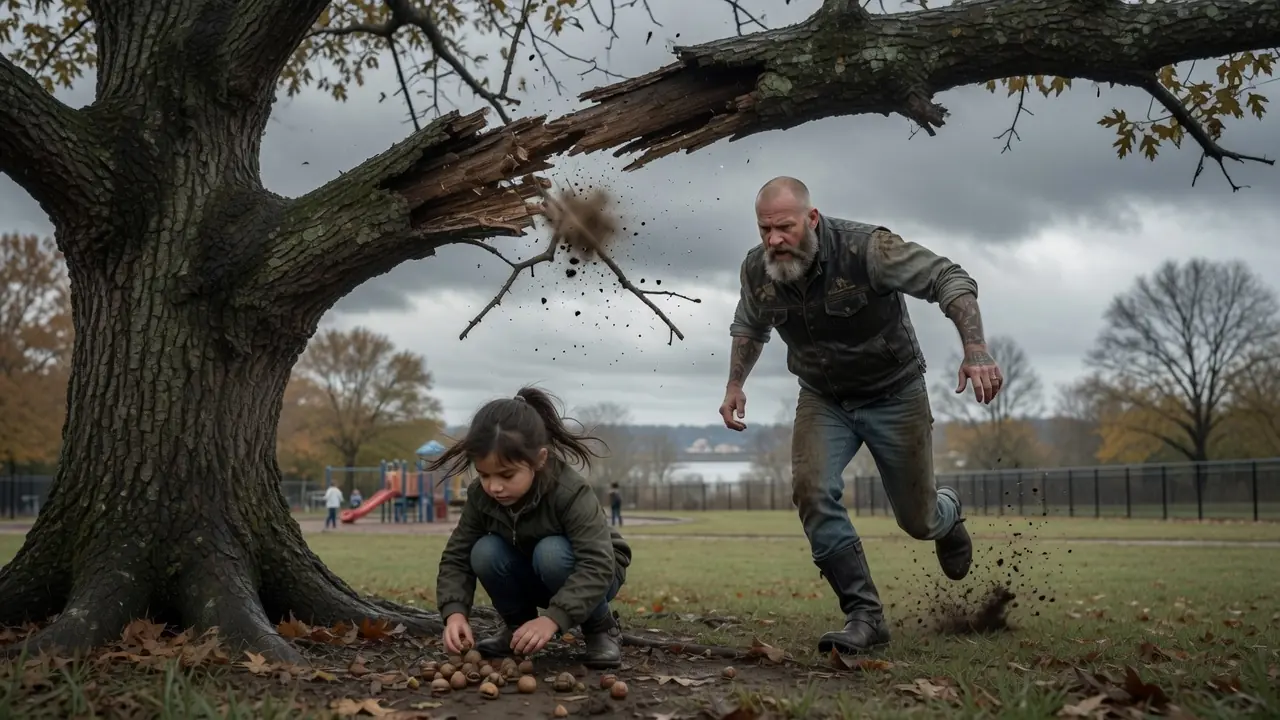
That Sunday afternoon, the loose mirror on his Harley started vibrating on the way back from a delivery. He pulled into the small lot beside Riverside Park to fix it. While tightening the bolt, his eyes lifted to the big oak near the playground.
The trunk leaned slightly toward the swings. One upper limb carried a dark seam near the base where lightning had once split the bark. In the post-storm wind, that limb dipped lower and slower than the others, as if the wood inside no longer had the strength to resist.
Stone watched it for eight seconds.
Then he saw the little girl.
She was six, maybe seven, dark hair in a ponytail, crouched beneath the tree collecting acorns. Her mother stood near the swings talking to another parent, phone in one hand, only half-watching. The girl — Mia — had her back to the oak, completely unaware of the dark seam above her.
Stone dropped the wrench.
He was already running when the first soft pop came from the limb.
He didn’t shout. Shouting made children freeze. He didn’t wave his arms. There wasn’t time. He simply crossed the grass in long, heavy strides and grabbed Mia around the waist just as the second, sharper crack split the air.
A large man in a black leather vest covered in patches and tattoos was running away with her daughter. Mia was struggling in his arms. Danielle’s scream tore out of her before she even realized she was moving.
Other parents turned. A father near the slide started running toward Stone. Someone yelled “Stop him!” A woman grabbed her own child and pulled her close. In those first chaotic seconds, nobody looked up at the tree.
The limb came down like a falling wall.
Eight hundred pounds of oak and leaves struck the exact spot where Mia had been standing. The impact shook the ground hard enough to rattle the swing chains. Smaller branches and dirt flew outward. One thick piece of wood bounced and struck the edge of the slide.
For several long seconds, the entire playground went silent except for Danielle’s ragged breathing as she reached Stone and tore Mia from his grip. She clutched her daughter so tightly that Mia made a small sound of protest. Stone immediately stepped back, hands raised, chest heaving.
A long scratch ran down his left forearm. The shoulder of his leather vest was torn where he had turned his body to shield the child from falling debris.
People were still trying to understand what they had just seen.
Eric Wallace, the father who had been filming his son, slowly lowered his phone. The video showed a biker carrying a struggling little girl while her mother chased him. Only in the final second did the camera catch the massive branch hitting the ground.
“I thought he was kidnapping her,” Eric said, voice shaking.
“So did I,” Danielle answered. Her arms were locked around Mia like she might disappear.
Stone stayed several feet away. He wanted to check if Mia had been hit by any debris, but moving closer right now would only make the situation worse. His heart was still hammering from the run and from the old, familiar weight of almost being too late.
Mia peeked out from her mother’s arms and looked at him with wide eyes.
“Did the tree try to fall on me?”
Stone crouched slowly so he wasn’t towering over her.
“Trees don’t try, kiddo. Sometimes they’re already broken inside and we just don’t see it until it’s too late.”
Mia considered this with serious concentration.
“Did you know it was going to fall?”
“I heard it starting to break.”
Danielle finally looked straight at Stone. She noticed the blood on his arm and the torn vest. The raw terror on her face had begun shifting into something heavier — the sickening realization of what had almost happened and who had stopped it.
“You could have been hurt,” she said.
“So could she.”
“That isn’t what I meant.”
Stone met her eyes. “It’s the only part that matters.”
Police arrived within minutes after receiving two very different 911 calls — one reporting a man trying to abduct a child and another reporting a tree falling on the playground. Officer Lena Ortiz had to sort through conflicting witness statements while paramedics checked Mia. The girl had a small scrape on her knee from being lifted so quickly, but nothing worse. Stone refused treatment for his arm until Danielle told him, in a voice that brooked no argument, to let someone clean the wound.
While the paramedic worked, Mia walked over holding one acorn she had kept clenched in her fist the entire time. She placed it carefully into Stone’s palm.
“This one didn’t get smashed.”
Stone closed his fingers around it.
“Then we should probably make sure it stays that way.”
The park closed the playground immediately. City arborists arrived the next morning and confirmed what Stone had already suspected: the oak had been hollowed out by an old lightning strike that had never been properly treated. Two more large limbs were at risk. The tree was removed within forty-eight hours.
Danielle did not sleep properly for nearly a week.
Every time she closed her eyes she saw Stone running with Mia in his arms and, right behind that image, the branch crashing down. She kept replaying her own scream and the way other parents had moved to stop him. She also kept replaying the fact that he had been right when no one else had seen the danger.
On the fifth day, she found the address for Mercer Cycle and Motor through the police report and drove there with Mia.
Stone was bent over a motorcycle engine when they walked in. He straightened, wiping his hands on a rag, and his expression changed when he saw them.
“Is she okay?” he asked quietly.
Mia nodded. “Mom says I’m not allowed to climb on the couch anymore.”
Stone’s mouth twitched. “Sounds like an ongoing situation.”
Danielle held out an envelope with cash inside to cover the damaged vest. Stone refused it twice. She left it on the counter anyway and told him she had come to apologize.
“You saw a stranger grabbing your child,” Stone said. “You did what any mother would do.”
“I called you a kidnapper in front of twenty people.”
“You didn’t have the information I had.”
Danielle studied him for a long moment.
“Why did you know to watch that tree?”
Stone was quiet for several seconds. When he finally spoke, his voice was lower.
“I used to work for the city’s tree crew. Fourteen years. There was a day about six years ago when we got a report about a damaged oak near a school playground. I was the one who went to inspect it. I saw the same kind of seam you saw on that limb. I told my supervisor we needed to close the area and remove it immediately. He said we didn’t have the budget and the school was already pushing back about losing playground time. I argued. He told me to move on to the next job. Two days later a branch came down during recess. It hit a fourth-grade boy. He lived, but he’ll never walk without a limp again.”
Stone looked down at his hands.
“I should have gone over my supervisor’s head. I should have called the school myself. I didn’t. I told myself it wasn’t my decision to make. After that, I couldn’t keep doing the job. Every time I looked at a tree I saw that kid’s face. So I left.”
He met Danielle’s eyes again.
“When I saw that limb moving wrong, I wasn’t going to make the same mistake twice. Even if it meant looking like the threat.”
Danielle didn’t try to offer empty comfort. She simply nodded, accepting the weight he carried.
Mia stepped forward.
“Can you teach me how to tell when trees are dangerous?”
Stone looked at Danielle. She nodded.
That Saturday afternoon he met them at Riverside Park. The damaged oak was gone, but he showed Mia how to read the signs on other trees — dark seams in bark, branches that moved differently in the wind, mushrooms growing at the base, or limbs resting against power lines. He didn’t teach her to be afraid. He taught her to pay attention and to tell an adult when something looked wrong.
Danielle watched from a nearby bench while other families glanced warily at the large tattooed man kneeling in the grass with her daughter. She understood those glances now.
Eric Wallace eventually approached them. He still had the original video but hadn’t posted it.
“I wanted to ask before I did anything with it,” he said.
Stone considered it.
“If you post it, show the whole thing,” he said. “Don’t cut out the part where people were trying to stop me. They were protecting a child the only way they knew how in those first seconds. That matters too.”
Eric agreed.
The edited video spread through local parent groups with a caption that read: *Sometimes the person who looks like he is taking a child away is actually taking her away from danger. Stay long enough to see the branch fall.*
Stone hated the attention that followed. News stations called the shop. Strangers online argued about whether he should have shouted first or waited for permission. He refused all interviews but agreed to speak at a city safety event about storm-damaged trees, on the condition that the focus stayed on practical information rather than turning him into a hero.
The program was eventually called Look Up Louisville. Several motorcycle clubs helped distribute information after major storms. Stone attended the first event without his leather vest because of the heat. Several families didn’t recognize him until Mia ran across the community center holding a paper cup with a tiny green sprout pushing through the soil.
“It worked!” she announced proudly.
Stone examined the seedling. “Looks like you did the hard part.”
“I watered it every single day.”
Danielle stood a few feet away holding a new leather vest. She and several members of Stone’s club had replaced the torn one, carefully moving every original patch onto the fresh leather. One new patch had been added near the inside pocket — a small oak leaf with two words stitched beneath it:
TWO SECONDS.
Stone touched the patch but didn’t speak for a long moment.
Mia slipped her small hand into his.
“I needed those two seconds,” she said quietly.
Stone looked away, the way he always did when emotion threatened to show. Danielle let him have the moment without comment.
Over the following years, Stone became a steady, quiet presence in their lives. He never tried to become anything more than what he was. He repaired Mia’s bicycle when the chain broke, taught her how to change a tire on her mother’s car when she turned sixteen, and made it clear he would not allow her near a motorcycle until she was old enough and properly trained. Danielle eventually joined the city’s parks advisory committee and pushed for faster hazard inspections after storms and clearer protocols for closing playgrounds.
Mia visited the young oak they eventually planted from her rescued acorn every year. It grew slowly at first, then with steady strength. On her eighteenth birthday, she found Stone sitting beneath it in Riverside Park, the late afternoon light filtering through the leaves.
“You said I’d be ancient before it got big,” she reminded him.
“You’re eighteen. Close enough for government work.”
Mia sat beside him on the grass.
“Do you still think about that day?”
“Every time the wind moves through a tree that doesn’t sound right.”
“I remember Mom screaming.”
“So do I.”
“I remember you running.”
Stone was quiet for a while.
“I remember wishing I’d had time to explain what I was doing.”
Mia leaned her shoulder against his.
“If you had stopped to explain, I probably wouldn’t be sitting here.”
That remained the simplest and hardest truth.
Stone had not looked like a hero in those two seconds. He had looked like a stranger taking a child. Danielle had not been wrong to scream. The other parents had not been wrong to try to stop him. They simply hadn’t possessed the one piece of information Stone carried from years of watching trees and from one mistake he had never forgiven himself for making.
A branch was falling.
And sometimes the only person close enough to do anything about it does not have time to look gentle, speak clearly, or wait for permission from people who cannot yet see the danger.
Sometimes he only has two seconds.
Two seconds to be misunderstood by everyone watching.
Two seconds to choose action over explanation.
Two seconds to give a little girl the rest of her life — and, in the process, to begin slowly forgiving himself for the one time he had chosen silence instead.